Mountains

The Sheep of Himalaya
Photo: Anuradha Miyan

The Sheep of Himalaya

Handloom and handicraft are an age-old tradition in Kinnaur (H.P) and have their roots in the ancient trade routes. The intricate designs and colorful patterns differentiate Kinnauri handcrafted shawls- making them a much-coveted textile product in India. However, the bulk of its history, symbolism, and contemporary relevance remains obscure. A history of textile production reveals interesting facts about the local environment, different modes of living, and cultural exchange. The Silk Road is the most famous trade route dating back five thousand years. Another lesser-known trade route connecting India, Tibet, China, and Central Asia is called the “wool road” which passes through Kinnaur and Kullu in Himachal Pradesh. The strategic location of Kinnauri weaving communities settled along the trade route inspired many weaving traditions across different states as well as took cultural inspiration from their trading affairs. Some of the most famous motifs and designs on the Kinnauri shawl bear a resemblance to Central Asian designs. The journey of wool trade and weaving traditions was truly iconic and drastically changed the destiny of the Himachali textile trade. Today, Himachali handloom stands amongst the foremost contributors of state revenue along with tourism and agriculture.

Traditional Kinnauri shawl and Topi worn by the bride and the groom

Growing up in Kinnaur, I saw my elders weave, knit, spin, and make yarn. Most women and young girls in my village knew how to weave and they owned the traditional weaving machine called “Khaddi”. Wool weaving and handicraft became indigenous to the region because of the cold weather conditions and women picked up the skill and nurtured it passionately. Most of the weaving, yarn-making, spinning, and knitting work happens during winter and the process is more collaborative. Since women made garments for self-consumption, it is common for one or two artisanal families to work together especially if it is a large-sized product like a carpet or a woolen quilt. I have always been passionate about handicrafts and after finishing my higher studies (MBA), the zeal was renewed all over again. I observed that although the women of my village – Labrang in Pooh tehsil of Kinnaur are skilled artisans, their products were used only locally within different villages of Kinnaur. There was no handicraft center in our village and given the difficult terrain, the market remains inaccessible to us.

I took a leap of faith and started “Sheep Of Himalaya” in 2019 with just two artisans from my village. The prime motive was to bring some visibility to Kinnauri handcraft on an international level and showcase regional craftsmanship.
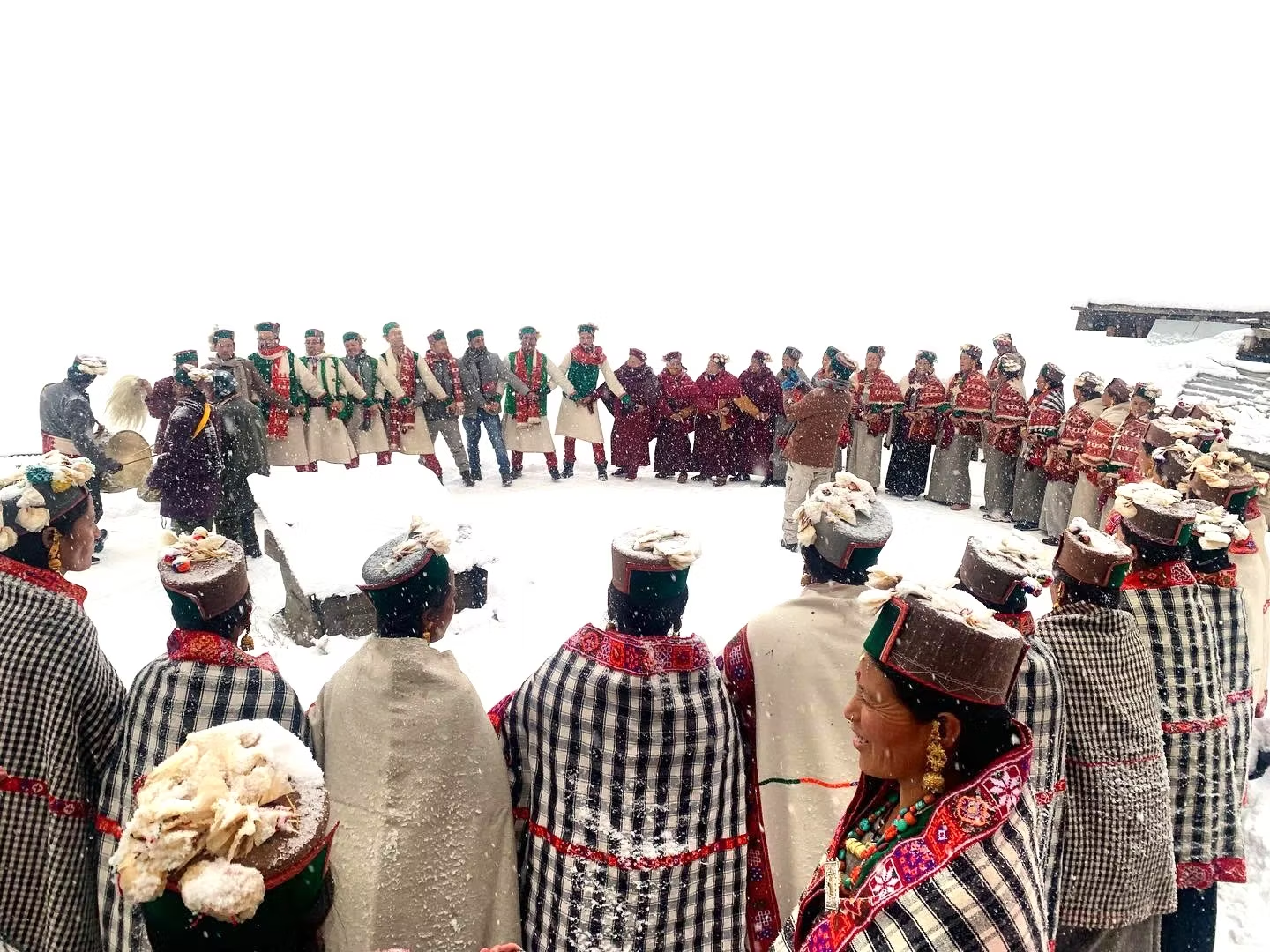
Agriculture and cultivation of apples in our village orchards are primary vocations for most people but many women still rely on handicrafts as a secondary occupation to earn for themselves. When I broached the idea of building a clothing brand showcasing our traditional attire, there was a bit of reluctance from many artisans for they feared uncertainties. I took a leap of faith and started “Sheep Of Himalaya” in 2019 with just two artisans from my village. The prime motive was to bring some visibility to Kinnauri handcraft on an international level and showcase regional craftsmanship. While the artisans would weave mufflers, stoles, and shawls with vibrant Kinnauri designs and knit sweaters and socks, I would find market avenues for us. For me, the process proved a bit challenging as there were no established Kinnauri brands and our products were often mistaken for Kulluvi products which have better brand visibility. I took to social media to build a unique handicraft brand for Kinnaur and to connect with people who appreciate the labor of love.

Photo: Anuradha Miyan

Over the years, the enterprise found its feet as more artisans joined us in our journey from neighboring villages like Spillow and Kanam. We are now a proud all-women’s team with twenty-five artisans who are involved in the handcrafted and handloom business during our spare time. Kinnauri handicrafts and handwoven attire require dexterity that can be perfected only through patience and meticulous care while weaving.

To make a shawl, each thread is carefully pulled through the reed (part of the weaving loom that resembles a comb) and installed on a loom that forms the base for an entire textile to be woven. It is one of the most complex and laborious processes that an artisan undertakes. Given the complexity of designs, it can take up to three months to finish a shawl and it can cost around twenty-five thousand rupees for a single shawl. Widely known for their intricacy and finesse, Kinnauri shawls are unique and reflect indigenous designs. We use five key colors to design our attires – red, white, yellow, green, and blue which symbolize five elements of nature- earth, water, fire, air, and space. The elaborate geometrical and floral designs have strong symbolism and many of the motifs woven have religious significance like the representation of stupas in the border design of a shawl. Since many families are into livestock rearing, raw wools are sheared locally from goats and sheep for making yarn and weaving but in recent times, we have also started procuring Angora and Merino wool from Ludhiana.
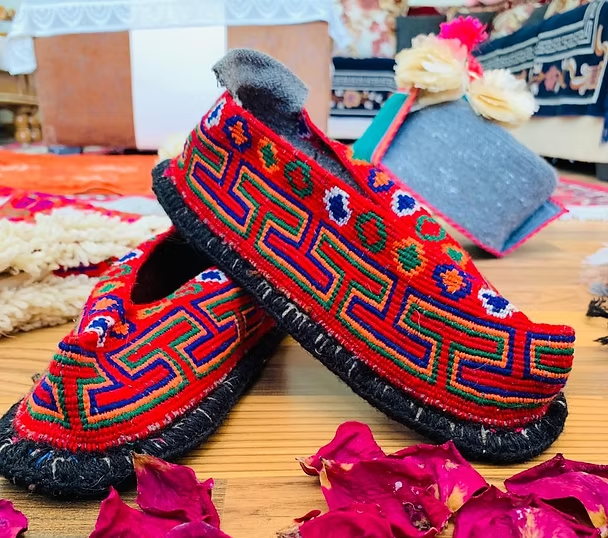
Photo: Anuradha Miyan

Balzanu Pona or Pullans (grass slippers) is another traditional wear that is slowly disappearing from daily use and in fact, there’s only one artisan left in my village who can skillfully make it from scratch! The footwear is made out of fibers procured from the bark of wild bushes. The upper portion of the Pullan is handknitted with goat wool and is adorned with colorful patterns while the lower portion is made of hemp or Bhang fiber (Cannabis). We make all kinds of traditional wear including Kinnauri shawls, stoles, mufflers, sweaters, Pulla (socks), and Kinnauri topi (hats). It didn’t take us long to sell products online via Instagram/Facebook and soon we were getting international orders! We further expanded our product range and started making children’s wear, cushion covers, diary covers, and pouches – all while retaining our unique Kinnauri designs.

All the women artisans who are associated with us rely primarily on their traditional looms and work from their homes which at times, proves a bit challenging as they have to juggle agricultural work, and domestic works at home and are able to undertake handicraft works only during their spare time. I have been pleading with the H.P handicraft and handloom department in Shimla to open a handcraft center in Kinnaur so that it is easier for weavers and other artisans to organize for a mutually exclusive vision, gain training, exposure, procure raw materials, and boost the entire value chain. We have capable and hardworking artisans who are passionate about their work and with the right market opportunity and assistance from the government, they will soar high.
1440 633 Anuradha Miyan
Traditional Farming in Spiti

Traditional Farming in Spiti

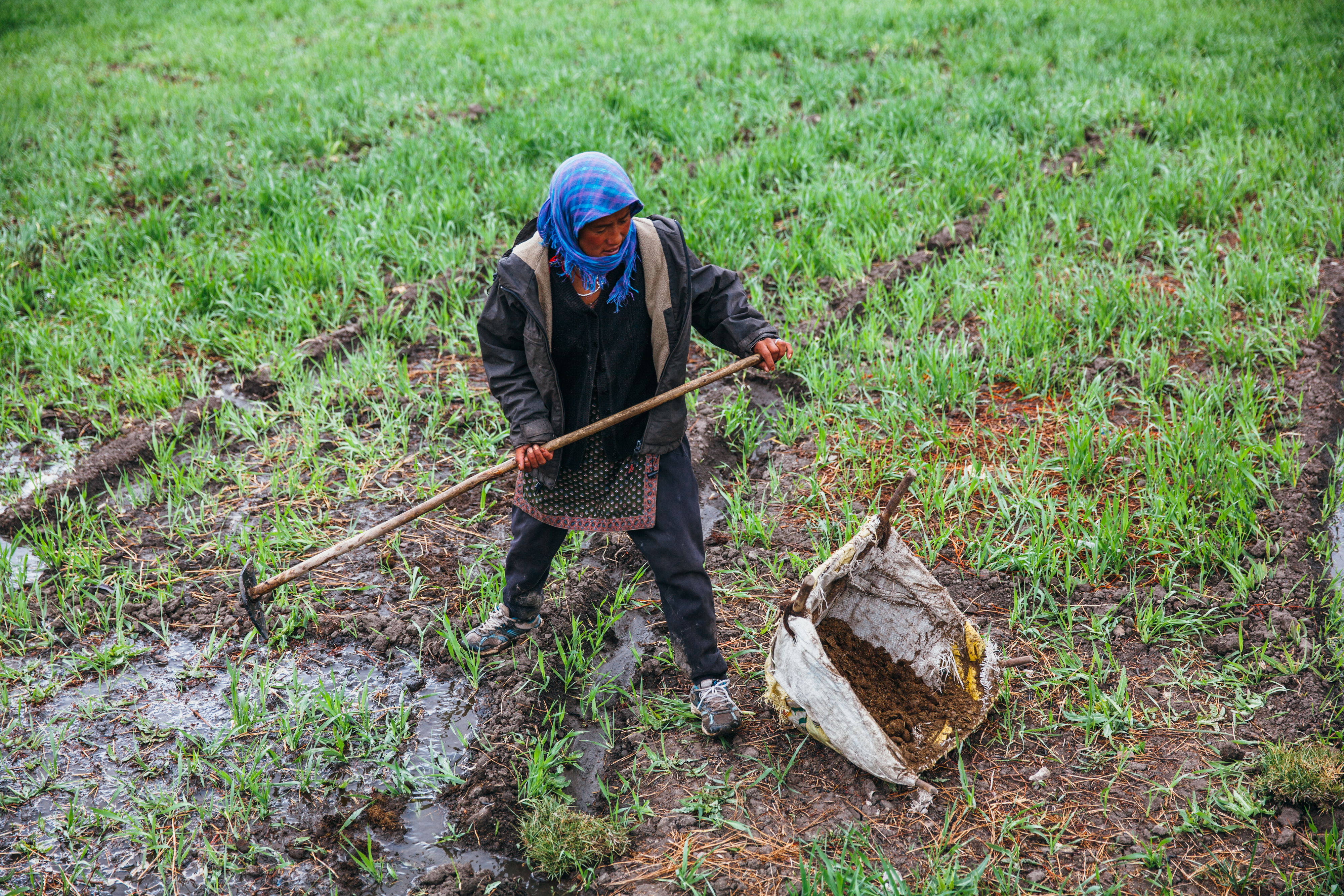
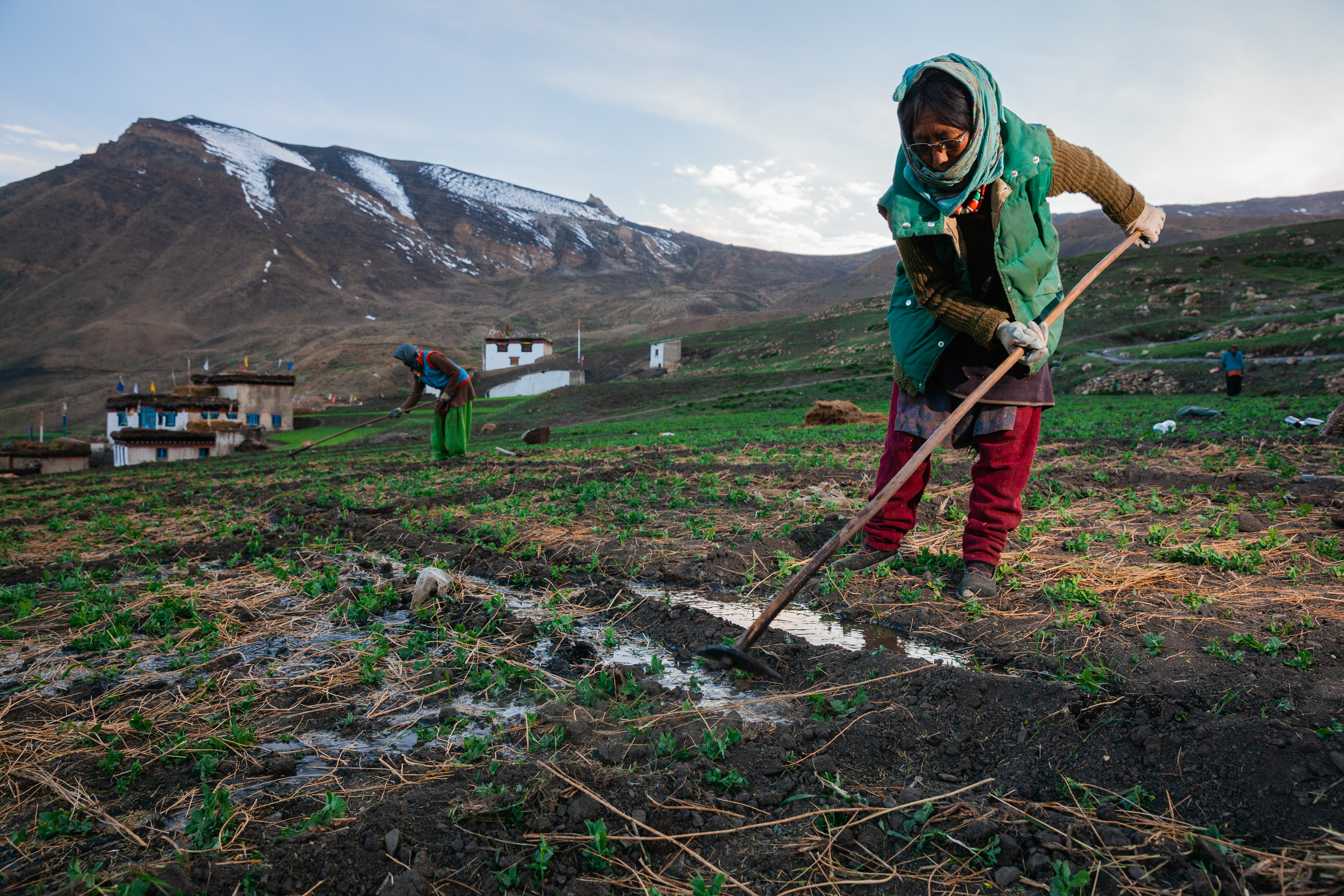
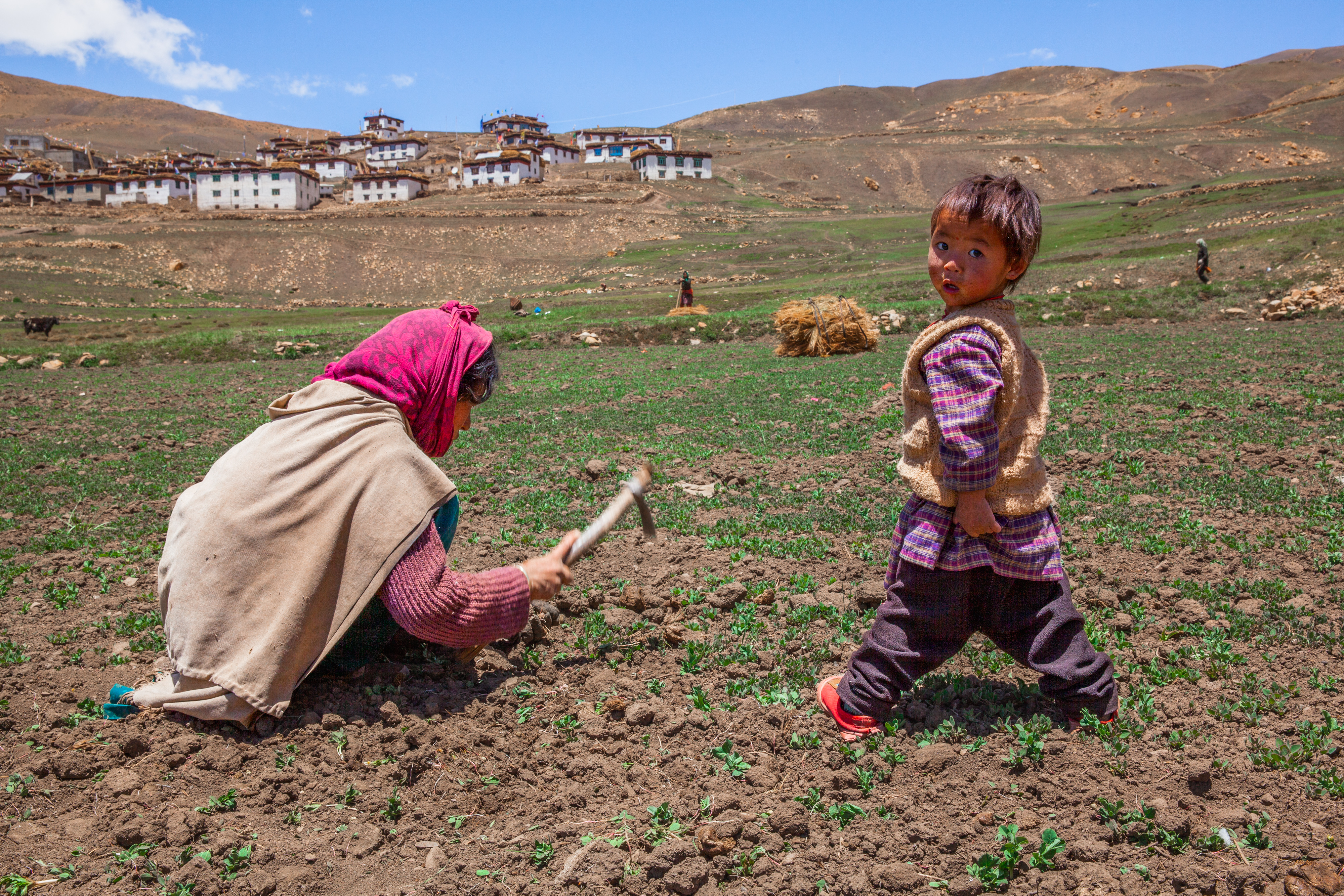
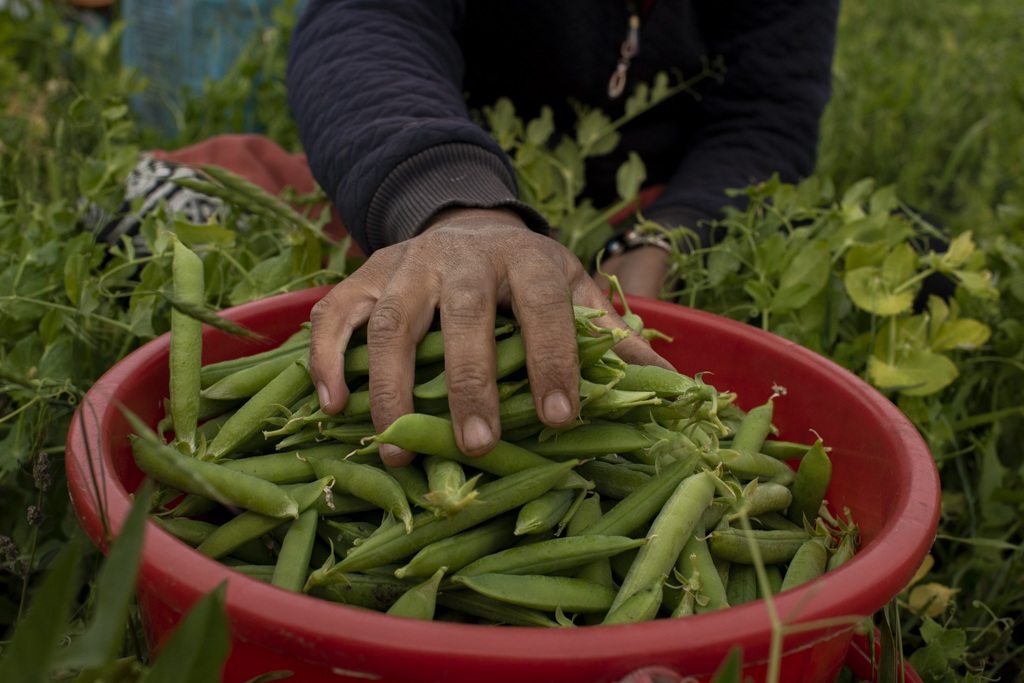
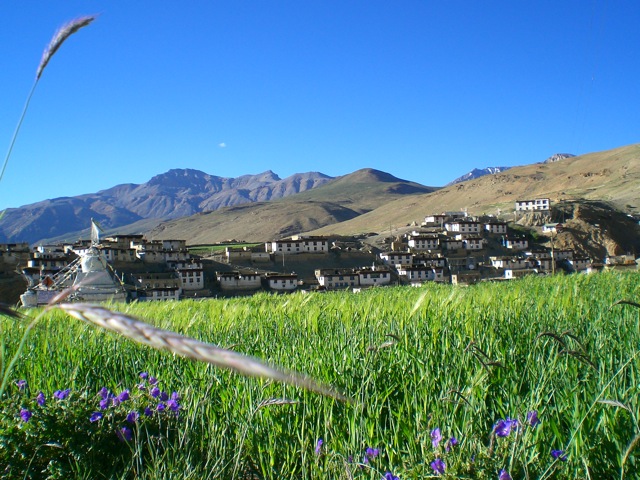
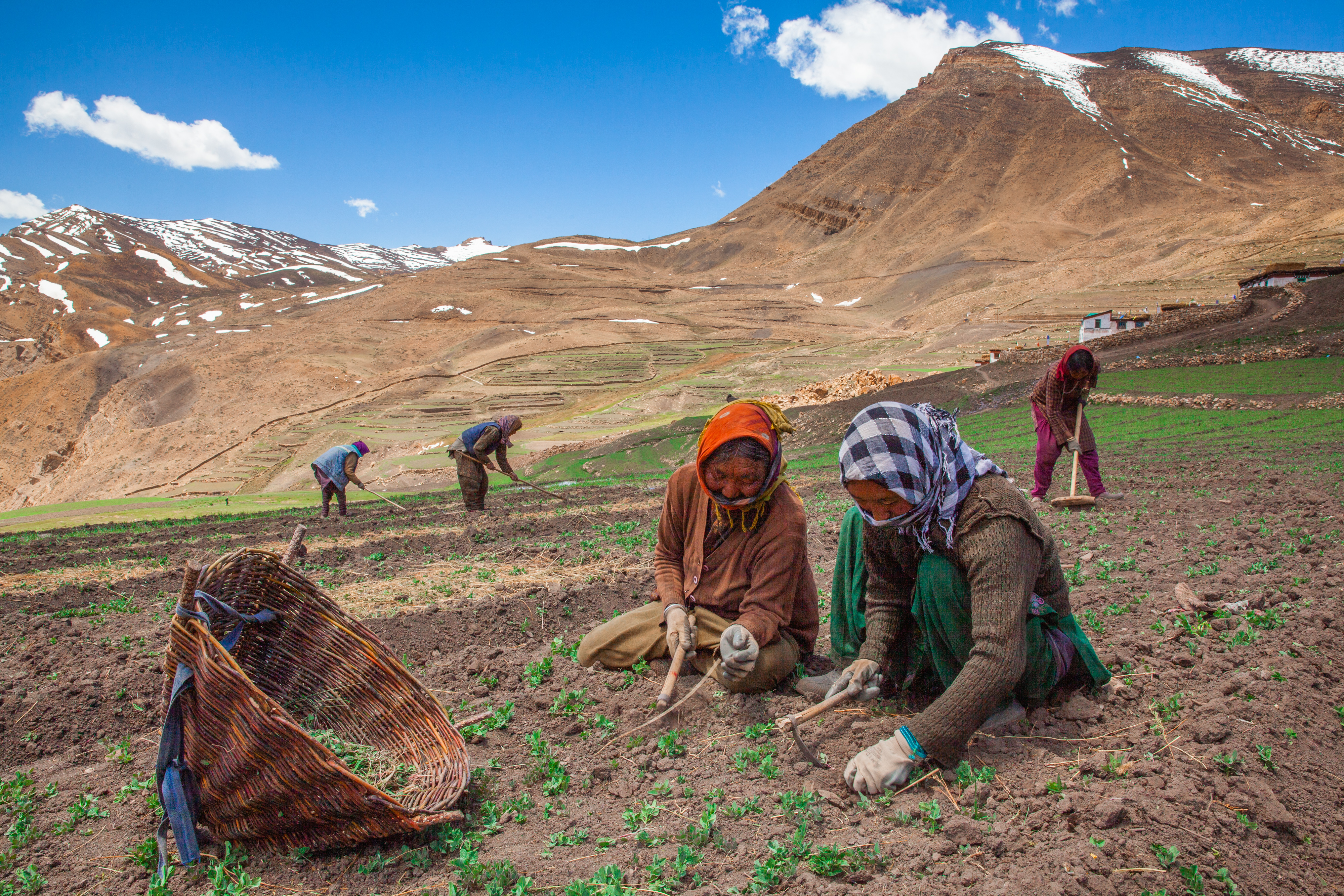
After the snow melts on the high peaks around the villages of Spiti, the hard working people start their annual summer works - livestock are taken to the grasslands for grazing and people get busy preparing for agriculture season. Barley, potatoes and green peas are cultivated in the month of May and the crop is harvested at the end of August. It is then the valley gets a shade of green on its barren brown mountains.
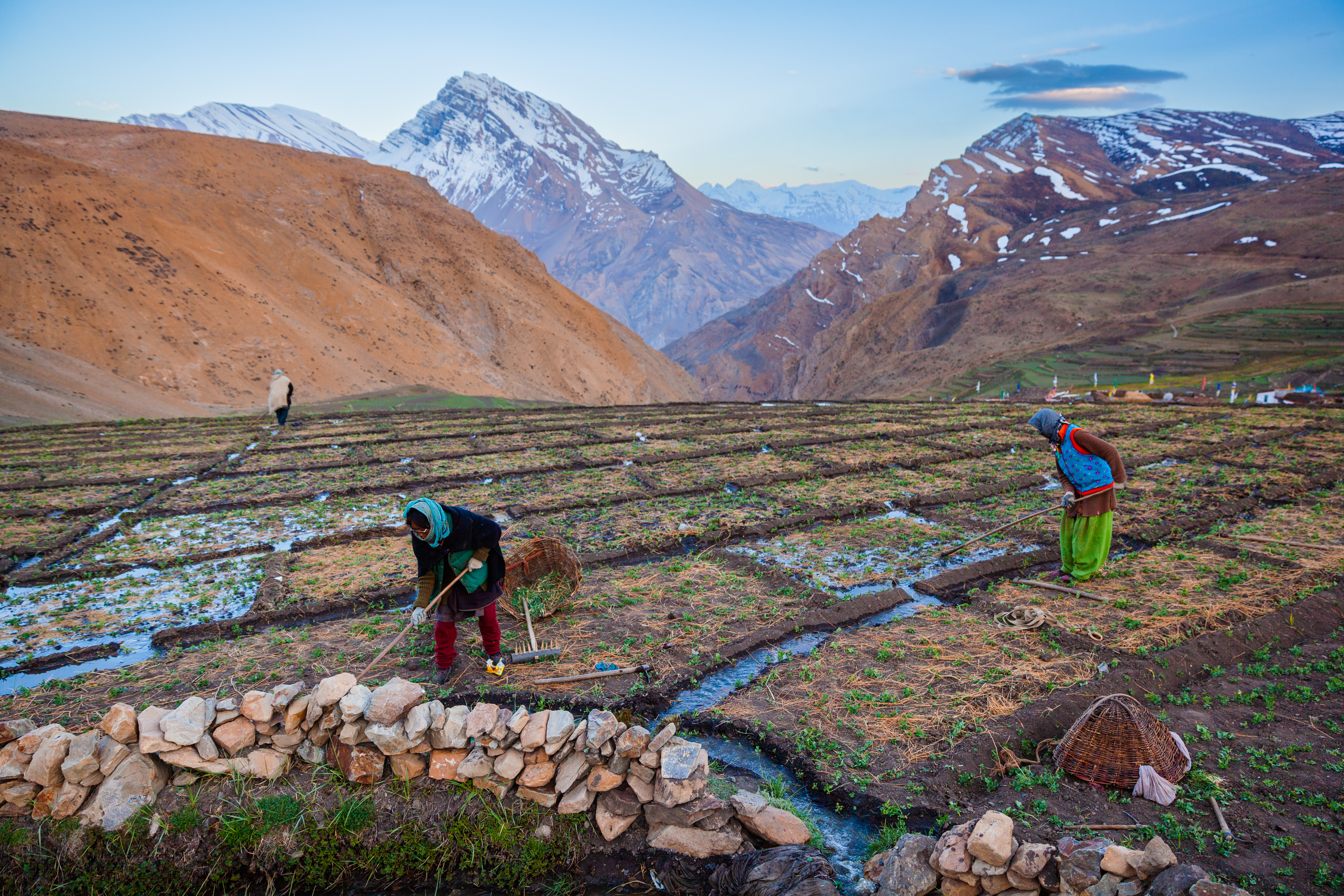
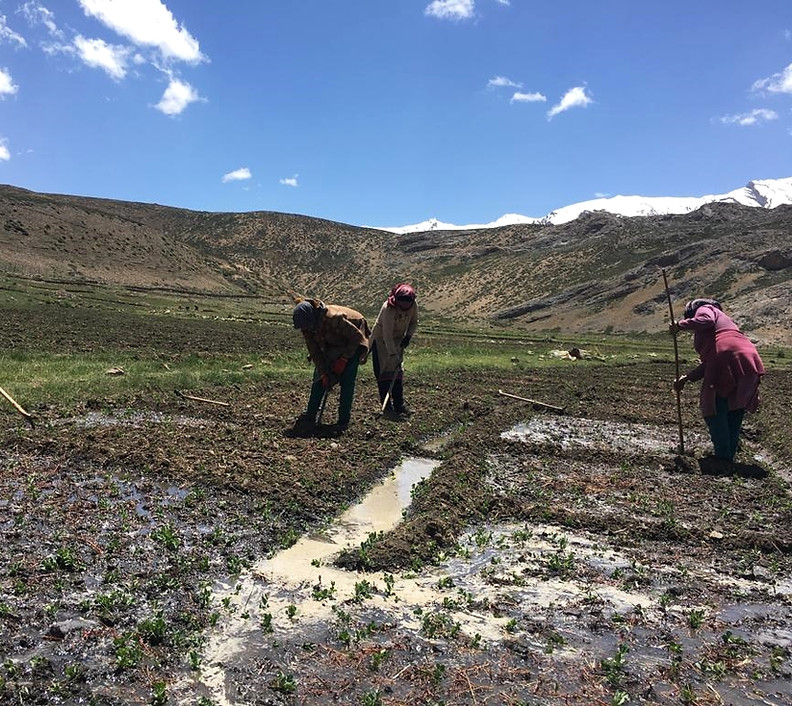
Spiti receives very less average rainfall. The locals can not depend on rain for irrigation. The solution for this was found centuries ago and is still in practice. The melted snow water from the glaciers flows down in the valley and is directed through kulhs (water channels) to the fields.

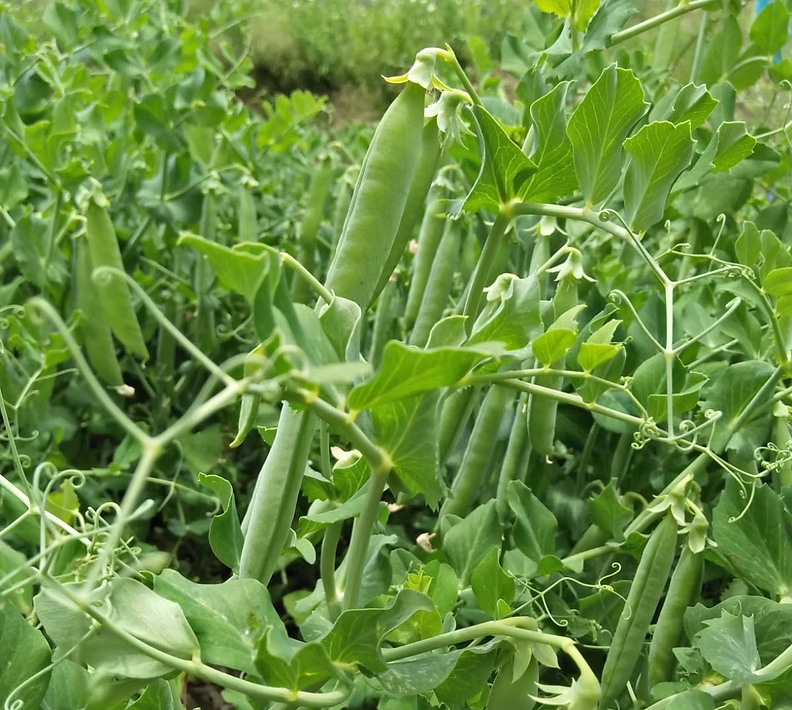
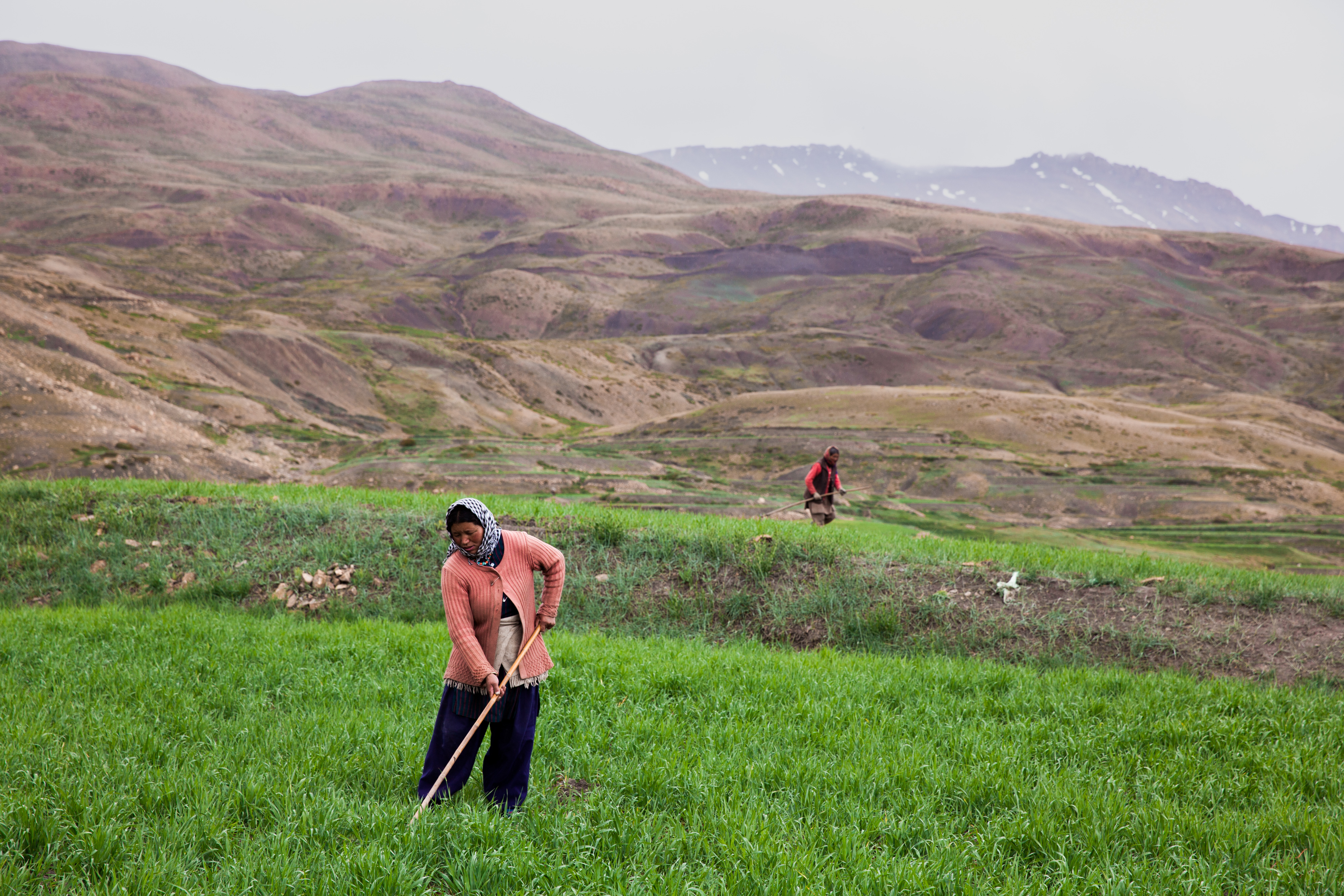
This process takes hours of hard work. The villagers, mostly women, start curing the fields in the month of June when the small stems of green pea plants can be seen in the fields.

In old days, people cultivated only barley and black peas for self- consumption, but around 1960s, the H.P govt. started promoting the cultivation of green peas, potatoes and other cash crops. In recent years, the region is gaining keen interest on cultivation of sea-buckthorn; the wonder berries rich in vitamin C.
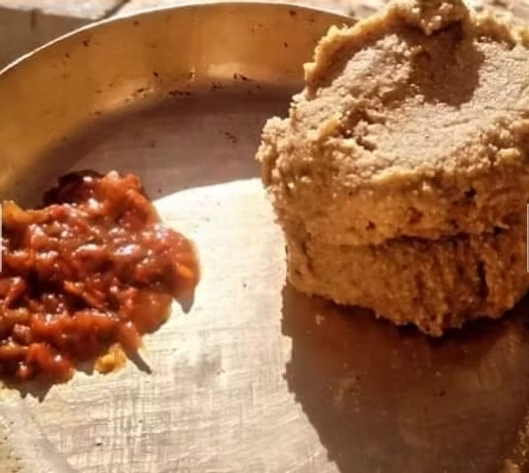
The concept of organic farming, which has become well known in the last decade, is not new to Spiti. Crops like black pea and barley still remain free from any chemicals. So the next time you have Sampa (local Spitian barley flour), you can be certain of its purity!
The green peas of Spiti are sold at a premium when they reach the market but people face the problem of connectivity. There is a major delay for the crop to reach the markets.
Despite many problems, the people of Spiti live with happiness and pride. They will be more than happy to have you as their guest. When my friend and I were trekking through distant villages, we tried to offer them money as a token of our gratitude for their amazing hospitality. No one accepted it and yet they asked us to come back again. We soon found a way to thank them. After saying bye to them, we would put the money in their pockets and run away!
4000 2667 Himanshu Khagta
Reviving Organic Apple cultivation in Shalkar (Kinnaur)
Photo: Mayank Pathak

Reviving Organic Apple cultivation in Shalkar (Kinnaur)

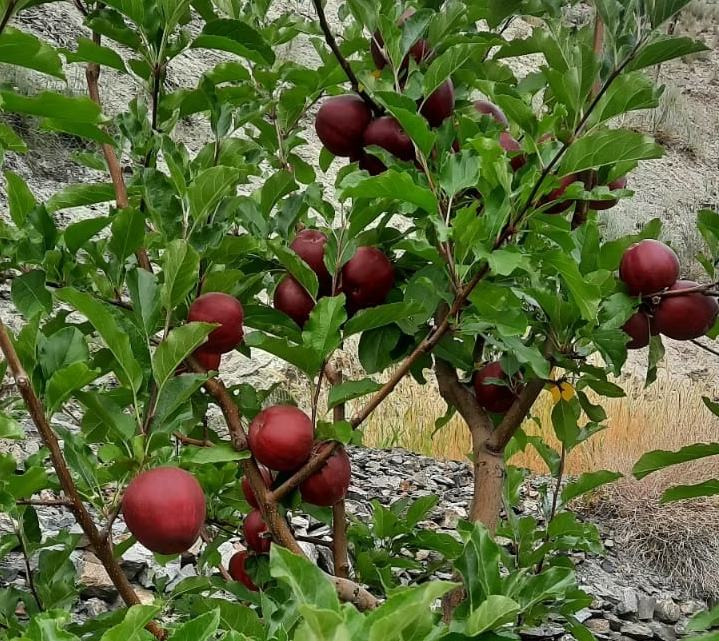
Kinnaur valley in Himachal Pradesh is well known for their apple cultivation. These high hills provide ideal climatic conditions for apple crops with the requisite chilling season in the winter. An apple variety known as Malus Pumila is a widely grown cash crop in the entire Upper Kinnaur valley. Shalkar village in particular is known for growing organic apples that’s much coveted for it’s sweetness and crunchiness. However, organic cultivation hasn’t always been the default practice in the village. This change is inspired by one man’s zeal and subsequent community resilience for better farming practises.

Photo: Karam Singh Negi

Perched at the altitude of 3200 metres, Shalkar is one of the last villages of Upper Kinnaur region before Spiti valley starts. There are over 110 households in the village – most of them dependent on apple cultivation for livelihood. While apples produced from other districts of Himachal ripen by July, the Kinnaur apples grown at a higher altitude start ripening around mid September or sometimes stretching till November hitting fruit markets across the country just before winter. The apples produced here are bulk transported to neighbouring metropolitan states where it is sold at a premium rate. Like many apple producing regions, the farmers here use chemical fertilisers and pesticides for bulk production. The usage became particularly more popular in recent years. In Kinnaur, It begins during the flowering season and continues till harvest. Use of chemical pesticides like Tefgor, Malathion, insecticide like Rogor, Durmet and a wide range of fungicides like Lethal, Kashstin, Majestic became quite handy for farmers seeking higher yield.

Earlier, many farmers do not use pesticides and fertilisers; most of them cannot even afford these but in recent years, the chemical spraying has increased from doing twice in a year up to spraying seven times in a year. The rampant usage of pesticides deeply bothered Karam Sing Negi – a cultivator from Shalkar village. He became conscious of the long term health and environmental hazards of pesticides and was determined to find an alternative. He gradually minimised the use of harmful pesticides and other chemical fertilisers in his own orchard.

The apple worm | Photo: Chunnit Kesang

For a farmer whose livelihood is entirely dependent on his orchard produce it was a risky move but for Karam Singh, there’s no greater satisfaction than reviving natural ways of farming his ancestors practised for generations. Transitioning his orchard for organic farming wasn’t easy – it needed a slow but consistent approach. He started minimising heavy chemical inputs and used only animal manure, human waste and other biodegradable waste suitable for it. For the initial few years, there was no prominent change and the yields were low. But he kept moving on with the same approach – his land needed to heal and the soil, the plants needed to reach its natural equilibrium.
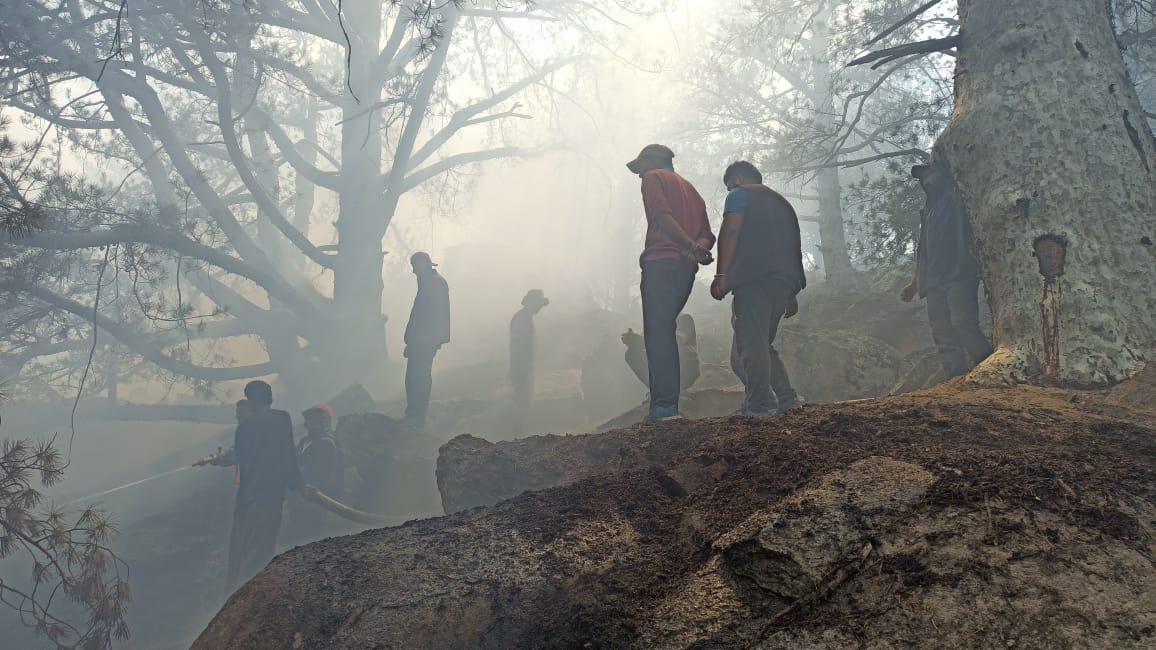
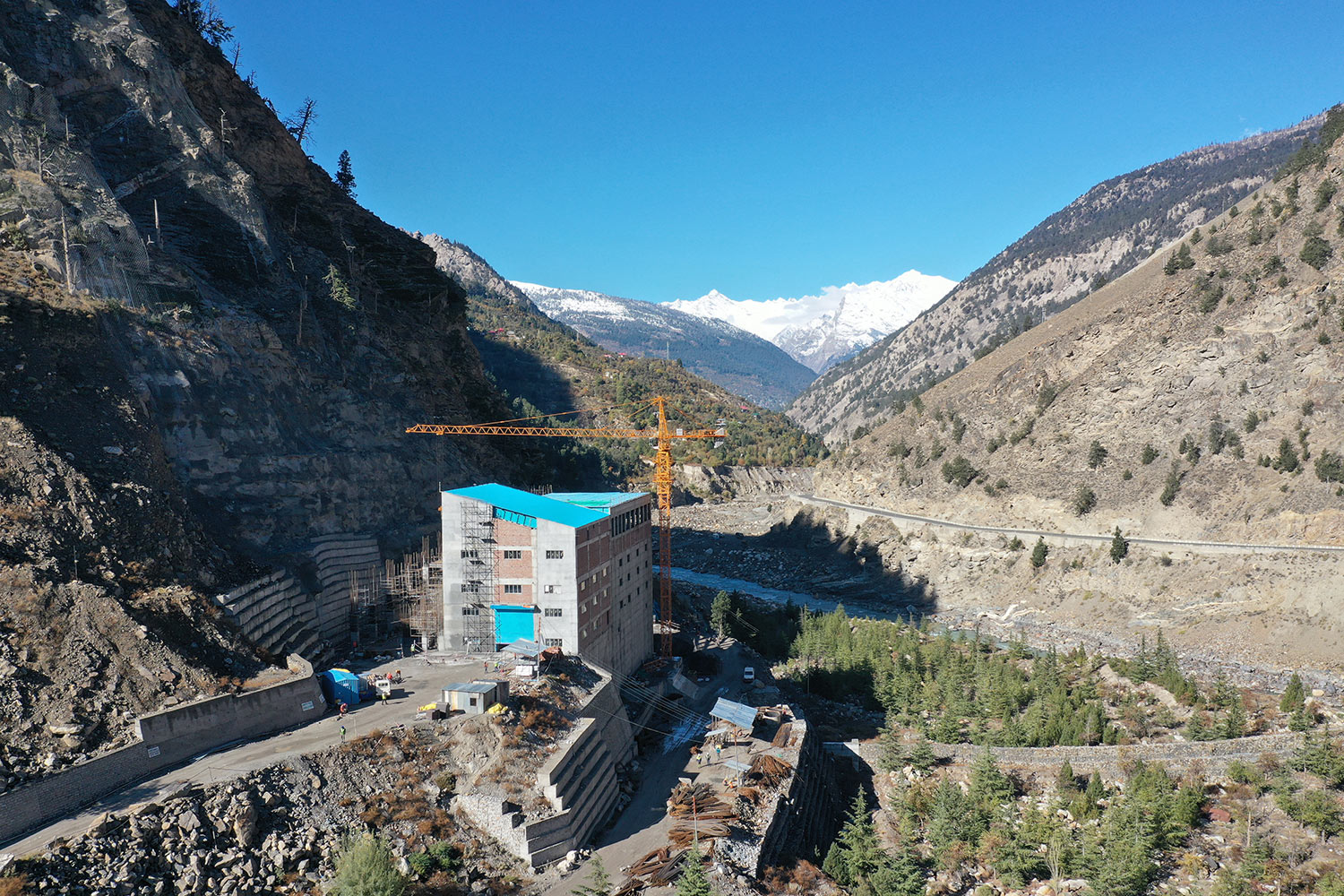
Photo: Mayank Pathak

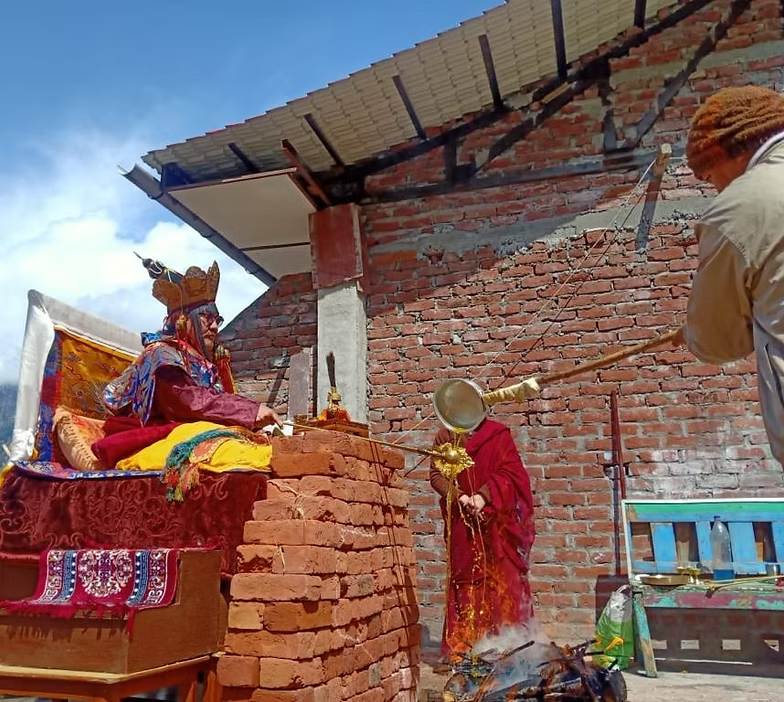
Hearing his approach, His Holiness Lochen Tulku Rinpoche (Highly revered spiritual leader) advised everyone in the village to follow the same path. Rinpoche also shared Karam Singh’s concerns regarding long term ecological damage. Adopting natural ways of farming will not only restore damaged ecosystems but also will help avoid killing of small insects and microorganisms. Convincing everyone else in the village to avoid using pesticides and chemical fertilisers was challenging. Shalkar village comprised both big Zamindars as well as marginal farmers. The villagers had an internal community meeting regarding it and there were various opinions/reactions regarding it. Few agreed with the idea while others were concerned about low yield and low productivity which could eventually impact their own livelihood as apple orchards were subject to a lot of pests and diseases. After much discussion, everyone in the village unanimously agreed to avoid chemical fertilisers in their orchards. The villagers even hosted a religious ceremony seeking blessings from local deities for good harvest. Lochen Rinpoche inaugurated the “Jinshak” ceremony by scattering ash and manure in the apple orchards of Shalkar village and advising everyone to revive traditional farming practises. For the first 3-4 years, the apple yield from Shalkar village dropped drastically. With dwindling yields, there were many uncertainties – some farmers even struggled to pay school fees for their children. However, their resilience paid off when the apple orchards of Shalkar village slowly recovered and started bearing luscious apples again!

With passing years, the villagers experienced improved yield from their orchard and noticed the apples from their village are different from neighbouring Kinnaur villages. Apples grown in organic farms in Shalkar have a distinctive sweet, crunchy taste with a natural waxy exterior which even gained preference among bidders who are involved in large scale apple export business. The villagers are working towards organic certification which will help them gain due recognition in the market. This story of organic farming and community led change in a small himalayan village shows it is possible to grow pristine apples without harmful pesticides.

1368 912 Villagers of Shalkhar
Reflections on farming life
Photo: Panma Gyatso

Reflections on farming life

I was born in Hango (11,500 ft) which is a remote village in the Hangrang valley of Kinnaur. I am 72 years old and have spent my life in this village as an agro-pastoral farmer. Agriculture is very important to us. When I look back, I now realise that some of my most treasured memories of my village are related to agriculture and food. One of my favourite and most vivid childhood memories is from the time chulli (apricot) season arrived. Our village did not have any chulli trees, so our elders would go to the nearby village of Leo and get chulli for us. When they arrived, all the children of the village would run to the common ground to grab as much as possible in our little hands. Women would also find time during the day to enjoy chulli with each other under the winter sun. Relishing chulli was a communal affair. The seeds were saved to make prized chulli oil (750 ml for INR 2000/ USD 27).

Photo: Panma Gyatso

My other happiest memories are of the festivities and celebrations we had after the harvest. Until a few years back, we had an isolated winter in Hango. So we had to work really hard during the summers to ensure we had enough grains to survive the harsh winters. After gruelling work in the short summer season, the celebrations were especially sweet. Our harvest back then was of barley, potatoes, black peas and cheena/chize (local name). Cheena & barley were used to make flour for thukpa (soups) and salma (local bread). During the festivities we would make various dishes like tolopa, chulipanting (sweet apricot). Communally preparing and eating added exponentially to the taste of these dishes.

Barley was and continues to be used for making local alcohol like chhang and arak. No one, now, grows cheena. The seeds are also very hard to come by. It has completely vanished. Black peas & barley cultivation has also reduced and mainly taken over by the cash crops like green peas, apple, cauliflower etc. Due to increase in connectivity with the outside world, wheat and rice which were only heard of back in my days, have now become staple food. Salma, tolopa, chulipanting etc which were favorites of all age groups are now hardly prepared.

With our generation most of the traditional dishes are also fading away. I am hoping that we can slowly shift back to our traditional crops, as they grow best in our landscape, with focus on apricots for better economic gains. This way we will be able to ensure sustainable growth from agriculture.

792 706 Prithvi Singh
Agricultural Practices in Spiti Valley
Photo: Prasenjeet Yadav

Agricultural Practices in Spiti Valley

“Ney yotna chukpo sam, nor yotna mak”
“Those who have barley are rich, not the ones with money”
Spitian Proverb, Anonymous

Ever since my childhood days, I was very curious to know about the agricultural practices of Spiti valley – traditional crops we grow and how farming happens in a cold Himalayan desert. Like any Spitian youngster growing up I used to help my family with agricultural works whenever I am at home for holidays or during the peak harvesting season but I never got the opportunity to help them for the whole season. But last year, due to an ongoing pandemic, when I came home, I realized it was a good opportunity for me to understand agricultural practices first hand. I helped my family through whole process right from scattering ashes in the snow covered fields to prepare the field for ploughing to cleaning dried-up water canals before harvest season to helping during peak season of ploughing and harvesting. I also wanted to learn about the history of agriculture in Spiti valley and the elders in my family shared some interesting insights with me.

Photo: Lobzang Tandup

Traditionally, the people living in this valley grew barley and black peas for sustenance. They used barley grains to make Sampa (flour) or Arak (traditional alcohol). They also used barley and black peas to barter it with traders from Changthang who in turn would give Lena (Pashmina) and Khullu (Yak wool) in the 1960s however, things started to change in the valley. People started growing cash crops like green peas and potatoes as access to outside markets improved due to development of key roadways. Now, barley and black peas are grown only for self-consumption and are only a small share of the total agricultural production.

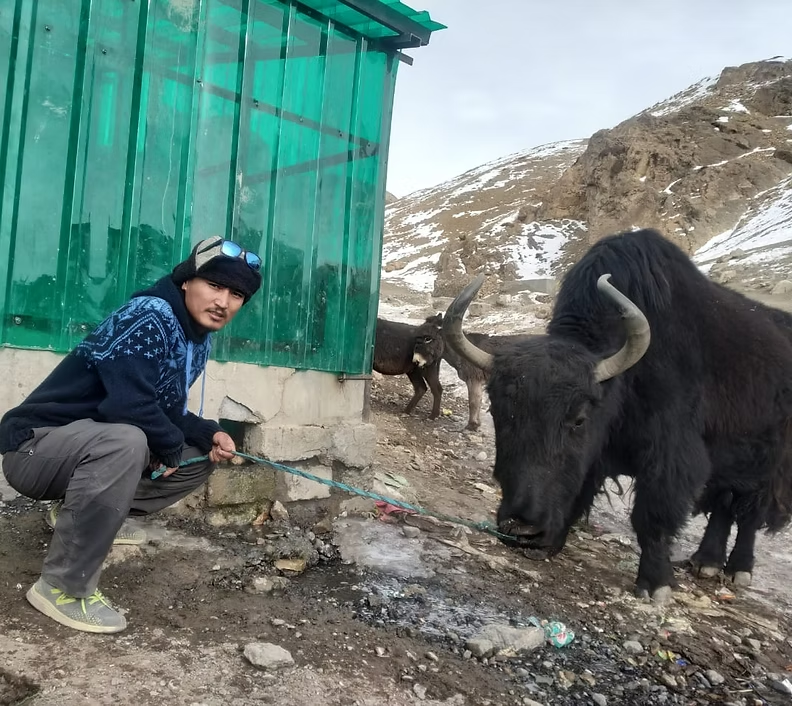
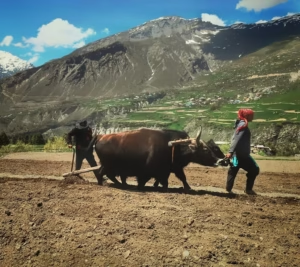
Agriculture in Spiti lasts only for six months. It’s the most crucial time for all the farmers. Although the sowing season starts only in April, the preparations start months before. The seeds are either procured or developed and stored safely during the winters. When the snow first melts around mid-April, the farmers plough their fields with the best resource they have – Yak or a pair of Dzo and seeds are scattered by hand, but these days people use tractors, ploughing machines and even tillers are used. Ploughing the field is a two person job, but sometimes the whole family can be seen in the fields helping out the parents. In Spiti, one’s family, relatives and friends are one’s greatest resources. Farming is very communal in nature. Everyone helps each other and sometimes even 3-4 families work collectively.

The system of communal farming helps ease the burden of marginal farmers who do not own Yak – they collaborate with Khangchen households (Zamindar family), borrow Yak for ploughing the field and in turn repay through their labour. Yaks are an effective but an expensive farming asset and not everyone can afford to buy and maintain them. The system works because it is based on a reciprocal relationship between Khang-chen (Big Zamindar) and Khang-chung (Small farmers) households and resource and labour are shared communally. Sometimes, the members of the Khang-chen household lend a piece of land for a few years to the Khang-chung household for farming. They do not have to necessarily repay through capital but the Khang-chung family can repay the benevolence through their labour works in the Khang-chen family – for instance, they can help the Khang-chen family during ploughing and harvesting season. This system is called “Shey” in Spitian.

The relationship between people, wildlife and nature go beyond utilitarian aspects. It is heavily influenced by cultural values and local practices around it. For instance, many Spitian households have unique names for their agricultural land which is a helpful marker of identification of one’s land and also carries meaningful ecological symbolism: “Chup- ja” (water-bird) is named for agricultural lands that resemble the shape of long-necked water cranes. “Ti-rik” is named for lands that resembles local barley-flour delicacy, “Dorgya-ma” is named for agricultural lands which is full of stones or pebbles owing to its hilly terrain, “Yur-yok” is referred to lands located beneath a water canal and “Phe-kak” (meaning half in Spitian) is often given to agricultural lands of “Khang-chung” families (small farmers) who gain their land after ancestral subdivision from Khang-chen family (big zamindari household).

There are a lot of farming songs and prayers that people hum while toiling in their fields. Farmers sing particular songs at every step. The songs have rich meanings related to farm works, weather conditions and comprises of odes and incantations towards local deities pleading for bountiful harvest. “Om Mani Padme Hung” – the holy Buddhist mantra is chanted while ploughing which symbolises farmer’s gratitude and compassion for Yaks and Dzos who toil so hard in our fields. “Laso- ho” is chanted in merriment to ease the stress and fatigue of animals when they plough in harsh weather.

As soon as the ploughing is done, the farmers wait for the first crop or sapling to grow a little before the cycle of irrigation begins (Yurma). This period is usually after 40 days from the day of sowing. Water is a scarce resource and there are local systems of water distribution and management called “Chu-rey” (water turns) entirely handled by women of the village. A group of women is appointed to take charge for the season to ensure timely, equitable distribution of water to each household. The Khang-chen (big zamindar) households have more access to water resources – they have frequent water-turns (chu-rey) and more water is allotted in their canals for irrigation. They also have more authority in decision-making as they are the original tax-payers of the land and have earned that right historically. Owing to scanty precipitation, irrigation becomes a daunting task – women get busy with watering works (Yurma) for over 2 months till the crops are fully ripe.

Photo: Lobzang Tandup

The green pea crop gets ready around June in low-lying villages (Kaza, Tabo, Rangrik, Pin) and August in villages in elevated regions (Demul, Komic, Langza, Hikkim, Kibber and Chicham) . These crops are then transported and sold in Delhi and other nearby states. The produce from Spiti is considered of highest quality as the farmers do not use any insecticide, pesticide or weedicide in their fields. Instead they only rely on animal and human waste as manure. The sweet taste of green peas from Spiti valley is the result of unique farming techniques and hard-work of the people who do not give up despite harsh conditions and scarce resources.

The cropping patterns of green peas and barley are different. Green pea, although is the primary source of livelihood for the farmers, requires much more work and tends to consume more water. Barley is a traditional crop of Spiti that is favoured more by farmers due to its low input requirements, better adaptability to harsh conditions and is considered drought/disease resilient. Barley crops and black peas (kala matar) can be harvested later around August-September when the work around green-peas is done. The remaining grass residues are collected to use for fodder or as a livestock feed for animals during winter.

Most Spitian households own a flat ground near their agricultural field called “Ul-tak” where separation of straw and barley (Khu-yuk) are done, cut grasses are brought and flours are grinded. The grains are finally stored in village. A group of women is appointed to take charge for the season to ensure timely, equitable distribution of water to each household. The Khang-chen households have more access to water resources – they have frequent water-turns (chu-rey) and more water is allotted in their canals for irrigation. They also have more authority in decision-making as they are the original tax-payers of the land and have traditional go-downs/storage called “Bhang” for better preservation.

Agriculture is the lifeline of Spitians and it is not just a livelihood means for us, but a way of life. Our tradition, cultural values and regional ethos revolve around agrarian practices. Many local Spitian proverbs (pera) are reflective of that knowledge. I am sharing few as recounted by elders:

Nyima dot la mata, Dotpa chung la mata
Do not rely on the sun’s warmth nor your appetite. This proverb talks about the importance of being alert, active and prepared when one is undertaking any agricultural work. When one leaves home in the morning for the field, a farmer has to be ready for any unpredictability – nor the pleasant heat of sun or one’s appetite at that point can be relied on.

Soye me phung, nyal phung
There will be agricultural loss not when you eat but when you sleep/laze around.

Ley betna, sey nyong
If you work hard, there will be a bountiful harvest.

Ney yotna chukpo sam, nor yotna mak

Those who have barley are rich, not the ones with money.

I am not an expert in farming or possess rich knowledge but I would like to share some suggestions, the ecosystem in the trans-Himalayan region is very fragile. Excessive focus on cash crops like green peas won’t be sustainable for the long run. We need to incorporate traditional crops like barley as well as black peas which are more suitable to local conditions. We should think about long term ecological sustenance and food security for the entire community. Cooperative societies, local management should work in a collaborative manner to fetch fair prices to our farmers. Youngsters should realize that although modern farming and technology are easier and more convenient, nothing beats natural farming technique and indigenous knowledge of the people.

1024 683 Lobzang Tandup
A day in the life of a young farmer
Photo: Vicky

A day in the life of a young farmer

There’s an air of celebration when the agricultural season begins in my village. It is time to end the dormancy of long winter days and come out and start preparing the fields. I remember enjoying working in the fields and on the days when the fields had to be ploughed, I used to try to take leave from school on the pretext of doing some necessary work. We used to take out all the farming tools, clean it and check for any repairs. A day earlier, our bulls were also brought from another village and were prepared for ploughing. The excitement would not let me sleep and I would think of all possible excuses to take leave form school so I could and help my family in the field.

The next day, my grandfather would make a barley offering to the local deity Jogani. After the prayers everyone would take the offerings as blessings and proceed to prepare for the day. Before going to the fields, we would place flowers in the horns of the bulls. All the equipment and the bulls were then taken to the agriculture fields. I would also help out in guiding the bulls to the field which would give me immense pleasure. For traditional rituals, my mother would bring roasted barley (kha) & local alcohol (chhang) to the fields. We would then gather the bulls in teams of 2 and attach the plougher to them. After that we would offer chaang, kha and our prayers to our fields facing east (to garner the sun’s positive energy into our lives).

Photo: Vicky

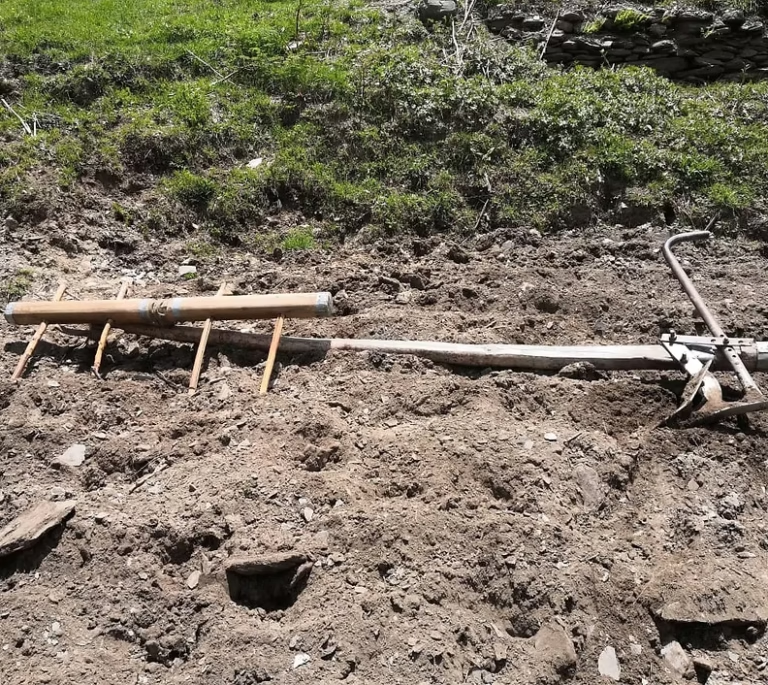
My family would then begin the hardwork of ploughing the fields which would last a few days. The fields which were harder to plough, were then ploughed with the help of Shaalu – my favourite mare. Unfortunately, I would never get permission from school to take off for a full day, so after the rituals, I had to rush to the school! Lunch for the farmers was prepared in the community hall and was served every day at 12:30 pm. For the bulls, the farmer would prepare Pinniyan balls of barley dough Sattu kneaded with local alcohol Chaang. This would give them strength for the remaining day’s work. After resting for an hour after lunch the farmers would get back to work. In the evening, the farmers would have tea and local bread puri at 6, around the same time we would return from school. We would help out our parents till the sunset and then head back home. If there was any time left before it got dark, we would level out the uneven fields. The blades of the plough would be replaced by a plank of wood and the bulls would then walk the fields levelling it. To add extra weight, my sibling and I would fight to climb onto the plank. By the end we would be covered in mud. We had an amazing childhood.

Farming life has changed drastically. The new age equipment gets the job done quickly but it’s not a celebration like the old times. Earlier whole family would partake in the ploughing, sowing and harvest process, now it’s a one person job. These equipment have in some way facilitated migration as now women single-handedly manage the fields. Bulls are replaced by power tillers and are rarely seen in any village. Agriculture was not just about growing produce for sustenance, but it was a way to form connections with our land, our animals and nature. And now, I see those connections fade.

792 706 Vicky
Beyond Agriculture
Photo: Tashi Angroop

Beyond Agriculture

Agriculture has made considerable progress in Himalayan states. One of the major changes in the mountain farming system is from subsistence to commercial farming practice. There’s a curious move towards high-value cash crops and diversification of cropping patterns. With connectivity and better exposure, farmers in these landscapes are increasingly becoming more innovative. Their approach in production, managing supply chains, and marketing are aimed at higher returns from farming. The New Age farmers from High Himalayan villages are more experimental and are more focused on searching for niches -apples, cash crops, fruits, exotic vegetables, flowers. Their engagement with farming goes beyond survival and sees it as an economically lucrative option for themselves and others associated in the value chain. Stories of such individuals dismiss stereotypical myths about farming and show how it can be adopted in changing times.

Tashi Angroop from Tinno village in Lahaul (H.P) dons more than one hat. He is a farmer, passionate entrepreneur, and agri-businessman who cultivates traditional grains, experimented and scaled up the cultivation of exotic vegetables in Todh valley, and is also initiating agro-tourism in his village. He started his journey in 2007 when he got an opportunity to work with World Bank’s Project in Lahaul promoting Seabuckthorn nurseries. Further collaboration with the Department of Horticulture on Desert Development Program (DDP) deepened his experience of developing poplar tree nurseries and building seabuckthorn nurseries. With Jain Irrigation System, he extensively traveled in Himachal Pradesh covering 11 districts to understand diverse cultivation processes within the state and train locals in nursery building. He took a leap at his own venture in 2014 when he decided to take up farming as a full-time vocation. He took land on lease in his village to cultivate organic vegetables and experiment with the cultivation of exotic vegetables which is a fairly new intervention in Lahaul back then. He began by procuring 1000 potato seeds (1000 Katta) and started growing them in his field. Initially, it was just potatoes, green peas, and cauliflower.

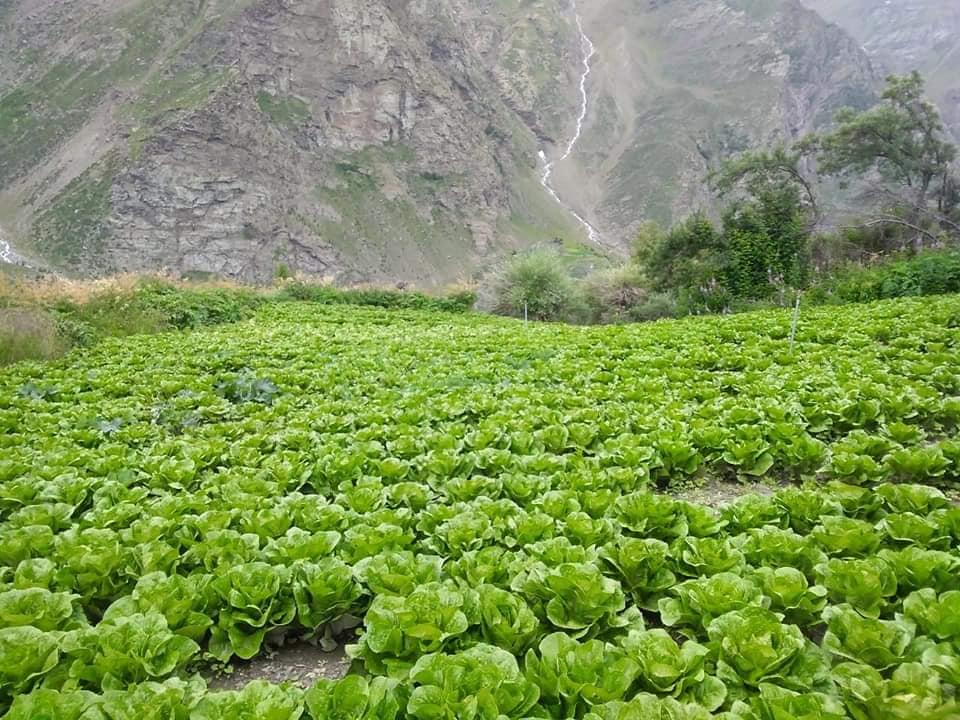
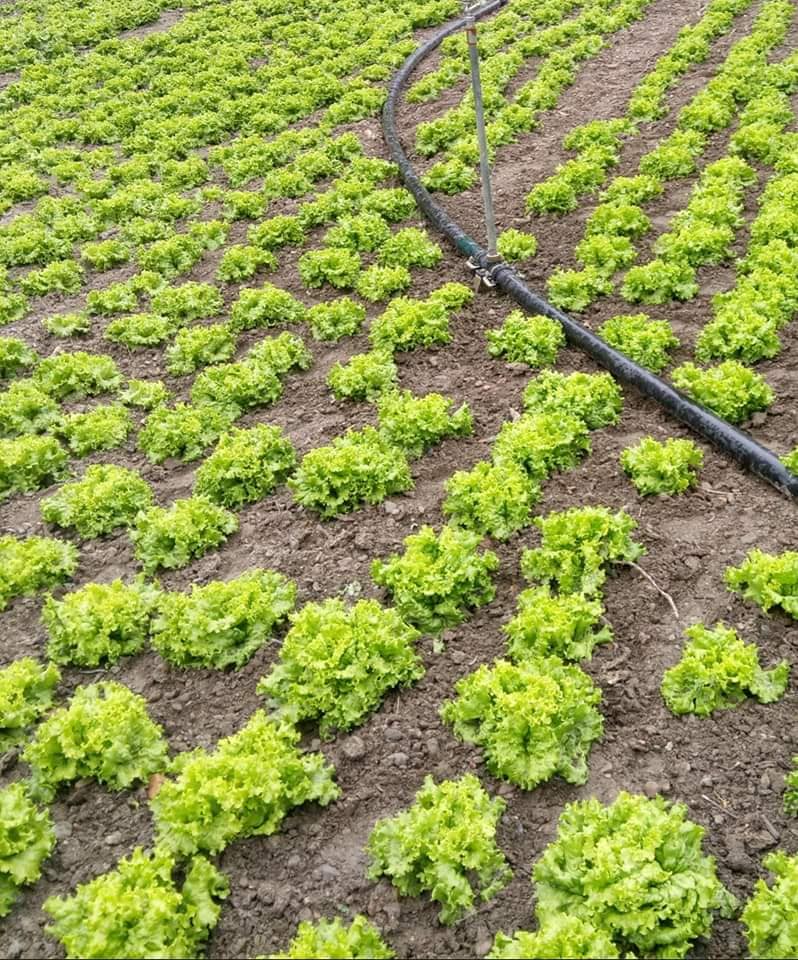
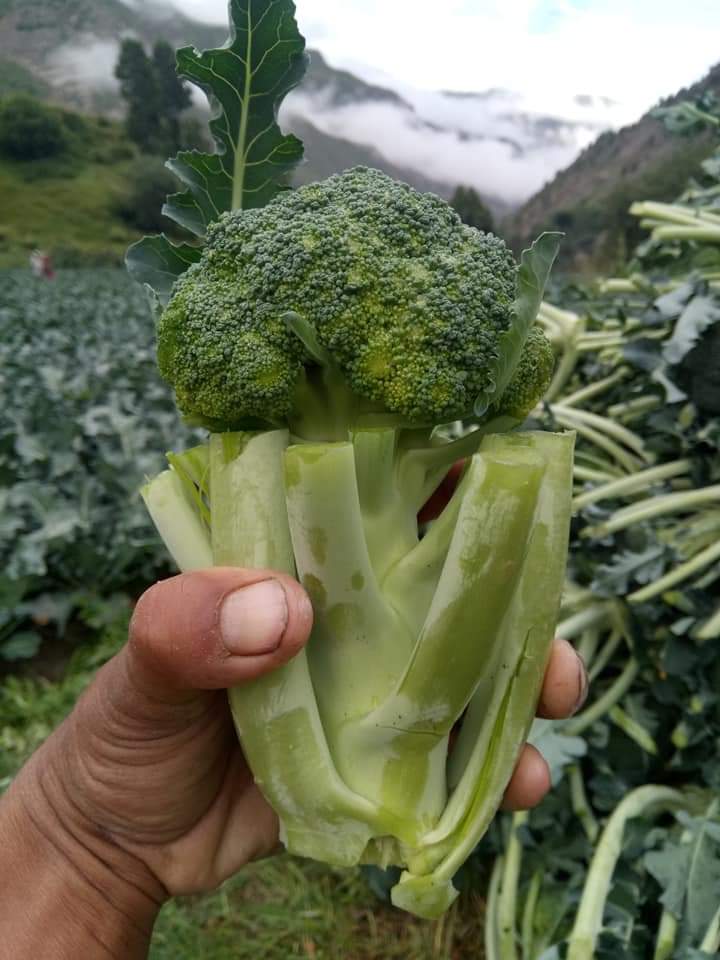
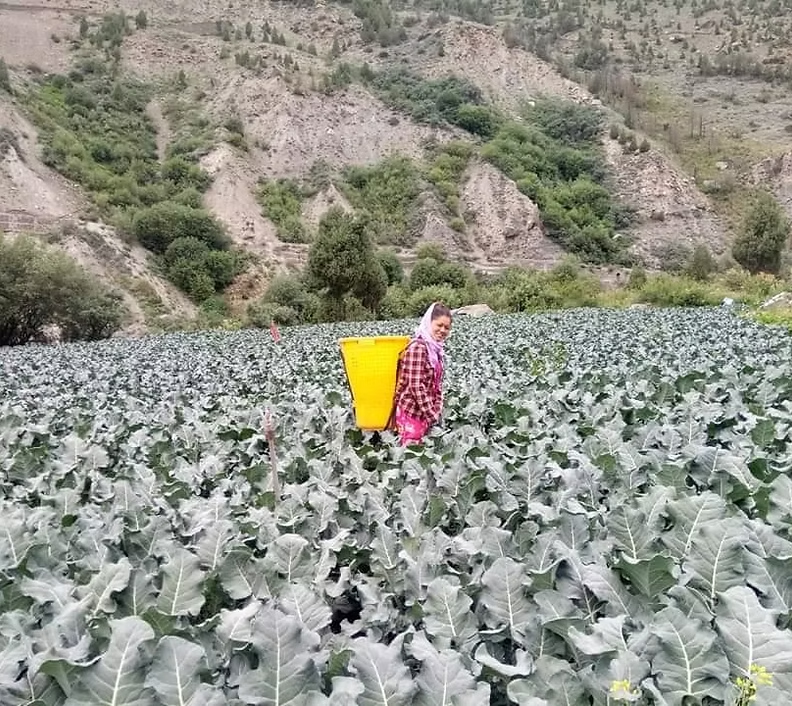
Over the years, Tashi gradually started diversifying and began cultivating more varieties of exotic vegetables and made efficient use of farming technologies and irrigation facilities. He now cultivates 19 varieties (mostly European exotic vegetables) vegetables in his field including broccoli, Iceberg lettuce, Red leaf, Yellow leaf lettuce, green leaf lettuce, Squash (Jugni), Yellow & green zucchini, celery, parsley, leek, snow peas, fennel, European carrots, red cabbages, other herbs, and exotic roots, etc. He introduced the same to many villages in Todh valley (Tinno, Gaimur, Jispa, Chika, and Sumdo) in Lahaul where farmers are now able to grow vegetables during off-seasons and sell them at a premium rate in metropolitan markets. Within his own community, he became the face of changing agricultural practices and popularized the phrase “Tel bharo, Kheti Karo” in Lahaul where he encouraged young farmers to adopt improved technologies like tillage machines and JCBs to do farming. In many instances, he even lent his own JCB and tiller machines to help people till rocky barren lands for farming.

The farming communities in Todh valley of Lahaul are now incorporating off-season vegetables along with traditional cereal crops. Different farming technologies like power tillers, tractor, power bidders, grass cutter, spray machine, sprinklers to improve the yield. Compared to Spiti the neighboring district, Lahaul receives more rain which is suitable for cultivation, potatoes, green peas, hops, cabbages, and other exotic vegetables and herbs. In fact, Lahauli potatoes are considered some of the best in the country and it is believed that these crops have brought prosperity to Lahaul.

Composting is an essential requirement to grow exotic vegetables and locals rely heavily on vermicomposting. Most Lahauli households have separate vermicompost structure at their home. Tashi himself annually prepares around 17 tonnes of compost to use it in his fields. He adds “We use jungle wastes like wild leaves, raw leaves, dry leaves, Juniper leaves, and other organic waste inlcuding manure, human waste, and Kenchua (organic manure)”. “Every household prepares compost 3-4 times in the unit and use it in their field to improve soil fertility”.

With time, locals were also able to enhance irrigation system and equip technologies which is more efficient and convenient. Earlier water resources are distributed among farming households on a rotational basis. There’s a watering turn for everyone and a farmer has to wait for about 6 days to receive his share of water to irrigate the fields. With improved irrigation systems in most Lahauli villages, the watering turns have almost disappeared. Direct pipes were connected from glacial sources to Kuccha Kuls (field canals) and every household have direct access to it. Tashi enthusiastically adds “one can finish the irrigation within 3-4 hours now! Almost unthinkable in the past.” Almost 90 percent of Lahauli villages are relying on piped or drip irrigation systems. There’s an increased use of sprinklers and rain gun watering systems.

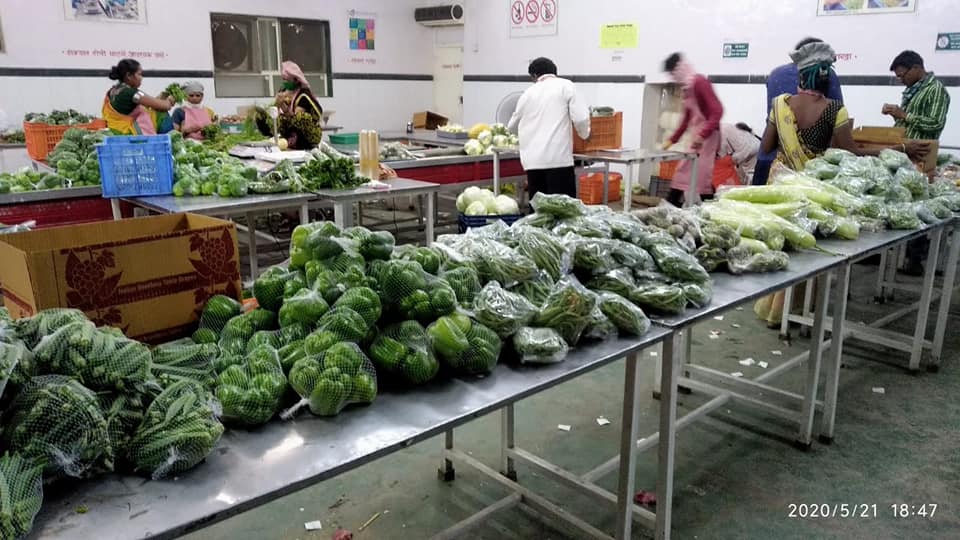
With improved road connectivity, better transportation system, and the availability of new crop inputs like hybrid seeds and organic fertilizers, the farmers in the hilly region of Lahaul are able to fetch gain higher yields and better prices. The returns from the sale of vegetables are five times higher than that of traditional crops. There’s a high demand for exotic vegetables in metropolitan cities and Lahauli cultivators are now able to sell their produce in Delhi, Chandigarh, Ahmedabad, Surat, etc. The farmers from Todh, Turat and Keylong have collectivized and formed a union of 101 farming households to provide better market exposure and greater revenues for the local producers.

Some of the initiatives include farmers market, over-the-counter payment system for the farmers, and also experimenting with the concept of “one village, one crop” where each village will focus on producing a single crop unique to their area and giving better opportunities for farm entrepreneurs. The farmer’s union will be collaborating with big hotel chains like Taj to supply them year-round vegetables.

Opening up of Atal Tunnel has also huge impact on farming in Lahaul. There’s surge in tourists flocking in the valley and farmers are keen on integrating agriculture and tourism. They have initiated farm-based enterprises like camps and homestays where tourists can take part in the sowing process, harvesting, procuring vegetables, and immerse themselves in rural agricultural life with locals during their stay. Tashi’s own farm camp in Tinno and Keylong attracts a lot of tourists. He shares that the motive is to give them first-hand experience of agriculture, self-cooking and be part of the collective experience of the landscape. Cultivators like Tashi show that there can be a more forward-looking approach for agriculture and it can harp beyond the traditional way of life. With greater solidarity, there’s positive hope for farming in high Himalayan landscapes to empower small farmers.

960 720 Tashi Angroop
My farming memories
Photo: Vikram Katoch

My farming memories

I spent my whole childhood in a small hamlet called Garang in Lahaul. In the summers my sister and I would help our grandmother with the household chores and in in the fields. She would cultivate green peas, potatoes and wheat. In Lahaul, the sowing season starts from mid-March. Villagers would first clear the snow from the fields and then start sowing various seeds. Green peas and cauliflower seeds are sown first followed by potatoes. Farming is the sole livelihood of many villagers and before ploughing, people pray to their fields, the tools and the baang (oxen) in hope of a good harvest. After ploughing, the farmers use pickaxe to create small water channels in the fields. Our grandmother would let me and my sister do this task. She would instruct us on how to do this carefully and correctly. She would then add seeds of green peas after us. After covering the field with seeds, she would level it using long dry twigs.

We used to eagerly wait for the seedlings to grow. It would take around 30 to 45 days for the first seedlings to emerge. This was the time when the weeds would be removed and the field would be watered through Kuls. Unlike traditional crops, most of the fields like green peas and cauliflower, require frequent watering – once in every 15-20 days. Around June flowers will start blooming in green peas fields and by August, the crops are ready. Harvesting season is the most important and everyone in the family will help collect the ripe peas. Since there is no farmers market/cooperative for peas in Lahaul, we are often forced to sell their produce to private dealers at meagre sum.

Similarly potatoes are also grown in our village. Each household prepares their own seed by keeping sacks of potatoes in a pit during the winters. When spring arrives, the seeds are unearthed and prepared. The beds laid for potatoes are deeper than that of green peas and are placed 5 to 6 inches apart from each other. The seeds are buried deep in the soil to ensure high and good production of potatoes. When the seedlings emerge, the fields are watered and by September the harvest is almost ready. The leaves from the plant are removed a few days before uprooting the plants. This helps to thicken the potato skin, thus making them more long-lasting. The potato harvest is ready by early October and the whole valley is suddenly humming with trucks collecting produce and taking it to the market. There are times when it’s even difficult to find trucks in Lahaul and the farmers have to arrange trucks from the nearest town. Farming has changed a lot since my grandmother’s days – increasing mechanization has certainly filled the gap of labour shortage but many households still struggle to find good market exposure.

729 410 Vikram Singh Katoch
Unpredictable Lifelines
Integrated Kashang Hydroelectricity Project, HP, India| Photo: ejatlas.org

Unpredictable Lifelines

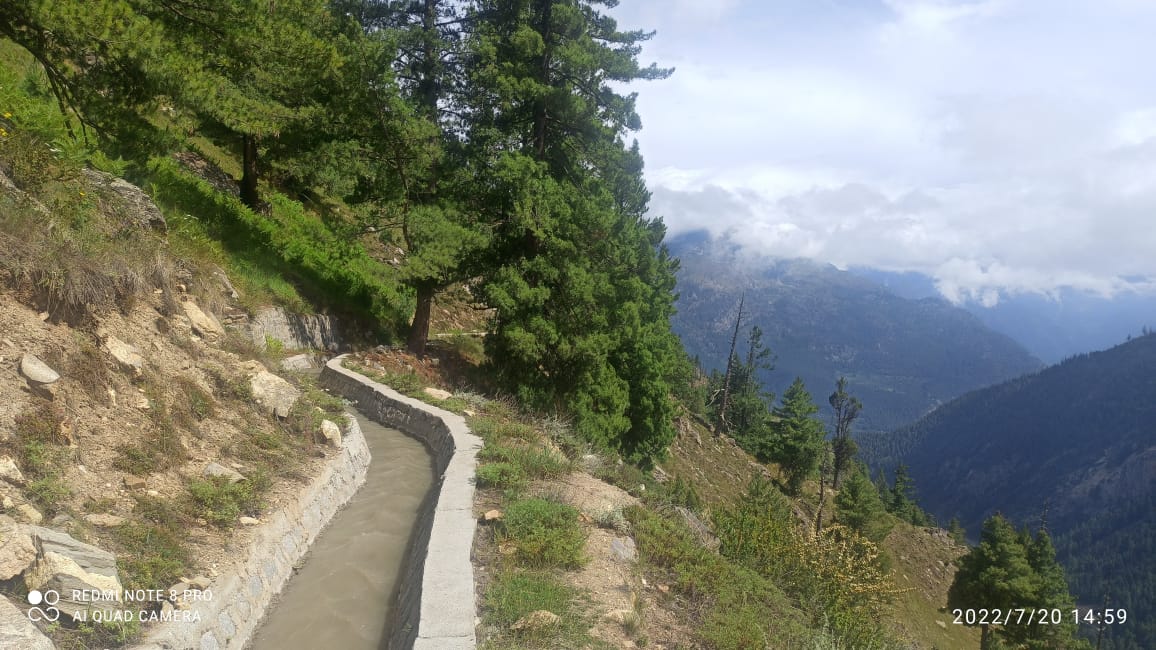
Verses of prayers reverberate throughout the valley as men sing and climb mountains to ensure their village has water in the summer. People from Khadra, Akpa and Rarang village trek for 27 km to reach Pangi top and clear the path of the artificial stream – Kashang nahar to let the water flow freely towards their villages. Generations ago many streams flowed towards the foothills but now only a few remain and Kashang Nahar is the only reliable source. Completed in 2005 this canal is helping the local villages meet their demand for water.

Kashang nahar | Photo: Yowan Negi, (Village Rarang)

Khadra, Akpa and Rarang, villages at 8000ft of Moorang tehsil, fall in the semi-arid region of Kinnaur district in Himachal Pradesh and rely mainly on glacial melt for their water needs. Though over the past few decades things are changing. As the climate is getting warmer, precipitation (rains and snowfall) is getting erratic. With each passing winter the glacier is unable to recover due to reducing snowfall trends. This is not only reducing the water availability during summers to the villages dependent on them but also leading to glacial instability. This phenomenon is already bringing grave consequences to the communities living in the mountains as was observed in Chamoli district of Uttarakhand. A glacier collapsed and released a ton of water and energy which destroyed everything that was in its path.

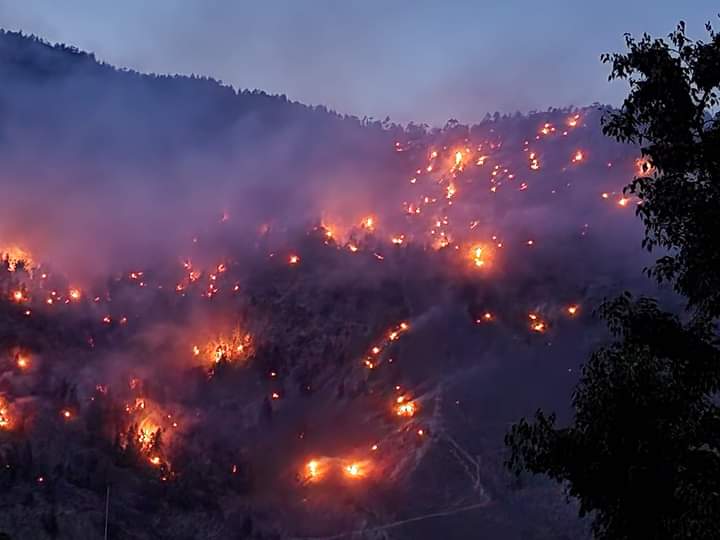
During monsoons, flash floods and landslides are increasing and becoming more frequent by each passing year, adding to the woes of the communities. A few years back, in my village of Khadra and the nearby villages of Akpa and Rarang, a major landslide washed away many agricultural fields leading to loss of acres of productive land. This year we faced a severe heat wave which led to fires in our forests. As Deodar and Chilgoza trees around us burned and fell and the wild species fled, we felt so helpless as the water in Kashang nahar fell short. Some of us collected the water at the base of the nahar and managed to save a few trees. But a lot of the damage had already been done. Each year we are caught up in a dichotomy of drought and heavy devastating rains and we don’t know what we should prepare for.

Forest fires in Akpa & Jangi forest | Photo: Heer Chander (Village Jangi)
Aftermath | Photo: Sunder Negi

Development based on destruction

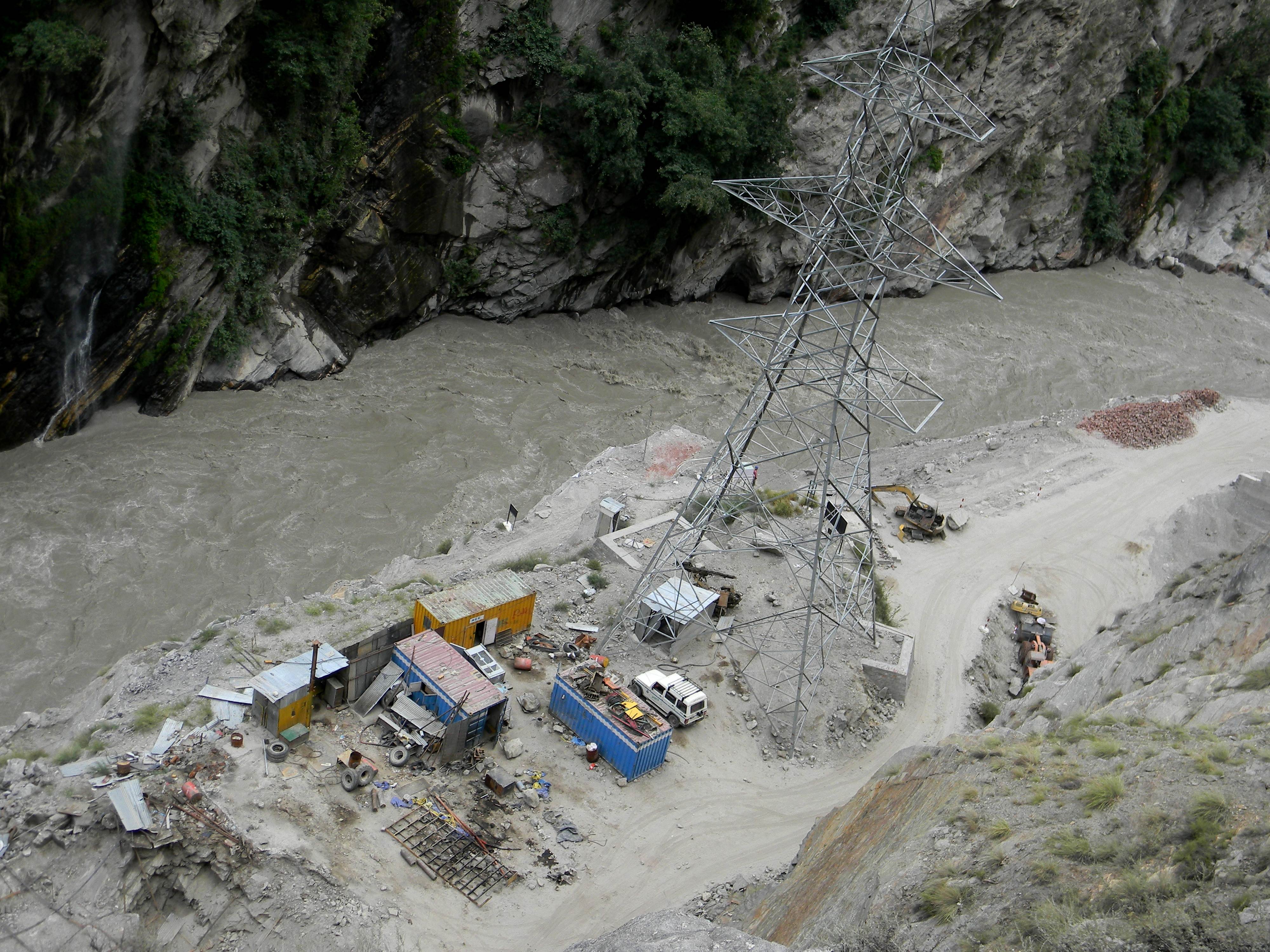
Himachal Pradesh, being a mountainous and river rich state, is known for its potential to generate hydro power. However that is coming at a cost to the communities. Villages and community forests are sanctioned under different projects to either be submerged or cleared off for the development. Around our village we have two hydro power plants – Tidong (150 MW) & Kashang Integrated (243MW) under construction and one mega project – Jangi Thopan of 804 MW is proposed. Kashang integrated project has plans to divert the Kashang nahar to meet its production needs. These projects are hindering the flow of our already distressed rivers and causing long term implications towards the health of the ecosystems and communities dependent on them. We have always opposed such mega developments and will continue to oppose them.

Photo: statkraft.in

Science and spirituality

To our communities, water means much more than a resource. Our ancestors have revered and protected the resource not just for themselves but for the generations to come. And today we continue to reap the benefits. Even today elders in the village guide us with ways to protect the water and thank the spiritual beings for their benevolence.  Every time we go to the source of a natural spring, we recite Naaga Chhonme, an ode to nature thanking her for the abundance of resources. It is deep rooted in our basic nature to feel connected to the forests, streams, rivers, mountains and we treat them as living being.

As much as spirituality is important to help us stay grounded and connected to our land and water we are also focusing on taking informed decisions to monitor and manage our resources based on scientific tools at our disposal. In early June this year, the youth of the 7 village clubs- Spillow, Kanam, Moorang, Jangi, Akpa, Rarang and Khadra, organised and attended a workshop conducted by Himdhara and People Science Institute on long-term monitoring of the health of the streams around our village. It was a 3-day workshop and we explored various themes around water including topics of development, climate change and its impact on our hydro and ecosystems. With the help of the Open Foris Collect, a mobile application, the youth have already started recording their readings of our streams.

River monitoring workshop | Photo: Sunder Negi

Climate change is a problem that we cannot solve at our village level. In the coming few years, the negative impact of climate change will only worsen and all we can do is prepare for the challenges we are to face. What we can do as a community is to raise awareness, write about the issues and continue to engage people in action towards climate change.

4000 3000 Sunder Negi
Changes in Agriculture (Lahaul)
Photos: Prasenjeet Yadav

Changes in Agriculture (Lahaul)

I hail from Gumrang – a small rugged village in Lahaul (Himachal Pradesh). There are about 22 households and we are majorly dependent on agriculture. Farming along with livestock husbandry and agro-pastoralism has been traditional livelihood for locals here but there has been significant changes in since last decade. I have been farming for over the last 17 years, I have seen how much has changed in the valley in terms of food sustenance, practices around agriculture and resource usage.

I remember, when I was young, we used Yak and bulls to plough our fields. Traditional methods of ploughing like this required at-least two men and yaks to complete the task but we have gradually shifted to machinery to get the work done single handedly. About 30-40 years ago, we would cultivate Kaatu/Kathu (buckwheat), Jo (barley), Kala matar (black peas) in Lahaul which is enough for our sustenance. These traditional crops are full of nutrients and are suitable for people living in high altitude landscapes. In the current economy, even with introduced cash crops like green peas, potatoes and apples, it is sometimes hard to make ends meet. One cannot fully rely on cultivation anymore, we are less resilient towards changes in weather and crop disease.

Many villages in Lahaul are dependent on snow fed glaciers and springs for water resources. People wait for glaciers to melt and collect in water reservoirs before it is channelled for various purposes. In older days when the water was abundant, we could make water channels by our hands and get the water to the fields. Irrigation was done through hand-made Kuls (canals) and the water was distributed among different households on a rotational basis. However, due to change in weather patterns and growing need, the glacial water melt is a scarce resource and sometimes there is also a need to pump it up from the river. The general access for water and irrigation has become more convenient with the use of drip and sprinklers in the fields but at the same time, many of the natural water sources like springs are drying up and there’s less water in our Kuls now. Sprinklers and drip irrigation seem to consume less water but I realized our crops require frequent watering (2-3 times a week) as the water is not able to penetrate deeply in soil.

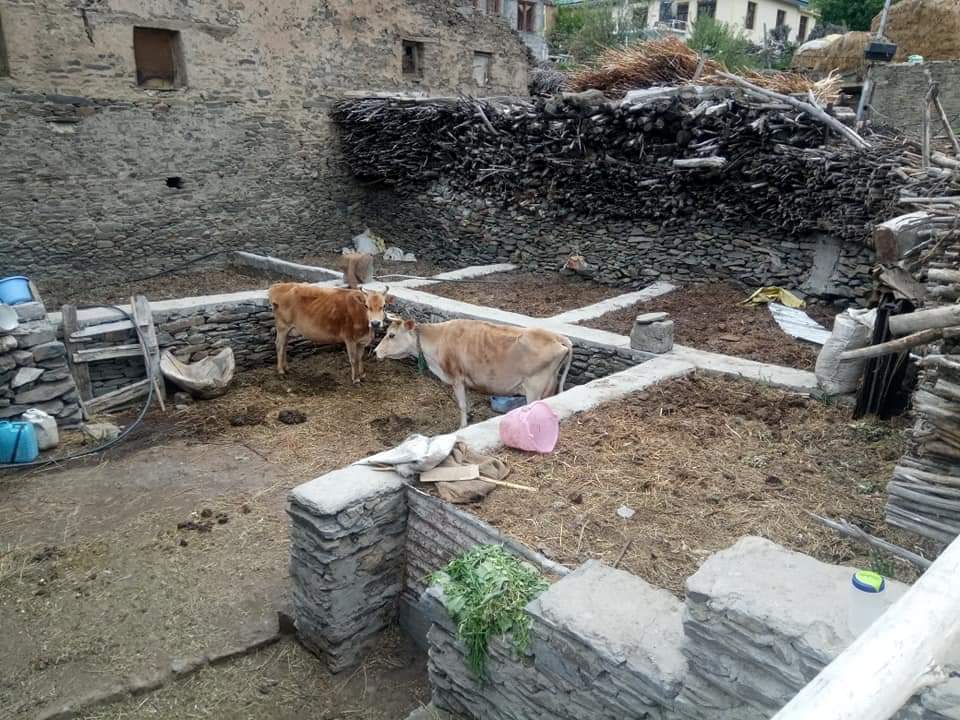
Years ago, each household had 40-60 livestock which was a good source of manure to the fields. Many families now have sold their livestock and now it’s hard to find any cattle in the villages. Due to this, the access to manure also reduced and the fields produced less. Cash crops like green peas, cabbages and the cultivation of exotic vegetables like broccoli which is increasingly becoming more dominant in the valley require more tending. The families then opted to supplement their field with urea fertiliser which caused damage. Excessive usage can deteriorate the soil quality and can lead to more pest attacks. In many cases, it also impacts the field of neighboring families who might be using organic fertilizers for the crops. I hope we, as a community, become more sensitive to these changes and be mindful of long term sustainability of our land and resources.

880 587 Chhering Gaaji