Traditional Knowledge

Food of the mountains: Stinging nettle (Zatsod)

Food of the mountains: Stinging nettle (Zatsod)

People of the high mountains have traditionally gathered plants and herbs from the wild, which would then be carefully stored and consumed in winter. Most of this collection is for personal use and never for commercial purposes. In this story, Karma Sonam of Gya village of Ladakh tells us about the traditional technique for collection and storage of zatsod or stinging nettle. He also shares a recipe of zatsod thukpa.

ऊंचे पहाड़ों के समुदाय पारंपरिक रूप से जंगली पौधों और जड़ी-बूटियों की तलाश करते हैं, जिन्हें बाद में सावधानीपूर्वक संग्रहीत किया जाता है और सर्दियों में खाया जाता है। इस संग्रह का अधिकांश भाग व्यक्तिगत उपयोग के लिए था, न कि व्यावसायिक उद्देश्यों के लिए। इस कहानी में, लद्दाख के ग्या गाँव से कर्मा सोनम हमें बिच्छू बूटी के संग्रह की तकनीक के बारे में बताते हैं। वह स्थानीय सामग्रियों का उपयोग करके बनाई गई थुकपा की एक पारंपरिक रेसिपी भी साझा करते हैं।

This story was narrated, shot and edited by Karma Sonam.

यह कहानी कर्मा सोनम द्वारा सुनाई, शूट और संपादित की गई है।

1718 1052 Himkatha
भारत में पहली बार हिम तेंदुए की जनगणना कैसे की गई?

भारत में पहली बार हिम तेंदुए की जनगणना कैसे की गई?

अंतर्राष्ट्रीय हिम तेंदुआ दिवस 23 अक्टूबर को मनाया जाता है। भारत इस साल अपनी पहली हिम तेंदुए की जनगणना के नतीजे घोषित करेगा। यह परिणाम देश के हिमालयी क्षेत्रों में किए गए 4 साल के व्यापक अभ्यास पर आधारित है। यह विशाल अभ्यास देश के सुदूर ऊंचाई वाले क्षेत्रों में रहने वाले स्थानीय लोगों के समर्थन और भागीदारी के बिना पूरा नहीं किया जा सकता था।

वीडियो: समर्थ ज्योति
कथन: अक्षिता अशोकन
अनुवाद: सीमा बजाज
कैमरा ट्रैप छवियां: हिमाचल प्रदेश वन विभाग, नेचर कंजर्वेशन फाउंडेशन और स्नो लेपर्ड ट्रस्ट
फुटेज: तेंज़िन थुक्तान, मुनीब खन्यारी और अजय बिजूर
छवियाँ: हाई एल्टीट्यूड प्रोग्राम और प्रसेनजीत यादव
अतिरिक्त फ़ुटेज: ओपन प्लैनेट

2444 1360 Himkatha
The Sowa-Rigpa medicine system

The Sowa-Rigpa medicine system

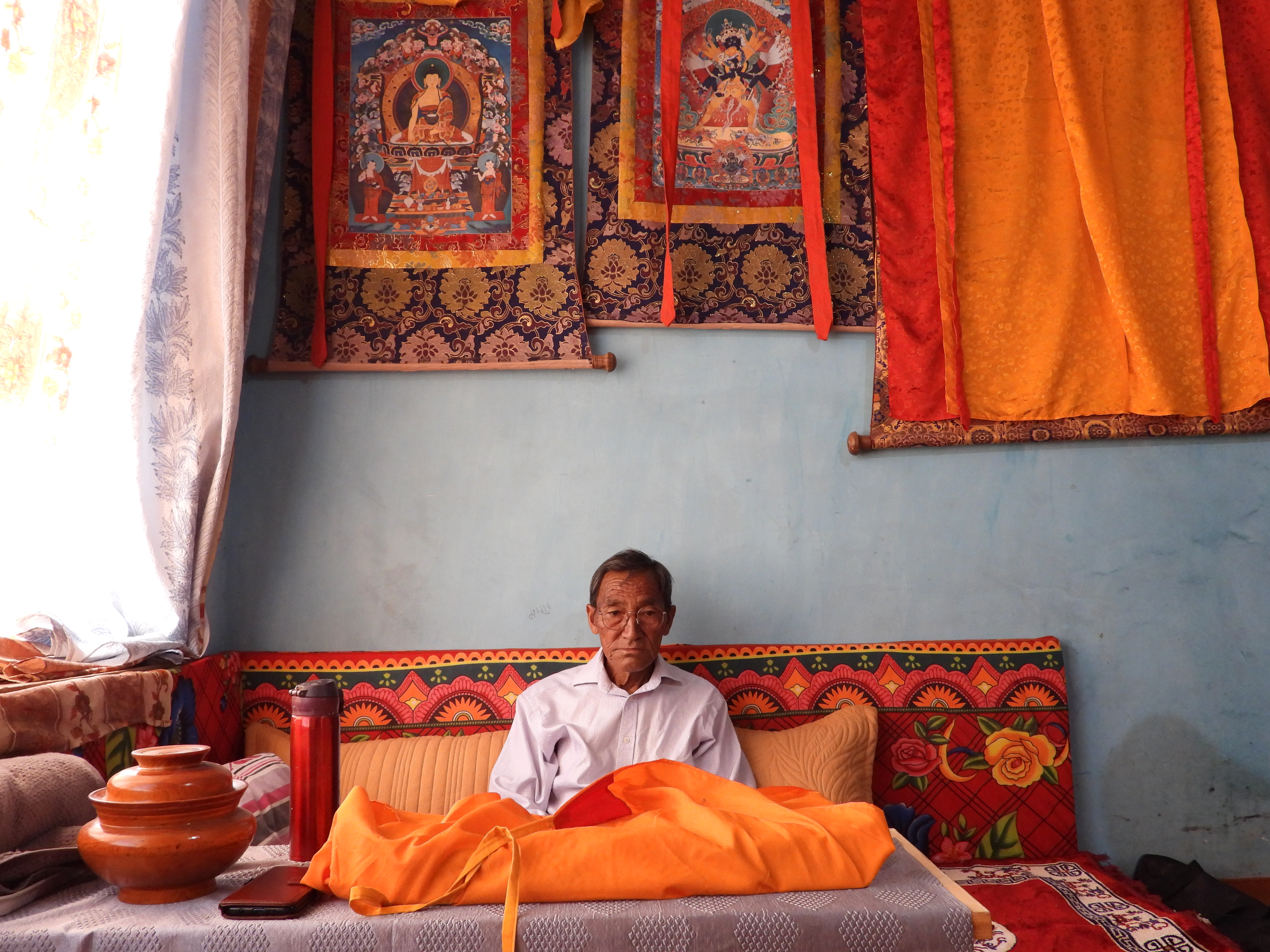
In this episode of Himkatha Charcha, we spoke with Amchi Chhering Tashi of Hansa village in Spiti about the Sowa Rigpa medicine system which is being practiced in his family for at least four generations. We tried to center our conversation on the origin of this system and the deep knowledge it preserves about local plants. Amchi Chhering Tashi was interviewed by Dr. Mayank Kohli and Tanzin Thinley. Additional footage via. Open Planet (https://openplanet.org/)

हिमकथा चर्चा के इस एपिसोड में हमने स्पीति के हंसा गांव के अमची छेरिंग ताशी से सोवा रिग्पा चिकित्सा प्रणाली के बारे में बात की, जो उनके परिवार में कम से कम चार पीढ़ियों से चली आ रही है। हमने अपनी बातचीत को इस प्रणाली की उत्पत्ति और स्थानीय पौधों के बारे में इसके द्वारा संरक्षित गहन ज्ञान पर केंद्रित करने का प्रयास किया। अमची छेरिंग ताशी का इंटरव्यू डॉ. मयंक कोहली और तंजिन थिनले ने लिया। अतिरिक्त फुटेज ओपन प्लैनेट (https://openplanet.org/) के माध्यम से।

1200 668 Dr. Mayank Kohli
The Sowa-Rigpa medical tradition
Illustration: Peeyush Sekhsaria

The Sowa-Rigpa medical tradition

Sowa-Rigpa, also known as the Amchi system of medicine, is practiced in the high Himalayan region. It is also referred to as the Tibetan medicine system and is among the oldest existing knowledge systems in the world that relies on knowledge of ecology, especially plants. In an hour-long conversation with 71-year-old Amchi Chhering Tashi of Hansa village in Spiti we speak about the Sowa-Rigpa tradition. Here is a short excerpt of this interview.

Can you speak about the origins of the Sowa-Rigpa medical tradition?

Contrary to popular belief, Sowa-Rigpa is an ancient Indian knowledge system, not Tibetan. It is believed that when the Buddha gave his sermon on ending suffering at Vaishali in present day Bihar, there were many in attendance. The audience included many learned people including spiritual and celestial beings from different realms. Buddha delivered the discourse in Pali, but all those in attendance heard his message in their respective languages. Since everyone heard it differently, it got recorded and disseminated in different ways – as Ayurveda across the Indian subcontinent, Sowa-Rigpa across the Himalayas and Tibet, and Yunani in Central Asia. That is how this knowledge spread across different cultures. It was later translated into Sanskrit at Nalanda. A part of this knowledge system was at risk of being lost due to the predominance of Ayurveda, but was preserved by the Tibetans. So, while Sowa-Rigpa originated in India, it was preserved and nurtured in Tibet. Lotsawa Rinchen Zangpo – the Great Translator of Buddhism – translated these works to the local Bhoti dialect in his sixth incarnation.

Since when has this system been practiced in your family? 

Every village in Spiti – from Losar to Lari – has at least one family that practices this system. Villagers help with the collection of medicinal plants and in preparing medicines. Historically, each village had an Amchi because connectivity between villages was poor and this was an essential service that all villagers needed. No fees are charged by the Amchi; it is offered as a public service to anyone seeking medical attention.

About our family, my father was a very learned man. He knew exactly what treatment is described on which page in the handbook (pointing to the old medical scriptures placed before him). I never met my grandfather, but he might have passed on this knowledge to my father. While I don’t know how and when my forefathers began practicing, I have with me several old scribbled notes that belonged to them. My grandfather, in the 1930s, also received a letter from the then Governor of Punjab which I preserve to this day. Our family has been in this practice for at least a few hundred years.

Amchi's collecting parts of plant for medicinal purpose | Photo: Mayank Kohli

How did you get inducted into becoming an Amchi?

My father started training me since I was in sixth grade. I had to attend school, manage a lot of the house work and focus on this too. I was the only male child and my sisters were already married by then. I had little interest

in learning about plants and reading the handbook. But my father was very persistent. He taught me patiently. Maybe that is how I learnt whatever little I did. Had I taken interest from the beginning, I might have become a better Amchi.

One can learn everything about the practice in six years. But my father taught me daily and he inculcated in me a habit of reading these scriptures every day, even if it is only for just five minutes. These scriptures that I possess, are nearly 600-years old. Reading them daily has been very helpful.

What is the process of diagnosis and prescribing medication?

There are four fundamental books that form the basis of this practice, which need to be learnt by heart by any Amchi. Further there are four books explaining these fundamental principles in detail. Lastly, there are these scriptures (pointing to the old medical scripts placed before him) which are like a handbook. They explain the symptoms of every illness and contain details of its treatment and medication. We match the symptoms of every patient with the explanations in this handbook and follow its recommendation for prescribing treatment.

When a patient approaches me, I first check their pulse and sometimes their urine. I then match the description of the symptoms with those in the handbook. The handbook gives details of all the local plants and their medicinal values. It also suggests the proportion in which they should be mixed for a particular treatment. I always make all the medicines and test them on myself before I distribute them.

Any illness has two causes: first from accumulation of bad karma earned in one’s past lives, and second from an imbalance in what we consume (food, water, air etc.) from our general surroundings. An Amchi can cure illnesses caused by the latter; the former cannot be cured by medicine. While modern medicine addresses the symptoms of an illness, Sowa-Rigpa tries to address the root cause of it.

Amchi Chhering Tashi from Hansa village in Spiti | Photo: Tanzin Thinley

How and when are plants collected?

There is no fixed time for collection. We use different parts of a plant for treatment, and hence collection happens across seasons. We use the flowers of some plants, while we need seeds of some and roots of others. Generally, roots of a plant grow deep into the soil before autumn and that is when we collect roots, we will not collect them in any other season. Flowers will only be collected in spring once they have blossomed. There are clear rules on when and how different parts can be collected. A separate book describes locations of where plants can be found. For example, Aconitum spp. (Bhoan karpo) are mostly found on north-facing slopes and that is where we scout for them. Delphinium spp. (Lader mentok) is another invaluable plant that grows commonly in our landscape. Rhodiola spp. (Shrolo) is also found on north-facing slopes – there are three varieties found in Spiti: one with white flowers, one with red flowers, and one that grows tall. These details help us in collection.

The handbook also carries details of the medicinal values of these plants. For example, Rhodiola spp. cure lung infections while Aconitum spp. cure multiple ailments: flowers improve eyesight, their roots help our bones, the branches are good for our hands and legs while the stem of the plant is good for our skin. Meconopsis spp. (Landre mentok), Saussurea spp. (Kasturi kamal or Yuliang) and Trillium spp. (Nag chhatri) are mixed to make a very effective painkiller, even better than diclofenac sodium that is administered commonly. We are aware of all the medicinal qualities of many local plant species and we make use of them judiciously.

Is a change in climate patterns affecting the availability of medicinal plants? 

There was a time when collection of wild plants for commercial use was common. We had then spoken with the local administration to limit irresponsible collection. They acted swiftly and we are glad that the situation was handled effectively. We believe that Spiti produces sufficient plants to fulfil local needs. No matter how much medicine the people of Spiti consume, this land will produce plants and they will never exhaust. However, if we start exporting plants outside Spiti for commercial use, then we invite the risk of depleting this valuable resource. There is a finely balanced cycle of production and consumption, which we should not disturb. Variations in snowfall may marginally affect plant growth, but not so much as to disrupt this system.

What do you think about the sustenance of this practice in future?  

The practice is offered as a public service by the Amchi in each village. There is no financial benefit in the practice. In fact, we often incur expenses in the collection of plants and preparation of medicines. Our homes are always open to any patient seeking medical help.

Illustration: Nawang Tankhe

Sometimes I wonder that one must be stupid to offer such a service free-of-cost at a time when everyone runs after money. But then, I also remember that when I die, I will leave everything behind: land, family, even my own body. I will only be remembered for my integrity. That is what keeps me going. However, the local administration should consider providing basic financial support to practitioners so that they continue practicing this tradition.

This is a short excerpt and you can watch the full interview on our YouTube channel.

2241 1524 Dr. Mayank Kohli
Ladakh Pashmina

Ladakh Pashmina

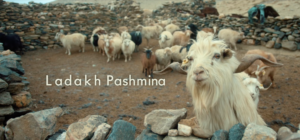
The story of Ladakh Pashmina: The authentic, sustainable cashmere. A film by Munmun Dhalaria. (Language: English and Ladakhi with English subtitles)

2292 1072 Munmun Dhalaria
The dog and the wolf
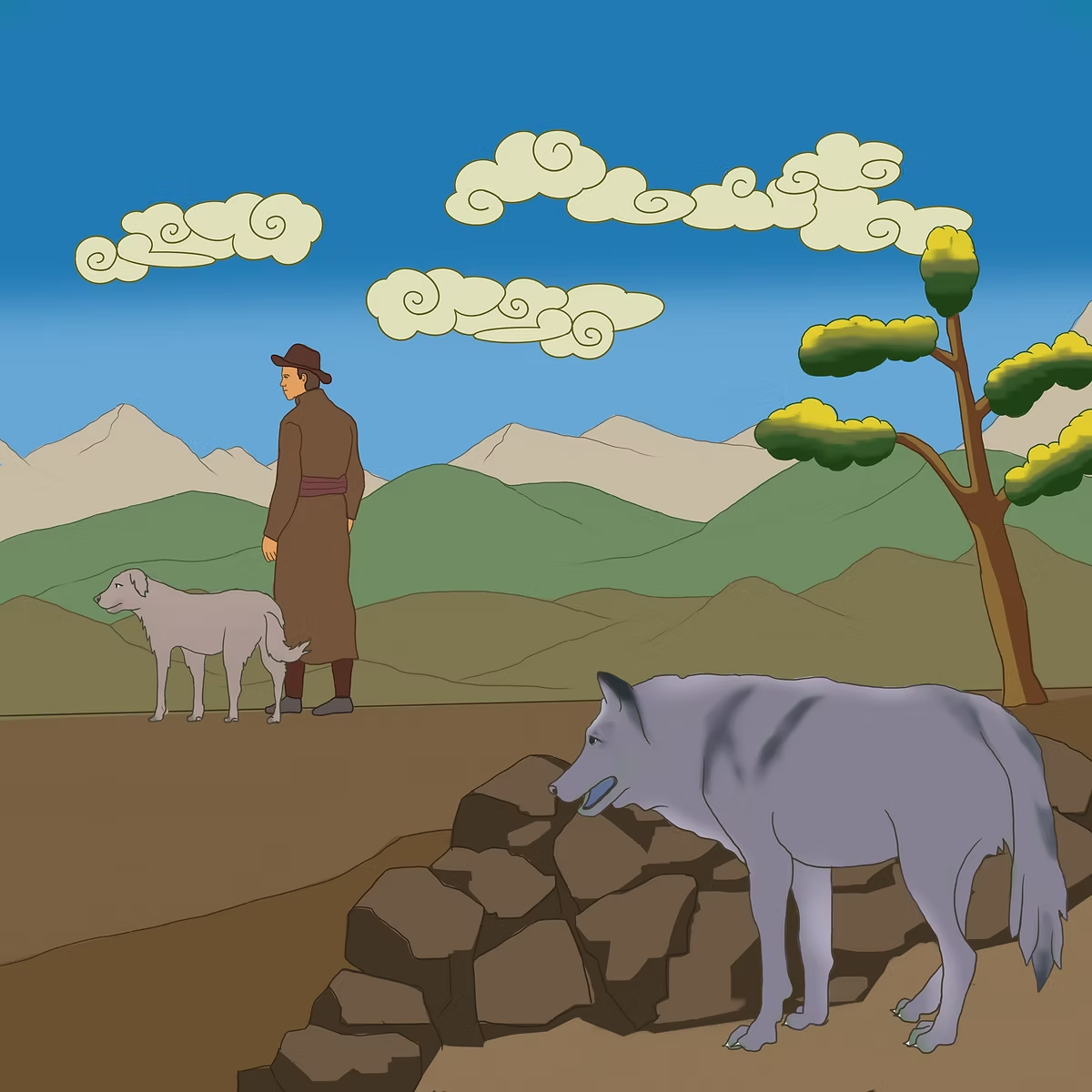
Illustration: Nawang Tankhe

The dog and the wolf

The dog and the wolf are brothers. For long they had lived happily until one day jealousy got the better of them. Ask any herder, and they will tell you how it happened.

The dog and the wolf possessed qualities that helped them survive in the wild. The wolf was a stealthy runner who could run great distances, while the dog was gifted with the power of smell. Together, they complemented each other perfectly. The dog would sniff prey from a distance, while the wolf would then hunt down the prey by outrunning them. They would share the spoils from the hunt and barely did they go without food.  However, one question bothered them – how would they survive alone if the other was missing for some reason? So, both the dog and the wolf made a pact: to help each acquire the skill possessed by the other.

It was the wolf’s turn first. He was a very patient teacher. He taught the dog every trick he knew which had helped him run long and fast. With time the dog followed the wolf’s lessons and became a good runner. It was now the dog’s turn to teach the wolf the art of sniffing. The dog was slow in training the wolf, who was a good learner. Soon the wolf learnt to sniff out prey that were at short distances. The dog promised to teach the wolf the final tricks soon. But it was all a farce. When the wolf woke up the next morning, he was shattered to see that his brother had actually run away and made friends with a new companion. The dog had fled and made friends with the man, just so he wouldn’t have to share his prized skill with his brother.

Ever since, herders who rear livestock have kept guard dogs to protect them from being lifted. But wolves often manage to lift livestock, which herders believe, is an attempt to square off a deal that the dog left incomplete.

Illustration: Nawang Tankhe
1200 1200 Ajay Bijoor
The Nettle Army

The Nettle Army

In summer, there is hardly any place that can match up to the beauty of Lahaul. Agricultural fields set within a carpet of wild flowers, waterfalls of every size, the majestic Chandrabhaga river flowing in all her majesty with villages along the valley. It was no wonder then that the eyes of invaders fell on this beautiful valley. They were secretly hoping to establish themselves in one village and then mount an attempt to establish themselves across the entire valley. But where could they start from?

A small group of spies set out to find a suitable village that could serve as their base. After much scouring they agreed on the village of Gushal. This village had table lands with fields of agriculture that could feed an entire army. Water was bountiful and the village received good sunlight in both summer and winter. The spies decided that the army could sneak in from the peaks across the village, and take everyone by surprise. The plan was finalized and a handful of soldiers set out to mount an attack on foot, establish themselves and then bring in the rest of their forces.

This small group of men marched straight into the patch of stinging nettle. They crouched and crawled in order to remain out of sight. In the bargain, they’d rub themselves entirely against the nettle bushes. It was only a matter of time before rashes erupted. In a matter of minutes, the entire group was on the floor scratching to soothe their itch.

Gushal, like most other villages, was richly covered by wild plants and grasses. Among them were dense patches of stinging nettle. While nettle leaves are a delicious addition to thukpa, one has to be very careful when handling them. The plant can leave you with an ugly rash should you accidentally touch its spiny leaves. While this was well known to the locals, the invaders had no clue of this. They tried to sneak into the village while it was still dark.

Their leader was particularly distressed. He made an exasperated comment that ‘if the plants here are so feisty, imagine how dangerous the people might be’. No sooner had he made this remark, his men turned back and beat a hasty retreat. He was left with little choice but to follow them, even as he was struggling to soothe his itch. The men went back and narrated the incident after which their headman decided that it was best to leave Lahaul and go looking for a less challenging place to conquer.

The villagers of Gushal woke up completely unaware of what had transpired in the early hours of that morning. Life seemed normal, as usual. Little did they know that their stubborn nettle army had bravely diffused the plans of invaders who were eyeing their beautiful valley.

  • Chandrabhaga river, also known as Chenab, emerges from the confluence of the waters emerging from the Chandra and Bhaga valleys of Lahaul. Their confluence is at Tandi in Lahaul.
  • Gushal is a beautiful village on the banks of the Chandra in Lahaul.
  • Stinging nettle is a plant variety that grows widely across the world, including the Himalaya. It is known to possess several medicinal values. It is also famous for causing burning sensation of skin when accidentally touched.
  • Thukpa is a Tibetan noodle soup, which is prepared and relished in several Himalayan regions including Ladakh, Lahaul and Spiti.
532 500 Ajay Bijoor
Agri-Culture and Agriculture
Illustration: Nawang Tankhe

Agri-Culture and Agriculture

Agriculture on the earth is about 10,000-12,000 years old and it appeared in India about 8000-9000 years ago. From hunting and gathering in the forests, how humans came to produce grains and how the entire process must have grown and spread across migrants, communities, regions and countries – is a fascinating history by itself. But have we ever paused to wonder or ask, what was it about agriculture that so many millennia later, it continues to be the principal foundation of our lives, relevance and survival and the main yardstick of our life’s fertility and continuous existence?

The primary significance of agriculture lies in its role as the provider of our food, sustaining our physical well-being and activity. However, its significance extends beyond mere sustenance. For instance, let me ask you, the food that we eat, does that affect us only physically? The straight answer to that is – No! Besides producing food for our physical body, the entire process of agriculture nurtures our minds and souls, transforming us into individuals capable of thoughtful contemplation with wisdom. This, in turn, has given birth to or impacted all aspects of our lives, be these physical, mental or spiritual, and social, economic and cultural. Just take a look around yourself and you will realize that there is no aspect of our society and lives – be it our meditations on the forests or the water, or our livelihood resources or artistic endeavours – which has not emanated or developed as a result of our agricultural pursuits. In different times and space, struggling through various passages and milestones, agriculture has nurtured human and social survival and our civilizations; and the society too, by making it a major part of one’s daily life, thought and sociability. Thus, it has given birth to and developed various aspects of social life and allowed itself to remain relevant.

Here, we are trying to look at the changes that have occurred in agriculture throughout its journey. For this, there are two aspects of agriculture that we need to look at a little closely – (1) Agriculture as the physical aspect or task of growing food crops; and (2) Going beyond the physical act of growing food and assimilating agriculture into the very nature of one’s social life, i.e. turning the entire process into agri-culture. For want of appropriate terminology let us call these as Agriculture and Agri-culture (Agri as Culture). Can you see the difference between the two – difference between the act of growing food and making the act as part of one’s culture? When we look from such a perspective, we can see that, if agriculture had remained just the physical act of growing food, then it would have become a mere profession but by developing it into agri-culture it has become a vocation and occupation that is at the very centre of our entire life. By turning it into agri-culture, an interactive bond developed between it and the society, leading to both learning and feeding from and giving to each other. This is why, no society ever, defined agriculture as a profession or trade nor treated it as such, but turned it into a life-style, which did not allow agriculture to remain stagnant and rooted but imbued it with the trait of “renewability”, enabling it across time and space, down to the needs and traits of every local community, in accordance with local experience, wisdom and sensibilities that enable it to remain relevant, alive and forever in step with the times. The trait of renewability developed into a natural trait which gave society the “vardaan” of the everlasting – and which we call development.

By harping on this difference, and seeking to use the two terms “change” and “renewability” with two different meanings, I wish to see and analyse the changes that we are seeking to understand. It might be appropriate that we analyse the dimensions and meanings of these two terms, for a clearer understanding of the change that we are discussing.

Are the terms “change” and “renewability”, synonyms?

I think not, and this is what I am seeking to understand and explain. Further, if we can see “agriculture and agri-culture” and “change and renewability” in the context of each other then we may be able to grasp better the essence of change in this sector in the last fifty odd years. For this, we may need to compare these in two distinct time eras.

The changes that have happened in agri-culture in the last 50 or so years are actually the consequence of changes in society that began with the advent of industrial revolution in Europe about two-three hundred years ago. That period provides a distinct dividing line across which we can clearly see an overall difference in the basic nature, belief, concept, action and result between agriculture and agri-culture. We can then clearly understand the cause and the impact of the changes that we have been witnessing in the last four-five decades.

The pre-industrial revolution 10-12 thousand years saw countless small and big changes. However, those changes happened in different times, in different places and amidst different communities and in accordance with retaining the balance of and in cooperation with the five elements. The genesis of those changes happened at specific local levels and no change was sudden but happened slowly as a result of close observation and experience over a long period. In other words, those changes had elements of deep reflection and experiment, wherein some experiments may have been fruitful and some not successful, immediately or over time, on the basis of which the society would have accepted, rejected, corrected or improved upon those. And such a process continued constantly. In fact, this entire process of doing, seeing, improving, adding on was what gave agriculture the trait that we are naming and explaining as “renewability” – wherein something new did not happen suddenly but grew on the foundation of the old and which sought to carry the old a few steps ahead.

Barahnaja, a traditional system of taking 12 crops in a year; Beej Bachao Andolan

What was special or specific about any such change or development was that it was based entirely on the experience and wisdom of the local farming community. As a result, there was a development of a repository of traditional knowledge which was not limited to grains and crops but assimilated understanding and knowledge of all natural resources. This encouraged at the local geographical level, diversity of crops growing in the field and the food being cooked in the kitchens. Not just that, its impact was seen and felt beyond local agriculture practice, on the development of native languages and proverbs, diverse folk arts and culture, and gave birth to the technology of making wood or metal implements and utensils. This is where, agriculture went beyond growing crops and adopted the wide character of what I have termed as agri-culture to become an intrinsic and inherent part of life, to become its lifestyle. It will not be an exaggeration to claim that it was this agri-culture which developed in the humans, observation based scientific temper and process which further developed among the humans, an understanding of climate and weather, botany and zoology, etc. Try to look at basic knowledge in any discipline and you will find that its seeds germinated as a result of and in the general environment created by agri-culture. Indeed, despite its very local nature and characteristics, agri-culture proved to assimilate within itself the vast and global natural vision. It became a close reflection of nature’s godly vision, and played a critical role in the existence and continued well-being of this earth.

If we take this entire spectrum together and borrow from the definition of democracy, we can say that the renewability in agri-culture is of the people, for the people, by the people. From concept to planning and execution, the entire responsibility and control remained with the local community.

Agri-culture which was life’s philosophy, a lifestyle is today a mere profession and mode of employment. In fact, it is no longer agri-culture and has reverted to being plain agriculture. Today, it is no longer a medium to enhance life but just to stay alive and afloat, to remain economically alive. The agriculture which is being encouraged and propagated today is no longer social but industrial, or in other words, the society no longer owns it but has rapidly been given to or taken over by the industrial and corporate companies. It is not based on the knowledge invented or developed by the farmers on the field, but the entire thought, observation, research and implementation is developed in the laboratory of some institution or company and then served as a package to the farmers. This is not part of agri-culture’s renewability emerging from the existing practice and from within the society and indeed, it is not even a change but an intentionally planned campaign (even, a conspiracy), a replacement deliberately imposed from the above and outside, to completely uproot this most important function in society. The cardinal characteristics of agri-culture were then steadily marginalized and erased.

This replacement about 50-60 years ago, which turned agri-culture on its head did not come with the Green Revolution (more appropriately called Greed Revolution) then but was the consequence of what had emerged as the industrial revolution two-three hundred years ago. And it started with de-legitimising traditional society’s existence, identity and knowledge by naming it ‘backward’ and following it up by seeking to shame people’s knowledge systems and their seeds. It was crucial and strategic that this society begin to have an inferiority complex about oneself. This was the first essential stage of the conspiracy. Once this was achieved, it was followed by a systematic replacement of the principles, methods, seeds with the means that it had created. As a result, a creative, productive and self-reliant society has today become a dependent slave farmer society.

Photo: Wikimedia Commons

An important aspect of this change in India was the establishment of the institution of the Zamindari system, wherein the society itself saw its division into two distinct classes. This system, the “divide and rule” confiscated from farmers their independence and creativity and turned them into slaves at the village level itself. So, there is an entire stretch of an exploitative pattern, which later developed into the introduction and dominance of Green Revolution. In the course of the industrial revolution starting from Europe, all aspects of agri-culture were side-lined one by one. This started with terming the entire identity of character of a local society as backward. It was important, in fact, essential for new agriculture to establish itself by downgrading and marginalizing traditional knowledge systems and particularly, its local seeds, and for the people to feel ashamed of their own rich traditions. Once this was done, it was followed by introducing and establishing its own means and resources. The net result of this was that a productive farming society has today become an enslaved, dependent society.

Let us try to understand this through an example or two.

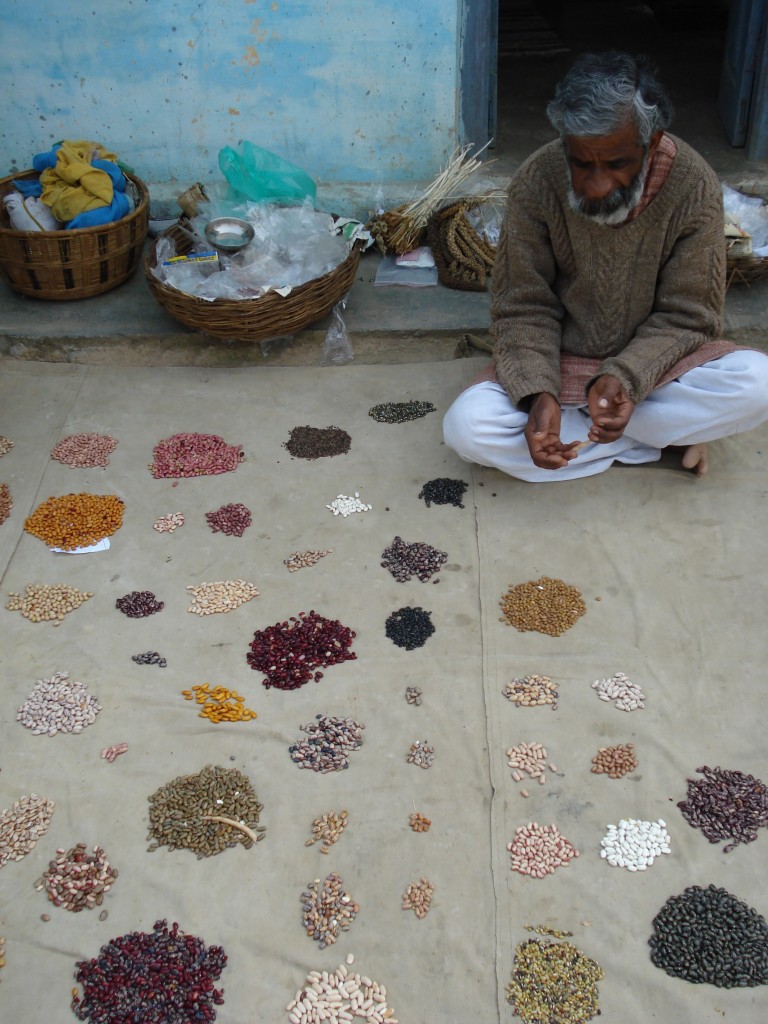
Earlier, seeds of any grain or produce came from the farmers themselves and whose ownership was theirs, collectively. Any seed needed, in the first instance, came from their own homes, or neighbours, or village, or neighbouring villages. Those were seeds which bred and prospered in the soil and water of the respective village, were acclimatized to the local geographical conditions and situations, and which were also the reasons that resulted in their tremendous diversity.  Consequently, this diversity enabled the seeds or crops to develop characteristics to suit every season, every taste, every health point of view and which provided them with tremendous disease resistance and ensured the society remarkable prosperity.

This led people to develop their own exchange traditions and practices – seeds travelled from one farmer to another, one community to another, one village to another, one society to another. For instance, a borrower did not have to pay the lender but only later, post-harvest returned to the lender double the amount (or whatever measure the community practiced) they had taken. A typical exchange practice also had a humanitarian aspect to it – for reasons of flood or drought or any other, if the crop failed, the borrower did not feel forced to return the lent amount to the lender – it was an unwritten understanding within the society. What this ultimately meant is that there was regular availability of seeds in the community.

Today, the system has been turned on its head. The control over seeds has been usurped from the farmers’ hands to the company’s control – and the farmers from the producer and master has become a mere customer bound by the company’s many conditions of restriction, rising cost and despair – all that farmers today understand clearly and suffer, but are not in a position to do anything about it.

Let us look at another example on this. Today, as the harvest begins to fall rapidly after a year or more, farmers need to change the seeds – and actually, purchase new ones. This considerably enhances the farmers’ input costs. The fall in production, is a basic failing of any crop or seed, which farmers were well aware of. However, earlier, farmers did not need to change their seeds as frequently or rapidly as they do now. And even then, farming communities had developed their own mechanisms of seed-change. At the first level, they would merely change the field (avoid growing a crop in the same field every year), and change seeds only after considerable number of years. The entire system of seed change, from concept to practice was in the farmers’ or community control, and so it continued to remain even after seed exchange. But today, with what guile and cleverness, this community practice has been taken away from their hands and turned into a practice of excessive profit of the companies.

Illustration: Nawang Tankhe

Likewise, comparing old agri-culture and new agriculture, we can see how a farmer in their practice has gone from being a self-reliant producer to becoming a mere consumer, from being a master to becoming an employee, service provider or servant. And agri-culture which was critical or foundational to maintain the ecological balance of the earth, has through consumption and exploitation become a trade and profession. Our food crops are no longer a gift of nature but are a market product. Farmers who had a god-like status of being providers of food have today become mere service providers to large companies.

Don’t you find it strange or doesn’t it trouble you that farmers are possibly the only producers who do not determine the price of their produce, unlike manufacturing companies that fix the price of their own manufactured material, and consumers readily pay that price. Not just determine the price but also raise or lower that to suit their convenience, for profit or even as a nefarious act. We normally do not pay attention to this or choose to ignore it.

Many institutions and organisations are trying to address these issues. Of late, the growing acceptance of organic food crops have increased the demand for mountain produce – which, in any case, are organic by default, and which have allowed more and more organisations to work with farmers. For a while it appeared that, at last, we will be able to look up to the farmers and regard them for the honour that is rightfully theirs. But, in reality, has it helped?  When you look at the wider picture, you realise that this is yet another scenario of the initiative being trapped in the grips of the market and companies. Instead of re-establishing the ecological and natural values of agri-culture, organic is rapidly being assimilated into the market system. What the organisations are doing are ultimately only fighting the market within the existing market concept, instead of looking for their own markets.  It is an unequal battle where the rules are laid down by and controlled by the market. How can you battle the market in the latter’s arena?

As such, earlier the farmers cultivated for their families and communities, today they are essentially cultivating for the market. And a good test can be, to find out how many of such successful farmers wish their children to go in to farming.

If we can grasp the essence of the basic differences between agriculture and agri-culture, we will be able to see more clearly the location of local and global changes happening in farming. Hopefully, that would enable us to determine our future course of action better.

2000 2000 Biju Negi
People and their land
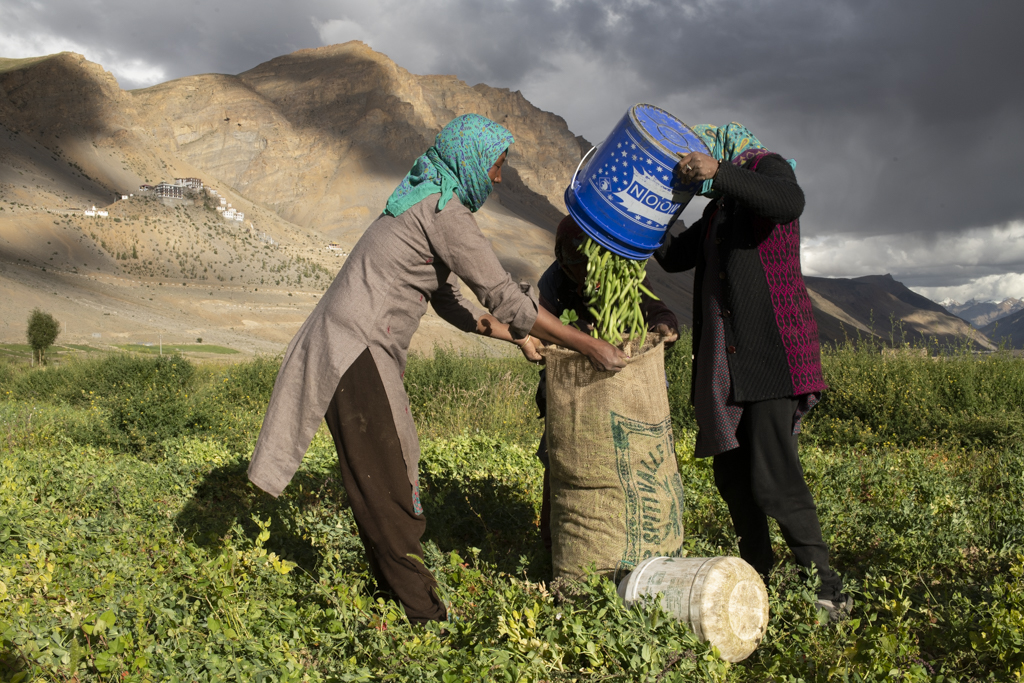
Pea harvest in Kee village | Photo: Prasenjeet Yadav

People and their land

Parts of Lahaul-Spiti and Kinnaur that fall above an elevation of 2500m are home to traditionally agro-pastoral societies. People who have combined farming and horticulture with rearing livestock as a dual source of living. Success at growing barley, a crop that can tolerate cold temperatures, allowed people to farm and hence inhabit high-altitude areas about 3,600 years ago. Agricultural land was historically held through semi-feudal arrangements – by the appointment officials who were given powers to collect taxes. Over centuries the traditional crops ranged from varieties of barley (at least four varieties that were locally known as kneu, soa, nenak, and eumo), to buckwheat (known locally as ogla and phafda or kaathu), and black peas. Horticultural produce included varieties of apricots and apples, especially in Kinnaur. In addition to helping plough farms, livestock were a source of many essentials: protein, dairy, wool and manure. The region’s remoteness and sparse population made cooperation in farming essential. Clear rules to manage water, pastures and other essential village common resources have been practiced for centuries. Farming enabled subsistence with surpluses being traded.  Such trade involved barter that was largely regional. Annual trade fairs held at Ladarcha (Spiti), Kullu and Lavi (Rampur-Bushahr) provided occasions for such exchange.

Agriculture began to transform soon after India’s independence in 1947. Himachal Pradesh witnessed land reforms in the form of four separate acts that were enacted between 1953 and 1968. In addition to a ceiling on the amount of land that could be owned individually, ownership rights of land were granted to those who had traditionally cultivated them under old semi-feudal arrangements. Land for farming was allotted to landless individuals, a landmark reform referred to as nautor. Even though there were discrepancies in land holdings and allotments, the laws ensured that almost every household owned land for agriculture. Another key factor that went on to influence farming was the setting up of cooperative societies with the aim of preventing outsiders exploiting local people because of their isolation.

Illustration: Nawang Tankhe

Lahaul

Set to the north-east of Manali across Rohtang La, Lahaul was the most remote part of this region remaining cut-off during winter. Enterprising Lahaulis set up an informal Muleteers  society in Manali in the 1950s, where they used to come in the winters to rent mules or to work as labour. This arrangement let them fix rates they would charge and prevent any exploitation. This ran successfully without any formal support or intervention until the road over the Rohtang La was built in 1967. A Kuth Cooperative Marketing Society, established in 1959, was the first registered cooperative set up by Lahaulis in Manali in order to stabilise kuth prices and explore new markets. The roots of the kuth plant, introduced in Lahaul around 1925 from Jammu and Kashmir, has medicinal values and is a non-perishable item. Kuth cultivation was a success and probably brought local Lahauli farmers their first substantial financial gain by planting 10–15% of their fields with kuth. Though kuth prices started to decline in the 1960s, this success marked the start of the region’s experiments with commercial crops which continues to this day.

Potato was first introduced into Lahaul in 1860 by Moravian missionaries. Local climatic conditions offered an advantage as it enabled Lahualis to produce off-season vegetables. In 1965, as kuth prices began to fall, a meeting was held in Keylong where a few leading farmers of Lahaul held discussions with scientists and potato growers of Punjab. Some potato growers from Jallandhar assured the purchase of their entire first crop at rates that would give farmers higher returns than kuth. All preparation for potato cultivation were completed months before the closing of the Rohtang pass in winter. In 1966 the first batch of disease-free seed potato was exported from Lahaul. This led to the formation of the Lahaul Potato Cooperative Marketing Society (or simply, Lahaul Potato Society) in 1966 with just 20 farmers. Farmers had soon realised that potato cultivation would not be financially viable without collective action to influence the market to which all the farmers were vulnerable. The Lahaul Potato Society thus set out to procure, store and market agricultural and horticultural produce of the region. It worked closely with the Central Potato Research Institute that had come up in Shimla in 1956.  These collaborations brought in knowledge of contemporary farming techniques and access to fertilisers. By the mid-1970s potato became the most prominent produce of Lahaul, with very small portions remaining under barley and buckwheat. Seed potatoes were being marketed to Gujarat, West Bengal and Maharashtra with small amounts going as far as Pakistan, Bangladesh and Sri Lanka. By 1975 the Society was not only financially viable but it also started gathering assets and venturing into other services. At its peak, the Lahaul Potato Society was India’s second largest cooperative after Amul.

When prices of potatoes fell in 1979-80 and again in 1984-85, the Society lobbied with the State government to ensure a support price for their produce. The Society supported diversification through the promotion of hops cultivation in 1973-74, and later with the introduction of green peas in 1984. Cultivation of green peas picked up in the following decade, with farmers switching from potato to peas. Since green peas was perishable, the Society’s role in its marketing remained limited to offering a support price in the case of a crisis. Farmers initially sold their produce in markets directly by taking heavy risks. In time, private buyers emerged who bought green peas directly from the farms at attractive prices. This led to the expansion of green peas cultivation across Lahaul, and to surrounding areas. Currently, Lahaulis grow newer off-season vegetables like cauliflower, purple cabbage and iceberg (lettuce) which are more profitable than green peas and are also procured by private buyers. Potatoes are still cultivated, but its acreage remains marginal. The Lahaul Potato Society remains active in the region and continues to work on the principle of pooling prices, costs and risks. In its nearly 60 years of running, the Society managed to prevent political influence in its administration with its management focusing on the broader collective benefit of Lahaulis. Over the years, farming in Lahaul transformed from being a subsistence-based livelihood to a lucrative cash-crop based occupation.

Organically grown iceberg lettuce in Lahaul | Photo: Tashi Angroop

Kinnaur

Within Kinnaur we especially focus on the Hangrang valley that falls in upper Kinnaur at elevations above 2500 m. Set around the confluence of the Spiti river and Sutlej, farming in this region faced multiple challenges due to its remoteness even though it remained accessible in winter. Subsistence based farming and livestock rearing were the mainstay in the region, alongside active trade with Tibet via the Shipki La. The Indo-China war of 1962 led to the development of infrastructure along the border, but affected trade ties that the locals traditionally had with Tibet.

Apple was first introduced in Himachal Pradesh around 1916 and soon these parts were identified for horticultural development. Kinnauras were encouraged to grow temperate fruits such as apples, cherries, apricots, pears, almonds and walnuts. Kinnaur did grow potatoes, also registering a Society in 1962 and one in 1981 for upper Kinnaur, but its cultivation almost always remained marginal. Upper Kinnaur switched to green peas as a cash crop and by the late 1980s, its production was picking up. Kinnaur’s economic switch to a cash-crop based economy, thus began to take shape from the late 1980s.

In 1988, about 70% of cultivable land in Kinnaur was still under traditional crops such as buckwheat and barley, with green peas providing cash. Hill slopes had begun to be occupied by apple, which took up to 15 years to bear marketable fruits. By the mid-1990s, apple became a prominent source of livelihood. With the adoption of apple, came newer techniques of orchard management and the introduction of synthetic fertilisers and pesticides. Today, green peas cultivation remains restricted in pockets as apple plantations are fast replacing them. Farming in upper Kinnaur has almost completely switched to horticultural produce, with a rising demand for land that can be brought under apple production. This boom in apple production has become possible because of the warming of temperatures due to which the apple belt appears to have migrated higher to this cold and dry mountain zone. It is a rare example of how changing climate may have created opportunities for the community, while also creating several vulnerabilities.

Apples of Himachal Pradesh | Photo: Wikimedia Commons

Spiti

Set between Lahaul to one side and Kinnaur to the other, Spiti is probably the highest and coldest part of this region. Though technically Spiti remains accessible in winter, it was the region farthest from any large town of prominence. This reflects in the fact that while Spiti too is moving from subsistence crops to cash crops, its transition is the most gradual.

The two prominent crops of this valley were barley and black peas. Spiti too experimented with potato and set up a Society in 1977, but potato production did not pick up as did in Lahaul. Many Spitian farmers felt that this was likely because the harvest of potatoes overlapped with that of barley, which was a more essential crop for subsistence. Spiti eventually began to experiment with green peas, and in the 1990s Spitian farmers traveled to Delhi for the sale of their produce. The production of green peas picked up significantly from the 2000s, when private buyers started to purchase their produce from their farms. Around 1990, barley was sown on 55% of the arable land, while peas occupied around 30%. By 2009 barley had fallen to 43% while green peas had risen to 51%, mainly by reducing cultivation of other marginal crops like black peas, wheat, masur dal, rajma and mustard that were cultivated for personal consumption. Today green peas are being cultivated in more than 75% of the fields, and most locals’ cultivating barley occasionally in a few years to fulfil household demand. The success of apple in the villages closer to Kinnaur has excited farmers to also start experimenting with apple plantation in the hope that apple orchards may eventually move even higher than Kinnaur. In 2023, a few farmers from Kee village succeeded in growing sample apples at an elevation of nearly 4000m, which has further increased hopes.

While Spiti is following a similar trajectory to Lahaul and Kinnaur in switching to cash crops, there is one aspect in which it still remains traditional. While Lahaul and Kinnaur have adopted the use of synthetic fertilisers and pesticides, Spiti has largely resisted this switch. While a decreasing interest in livestock rearing may have led farmers of Lahaul and Kinnaur with little choice, livestock rearing persists in Spiti and most farmers are skeptical of introducing synthetic supplements. Farmers buy organic livestock manure from as far as Changthang in Ladakh and are also buying poultry manure from the plains.

Apple orchards on the hill slopes of Kinnaur | Photo: Wikimedia Commons

Agriculture – a story of constant change

Agriculture in the high mountains of Himachal Pradesh has evolved continuously. Improving access and connectivity made it possible for farmers to take their produce to markets. With connectivity improving over the years, farmers have taken risks with growing perishable cash crops. Sometimes these risks also bring major losses, as they did in 2023 when unforeseen weather events caused widescale damage to infrastructure affecting transportation. However, in regular years the financial returns can be attractive. The advent of technology has further led to the adoption of locally relevant technical solutions. Farmers have diversified cropping and have been open to experiments, which have brought them financial rewards. They have balanced between selling their produce to cooperatives and private buyers. Rising incomes have let them broaden their aspirations, with younger generation getting opportunities for better education and greater exposure. Access to cash has also allowed farmers to hire labour, which was previously not possible. Many parts of Lahaul are now experimenting with various forms of contract farming where the profits are shared between the landowners and the labour who manage them. Remoteness may have brought out the dynamism of the farmers of Lahaul-Spiti and Kinnaur. The success of early experiments with cash crops by a handful of farmers paved the way for the entire region. Locals were aware of the risks they were exposed to on account of their remoteness, and they countered this challenge by setting up institutions and arrangements that distributed both the risks and rewards. In the process, cultivation of traditional crops has declined and is now limited to very small pockets.

Unlike several other Himalayan regions where farming is in severe decline, farming retains its significance in the region. With nearly all households of the region involved in agriculture, it forms a key source of income. And with almost all households owning land parcels on account of land reforms, almost every family has benefited financially, even though the benefits may vary with the size of land holding. This reflects in the fact that the districts of Kinnaur and Lahaul-Spiti rank second and third in terms of per capita incomes among the districts of Himachal Pradesh, and are well above the average per capita income of the country. There is a continuous demand for land to be brought under cultivation through the extension of nautor rules. A lot of this commercial success has also been possible because of the local climate, which has allowed these regions to supply off-season produce that fetch a premium. But with rising uncertainty in weather patterns, farmers and farming stand increasingly exposed to greater risks even as people’s relation with their land remains strong.

1024 683 Multiple Authors
Shangdong to Stupa
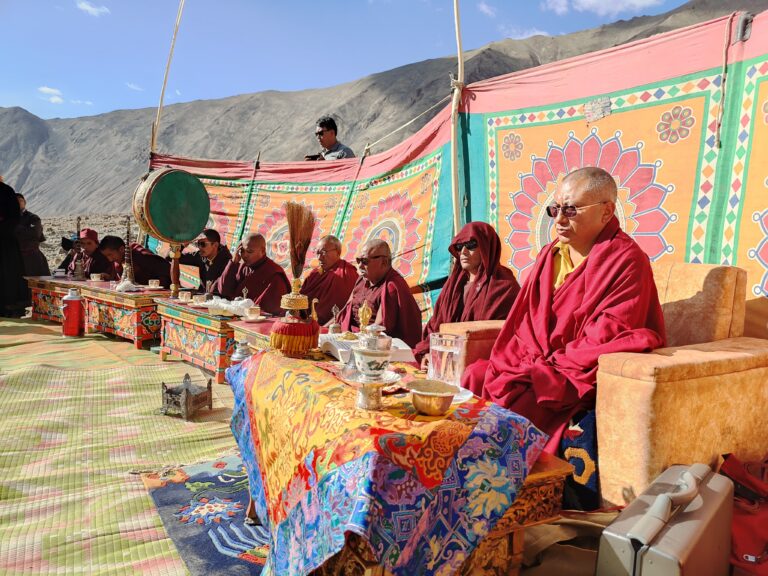
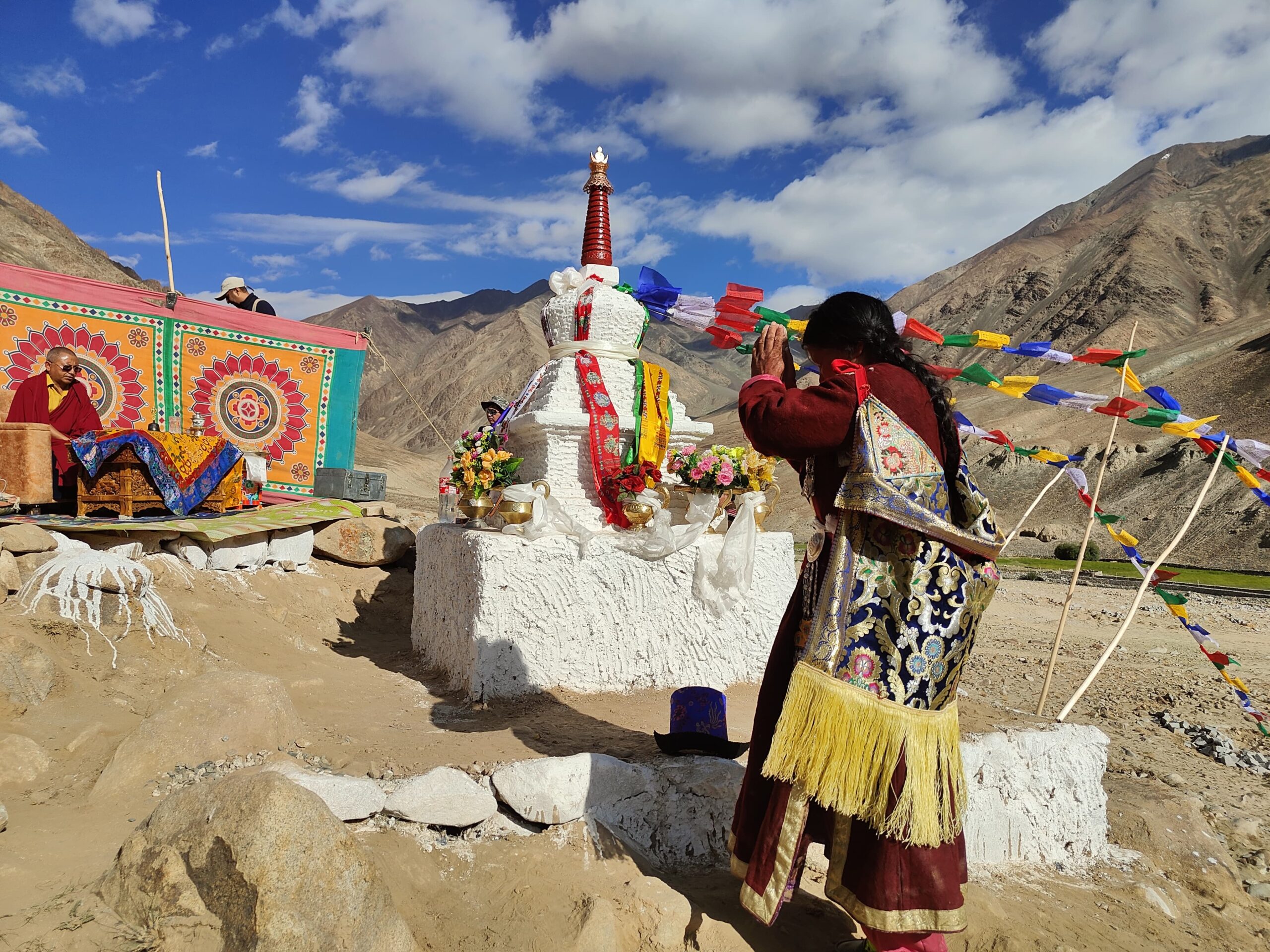
Consecration ceremony of the newly constructed Stupa at Tharuk, July 2024

Shangdong to Stupa

Two years ago, during a winter vacation, I took my four-year-old daughter, Gyanzin Yeeyong Wangmo, to a Shangdong, an ancient wolf trap. I wanted to share the stories of my childhood and the experiences of our village, where people once relied heavily
on livestock for their livelihood. The Shangdong was a method used to control the wolf population and protect domestic animals from these predators. I vividly remember a day when, on my way to school, I heard a commotion—dogs barking and
people shouting. Drawn by curiosity, I arrived at the scene to find a wolf trapped and being stoned by the villagers. The reactions were mixed: some were relieved, while others, particularly the elderly, chanted “OM MANI PADME HUM,” praying for the
wolf’s soul. This ritual reflected a deep-seated ambivalence—people felt compelled to kill the wolf, but not without sorrow.

​Sharing these stories with Gyanzin made me reflect on the complex relationship between our community and wildlife. It also reminded me of the “Shangdong to Stupa” project initiated by the Nature Conservation Foundation (NCF) in 2016. The project aimed to replace these wolf traps with stupas, symbolizing a shift from harm to healing and from fear to coexistence. The first stupa was built in Chushul, and since then, six more have been constructed across Ladakh.​

​The site I visited with Gyanzin seemed a fitting location for another stupa. I reached out to Karma Sonam, the field coordinator at NCF, to discuss the possibility of incorporating this site into the project. Despite recent incidents of wolves preying on livestock in the valley, including losses within our own family, we believed that fostering a more positive attitude toward wildlife was crucial.

Consecration ceremony of the newly constructed Stupa at Tharuk, July 2024

Consecration ceremony of the newly constructed Stupa at Tharuk, July 2024

On July 20, 2024, with the collective efforts of the NCF and the villagers of Tharuk, the seventh stupa was completed near a traditional Shangdong in the Serkungchan valley. This effort, part of the “Shangdong to Stupa” project, represents a significant move towards wildlife conservation and a renewed respect for nature. The construction began on July 14, 2024, with the support of Karma Sonam, the NCF team, skilled stupa makers from Nubra, and the Tharuk villagers. The stupa was completed on July 19 and consecrated on July 20 by His Eminence Bakula Rangdol Nima Rinpoche, Khenpo Shedrup, and monks from Shachukul Monastery.

His Eminence Bakula Rangdol Nima Rinpoche, who had blessed the first stupa at Chushul in 2018, encouraged the community to live in harmony with wildlife and to cherish their natural surroundings . He commended the efforts of NCF and the Tharuk villagers, emphasizing the importance of this project as a model for other regions in Ladakh and the Himalayas, where similar traditional practices still persist.

The transformation from Shangdong to Stupa symbolizes a journey of forgiveness and a commitment to conservation. It reflects a growing awareness and respect for the delicate balance of our ecosystem, where both humans and wildlife can coexist peacefully. Through this initiative, we hope to inspire other communities to embrace compassionate and sustainable practices, ensuring a harmonious future for all beings.

2560 1920 Dr. Stanzin Namgial