Wool

Changthang – An Oasis of Himalayan Fiber
Photo: Sherab Lobzang

Changthang – An Oasis of Himalayan Fiber

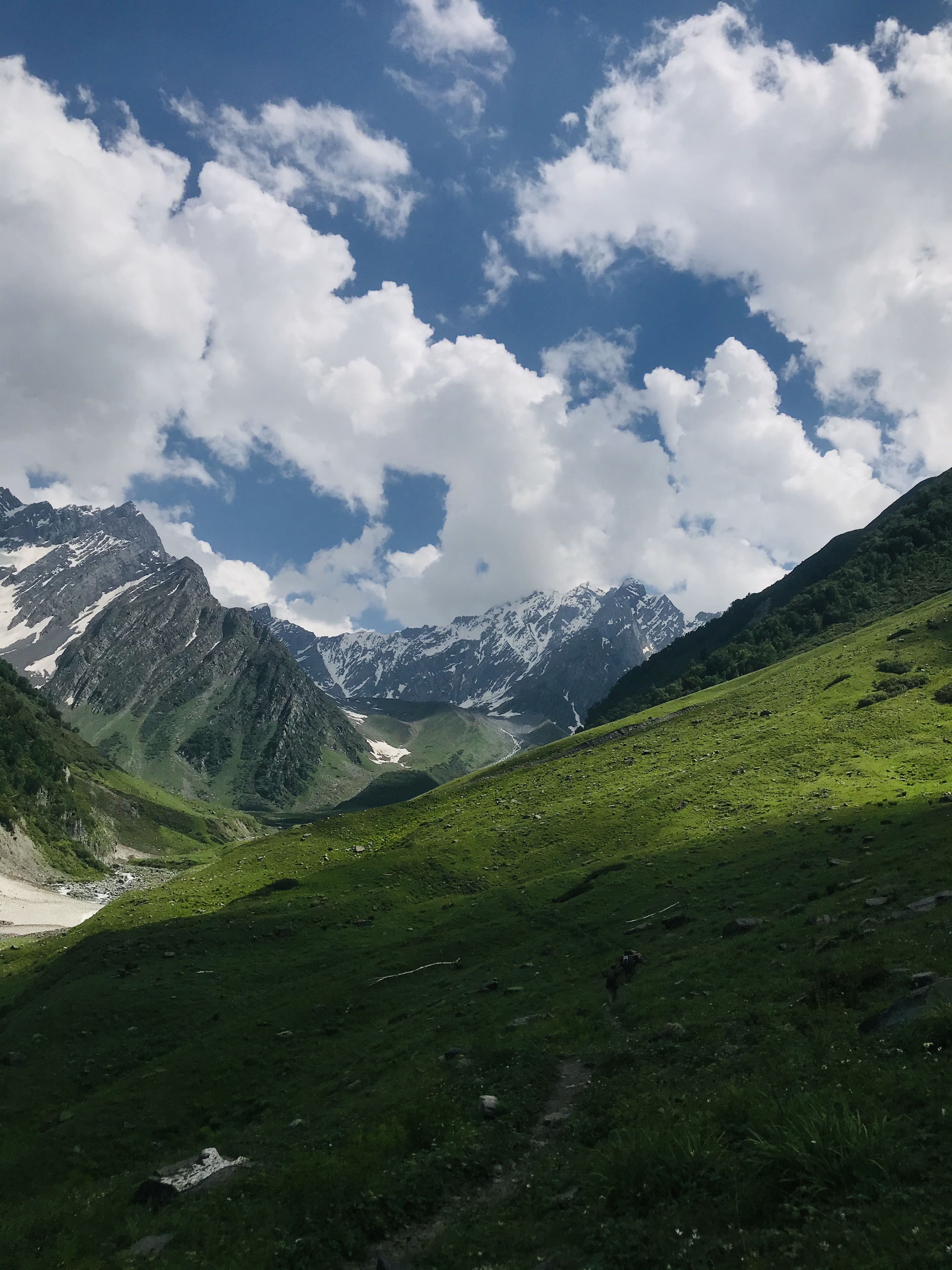
Nestled amid the lofty Trans-himalayan mountains, Changthang is a unique terrain where climate and topography play a crucial role in the sustenance of local communities. The region consists of wide wetlands and giant mountains which offer indispensable ecosystem services and safeguard our water and food security. Many wetlands in Changthang are located at a higher altitude and are fed by glaciers and snow from the surrounding mountains. The high-altitude wetlands in my region contribute significantly to the downstream landscape productivity and form a unique ecosystem for floral and faunal diversity.

The nomadic pastoral communities composed of distinct groups located at Rupsho, Kharnak and Korzokh rear a variety of livestock such as goat (rama), sheep (luk), horses (ta), yaks, and donkeys (bhungpa) which supports them in all aspects of their lives. The Changpa shepherds are skillful in tending their herds; navigating steppe grasslands, accessing fertile pastures, breeding resilient animals, caring for livestock, and preventing diseases. When there’s less grass in the pastures or the livestock are not able to graze due to excessive snowfall, they provide the cattle with fodder they have stocked months before to avoid weakness and starvation. It is precisely the efforts of the local herders and the nutritious resources in the cold arid land that the livestock we breed gives the finest fiber.
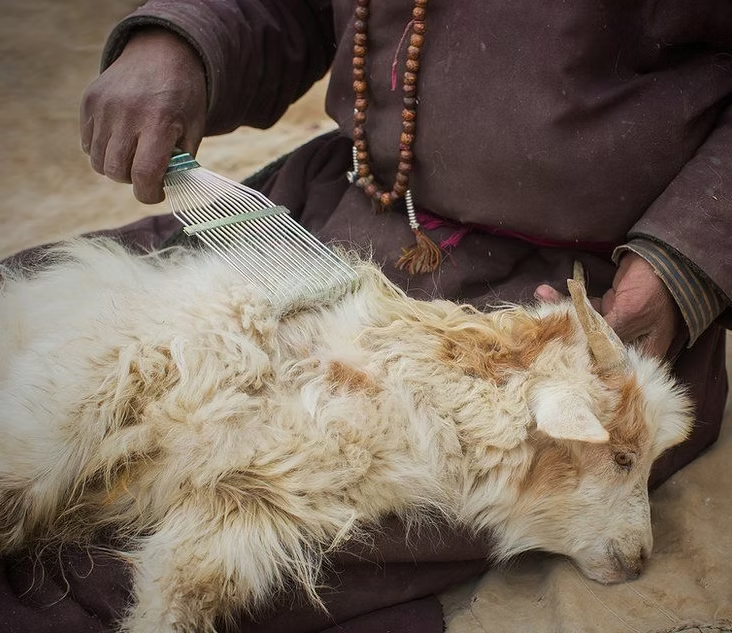
Pashmina Combing | Photo: Andrew Newey (cnn.com)

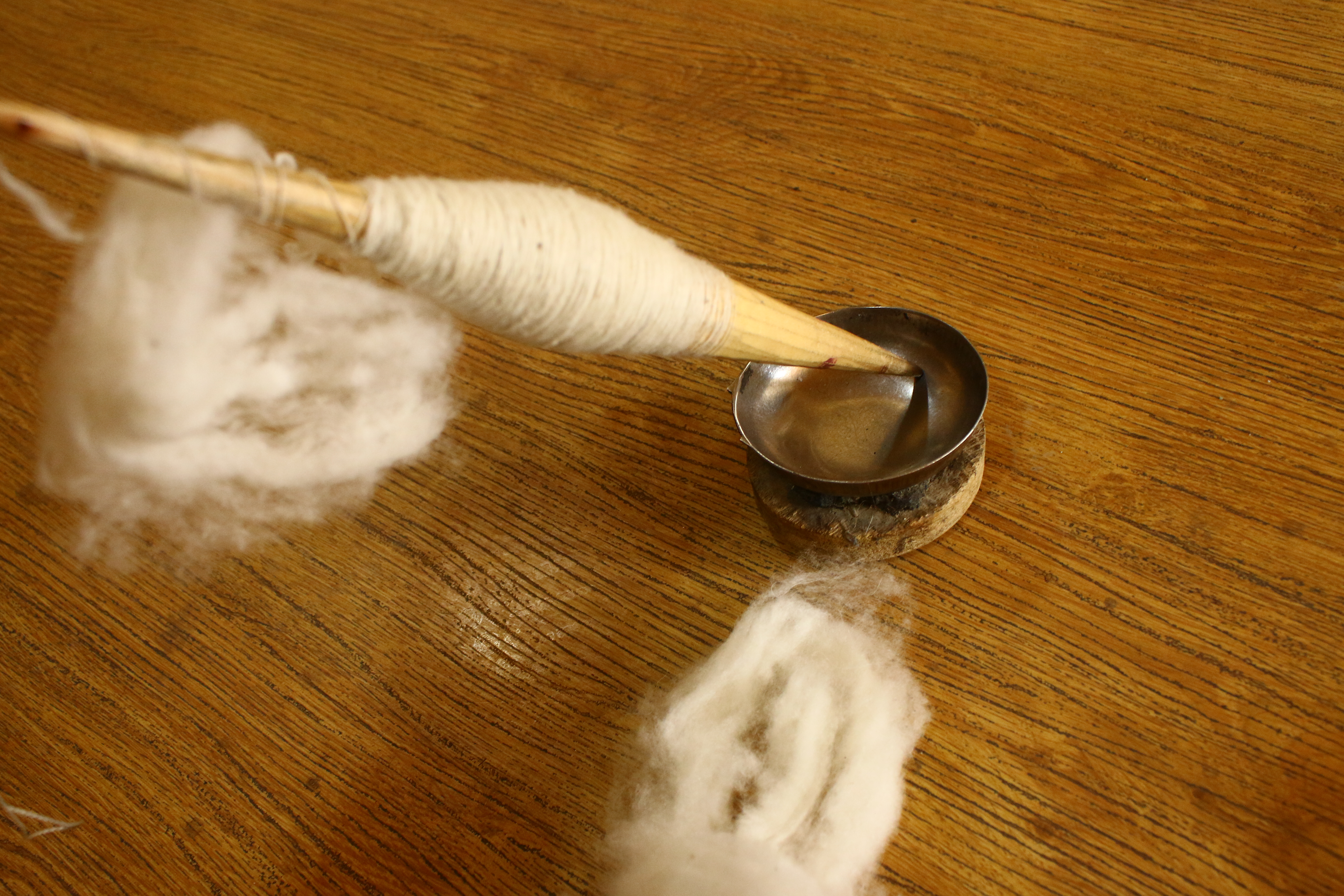
Ladakh has a highly diverse textile tradition that reflects its physical, socio-cultural, and environmental features. The herd provides different kinds of fiber: Khullu or Sitpa from Yak wool, Ral from Goat hair or Sheep wool, and Lena (Pashmina) from the underbelly of Changthangi goat. The wool is sheared from the livestock around early Spring or before lambing season using a wooden/metallic comb. It takes about 2-3 hours to shear wool from a single sheep and since it requires physical strength to hold a sheep, goat or yak to shear, it is usually men who do the work while women clean and sort the wool to remove any impurities. Once the wool is collected, it is laid on the sheet and beaten with a wooden stick to remove dust, dry grasses, and other impurities. It is then washed, dried, and then hand spun with a traditional spindle called “Phang” – thin yarns are made for weaving while slightly thicker and knottier yarns can be used for knitting. From elaborately patterned garments for the nobility to simple home-spun garments from local fibers, a range of garments are processed and procured in Changthang. The local fibers found in Changthang are used for various purposes; Yak wool and goat/sheep wool are primarily used for self-consumption while Pashmina (Lena) is often traded. The high altitude and the intense cold of Changthang serve a good purpose for the growth of the fine luxury fiber Pashmina. Due to its softness, elegance, and warmth, it is one of the most coveted fibers and fetches the highest price.
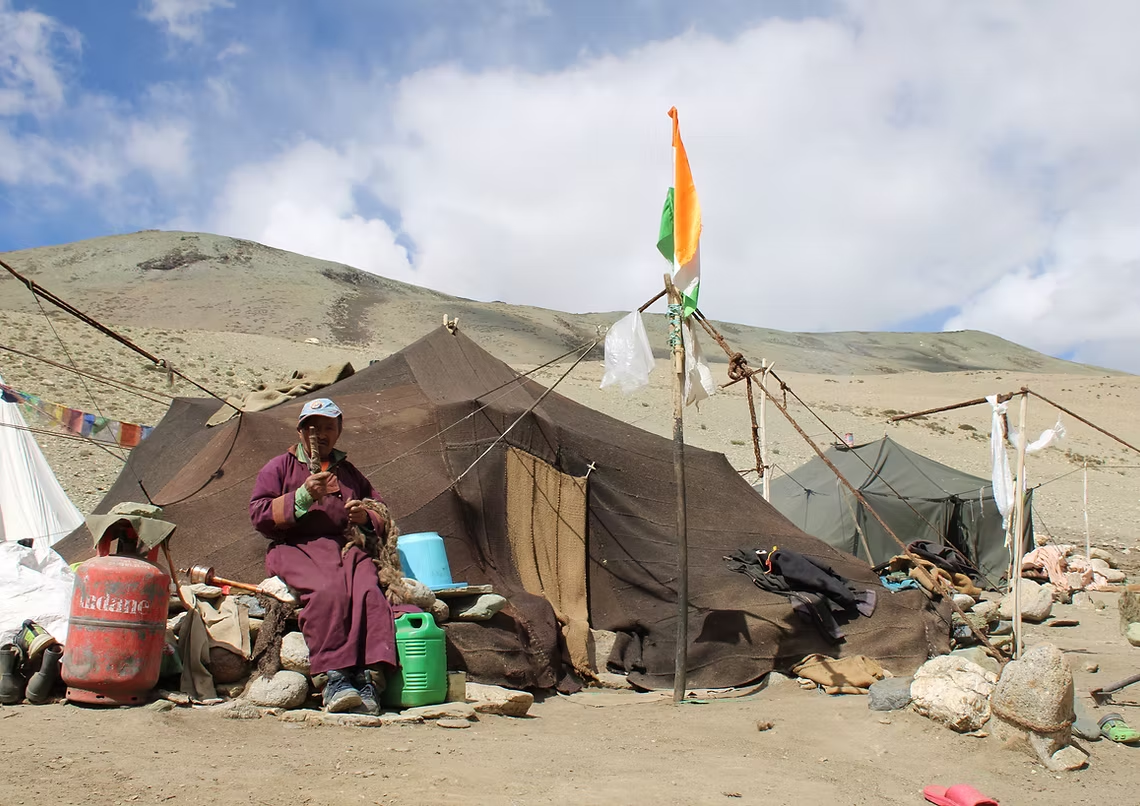
Rebo and landscape of Changthang

Weaving is an ancient craft and Changpas are reminiscent of the time when our ancestors wore clothes made up of animal skin. Due to freezing weather, animal skins are still used for various garments, quilts, and mattresses. The rich tradition of textiles came into being when our ancestors learned how to spin, make yarn, and weave. Wool and fiber are an integral part of the nomadic culture as Changpas reside in the traditional tents called Rebo made of Sitpa (Yak wool). Rebos are very functional and aptly suited for the nomadic lifestyle – as the nomads migrate in search of better pastures for their herd, the use of Rebo comes in handy for them.

“Rebos are very functional and aptly suited for the nomadic lifestyle – as the nomads migrate in search of better pastures for their herd, the use of Rebo comes in handy for them.”

Making Rebos are extremely labor-intensive as it is handspun and handwoven and a group of nomads makes it collectively. Rebos are also precious family assets and are passed down from one generation to another but these days the use of canvas tents is also becoming popular. Handcrafting has great significance in Changpa tradition, it is a skill that everyone inherits and proves useful in resource-starved land like ours. Weaving and knitting are so economical and wholly self-sufficient – we knit sweaters, socks, hats, and mufflers, and weave mattresses, quilts, saddles, and even containers for foodstuffs. Imagine having to buy all these!

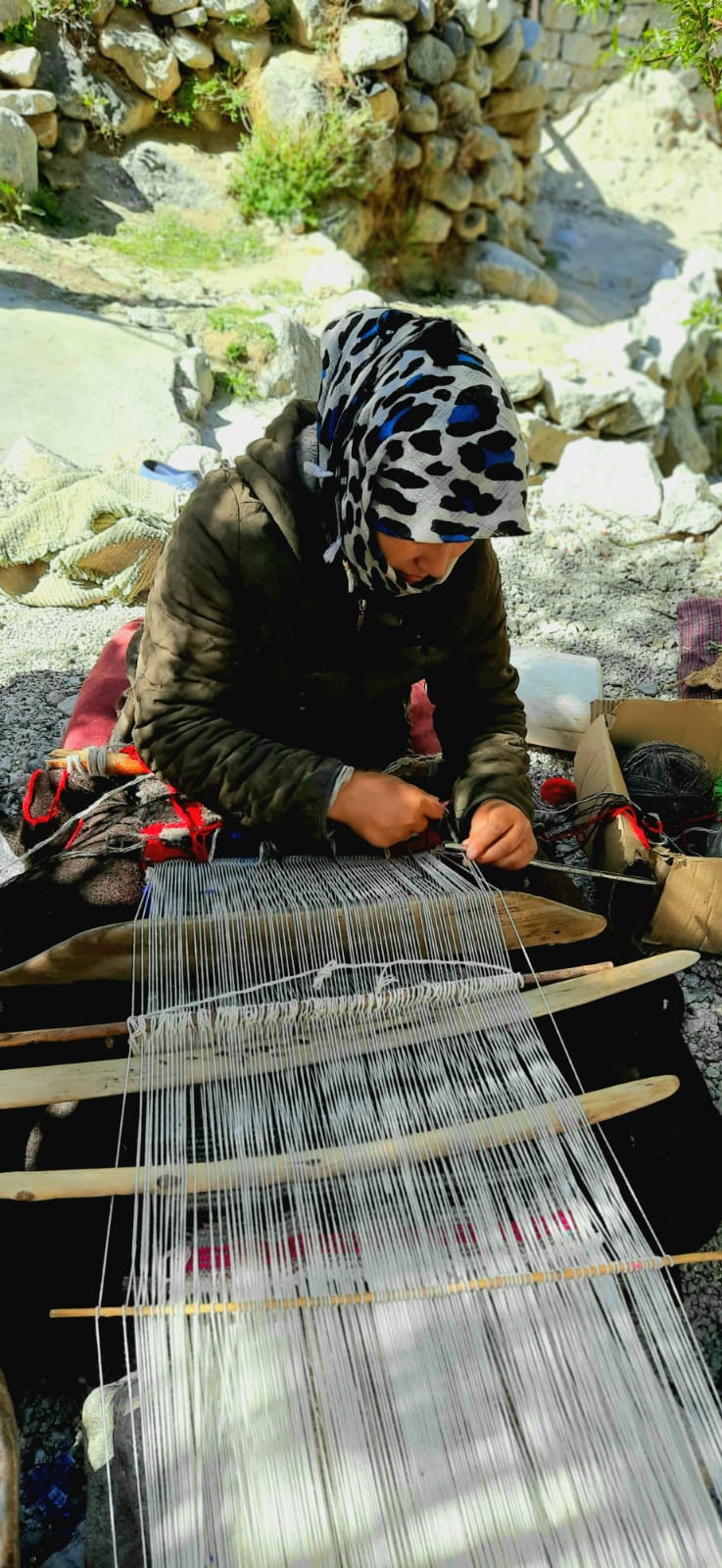
Traditional weaving in Changthang

Even the traditional clothes we wear Gos made up of fabric called Snambus. All of which are handwoven from scratch! When I think about the olden tradition of Changpas – whether it is sustainable grazing of the livestock, food habits, lifestyle, or the practices of spinning, and weaving I realize how self-sufficient and environment-friendly the whole system is. However, the practices around local fiber and cloth making are undergoing changes. Machine-made fabrics and ready-made clothes are easily procurable from the markets and one doesn’t necessarily have to make everything from scratch like in olden times. Although a great variety of wool and fibers are found in Changthang, there’s relatively little expertise when it comes to processing these fibers and adding value to them. Kashmiri artisans are way more known for their skills in handicrafts and if this gap can be fulfilled locally, the fiber value chain will be complete in Changthang itself.
1770 1048 Padma Dolker
Tepang – the Pride of Kinnaur
Kinnauri Tepang | Photo: Anuradha Miyan

Tepang – the Pride of Kinnaur

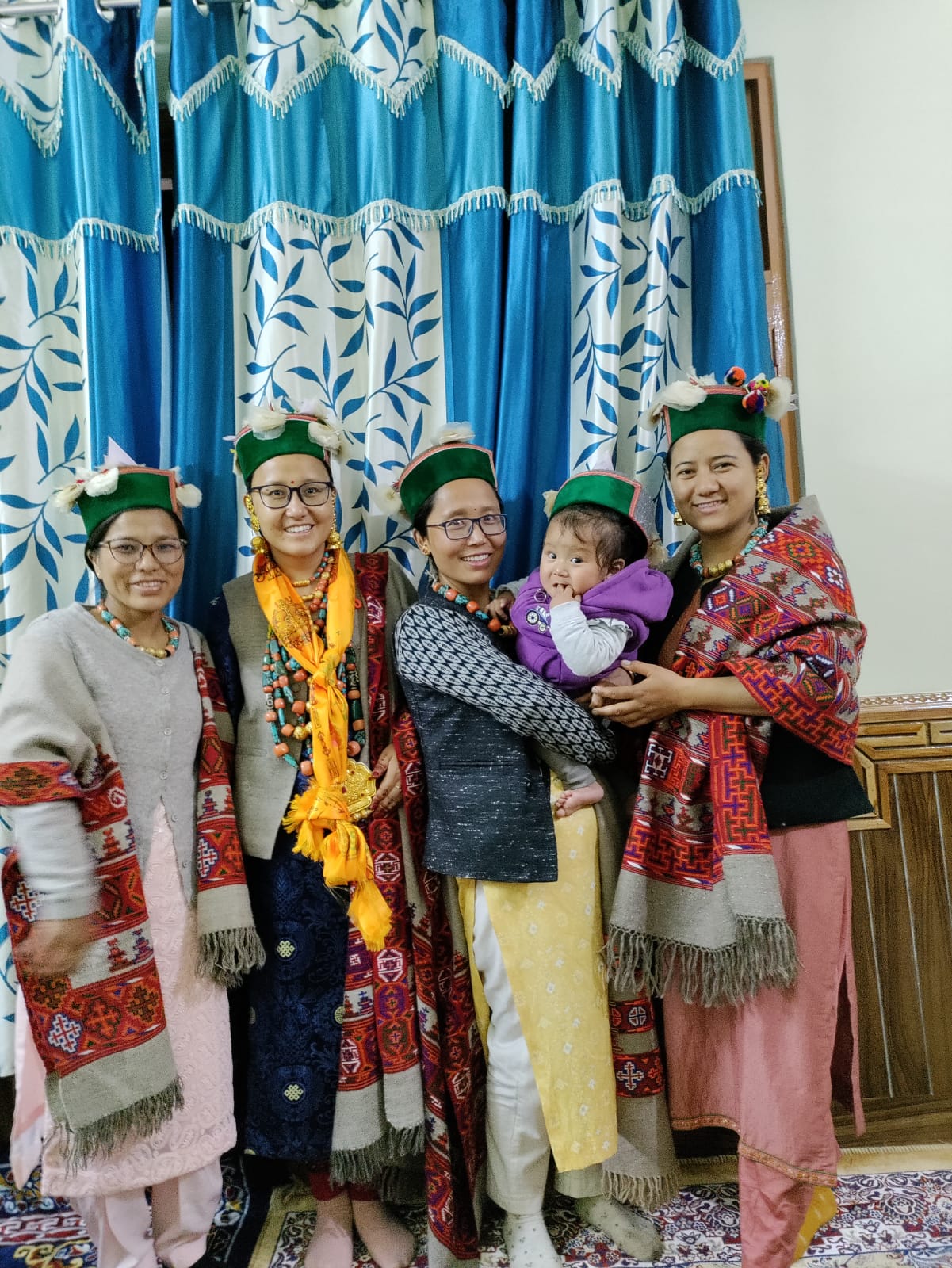
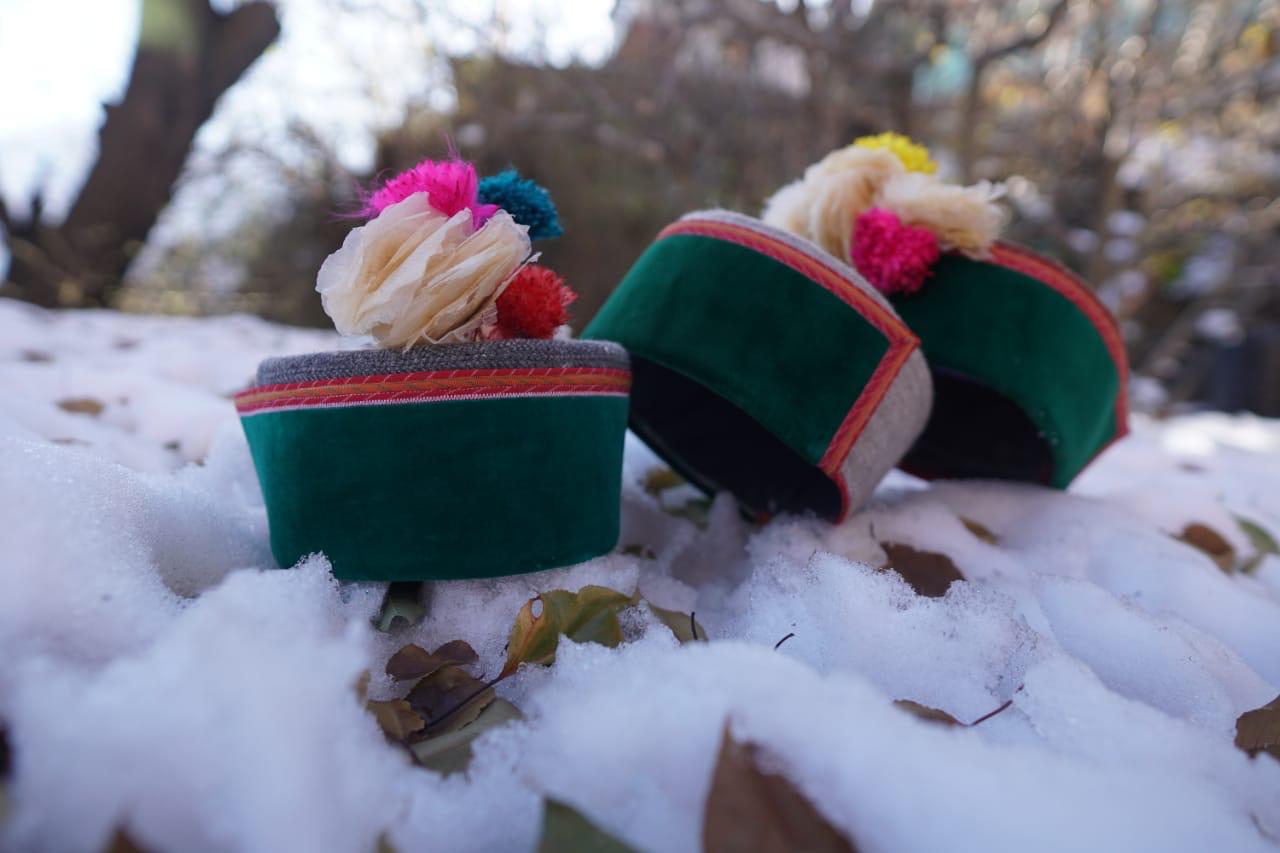
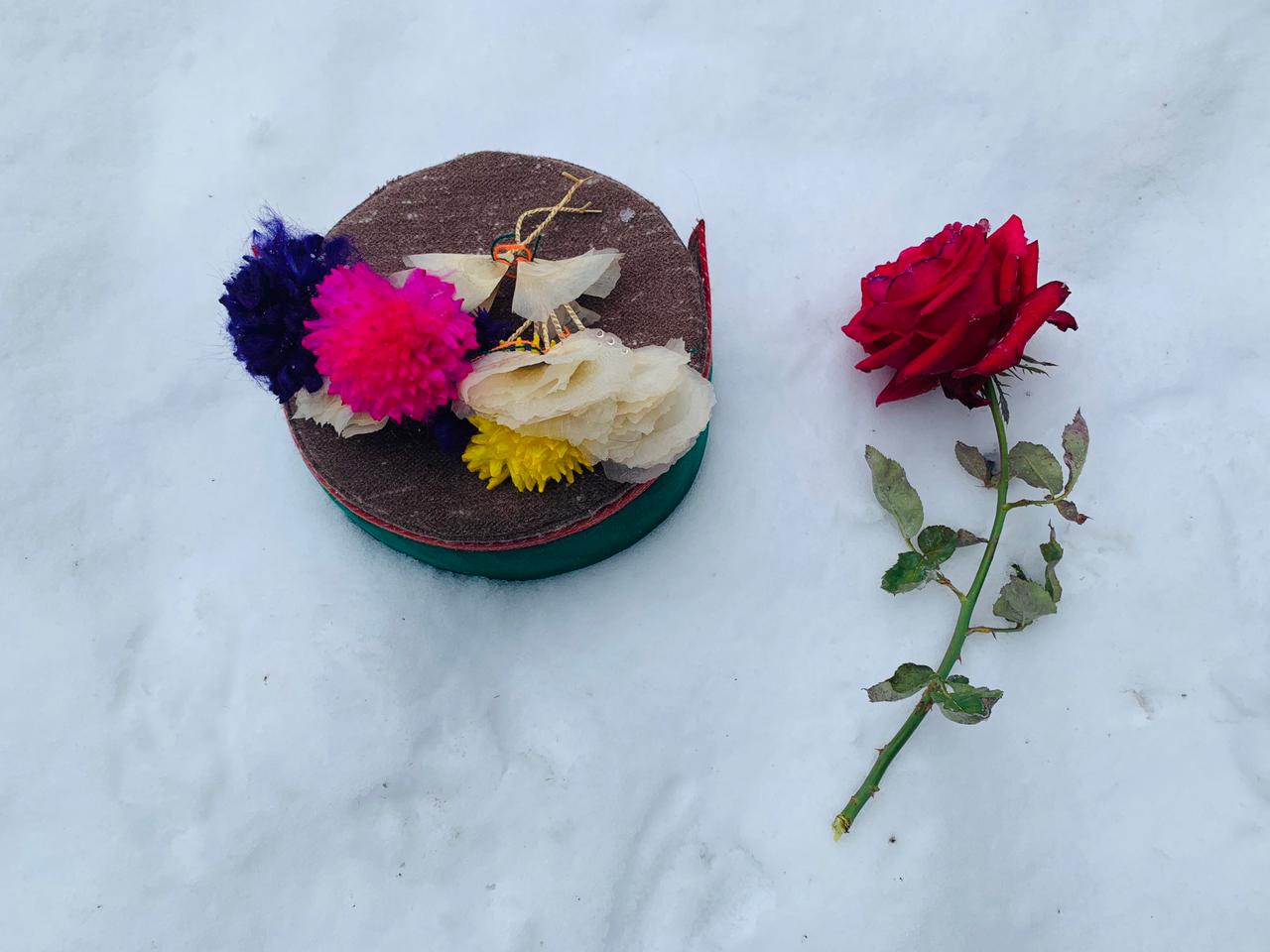
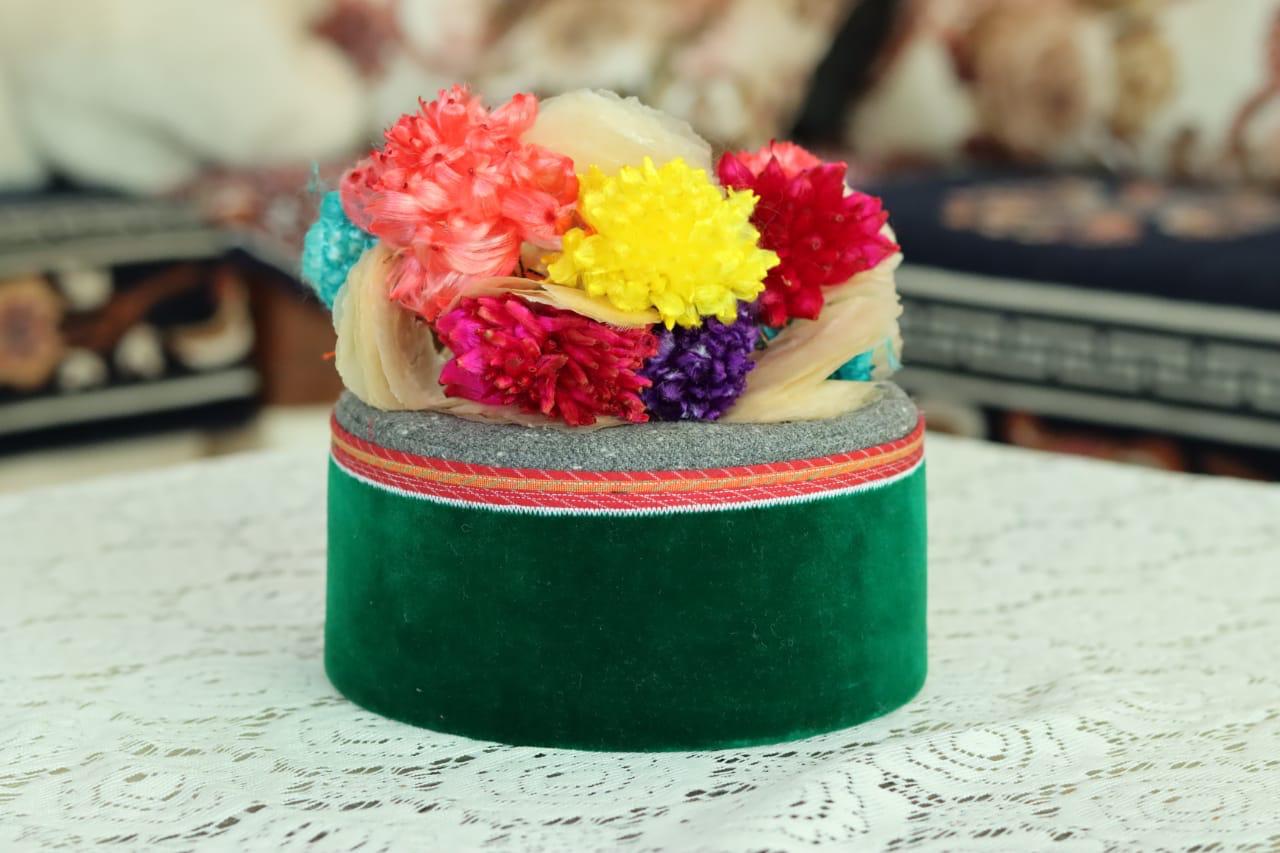
Nestled amid beautiful gigantic mountain ranges, Kinnaur is one of the most picturesque districts of Himachal Pradesh. Owing to its geographical proximity to Spiti and having been historically part of Rampur Bushahr, Kinnaur inhibits the unique cultural amalgamation of Buddhists and Hindus. One of the defining features of people living in Kinnaur is their vibrant traditional dress and the unmistakable headwear Kinnauri Topi which forms an integral part of the whole attire. The headwear is colloquially called “Tepang” or “Khunnu Tiwi” and is different from the Himachali Topis of Shimla, Kangra, Kullu, and Chamba. The design variations and the aesthetics of this headwear represent different parts of Himachal where it is worn. The Bushehri (Rampur region) cap is plain maroon in color with the same design as the Kinnauri topi, the Kulluvi (Kullu-Manali) topis have vibrant multicolored stripes, and the Kinnauri Topi has unique green velvet color and the ones worn in Kangra is a deep saffron color.

Made up of local wool yarn with velvet green stripe, it is adorned with beautiful wildflowers among which the bright white colored flower seed called “Chamakha” ( oroxyllum Indicum) is preferred among locals. The flower is not indigenous to the region and is mostly found in the lower Himachal region like Mandi, Palampur, Bilaspur, Nalagarh, etc. The usage of Chamakha flower seeds became popular in Kinnaur because of the flower’s resilient qualities – once plucked from its pod, the flower seeds don’t get spoiled and can last for years without getting dried.

Kinnauri Tepang

The Chamakha seeds are split open from their’s pod and a bundle of seeds called “Dalang” is strung together on a green, and red thread and is fixed on the Tepang. Apart from that, the cap is also accessorized with peacock feathers, marigold flowers, or the dried petals of the rare Himalayan Brahma Kamal (Lotus). However, the use of Chamakha flower seeds as well as the Brahma Kamal is decreasing as these flowers are endangered.

Kinnauri Tepang forms an integral part of their identity |  Photo: Tanzin Palkit

In the olden days, the Tepangs were domestically made at home by all households but the weaving tradition has become less popular nowadays and it is woven only in a few cluster villages like Leo, other parts of Hangrang valley, Pooh and Reckong Peo. Unlike Kinnauri Shawl and other traditional dresses, the handweaving tradition of Tephang disappeared among general people and is now kept alive among a handful of skilled artisans and weavers. In recent years, machine-made Topis are also getting more popular in Looms and handicraft centers in Lower Himachal. However, the difference between handwoven and machine-made topis is so stark.

There’s a huge difference in terms of material, quality, technique, appeal,  garment feel, and usability. The handwoven Topis, although takes a long time to make and is more labor intensive, the overall usage and desirability isare higher due to warmth and durability. A topi once woven can last for years till its natural wear and tear, while the usage of machine-made topis is more popular among non-locals and tourists for it is also treated as a souvenir. The native Kinnauri people always prefer the handwoven ones for it has far more value than their materiality.

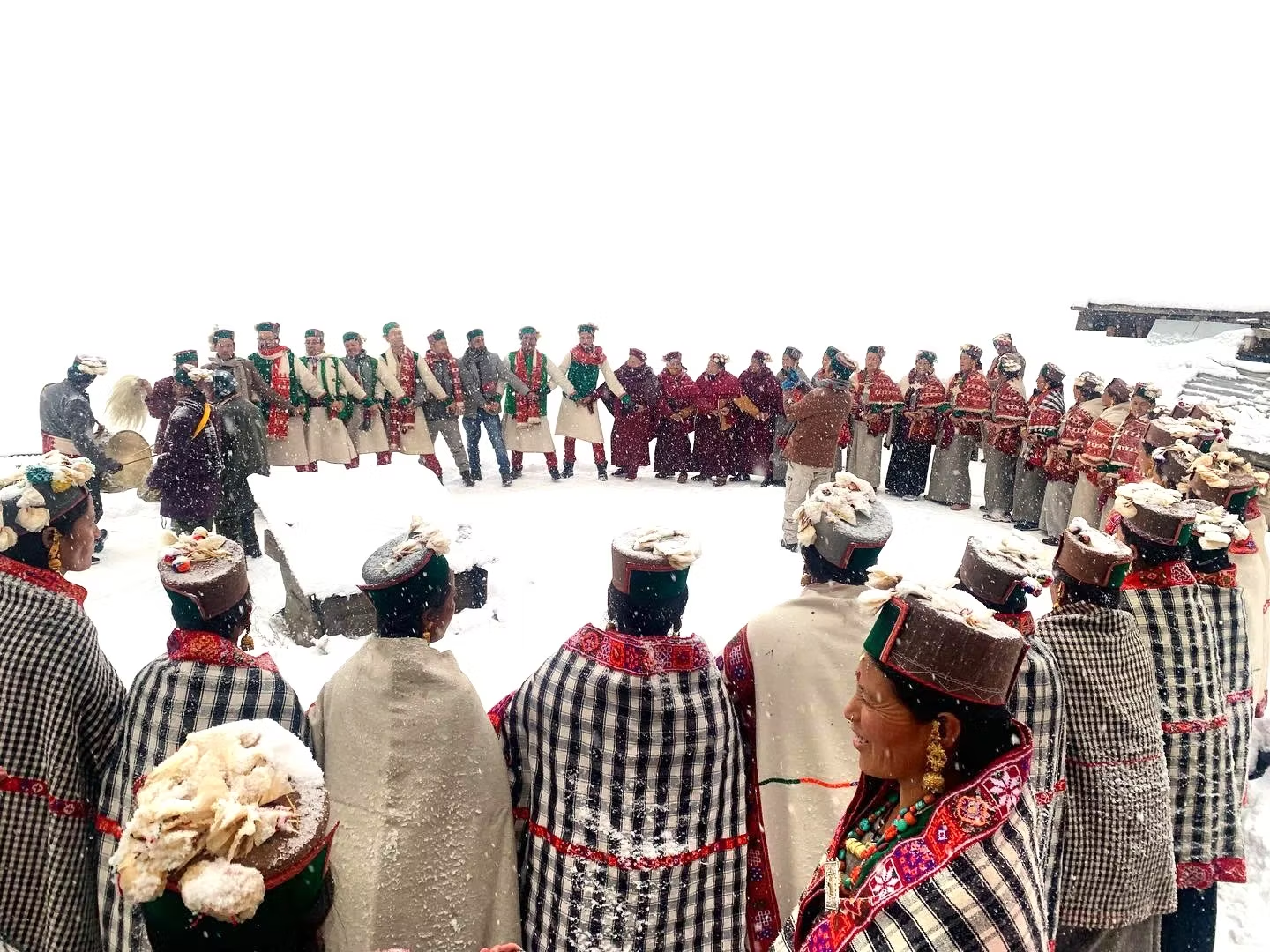
The use of Tepang is ubiquitous across all villages of Kinnaur and locals people take great pride in wearing it. The local communities lovingly refer to it as their crown, symbolizing communal pride and prestige, and they believe it upholds their indigenous cultural values. It is worn both by men and women on a daily basis and during festivals, ceremonies and occasions, people heap it with all kinds of floral adornments. There’s also a tradition of gifting Tepangs to one’s special guest and during weddings as ceremonial gifts. The use of Tepang has percolated so deeply in the collective consciousness of Kinnauris that it not only holds significant cultural value but is also seen as a defining part of their identity.

“One of the defining features of people living in Kinnaur is their vibrant traditional dress and the unmistakable headwear Kinnauri Topi which forms an integral part of the whole attire.”

1280 960 Tanzin Palkit Negi
Spiti’s Handwoven Traditional Clothes

Spiti’s Handwoven Traditional Clothes

Clothes and identity are closely related: traditional clothes of a region reveal a lot about its geography, physical environment, climatic conditions, and cultural practices. The high altitude and cold weather conditions in Spiti have led to distinct clothing attributes of its people. Since most of the families are agro-pastoralists, the livestock people breed gives different kinds of wool like yak wool, sheep wool, and goat and that forms the natural source for most of the attire worn by the people. In the olden times, people wove handcrafted attires and ornaments from scratch but with increasing access to market and trade, wide varieties of fabrics and garments are available and the clothes designs are adapted with time. Let us share about some of the traditional clothes of the region:


Spitian Ghoey | Photo: Rabhi Kunga

1. Reygoi or Ghoey
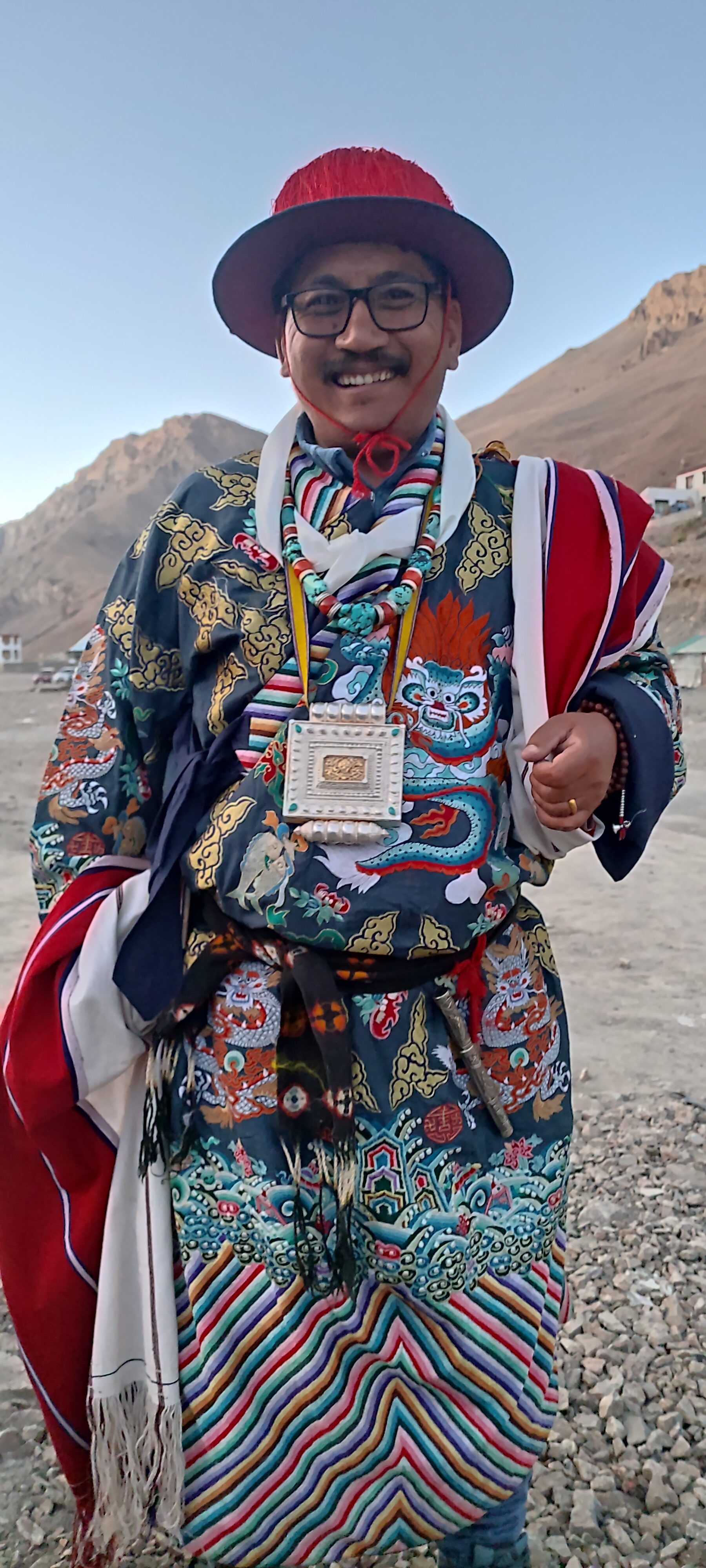
Ghoey is a thick full-length robe worn by Spitian men. In the olden days, men would wear Ghoey made up of woolen material but with time, robes of thin fabric like cotton also became popular which is called Rey (thin cloth) ghoey (to be worn). The style of the robe resembles the Mongolian robe which overlaps on the right side and is buttoned from the left shoulder. Men usually wear a thin shirt or plain trousers to pair with it and the robe is finally secured by a wide belt around the waist made up of woven threads called Keera. These robes come in neutral shades of brown, maroon, dark blue, and black. With changing times, access to fabrics like silk and velvet has increased so a Ghoey can also be made up of silk, velvet, and other multicolored synthetic fabrics.

Spitian traditional dress: Sulma, Tsadar and Reygoi | Photo: Radbhi Kunga

2. Sulma
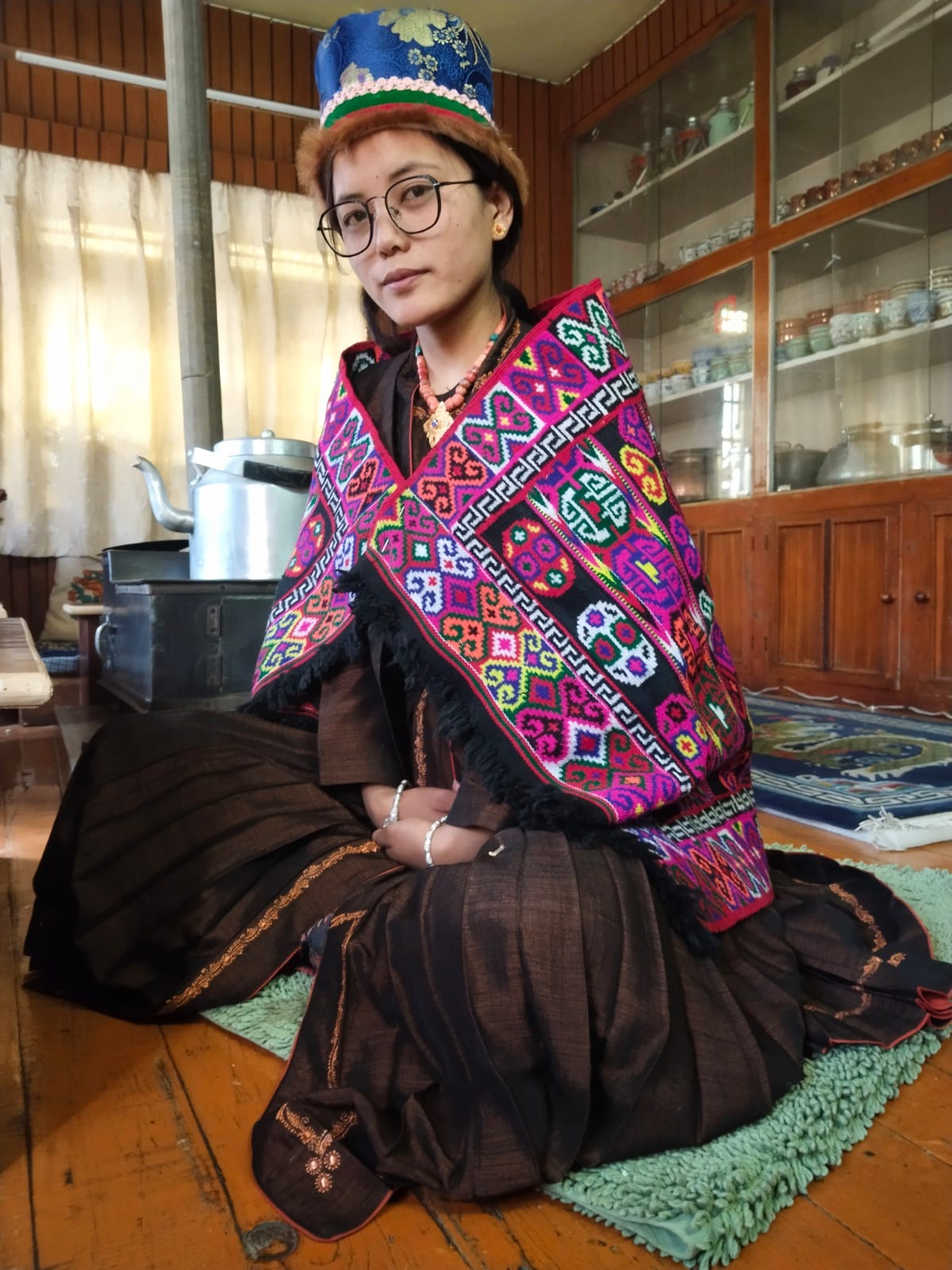
Sulma is a long voluminous traditional gown worn by Spitian women. It has a round neck and long sleeves. The dress flares downwards with multiple pleats which is why it is called Sulma which means; to gather, to fold, to fold into pleats. A thin undershirt is worn underneath and the Sulma is tied with a waist belt called Keera. The dress is fairly wide around the leg, making it comfortable for walking or working in the fields.

Spitian men wearing Reygoi. Photo: Rabhi Kunga

3. Bhal Sutan
Sutan is woolen or cotton trousers worn both by men and women in Spiti. It is made up of thick woolen fabric called “Nimpu” procured from the local sheep hair. The fabric is woven on a backstrap loom or foot loom, which can then be stitched into trousers of the desired style. Nimpu Sutan or bhal Sutan (woolen pants) is primarily worn under Sulma by women and under Reygoi by men. With changing times, Spitian women popularly wear it with a matching Salwaar or Suit.

4. Lokpa
Lokpa is a thick cloak-like garment worn by women. It is hand-strewn with sheep skin turned upside down with elaborate woven designs on the front. The local name Lokpa (meaning: to turn over) is reflective of the intricate process with which a seamstress makes it. It is extremely warm and is perfect for harsh weather conditions. The thickness of the garment also cushions the wearer’s back while carrying a heavy load on the back like firewood or fodder for livestock. Sometimes, newborn babies or even lamb kids are wrapped in the garment to provide warmth and comfort.

5. Lingzey
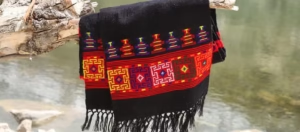
Lingzey is a traditional handwoven shawl worn by women on the back. It is one of the most vibrant and elegantly designed shawls woven by women on the loom and comes in a wide variety of colors and patterns. The base color can be red, white, or black where elaborate symbolic geometrical designs are handwoven. Motifs inspired by nature are common like local flora or fauna or religious motifs like stupa and swastika (to protect the wearer from evil spirits) or motifs of precious stones. Lingzey is worn during special occasions like marriage, ceremonies, festivals, rituals, or while visiting Rinpoches.

6. Tsadar
Tsadar is a plain woolen shawl worn by women on a daily basis. It is thin, light weighted compared to Lokpa, and is woven on a handloom called Khaddi. It is made up of goat or sheep wool and is usually found in toned neutral colors like beige, grey, off -white and black. It is the most functional piece of clothing and can be worn over Sulma or even drape babies in it. In the olden days, it was said that women were not allowed to go out bareback, wearing a Tsadar symbolizes one’s respect for the person you are visiting.

Lingzey - the multicolored shawl with traditional designs

“Since most of the families are agro-pastoralists, the livestock people breed gives different kinds of wool like yak wool, sheep wool, and goat and that forms the natural source for most of the attire worn by the people.”

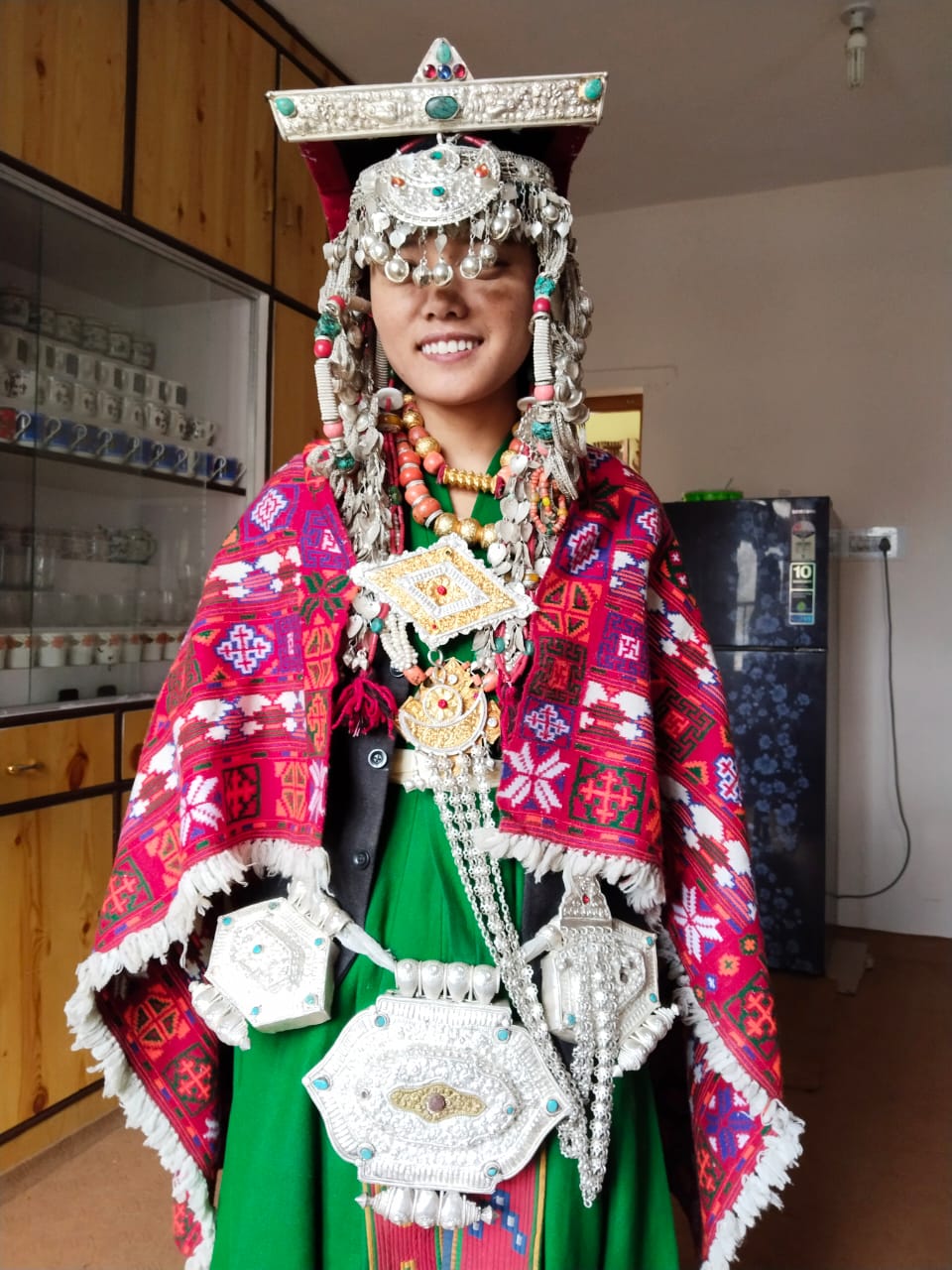
Spitian bride wearing Lingzey (multi colored shawl) Lokpa (thick hand strewn green cloak) Sulma (brown gown ) and Tiwi (hat)

7. Tiwi
Tiwi is worn both by men and women. Traditionally, Nambu (yak wool) is the base fabric with which it is made and has goat or sheep skin lined underneath. Cotton or wool fabric is sewn inside for warmth with matching silk brocade. Golden or silver zari designs or threadwork can be supplemented depending on the need.

8. Lham
Lham refers to footwear worn by people in the high Himalayan region or more suitably to the boots worn in the nomadic region. Originally it was made up of yak hides but with time, it is adapted to canvas, jute, or cloth material. Lhams are decorated with rich embroidery and exquisite designs of dragons or snakeheads. The material, color, and fabrics used to make Lham showcase the craftsmanship of the creator. Men’s Lham is knee length and comes in handy while treading snowy mountains. It is worn with Ghoey-shan (Silk robe) by men and women wear a slightly smaller frame with Sulma. The usage of Lham has gone out of daily use and is now worn only during festivals or special occasions.

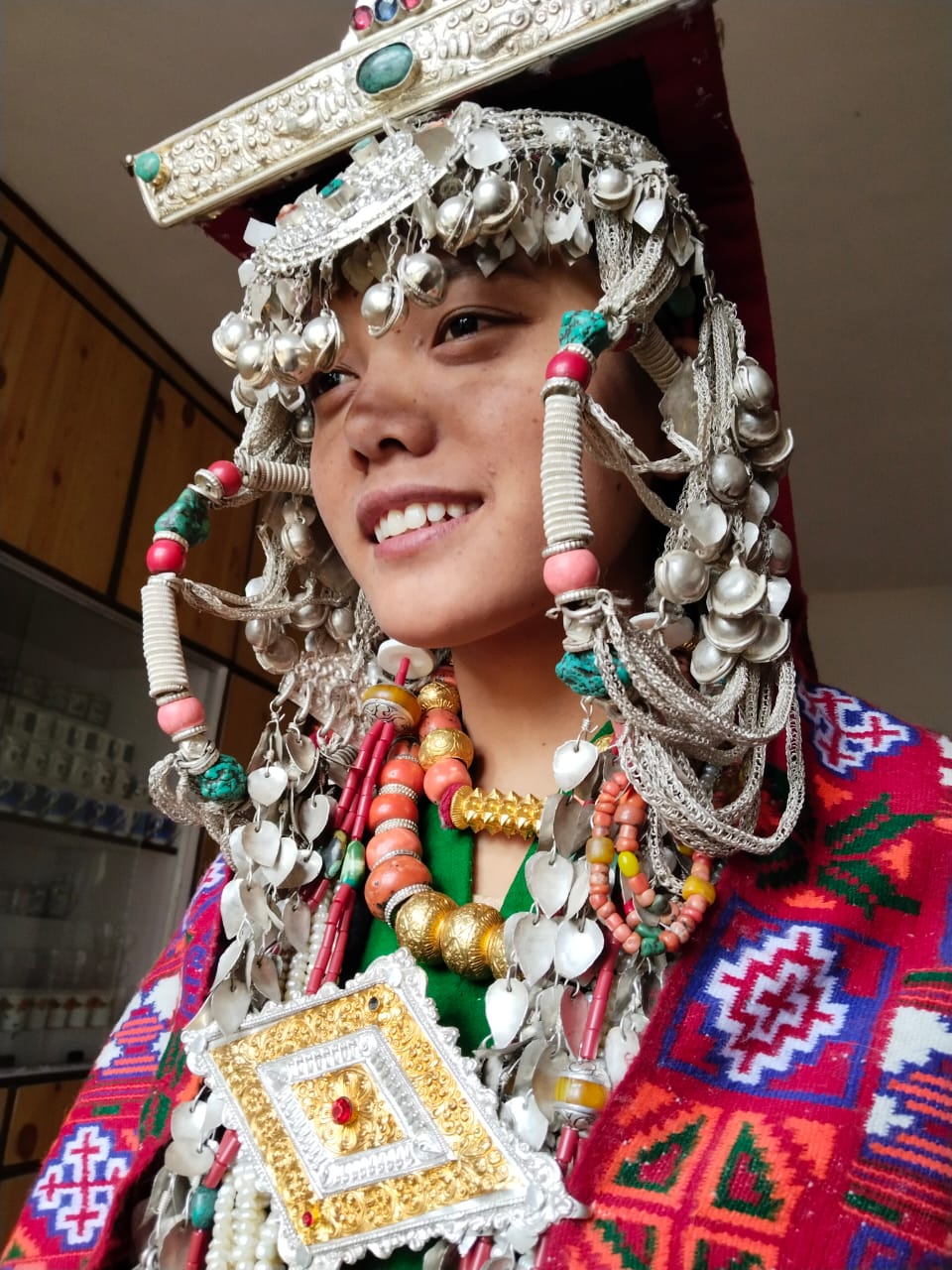
The garment and material used to make the traditional attire of Spiti symbolize the optimum use of local resources and fibers available regionally. During festivals and special occasions, this is adorned with elaborate pieces of jewelry like the vibrant turquoise Perak, the pearl-made Uldik, the Silver Docha, Dhikra (brooch), Khinyur, and Pitsup. Our traditional dress represents close cultural affinity with the Western part of Tibet and forms a big part of our cultural heritage.

960 1280 Dolma Zangmo, Chhering Zangmo and Tanzin Ankit
The Art of Weaving in Lahaul’s Upper Valleys
"Phang" - Traditional spindle | Photo: Rigzin Dorjee

The Art of Weaving in Lahaul’s Upper Valleys

In the higher Himalayan region, weaving is an ancient craft and forms an integral part of people’s lives. In Lahaul, weaving signifies a retreat into slower, simpler times amid icy cold weather when the farming works are at its lowest. There’s a saying in local folklore attributing weaving as visual art that reflects stories about people, their communities, and their place in the universe. It symbolizes the value of creation, interconnectedness, and rejuvenation. Weaving requires profound discipline and dexterity to untie complexities; it involves crossing two threads the warp and the weft, one vertical, and one horizontal, one stretched tight, the other intertwining the first. To produce a textile, the two threads need to be bound together otherwise, the weaving work will remain fragile. Hence in ancient Buddhist belief, a weaver is akin to a problem solver, someone who is adept at bridging silos and bringing greater connectedness.

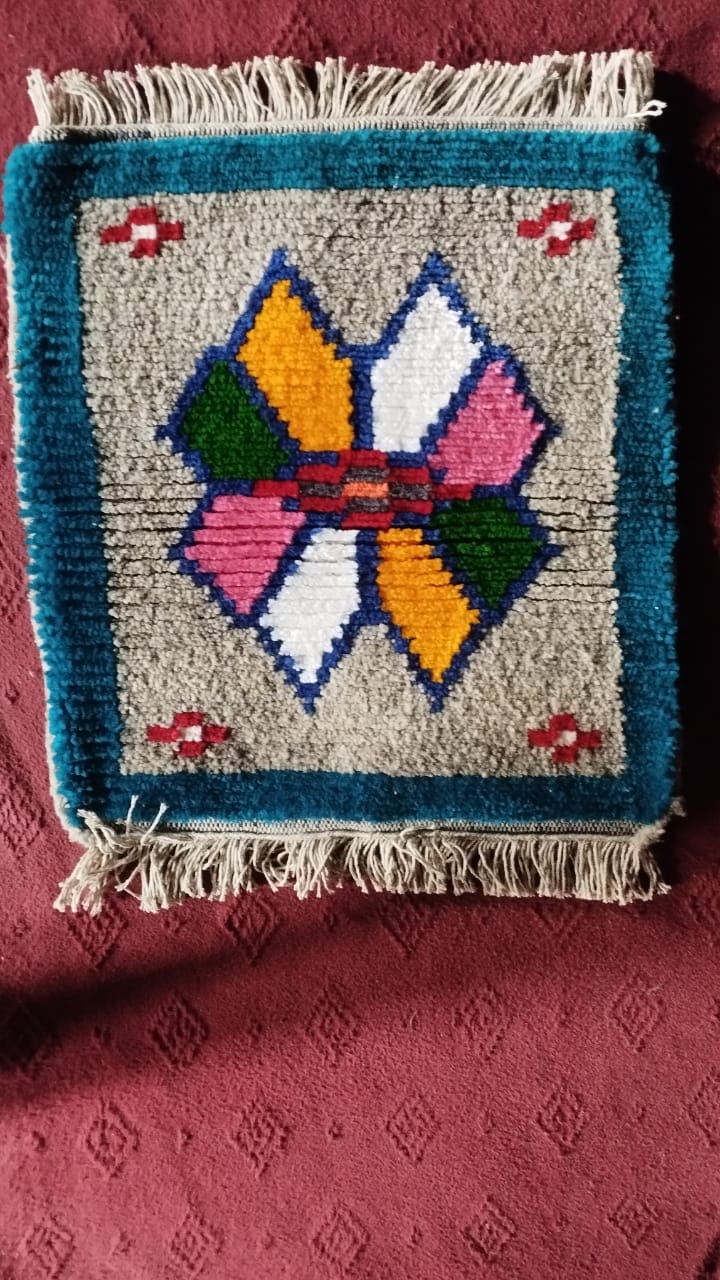
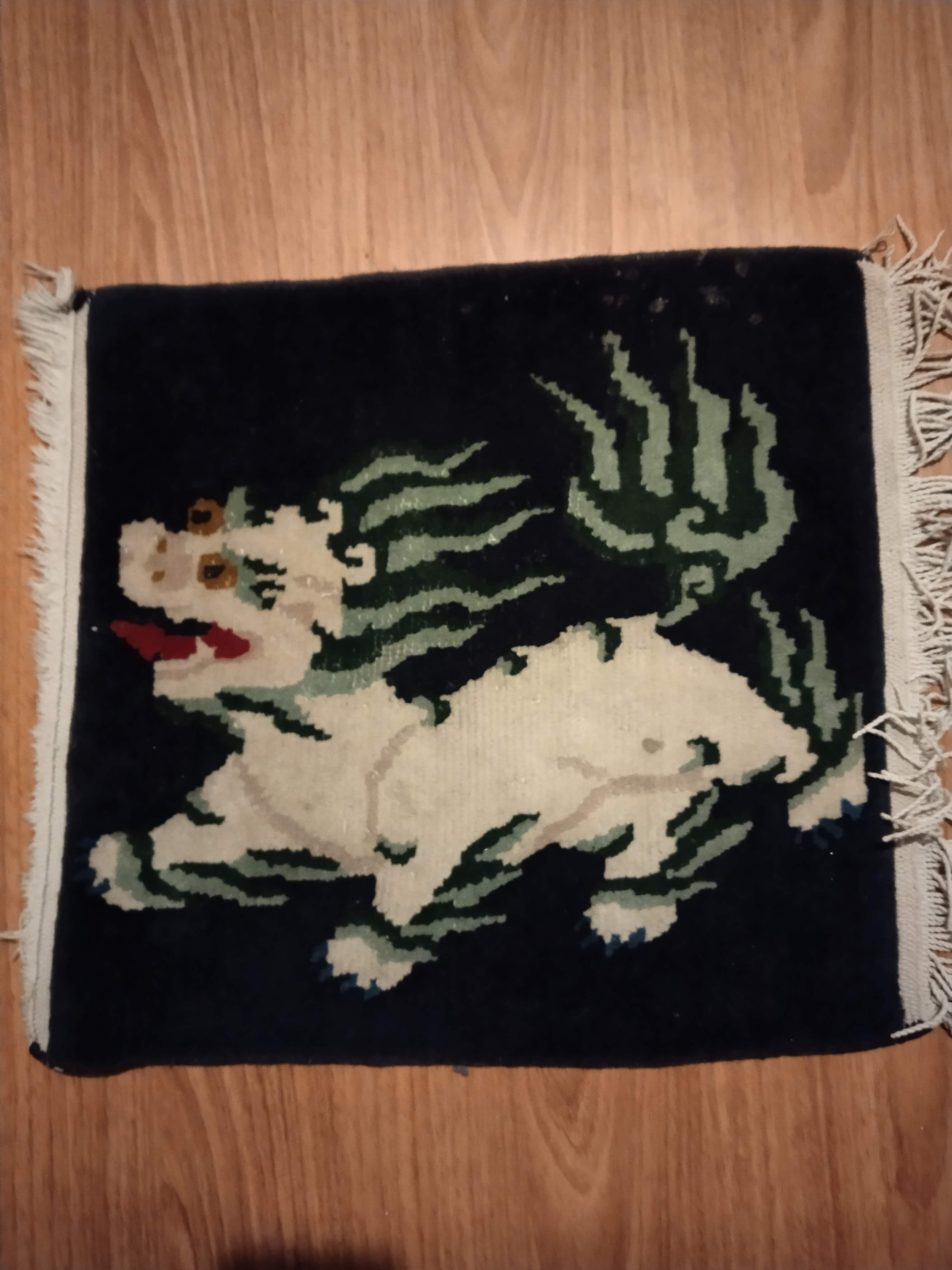
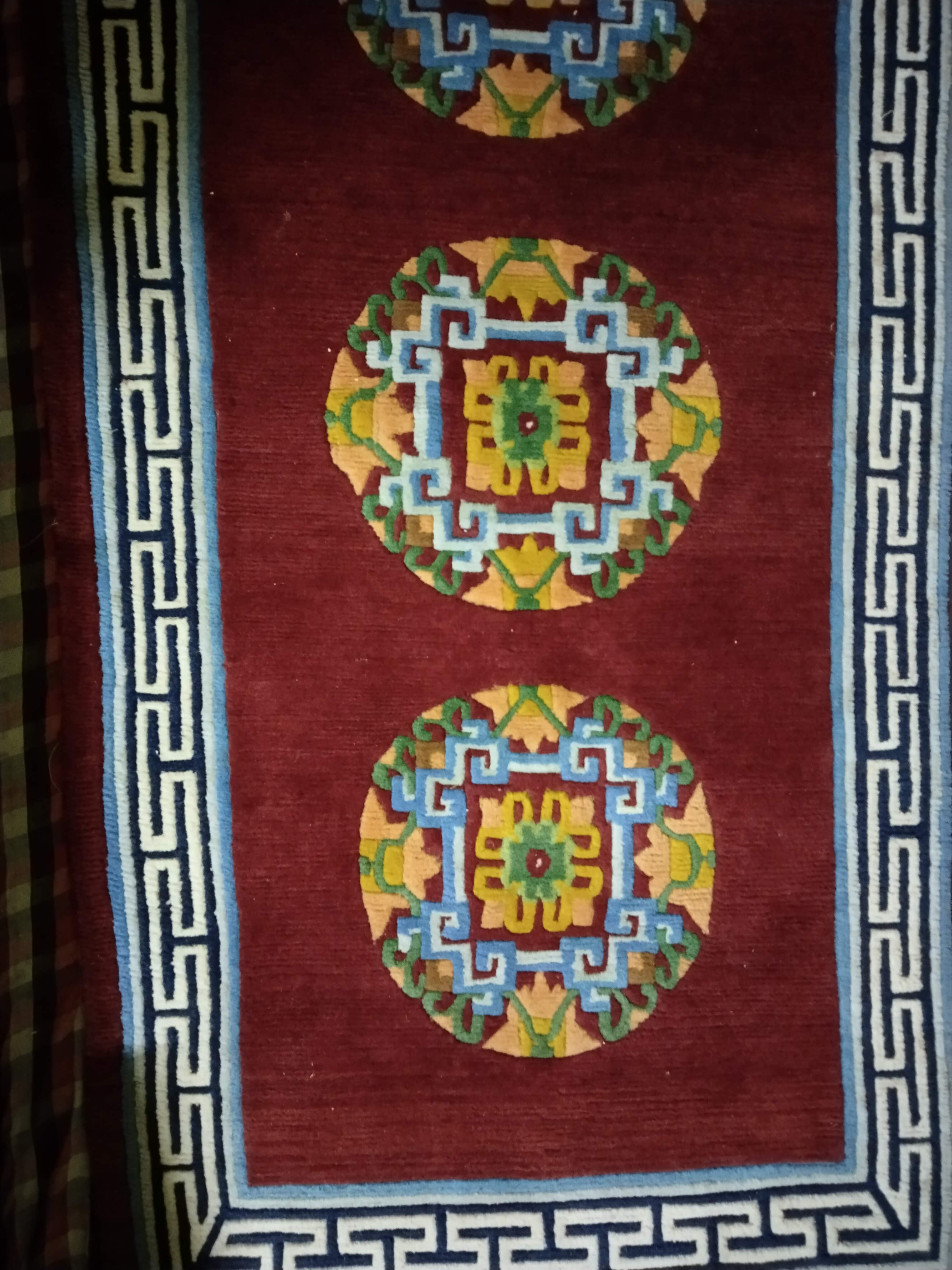
Weaving is a traditional skill that’s passed down through generations and is practiced with great vigor in our village. Of the many products that are woven, Tsug-den (Tibetan rug) weaving remains the most popular with its elegant design and high pile, plush feel. In our village, the handwoven woollen carpets are called Tsug-thu or Tuk-tuk in villages around the Darcha side in Lahaul. Tsug-dens are unique handwoven carpets, that are woven on a backstrap loom called “Khaddi”. It is an extremely slow, time-consuming process, that involves a lot of hard work as each bit of the work is done manually – from livestock herding to wool shearing to cleaning, carding, spinning, and yarn making and finally weaving, the process can stretch up to a year.

Photo: Sherab Lobzang

Most families still keep livestock and the wool is shorn around March or April month. Wool from a single sheep is sufficient to make one pair of Tsug-den. It is then sorted and cleaned to remove any impurities, and further processing of wool is done in Shamshi in Kullu valley in Himachal. We take wool gunny bags in bulk and get them carded and de-haired before we bring them back for spinning and yarn making.

Spinning is done mostly during winter and much like agriculture, it is collaborative work involving a group of women. Wood-made traditional spindles called “Phang’‘ are used for spinning and great care is taken to get consistent, smooth yarn. The base of the weaving is done with cotton threads on a metallic or wooden loom Khaddi. The handspun woollen yarns are weaved in a knotting system where one thread is interwoven with the other on a loom. Once a row of knots is complete, a rod is hammered against it to tighten the row below. A weaver uses the blueprint of a woven carpet to weave complex designs and to ensure accurate shape, size, and alignment of the carpet. Black, white and beige sheep wool is used for tsug-den while the rare white yak hair is used for Challi (woolen quilt).

The elaborate designs and motifs on the carpet are inspired by lives in the higher mountains of Tibet and often nostalgically evoke themes of nature and the environment. Motifs of birds, flowers, and mythical animals are quite common- dandelions, native birds, Druk (sky dragon), tiger, ibex, leopards, snow lions, and yaks can be seen beautifully woven on the carpets along with motifs that have special religious, cultural significance like the mandala, four elements of nature (earth, fire, water, space), the Buddha’s vajra, Swastika and depiction of the precious stones Dzi and Gau (amulet). The motifs on the carpet are not mere designs but have larger symbolic meanings to it for eg: the depiction of the crane motif on Tsug-den symbolizes good luck, Yak motifs are reminiscent of nomadic life, dandelions, birds, and clouds depict one’s closeness to nature, the vajra is symbolic of Buddha’s enlightenment, tiger stripes symbolizes one’s prestige and wealth, while snow lion and sky dragons represent mythical creature from traditional folklore and phoenix is a sign of auspiciousness.

 “There’s a saying in local folklore attributing weaving as visual art that reflects stories about people, their communities, and their place in the universe. It symbolizes the value of creation, interconnectedness, and rejuvenation.”

Most families in Lahaul and other higher Himalayan regions own simple domestically produced Tsug-dens and it remains one of the most functional pieces of the item which comes in really handy during harsh winters. The usage of natural fiber and natural vegetable dyes also enhances the overall aesthetics of Tsug-den and it is one of the practical pieces of a garment whose luster, and sheen increases over the years with usage. One of the most appealing characteristics of the Tsug-den-making process is that it is the result of resource utilization in the most natural way. The entire carpet is handspun, hand-carded, naturally dyed, and handwoven where nothing goes waste and the final product lasts for decades, some even passed down to generations. One of the greatest wealth a woman can inherit from her parents is the traditional handwoven carpets, rugs, and quilts along with handwoven shawls. Weaving is not just a craft, it holds ample of material, and cultural value and the artwork on woven Tsug-den is symbolic of values, beliefs, and mysticism beyond our comprehension.

5472 3648 Rinchen Angmo and Chhering Gaaji
The Sheep of Himalaya
Photo: Anuradha Miyan

The Sheep of Himalaya

Handloom and handicraft are an age-old tradition in Kinnaur (H.P) and have their roots in the ancient trade routes. The intricate designs and colorful patterns differentiate Kinnauri handcrafted shawls- making them a much-coveted textile product in India. However, the bulk of its history, symbolism, and contemporary relevance remains obscure. A history of textile production reveals interesting facts about the local environment, different modes of living, and cultural exchange. The Silk Road is the most famous trade route dating back five thousand years. Another lesser-known trade route connecting India, Tibet, China, and Central Asia is called the “wool road” which passes through Kinnaur and Kullu in Himachal Pradesh. The strategic location of Kinnauri weaving communities settled along the trade route inspired many weaving traditions across different states as well as took cultural inspiration from their trading affairs. Some of the most famous motifs and designs on the Kinnauri shawl bear a resemblance to Central Asian designs. The journey of wool trade and weaving traditions was truly iconic and drastically changed the destiny of the Himachali textile trade. Today, Himachali handloom stands amongst the foremost contributors of state revenue along with tourism and agriculture.

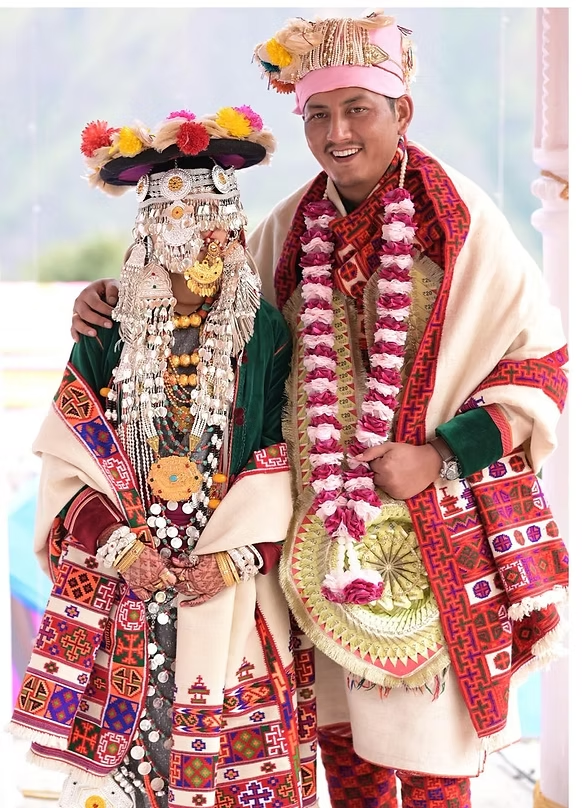
Traditional Kinnauri shawl and Topi worn by the bride and the groom

Growing up in Kinnaur, I saw my elders weave, knit, spin, and make yarn. Most women and young girls in my village knew how to weave and they owned the traditional weaving machine called “Khaddi”. Wool weaving and handicraft became indigenous to the region because of the cold weather conditions and women picked up the skill and nurtured it passionately. Most of the weaving, yarn-making, spinning, and knitting work happens during winter and the process is more collaborative. Since women made garments for self-consumption, it is common for one or two artisanal families to work together especially if it is a large-sized product like a carpet or a woolen quilt. I have always been passionate about handicrafts and after finishing my higher studies (MBA), the zeal was renewed all over again. I observed that although the women of my village – Labrang in Pooh tehsil of Kinnaur are skilled artisans, their products were used only locally within different villages of Kinnaur. There was no handicraft center in our village and given the difficult terrain, the market remains inaccessible to us.

I took a leap of faith and started “Sheep Of Himalaya” in 2019 with just two artisans from my village. The prime motive was to bring some visibility to Kinnauri handcraft on an international level and showcase regional craftsmanship.

Agriculture and cultivation of apples in our village orchards are primary vocations for most people but many women still rely on handicrafts as a secondary occupation to earn for themselves. When I broached the idea of building a clothing brand showcasing our traditional attire, there was a bit of reluctance from many artisans for they feared uncertainties. I took a leap of faith and started “Sheep Of Himalaya” in 2019 with just two artisans from my village. The prime motive was to bring some visibility to Kinnauri handcraft on an international level and showcase regional craftsmanship. While the artisans would weave mufflers, stoles, and shawls with vibrant Kinnauri designs and knit sweaters and socks, I would find market avenues for us. For me, the process proved a bit challenging as there were no established Kinnauri brands and our products were often mistaken for Kulluvi products which have better brand visibility. I took to social media to build a unique handicraft brand for Kinnaur and to connect with people who appreciate the labor of love.

Photo: Anuradha Miyan

Over the years, the enterprise found its feet as more artisans joined us in our journey from neighboring villages like Spillow and Kanam. We are now a proud all-women’s team with twenty-five artisans who are involved in the handcrafted and handloom business during our spare time. Kinnauri handicrafts and handwoven attire require dexterity that can be perfected only through patience and meticulous care while weaving.

To make a shawl, each thread is carefully pulled through the reed (part of the weaving loom that resembles a comb) and installed on a loom that forms the base for an entire textile to be woven. It is one of the most complex and laborious processes that an artisan undertakes. Given the complexity of designs, it can take up to three months to finish a shawl and it can cost around twenty-five thousand rupees for a single shawl. Widely known for their intricacy and finesse, Kinnauri shawls are unique and reflect indigenous designs. We use five key colors to design our attires – red, white, yellow, green, and blue which symbolize five elements of nature- earth, water, fire, air, and space. The elaborate geometrical and floral designs have strong symbolism and many of the motifs woven have religious significance like the representation of stupas in the border design of a shawl. Since many families are into livestock rearing, raw wools are sheared locally from goats and sheep for making yarn and weaving but in recent times, we have also started procuring Angora and Merino wool from Ludhiana.

Photo: Anuradha Miyan

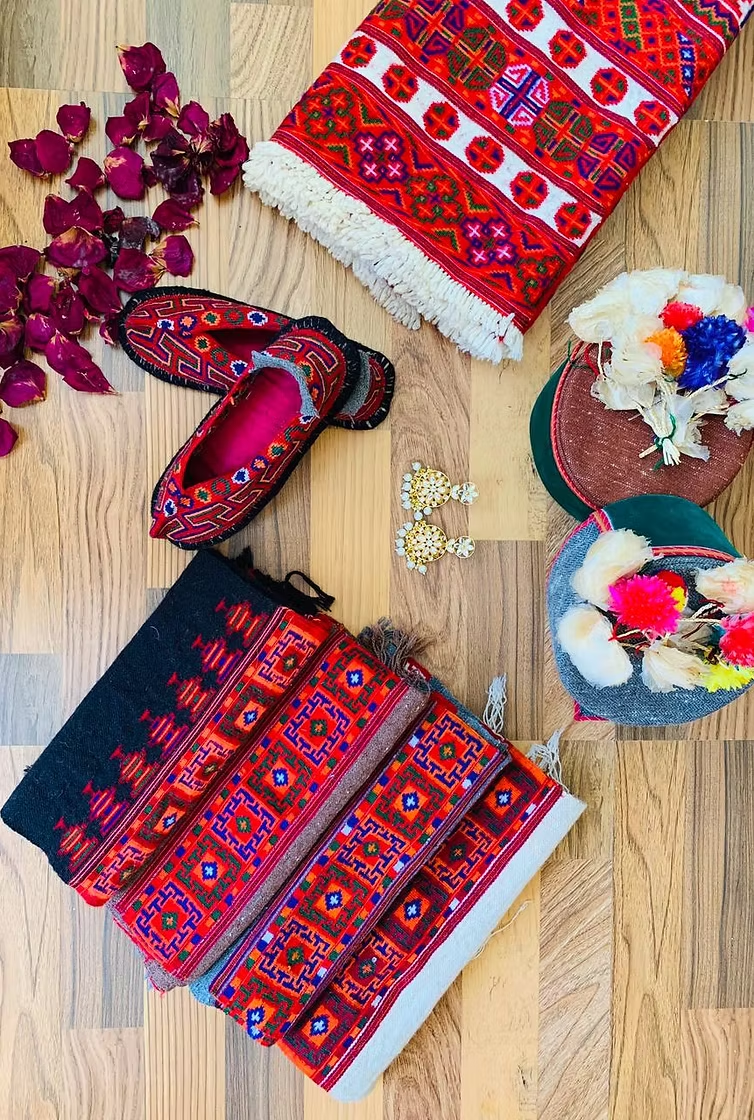
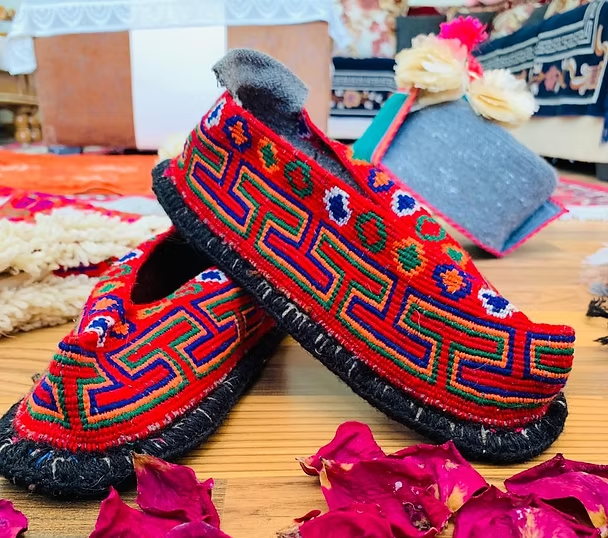
Balzanu Pona or Pullans (grass slippers) is another traditional wear that is slowly disappearing from daily use and in fact, there’s only one artisan left in my village who can skillfully make it from scratch! The footwear is made out of fibers procured from the bark of wild bushes. The upper portion of the Pullan is handknitted with goat wool and is adorned with colorful patterns while the lower portion is made of hemp or Bhang fiber (Cannabis). We make all kinds of traditional wear including Kinnauri shawls, stoles, mufflers, sweaters, Pulla (socks), and Kinnauri topi (hats). It didn’t take us long to sell products online via Instagram/Facebook and soon we were getting international orders! We further expanded our product range and started making children’s wear, cushion covers, diary covers, and pouches – all while retaining our unique Kinnauri designs.

All the women artisans who are associated with us rely primarily on their traditional looms and work from their homes which at times, proves a bit challenging as they have to juggle agricultural work, and domestic works at home and are able to undertake handicraft works only during their spare time. I have been pleading with the H.P handicraft and handloom department in Shimla to open a handcraft center in Kinnaur so that it is easier for weavers and other artisans to organize for a mutually exclusive vision, gain training, exposure, procure raw materials, and boost the entire value chain. We have capable and hardworking artisans who are passionate about their work and with the right market opportunity and assistance from the government, they will soar high.

1440 633 Anuradha Miyan
Traversing Climate Change
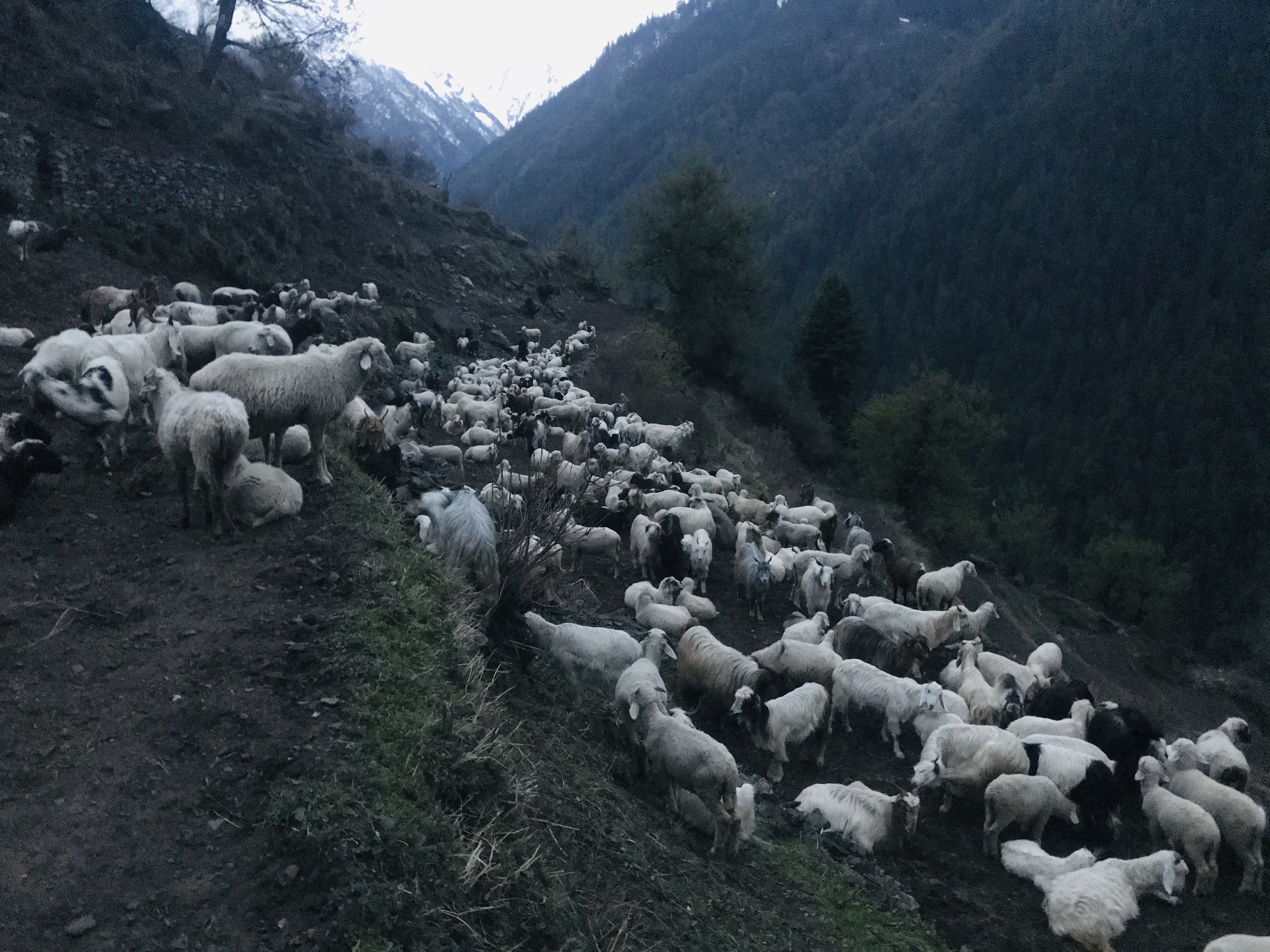
Herds of sheeps and goats return after grazing in the Dhar on the North-east of Kungti village | Photo: Virendra Mathur

Traversing Climate Change

In the mystical lands of Bharmour and Lahaul, located in the north-western part of Himachal Pradesh, India, a seasonal event takes place every year that is an elegant harmony between local culture and nature. Here in the traditional seat of Gaddi shepherds, the community is described variably as semi-nomadic, transhumant pastoralists, or agro-pastoralists. The Gaddis, usually men of the family, start on a migratory event in early April, gathering their goat and sheep herd and taking them to the high-altitude summer foraging grounds. These unbridled pastures, known as alpine meadows are called dhars. This seasonal movement is ingenious at various levels – it sustains the economy of a Gaddi household without being too reliant on agriculture. Further, Gaddi herds provide rich manure to the tilled lands across various agricultural landscapes they pass through and in return receive food and a place to camp; a barter system still in place. And this practice helps avoid low productivity foraging grounds without putting undue pressure on alpine pastures.

The shepherds pass through various towns and villages, as they start their journey from the low-lying areas of Kangra valley and plains of Pathankot, crossing the Dhauladhar mountain range towards Chamba district and travelling north towards the alpine pastures in the inner Himalaya. With them, on this arduous journey, are of course the livestock that they address as “Dhan” which also translates to money and wealth in Hindi. The sheep and goat herd constitute a flexible and continuous source of economic return for this community, especially when small land holdings do not allow for huge returns from agriculture. The flocks serve as a source of meat, milk, fleece and wool. The wool produced by Gaddi sheep is primarily used to make warm clothes, and is considered to be fine quality wool in a market where the quality dictates the price of the wool.

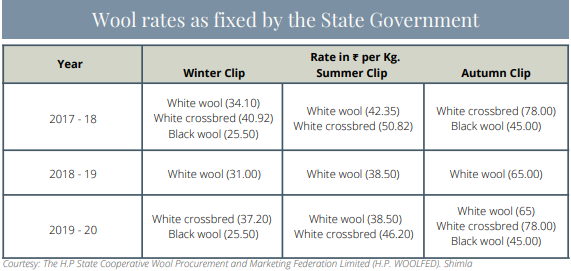
Himachal Pradesh State Wool Federation website displays the minimum support price (MSP) offered by the government for the sheared wool. Based on per kilogram price, the prices are lowest for the wool sheared in winter in the month of January-February, whereas the highest price is set for the wool that is sheared in autumn (in September or October), after the flocks have come down from the alpine pastures. The Gaddi shepherds I interviewed called this an ‘A’ grade wool. In their opinion, the nutritional forage available in the alpine pastures, which consists of medicinal herbs, shrubs, and vital grasses, contributes towards development of such fine and gregarious Gaddi wool.

Even more difficult than the journey to these pastures is living there. When I asked a Gaddi about the most important skill to survive in the alpine pastures, he simply stated that “You have to become an animal to live with an animal.” indicating the laborious life in alpine pastures. The arrival of Gaddi in the alpine pastures is met by receding snow, and below it lays the abundant grass to forage for the livestock/goat and sheep herd. These alpine pastures stretch till the horizon, vast carpets slowly turning green. Guiding herds in these alpine pastures is the least of their worry, the real challenge is to protect the herd from the harsh surroundings. The relationship of herd and the shepherd arises from mutual dependency, and for Gaddi men who remain away from their families, their herd is their family. The relationship of care is intertwined around wool – it transcends the material value and takes up emotional significance. It is the wool that earns shepherds the money, and it is this wool that comes back on the journey – laden on the back of a shepherd in the form of a blanket or a shawl.

They keep a portion of the sheared wool for themselves, and use it to manufacture clothing – their traditional attire, shawls and blankets, which keeps them warm and protected. When a lamb is born, it is wrapped around in this blanket and kept inside their camp, and on the long treks in alpine pastures, lambs and goat kids are carried wrapped inside the blankets. Each head counts in this family, and shepherds sometimes risk their lives for their flock. On two separate instances, a group of shepherds, at night, rescued their stranded goats from potential attack of a black bear, and on another day, Thaapu, a young apprentice jumped into a glacial stream, shattering the thick sheet of ice to rescue a sheep and a goat kid that fell while crossing the glacier. He said that a shepherd has to protect every head he is responsible for, as this proves his credibility to his employer. While the shepherds have adapted to the vagaries of nature, will their resilience fare them through impacts of climate change in the inner Himalaya?

In many ways, the life of a Gaddi shepherd and that of their flocks is interlaced with the seasonal changes in Himalayan pasture lands. Without knowing the term, the shepherds understand that their summer home is undergoing changes. Rainfall patterns have become erratic and it can impact the livelihood of Gaddi communities negatively. Abundant rain could lead to livestock mortality as the sheep contract various diseases in wet environments while less rainfall can delay the growth of grass and herbs in alpine pasture, as was the case this year. This is further worsened by foraging competition from large mountain ungulates; they informed me that a lot of problems has been caused by chur, commonly known as dZo across Himalaya (a magnificent cross between a yak and a cow). These large herbivores are domesticated by the villagers in high-altitude Himalayan communities for agriculture. These massive animals also graze in the alpine pastures, along with other ungulates like Himalayan Ibex and Himalayan Tahr, mules and horses. Large herbivores consume hefty amounts of fresh grown grass leaving only small patches for the sheep and goat herds, creating scarcity for Gaddi livestock. Similarly, the duration of grazing in the alpine pastures can also be cut short by erratic weather patterns, affecting growth of fresh grass and the productivity of alpine pastures in the long-term. A decrease in nutritional quality will in turn impact the quality of the wool produced by the sheep.

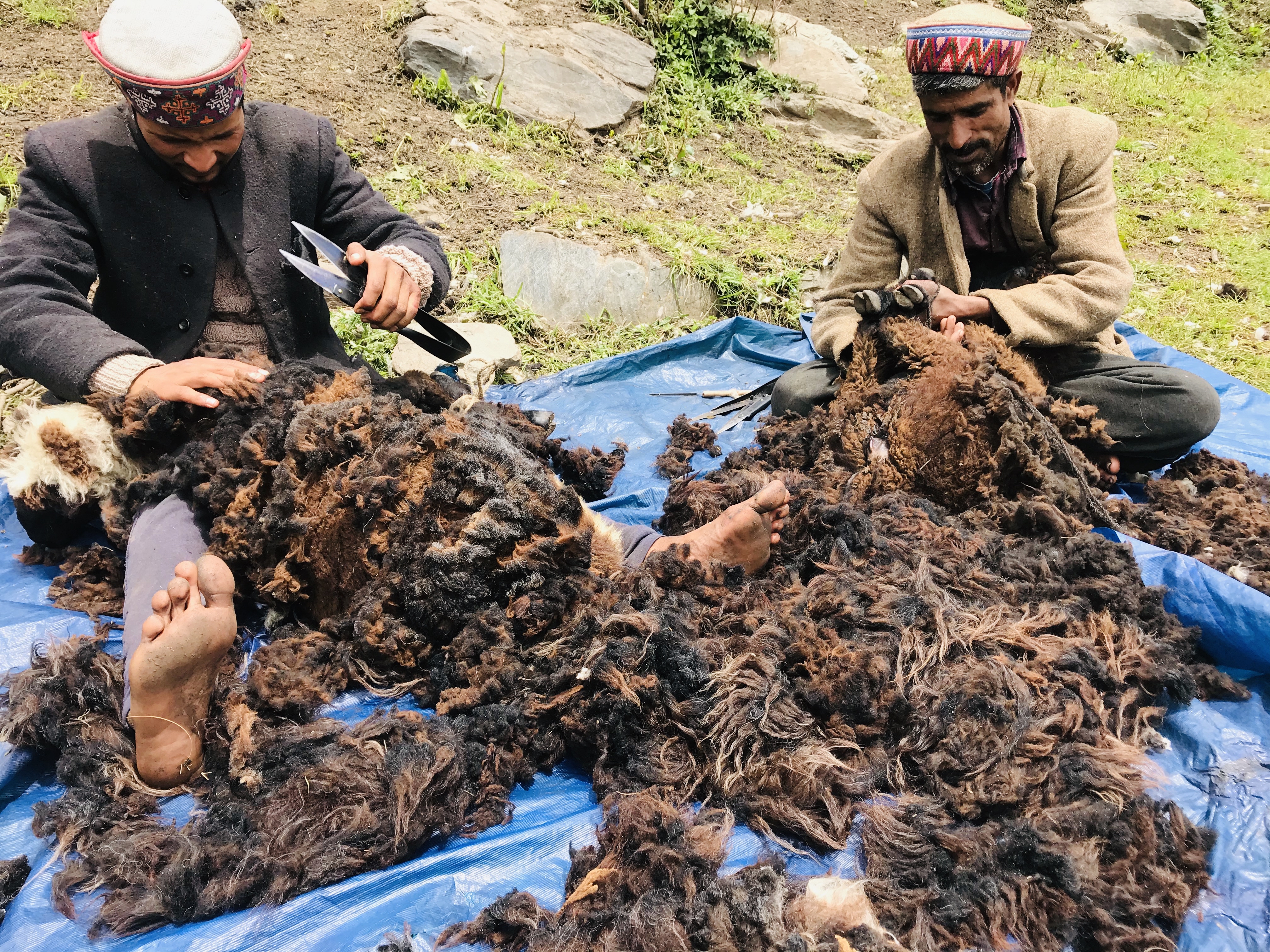
Subhash Bhai and Sonu Bhai shear wool from the sheeps in their herd. Shearing happens thrice in a one- year season, and while some herders use scissors , others use wool-trimmers for shearing the wool | Photo: Virendra Mathur

Today, the market for natural wool is facing increased competition from synthetic wool supplies which has made market accessibility difficult for these shepherds. While the traditional usage of wool is facing a decline, partly due to absence of knowledge transfer across generation, partly due to the lucrative nature of cosmopolitan living, traders and craftsmen now tend to prefer using imported wool. In the face of emerging changes, proper management mechanisms can help survive traditional agro-pastoralism in high Himalaya. Gaddi shepherds who are in this vocation constitute a dynamic medium of cultural exchange and fulfill economic needs of various farming communities through their resource exchange. Thus, the gradual loss of transhumance in Himalaya interacts with the loss of natural cycles of nutrient cycling in high-altitude communities and might possibly have downstream effects.

Acknowledgments:
Virendra would like to thank Wildlife Conservation Trust for funding this fieldwork at Kugti as a part of their Small Grants program. He owes all his gratitude to the humble and loving Gaddi community who make him feel at home through their generous, helping, and cheerful nature.

4032 3024 Virendra Mathur