Villages

A day in the life of a young farmer
Photo: Vicky

A day in the life of a young farmer

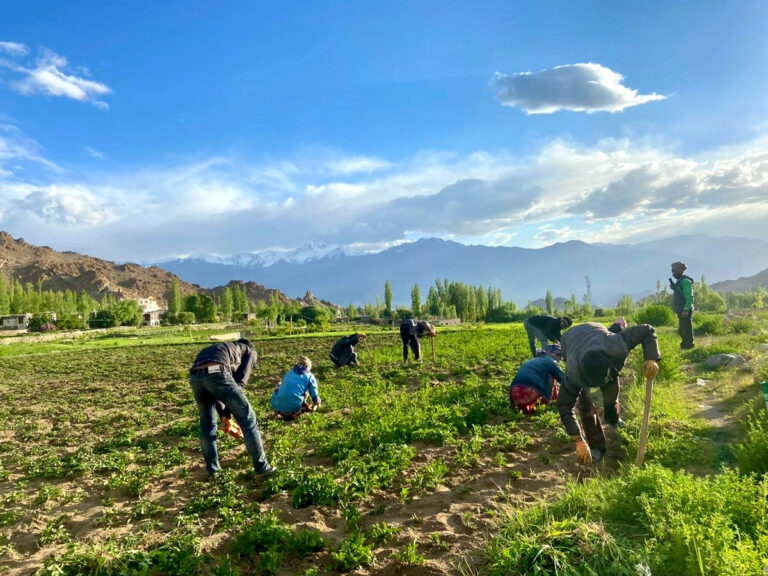
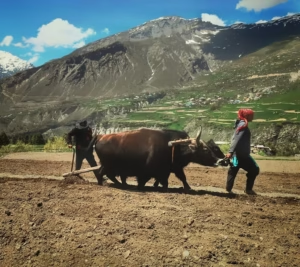
There’s an air of celebration when the agricultural season begins in my village. It is time to end the dormancy of long winter days and come out and start preparing the fields. I remember enjoying working in the fields and on the days when the fields had to be ploughed, I used to try to take leave from school on the pretext of doing some necessary work. We used to take out all the farming tools, clean it and check for any repairs. A day earlier, our bulls were also brought from another village and were prepared for ploughing. The excitement would not let me sleep and I would think of all possible excuses to take leave form school so I could and help my family in the field.

The next day, my grandfather would make a barley offering to the local deity Jogani. After the prayers everyone would take the offerings as blessings and proceed to prepare for the day. Before going to the fields, we would place flowers in the horns of the bulls. All the equipment and the bulls were then taken to the agriculture fields. I would also help out in guiding the bulls to the field which would give me immense pleasure. For traditional rituals, my mother would bring roasted barley (kha) & local alcohol (chhang) to the fields. We would then gather the bulls in teams of 2 and attach the plougher to them. After that we would offer chaang, kha and our prayers to our fields facing east (to garner the sun’s positive energy into our lives).
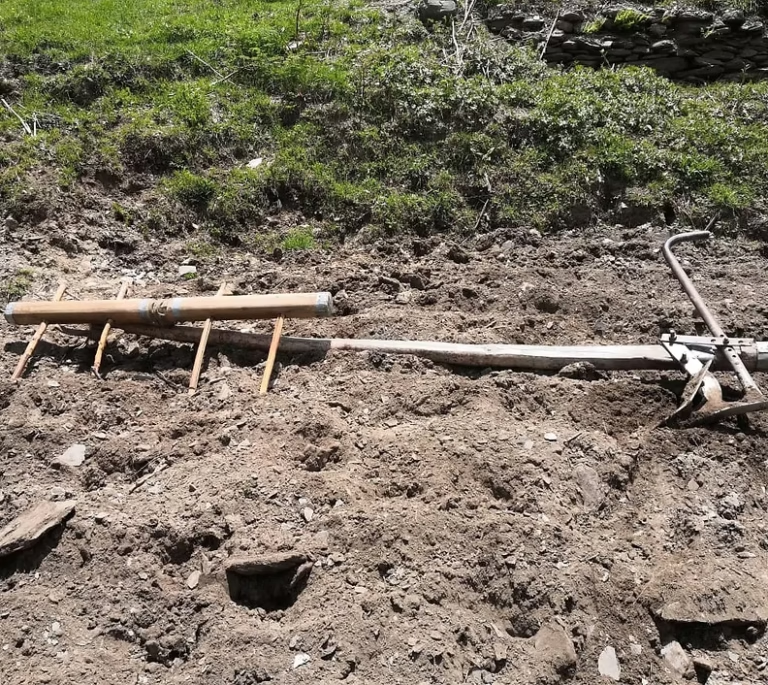
Photo: Vicky

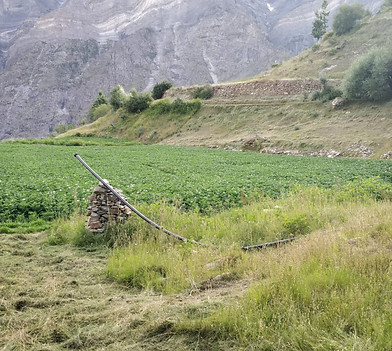
My family would then begin the hardwork of ploughing the fields which would last a few days. The fields which were harder to plough, were then ploughed with the help of Shaalu – my favourite mare. Unfortunately, I would never get permission from school to take off for a full day, so after the rituals, I had to rush to the school! Lunch for the farmers was prepared in the community hall and was served every day at 12:30 pm. For the bulls, the farmer would prepare Pinniyan balls of barley dough Sattu kneaded with local alcohol Chaang. This would give them strength for the remaining day’s work. After resting for an hour after lunch the farmers would get back to work. In the evening, the farmers would have tea and local bread puri at 6, around the same time we would return from school. We would help out our parents till the sunset and then head back home. If there was any time left before it got dark, we would level out the uneven fields. The blades of the plough would be replaced by a plank of wood and the bulls would then walk the fields levelling it. To add extra weight, my sibling and I would fight to climb onto the plank. By the end we would be covered in mud. We had an amazing childhood.

Farming life has changed drastically. The new age equipment gets the job done quickly but it’s not a celebration like the old times. Earlier whole family would partake in the ploughing, sowing and harvest process, now it’s a one person job. These equipment have in some way facilitated migration as now women single-handedly manage the fields. Bulls are replaced by power tillers and are rarely seen in any village. Agriculture was not just about growing produce for sustenance, but it was a way to form connections with our land, our animals and nature. And now, I see those connections fade.
792 706 Vicky
Beyond Agriculture
Photo: Tashi Angroop

Beyond Agriculture

Agriculture has made considerable progress in Himalayan states. One of the major changes in the mountain farming system is from subsistence to commercial farming practice. There’s a curious move towards high-value cash crops and diversification of cropping patterns. With connectivity and better exposure, farmers in these landscapes are increasingly becoming more innovative. Their approach in production, managing supply chains, and marketing are aimed at higher returns from farming. The New Age farmers from High Himalayan villages are more experimental and are more focused on searching for niches -apples, cash crops, fruits, exotic vegetables, flowers. Their engagement with farming goes beyond survival and sees it as an economically lucrative option for themselves and others associated in the value chain. Stories of such individuals dismiss stereotypical myths about farming and show how it can be adopted in changing times.

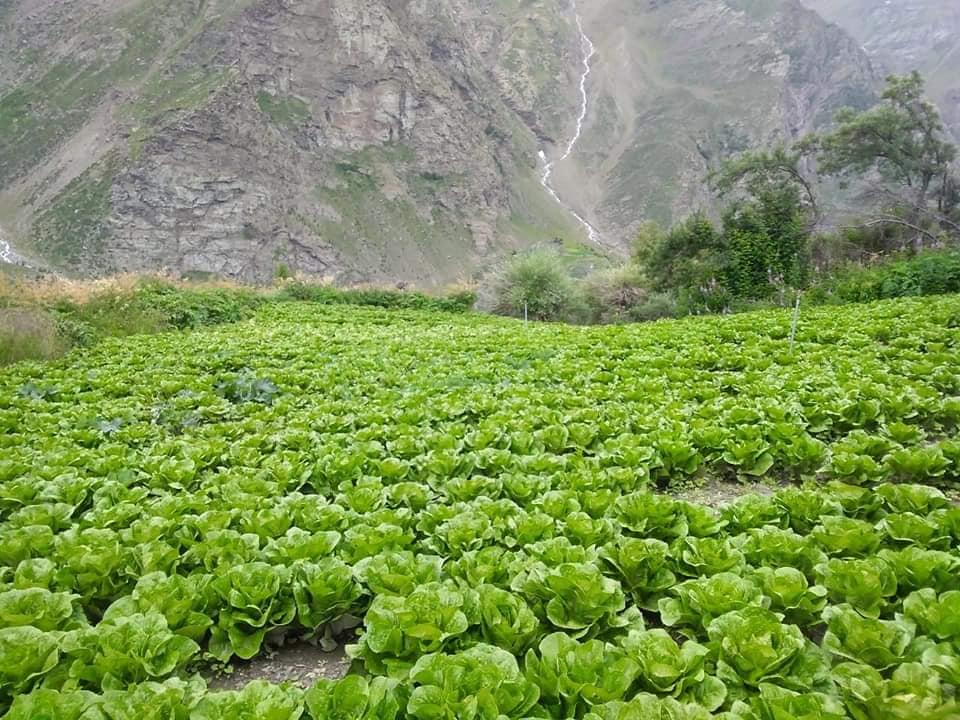
Tashi Angroop from Tinno village in Lahaul (H.P) dons more than one hat. He is a farmer, passionate entrepreneur, and agri-businessman who cultivates traditional grains, experimented and scaled up the cultivation of exotic vegetables in Todh valley, and is also initiating agro-tourism in his village. He started his journey in 2007 when he got an opportunity to work with World Bank’s Project in Lahaul promoting Seabuckthorn nurseries. Further collaboration with the Department of Horticulture on Desert Development Program (DDP) deepened his experience of developing poplar tree nurseries and building seabuckthorn nurseries. With Jain Irrigation System, he extensively traveled in Himachal Pradesh covering 11 districts to understand diverse cultivation processes within the state and train locals in nursery building. He took a leap at his own venture in 2014 when he decided to take up farming as a full-time vocation. He took land on lease in his village to cultivate organic vegetables and experiment with the cultivation of exotic vegetables which is a fairly new intervention in Lahaul back then. He began by procuring 1000 potato seeds (1000 Katta) and started growing them in his field. Initially, it was just potatoes, green peas, and cauliflower.

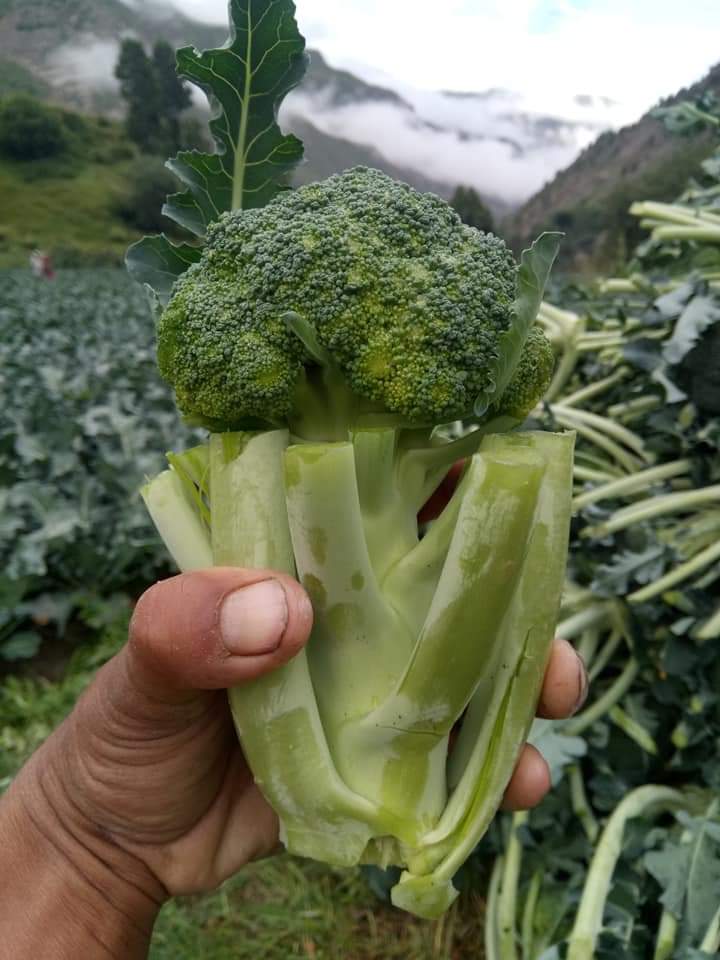
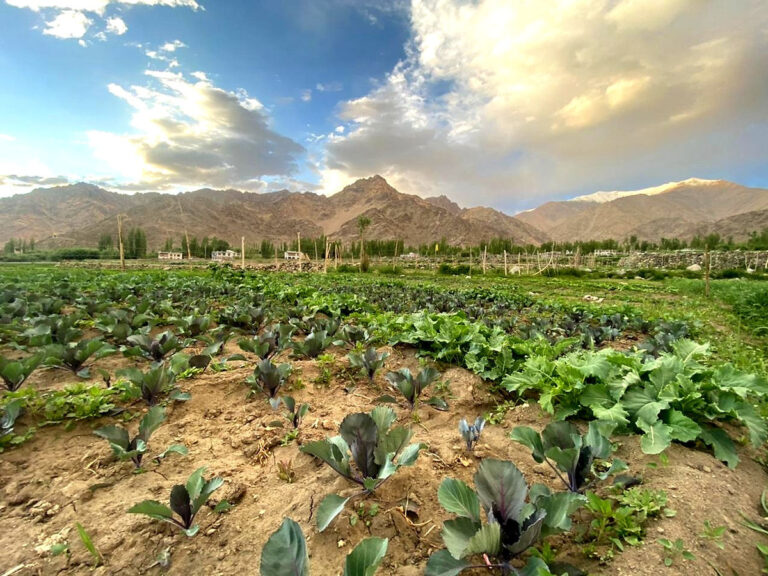
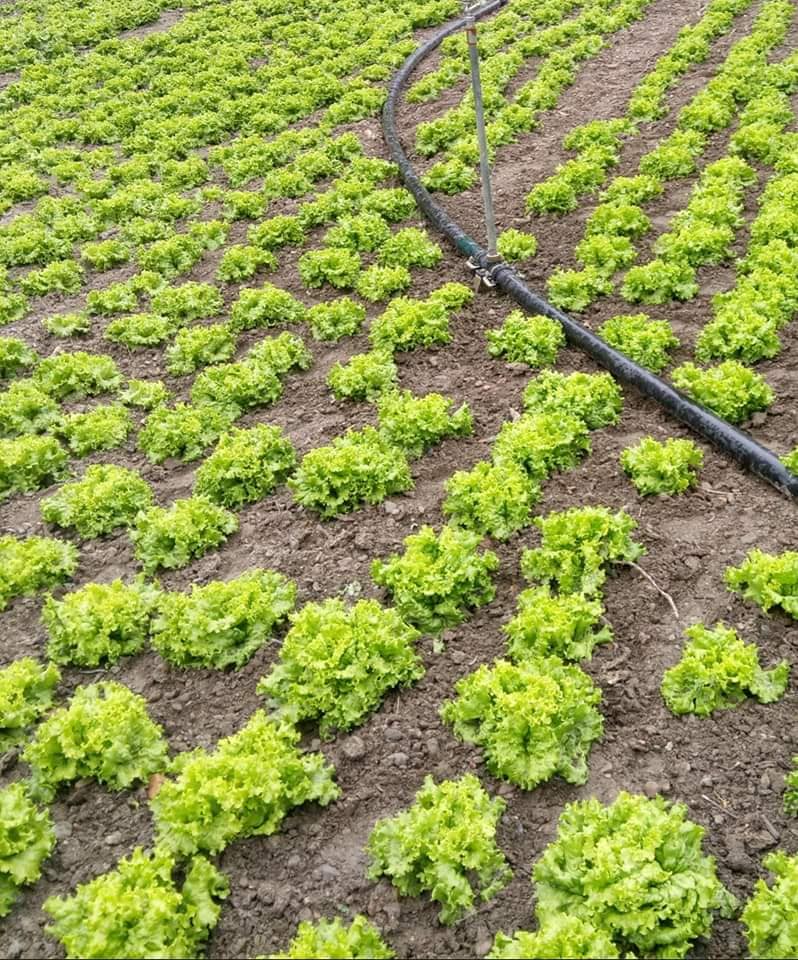
Over the years, Tashi gradually started diversifying and began cultivating more varieties of exotic vegetables and made efficient use of farming technologies and irrigation facilities. He now cultivates 19 varieties (mostly European exotic vegetables) vegetables in his field including broccoli, Iceberg lettuce, Red leaf, Yellow leaf lettuce, green leaf lettuce, Squash (Jugni), Yellow & green zucchini, celery, parsley, leek, snow peas, fennel, European carrots, red cabbages, other herbs, and exotic roots, etc. He introduced the same to many villages in Todh valley (Tinno, Gaimur, Jispa, Chika, and Sumdo) in Lahaul where farmers are now able to grow vegetables during off-seasons and sell them at a premium rate in metropolitan markets. Within his own community, he became the face of changing agricultural practices and popularized the phrase “Tel bharo, Kheti Karo” in Lahaul where he encouraged young farmers to adopt improved technologies like tillage machines and JCBs to do farming. In many instances, he even lent his own JCB and tiller machines to help people till rocky barren lands for farming.

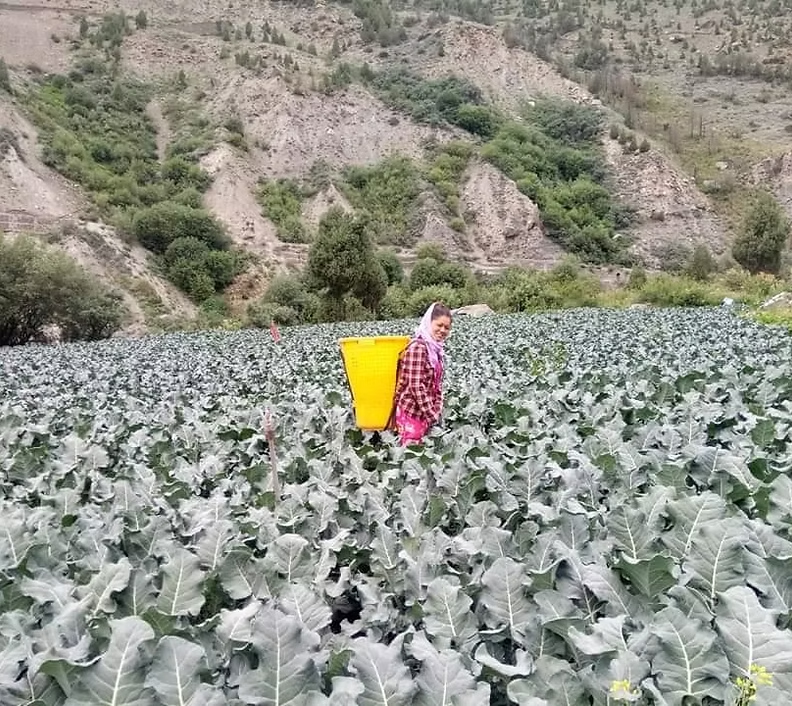
The farming communities in Todh valley of Lahaul are now incorporating off-season vegetables along with traditional cereal crops. Different farming technologies like power tillers, tractor, power bidders, grass cutter, spray machine, sprinklers to improve the yield. Compared to Spiti the neighboring district, Lahaul receives more rain which is suitable for cultivation, potatoes, green peas, hops, cabbages, and other exotic vegetables and herbs. In fact, Lahauli potatoes are considered some of the best in the country and it is believed that these crops have brought prosperity to Lahaul.

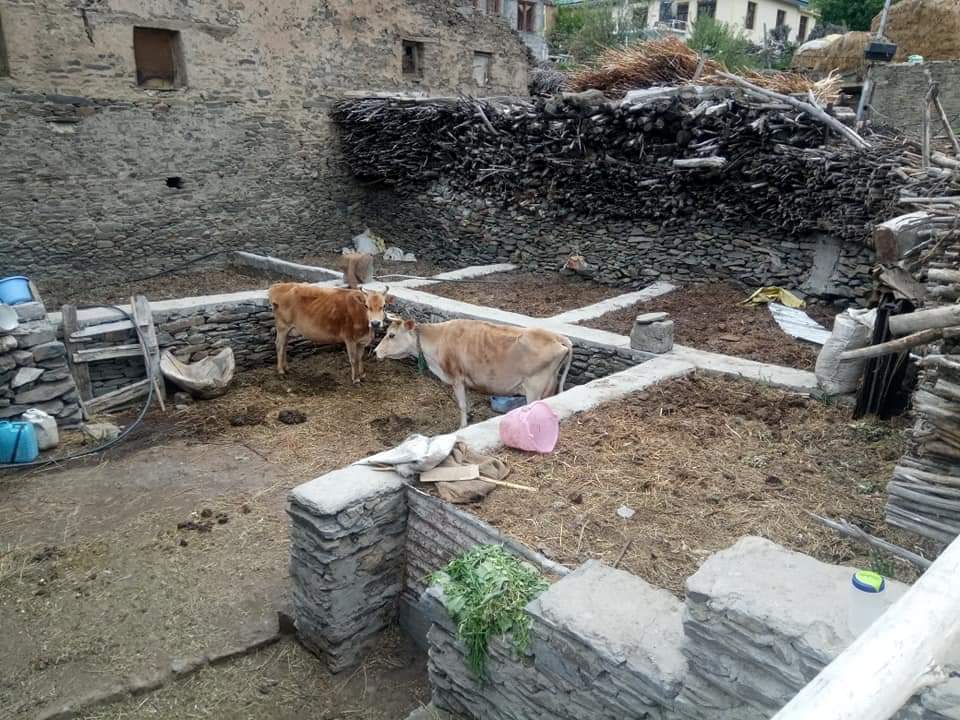
Composting is an essential requirement to grow exotic vegetables and locals rely heavily on vermicomposting. Most Lahauli households have separate vermicompost structure at their home. Tashi himself annually prepares around 17 tonnes of compost to use it in his fields. He adds “We use jungle wastes like wild leaves, raw leaves, dry leaves, Juniper leaves, and other organic waste inlcuding manure, human waste, and Kenchua (organic manure)”. “Every household prepares compost 3-4 times in the unit and use it in their field to improve soil fertility”.

With time, locals were also able to enhance irrigation system and equip technologies which is more efficient and convenient. Earlier water resources are distributed among farming households on a rotational basis. There’s a watering turn for everyone and a farmer has to wait for about 6 days to receive his share of water to irrigate the fields. With improved irrigation systems in most Lahauli villages, the watering turns have almost disappeared. Direct pipes were connected from glacial sources to Kuccha Kuls (field canals) and every household have direct access to it. Tashi enthusiastically adds “one can finish the irrigation within 3-4 hours now! Almost unthinkable in the past.” Almost 90 percent of Lahauli villages are relying on piped or drip irrigation systems. There’s an increased use of sprinklers and rain gun watering systems.

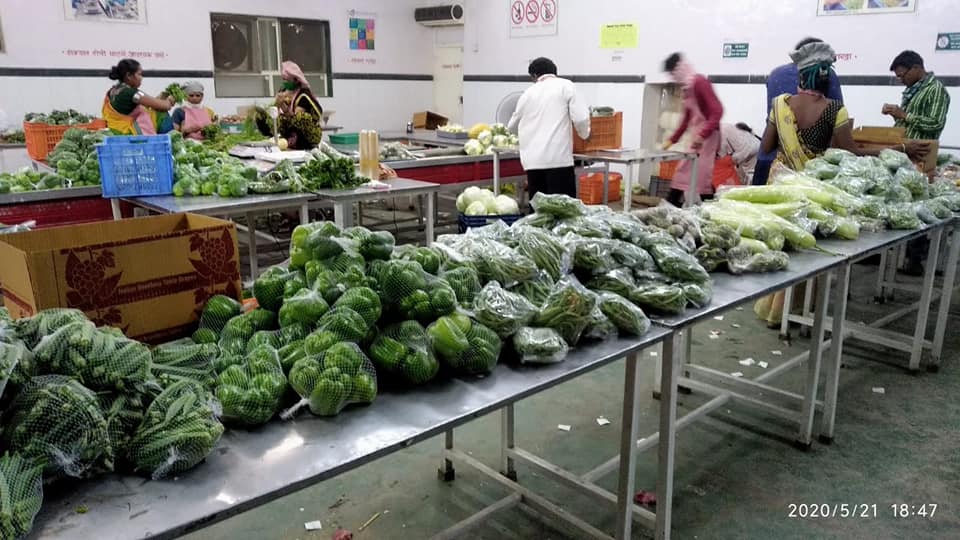
With improved road connectivity, better transportation system, and the availability of new crop inputs like hybrid seeds and organic fertilizers, the farmers in the hilly region of Lahaul are able to fetch gain higher yields and better prices. The returns from the sale of vegetables are five times higher than that of traditional crops. There’s a high demand for exotic vegetables in metropolitan cities and Lahauli cultivators are now able to sell their produce in Delhi, Chandigarh, Ahmedabad, Surat, etc. The farmers from Todh, Turat and Keylong have collectivized and formed a union of 101 farming households to provide better market exposure and greater revenues for the local producers.

Some of the initiatives include farmers market, over-the-counter payment system for the farmers, and also experimenting with the concept of “one village, one crop” where each village will focus on producing a single crop unique to their area and giving better opportunities for farm entrepreneurs. The farmer’s union will be collaborating with big hotel chains like Taj to supply them year-round vegetables.

Opening up of Atal Tunnel has also huge impact on farming in Lahaul. There’s surge in tourists flocking in the valley and farmers are keen on integrating agriculture and tourism. They have initiated farm-based enterprises like camps and homestays where tourists can take part in the sowing process, harvesting, procuring vegetables, and immerse themselves in rural agricultural life with locals during their stay. Tashi’s own farm camp in Tinno and Keylong attracts a lot of tourists. He shares that the motive is to give them first-hand experience of agriculture, self-cooking and be part of the collective experience of the landscape. Cultivators like Tashi show that there can be a more forward-looking approach for agriculture and it can harp beyond the traditional way of life. With greater solidarity, there’s positive hope for farming in high Himalayan landscapes to empower small farmers.

960 720 Tashi Angroop
My farming memories
Photo: Vikram Katoch

My farming memories

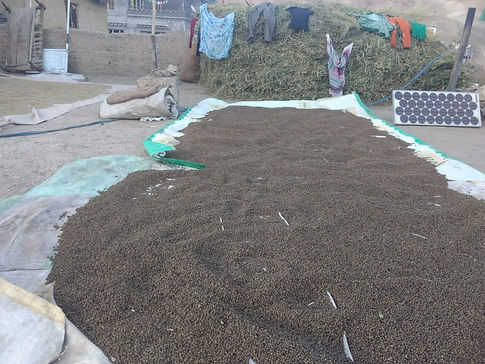
I spent my whole childhood in a small hamlet called Garang in Lahaul. In the summers my sister and I would help our grandmother with the household chores and in in the fields. She would cultivate green peas, potatoes and wheat. In Lahaul, the sowing season starts from mid-March. Villagers would first clear the snow from the fields and then start sowing various seeds. Green peas and cauliflower seeds are sown first followed by potatoes. Farming is the sole livelihood of many villagers and before ploughing, people pray to their fields, the tools and the baang (oxen) in hope of a good harvest. After ploughing, the farmers use pickaxe to create small water channels in the fields. Our grandmother would let me and my sister do this task. She would instruct us on how to do this carefully and correctly. She would then add seeds of green peas after us. After covering the field with seeds, she would level it using long dry twigs.

We used to eagerly wait for the seedlings to grow. It would take around 30 to 45 days for the first seedlings to emerge. This was the time when the weeds would be removed and the field would be watered through Kuls. Unlike traditional crops, most of the fields like green peas and cauliflower, require frequent watering – once in every 15-20 days. Around June flowers will start blooming in green peas fields and by August, the crops are ready. Harvesting season is the most important and everyone in the family will help collect the ripe peas. Since there is no farmers market/cooperative for peas in Lahaul, we are often forced to sell their produce to private dealers at meagre sum.

Similarly potatoes are also grown in our village. Each household prepares their own seed by keeping sacks of potatoes in a pit during the winters. When spring arrives, the seeds are unearthed and prepared. The beds laid for potatoes are deeper than that of green peas and are placed 5 to 6 inches apart from each other. The seeds are buried deep in the soil to ensure high and good production of potatoes. When the seedlings emerge, the fields are watered and by September the harvest is almost ready. The leaves from the plant are removed a few days before uprooting the plants. This helps to thicken the potato skin, thus making them more long-lasting. The potato harvest is ready by early October and the whole valley is suddenly humming with trucks collecting produce and taking it to the market. There are times when it’s even difficult to find trucks in Lahaul and the farmers have to arrange trucks from the nearest town. Farming has changed a lot since my grandmother’s days – increasing mechanization has certainly filled the gap of labour shortage but many households still struggle to find good market exposure.

729 410 Vikram Singh Katoch
Mushroom Cultivation in Spiti
Photo: Kalzang Ladey

Mushroom Cultivation in Spiti

Majority of Indians stay in rural areas with agriculture as their primary source of livelihood making India, largely, an agricultural country. Farming varies greatly across different regions given its geographical conditions and access to resources. It is increasingly becoming difficult due to growing effects of climate change across the country. Melting of glaciers, extreme weather patterns and excessive drought and rain have further increased our vulnerability. Farmers who are completely dependent on agriculture for their livelihood will face the brunt of changing phenomena and it is important to diversify our cultivation patterns. To aptly complement existing agricultural patterns, these alternatives need to be time-saving, less laborious and should also offer decent economic returns for the cultivator.

Photo: Kalzang Ladey

Given Spiti’s mono cultural practises, I realised that mushroom cultivation in Spiti will provide a viable option for the locals. Growing mushrooms is fairly easy and anyone can replicate the process once they are a bit familiar with it. One can easily cultivate mushrooms 2-3 times a year without any mechanical equipment. Moreover, there are no constraints on the scale of cultivation. It can be considered as a viable option by both small and big farmers alike. All they need is a small space in their houses. It roughly takes one month to cultivate mushrooms from scratch. In addition to usual agricultural crops, mushrooms can be added delicacy to your meals. Mushrooms are one the cheapest crops to cultivate if done with proper care -thus, with limited space and time, one can obtain a good yield. Mushrooms are extremely delicious and nutritious. It is a great way to build a diet full of protein, fibre and minerals. It contains a lot of vitamins, especially vitamin D. The nutrients available in mushrooms are helpful for people suffering from diabetes and other ailments. It is not surprising, then, that its presence in global as well as Indian diets is increasing. This is all the more reason for farmers to take up mushroom cultivation.

Photo: Kalzang Ladey

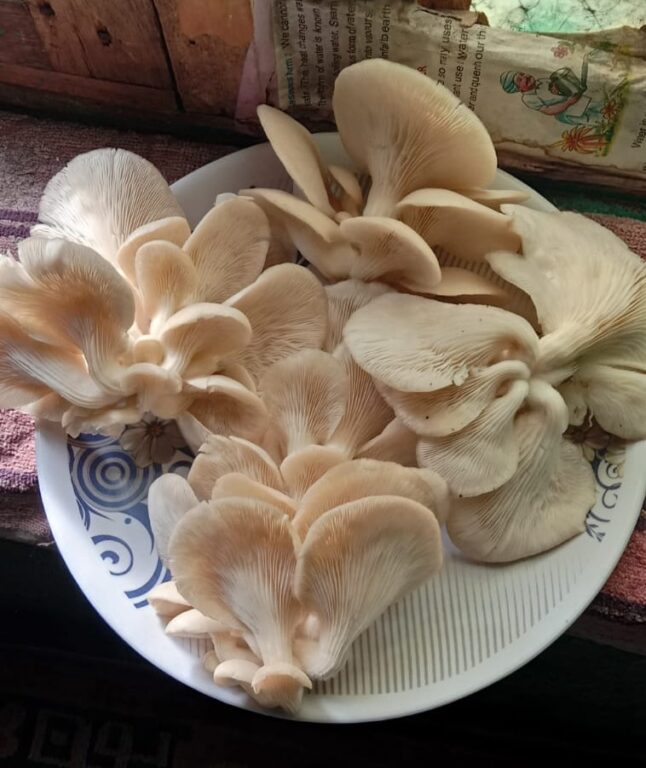
Many types of mushrooms are in demand, but specifically in Spiti, we cultivate oyster mushrooms. Both fresh and dry varieties of these mushrooms are sold in the market. The mushroom soup you get is made from these oyster mushrooms. We have experimented with the cultivation of White oyster mushrooms (Pleurotus florida), Pink Oyster mushroom (Pleurotus Djamor), King Oyster mushroom (Pleurotus Eryngii/Kabuli Dhingri), Gray oyster mushroom (Pleurotus Sajor Caju) and Tree Oyster mushroom (Pleurotus Ostreatus). Oyster mushrooms are the best varieties to cultivate if you are trying it for the first time. These are very nutritious and require much less space and environmental conditions for a beginner. Mushrooms can be grown either through spawns or substrate. Spawns are referred to any carrier material which has mycelial growth to propagate mushroom. It can be considered like a seed in mushroom farming and comes in various forms like sawdust spawn, grain spawn (most popular for home grown mushroom cultivation process), woodchip spawn and straw spawn. Substrate is a soil-like material that provides mushrooms with the nutrients, moisture and energy. It is high in organic matter making it desirable for cultivation. Different species of mushroom have different preferences of substrate hence it is important to match those requirements. A good substrate is dense woody fibrous material full of carbon.

I will briefly explain the cultivation process for those who are interested. There are two methods of mushroom cultivation:

  1. Organic sterilisation method
  2. Chemical sterilisation method but I will recommend people to follow the organic cultivation method.

In the organic sterilisation method, fill a large sized utensil with ⅓ of water and keep it to boil. When the water starts boiling, add straw which will play the role of substrate. In Spiti, we add dry grass chips called Phungma. Keep the mixture on boil for about 2 hours (depending upon the quantity). Drain the excess water, lay the straw on a clean mat to dry it (overnight). When it is completely dry, you will need strong poly bags (14X18 or 16X24 inches) to transfer the material. As for spawning, for 80 Kgs of straw, we require 1 Kg of spawn (mushroom seeds). The spawn can be sprinkled on the straw and can be mixed. Then comes layering where first we put some spawn in the polybag, then apply the first layer (2 inch straw), followed by another layer of spawn and finally topping it with the final layer of straw till we fill the poly bags to the brim. When this is done, close the bags in a way that it’s air-tight and there’s no room for moisture to enter. Once the bag is closed, make around 10-15 holes in each bag. Place these bags in a dark empty room or closet at 25 degrees Celsius for 15-20 days until the entire bag turns white. If there is any other colour formation, you’ll have to dispose of the bag and start over.

It is important to keep the bags in a clean room with good humidity. Keep checking the mushroom bags every other day and start sprinkling the floor with water to increase the humidity in the room. Once it starts sprouting, softly twist individual mushrooms and pluck them for consumption. For the chemical sterilisation process, add 125ml of formalin and 10 gm of bovesteen (fungicide) in 100 litres of water. Washed and damp straw is then soaked in this water for 12 hours. Following that, the excess water is drained and straw is dried out and then transferred to polybags. The polybags are then tightly closed with a string and left for cultivation. Once the bags start becoming white, you can make a few more holes in it. Roughly, at every 3 inches, there should be one hole in the bag. This will help you get a better yield. These holes should be made by only those cultivators who are unable to maintain 90% humidity in the room.If the room temperature is between 20-22 degree celsius, then it is considered to be the most ideal for incubation.

Once it sprouts, same bag of mushrooms should be harvested together otherwise, it would take longer to prepare for the second flash. Second flash can be carried out roughly 7-8 days after the previous harvest. In this way, each bag can take 3-4 flashes easily. After 3-4 flashes of harvesting, remove the poly bags and prepare for the second batch using different bags. If this is done with proper care, the mushrooms will be ready in 25-30 days. If you are planning to cultivate pink oysters (Pleurotus Djamor), then a slightly higher temperature is required in the room. Thus, you can cultivate these mushrooms in the month of June or July in Spiti. Other mushrooms can be cultivated between the months of April to September.

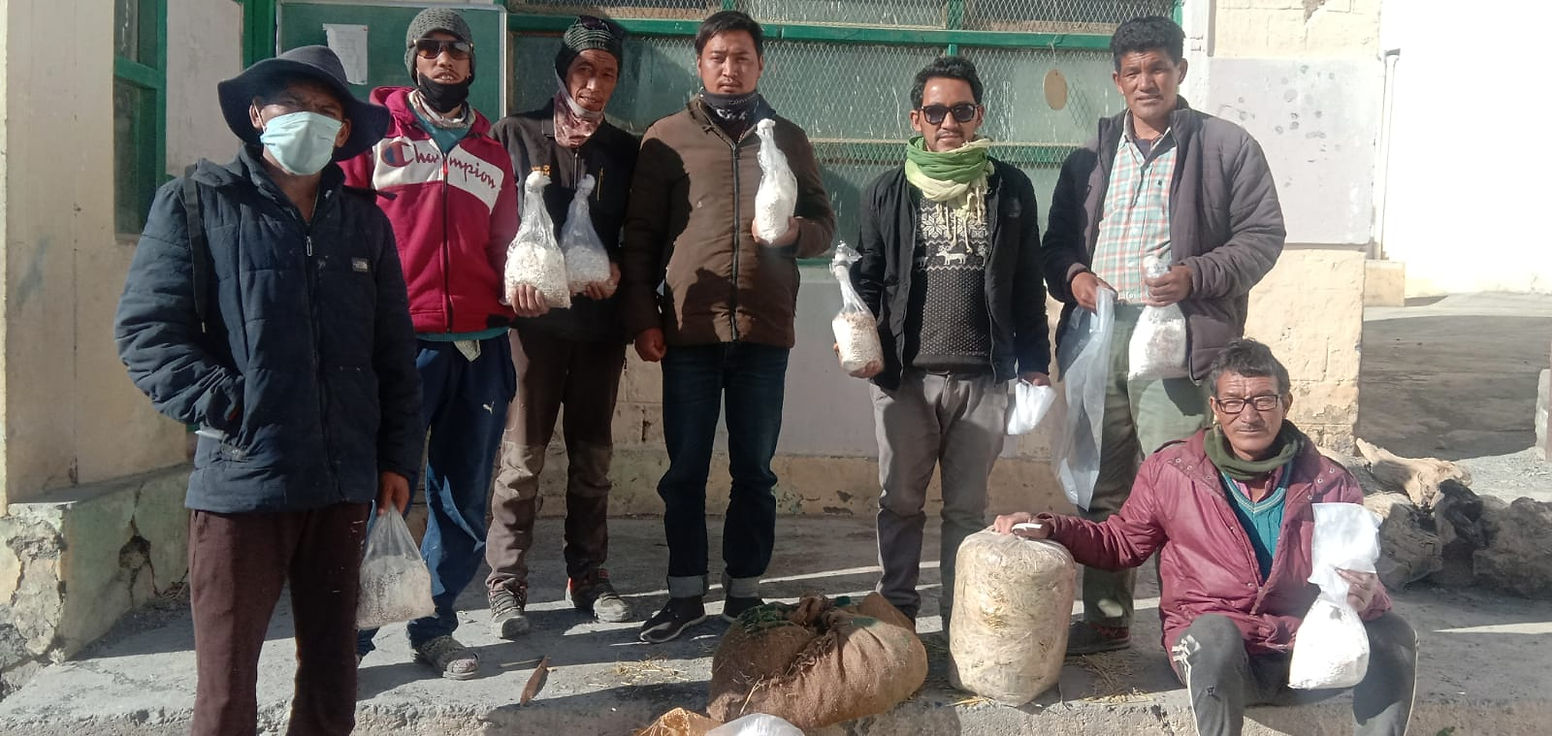
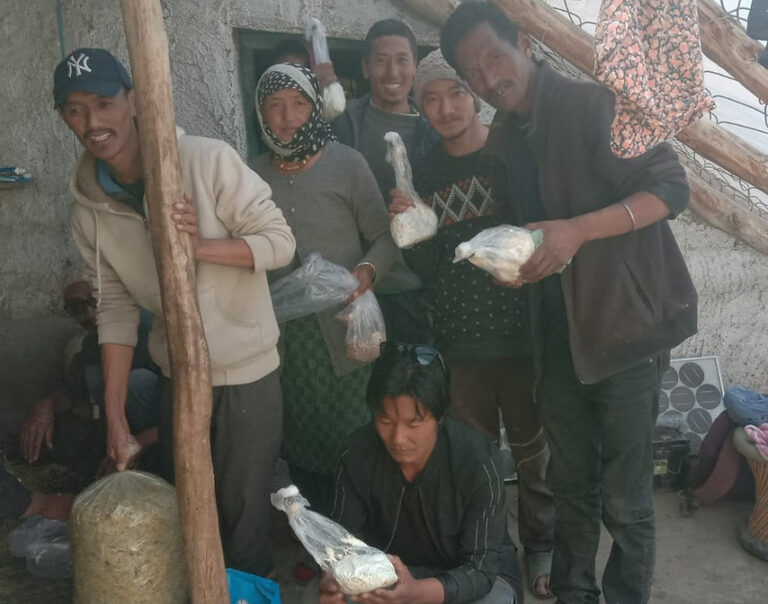
The Department of Horticulture in Spiti and honourable Agricultural Minister Shri. Ramlal Markanda helped me immensely in my journey of cultivating mushrooms. They helped me procure seeds, gain training and greater awareness about mushroom cultivation and subsequently helped me popularise it among local farmers. Along with the Department of Horticulture in Spiti, I have visited multiple villages to spread awareness and conduct training about spawn. We visited Losar Panchayat, Pangmo, Kibber Panchayat, Pin Valley, Kewling, Langza, Komic and trained about 500 people on mushroom cultivation. Men, women, young and elders all showed great interest and several of them started cultivating at household level. Along with awareness, we would also distribute free Spawns to encourage them.

We have been cultivating Oyster mushrooms till now, we can certainly try button mushrooms if we get the seeds. Institutions like ICR-DMR (Directorate of Mushroom Research), Centre for Mushroom Research and Training in Palampur and Dr. Y. S. Parmar University of Horticulture and Forestry, in Nauni (Solan) has been carrying out extensive research and training for mushroom cultivation. We should gain firsthand insights and attend their workshop. Their hands-on training is extremely beneficial. I am very thankful to the department and its officials. I will continue to work for mushroom development in Spiti and I hope that we are able to bear the fruits of this venture in future. My request to all farmers is to adopt mushroom cultivation actively and in case of any hurdles, please do not hesitate to reach out to me for any queries.

1036 492 Kalzang Ladey
Celebration of Churs-pon
Saboo village | Photo: Dawa Dolma

Celebration of Churs-pon

I was a young girl when I first visited Saboo. It was a school picnic and the lush green beauty of Saboo mesmerised me. Having been born and brought up in Choglamsar – a suburb of Leh, filled with overcrowded concrete buildings with sparse vegetation, I assumed all villages in Ladakh to be dull, dusty and barren. So finding a green patch of land was unbelievable. My interest in Ladakh renewed in my early twenties when I first started exploring lesser known places and experiencing its unique socio-cultural practices that sustained life in the region.

Within a few kilometers outside of Leh, one can start to observe the changes in the land-use. Saboo (Sa-phuk in Tibetan), traditionally referring to an inner grassland near mountain foothills, has abundant water resources and greenery. There is relatively less influence of tourism and people still practice traditional agriculture solely dependent on Gang-chu (glacial water melt) and Chu-mig (natural springs). Due to its proximity to glacial water melt, the area supports healthy mountain grassland and diverse agricultural fields. But the main difference between Leh and Saboo is deeper than mere land use. The rural lands in Ladakh are governed by local traditional systems and customs which are truly rooted in the reality of people living there. These governance practices are highly visible in case of village resource management and are as effective as any other form of governance. Although the nearby town has grown multifold in the past few decades, nothing much has changed in Saboo, which is still a village of 500 households. One such fascinating tradition that has stood the test of time is a local custom of electing a water leader in their village. Water leader is the one who is responsible for governing water resources. In my curiosity to know more about water management, I spoke to a local farmer who shared with me the story of Churs-pon.

Photo: Dawa Dolma

Water is the most precious resource and the election of Churs-pon is an indispensable part of the traditional festival in this village. “Chu” means water and “pon” means leader. Churs-pon therefore is a unique water management system which ensures local governance, maintenance and distribution of water resources. Located at the high altitude, cold arid zone with a short cultivation period people have devised local systems that maximizes their resource usage with minimal conflict. Like any social institution, churs-pon enables farming communities in Saboo to judiciously use their land, water resources and enjoy greater prosperity. Churs-pon are annually appointed at the beginning of the agricultural season and Saboo being predominantly an agricultural society, the election of churs-pon is quite an important tradition in the region.

Historically, villagers unanimously elected a well respected man in the community who had rigorous knowledge of customary duties, rights and responsibilities around water management. Now, Churs-pon is appointed rotationally. The selection process differs in each village but in Saboo, the day is marked with auspicious ceremonies and prayers. Venerable lamas are consulted for an auspicious date and communal meetings are held. It is no less than any other cultural affair and locals host a festival called “sa-phak” which celebrates the selection process of churs-pon. Water being a crucial resource, there’s great excitement around it and at least one member of each family is present during the selection ceremony to ensure appointment of a competent leader. The two key Buddhist prayers “Tashi Tsekpa” and “Nangsa Nang-gey” are recited by monks to mark the auspicious start of farming work and bless the newly elected “churs-pon”for his work. The religious ceremony is particularly important for the rightful selection of the leader, who ethically follows all rules and regulations to ensure equitable distribution of water and harmony among farming communities. Communal prayers and holy tantric rituals like “tormas” (barley flour effigies) are offered to deities for agricultural productivity and to garner their spiritual support during the farming season.

Photo: Dawa Dolma

Traditionally, high-altitude communities have self-sufficient agricultural systems and religious ceremonies are done to invoke spiritual blessings of the local deities and to harmonize people’s relation with nature. “The tasks are overwhelming and challenging – a churs-pon has to monitor the water reservoir from five in the morning till eleven at night. Therefore, the right to churs-ponship is mostly given to male members”, says Tsering Dorjay (46) who was Saboo’s churs-pon a few years back. “Earlier we used to have 2 churs-pon but these days we have 4 as there are numerous agricultural lands and we need to ensure equitable distribution to all fields. The work has become more laborious” he concludes.

The agriculture in Ladakh is governed by a short growing season during which Gang-chu (glacial meltwater) is the most important resource. All Ladakhi villages have a community water reservoir called “zing” where glacial water melt is directly collected for irrigation. The zings are connected with water canals called “yura” which feeds water to all agricultural fields. The water is distributed based on requirements of the crops. Since food and cereal crops consume more water, it is first distributed to wheat fields, followed by green pea, barley and finally to fodder crops which are more resilient. A churs-pon is responsible for managing water distribution, irrigation turns, overseeing maintenance of zing, yura, resolving water disputes and ensuring equitable distribution of water among all families of the village without any personal bias and favoritism.

Churs-ponship of Saboo village is a classic example of how a community resource like water is effectively self-governed by villagers and is codified into distinct rules and regulations that everyone follows stringently. The lives of people are dependent on such traditional systems which are orally passed to the next generation, representing a unique community-led, self-governing system. The ethics of impartiality, equity, mutual cooperation and reciprocity are built inherently into the system. However, there’s considerable decline in the tradition of churs-pon due to alternative livelihood options like tourism and younger generations growing up without any knowledge and awareness about the local agricultural system. Mohammad Akbar, a 52 year-old churs-pon of Saboo village, painfully mulls over the loss of this beautiful tradition in his village, “it is doubtful whether the youth these days will continue with the tradition and do farming. It will be a huge loss if churs-pon becomes another lost tradition in the coming few years”. Entire agricultural practices of Saboo and other villages following this practice will fall apart if there is no churs-pon system. It is an indispensable part of people’s livelihood and forms crucial part of their identity.

1200 900 Dawa Dolma
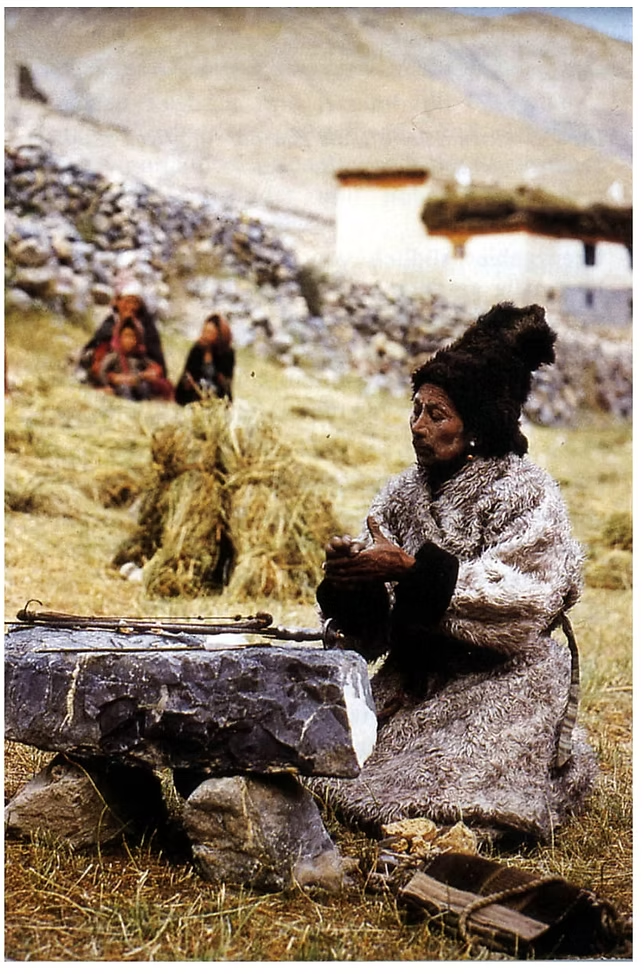
Stone breaking ceremony and Buchen of Spiti
Picture taken in 1998 | Photo: Buchen Tsetan Dorjee

Stone breaking ceremony and Buchen of Spiti

Buchen “the great disciples”

The first time I witnessed a Buchen performance, I remember feeling eerily awed. I do not remember much details about the performance but their ghastly white face smeared with flour and the cheek piercing ritual has stayed distinctly with me. My mother used to scare me that if I ever behaved badly, I would be taken away by meme buchen at night. 

Buchen are a group of religious performers in Spiti who enact elaborate rituals and ceremonies to ward off evil spirits that bring misfortunes. They entrap the spirit in a stone and demolish it through a sacred stone breaking ceremony. The ritual is also associated with curing diseases and healing an ailing heart. Nowadays, it is most commonly commissioned to prevent agricultural mishaps, disease outbreak, disaster and water scarcity in a region. Buchen are well-known for performing folk lore, enacting stories of Buddhist saints, Lhamo (opera) and Namthar (biographies). Given their dynamic role in Spitian society, they are viewed differently as ritualistic performers, opera performers, healers, storytellers and messengers of Buddha’s teachings.

Photo: Pitt Rivers Museum, UK

The Buchen of Spiti trace their lineage to Thangtong Gyalpo, a 14th C religious practitioner in Tibet who was famously known as “Chak zampa” for making iron bridges and stupa in Tibet. It is said that the stone breaking ceremony was first performed by him to curb an epidemic in Tibet; the capital city Lhasa was plagued with 360 different types of deadly diseases – massively ravaging the lives of ordinary citizens. A demonic force is believed to have caused the disease outbreak and it was then Thangtong Gyalpo first performed the sacred stone breaking ceremony to tame the evil spirit. It is believed that he entrapped the demon in a stone, performed the ritual by breaking the stone, and successfully managed to stop the disease from spreading.

He performed it the second time when a demonic spirit was obstructing the monastery he was building. Whatever was made during the daytime was demolished by demons at night. He then performed the stone breaking ceremony where he subdued the evil spirit in a stone and annihilated it by performing the ritual. The monastery eventually came to completion after the demons were tamed. The practice then became widespread in other Himalayan regions and became an important tradition.

Photo: Tenzin Sonam

Thangtong Gyalpo was a versatile figure. He was a highly revered Buddhist tantric master, skilled in monument making, and nurtured a strong penchant for performative art forms like opera, theater, folk songs and writing. He was also the first priest to spread religious teachings through physical enactments of morality plays, allegorical folklore, song & dance and narratorial acting. He strongly felt that the core teachings on compassion, kindness, peace and impermanence should be taught in a way people can understand and implement in their real lives rather than just instructing from scriptures. He then founded the first theatre group in Tibet which goes to every village and performs religious teachings through morality plays and songs. Buchens of Pin valley in Spiti are disciples of this great master and they consider themselves as his sons “Bu-chen = great sons” who will follow the legacy of their master. Paying tribute to Thangtong Gyalpo is a huge part of Buchen’s performance; they put his statue on the altar, pray to him, sing odes and his teachings are orally passed through many generations.

Buchen as healers – relevance of the ceremony

I have seen several Buchen ceremonies during my growing up years and their performances are always invariably very striking. They are bold and impressionistic – one can remember the visuals long after the performance is over. Their repertoire, the enactments, narration and audience engagement are hugely appealing. It is like when they are performing – you are part of the stage, the play and the world they created for you. You might be a silent audience observing them from a distance but they will break the barrier by suddenly putting you in the spotlight – asking you questions, mimicking you and making you part of the play. As such, the distance between the performer and the audience is fluid. You are part of their stage, their world and they derive inspiration, anecdotes from you, your life and the larger community.

The Buchen’s performances are highly centered on religious precepts but with time, it has evolved to incorporate social realities of local communities. The practice is no longer restricted to impart religious teachings but it’s also done to avert serious social and ecological crises like drought, disasters, plague, agricultural loss and to bring harmony among communities. Locals appeal Buchens to perform ceremonies before agricultural season, during particularly low snowfall year, for recovery of physical ailments, while building houses, before starting any new venture in life or to bless a pregnant woman for health and happiness. Meme Buchens play a critical role as healers in Buddhist societies in Himalayan region and their blessings are sought during times of insurmountable distress as well as to bring peace and prosperity. Last year, when the world was gripped with novel coronavirus and there was panic everywhere, remote communities from Spiti sought solace in the healing powers of Buchen, to protect and safeguard them.

Photo: Buchen Gatuk Sonam

Stone breaking ceremonies were performed in many villages like Kaza, Demul, Khurik, Ki and Pin valley. They were also invited to many parts of Ladakh, Zanskar, Lahaul and Kinnaur to help communities deal with crop failure and drought. They were once invited to Patlikuhl, a small village near Kullu/Manali where an annual flood was causing huge devastation. Similarly, in 2018 when His Holiness the 14th Dalai Lama fell gravely ill after an eye surgery, meme Buchen of Pin performed a stone breaking ceremony in his “sim-chung” (private residence) for quick recovery. Individuals, villagers, institutions and monasteries consult them for healing, to dispel hindrances and for an auspicious beginning deed.

Sword dance and the stone breaking ceremony

Buchen form groups of 4 or 5 people. The troupe is led by the head Buchen (Lo chen), an actor who plays the role of Lukzi (shepherd) or Onpa (hunter) followed by two other actors who assist them in various tasks. The Lo-chen performs all key ceremonies and religious narratives while Lukzi grips the audience through his skillful narration, storytelling and repertoire. He is the most captivating character – his deliveries are a blend of social commentaries, mimicries, moral teachings and comic interludes.

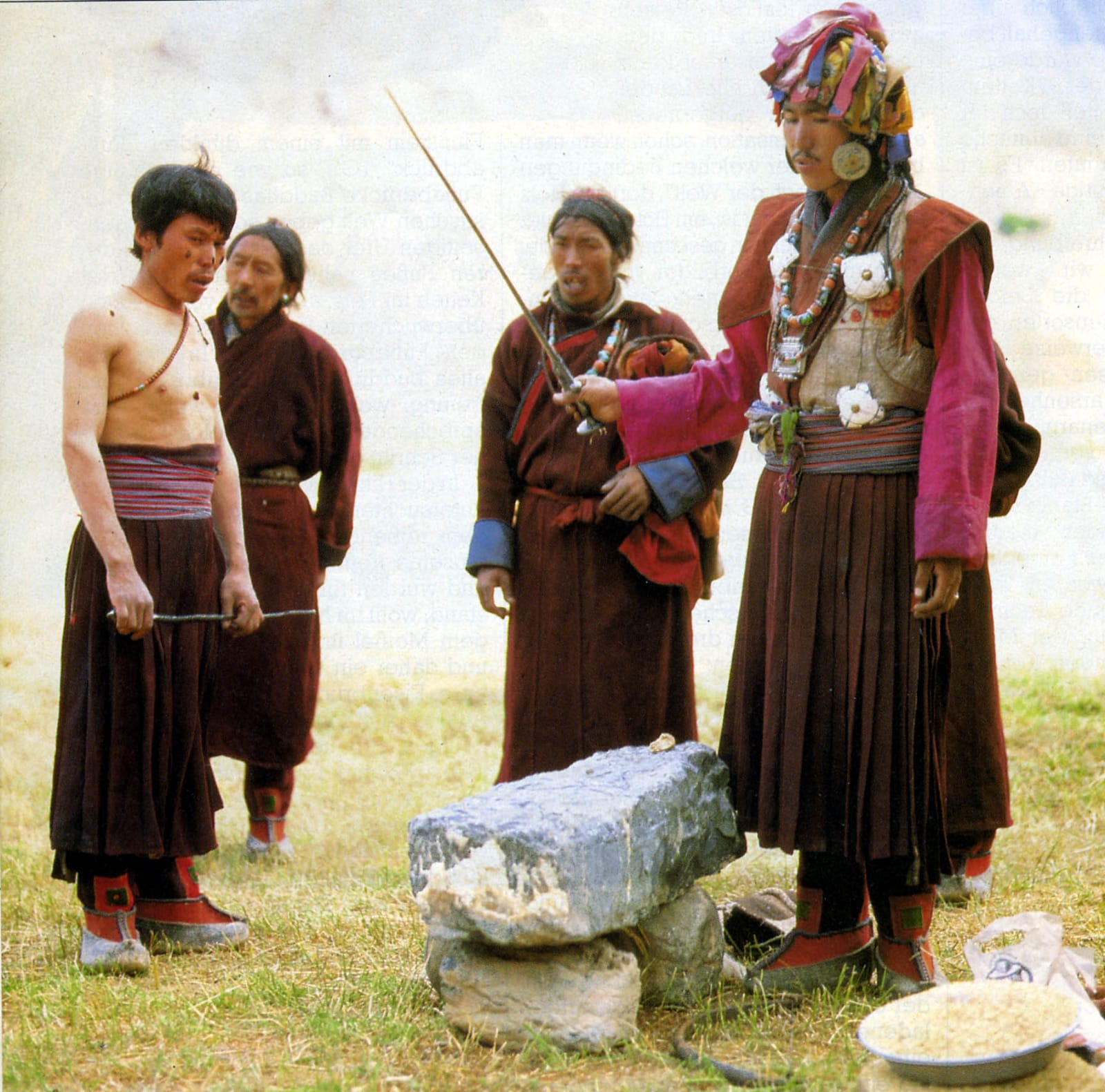
The Buchen head opens the ceremony with prayers, places the statue of Thangtong Gyalpo on the altar, pays him homage and narrates Namthar (biographies). The other team prepares the stage by placing a large boulder near the altar, drawing a human figure on it symbolizing the evil spirit/ demon that is to be demolished and burning incense. There will be brief prayer in between and after that, followed by a dance led by the head Lama rhythmically swinging the sword in slow dance movements.

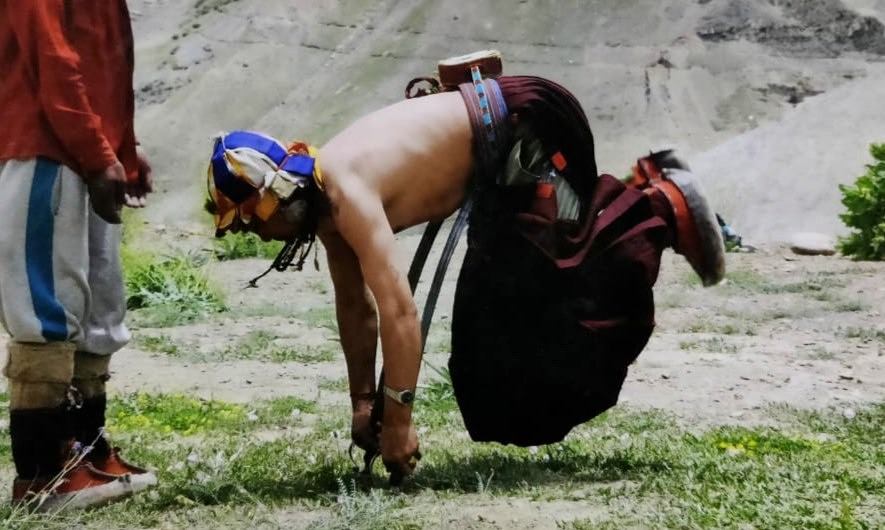
Then comes Lukzi’s turn, who enters the stage wearing a sheep skin and face smeared with white barley flour. He takes over the performance, engaging with the audience – making them crack into loud laughter and burst into tears while the head Buchen prepares for sword dance. He strips the upper part of his body naked, then slowly pierces his cheeks with a large pin and there’s considerable excitement, fear and thrill among the audience who watch him do this. It is a slow careful action and is done to dispel ill omens – the piercing of cheeks symbolizes purity of speech. He then proceeds to point the tip of the sword on his belly and slowly jumps to put all his body weight on it – repeating the act by drawing a sword in his armpits. The whole ritual of body piercing symbolizes the mutual existence of the mortal human body and lha (spiritual deity) that resides in each one of us. The sword dancing and body piercing symbolizes purity of body, mind and speech.

At the culminating act, while Lochen prepares himself for the sacred stone breaking ceremony, the dancer on whose body the stone is to be broken, lies down. A thin cloth and a heavy stone is placed on his body while the other actors look for a second stone. Lo-chen enters the scene, lifts the second boulder and smashes it on the stone placed on the dancer’s belly. The stone breaks with loud thudding noise signaling annihilation of the demon whose spirit was entrapped in the stone. Meme Buchens undergo intense tantric training, yoga, meditation and scripture learning in retreat to acquire such high feat. They acquire immunity towards fatal injuries and mishaps while performing ceremonies after decades of stringent training and disciplining of body and mind. They acquire mastery over their being before they perform healing treatments on others.

Photo: Buchen Tsetan Dorjee

They travel extensively within Spiti and outside to perform stone breaking ceremonies among various communities in Himalayan region like Ladakh, Kinnaur, Kullu/Manali, Riwalsar (Tso Pema), Sikkim and Nepal.  Every year they make a journey in small groups carrying the traveling altar, a trunk comprising their costumes, props and other material used for performance and leave from Pin for months at stretch. Sometimes they are out of their homes for as long as six months and come back only during harvest season for the farm work. They recite Namthars, folksongs and perform ceremonies in settlements where they reside and also make trade deals with the locals. They also sell horses and in turn receive Khullu (Yak wool), hand spun blankets,  Lena (Pashmina) and apricots. The Buchen tradition has seen huge decline in Ladakh and the meme Buchens of Pin valley often get invited to perform ceremonies to revive crop failure, crop damage and to appease local deities for abundant snowfall. They travel all over Ladakh; Demchok, Korrzok, Tsokar in Changthang to Choglamsar, Parang valley and even in Zanskar. Alternatively, in Kinnaur they visit Chango, Nako, Malling, Leo, Hangrang and even go as far as Rampur where the biggest trade fair in Himachal happens. Wherever they go, they are treated with utmost respect and their sword dancing and stone breaking ceremonies are considered equivalent to the Jintsak ceremony performed by highly incarnated Rinpoches (religious leader) to dispel ill omen and bring prosperity in the region.

Buchen tradition has undergone a tremendous change over the years. It used to be a widespread practice in many Himalayan communities but now it is actively pursued only in Spiti and that too minimally – there are only 10 remaining Buchen households in the region. “.. people no longer value our skills” laments Meme Buchen Tsetan (76) who is one of the oldest Buchen in Spiti. “Earlier people would bow down in front of Buchen to show their reverence but there’s considerable change in people’s attitude.” They also confide that with the influx of tourists, photographers and filmmakers, the practice has been reduced to a bare minimum where they are generally not interested in listening to prayers and Namthar (biographies) and rush them to perform sword dance and stone breaking which has more element of spectacle.

1600 1581 Chemi Lhamo
Reyun Tache
Remu Painting | Jugmat Norboo (Urgos)

Reyun Tache

Reyun Tache is a festival celebrated two days before Losar in many parts of Lahaul. In my village-Urgos, the festival is marked by each household painting Remu paintings on their walls for inviting good omen and warding off evil. Paintings are made with almost a competitive spirit, with each house trying to do better than others. All the members of the house take part in this celebratory moment and contribute to the painting. Each element of the painting signifies a deeper religious sentiment, and connectedness and harmony of indigenous communities with nature. Thus, it is important for each house to ensure all elements are present on their painting.

The next day is when the fun begins. Everyone visits the homes of the others to appreciate their efforts and ensure that they have included all the necessary elements in their painting. If not, then they have to pay a fine to the village committee and carry shukpa (incense sticks) throughout the day as a penalty.

1471 1811 Jigmat Nurboo
Dartse: The Archery Festival
Illustration: Nawang Tankhe

Dartse: The Archery Festival

Archery has been a vibrant part of Ladakhi culture for generations. It has its origin in traditional hunting. In the prehistoric times, it was practiced during warfare and for livelihood but gradually with change in socio-cultural positions, use of archery in people’s daily practice have dwindled. It, however, continues to hold an important part in Ladakhi culture and local customs. Playing archery using traditional bows and arrows is perhaps one of the very few visible cultural remnants of the past and symbolizes rich socio-cultural heritage.

Many Ladakhi folklore, proverbs, literature and rock-art have references to archery, unraveling fascinating insights into traditional way of living. The oral folklore – The Epic of King Gesar (Kesar-e-zGrums) narrates heroic stories of the warrior king Ling Gesar who was a skilled archer and horse rider. The epic saga also has a detailed account of the art of weapon and armor making.

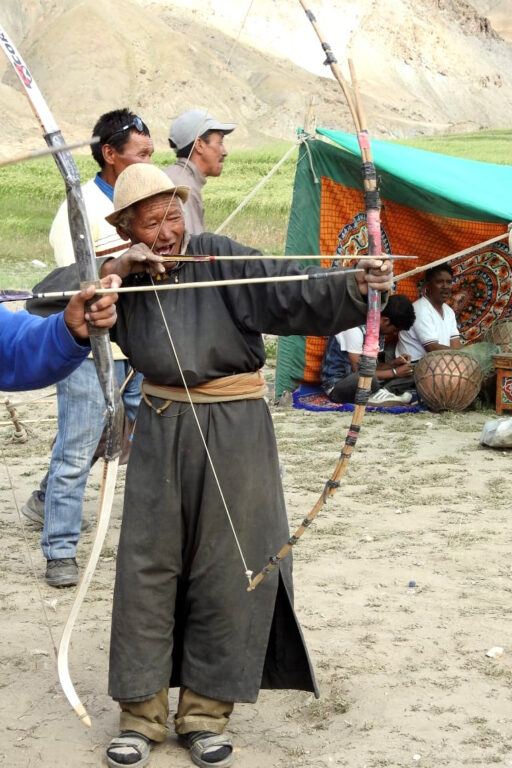
Archery festival in Gya | Photo: Abhijit Dutta

The Epic of King Gesar is the most celebrated oral narrative of the central Asian region and has a particularly huge influence in highland pastoral areas of Tibetan plateau and Ladakh. Phrases like “fast like Ling” – evoking magnanimous strength and speed of Ling Gesar Gyalpo is a common part of local speech. The allusion to natural elements and imagery of nature is also quite frequent. The oral narrative explores the theme of harmony in nature, balance between human and nature, battle between good and evil (deities v/s demons) and disruption of natural order in great depth. In today’s times, much of these oral traditions and cultures are going out of practice and what remains is a watered down version of the rich cultural heritage our ancestors have passed on.

Photo: Karma Sonam

Archery, one of the few remaining traditions, is the most celebrated local festival in Ladakh and is very popular in my village Gya too. Gya, one of the oldest settlements in Ladakh, was historically the abode of chieftain ruler Gya-pa Chow. Today, there are around 150 households in the village dependent on agro-pastoralism. Dah- Fang or Dartse (Archery) is celebrated for good harvest, harmony and happiness in the village. Traditional song and dance, feasts, archery competitions, rituals- all are part of the festivity and prayers.

Dartse is celebrated twice in a year; sPitda is celebrated in early spring after dormancy of winter days and Yarda is a mid-summer celebration. The Spring archery festival marks the beginning of harvesting season and is celebrated right before watering the fields when farmers are getting ready for the cultivation. The Goba (village heads) of all neighboring hamlets collectively consult Rongtsen (oracle) for an auspicious date for cultivation and subsequently coordination for archery celebration is carried out. Once the date for ploughing is finalized, the Goba will announce the date of festival and gather barley, grains and ra-luk (sheep-goat) for the feast.

Women and young girls participate in preparing food for the whole village while men and adolescent boys take part in archery competitions. Drinking traditional wine is a huge part of the celebration and a group of women known as Changma (wine incharge) are solely responsible for brewing Chaang (barley wine) and Aarak (local alcohol) and serving it to archers during the festival.

Gya has 3 main hamlets and Dartse is celebrated collectively in all these villages. It goes on, uninterrupted for 6 days and each village takes turns hosting it in their village. In Hemya (my mother’s village) religious ceremonies for good harvest and prayers for peace and harmony among villagers are done by holy lamas (monks) and the grain sheaf called “Phut”(first offering to god) is offered in monasteries as a gesture of gratitude.

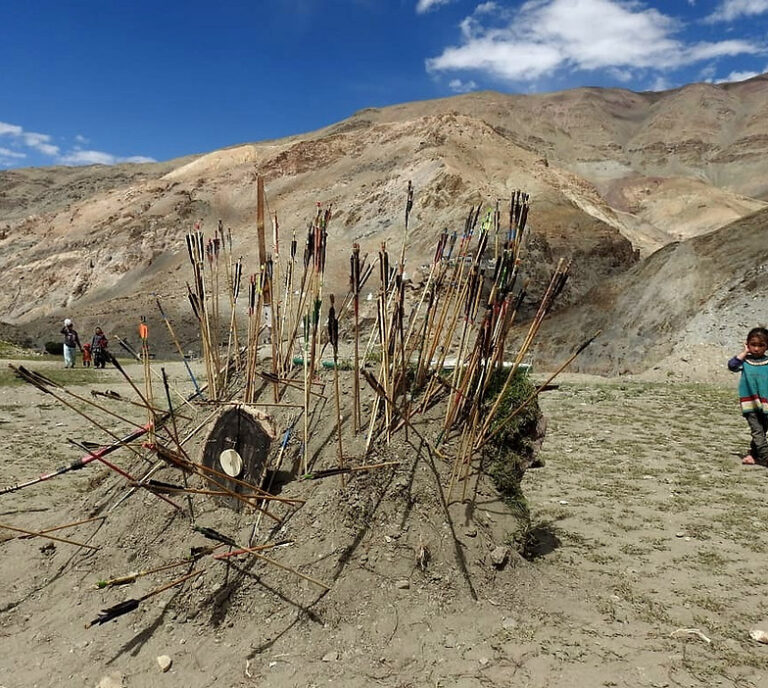
The archery competition is one of the most awaited events of the festivals and a lot of men and young boys take part in the competition. The archers are divided in two teams known as Ma-Bhu (Ma – mother, bhu-son) with one team headed byGoba (village leader) and another team led by Nyerpa (a monk representative). Earlier, bows and arrows were made of ibex horns by skilled artisans but these days we use the ones made of willow and bamboo. The target area is made on a heap of mud to ensure the arrows don’t break, and the target (bull’s eye) known as Tsage is either made of zama (earthen clay) or a wooden plank. The archery competition starts with rdaman pa (traditional musicians) playing songs and when an archer hits Tsege (bull’s eye target) people breakout in loud songs and dance cheering the team. Whichever team hits the target maximum number of times, wins the competition. The winning team has to pay some amount to Rdaman pa as a gesture of gratitude for their services and circumambulate Tsege (target area) in loud celebratory cry Rzang solo!!

Photo: Karma Sonam

Archery is not merely a sports tournament but is an integral part of our communal identity and cultural ethos. It is a reflection of the rich Ladakhi cultural heritage and carries strong socio-cultural sentiments of the people. The festival brings together communities and is important for maintaining cohesion and peace within society. Ladakh being primarily an agro-pastoralist society, the festival is in a way also a celebration of crops that are grown on land and cherish the efforts of the farmers.

But such traditional practices are slowly fading away and many aspects of the festival and traditional customs are altered to suit modernity. Wearing traditional clothes like Goncha (woolen robe), eating paba (barley delicacy) and using bows and arrows handmade by local artisans were significant aspects of the archery festival but are slowly eroding. These days, modern sports gear are used for archery and the spirit of harmony between people, between communities is slowly being replaced by competitiveness of the game. I have personally witnessed these traditional practices (whether farming or archery) undergo drastic change in the past few years and I feel an overwhelming sense of loss. Our land and our practices make up for who we are and I feel it is important to preserve these traditional practices.

1724 588 Karma Sonam
The Water Managers in Kibber
Illustration: Tenzin Metok

The Water Managers in Kibber

In the distance, the early morning sunlight chased the shadows on the mountain peaks. I gazed longingly at the golden patches, wondering how long before I could feel the warmth of the rays. Lobzang saw me and laughed, “Are you cold? Come help, it will warm you up!”

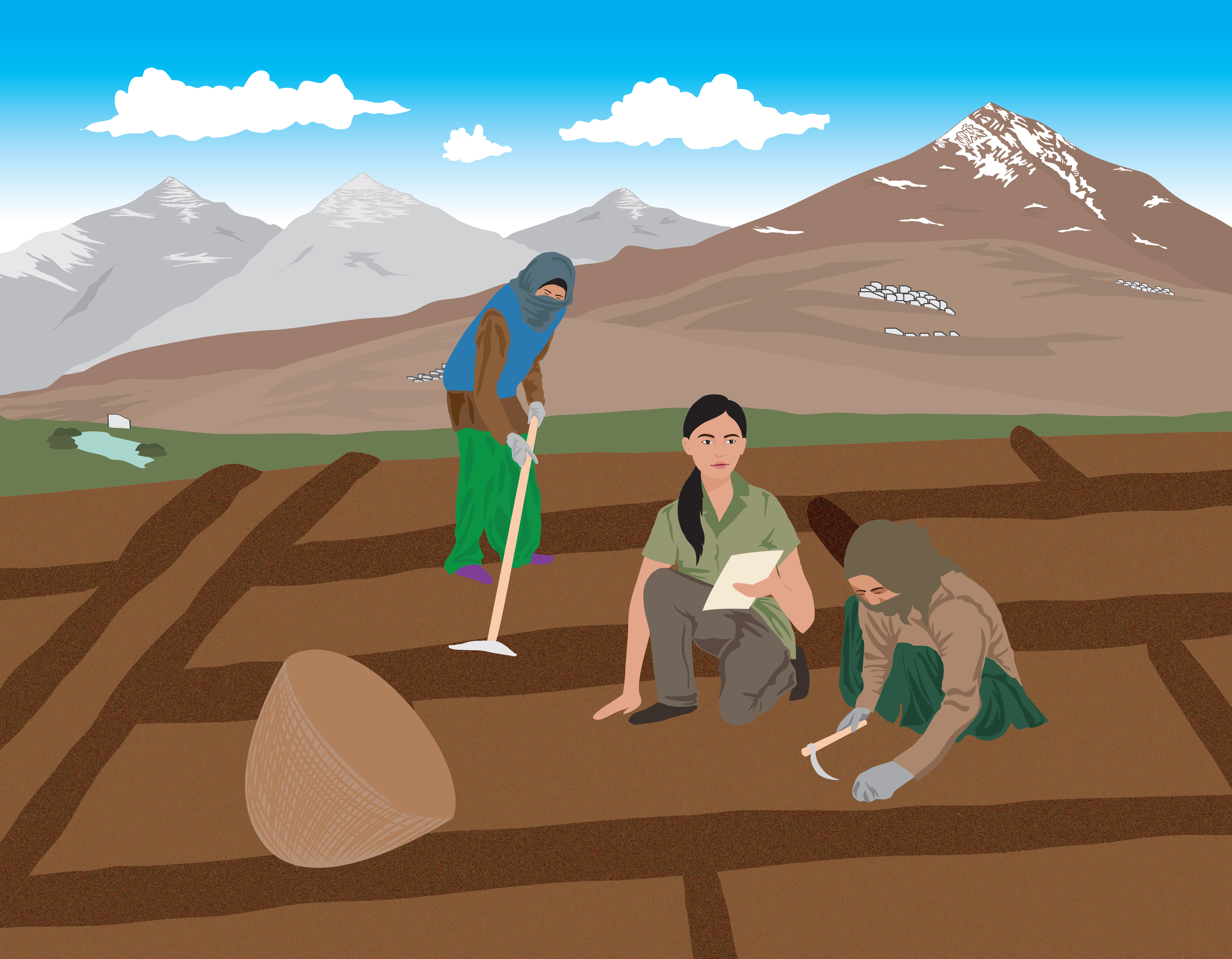
Lobzang was building kyaari in her field. These are embankments built in the fields that help guide the flow of water. They are carefully built based on the natural slope of the land. In the neighboring field, I see Thinley ploughing his land using two yaks. I was in Kibber village, in Spiti valley, and the agricultural season had just begun. The day of ploughing had been decided a few days ago at the village meeting.

“How did you learn how to do this?” I asked Lobzang, fascinated at the skill and speed she was constructing the kyaari. “I’ve been doing this for years. When I was a little girl, I used to help my mother and I learnt from her. This year, it has snowed well, the water will be good.”

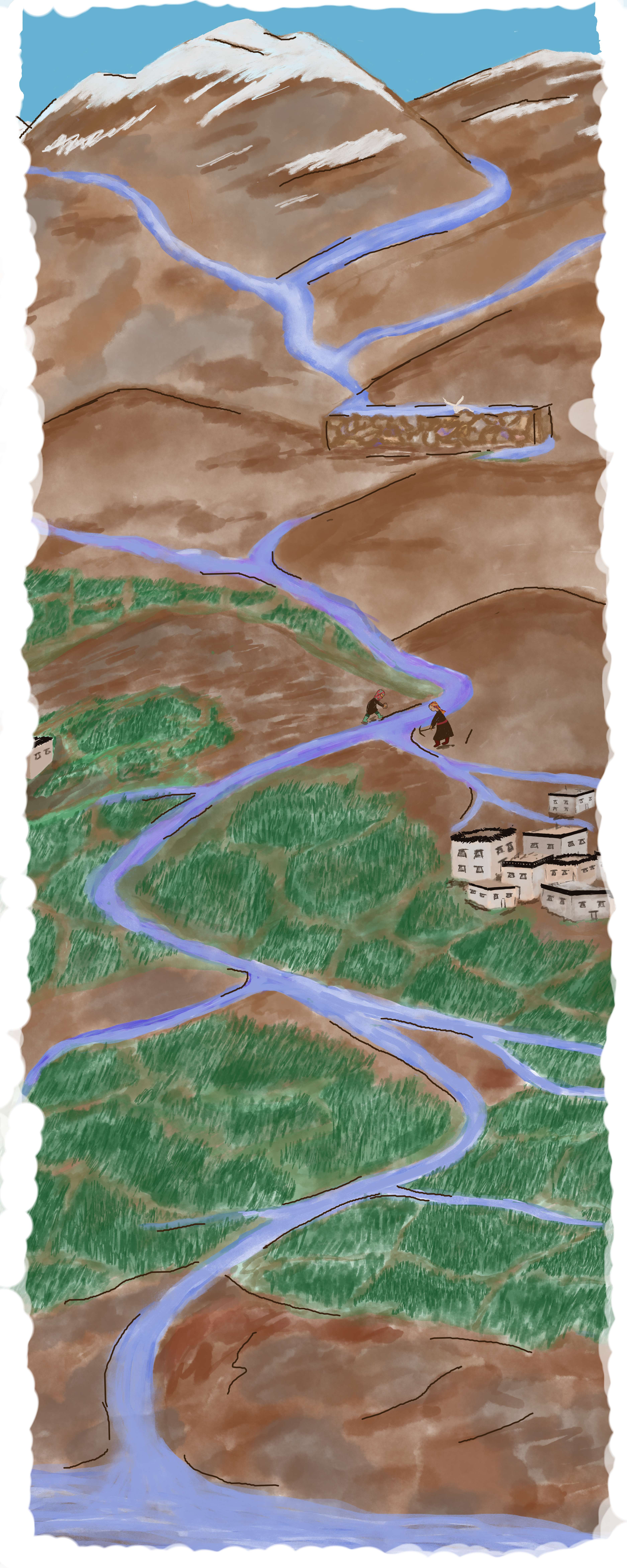
In Kibber, I’ve learnt that the irrigation system is considered the domain of the women. The water comes from the snow melt from Kanamo, a holy peak in Spiti. The water from the peak is directed to the Kibber fields using khuls. This irrigation system was initially built for barley and black pea, but has been modified for irrigating green pea. Lobzang tells me that the women were responsible for fine-tuning the watering for green pea. They learnt through trial and error, but now have perfected the quantity of water needed and when it is needed for a bountiful harvest.

“If you water them too much, or too early, the plants get thirsty, and will need more water. You have to water at the right time, with the right amount”, she tells me.

The crops are irrigated in cycles and in each cycle a fixed order is followed. Yurma, the first round of irrigation, happens 40 days after the ploughing. Just before yurma, women remove the weeds from the field and scatter them with dried yalo (Aconogonum sp). This prevents soil run-off and increases water retention. Irrigation on the first day of yurma is reserved for the fields of amchi and the devta. Women from all households participate in irrigation on the first day. The second day is reserved for families who have faced a serious illness or death the previous year or have pregnant women who are unable to work in the fields. The third day, tiping langzet, is reserved for families who have participated in the maintenance of water channels. After the third day, the remaining fields are irrigated.
This order is followed for the first three irrigation cycles, after which all the fields receive fixed turns. It is the women who decide the time of the second and third irrigation. The women also manage the daily distribution of water. Every year, two women are chosen to be the khul managers. They are in charge of managing the khuls, making sure the fields receive their quota of water, and managing small arguments that might arise related to the distribution of water. This system of women managing irrigation, is similar to systems in other parts of Nepal and South-East Asia. However, across the world, it is uncommon to come across natural resources that are managed by women. Men manage most natural resources, especially those that are shared. This makes the irrigation system in Kibber, and likely other parts of Spiti, special.

The irrigation system in Kibber has been in existence for centuries. Lobzang tells me it has remained unchanged as far back as she or her grandmother can remember. The knowledge of irrigation is passed on from mother to daughter, from the time little girls start helping in the fields.

As the sunrays finally reached the spot we were in, and started warming me up, I felt more motivated to help Lobzang make the kyaari. “Show me”, I said. I was eager to learn a skill that has been passed down from woman to woman for generations. Are irrigation systems in your villages similar to the one in Kibber? Do write-in and tell us about them.

4623 3600 Dr. Ranjini Murali
Himalayan Agriculture
Photo: Thapasu

Himalayan Agriculture

At 14,200 ft above sea-level, surrounded by the trans Himalayan range, I was looking forward to seeing the yak, for which I had travelled from Mysore to Kibber village in Spiti during the summer of 2016. The walk from the village to the pasture was an arduous one, but I had two girls from the village Lobzang & Tenzin who were accompanying me on my quest. On our way, we crossed many agricultural fields where the villagers were growing green peas. It was unusual to see a cash-crop in such a harsh and remote region. They explained how agriculture had taken shape in the last few decades and opening up of roads and tourism brought many possibilities to these remote places. “For our own consumption, we still grow barley. Green peas are only for the outside market” they exclaimed. Barley, a cereal grain, which has been a staple in upper Himachal has been the source of nutrition especially during the long winter months when supply of any food produce is infrequent and unpredictable. However, due to lack of marketing opportunities, there is hardly any demand for it outside of Spiti. Discussion with these young girls led me to develop the idea of ‘Thapasu’.

Photo: Thapasu

Thapasu is a for-profit impact company that closely works with farmers and other collaborations at multiple levels to make agriculture nutrition-rich and accessible to all. We hope to do this by working at ground level in protecting and preserving the agriculture knowledge and the biodiversity surrounding it. Our work began in early 2016 when, with the help of a few researchers and the Government of India, we were able to start this initiative alongside two farmers – Deepak and Poonam from Kullu valley. We began by cultivating and marketing Jattoo variety of red rice. It was a huge success. Since then, Thapasu has been working with tribal farmers to produce, add-value and market various native, heirloom and wild products promoting natural and organic form of agriculture. Some of these include Barley, Seabuckthorn – a wild berry, Black-peas, Rhododendron, Rose Hips and Tartary Buckwheat. Today, approximately 3200 farmers have joined us from three districts in Himachal Pradesh (Lahaul & Spiti, Kullu, Mandi) and two districts in Karnataka (Mandya & Hassan) along with few regions in Leh, Ladakh.

Thapasu works with a ‘Farm to Store’ Model by marketing these heirloom species with the help of institutional partnerships and Government schemes. Through institutional collaboration, Thapasu also engages in building newer technologies which are then transferred to the farmers and self-help groups in converting the produce to the final product. 10% of our profit goes back into the community through various agricultural services we provide for farmers such as soil testing, land mapping, semi processing subsidies from government, skill training and new technology introductions. We are a team of eight resourceful people who bring various skills to enable this work in the Himalayas.

Photo: Thapasu

Food habits have changed drastically over the last 5-6 decades, however, the importance of saving local food systems is only becoming apparent to us in the recent past. Biodiversity is the key indicator of the health of an ecosystem. But the extinction of wild, native and heirloom food grain species may have unforeseen impacts, sometimes snowballing into the destruction of entire ecosystems. Ancient products still continue to grow in certain parts of the country specifically where climatic conditions are harsh and rough because they are able to withstand drought, fix nitrogen and survive in the harsh climatic condition. Introduced crop needs external inputs to do the same. But we are experiencing this shift where traditional crop patterns are being replaced by newer varieties of produce even in the remotest regions of the country. The best way to save the little that remains is by unlearning modern agricultural practices, re-adopting the traditional practices and building a circular system that benefits the farmer, consumer and the environment.

Why Thapasu?
Farmers growing ancient heirloom products do so mostly for self-consumption. For livelihood, however, they have to depend on introduced crops for which they may be using chemical based fertilizers and pesticides. This is harmful to the soil quality and health of the community in the long run. Thapasu ensures a market for the organically grown heirloom products and fills gaps which are prevalent in the conventional agro-marketing infrastructure.

How Thapasu works?
Any farmer/s who grows ancient heirloom products, organically, can reach out to us to help them sell their produce to the outside market. Once the quality and nutritional value of produce is assessed, we begin marketing and selling the produce as a Thapasu product. We buy a set quantity from the farmer which is mostly stored with the farmer and when we receive an order from our website (www.thapasu.com) we request the farmer to send the package to the address via India post. Bigger orders are managed by us directly.

How are farmers paid?
Farmers are paid when we buy the product from them. All the transfers are made directly to the bank account of the farmer. If the farmer does not have a bank account then the payments are made through our local champion who pays them in cash.

How much share does a farmer earn?
Of the total profits earned, up to 50% goes to the farmer as part of direct income and/or services provided by us.

Are there any other services provided by Thapasu?
Organic farmers or farmers looking to change to organic agriculture, can reach out to us for any grievances or consultation with regards to their fields or produce. In collaboration with other institutions, we also conduct regular workshops for farmers for transitioning to organic farming and skill building. We also do soil-testing, land mapping and support farmers to avail government subsidies.

How can farmers reach out to you?
You can give a call or leave a message with your name on +91 973 140 8844. You can also send an email at amshu@thapasu.com or visit our office in Manali: THAPASU Centre, #83/7, Siyal Village, Post Office Manali 175131, Kullu Dist., H.P, India.

427 320 Amshu CR