Pastures

What the Land Teaches Us

What the Land Teaches Us

Some of my earliest childhood memories are of running across the grasslands, chasing pikas, and catching Rufous-necked Snow Finches in Tibet. Growing up, we were told that the two were companions: the pika offered shelter within its burrows, while the snow finch warned of danger and helped keep the burrow clean. Whether this was science or folklore mattered little to us. What mattered was the lesson it carried. On the plateau, life endured through relationships. Animals, like people, survived not in isolation but through connection, dependence, and coexistence.

The pika became my lifelong companion. It is woven into my earliest memories of home. Later, the curiosity I felt as a child watching pikas disappear into their burrows followed me into adulthood, through science, research, and a lifelong desire to understand the natural world. In many ways, the questions that shaped my career grew from the wonder I first felt as a child back home in Tibet. But more than a scientific curiosity, the pika remains a memory of home, carrying a sense of belonging that distance and time cannot erase.
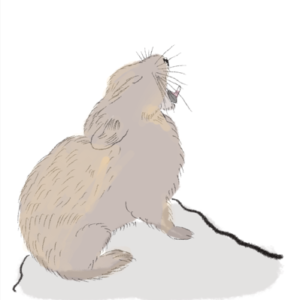
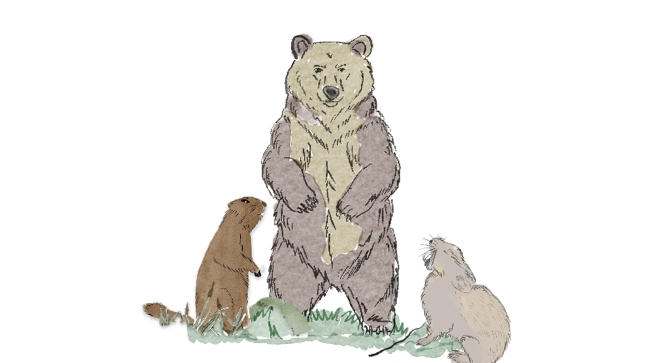
Some of my most cherished memories are of winter. Outside, the land lay silent beneath deep snow and bitter cold. Inside, our home glowed with warmth, laughter, and the comforting scent of butter tea. We gathered around my grandmother as she shared stories passed down through generations. Among them, my favourite was the story of the Tibetan brown bear, the marmot, and the pika. All three animals promised to sleep through the long winter without eating until spring arrived. The bear and the marmot kept their promise. The pika did not. It quietly nibbled from the food it had carefully stored during summer. As punishment, the pika was condemned to spend every short summer working tirelessly, gathering food while the other animals enjoyed spring’s fresh buffet. On the Tibetan Plateau, ecology was woven into stories, memory, and everyday life. Through such tales, people explained animal behaviour, seasonal change, and the realities of survival in a landscape shaped by long winters and brief summers.
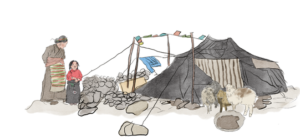
As the western extension of the Tibetan Plateau, Changthang shares its distinctive geography and interconnected social-ecological systems, where ecological knowledge remains deeply woven into everyday pastoral life. Time is not abstract but relational. They are experienced through events: Spring began with the first melodious call of the Pied Wheatear, known locally as the “little shepherd bird.” A sign that says, winter was loosening its grip. The long, harsh season was coming to an end, and soon the pastures would begin to green. As the snow retreated and the soil slowly warmed, marmots emerged from their burrows, and the frozen lakes began to thaw. Migratory birds returned to the wetlands, following the same seasonal rhythms that had brought them here for generations. As the Hoopoe arrives, the milking season begins. In Changthang, people call the Hoopoe a tax collector. Its return in spring is believed to bring its service in the form of abundance, the birth of yearlings and the return of milk to the herds. Carrying families through the lean days of early spring.
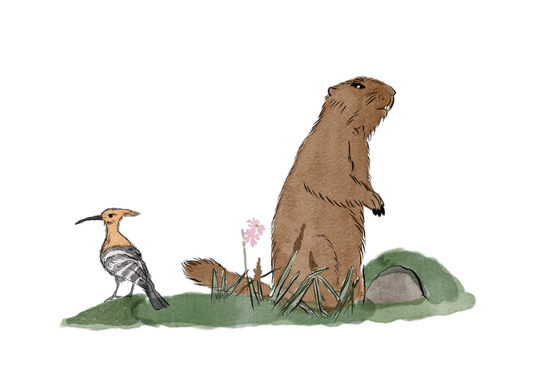
After the hasty spring, summer returns, the most vibrant season of life on the plateau. The earth has regained its biological pulse. The valleys glow green, and every living thing moves with urgency. Summer is brief here, but it is full of life and labour. Where to move livestock, when to leave a pasture, where water will be available, and how long a pasture can support grazing are all decisions embedded in ecological knowledge. Movement is therefore not simply a way of making a living. It is a way of living with the landscape. The boundaries between “nature” and “human life” become difficult to draw. Birds return to their nests, searching for mates; the black-necked crane remains the most unforgettable. A bird that pairs for life, it performs its elegant dances and echoing calls across the open marshes. Together, the pair build their nest and raise their young; marmots and bears, those who once promised to sleep through the long winter, greet the brief abundance and feast on the generosity of the land, as if teaching us that sometimes the greatest wisdom is simply to live fully in the moment given. Others prepare more carefully. The pika, tireless and watchful, begins its labour. Day after day it gathers forage, laying grass in careful layers beneath the sun, drying it patiently so it may last through the winter months. Tunnel by tunnel, it strengthens its home now that the earth has loosened itself. For the pika lives under constant watch, a small creature always on the menu of the plateau’s many predators. Predators too follow the rhythm of abundance. They move across the open land where prey is plentiful, and life is most concentrated. Summer offers choices, and with those choices come movement, hunger, and survival. Summer is generous, but fleeting, and all life on the plateau moves with the same unspoken wisdom: to gather strength from the moment before the cold returns again.
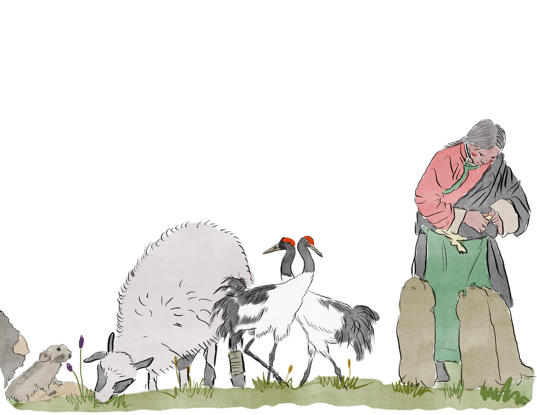
Slowly and steadily, autumn arrives, with shrubs and sedges that linger longer before senescence claims them. As the growing season closes, the landscape slowly shifts from abundance to endurance, reminding every creature that winter is near. The animals taste what remains of the season. Sometimes they graze on locoweed and wander back unsteadily and get drunk and confused. At other times they feast on wild chives, and when they return their breath carries the sharp scent of the chives, an aroma that lingers in the wool of goats and sheep. By now the delicate flavours of summer are gone. What remains is eaten not for delight, but for survival. The sedges are coarse and not as sweet, but they fill the belly, and that is enough.

The air sharpens day by day. Frost begins to settle on the meadow, and the rhythm of migration unfolds across the sky. Birds follow ecological pathways, leaving the high plateau for warmer valleys and distant wetlands. The brief alpine summer passes, and when the season turns, they return along the same timeless route. Slowly the pasture grows quieter. The grasses fade from green to gold, the winds grow colder, and the land settles into stillness. Life withdraws into burrows, nests, and human homes alike. And when the first snow begins to fall across the valley, we gather once more around the fire, carrying forward what the land has taught us through stories, metaphors, and songs. People often speak about strength as an individuality, to be strong enough to withstand hardship alone. But in Changthang, Survival is deeply relational. People depend on livestock; livestock depend on pasture and water; wildlife depends on the same landscape; and the health of the landscape depends on the timing and intensity of use.
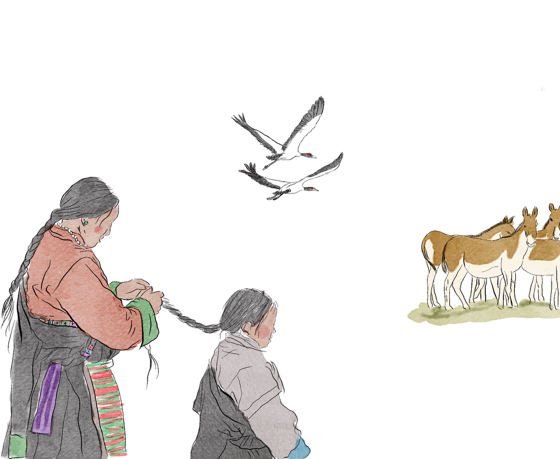
But Changthang is changing faster than we can measure. The most visible transformations are climatic. Temperatures are rising, snowfall patterns are shifting, rainfall has become more unpredictable, and the timing of seasons no longer follows familiar rhythms. These changes are evident across the landscape. But the most profound change is a change in the relationship between people and the land. For generations, survival in Changthang depended on an intimate understanding of the natural world. Water, pasture, snowfall, animal health, and seasonal cycles were not separate environmental concerns. They were part of a single living system that governed movement, livelihoods, and everyday life. Today, the ideas of progress, comfort, and a “better life” are increasingly shaped by urban lifestyles, markets, technology, and modern patterns of consumption. Comfort is often understood as freedom from cold, physical labour, uncertainty, and dependence on natural cycles. Yet these aspirations are not emerging in isolation. They are part of a broader worldview that increasingly portrays dependence on nature as a limitation to be overcome rather than a relationship to be maintained.
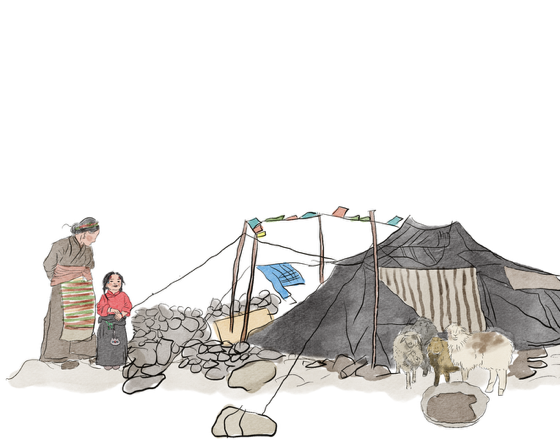
The life of a pastoralist is frequently reduced to uncertainty, livestock ownership, physical labour, or the slaughter of animals. Such interpretations overlook the far deeper relationships that sustain pastoral societies. Livestock is not simply a commodity or a source of meat. It forms part of an intimate web built through care, responsibility, and mutual dependence. Animals provide milk, fibre, wool, transport, income, nutrition, and security. Herders protect them during harsh winters, move with them across space and time, care for them through illness, defend them from predators, and organise their lives around their well-being. When pastoralism is viewed only through narrow external moral frameworks, much of what matters most becomes invisible. The care, knowledge, labour, reciprocity, and ecological understanding embedded within pastoral life disappear from view. What is at stake in Changthang is not merely the loss of a livelihood or a collection of ecological observations. What may be disappearing is an entire way of understanding the natural world. A way of life in which survival depended on attentiveness rather than extraction, adaptation rather than control, relationship rather than separation.

For the people of Changthang, living with the land has historically required limits. You cannot make grass grow faster simply because you need more. You cannot force winter to end. You cannot ask a frozen lake to provide water before it thaws. You move when the pasture changes. You store when abundance allows. You endure when the landscape becomes harsh. This creates a form of ecological intelligence that is easy to overlook because it is not always written down. It lives in memory. It lives in stories about pikas storing hay. It lives in knowing which bird signals the beginning of spring. It lives in recognising when the grass has dried enough to indicate that winter is approaching. It lives in knowing where animals will find shelter, when to move livestock, when milk will return, and when it will disappear again. This knowledge is not static. It changes with the landscape because the people who hold it are constantly observing and responding to change.

Perhaps this is what the land had been teaching me all along. As a child, that species, habitats, and people are bound together through relationships that sustain life on the plateau. The snow finch and the pika, livestock and pasture, people and animals are not isolated parts of a landscape, but participants in an interconnected ecological system. Survival here has never been simply about controlling nature, but about understanding its variability and learning to live within its rhythms. Yet development and conservation often reduce landscapes to resources, ecosystems to services, and ecological complexity to problems to be managed. In Changthang, the land is more than a resource; it is livelihood, memory, and home. The arrival of migratory birds, the condition of pastures, and the timing of snowfall are interconnected signals through which pastoralists interpret environmental change and guide their decisions. This knowledge emerges not from observing the land at a distance, but from generations of living within it.

For Changthang’s social–ecological systems to endure, local and pastoral knowledge must be recognized as more than cultural heritage. It is a dynamic knowledge system, grounded in long-term observation, collective memory, and adaptation to environmental variability. Bringing it into dialogue with scientific approaches is essential to understanding ecological change beyond what can be captured through measurements alone. Our schools, universities, and conservation institutions must teach not only how to study ecosystems, but also how to recognize the knowledge cultivated by those who live within them. As climate and social change reshape the natural world, what is at stake is not only the future of pastoralism, but also a way of understanding our place in the living world. The land continues to speak through returning birds, shifting seasons, animal behaviour, and stories passed between generations. The question is whether we will continue to listen. Perhaps the most enduring lesson of Changthang is that resilience is built through relationships, and that we cannot truly care for a landscape without recognizing that we are part of the ecological processes that sustain it.


Illustrations by Sonam Palmo
659 301 Sonam Palmo
Is pastoralism economically viable?
To add caption add it to "Alt Text"

Is pastoralism economically viable?

Pastoralism is a way of life for a very large section of society in India. But is pastoralism receding? We look at an example of the Changpa pastoral herders of eastern Ladakh, famous for producing pashmina, and see if their practice is economically viable.
This exploration is based on a study led by Chamba Tsetan from the Centre for Pastoralism and was carried out with the support of the World Wildlife Fund for Nature (WWF), India as part of a project funded by the Darwin Initiative.
The study makes an interesting distinction to show how pastoralism as a social activity may be undergoing a transformation, even while pastoralism as an economic activity remains lucrative. So, while the nature of pastoralism is changing, this practice is likely to remain active.

Acknowledgement:
We thank Chamba Tsetan for giving us time to explain this work.

Photo credits:
Pashmina: Aaditya Kitroo via. Wikimedia Commons
Bakarwal: Muzamil Bhat for PARI: https://ruralindiaonline.org/en/artic…
Changpa: Prasenjeet Yadav for Nature Conservation Foundation.
Gaddi: Ajay Bijoor for Nature Conservation Foundation.
Van Gujjar: Traditional Cultures Project, https://www.himalayanmigration.com/start

Map of eastern Ladakh is used for representational purposes only and is credited to UNDP Secure Himalaya (https://securehimalaya.org/ladakh/).

Map of pastoralists in Himalaya is credited to Singh, Bhati and Kerven (2023), https://pastres.org/2023/08/25/pastor…

News articles:
BBC https://www.bbc.com/news/world-asia-i…
Frontline: https://frontline.thehindu.com/enviro…
Mint: https://www.livemint.com/news/india/c…
The Asian Age: https://www.asianage.com/india/all-in…
The Economist: https://www.economist.com/asia/2021/1…

Cover image: Nawang Tankhe

Additional footage via. Pixabay (https://pixabay.com/) and Open Planet (https://openplanet.org/)
Music: Nomads by Edward Earl Hanson from Epidemic Sound via. Canva.

Location: Greenland Guest House, Leh

1200 667 Ajay Bijoor
How to care for livestock in harsh Himalayan winters

How to care for livestock in harsh Himalayan winters

Recent research highlights that viral loads in livestock rise in summer and affect animal health just before the onset of winter. Winters being the harshest season in the high Himalaya, a weak start to the season may mean a higher risk of losing weak animals. We explain some findings from this latest research which was led by Dr. Munib Khanyari and list some easy steps that could help reduce livestock damages from poor health in winter.

You can read the full research here: https://www.frontiersin.org/journals/…
Stock Footage from Pixabay (https://pixabay.com/)


हाल के शोध से पता चला है कि गर्मियों में पशुओं में वायरल लोड बढ़ जाता है और सर्दियों की शुरुआत से ठीक पहले पशु स्वास्थ्य को प्रभावित करता है। उच्च हिमालय में सर्दियाँ सबसे कठोर मौसम होती हैं, मौसम की कमजोर शुरुआत का मतलब कमजोर जानवरों के खोने का अधिक जोखिम हो सकता है। हम इस नवीनतम शोध से कुछ निष्कर्षों की व्याख्या करते हैं जिसका नेतृत्व डॉ. मुनीब खन्यारी ने किया था और कुछ आसान कदम सूचीबद्ध किए हैं जो सर्दियों में खराब स्वास्थ्य से पशुधन के नुकसान को कम करने में मदद कर सकते हैं।

आप पूरा शोध यहां पढ़ सकते हैं: https://www.frontiersin.org/journals/…
पिक्साबे से स्टॉक फुटेज (https://pixabay.com/)

1200 680 Ajay Bijoor
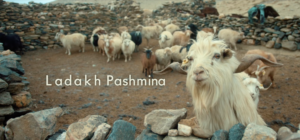
Ladakh Pashmina

Ladakh Pashmina

The story of Ladakh Pashmina: The authentic, sustainable cashmere. A film by Munmun Dhalaria. (Language: English and Ladakhi with English subtitles)

2292 1072 Munmun Dhalaria
Meat momos for everyone
Illustration: Peeyush S

Meat momos for everyone

Illustration: Peeyush S

Unlike most days, folks in Lalung were jostling around with a sense of great urgency that morning. Life in this little village, high up in the Himalaya, is generally slow. But not today. It was hard to tell what the cause of this commotion was. I asked Sonam Chhering, my neighbor, what was going on.

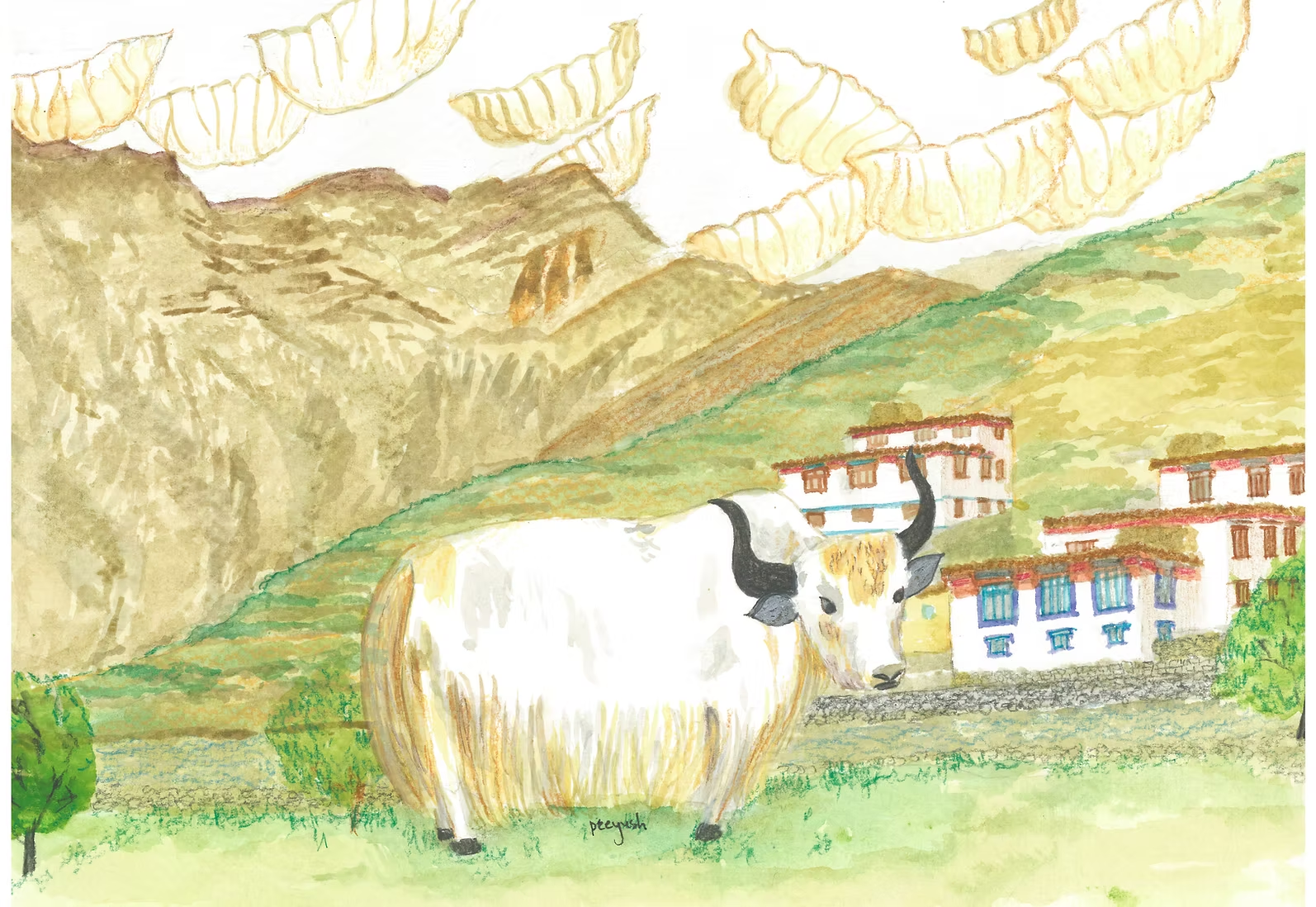
‘The villagers are going to herd the yak from the pasture. The herd was last seen at Kibri, a large pasture at some distance from the village, by the ‘yakzi’, the yak herder. He came home running last evening and reported that one of the yaks had gone crazy!’, said Sonam as he rolled in laughter. People in these villages reared sheep, goat, donkeys, horses, and cows. But the most important animal was the yak, and that for several reasons. The sturdy yak is an excellent assistant in the fields, during farming. Yak wool and yak dung was a precious source of warmth in the extreme winter months. And a yak’s tail can fetch over ten thousand rupees in the local market, if it is spotless white! Takpa—another of our neighbors—had recently purchased a yak from a trader in Manali. This old yak had spent all his life posing for photographs with tourists. He was used to a life of being fed by his master; a far cry from a yak’s life in Spiti. Here, yaks are left free to wander the pastures for most of the year. This means that they roam in a herd searching for green grasses to feast on. Not used to such a hard life, this old fellow spent most days basking in the sun, even if he had to go hungry. He soon developed a nasty temper and would chase down any soul who dared cross his path. Yesterday, it was the yakzi’s turn: he literally had to make a run for his life. So, the men from the village were preparing to catch this old yak. It took the men of the village an entire day to catch the old yak. This old fellow was brought back to the village and tied inside a corral so that he doesn’t play any more mischief. From that day on, I could see this old fellow from my window. He would stare back at me and grind his teeth, as if in warning. In some days I grew used to hearing that ominous sound at practically any hour of the day or night.

One evening, as I reached the village I found everyone beaming with joy. ‘There’s a party today. Meat momos!’, exclaimed Sonam Chhering. Momos—steamed dumplings—are the most favorite dish in Spiti and are prepared only on special occasions. That evening the entire village gathered to feast on meat momos eaten along with spicy tomato chutney. Full to our hearts’ content we walked back to our homes, that moonlit night. As we reached our respective homes, I realised something was missing. ‘Where’s the old yak?’ I asked. ‘He was the meat in our momos!’ Sonam had a wicked smile. My stomach gave a little lurch. It felt as if the old fellow was grinding his teeth inside my belly.

  • ​Lalung is a village inside the Lingti valley in Spiti and falls on the left bank of the Spiti river.
  • Kibri is a tiny hamlet deep inside Lingti valley and can only be accessed by foot.
  • Corral is a small enclosure made to keep domestic animals. Usually a corral is built just outside one’s house.
  • Momos are a type of steamed, stuffed dumplings. This is a very popular dish in the Himalayan region and usually made on special occasions.

​

1594 1098 Ajay Bijoor
The Rabbit, the Fox and the Snow Leopard

The Rabbit, the Fox and the Snow Leopard

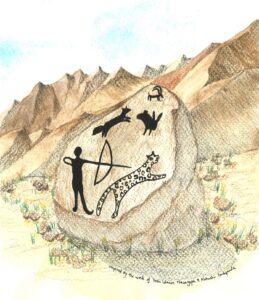
Once, there was a rabbit, a fox and a snow leopard. They lived together in the wild pastures of Pin Valley. The snow leopard was very fond of getting drunk, and loved to drink the blood of animals he had killed, just like humans get drunk when they drink alcohol.

Because the snow leopard was the strongest of all the animals, he would make the fox and the rabbit do all the work. The other animals grew tired of this and decided to get rid of the snow leopard. ​

One day, there was a wedding in the human village and the animals went into the village to partake in the humans’ food and alcohol and to enjoy the party. When the party was in full swing, the rabbit and the fox put on some jewelry and started to dance. Soon, all the animals had started dancing.

The snow leopard was the most drunk of all the animals and started singing loudly. He sang so loudly that his song caught the attention of the human villagers.

The rabbit and the fox smiled at each other mischievously. This was their chance. They got a very long gun and trained it on the snow leopard.

The snow leopard paused mid-song. Even in his very drunk state, the snow leopard had noticed the gun. He froze on the spot.

Meanwhile, the villagers had come running along to see what had caused all the commotion. The fox and the rabbit ran away, but the gun was still trained on the snow leopard, so he could not move.

The villagers saw the mess that the animals had made: the food, the alcohol, the scattered jewelry and the disheveled, drunk snow leopard. The villagers killed the snow leopard, while the fox and the rabbit gained their freedom.

Of course, snow leopards are very precious to us now in Spiti and none of us would ever harm them. But you might still hear local people telling stories of snow leopards who like to drink blood and get very drunk…

1393 1612 Dr. Jane Orton
Changthang – An Oasis of Himalayan Fiber
Photo: Sherab Lobzang

Changthang – An Oasis of Himalayan Fiber

Nestled amid the lofty Trans-himalayan mountains, Changthang is a unique terrain where climate and topography play a crucial role in the sustenance of local communities. The region consists of wide wetlands and giant mountains which offer indispensable ecosystem services and safeguard our water and food security. Many wetlands in Changthang are located at a higher altitude and are fed by glaciers and snow from the surrounding mountains. The high-altitude wetlands in my region contribute significantly to the downstream landscape productivity and form a unique ecosystem for floral and faunal diversity.

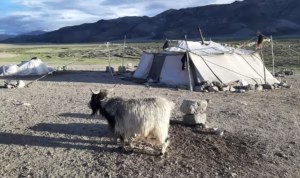
The nomadic pastoral communities composed of distinct groups located at Rupsho, Kharnak and Korzokh rear a variety of livestock such as goat (rama), sheep (luk), horses (ta), yaks, and donkeys (bhungpa) which supports them in all aspects of their lives. The Changpa shepherds are skillful in tending their herds; navigating steppe grasslands, accessing fertile pastures, breeding resilient animals, caring for livestock, and preventing diseases. When there’s less grass in the pastures or the livestock are not able to graze due to excessive snowfall, they provide the cattle with fodder they have stocked months before to avoid weakness and starvation. It is precisely the efforts of the local herders and the nutritious resources in the cold arid land that the livestock we breed gives the finest fiber.

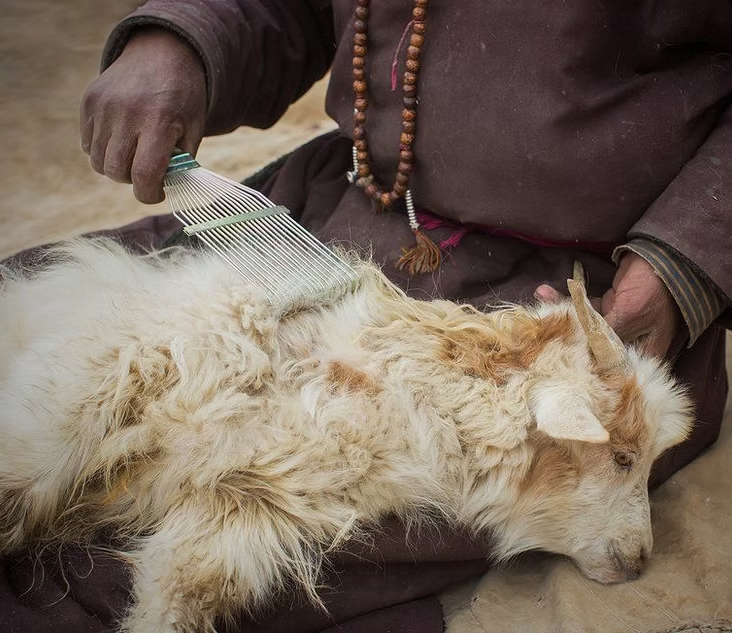
Pashmina Combing | Photo: Andrew Newey (cnn.com)

Ladakh has a highly diverse textile tradition that reflects its physical, socio-cultural, and environmental features. The herd provides different kinds of fiber: Khullu or Sitpa from Yak wool, Ral from Goat hair or Sheep wool, and Lena (Pashmina) from the underbelly of Changthangi goat. The wool is sheared from the livestock around early Spring or before lambing season using a wooden/metallic comb. It takes about 2-3 hours to shear wool from a single sheep and since it requires physical strength to hold a sheep, goat or yak to shear, it is usually men who do the work while women clean and sort the wool to remove any impurities. Once the wool is collected, it is laid on the sheet and beaten with a wooden stick to remove dust, dry grasses, and other impurities. It is then washed, dried, and then hand spun with a traditional spindle called “Phang” – thin yarns are made for weaving while slightly thicker and knottier yarns can be used for knitting. From elaborately patterned garments for the nobility to simple home-spun garments from local fibers, a range of garments are processed and procured in Changthang. The local fibers found in Changthang are used for various purposes; Yak wool and goat/sheep wool are primarily used for self-consumption while Pashmina (Lena) is often traded. The high altitude and the intense cold of Changthang serve a good purpose for the growth of the fine luxury fiber Pashmina. Due to its softness, elegance, and warmth, it is one of the most coveted fibers and fetches the highest price.

Rebo and landscape of Changthang

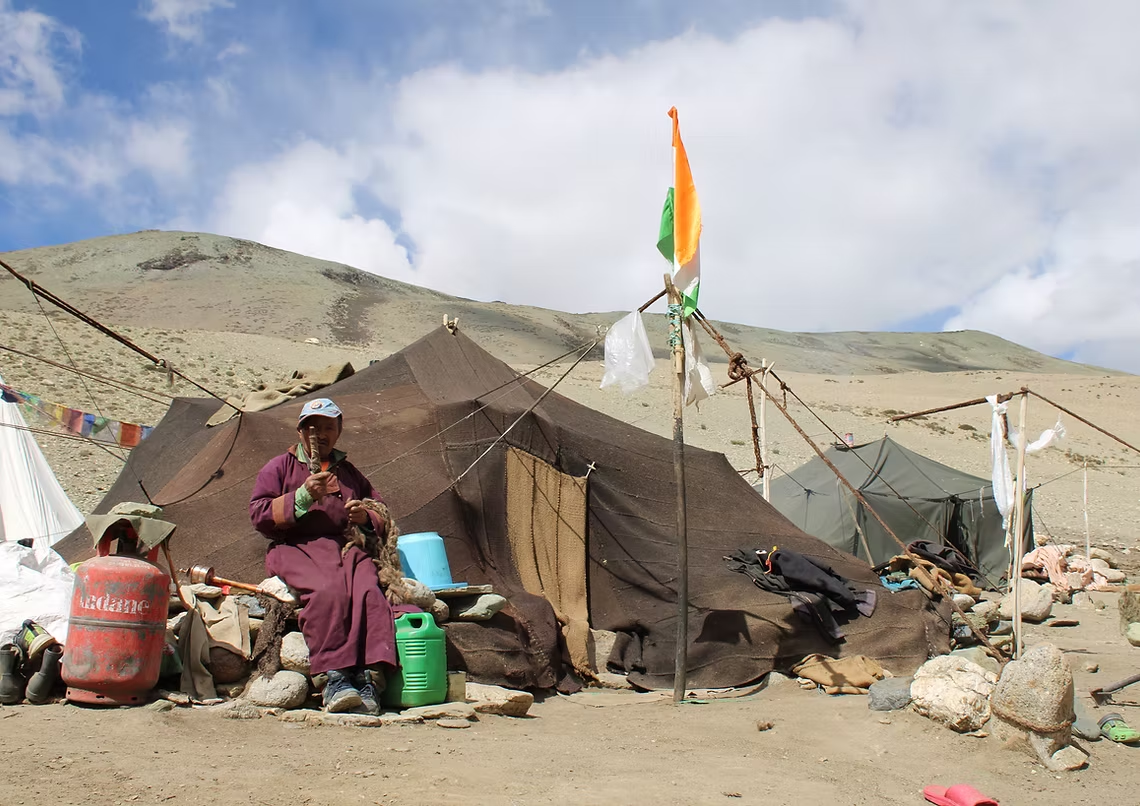
Weaving is an ancient craft and Changpas are reminiscent of the time when our ancestors wore clothes made up of animal skin. Due to freezing weather, animal skins are still used for various garments, quilts, and mattresses. The rich tradition of textiles came into being when our ancestors learned how to spin, make yarn, and weave. Wool and fiber are an integral part of the nomadic culture as Changpas reside in the traditional tents called Rebo made of Sitpa (Yak wool). Rebos are very functional and aptly suited for the nomadic lifestyle – as the nomads migrate in search of better pastures for their herd, the use of Rebo comes in handy for them.

“Rebos are very functional and aptly suited for the nomadic lifestyle – as the nomads migrate in search of better pastures for their herd, the use of Rebo comes in handy for them.”

Making Rebos are extremely labor-intensive as it is handspun and handwoven and a group of nomads makes it collectively. Rebos are also precious family assets and are passed down from one generation to another but these days the use of canvas tents is also becoming popular. Handcrafting has great significance in Changpa tradition, it is a skill that everyone inherits and proves useful in resource-starved land like ours. Weaving and knitting are so economical and wholly self-sufficient – we knit sweaters, socks, hats, and mufflers, and weave mattresses, quilts, saddles, and even containers for foodstuffs. Imagine having to buy all these!

Traditional weaving in Changthang

Even the traditional clothes we wear Gos made up of fabric called Snambus. All of which are handwoven from scratch! When I think about the olden tradition of Changpas – whether it is sustainable grazing of the livestock, food habits, lifestyle, or the practices of spinning, and weaving I realize how self-sufficient and environment-friendly the whole system is. However, the practices around local fiber and cloth making are undergoing changes. Machine-made fabrics and ready-made clothes are easily procurable from the markets and one doesn’t necessarily have to make everything from scratch like in olden times. Although a great variety of wool and fibers are found in Changthang, there’s relatively little expertise when it comes to processing these fibers and adding value to them. Kashmiri artisans are way more known for their skills in handicrafts and if this gap can be fulfilled locally, the fiber value chain will be complete in Changthang itself.

1770 1048 Padma Dolker
Reflections on farming life
Photo: Panma Gyatso

Reflections on farming life

I was born in Hango (11,500 ft) which is a remote village in the Hangrang valley of Kinnaur. I am 72 years old and have spent my life in this village as an agro-pastoral farmer. Agriculture is very important to us. When I look back, I now realise that some of my most treasured memories of my village are related to agriculture and food. One of my favourite and most vivid childhood memories is from the time chulli (apricot) season arrived. Our village did not have any chulli trees, so our elders would go to the nearby village of Leo and get chulli for us. When they arrived, all the children of the village would run to the common ground to grab as much as possible in our little hands. Women would also find time during the day to enjoy chulli with each other under the winter sun. Relishing chulli was a communal affair. The seeds were saved to make prized chulli oil (750 ml for INR 2000/ USD 27).

Photo: Panma Gyatso

My other happiest memories are of the festivities and celebrations we had after the harvest. Until a few years back, we had an isolated winter in Hango. So we had to work really hard during the summers to ensure we had enough grains to survive the harsh winters. After gruelling work in the short summer season, the celebrations were especially sweet. Our harvest back then was of barley, potatoes, black peas and cheena/chize (local name). Cheena & barley were used to make flour for thukpa (soups) and salma (local bread). During the festivities we would make various dishes like tolopa, chulipanting (sweet apricot). Communally preparing and eating added exponentially to the taste of these dishes.

Barley was and continues to be used for making local alcohol like chhang and arak. No one, now, grows cheena. The seeds are also very hard to come by. It has completely vanished. Black peas & barley cultivation has also reduced and mainly taken over by the cash crops like green peas, apple, cauliflower etc. Due to increase in connectivity with the outside world, wheat and rice which were only heard of back in my days, have now become staple food. Salma, tolopa, chulipanting etc which were favorites of all age groups are now hardly prepared.

With our generation most of the traditional dishes are also fading away. I am hoping that we can slowly shift back to our traditional crops, as they grow best in our landscape, with focus on apricots for better economic gains. This way we will be able to ensure sustainable growth from agriculture.

792 706 Prithvi Singh
Losar : Animal’s Day

Losar : Animal’s Day

I think I am in fact the least excited and most boring person at any form of festival. Much of it could be due to my introverted genes that wouldn’t fancy gatherings, dancing, fireworks or any other things which involve interacting with strangers, but part of it must be because of my upbringing. I am not sure of both though. But my heart just cannot seem to invite festivity as much as my friends and family do.

I hail from a small nomadic village in Ladakh where the livelihood of everyone is dependent on livestock. Almost every household owns some goats, sheep, horses and yak. These animals aren’t merely our source of income, but are used for obtaining food, fetching water, traveling, and most importantly seeking comforts and friendship. Since our life revolves around rearing these animals and more importantly enduring the harsh reality of having no access to electricity, water and worse not even a single shop in the vicinity throughout the year, we have little time for festivity. Or, many of us are even oblivious of its existence, except for Losar– the Tibetan new year and Thrungkar Duechen – His Holiness The Dalai Lama’s birthday. Hence, every single person in the village looks forward to these two days like a child, although for different reasons.

Photo: Namgyal Lhamo

My fondest memories of Losar and Thrungkar were significantly boring compared to my cousins. But these days, no matter how many festivals I witness as I travel through urban life, there is nothing more meaningful and beautiful than this idea of celebration I got to see early in my life. It was on one of the third days of Losar. My father came to me, patted my head gently and said with a smile “Life of your polled lamb will be set free”. I was elated beyond words and this memory has remained in my heart so vividly. In my village, on the third day of Losar or Thrungkar, fathers of the households are the busiest. They get up early in the morning to appease the Land God and other deities who are believed to be the true owners of our land according to their ancestors. This is followed by their brief journey to the animal shed where they would choose some animals randomly and set their life free. By that, we are not allowed to send them to slaughter houses, milk them and are expected to watch them with unconditional love and care which every animal receives anyway, until they die. It was my most awaited moment of the festival. My siblings and I would always hug our father with utter joy after he would come out of the shed. This act is mostly done to honor and thank the sacrifices of animals for our livelihoods while it is also performed for the health and long life of His Holiness and carry his message of love, kindness and compassion towards animals.

We eventually shifted to a town nearby, leaving the whole nomadic life behind due to the inability of my family to see the animals suffer for our survival. But, as I look back, I realised that it was this place where I gave birth to my love for animals. Today, even if we live a totally different life, my parents make sure to celebrate these two days by setting at least one animal’s life free. There is nothing more rewarding at a festival for me than this act of genuine kindness. Somehow I think of these two days as a festival of animals and I hope to carry this tradition forward in my own life too.

792 706 Namgyal Lhamo
Lingering memories of my grandmother
Ancestral house where Evi lived | Photo: Chemi Lhamo

Lingering memories of my grandmother

When I was young, I remember my Evi used to take me to yul-sa (Buddhist shrine for village deity) every day in the morning to offer prayers. She would ask me to light butter lamps while she circumambulates around the altar before joining me in prayers. I used to fervently pray for stable electricity at home so that I could watch television the whole day. As an eight year old, I used to be so curious what she prayed and insisted on getting to know. She would shirk me off for some time before succumbing to my pleas and tell me that she prayed for good winter snowfall so that we would have abundant water for our fields and for our animals during summer. She would continue sternly “One should always pray for all sentient beings and your personal wishes will be granted naturally. One should pray for peace, prosperity and abundant snowfall”.

Evi was from Tashi-gang, a quaint village in Spiti with abundant green pastures and less than 6 households. She was quite young when she got married and came to live in Kowang and like any other Spitian women of her generation, Evi had been nurturer all her life; she tended to our fields, the livestock and was sole custodian of our ancestral home where she lived independently until she was too old to live on her own.

Aapa used to tell me that Evi was deeply attached to her land “there was no difference between us, our shinga (fields) and our dzomos (female hybrid yak). She would tend to us all no differently”. She started working in the fields when she was fifteen and did that for another fifty years. She tilled all our fields, reared livestock and would traverse high mountains in our village to collect dungs and dry twigs for winters. When she got old and frail, she stayed with us briefly and would often tell me stories of her younger days. She’s filled with memories of my father’s, my uncle’s childhood and would often reminisce about the large herd of animals she raised with equal fondness; memories of dead cattle, sick goats she nursed, new-born calf she cared for and about our dZo (hybrid yak) which went missing mysteriously few years back. She took pride in the health of our land, our village chu-mig (spring water) and our cattle in the same vein she identifies as being a woman of Khangchen (Zamindar family) household whose life was devoted to agro-pastoral responsibilities. She was so closely engaged with the materiality of the agrarian landscape that it became a deeply embodying experience and a crucial part of her identity.

Ancestral house where Evi lived | Photo: Chemi Lhamo

Just like Tashi-gang, Kowang also is a small rural hamlet with just four or five households. Evi made the mountains, the fields, riverbanks and the vast expanse of barren lands an extension of her home. I was often told that she was very fierce and rigorous –someone who toiled hard in her fields and commanded authority. In Spiti, farming and related activities are considered communal affairs. Everyone partakes in the age-old traditional system “Bhey” where there is reciprocal exchange of work which denotes inter-household collectivism. This is further reinforced by Buddhist teachings intricately tying ecological ethics with religious beliefs laying emphasis on the virtue of cooperation and mutual support for each other in a community. Reality however, is more complex – village dynamics play a huge role in shaping agrarian responsibilities. Land ownership, access to resources and decision making is influenced by the undercurrents of unequal power dynamics within different members of a community.

Although men and women both work in fields, there is an apparent work division; Spitian men engage in more cohesive and heavy loaded works like ploughing, harvesting and grazing while women work on array of scattered works (thereby more invisible) like weeding, levelling fields, drawing water channels, irrigation, winnowing, preparatory works of grinding grains and taking out manure from dry toilets. All these supposedly menial works are equally important, time consuming and render solidity to agro-pastoral labour hence are often overlooked. The division of agriculture labour and resource allocation is a reflection of larger social stratification where men of Khangchen household enjoy greatest prestige. “Ane gyi leya la siruk mekak” (there’s no value in women’s work or women’s work is uncounted) is a popular expression and is often said grudgingly to show one’s discontentment.

Buddhist religious murals inside village shrine: Kowang, Spiti | Photo: Chemi Lhamo

I remember chuckling amusingly at a funny anecdote Evi shared, “Me-me (grandfather) used to be so laid-back. It doesn’t matter whether our luk-chung (lamb) strayed off from the herd or whether our village Zing (water reservoir fed from glacial melt water) is leaking. He has no care in the world. His seeding work is so disorganized that it looks as if he did that in drunken stupor of Aarak.” To balance the narrative she would continue, “What would he know of any farm works; he was a tsongpa (trader) and was always away. I used to do all the field work even the ones like ploughing with Yak and dZo”.

Our ancestors were so well attuned to the natural world they lived in that they bore the harshness of living in a high altitude landscape like Spiti with remarkable resilience and self-sufficiency. Their wisdom was so innate and grounded in the material reality of their everyday life. They were deeply engaged with the physicality of the farm-works that they knew how to harness the health of the whole ecosystem, yet they barely saw their contributions as worthwhile.

Living in remote, resource scarce places like Spiti, the value of rejuvenation is central to their environmental ethics. They might not quite articulate it that way but they embody it and live the experience which is also reflective in their ascetic lifestyle and in their belief of complex connection of living, non-living, material, immaterial, physical, non-physical entities to boost the overall health of an ecosystem. While laying dry hay for goats in Evi’s open corral, she would often lecture vehemently, “Farming is not just acquiring food from nature. It is honouring Kunchok Sum’s (three jewels of the Buddhist trinity) benevolence which looks after our soil, our streams, our pastures and overall health and happiness of our animals”.

Living in mountains is not always idyllic as one would imagine. Feeling of isolation and disconnectedness is pervasive | Photo: Chemi Lhamo

As a child, she used to narrate a story about cursed “srinmos” (demoness). She would say, “behind the gigantic barren mountains of our village lies “srinmo-yul” (land of demoness) where ferocious and hungry demoness lives”. She used to caution me that if we don’t tend to our riluk-balang (livestock), our land, let the crops rot, these “srinmos” can manifest themselves in our fields and can cause destruction to our fields and our animals. I used to believe in her story and would help her in chores like milking cows and putting fodder for cattle. Looking back, I think it was her way of making me reciprocate the deep attachment she shared with our land and our livestock.

The unconventional attachment she shares with the landscape results from decades of tenacious experience of physically engaging with the land yet it is not always idyllic as one would imagine. Living amid vast barren land of our village with scarce human companions posed its own challenge. She despised living in seclusion and would often run away as a newly bride only to be coaxed back to return by family members. Rural isolation drove her to the point of desperation even to pray for “miracle disasters” which would merge Kowang with its neighbouring more populated village Kaza. At her extreme old age she was able to enjoy more familial connections when she jointly lived with my cousin’s family in Rangrik. I was always told my Evi was a brilliant cultivator and I wonder whether I will ever be able to understand the rich tapestry of the life she led with all its apparent glory and poignancy.

1280 960 Chemi Lhamo