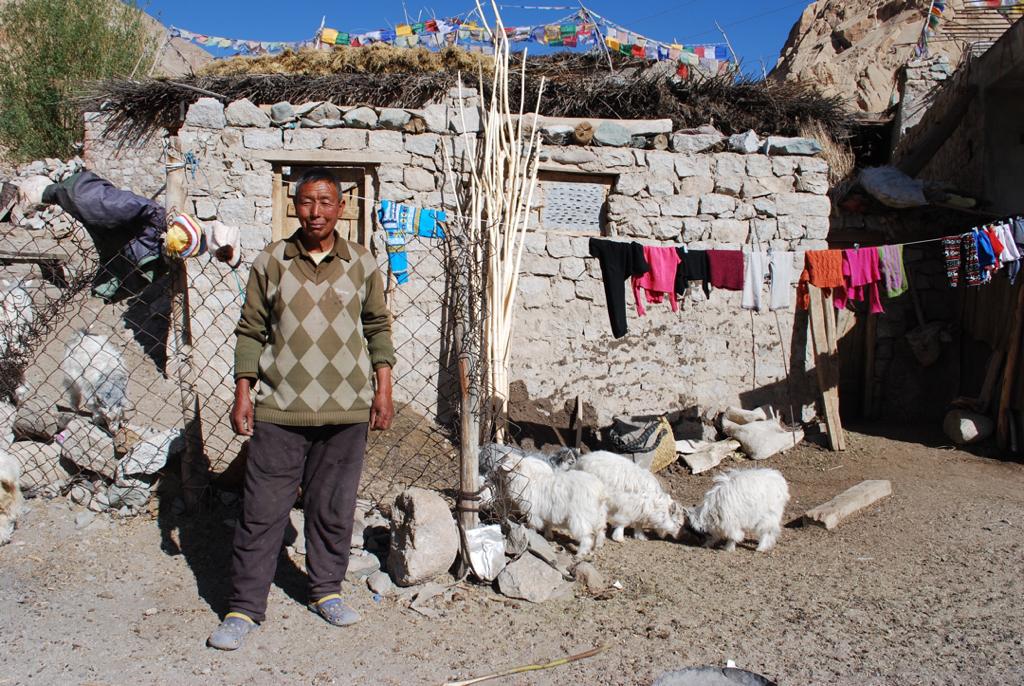
Human-Wildlife Conflict

Counting Spots in the Snow

Counting Spots in the Snow

International Snow Leopard Day is celebrated on 23 Oct. India is expected to announce the results of it’s first snow leopard census based on an extensive 4-year exercise undertaken in the Himalayan regions of the country. This mammoth exercise could not have been accomplished without the support and participation of local people living in the remote high altitude regions of the country.
1200 670 Himkatha
Trekking the Forests of Himachal
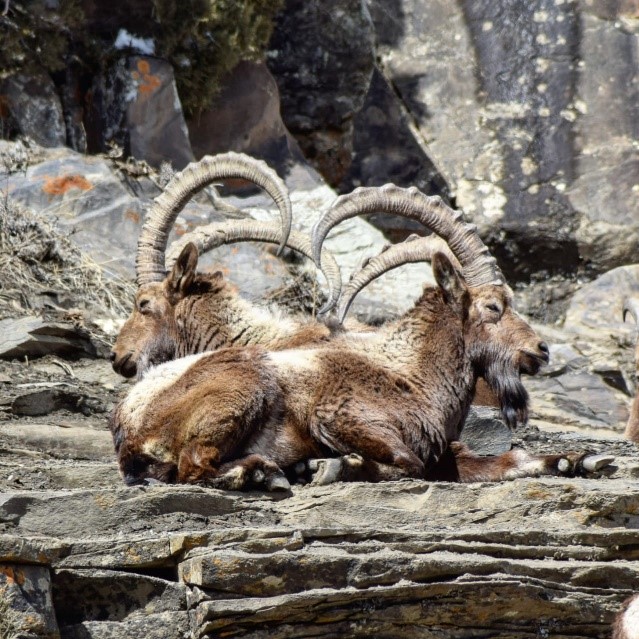
Two male ibexes resting | Photo: Tinkle Bhatt

Trekking the Forests of Himachal

To be a forest guard in Himachal Pradesh means trekking in some of the harshest terrains to document and protect the most vulnerable wildlife. But to me, that is what brings the thrill to my work. A few months back while I was patrolling the forest near Yangla village alone, as I mostly do, I came to learn that a black bear was also roaming the same areas that I had covered. The thought of encountering a bear is a scary one, and I was glad that I didn’t cross paths with the animal. At the same time, I was a little disappointed as I did not get the chance to see it.

Two male ibexes resting | Photo: Tinkle Bhatt

Being a forest guard takes you to new places, you get to meet new people and experience their culture and history and observe their relationship with wildlife. Lahaul offers a lot of opportunities in this regard with its rich culture and heritage. People here really respect forests and nature and it makes my work more enjoyable.

Since I get to travel a lot, I like to document it all through photographs and wildlife photography, although challenging, it is something that I enjoy a lot. This photograph of two male ibex resting on a rock was taken by me on March 17, 2020, at Stingari. I was trekking with a senior who told me that if we stay calm and respectful, the ibex will not run away and they will also take interest in us.

639 639 Tinkle Bhatt
The Predicament of a Herder

The Predicament of a Herder

Winters in Spiti valley are filled with celebrations of a fruitful year and prayers for a bountiful year ahead. Most of the time is spent within the villages as travel is usually difficult especially when heavy snowfall causes roadblocks. The year 2018 was also not much different. In the month of November, as we were readying ourselves for the coming winter months in Kibber, I received an urgent message from a colleague in Mysore in Karnataka.

“A herder has lost much livestock in Chango, possibly killed by a wild animal” the message said.

These were the only details along with a WhatsApp video that was being circulated. Understanding that the matter could be grave and the weather was still permitting travel, I decided to leave immediately for Chango which is in Kinnaur. I requested Tanzin Thuktan, my colleague, to join me. Chango is about 110 km away from Kibber.

We did not have any details about the owner or where exactly the incident had happened. Upon reaching Chango we were clueless, but the good thing about small towns and villages is that everyone knows each other very well. So, when we enquired about the case with local shopkeepers, they were well aware of it and they told us that Thuktan Tender was the owner of the livestock and showed us the way to his house. Thuktanji is an apple farmer in Chango and has a settlement at Liti Dogri. When we arrived at his house, he was confused about why we had traveled from so far to talk about his loss. With a little hesitation, he narrated the whole incidence to us.

On 16th November 2018, Raju, the caretaker of the corral, had returned to the village to gather supplies for the Dogri. He decided to stay back in the village for the night. The next day when he went back and opened the door of the corral, the animals rushed out in panic. Usually, he would have had to take a lot of effort into getting the animals out of the corral. He knew  something was wrong. It was  strange behavior.

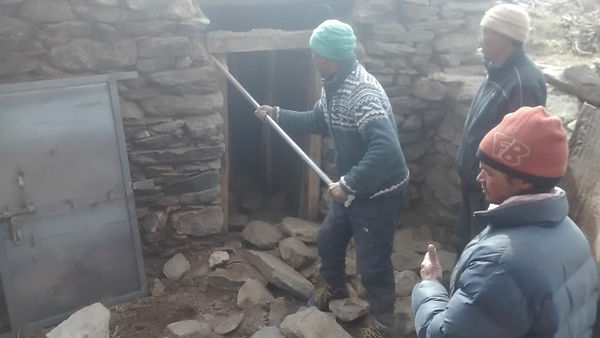
Broken Door | Photo: Mikey Dabro

Standing by the door he carefully scanned the inside of the corral and to his surprise, he saw a set of shining eyes staring back at him in the dark. He immediately knew what it was and slammed the door shut. He called Thuktan and narrated the incident. Within a few hours, the news had reached every household in Chango and nearby villages.

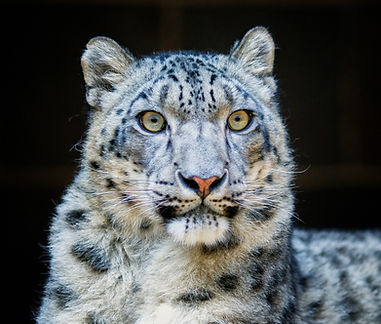
Snow Leopard | Photo: Adriaan Greyling

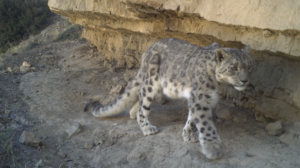
A snow leopard, which had entered the corral in the dark of the night, had somehow got trapped inside. It garnered a lot of attention from local leaders and the forest department to school teachers. Everyone had reached the Dogri to enquire about the incident and see the snow leopard. Upon many assurances of receiving relief for the loss, Thuktan released the snow leopard. He also made a video of the release as a record that the animal had been released unharmed. When they inspected the corral from inside, they saw 19 animals that had been killed and 11 critically injured. Within 2-3 days even they succumbed to their injuries. However, after the release, all the hype around the case vanished. So, when I met with Thuktanji, a few weeks later, he was understandably angry and had lost hope of receiving any financial help. I asked him if I could visit the Dogri, to which he agreed.

Liti Dogri is about 15 km away from Chango. It has three big corrals which houses small-bodied animals like goats and sheep of several livestock owners of the village. Thuktan ji’s corral at any time has 200-250 animals. Upon inspection of the corral, we noticed that the door of the corral was old and did not shut completely. We gathered that the snow leopard must have entered through the door and had gotten trapped inside. To prevent further loss, we decided that we would replace the door with a new sturdy one. The next few days were filled with hurdles. The closest material shop and welder was 130 km away in Reckong Peo. Getting the material on time was crucial to avoid further losses. The three of us drove to Peo in Thuktan ji’s car and bought doors for the corral. The villagers came to help us fix the door. The compensation process as well as the relief amount was also not very clear.

Repairing broken door of Thuktanji | Photo: Nature Conservation Foundation

We decided to speak to the local Forest Guards and Range Officers. They informed us that the compensation file had been sent to the DFO’s office in Reckong Peo. We then met with the DFO who was very sympathetic and assured us that Thuktanji would receive the claim as per the new notification rates. Within few weeks Thuktanji received the claim from the department. Compared to the actual loss suffered and other collateral costs incurred, the financial relief offered by the Forest Department was often considered too little. Fortunately, the department has revised these rates since August 2018 to ensure that the herders can cope with these situations better than before.

As a herder myself, I believe that we must try to ensure that such events are avoided in the first place. Wild animals have always lived around us and will continue to do so. We have always taken precautions to keep our livestock safe from them, and we have to continue doing so. With access to better resources in our remote areas, we may be able to plan this more effectively and upgrade our corrals to make them predator-proof. This way we may be able to prevent any future losses that might occur.

1014 676 Tanzin Thinley
Living With The Wild
Brown Bear | Photo: Janko Ferlic (Pexels)

Living With The Wild

The 19th day of November 2018 was like any other day for Vikram of Pangi, Chamba district. He was walking his cattle in the nearby village pasture by the banks of the Chenab river. Little did he know that his life was about to change. While walking through thick shrubs and vegetation, he didn’t realize that he had accidentally come too close to a brown bear. The sudden realization of the proximity threatened the animal, and out of fear, it attacked Vikram. Vikram caught off guard, did his best to reduce the impact of the attack. He managed to save his life but suffered multiple grievous injuries all over his body and partial loss of eyesight. He immediately went to the nearest hospital to get medical help. He later filed for compensation with the Range Office in Pangi.

In another part of Himachal, a snow leopard, in the dark of the night, entered the corral of a herder and killed 20 animals. The herder, overnight, lost most of his livestock, and being in one of the remote areas, he had no clear idea of what had to be done and how he could get some economic relief from the forest department.

Such cases are not new to these herding communities who often come in close quarters with the wildlife around their villages and pastures. Some of these instances lead to a lot of emotional stress and in some scenarios may also impact the individuals’ personal relationships. It is a very heavy price one pays for living around wildlife. We must ensure that anyone who suffers such a loss is not neglected and helped throughout the process.

Although this problem has been a part of herder’s life for many generations, there are new-age solutions to prevent and mitigate some of these economic losses.

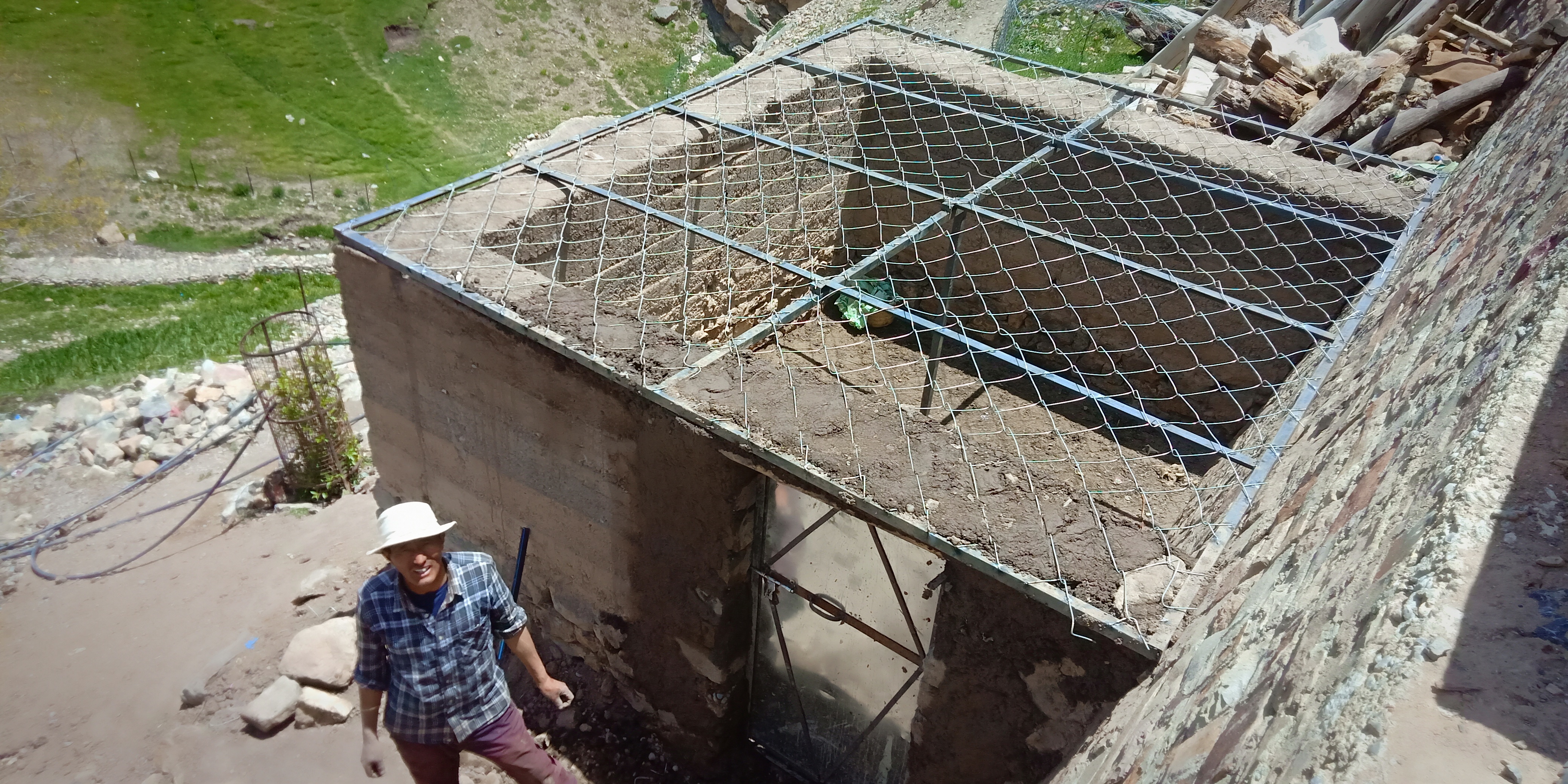
Reinforcing the roofs of the corral to make them predator-proof | Photo: Nature Conservation Foundation

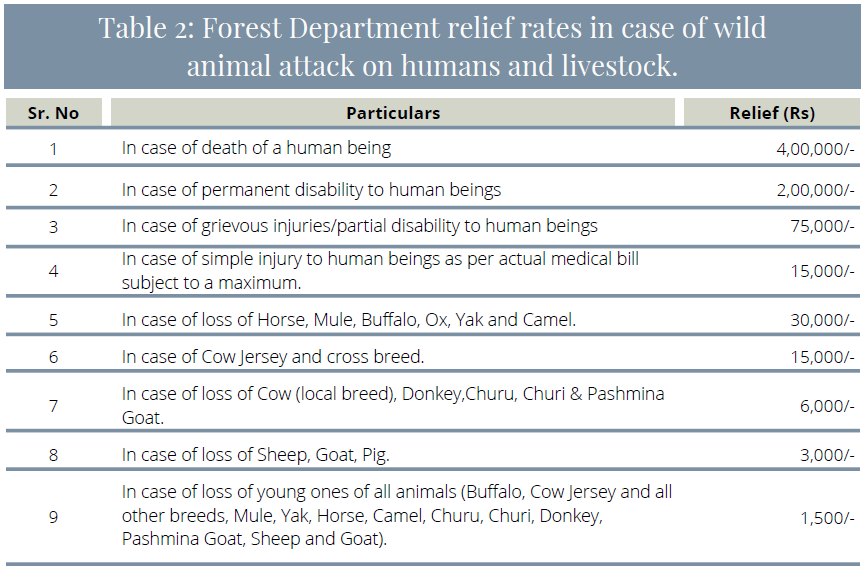
One thing that every individual can do beforehand is to economically safeguard themselves and their family, in case of a medical emergency, by opting for accidental death and disability insurance offered by the central government under Pradhan Mantri Suraksha Bima Yojana (PMSBY) scheme. Although there are eligibility criteria, some degree of financial coverage can be availed from Ayushman Bharat as well. Himachal Pradesh Government offers Ayushman Bharat through its Himachal Pradesh Swasthya Bima Yojna Society (HPSBY). If one does not have any life insurance or pension plan, they should also consider getting one from Pradhan Mantri Jeevan Jyoti Bima Yojana (PMJJBY) and Atal Pension Yojana (APY). For more details on these insurances refer to Table 1. The Forest department also has provisions for providing relief in case one is attacked by wildlife. For details on relief rates offered by Forest Department refer to Table 2.

For livestock, one could take steps to prevent such an incident by repairing and reinforcing corrals to ensure no gaps in walls/doors remain. The roofs can be reinforced with metal mesh to close off all possibilities of attack in the corral. Regular and timely maintenance is of utmost importance. However, the livestock is prone to attack in the pastures and forests as well. Village-level measures, like the insurance program, can help reduce the losses suffered due to such attacks. When the collective losses of the village are high, then insurance of livestock can be planned where the premium and compensation are decided by the villagers and a village committee manages the insurance fund. In case of a loss suffered by a family, compensation is paid out from such a fund. However, the community must be careful and set clear rules and guidelines when starting a village-level insurance program. Currently, there are three villages in Spiti valley where are the community runs the insurance program.

The forest department also provides compensation to the herders in case the livestock is killed by wildlife. However, despite all good intentions, there can be genuine difficulties in timely administering such claims by the forest department and one must be patient but persistent. For details on relief rates offered by Forest Department refer to Table 2.

There are also some traditional solutions to the problem of livestock depredation. For example, in Gue village of Lahaul & Spiti district, there were multiple cases of surplus killing this year. Whoever lost their livestock were helped out by the entire community by each household contributing an animal to the owners. This practice not only takes the stress of losing livestock away but also does not let herder suffer economically. Such practices are reported in other parts of Himachal as well. I am sure that there will be many other local solutions that I have not talked about. I would love to hear about them. Do write about the practices adopted to prevent and mitigate losses from wildlife in your village. Also, if you want to take up this issue in your own village or start an insurance program and need further assistance, do reach out to me or my team. Our details are available on the last page of the newsletter.

In the end, I would like to mention that there is no one, sure shot solution to such complex problems, but Himachalis have continuously been adapting to these challenges, a characteristic of life in the hills, and putting up with the adversities they face.

5824 3744 Deepshikha Sharma
Shangdong to Stupa

Shangdong to Stupa

A short video in Ladakhi explaining the Shangdong to Stupa initiative. Shot by Nomadic Brothers and edited by Munmun Dhalaria. (Includes English subtitles)

2560 1417 Nomadic Brothers