Narrative

Spiti’s Handwoven Traditional Clothes

Spiti’s Handwoven Traditional Clothes

Clothes and identity are closely related: traditional clothes of a region reveal a lot about its geography, physical environment, climatic conditions, and cultural practices. The high altitude and cold weather conditions in Spiti have led to distinct clothing attributes of its people. Since most of the families are agro-pastoralists, the livestock people breed gives different kinds of wool like yak wool, sheep wool, and goat and that forms the natural source for most of the attire worn by the people. In the olden times, people wove handcrafted attires and ornaments from scratch but with increasing access to market and trade, wide varieties of fabrics and garments are available and the clothes designs are adapted with time. Let us share about some of the traditional clothes of the region:
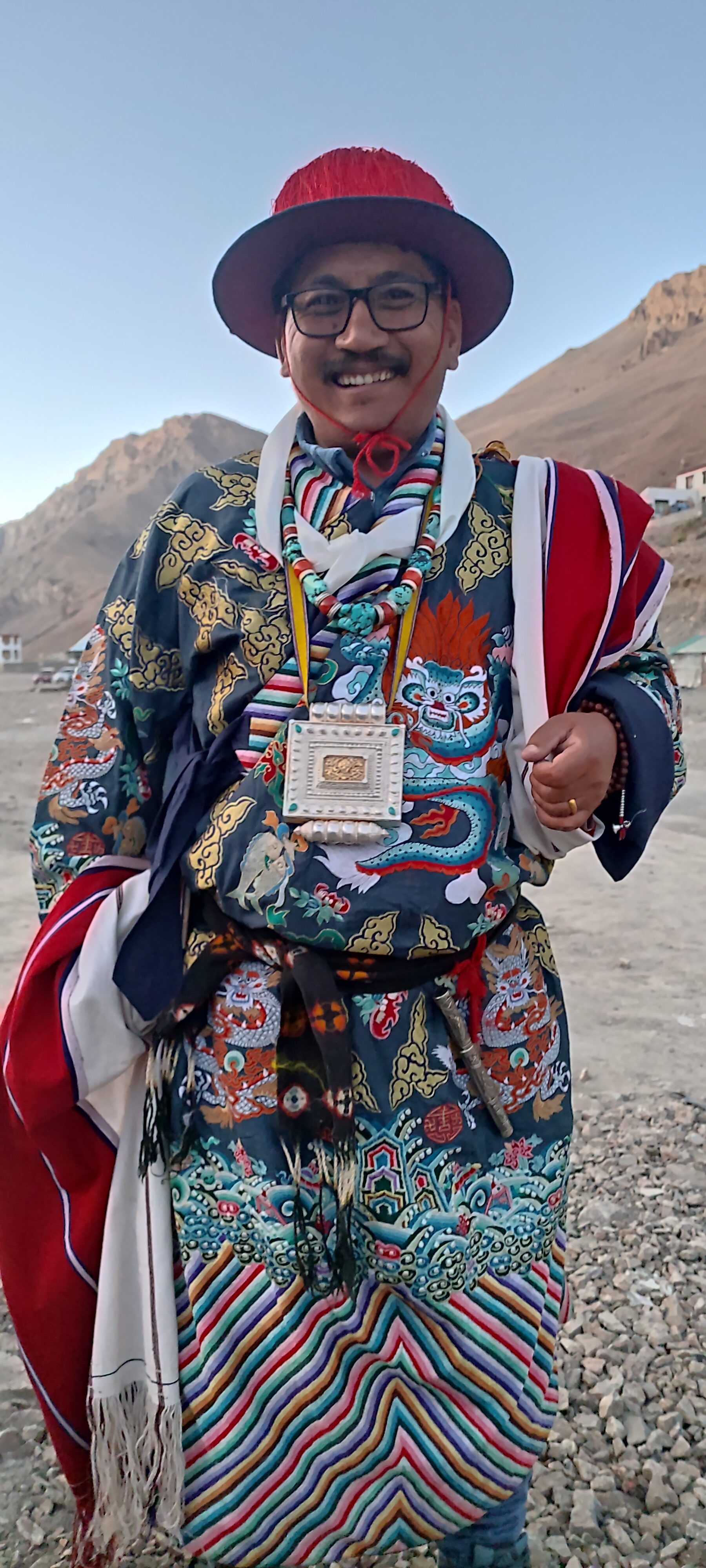
 

Spitian Ghoey | Photo: Rabhi Kunga

1. Reygoi or Ghoey
Ghoey is a thick full-length robe worn by Spitian men. In the olden days, men would wear Ghoey made up of woolen material but with time, robes of thin fabric like cotton also became popular which is called Rey (thin cloth) ghoey (to be worn). The style of the robe resembles the Mongolian robe which overlaps on the right side and is buttoned from the left shoulder. Men usually wear a thin shirt or plain trousers to pair with it and the robe is finally secured by a wide belt around the waist made up of woven threads called Keera. These robes come in neutral shades of brown, maroon, dark blue, and black. With changing times, access to fabrics like silk and velvet has increased so a Ghoey can also be made up of silk, velvet, and other multicolored synthetic fabrics.
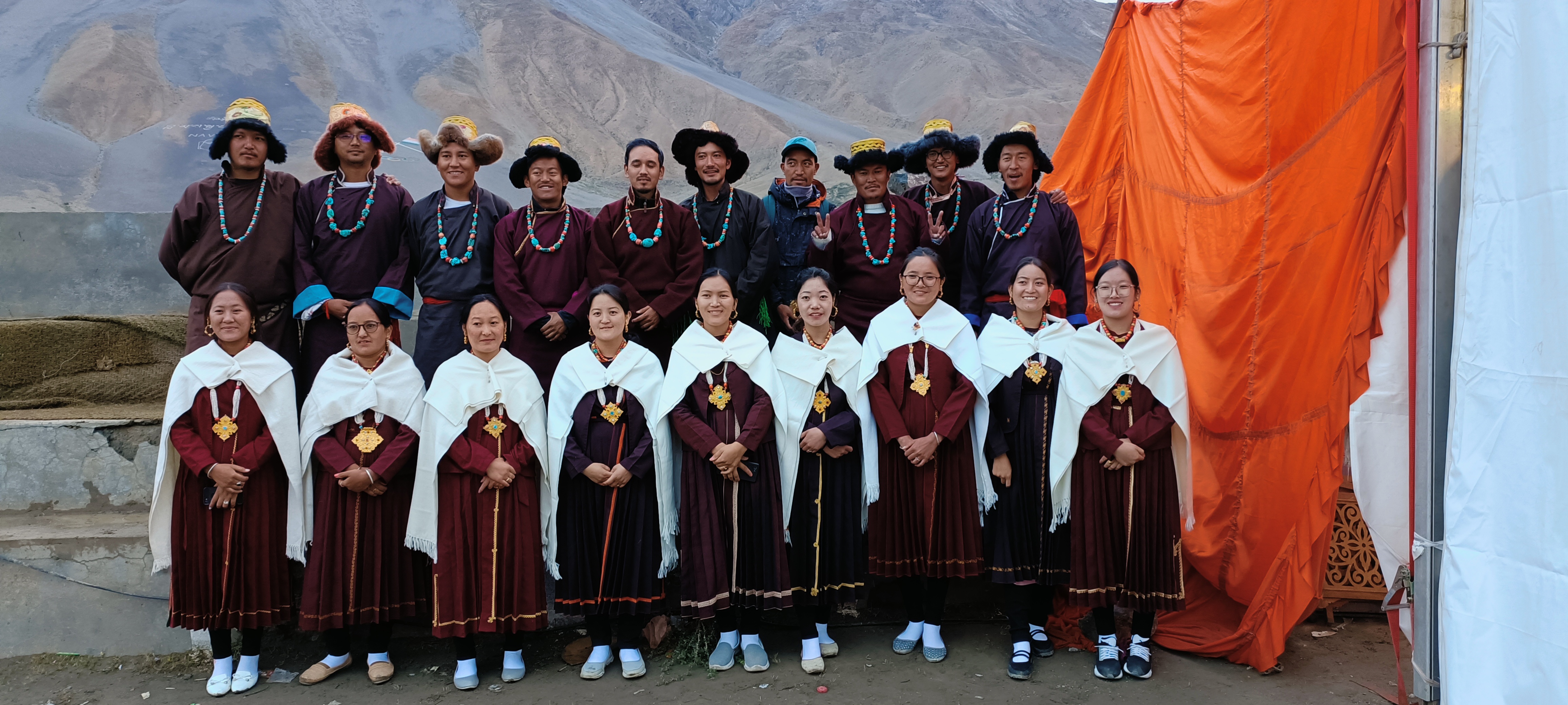
Spitian traditional dress: Sulma, Tsadar and Reygoi | Photo: Radbhi Kunga

2. Sulma
Sulma is a long voluminous traditional gown worn by Spitian women. It has a round neck and long sleeves. The dress flares downwards with multiple pleats which is why it is called Sulma which means; to gather, to fold, to fold into pleats. A thin undershirt is worn underneath and the Sulma is tied with a waist belt called Keera. The dress is fairly wide around the leg, making it comfortable for walking or working in the fields.
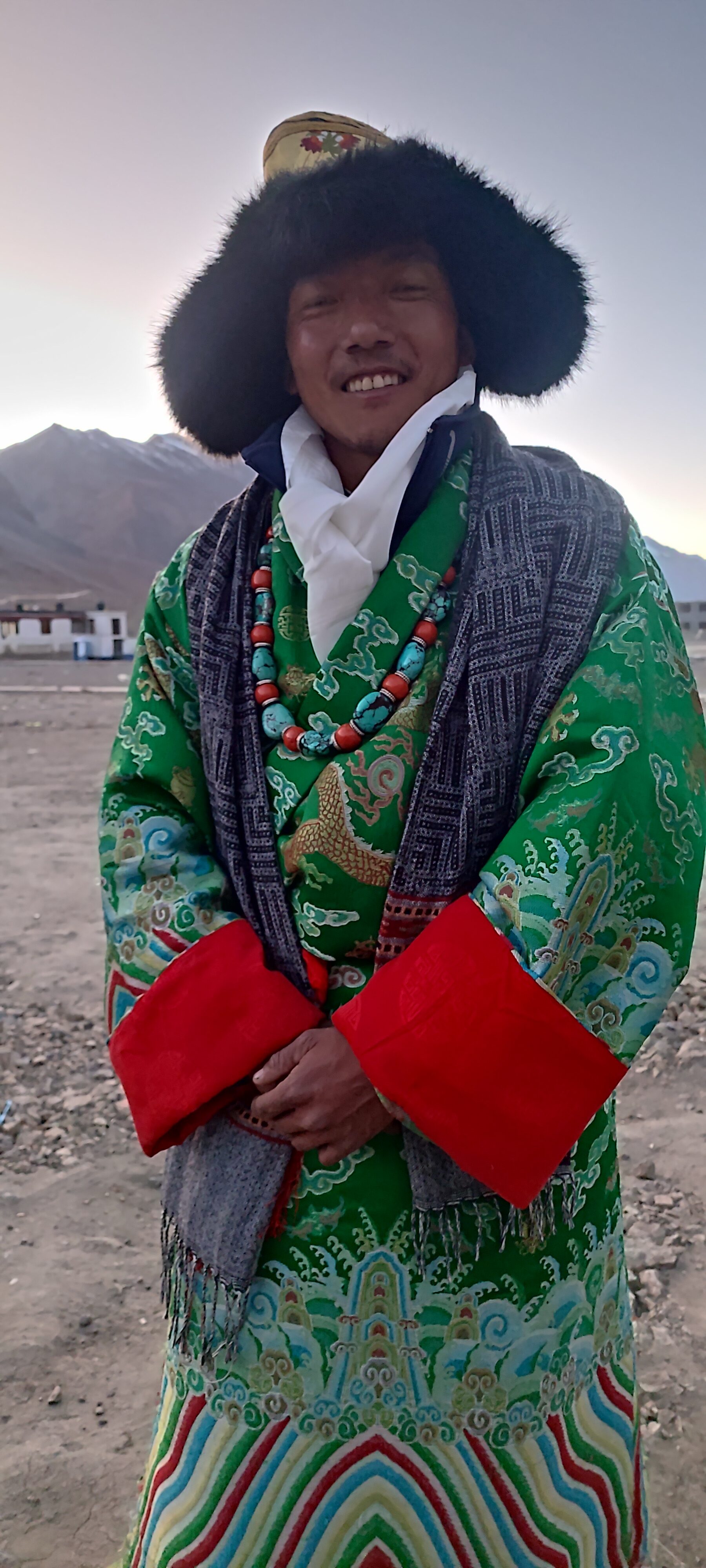
Spitian men wearing Reygoi. Photo: Rabhi Kunga

3. Bhal Sutan
Sutan is woolen or cotton trousers worn both by men and women in Spiti. It is made up of thick woolen fabric called “Nimpu” procured from the local sheep hair. The fabric is woven on a backstrap loom or foot loom, which can then be stitched into trousers of the desired style. Nimpu Sutan or bhal Sutan (woolen pants) is primarily worn under Sulma by women and under Reygoi by men. With changing times, Spitian women popularly wear it with a matching Salwaar or Suit.

4. Lokpa
Lokpa is a thick cloak-like garment worn by women. It is hand-strewn with sheep skin turned upside down with elaborate woven designs on the front. The local name Lokpa (meaning: to turn over) is reflective of the intricate process with which a seamstress makes it. It is extremely warm and is perfect for harsh weather conditions. The thickness of the garment also cushions the wearer’s back while carrying a heavy load on the back like firewood or fodder for livestock. Sometimes, newborn babies or even lamb kids are wrapped in the garment to provide warmth and comfort.

5. Lingzey
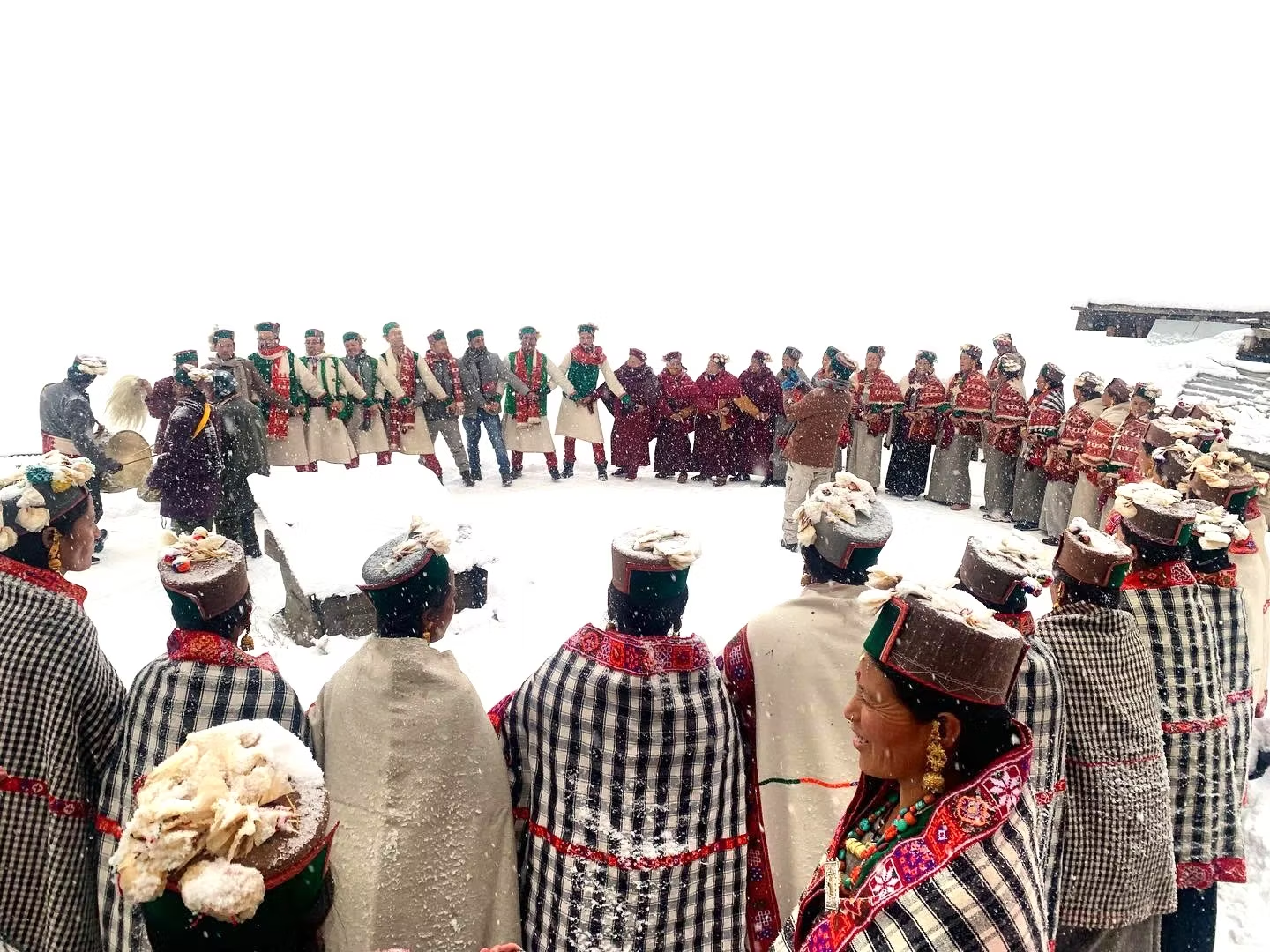
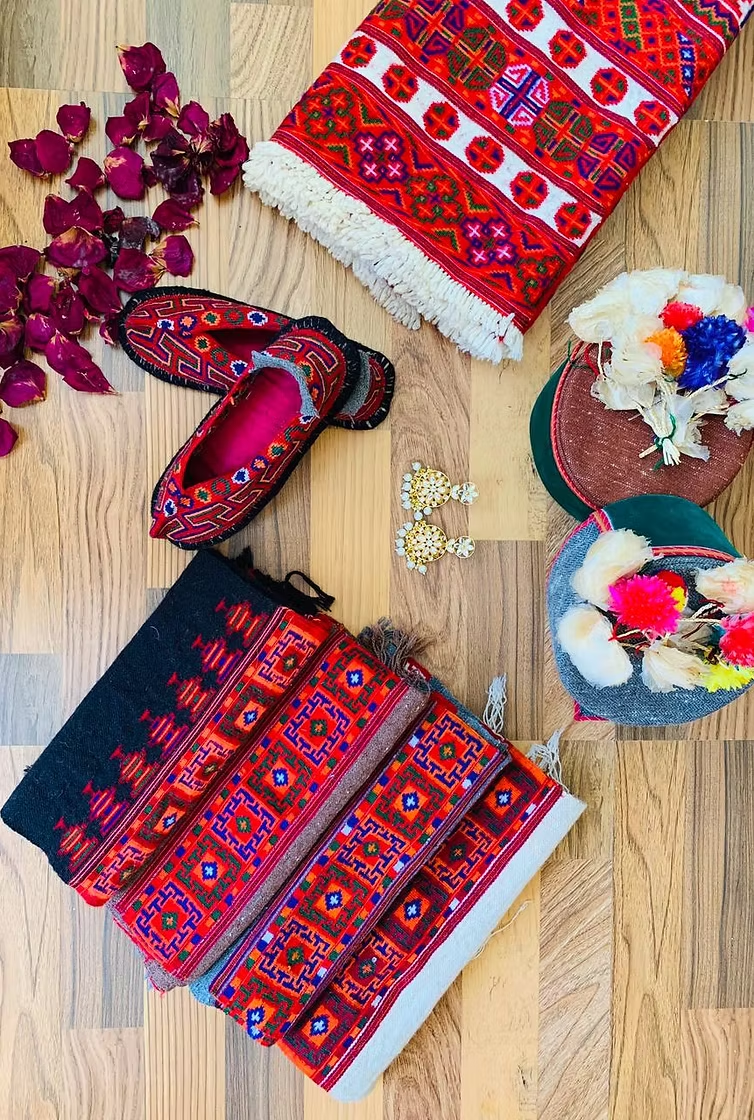
Lingzey is a traditional handwoven shawl worn by women on the back. It is one of the most vibrant and elegantly designed shawls woven by women on the loom and comes in a wide variety of colors and patterns. The base color can be red, white, or black where elaborate symbolic geometrical designs are handwoven. Motifs inspired by nature are common like local flora or fauna or religious motifs like stupa and swastika (to protect the wearer from evil spirits) or motifs of precious stones. Lingzey is worn during special occasions like marriage, ceremonies, festivals, rituals, or while visiting Rinpoches.

6. Tsadar
Tsadar is a plain woolen shawl worn by women on a daily basis. It is thin, light weighted compared to Lokpa, and is woven on a handloom called Khaddi. It is made up of goat or sheep wool and is usually found in toned neutral colors like beige, grey, off -white and black. It is the most functional piece of clothing and can be worn over Sulma or even drape babies in it. In the olden days, it was said that women were not allowed to go out bareback, wearing a Tsadar symbolizes one’s respect for the person you are visiting.
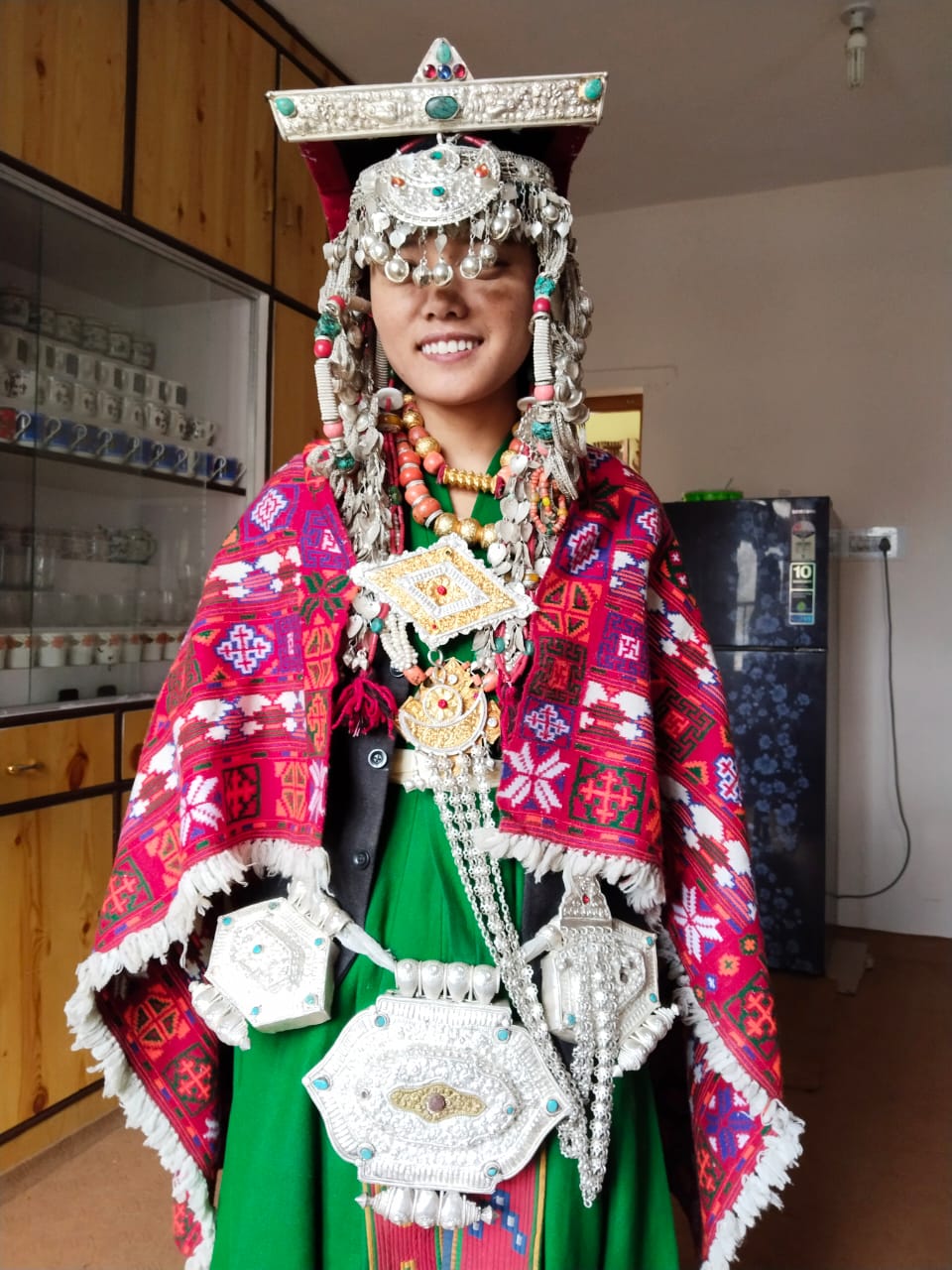
Lingzey - the multicolored shawl with traditional designs

“Since most of the families are agro-pastoralists, the livestock people breed gives different kinds of wool like yak wool, sheep wool, and goat and that forms the natural source for most of the attire worn by the people.”
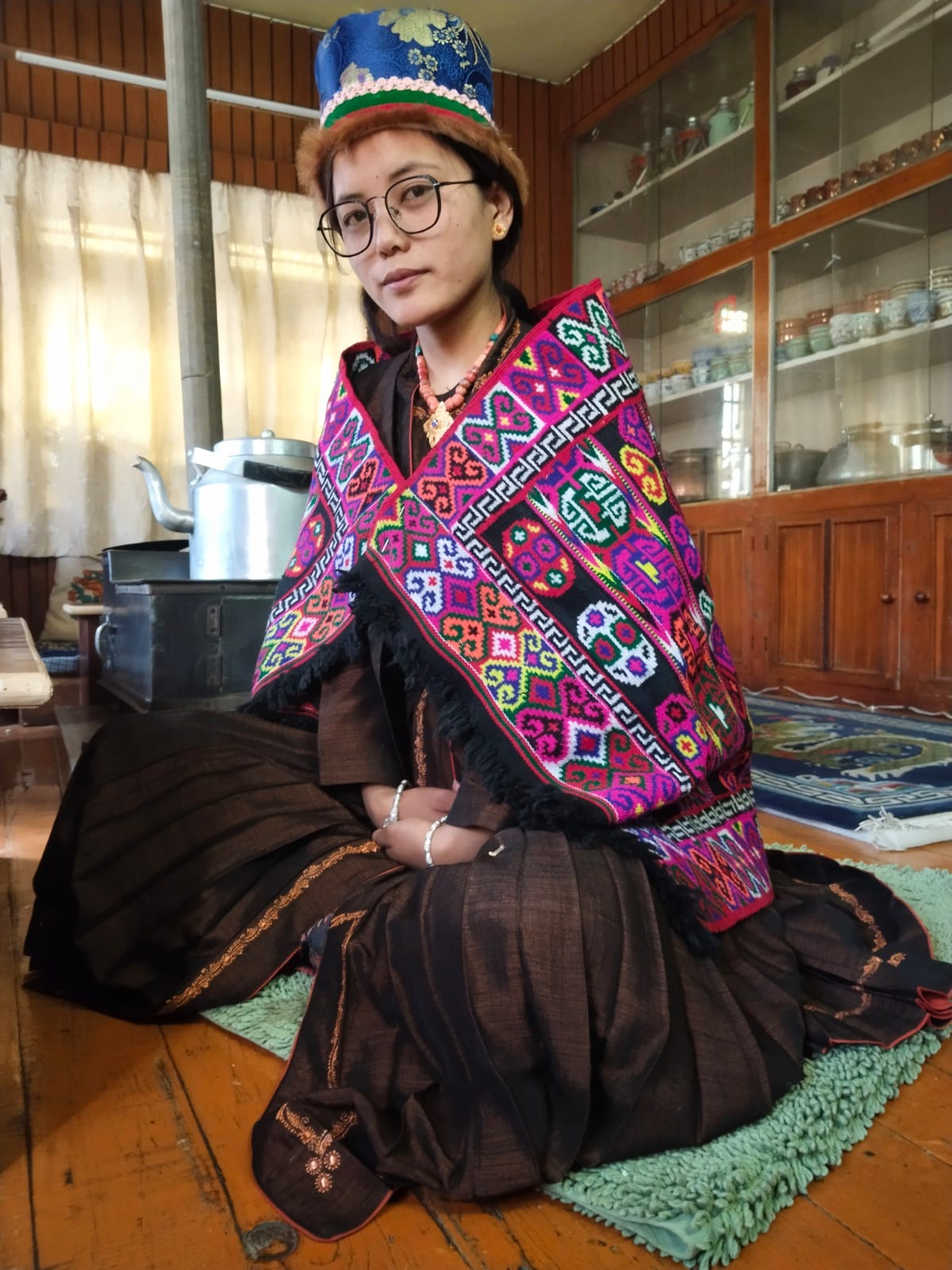
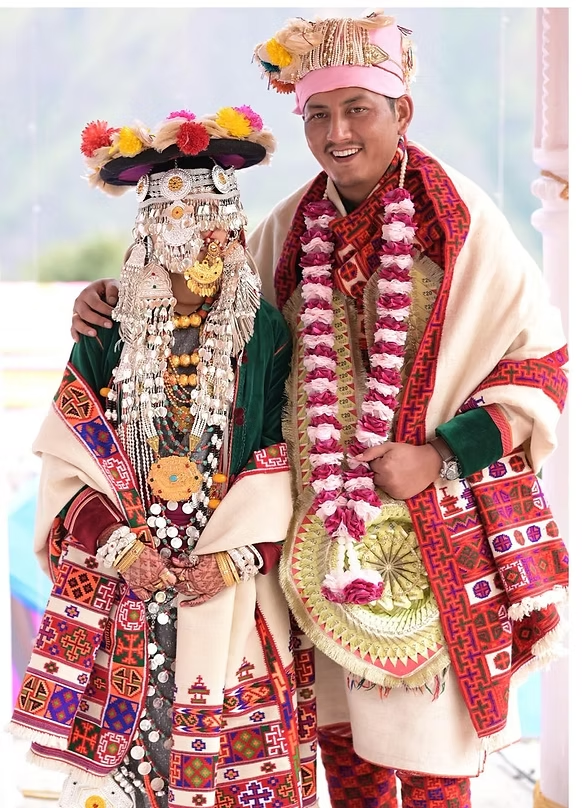
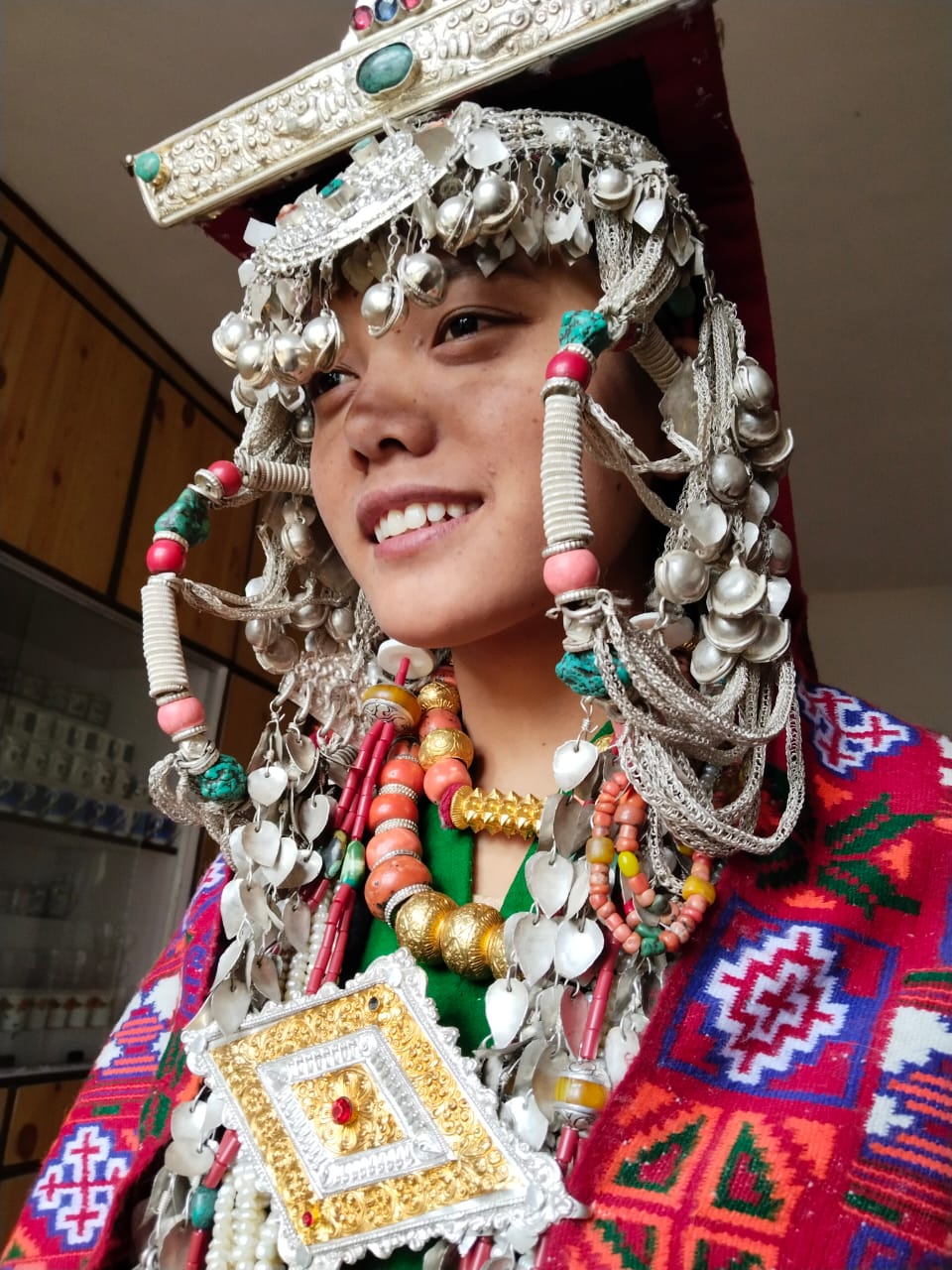
Spitian bride wearing Lingzey (multi colored shawl) Lokpa (thick hand strewn green cloak) Sulma (brown gown ) and Tiwi (hat)

7. Tiwi
Tiwi is worn both by men and women. Traditionally, Nambu (yak wool) is the base fabric with which it is made and has goat or sheep skin lined underneath. Cotton or wool fabric is sewn inside for warmth with matching silk brocade. Golden or silver zari designs or threadwork can be supplemented depending on the need.

8. Lham
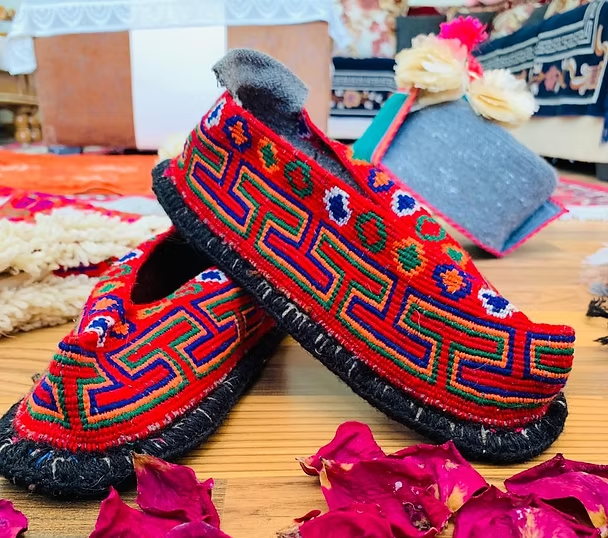
Lham refers to footwear worn by people in the high Himalayan region or more suitably to the boots worn in the nomadic region. Originally it was made up of yak hides but with time, it is adapted to canvas, jute, or cloth material. Lhams are decorated with rich embroidery and exquisite designs of dragons or snakeheads. The material, color, and fabrics used to make Lham showcase the craftsmanship of the creator. Men’s Lham is knee length and comes in handy while treading snowy mountains. It is worn with Ghoey-shan (Silk robe) by men and women wear a slightly smaller frame with Sulma. The usage of Lham has gone out of daily use and is now worn only during festivals or special occasions.

The garment and material used to make the traditional attire of Spiti symbolize the optimum use of local resources and fibers available regionally. During festivals and special occasions, this is adorned with elaborate pieces of jewelry like the vibrant turquoise Perak, the pearl-made Uldik, the Silver Docha, Dhikra (brooch), Khinyur, and Pitsup. Our traditional dress represents close cultural affinity with the Western part of Tibet and forms a big part of our cultural heritage.
960 1280 Dolma Zangmo, Chhering Zangmo and Tanzin Ankit
The Art of Weaving in Lahaul’s Upper Valleys
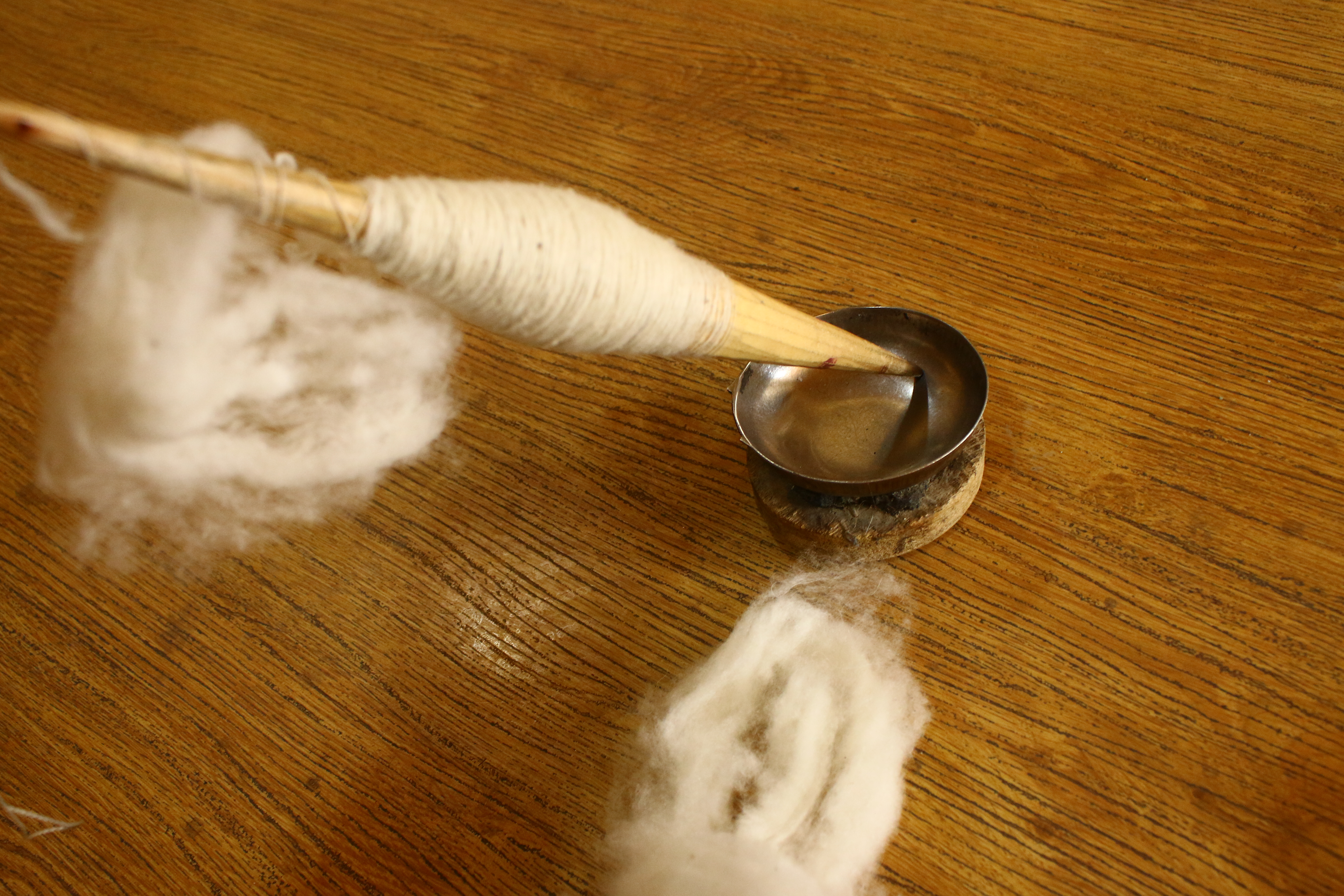
"Phang" - Traditional spindle | Photo: Rigzin Dorjee

The Art of Weaving in Lahaul’s Upper Valleys

In the higher Himalayan region, weaving is an ancient craft and forms an integral part of people’s lives. In Lahaul, weaving signifies a retreat into slower, simpler times amid icy cold weather when the farming works are at its lowest. There’s a saying in local folklore attributing weaving as visual art that reflects stories about people, their communities, and their place in the universe. It symbolizes the value of creation, interconnectedness, and rejuvenation. Weaving requires profound discipline and dexterity to untie complexities; it involves crossing two threads the warp and the weft, one vertical, and one horizontal, one stretched tight, the other intertwining the first. To produce a textile, the two threads need to be bound together otherwise, the weaving work will remain fragile. Hence in ancient Buddhist belief, a weaver is akin to a problem solver, someone who is adept at bridging silos and bringing greater connectedness.

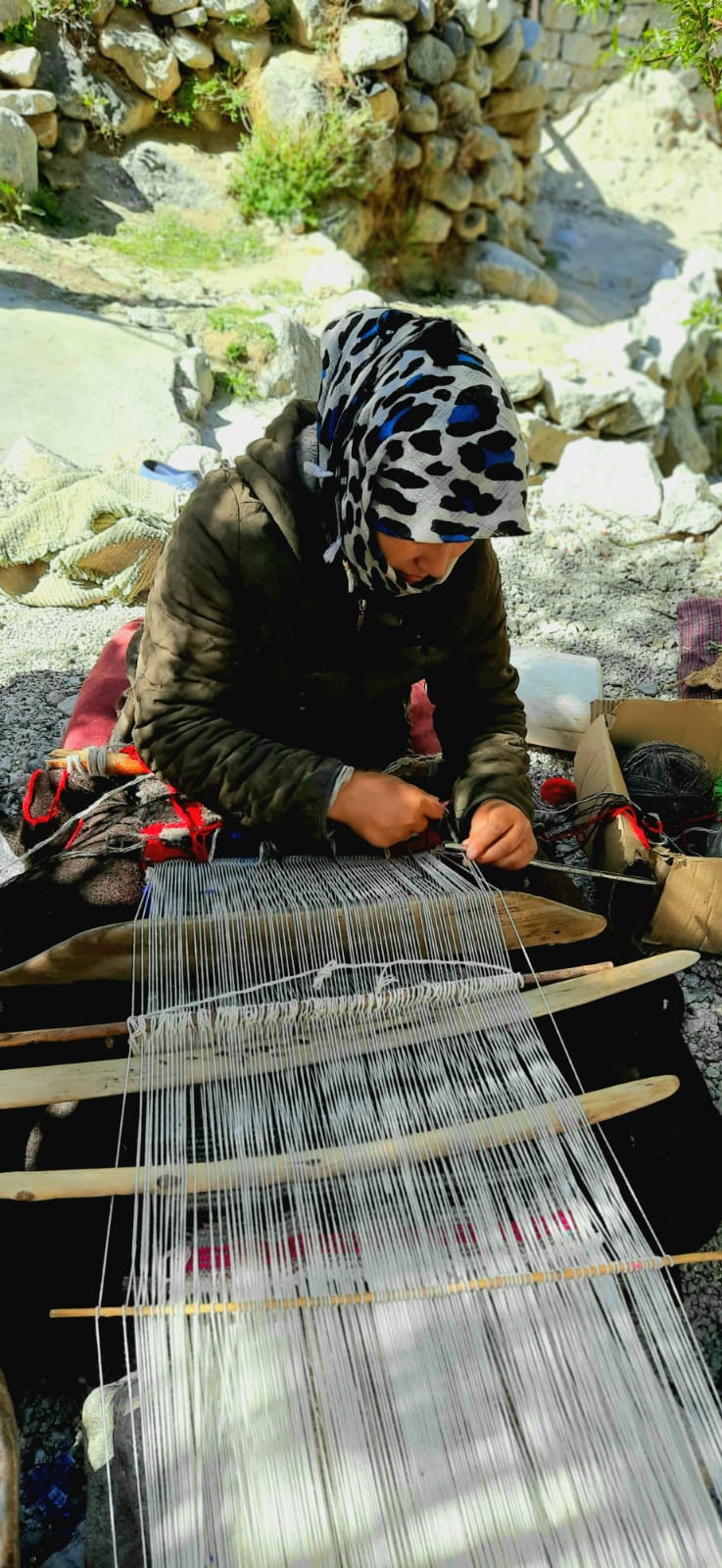
Weaving is a traditional skill that’s passed down through generations and is practiced with great vigor in our village. Of the many products that are woven, Tsug-den (Tibetan rug) weaving remains the most popular with its elegant design and high pile, plush feel. In our village, the handwoven woollen carpets are called Tsug-thu or Tuk-tuk in villages around the Darcha side in Lahaul. Tsug-dens are unique handwoven carpets, that are woven on a backstrap loom called “Khaddi”. It is an extremely slow, time-consuming process, that involves a lot of hard work as each bit of the work is done manually – from livestock herding to wool shearing to cleaning, carding, spinning, and yarn making and finally weaving, the process can stretch up to a year.

Photo: Sherab Lobzang

Most families still keep livestock and the wool is shorn around March or April month. Wool from a single sheep is sufficient to make one pair of Tsug-den. It is then sorted and cleaned to remove any impurities, and further processing of wool is done in Shamshi in Kullu valley in Himachal. We take wool gunny bags in bulk and get them carded and de-haired before we bring them back for spinning and yarn making.

Spinning is done mostly during winter and much like agriculture, it is collaborative work involving a group of women. Wood-made traditional spindles called “Phang’‘ are used for spinning and great care is taken to get consistent, smooth yarn. The base of the weaving is done with cotton threads on a metallic or wooden loom Khaddi. The handspun woollen yarns are weaved in a knotting system where one thread is interwoven with the other on a loom. Once a row of knots is complete, a rod is hammered against it to tighten the row below. A weaver uses the blueprint of a woven carpet to weave complex designs and to ensure accurate shape, size, and alignment of the carpet. Black, white and beige sheep wool is used for tsug-den while the rare white yak hair is used for Challi (woolen quilt).

The elaborate designs and motifs on the carpet are inspired by lives in the higher mountains of Tibet and often nostalgically evoke themes of nature and the environment. Motifs of birds, flowers, and mythical animals are quite common- dandelions, native birds, Druk (sky dragon), tiger, ibex, leopards, snow lions, and yaks can be seen beautifully woven on the carpets along with motifs that have special religious, cultural significance like the mandala, four elements of nature (earth, fire, water, space), the Buddha’s vajra, Swastika and depiction of the precious stones Dzi and Gau (amulet). The motifs on the carpet are not mere designs but have larger symbolic meanings to it for eg: the depiction of the crane motif on Tsug-den symbolizes good luck, Yak motifs are reminiscent of nomadic life, dandelions, birds, and clouds depict one’s closeness to nature, the vajra is symbolic of Buddha’s enlightenment, tiger stripes symbolizes one’s prestige and wealth, while snow lion and sky dragons represent mythical creature from traditional folklore and phoenix is a sign of auspiciousness.

 “There’s a saying in local folklore attributing weaving as visual art that reflects stories about people, their communities, and their place in the universe. It symbolizes the value of creation, interconnectedness, and rejuvenation.”

Most families in Lahaul and other higher Himalayan regions own simple domestically produced Tsug-dens and it remains one of the most functional pieces of the item which comes in really handy during harsh winters. The usage of natural fiber and natural vegetable dyes also enhances the overall aesthetics of Tsug-den and it is one of the practical pieces of a garment whose luster, and sheen increases over the years with usage. One of the most appealing characteristics of the Tsug-den-making process is that it is the result of resource utilization in the most natural way. The entire carpet is handspun, hand-carded, naturally dyed, and handwoven where nothing goes waste and the final product lasts for decades, some even passed down to generations. One of the greatest wealth a woman can inherit from her parents is the traditional handwoven carpets, rugs, and quilts along with handwoven shawls. Weaving is not just a craft, it holds ample of material, and cultural value and the artwork on woven Tsug-den is symbolic of values, beliefs, and mysticism beyond our comprehension.

5472 3648 Rinchen Angmo and Chhering Gaaji
The Sheep of Himalaya
Photo: Anuradha Miyan

The Sheep of Himalaya

Handloom and handicraft are an age-old tradition in Kinnaur (H.P) and have their roots in the ancient trade routes. The intricate designs and colorful patterns differentiate Kinnauri handcrafted shawls- making them a much-coveted textile product in India. However, the bulk of its history, symbolism, and contemporary relevance remains obscure. A history of textile production reveals interesting facts about the local environment, different modes of living, and cultural exchange. The Silk Road is the most famous trade route dating back five thousand years. Another lesser-known trade route connecting India, Tibet, China, and Central Asia is called the “wool road” which passes through Kinnaur and Kullu in Himachal Pradesh. The strategic location of Kinnauri weaving communities settled along the trade route inspired many weaving traditions across different states as well as took cultural inspiration from their trading affairs. Some of the most famous motifs and designs on the Kinnauri shawl bear a resemblance to Central Asian designs. The journey of wool trade and weaving traditions was truly iconic and drastically changed the destiny of the Himachali textile trade. Today, Himachali handloom stands amongst the foremost contributors of state revenue along with tourism and agriculture.

Traditional Kinnauri shawl and Topi worn by the bride and the groom

Growing up in Kinnaur, I saw my elders weave, knit, spin, and make yarn. Most women and young girls in my village knew how to weave and they owned the traditional weaving machine called “Khaddi”. Wool weaving and handicraft became indigenous to the region because of the cold weather conditions and women picked up the skill and nurtured it passionately. Most of the weaving, yarn-making, spinning, and knitting work happens during winter and the process is more collaborative. Since women made garments for self-consumption, it is common for one or two artisanal families to work together especially if it is a large-sized product like a carpet or a woolen quilt. I have always been passionate about handicrafts and after finishing my higher studies (MBA), the zeal was renewed all over again. I observed that although the women of my village – Labrang in Pooh tehsil of Kinnaur are skilled artisans, their products were used only locally within different villages of Kinnaur. There was no handicraft center in our village and given the difficult terrain, the market remains inaccessible to us.

I took a leap of faith and started “Sheep Of Himalaya” in 2019 with just two artisans from my village. The prime motive was to bring some visibility to Kinnauri handcraft on an international level and showcase regional craftsmanship.

Agriculture and cultivation of apples in our village orchards are primary vocations for most people but many women still rely on handicrafts as a secondary occupation to earn for themselves. When I broached the idea of building a clothing brand showcasing our traditional attire, there was a bit of reluctance from many artisans for they feared uncertainties. I took a leap of faith and started “Sheep Of Himalaya” in 2019 with just two artisans from my village. The prime motive was to bring some visibility to Kinnauri handcraft on an international level and showcase regional craftsmanship. While the artisans would weave mufflers, stoles, and shawls with vibrant Kinnauri designs and knit sweaters and socks, I would find market avenues for us. For me, the process proved a bit challenging as there were no established Kinnauri brands and our products were often mistaken for Kulluvi products which have better brand visibility. I took to social media to build a unique handicraft brand for Kinnaur and to connect with people who appreciate the labor of love.

Photo: Anuradha Miyan

Over the years, the enterprise found its feet as more artisans joined us in our journey from neighboring villages like Spillow and Kanam. We are now a proud all-women’s team with twenty-five artisans who are involved in the handcrafted and handloom business during our spare time. Kinnauri handicrafts and handwoven attire require dexterity that can be perfected only through patience and meticulous care while weaving.

To make a shawl, each thread is carefully pulled through the reed (part of the weaving loom that resembles a comb) and installed on a loom that forms the base for an entire textile to be woven. It is one of the most complex and laborious processes that an artisan undertakes. Given the complexity of designs, it can take up to three months to finish a shawl and it can cost around twenty-five thousand rupees for a single shawl. Widely known for their intricacy and finesse, Kinnauri shawls are unique and reflect indigenous designs. We use five key colors to design our attires – red, white, yellow, green, and blue which symbolize five elements of nature- earth, water, fire, air, and space. The elaborate geometrical and floral designs have strong symbolism and many of the motifs woven have religious significance like the representation of stupas in the border design of a shawl. Since many families are into livestock rearing, raw wools are sheared locally from goats and sheep for making yarn and weaving but in recent times, we have also started procuring Angora and Merino wool from Ludhiana.

Photo: Anuradha Miyan

Balzanu Pona or Pullans (grass slippers) is another traditional wear that is slowly disappearing from daily use and in fact, there’s only one artisan left in my village who can skillfully make it from scratch! The footwear is made out of fibers procured from the bark of wild bushes. The upper portion of the Pullan is handknitted with goat wool and is adorned with colorful patterns while the lower portion is made of hemp or Bhang fiber (Cannabis). We make all kinds of traditional wear including Kinnauri shawls, stoles, mufflers, sweaters, Pulla (socks), and Kinnauri topi (hats). It didn’t take us long to sell products online via Instagram/Facebook and soon we were getting international orders! We further expanded our product range and started making children’s wear, cushion covers, diary covers, and pouches – all while retaining our unique Kinnauri designs.

All the women artisans who are associated with us rely primarily on their traditional looms and work from their homes which at times, proves a bit challenging as they have to juggle agricultural work, and domestic works at home and are able to undertake handicraft works only during their spare time. I have been pleading with the H.P handicraft and handloom department in Shimla to open a handcraft center in Kinnaur so that it is easier for weavers and other artisans to organize for a mutually exclusive vision, gain training, exposure, procure raw materials, and boost the entire value chain. We have capable and hardworking artisans who are passionate about their work and with the right market opportunity and assistance from the government, they will soar high.

1440 633 Anuradha Miyan
Reflections on farming life
Photo: Panma Gyatso

Reflections on farming life

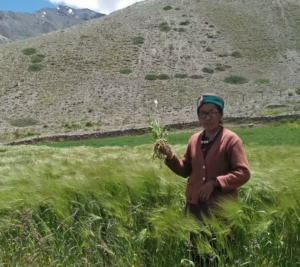
I was born in Hango (11,500 ft) which is a remote village in the Hangrang valley of Kinnaur. I am 72 years old and have spent my life in this village as an agro-pastoral farmer. Agriculture is very important to us. When I look back, I now realise that some of my most treasured memories of my village are related to agriculture and food. One of my favourite and most vivid childhood memories is from the time chulli (apricot) season arrived. Our village did not have any chulli trees, so our elders would go to the nearby village of Leo and get chulli for us. When they arrived, all the children of the village would run to the common ground to grab as much as possible in our little hands. Women would also find time during the day to enjoy chulli with each other under the winter sun. Relishing chulli was a communal affair. The seeds were saved to make prized chulli oil (750 ml for INR 2000/ USD 27).

Photo: Panma Gyatso

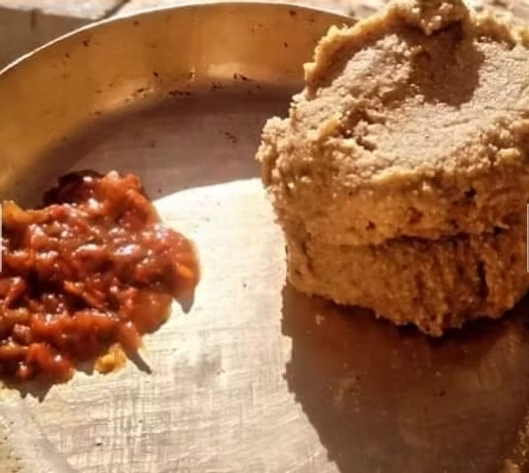
My other happiest memories are of the festivities and celebrations we had after the harvest. Until a few years back, we had an isolated winter in Hango. So we had to work really hard during the summers to ensure we had enough grains to survive the harsh winters. After gruelling work in the short summer season, the celebrations were especially sweet. Our harvest back then was of barley, potatoes, black peas and cheena/chize (local name). Cheena & barley were used to make flour for thukpa (soups) and salma (local bread). During the festivities we would make various dishes like tolopa, chulipanting (sweet apricot). Communally preparing and eating added exponentially to the taste of these dishes.

Barley was and continues to be used for making local alcohol like chhang and arak. No one, now, grows cheena. The seeds are also very hard to come by. It has completely vanished. Black peas & barley cultivation has also reduced and mainly taken over by the cash crops like green peas, apple, cauliflower etc. Due to increase in connectivity with the outside world, wheat and rice which were only heard of back in my days, have now become staple food. Salma, tolopa, chulipanting etc which were favorites of all age groups are now hardly prepared.

With our generation most of the traditional dishes are also fading away. I am hoping that we can slowly shift back to our traditional crops, as they grow best in our landscape, with focus on apricots for better economic gains. This way we will be able to ensure sustainable growth from agriculture.

792 706 Prithvi Singh
A day in the life of a young farmer
Photo: Vicky

A day in the life of a young farmer

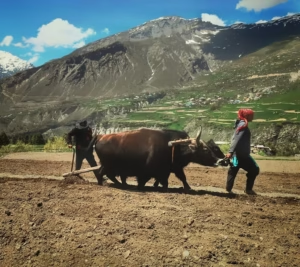
There’s an air of celebration when the agricultural season begins in my village. It is time to end the dormancy of long winter days and come out and start preparing the fields. I remember enjoying working in the fields and on the days when the fields had to be ploughed, I used to try to take leave from school on the pretext of doing some necessary work. We used to take out all the farming tools, clean it and check for any repairs. A day earlier, our bulls were also brought from another village and were prepared for ploughing. The excitement would not let me sleep and I would think of all possible excuses to take leave form school so I could and help my family in the field.

The next day, my grandfather would make a barley offering to the local deity Jogani. After the prayers everyone would take the offerings as blessings and proceed to prepare for the day. Before going to the fields, we would place flowers in the horns of the bulls. All the equipment and the bulls were then taken to the agriculture fields. I would also help out in guiding the bulls to the field which would give me immense pleasure. For traditional rituals, my mother would bring roasted barley (kha) & local alcohol (chhang) to the fields. We would then gather the bulls in teams of 2 and attach the plougher to them. After that we would offer chaang, kha and our prayers to our fields facing east (to garner the sun’s positive energy into our lives).

Photo: Vicky

My family would then begin the hardwork of ploughing the fields which would last a few days. The fields which were harder to plough, were then ploughed with the help of Shaalu – my favourite mare. Unfortunately, I would never get permission from school to take off for a full day, so after the rituals, I had to rush to the school! Lunch for the farmers was prepared in the community hall and was served every day at 12:30 pm. For the bulls, the farmer would prepare Pinniyan balls of barley dough Sattu kneaded with local alcohol Chaang. This would give them strength for the remaining day’s work. After resting for an hour after lunch the farmers would get back to work. In the evening, the farmers would have tea and local bread puri at 6, around the same time we would return from school. We would help out our parents till the sunset and then head back home. If there was any time left before it got dark, we would level out the uneven fields. The blades of the plough would be replaced by a plank of wood and the bulls would then walk the fields levelling it. To add extra weight, my sibling and I would fight to climb onto the plank. By the end we would be covered in mud. We had an amazing childhood.

Farming life has changed drastically. The new age equipment gets the job done quickly but it’s not a celebration like the old times. Earlier whole family would partake in the ploughing, sowing and harvest process, now it’s a one person job. These equipment have in some way facilitated migration as now women single-handedly manage the fields. Bulls are replaced by power tillers and are rarely seen in any village. Agriculture was not just about growing produce for sustenance, but it was a way to form connections with our land, our animals and nature. And now, I see those connections fade.

792 706 Vicky
Beyond Agriculture
Photo: Tashi Angroop

Beyond Agriculture

Agriculture has made considerable progress in Himalayan states. One of the major changes in the mountain farming system is from subsistence to commercial farming practice. There’s a curious move towards high-value cash crops and diversification of cropping patterns. With connectivity and better exposure, farmers in these landscapes are increasingly becoming more innovative. Their approach in production, managing supply chains, and marketing are aimed at higher returns from farming. The New Age farmers from High Himalayan villages are more experimental and are more focused on searching for niches -apples, cash crops, fruits, exotic vegetables, flowers. Their engagement with farming goes beyond survival and sees it as an economically lucrative option for themselves and others associated in the value chain. Stories of such individuals dismiss stereotypical myths about farming and show how it can be adopted in changing times.

Tashi Angroop from Tinno village in Lahaul (H.P) dons more than one hat. He is a farmer, passionate entrepreneur, and agri-businessman who cultivates traditional grains, experimented and scaled up the cultivation of exotic vegetables in Todh valley, and is also initiating agro-tourism in his village. He started his journey in 2007 when he got an opportunity to work with World Bank’s Project in Lahaul promoting Seabuckthorn nurseries. Further collaboration with the Department of Horticulture on Desert Development Program (DDP) deepened his experience of developing poplar tree nurseries and building seabuckthorn nurseries. With Jain Irrigation System, he extensively traveled in Himachal Pradesh covering 11 districts to understand diverse cultivation processes within the state and train locals in nursery building. He took a leap at his own venture in 2014 when he decided to take up farming as a full-time vocation. He took land on lease in his village to cultivate organic vegetables and experiment with the cultivation of exotic vegetables which is a fairly new intervention in Lahaul back then. He began by procuring 1000 potato seeds (1000 Katta) and started growing them in his field. Initially, it was just potatoes, green peas, and cauliflower.

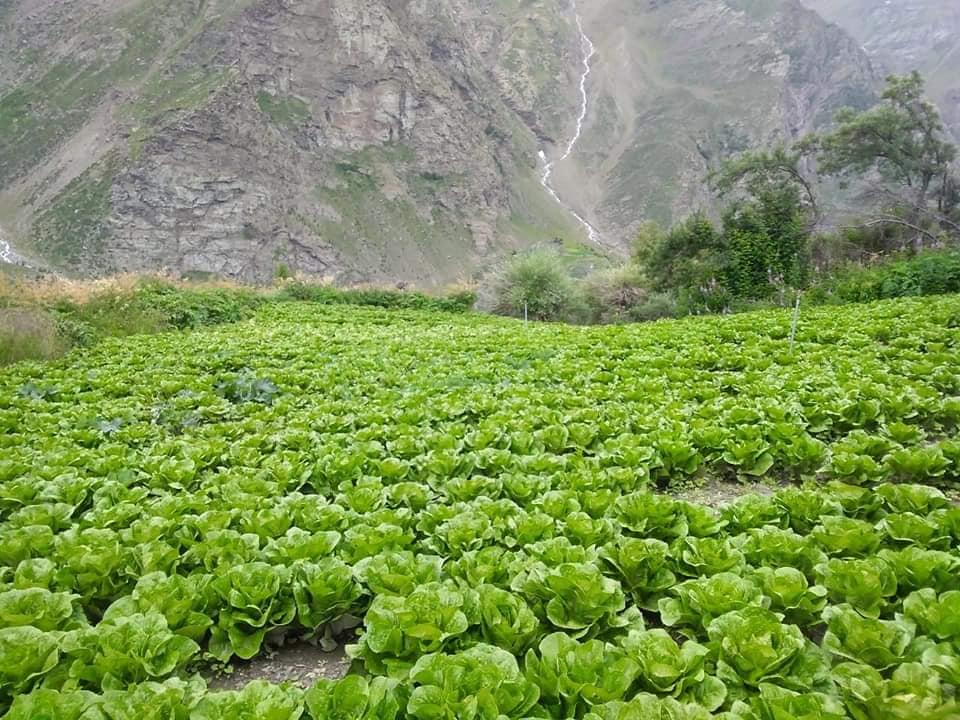
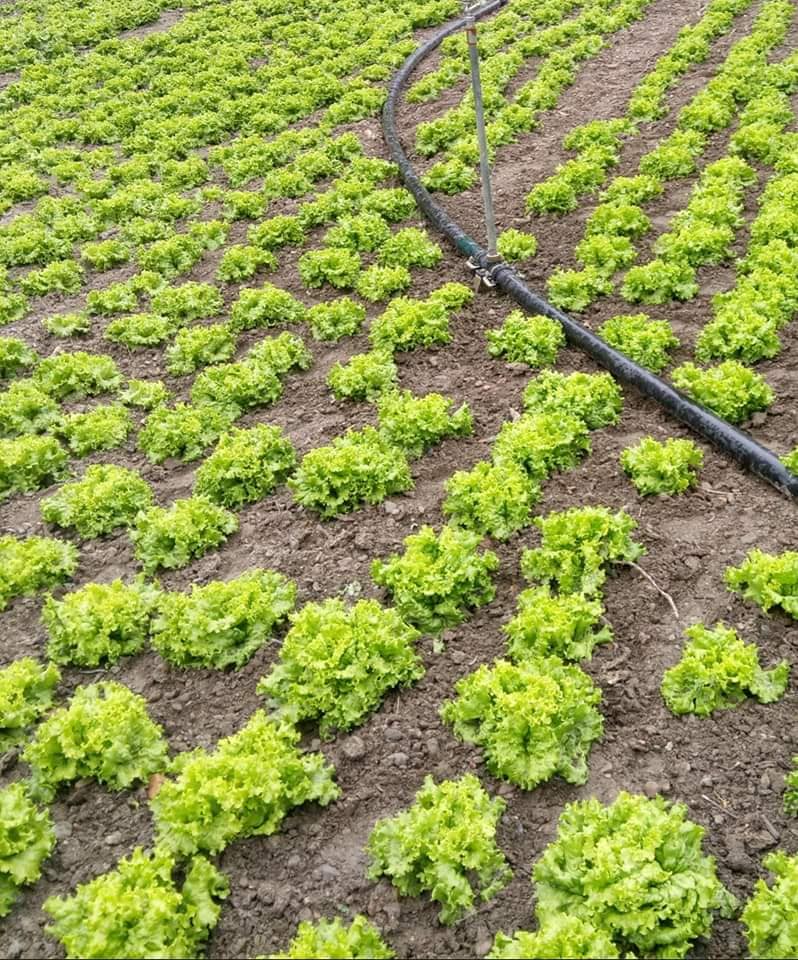
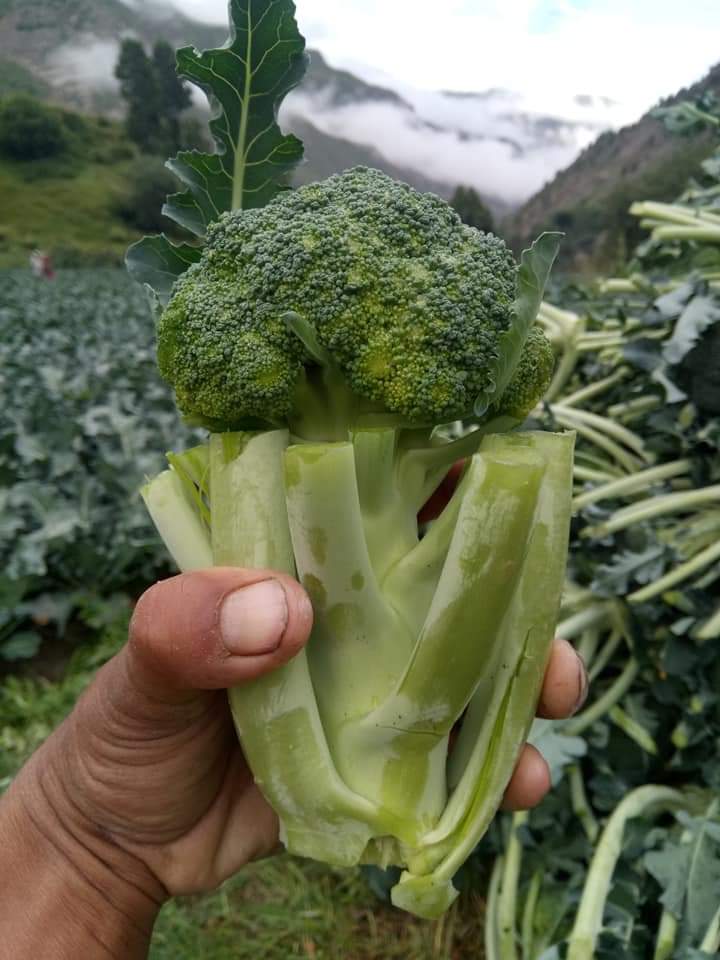
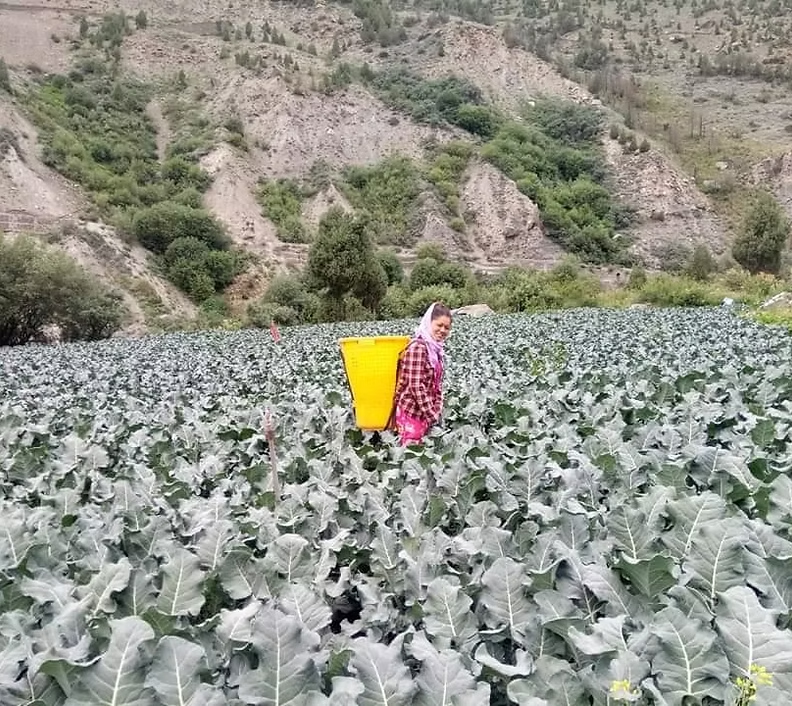
Over the years, Tashi gradually started diversifying and began cultivating more varieties of exotic vegetables and made efficient use of farming technologies and irrigation facilities. He now cultivates 19 varieties (mostly European exotic vegetables) vegetables in his field including broccoli, Iceberg lettuce, Red leaf, Yellow leaf lettuce, green leaf lettuce, Squash (Jugni), Yellow & green zucchini, celery, parsley, leek, snow peas, fennel, European carrots, red cabbages, other herbs, and exotic roots, etc. He introduced the same to many villages in Todh valley (Tinno, Gaimur, Jispa, Chika, and Sumdo) in Lahaul where farmers are now able to grow vegetables during off-seasons and sell them at a premium rate in metropolitan markets. Within his own community, he became the face of changing agricultural practices and popularized the phrase “Tel bharo, Kheti Karo” in Lahaul where he encouraged young farmers to adopt improved technologies like tillage machines and JCBs to do farming. In many instances, he even lent his own JCB and tiller machines to help people till rocky barren lands for farming.

The farming communities in Todh valley of Lahaul are now incorporating off-season vegetables along with traditional cereal crops. Different farming technologies like power tillers, tractor, power bidders, grass cutter, spray machine, sprinklers to improve the yield. Compared to Spiti the neighboring district, Lahaul receives more rain which is suitable for cultivation, potatoes, green peas, hops, cabbages, and other exotic vegetables and herbs. In fact, Lahauli potatoes are considered some of the best in the country and it is believed that these crops have brought prosperity to Lahaul.

Composting is an essential requirement to grow exotic vegetables and locals rely heavily on vermicomposting. Most Lahauli households have separate vermicompost structure at their home. Tashi himself annually prepares around 17 tonnes of compost to use it in his fields. He adds “We use jungle wastes like wild leaves, raw leaves, dry leaves, Juniper leaves, and other organic waste inlcuding manure, human waste, and Kenchua (organic manure)”. “Every household prepares compost 3-4 times in the unit and use it in their field to improve soil fertility”.

With time, locals were also able to enhance irrigation system and equip technologies which is more efficient and convenient. Earlier water resources are distributed among farming households on a rotational basis. There’s a watering turn for everyone and a farmer has to wait for about 6 days to receive his share of water to irrigate the fields. With improved irrigation systems in most Lahauli villages, the watering turns have almost disappeared. Direct pipes were connected from glacial sources to Kuccha Kuls (field canals) and every household have direct access to it. Tashi enthusiastically adds “one can finish the irrigation within 3-4 hours now! Almost unthinkable in the past.” Almost 90 percent of Lahauli villages are relying on piped or drip irrigation systems. There’s an increased use of sprinklers and rain gun watering systems.

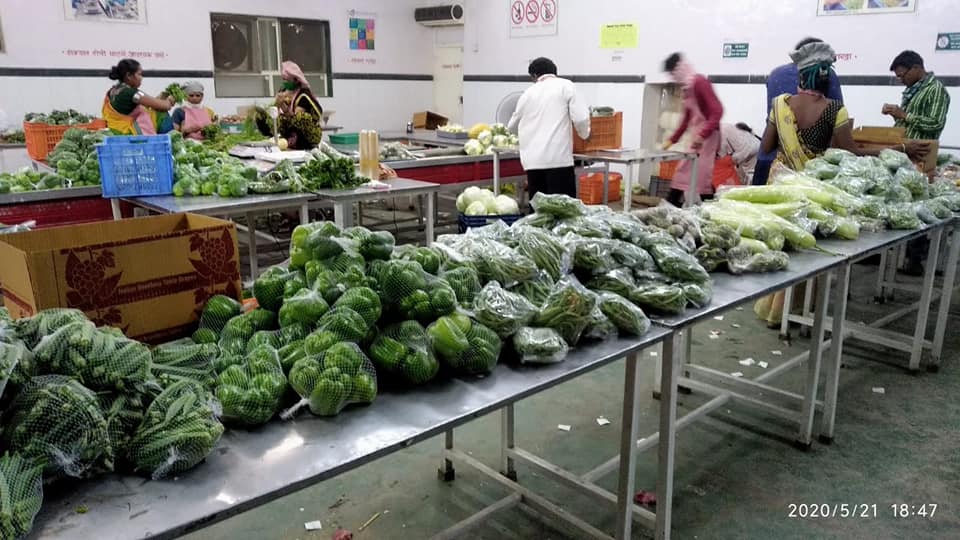
With improved road connectivity, better transportation system, and the availability of new crop inputs like hybrid seeds and organic fertilizers, the farmers in the hilly region of Lahaul are able to fetch gain higher yields and better prices. The returns from the sale of vegetables are five times higher than that of traditional crops. There’s a high demand for exotic vegetables in metropolitan cities and Lahauli cultivators are now able to sell their produce in Delhi, Chandigarh, Ahmedabad, Surat, etc. The farmers from Todh, Turat and Keylong have collectivized and formed a union of 101 farming households to provide better market exposure and greater revenues for the local producers.

Some of the initiatives include farmers market, over-the-counter payment system for the farmers, and also experimenting with the concept of “one village, one crop” where each village will focus on producing a single crop unique to their area and giving better opportunities for farm entrepreneurs. The farmer’s union will be collaborating with big hotel chains like Taj to supply them year-round vegetables.

Opening up of Atal Tunnel has also huge impact on farming in Lahaul. There’s surge in tourists flocking in the valley and farmers are keen on integrating agriculture and tourism. They have initiated farm-based enterprises like camps and homestays where tourists can take part in the sowing process, harvesting, procuring vegetables, and immerse themselves in rural agricultural life with locals during their stay. Tashi’s own farm camp in Tinno and Keylong attracts a lot of tourists. He shares that the motive is to give them first-hand experience of agriculture, self-cooking and be part of the collective experience of the landscape. Cultivators like Tashi show that there can be a more forward-looking approach for agriculture and it can harp beyond the traditional way of life. With greater solidarity, there’s positive hope for farming in high Himalayan landscapes to empower small farmers.

960 720 Tashi Angroop
Losar : Animal’s Day

Losar : Animal’s Day

I think I am in fact the least excited and most boring person at any form of festival. Much of it could be due to my introverted genes that wouldn’t fancy gatherings, dancing, fireworks or any other things which involve interacting with strangers, but part of it must be because of my upbringing. I am not sure of both though. But my heart just cannot seem to invite festivity as much as my friends and family do.

I hail from a small nomadic village in Ladakh where the livelihood of everyone is dependent on livestock. Almost every household owns some goats, sheep, horses and yak. These animals aren’t merely our source of income, but are used for obtaining food, fetching water, traveling, and most importantly seeking comforts and friendship. Since our life revolves around rearing these animals and more importantly enduring the harsh reality of having no access to electricity, water and worse not even a single shop in the vicinity throughout the year, we have little time for festivity. Or, many of us are even oblivious of its existence, except for Losar– the Tibetan new year and Thrungkar Duechen – His Holiness The Dalai Lama’s birthday. Hence, every single person in the village looks forward to these two days like a child, although for different reasons.

Photo: Namgyal Lhamo

My fondest memories of Losar and Thrungkar were significantly boring compared to my cousins. But these days, no matter how many festivals I witness as I travel through urban life, there is nothing more meaningful and beautiful than this idea of celebration I got to see early in my life. It was on one of the third days of Losar. My father came to me, patted my head gently and said with a smile “Life of your polled lamb will be set free”. I was elated beyond words and this memory has remained in my heart so vividly. In my village, on the third day of Losar or Thrungkar, fathers of the households are the busiest. They get up early in the morning to appease the Land God and other deities who are believed to be the true owners of our land according to their ancestors. This is followed by their brief journey to the animal shed where they would choose some animals randomly and set their life free. By that, we are not allowed to send them to slaughter houses, milk them and are expected to watch them with unconditional love and care which every animal receives anyway, until they die. It was my most awaited moment of the festival. My siblings and I would always hug our father with utter joy after he would come out of the shed. This act is mostly done to honor and thank the sacrifices of animals for our livelihoods while it is also performed for the health and long life of His Holiness and carry his message of love, kindness and compassion towards animals.

We eventually shifted to a town nearby, leaving the whole nomadic life behind due to the inability of my family to see the animals suffer for our survival. But, as I look back, I realised that it was this place where I gave birth to my love for animals. Today, even if we live a totally different life, my parents make sure to celebrate these two days by setting at least one animal’s life free. There is nothing more rewarding at a festival for me than this act of genuine kindness. Somehow I think of these two days as a festival of animals and I hope to carry this tradition forward in my own life too.

792 706 Namgyal Lhamo
Reyun Tache
Remu Painting | Jugmat Norboo (Urgos)

Reyun Tache

Reyun Tache is a festival celebrated two days before Losar in many parts of Lahaul. In my village-Urgos, the festival is marked by each household painting Remu paintings on their walls for inviting good omen and warding off evil. Paintings are made with almost a competitive spirit, with each house trying to do better than others. All the members of the house take part in this celebratory moment and contribute to the painting. Each element of the painting signifies a deeper religious sentiment, and connectedness and harmony of indigenous communities with nature. Thus, it is important for each house to ensure all elements are present on their painting.

The next day is when the fun begins. Everyone visits the homes of the others to appreciate their efforts and ensure that they have included all the necessary elements in their painting. If not, then they have to pay a fine to the village committee and carry shukpa (incense sticks) throughout the day as a penalty.

1471 1811 Jigmat Nurboo
The Water Managers in Kibber
Illustration: Tenzin Metok

The Water Managers in Kibber

In the distance, the early morning sunlight chased the shadows on the mountain peaks. I gazed longingly at the golden patches, wondering how long before I could feel the warmth of the rays. Lobzang saw me and laughed, “Are you cold? Come help, it will warm you up!”

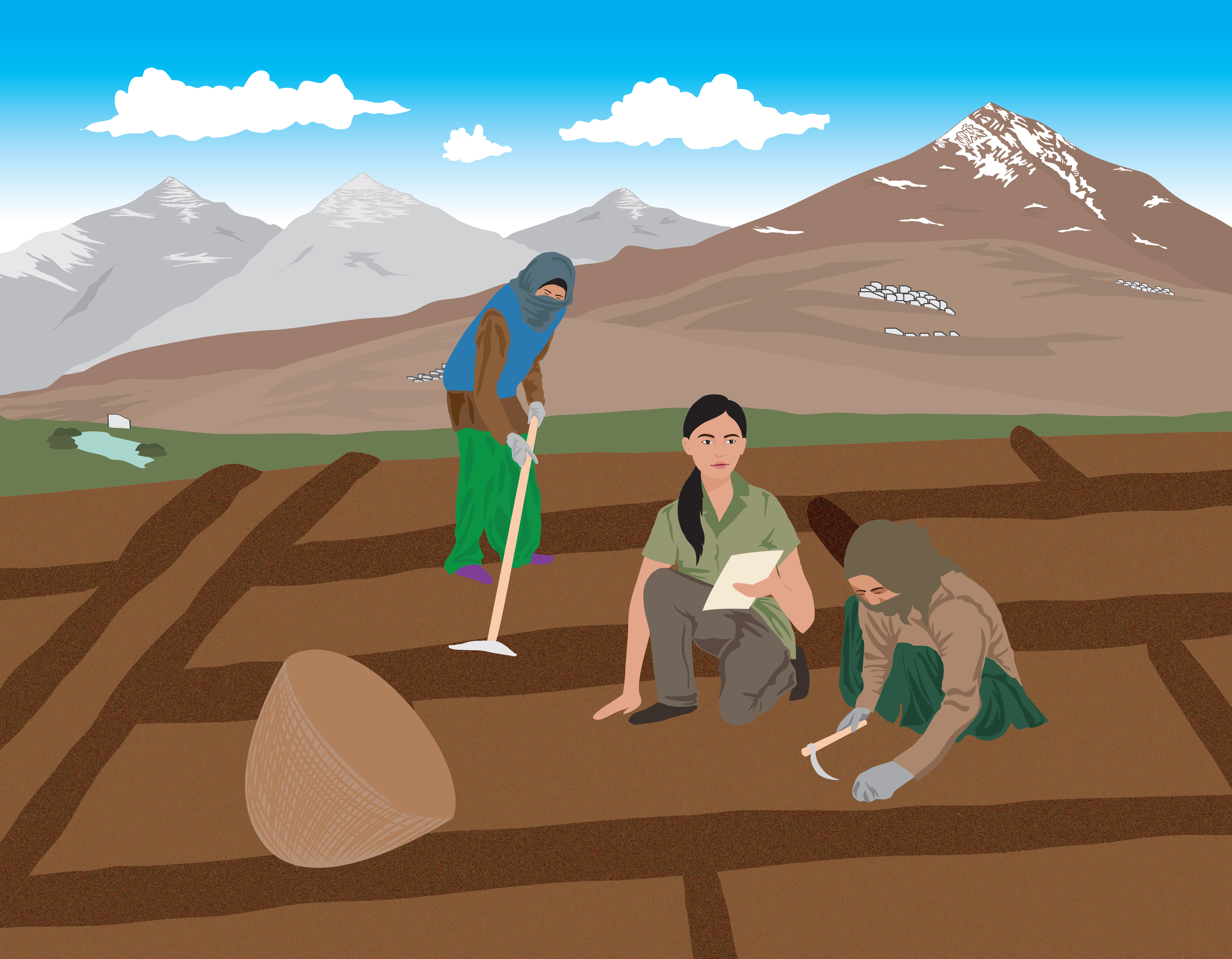
Lobzang was building kyaari in her field. These are embankments built in the fields that help guide the flow of water. They are carefully built based on the natural slope of the land. In the neighboring field, I see Thinley ploughing his land using two yaks. I was in Kibber village, in Spiti valley, and the agricultural season had just begun. The day of ploughing had been decided a few days ago at the village meeting.

“How did you learn how to do this?” I asked Lobzang, fascinated at the skill and speed she was constructing the kyaari. “I’ve been doing this for years. When I was a little girl, I used to help my mother and I learnt from her. This year, it has snowed well, the water will be good.”

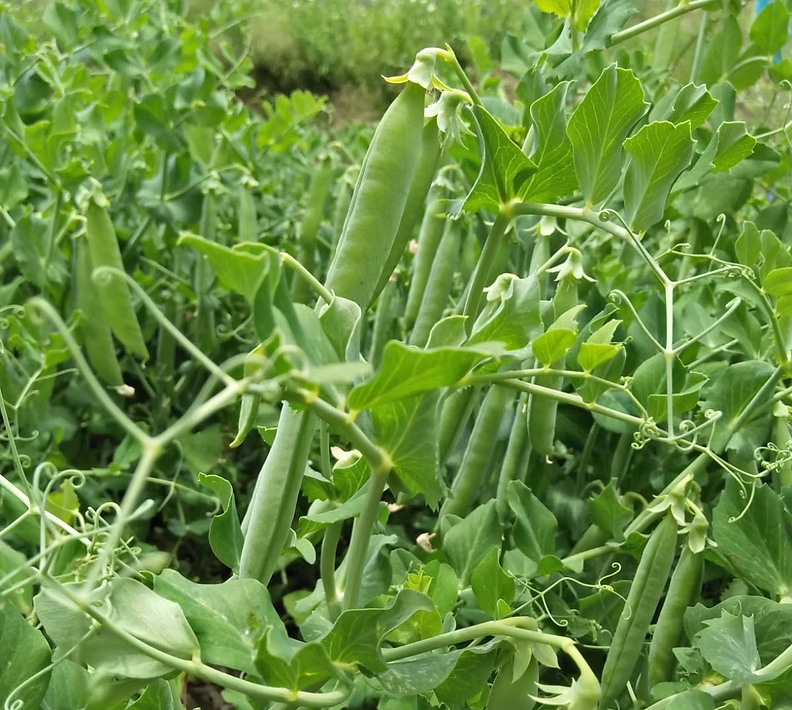
In Kibber, I’ve learnt that the irrigation system is considered the domain of the women. The water comes from the snow melt from Kanamo, a holy peak in Spiti. The water from the peak is directed to the Kibber fields using khuls. This irrigation system was initially built for barley and black pea, but has been modified for irrigating green pea. Lobzang tells me that the women were responsible for fine-tuning the watering for green pea. They learnt through trial and error, but now have perfected the quantity of water needed and when it is needed for a bountiful harvest.

“If you water them too much, or too early, the plants get thirsty, and will need more water. You have to water at the right time, with the right amount”, she tells me.

The crops are irrigated in cycles and in each cycle a fixed order is followed. Yurma, the first round of irrigation, happens 40 days after the ploughing. Just before yurma, women remove the weeds from the field and scatter them with dried yalo (Aconogonum sp). This prevents soil run-off and increases water retention. Irrigation on the first day of yurma is reserved for the fields of amchi and the devta. Women from all households participate in irrigation on the first day. The second day is reserved for families who have faced a serious illness or death the previous year or have pregnant women who are unable to work in the fields. The third day, tiping langzet, is reserved for families who have participated in the maintenance of water channels. After the third day, the remaining fields are irrigated.
This order is followed for the first three irrigation cycles, after which all the fields receive fixed turns. It is the women who decide the time of the second and third irrigation. The women also manage the daily distribution of water. Every year, two women are chosen to be the khul managers. They are in charge of managing the khuls, making sure the fields receive their quota of water, and managing small arguments that might arise related to the distribution of water. This system of women managing irrigation, is similar to systems in other parts of Nepal and South-East Asia. However, across the world, it is uncommon to come across natural resources that are managed by women. Men manage most natural resources, especially those that are shared. This makes the irrigation system in Kibber, and likely other parts of Spiti, special.

The irrigation system in Kibber has been in existence for centuries. Lobzang tells me it has remained unchanged as far back as she or her grandmother can remember. The knowledge of irrigation is passed on from mother to daughter, from the time little girls start helping in the fields.

As the sunrays finally reached the spot we were in, and started warming me up, I felt more motivated to help Lobzang make the kyaari. “Show me”, I said. I was eager to learn a skill that has been passed down from woman to woman for generations. Are irrigation systems in your villages similar to the one in Kibber? Do write-in and tell us about them.

4623 3600 Dr. Ranjini Murali
Who owns the Water?
Photo: Chhering Angchuk

Who owns the Water?

“Lungpa Bhu Med La Bhu, Ta Med La Teu, Chu Med La Chu”
Piti Da-Chang Monlam

“May the ones deprived of a son be blessed with one, the ones deprived of horse be blessed with a mare and the ones deprived of the water be blessed with this resource”
Spitian prayer verse during Da-Chang festival.

In Spiti we define wealth and prosperity in terms of water -“Chu Sang-na, Yul Sang” the expression aptly translates as  “abundant water results in prosperous villages”. Being a cold desert in high Himalaya, It is difficult to think of a resource more essential to the well being of people and their economies than water, yet managing water resources is a complex and challenging task and sometimes unfortunately results in many conflicts: between villages, households and within families. Sgrungs – Spitian oral stories are full of such narratives and show entangled relations between people and their water bodies. This one concerns two neighboring villages – a tale is known to many.

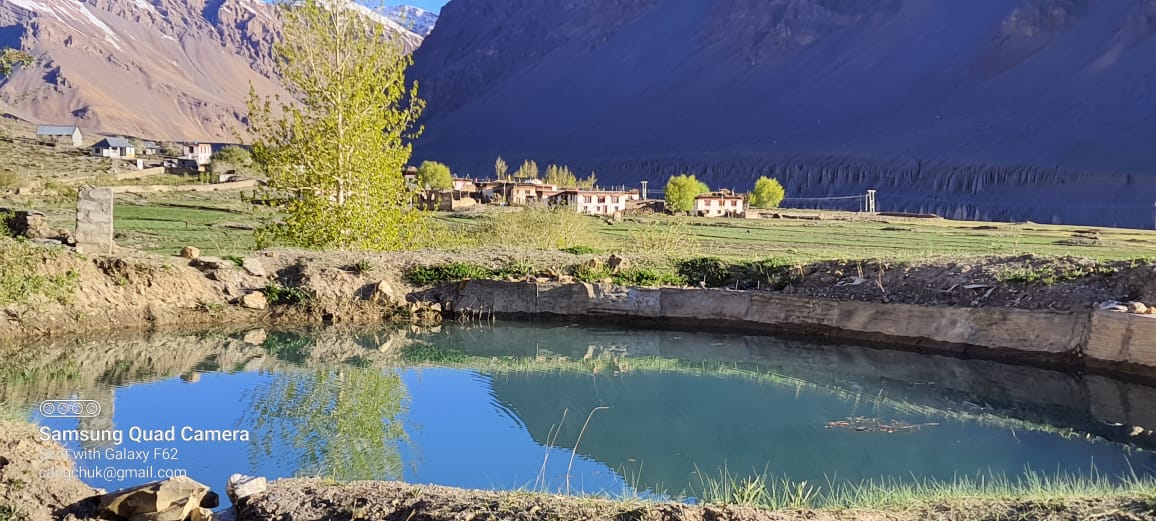
Every year, before agricultural season when the Spiti Valley gets engaged for the upcoming farming season; uncovering the tools, sharpening sickles, putting ashes to their fields and waiting for the glacial water-melt to fill their water canals, the villagers of Rangrik and Sumling, two neighbouring villages, have additional conundrum to resolve – that of the fate of “Shang-ma” – the precious mountain top water source. The dilemma of deciding who the water belongs to, which village gets to use water, channel it to irrigate their field and ultimately who are the custodians of this glacial melt water source. When disagreement arises, quite often a story is narrated that is believed to have happened a few decades ago.

Photo: Chhering Angchuk

Once a girl from Sumling village was married off to Rangrik village. Upon seeing the dry, parched fields of Rangrik, the girl’s family was distressed and decided to give her the most precious treasure they owned – the glacial water source. Back then wealth was measured in terms of one’s fields, cattle, agrarian assets and one’s access or ownership to land and water resources. With Sumling’s prime water source as a gift from her maiden family, the bride happily settled in Rangrik and many believe that Rangrik’s expansion, prosperity in present day and harvest abundance is attributed to the bride’s “Dak-ja” (parting gifts for brides). However, stories like these are often loaded with contentions and depending on who is telling the story and from what perspective, the details, the bold claims, the story arcs change dramatically.

Photo: Chhering Angchuk

While the story attributes Sumling-pa as the custodian of the precious glacial melt water which is located at the mountain range above their village, however the coin flips its side when Rangrik villagers elucidate the situation. They trace their ownership to the waterbody in accordance with traditional land and water rights that have been bestowed to them. In terms of settlement in Spiti, Rangrik came into existence much earlier than its neighboring villages and the locals believe that the vast stretch of land, pastures, waterbodies from Rangrik till Sumling covering Khurik, another villager in-between, historically comes under the territory of Rangrik and thereby belongs to them. They further elaborate that they have been maintaining the waterbody since the olden days. If there’s steady flow of water in canals of Rangrik and Sumling village, it is because villagers of Rangrik have traditionally been preserving it. In the olden days, one member from each household of Rangrik accompanied by their horses and donkeys would make a day’s trip till Shang-ma – located at the mountain top of Sumling to directly channel glacial melt into their canals.

Photo: Chhering Angchuk

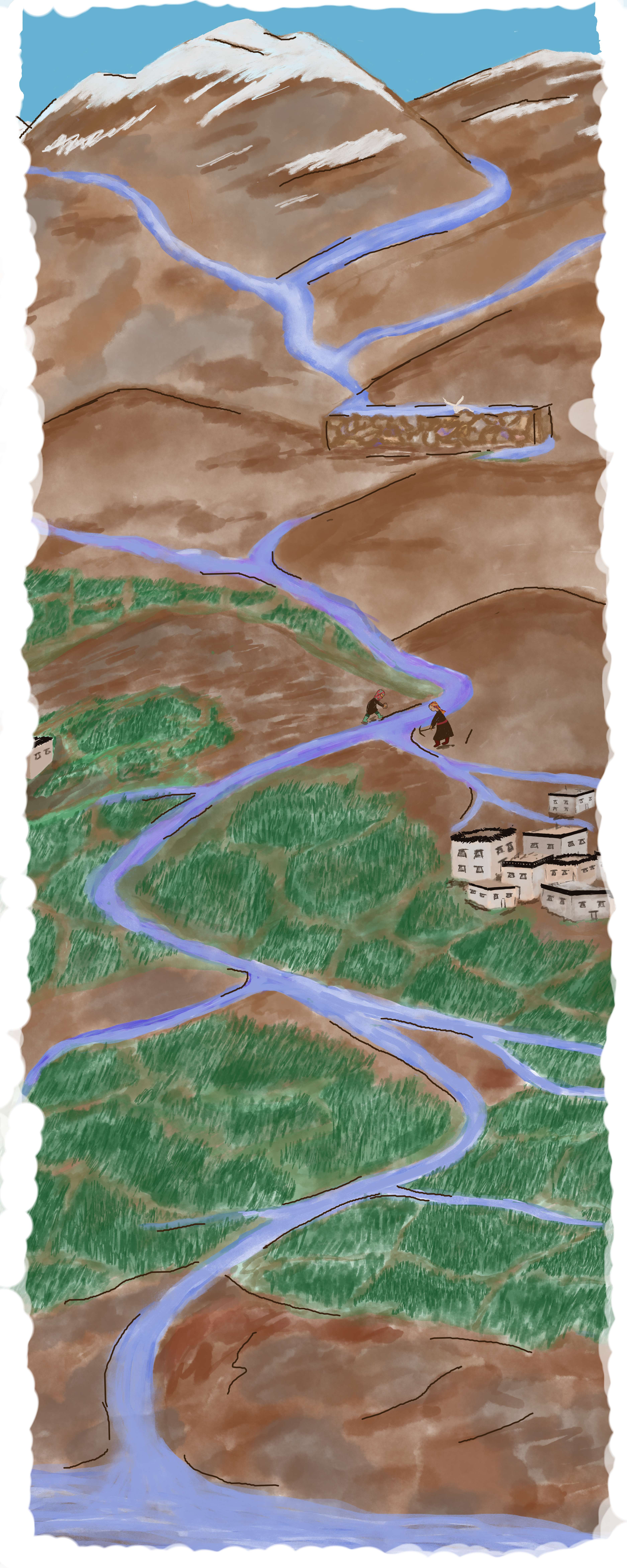
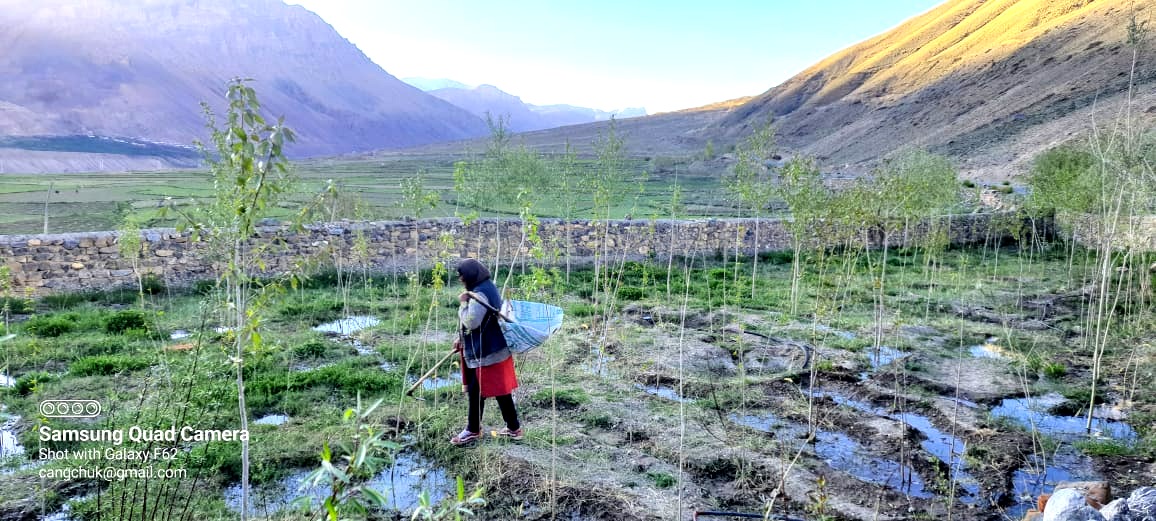
The crucial portion of the Kul (canal) head is at the glacier top, which is to be tapped. It is to be kept free of debris and so the Kul is lined with stone to prevent clogging and seepage. Water is, then, collected through the night and released into the exit channel in the morning. The Kul which stretches for over 7 km from Sumling runs through steep mountain slopes and crosses numerous crevices to reach Rangrik. The water flowing in the Kul is the only viable way to sustain vast agricultural lands in Rangrik and to feed their cattle. Villagers go on to describe that at night when the canal is dry, they even let their horses take shelter inside it to protect the livestock from cold. “In the olden days, our Kuls are that deep and water that abundant” muses munshi Chhering Angchuk – a teacher at government school in Rangrik who has been patiently corresponding with me over phone and explaining the details. Rangrik’s Gyetpo (village headman) is responsible for overseeing the maintenance of water, governing its distribution among farming households and mediating if there’s any conflict around for water distribution from Kuls can cause tensions when there’s shortage.

The glacial water source, although located at Sumling village, is primarily maintained by Rangrik village and therefore enjoys greater access to it. However, the rules around water are not straightforward and take on complicated turns as the meandering stream from the hills. In order to ensure there’s parity and less discrepancies, a consultation was made to village deities and the communities from two villages agreed upon several traditionally governed rules to be followed henceforth. While these rules are not hardbound or codified legally, it works purely on faith. Communal integrity and fidelity to verbal commitment is a virtue everyone strives to adhere to hence, going against one’s word or breaking a promise made in front of village deity and village elders is considered a grave offense.

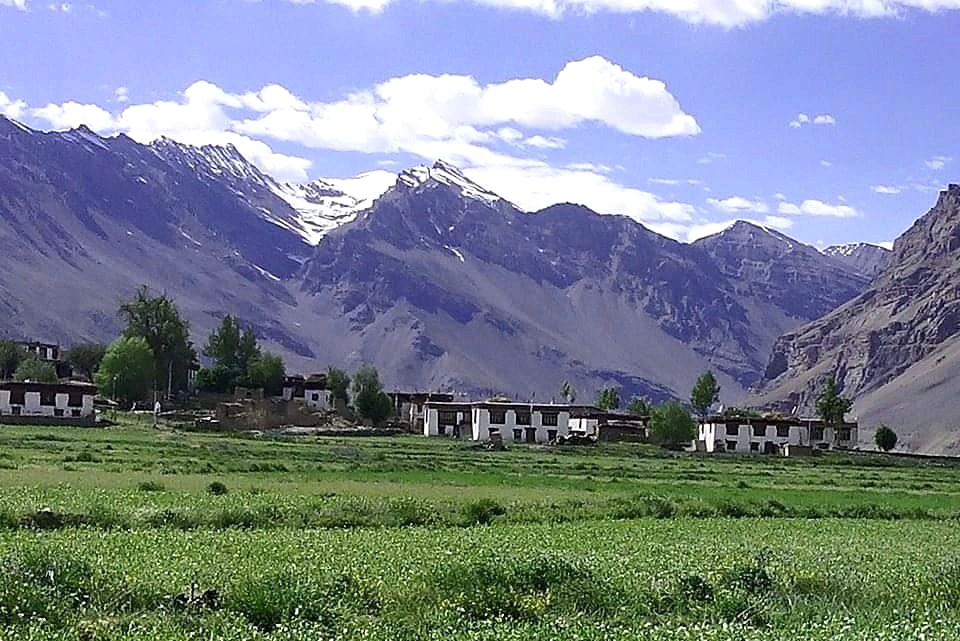
Sumling village | Photo: Chhering Angchuk

The rules governing usage of water and access to it is as follows:

  • while villagers of Rangrik can tap the glacial water from its source, they cannot completely divert it to their side or block the Kul’s head with mud, reinforce it with cement, grass or cloth to prevent downstream Sumling village from using it.
  • The water seeped out from the crevices, naturally caused chasm and narrow openings can be used by villagers of Sumling. The oozed-out water “Dsag-ti” is then subsequently diverted to the fields of Sumling and are fed to their cattle.

Water being a precious resource, there are meticulous rules even for using “dripped out” water (Dsag-chu) which would be otherwise viewed as an “extra flow” or “excess water” and left unregulated.

Is the contention then completely resolved?

Disagreements, tensions between two communities occur even now and in fact women from both these villages are stereotyped as ‘quarrelsome’ for they are primarily responsible for irrigating the fields and unfortunately sometimes end up in heated arguments. Knowing fully the onus of such conflict and subsequently a scandal that follows majorly lies on them, upon asking, many of them ruefully answers “chui thupa zinna mekak” – “our water conflict can never be fully resolved”. The story of bride being gifted water or the claims made by respective communities remains an enigma that transcends monolithic binaries of right or wrong but the story lives on and so do the many contentions around water that continues to discord people’s lives. Across the globe, access to water has always been a source of tension and it continues to be a conflict among stakeholders.

Despite the contention, many native Spitian lores, verses and religious incantations dwell on the divine, metamorphic concept of water. Referring to it as “life giving” “life line” – evoking mutual interdependence of people and water. It is culturally revered, venerated, celebrated and the guiding philosophy underlying diverse forms of water usage is respect for water considering it as an inherent, living part of nature. As such there are plenty of religious verses, hymns, odes dedicated to rivers, streams, ponds, spring waters, mountain top glaciers and rivulets to prevent it from drying and seeking its abundance in nature. In Spiti, during one of harvest festival Da-chang, villagers recite sacred verses (aforementioned) where they collectively pray protective deities to bestow “water, son and a horse” – three essential resources to sustain agrarian life in mountain desert.

1156 521 Chhering Angchuk