Yak

Meat momos for everyone
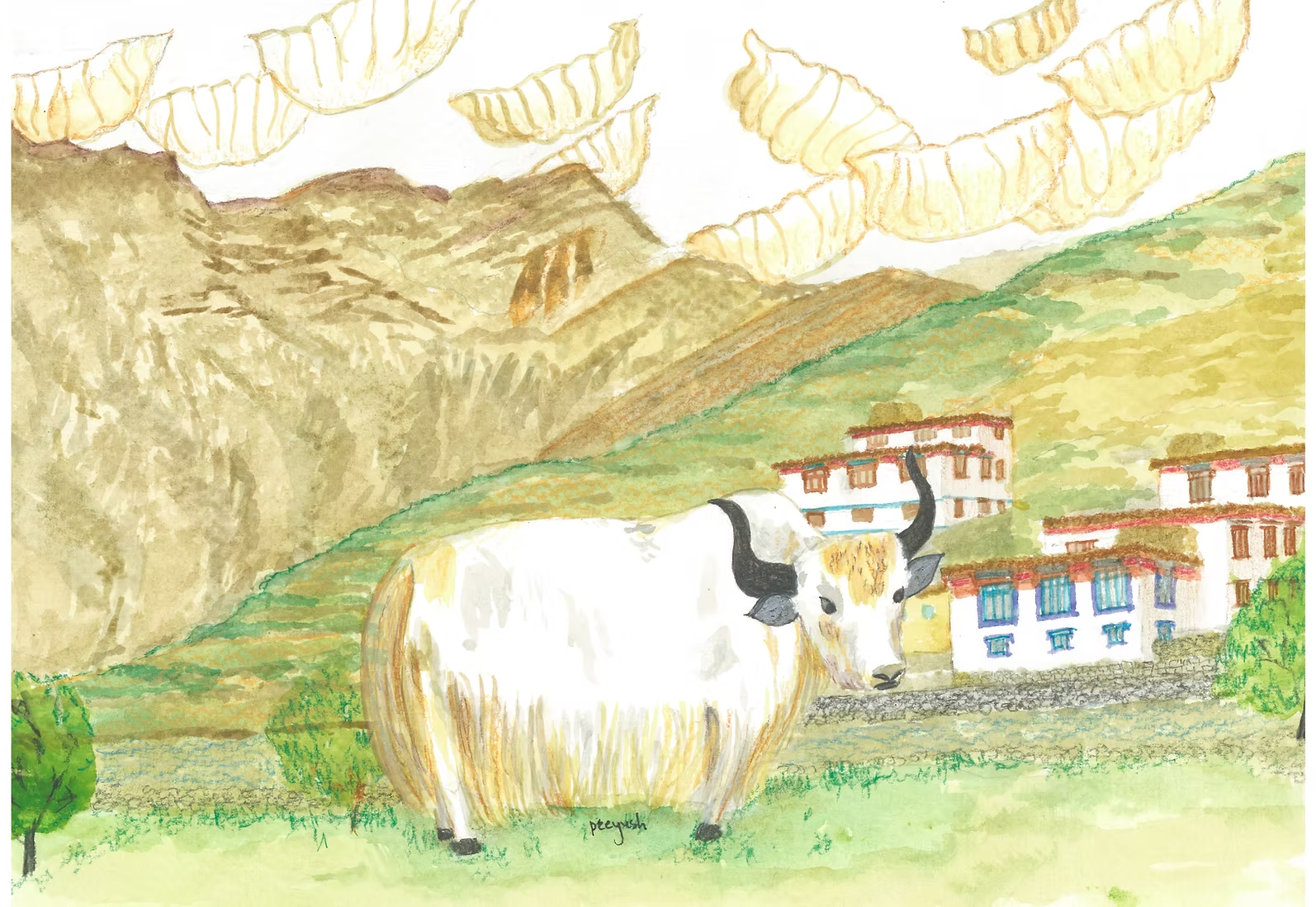
Illustration: Peeyush S

Meat momos for everyone

Illustration: Peeyush S

Unlike most days, folks in Lalung were jostling around with a sense of great urgency that morning. Life in this little village, high up in the Himalaya, is generally slow. But not today. It was hard to tell what the cause of this commotion was. I asked Sonam Chhering, my neighbor, what was going on.

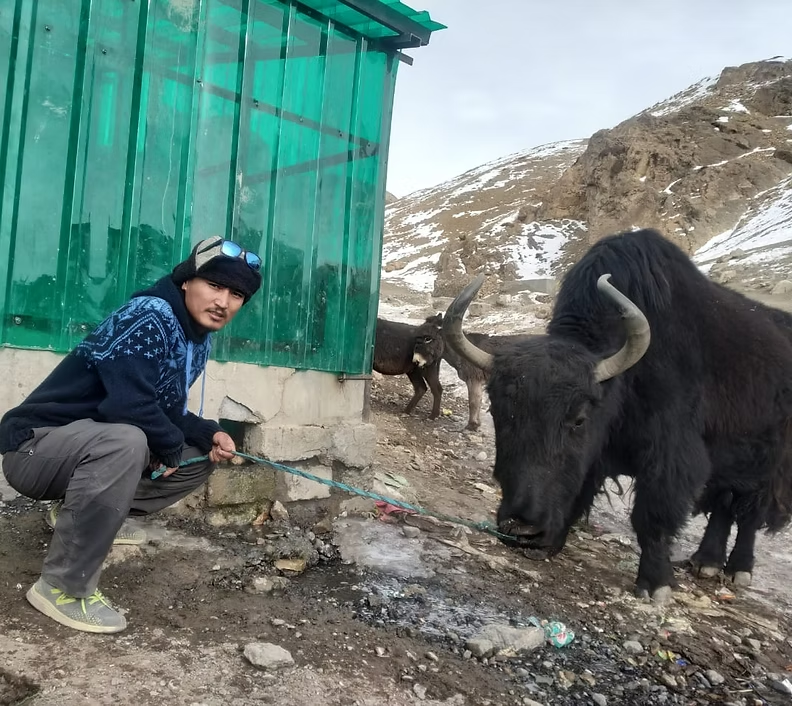
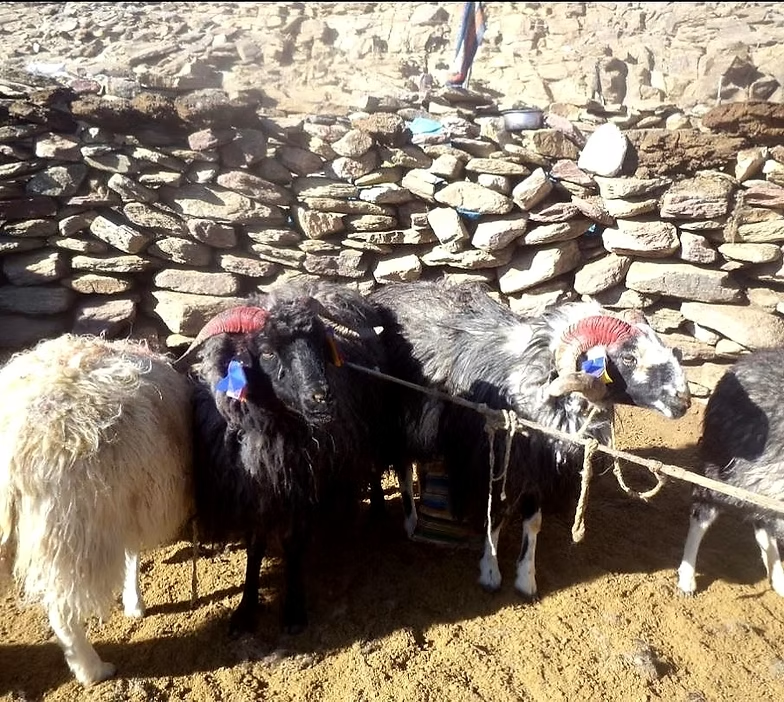
‘The villagers are going to herd the yak from the pasture. The herd was last seen at Kibri, a large pasture at some distance from the village, by the ‘yakzi’, the yak herder. He came home running last evening and reported that one of the yaks had gone crazy!’, said Sonam as he rolled in laughter. People in these villages reared sheep, goat, donkeys, horses, and cows. But the most important animal was the yak, and that for several reasons. The sturdy yak is an excellent assistant in the fields, during farming. Yak wool and yak dung was a precious source of warmth in the extreme winter months. And a yak’s tail can fetch over ten thousand rupees in the local market, if it is spotless white! Takpa—another of our neighbors—had recently purchased a yak from a trader in Manali. This old yak had spent all his life posing for photographs with tourists. He was used to a life of being fed by his master; a far cry from a yak’s life in Spiti. Here, yaks are left free to wander the pastures for most of the year. This means that they roam in a herd searching for green grasses to feast on. Not used to such a hard life, this old fellow spent most days basking in the sun, even if he had to go hungry. He soon developed a nasty temper and would chase down any soul who dared cross his path. Yesterday, it was the yakzi’s turn: he literally had to make a run for his life. So, the men from the village were preparing to catch this old yak. It took the men of the village an entire day to catch the old yak. This old fellow was brought back to the village and tied inside a corral so that he doesn’t play any more mischief. From that day on, I could see this old fellow from my window. He would stare back at me and grind his teeth, as if in warning. In some days I grew used to hearing that ominous sound at practically any hour of the day or night.

One evening, as I reached the village I found everyone beaming with joy. ‘There’s a party today. Meat momos!’, exclaimed Sonam Chhering. Momos—steamed dumplings—are the most favorite dish in Spiti and are prepared only on special occasions. That evening the entire village gathered to feast on meat momos eaten along with spicy tomato chutney. Full to our hearts’ content we walked back to our homes, that moonlit night. As we reached our respective homes, I realised something was missing. ‘Where’s the old yak?’ I asked. ‘He was the meat in our momos!’ Sonam had a wicked smile. My stomach gave a little lurch. It felt as if the old fellow was grinding his teeth inside my belly.

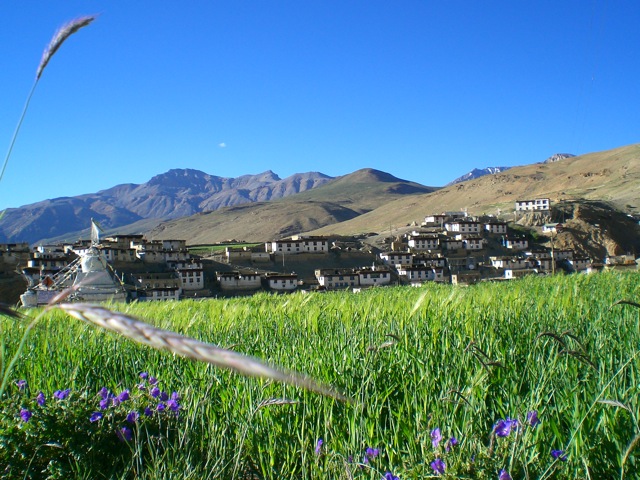
  • ​Lalung is a village inside the Lingti valley in Spiti and falls on the left bank of the Spiti river.
  • Kibri is a tiny hamlet deep inside Lingti valley and can only be accessed by foot.
  • Corral is a small enclosure made to keep domestic animals. Usually a corral is built just outside one’s house.
  • Momos are a type of steamed, stuffed dumplings. This is a very popular dish in the Himalayan region and usually made on special occasions.
​

1594 1098 Ajay Bijoor
Spiti’s Richest Village

Spiti’s Richest Village

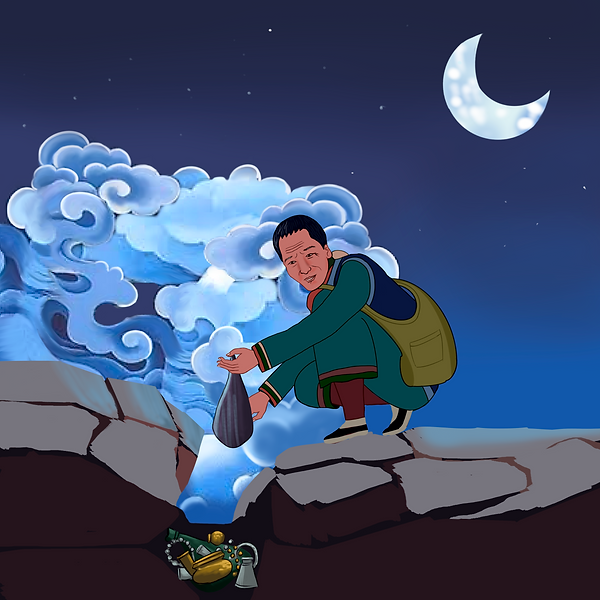
Morang was a hamlet of just five homes, but it was known far and wide not just in Spiti valley but even beyond. Thanks to Meme Chukpo. Meme Chukpo was the smartest trader of the region. He was also the richest man in the valley. He could sniff out an opportunity to make money where most others saw none. He sold yaks to the Changpas and the best Chumurti horses at the Lavi mela in Rampur Bushahr. He had traveled far and wide to trade. But Meme Chukpo had one festering fear. He was weary of people who came to his door seeking financial aid. Over time, he had devised an ingenious way to deal with such requests.

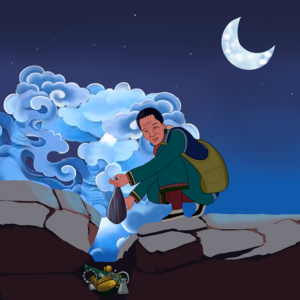
Each time he returned from a trip, he would look up to the sky. Now, if you have ever been to Spiti the first thing you might notice is how few clouds there are on most sunny days. There is barely a cloud or two in the bright blue sky. Meme Chukpo made it a habit to look for such lonely clouds. He would keep some money for domestic use and then dig a hole in the ground under the cloud and hide the rest of his money there. Surely this was the safest place to hide his treasures, and the easiest place to find it if he ever needed it. So busy had he been toiling away making money that he’d hardly ever noticed the magnificence of the rising sun, or the song of a whistling thrush, of flowers that flushed the valley in spring, or that of the slow movement of clouds in the sky.

Each time someone walked up to him seeking financial aid, Meme Chukpo would smile and say ‘I would have helped had there been some money in the house. I’m sorry, but I have none.’ He felt glad that he wasn’t lying after all. All his treasures were buried away under the cloud.

Meme Chukpo went through life working hard. Fortunately, he never faced a time when he had to fall back on the money he had buried under the cloud. But many years after he passed away some children accidentally found a pot of money in a pit under the ground. It was probably one of many pits that Meme Chukpo had dug around Morang.​

Some people still dig the soil around Morang hoping that they might find one of Meme Chukpo’s treasures that he’d buried under a cloud.

  • Meme is a title used by everyone to refer to their grandpa or an elderly man in Spiti.
  • Changpa is a term used to refer to the residents of Changthang – a region in the northern part of Tibet and the eastern part of Ladakh. Changpa are a nomadic community known to rear goats that produce the famous pashmina. They have had ancient trade links with people of Spiti.
  • Chumurti horse is a local breed of horse from Spiti. It is known to be a very sturdy variety, especially adapted for high altitudes.
  • Lavi mela is an annual trade fair that has been held in Rampur-Bushahr for many centuries. Trade fairs were and still are very popular across Himachal Pradesh.
600 600 Ajay Bijoor
The Red Fox and the Yak

The Red Fox and the Yak

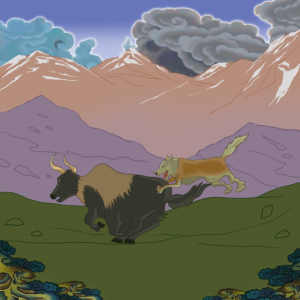
Once upon a time in the scenic valleys of Spiti, there lived a clever red fox and a gentle yak. The fox had heaps of fresh, green grass, while the yak had heaps of smelly waste. One day, as they roamed the forest, they accidentally bumped into each other.

“Oh, sorry!” said the fox.

“No problem!” replied the yak.​

As they chatted, they realized how useless their possessions were to them. But then, they had a bright idea.

“Why don’t we trade?” suggested the fox. “Your waste is perfect for my garden, and my grass is perfect for your tummy!”

The yak agreed, and they made the swap. This simple exchange made them best friends.

One day, as their friendship blossomed, the fox promised the yak, “If you ever need help, just call me, and I’ll be there in a flash!”

The yak, feeling mischievous, decided to test the fox’s promise. While grazing, he called out, “Fox, help me!”

The fox rushed to the yak, only to find him laughing. “You got me this time, yak!” the fox chuckled but was a bit annoyed.

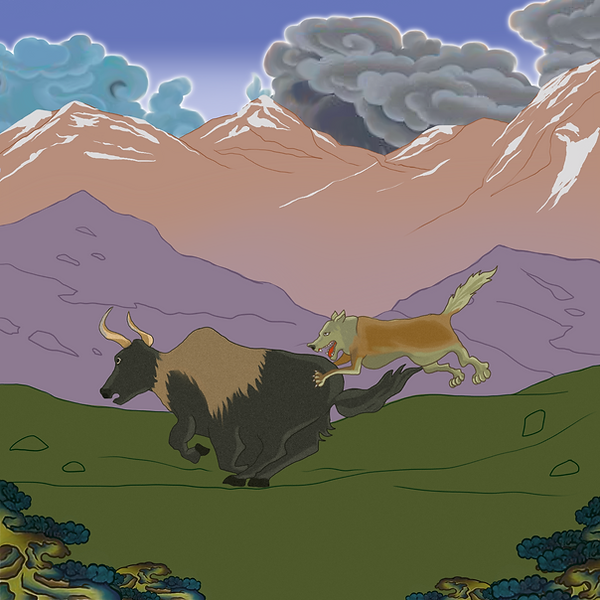
The very next morning, while grazing again, the yak was suddenly attacked by a fierce wolf! Terrified, he called out, “Fox, help me!”

But the fox, thinking it was another prank, ignored the cries. Sadly, the wolf killed the yak.

The following day, the fox went to check on his friend. When he saw the yak’s lifeless body, he felt a pang of guilt. He vowed to take revenge on the wicked wolf.

The fox’s first plan was sneaky. He smeared oil on his tail and started beating it against the icy snow. The same wolf, curious, approached him and asked, “What are you doing, fox?”

“This makes your tail strong and beautiful,” the fox lied.

The wolf, eager to have a strong tail, begged to try. The fox pretended to hesitate but finally agreed. When the wolf’s tail stuck to the snow, the fox ran away laughing. The wolf struggled to free his tail, losing all its hair in the process.​

Next, the fox made a sticky potion. When the bald-tailed wolf saw him, he asked, “What are you making now, fox?”

“This potion makes your eyes cool and soothing,” the fox fibbed.

The wolf insisted on trying it. Once applied, the potion made the wolf’s eyes burn! He scratched them furiously, making it worse. The fox, giggling, ran away again, leaving the wolf half-blind and in pain.

Days later, the furious wolf found the fox and wanted to kill him. The quick-witted fox lied again, “Oh, I’m not that fox! I come from another forest and got lost.”

The wolf, now confused, believed him. “What are you doing here?”

“I’m making a basket to carry on my back. It’s great for building strength,” the fox said.

The wolf, wanting to be strong, begged the fox to make a basket for him. The fox filled it with heavy stones and placed it on the wolf’s back. The wolf groaned in pain as the fox ran away, laughing.

The fox’s final plan was the trickiest. He made a sack and waited for the wolf. When the wolf arrived, he asked, “What are you doing now, fox?”

“I’m making a fun sack to play with my friends,” the fox said.

The wolf wanted to join. The fox asked him to get into the sack and pushed him down a hill. Miraculously, the wolf survived, and the fox grew even more frustrated. He knew the villagers disliked the wolf, so he concocted his ultimate plan.

One day, the fox was measuring sand when the wolf, now with memory loss, came by. “What are you doing, fox?”

“I’m measuring sand to make my friend powerful,” the fox lied.

The wolf, eager to be powerful again, begged the fox to put the sand on his back. The fox agreed, piled the sand on the wolf, and climbed on top. They headed toward the village.

Upon reaching the village, the fox yelled, “Help! A wolf is here!”

The villagers, armed with weapons, surrounded the wolf. Shocked and unable to run due to the heavy sand, the wolf asked the fox, “What’s happening?”

The fox replied, “I’m avenging my friend, the yak, whom you killed.”

The villagers, angered by the wolf’s presence, killed him. The fox felt a bittersweet satisfaction, having avenged his friend. The forest animals learned the importance of trust and lived peacefully, always remembering the clever fox and the unfortunate wolf.

  • Red fox is a common fox with a reddish coat. It is one of the most widely distributed species in the world.
  • Yak an animal of the cow family, with long horns and long hair. It is reared in villages in the Himalayan region
600 600 Aryan Gadgil
Agricultural Practices in Spiti Valley
Photo: Prasenjeet Yadav

Agricultural Practices in Spiti Valley

“Ney yotna chukpo sam, nor yotna mak”
“Those who have barley are rich, not the ones with money”
Spitian Proverb, Anonymous

Ever since my childhood days, I was very curious to know about the agricultural practices of Spiti valley – traditional crops we grow and how farming happens in a cold Himalayan desert. Like any Spitian youngster growing up I used to help my family with agricultural works whenever I am at home for holidays or during the peak harvesting season but I never got the opportunity to help them for the whole season. But last year, due to an ongoing pandemic, when I came home, I realized it was a good opportunity for me to understand agricultural practices first hand. I helped my family through whole process right from scattering ashes in the snow covered fields to prepare the field for ploughing to cleaning dried-up water canals before harvest season to helping during peak season of ploughing and harvesting. I also wanted to learn about the history of agriculture in Spiti valley and the elders in my family shared some interesting insights with me.

Photo: Lobzang Tandup

Traditionally, the people living in this valley grew barley and black peas for sustenance. They used barley grains to make Sampa (flour) or Arak (traditional alcohol). They also used barley and black peas to barter it with traders from Changthang who in turn would give Lena (Pashmina) and Khullu (Yak wool) in the 1960s however, things started to change in the valley. People started growing cash crops like green peas and potatoes as access to outside markets improved due to development of key roadways. Now, barley and black peas are grown only for self-consumption and are only a small share of the total agricultural production.

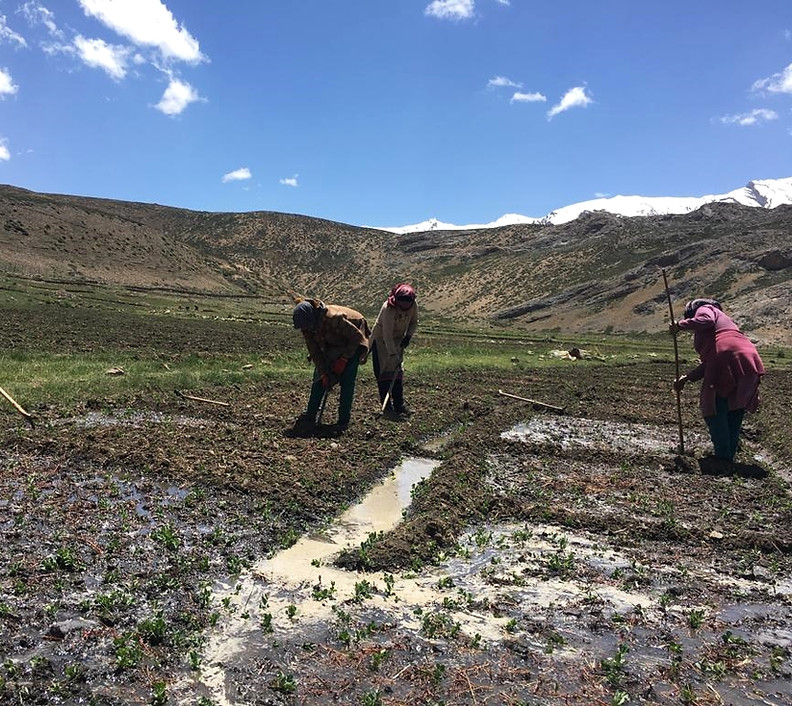
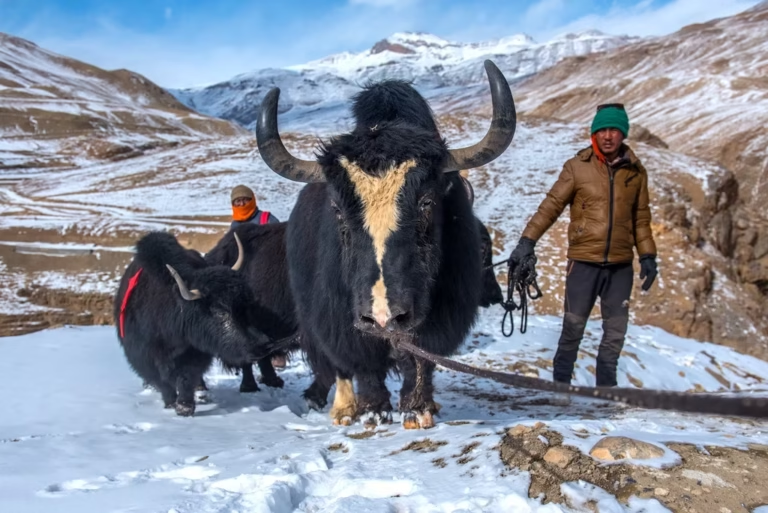
Agriculture in Spiti lasts only for six months. It’s the most crucial time for all the farmers. Although the sowing season starts only in April, the preparations start months before. The seeds are either procured or developed and stored safely during the winters. When the snow first melts around mid-April, the farmers plough their fields with the best resource they have – Yak or a pair of Dzo and seeds are scattered by hand, but these days people use tractors, ploughing machines and even tillers are used. Ploughing the field is a two person job, but sometimes the whole family can be seen in the fields helping out the parents. In Spiti, one’s family, relatives and friends are one’s greatest resources. Farming is very communal in nature. Everyone helps each other and sometimes even 3-4 families work collectively.

The system of communal farming helps ease the burden of marginal farmers who do not own Yak – they collaborate with Khangchen households (Zamindar family), borrow Yak for ploughing the field and in turn repay through their labour. Yaks are an effective but an expensive farming asset and not everyone can afford to buy and maintain them. The system works because it is based on a reciprocal relationship between Khang-chen (Big Zamindar) and Khang-chung (Small farmers) households and resource and labour are shared communally. Sometimes, the members of the Khang-chen household lend a piece of land for a few years to the Khang-chung household for farming. They do not have to necessarily repay through capital but the Khang-chung family can repay the benevolence through their labour works in the Khang-chen family – for instance, they can help the Khang-chen family during ploughing and harvesting season. This system is called “Shey” in Spitian.

The relationship between people, wildlife and nature go beyond utilitarian aspects. It is heavily influenced by cultural values and local practices around it. For instance, many Spitian households have unique names for their agricultural land which is a helpful marker of identification of one’s land and also carries meaningful ecological symbolism: “Chup- ja” (water-bird) is named for agricultural lands that resemble the shape of long-necked water cranes. “Ti-rik” is named for lands that resembles local barley-flour delicacy, “Dorgya-ma” is named for agricultural lands which is full of stones or pebbles owing to its hilly terrain, “Yur-yok” is referred to lands located beneath a water canal and “Phe-kak” (meaning half in Spitian) is often given to agricultural lands of “Khang-chung” families (small farmers) who gain their land after ancestral subdivision from Khang-chen family (big zamindari household).

There are a lot of farming songs and prayers that people hum while toiling in their fields. Farmers sing particular songs at every step. The songs have rich meanings related to farm works, weather conditions and comprises of odes and incantations towards local deities pleading for bountiful harvest. “Om Mani Padme Hung” – the holy Buddhist mantra is chanted while ploughing which symbolises farmer’s gratitude and compassion for Yaks and Dzos who toil so hard in our fields. “Laso- ho” is chanted in merriment to ease the stress and fatigue of animals when they plough in harsh weather.

As soon as the ploughing is done, the farmers wait for the first crop or sapling to grow a little before the cycle of irrigation begins (Yurma). This period is usually after 40 days from the day of sowing. Water is a scarce resource and there are local systems of water distribution and management called “Chu-rey” (water turns) entirely handled by women of the village. A group of women is appointed to take charge for the season to ensure timely, equitable distribution of water to each household. The Khang-chen (big zamindar) households have more access to water resources – they have frequent water-turns (chu-rey) and more water is allotted in their canals for irrigation. They also have more authority in decision-making as they are the original tax-payers of the land and have earned that right historically. Owing to scanty precipitation, irrigation becomes a daunting task – women get busy with watering works (Yurma) for over 2 months till the crops are fully ripe.

Photo: Lobzang Tandup

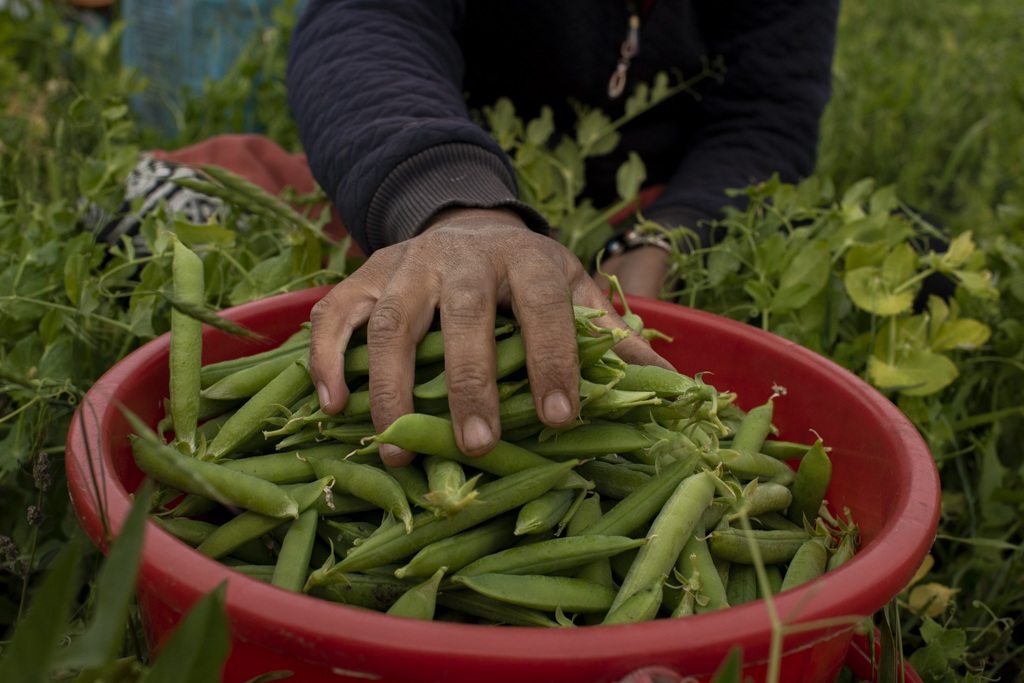
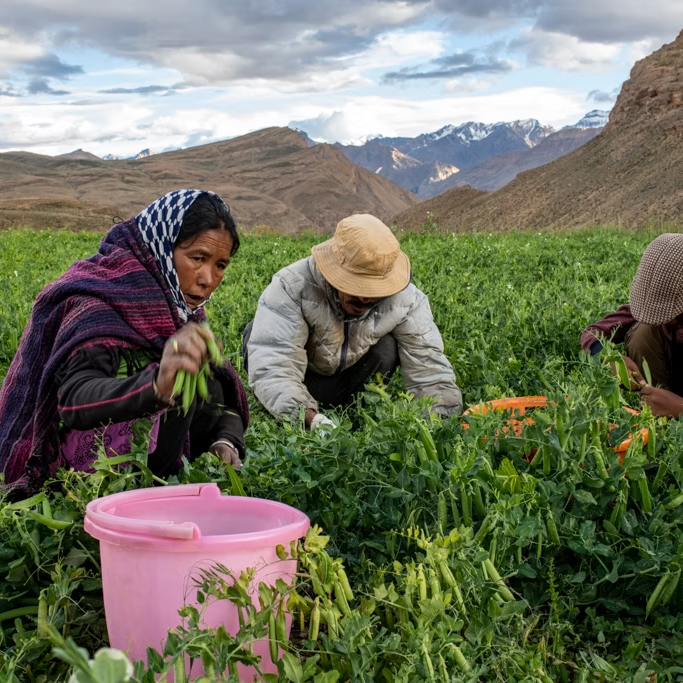
The green pea crop gets ready around June in low-lying villages (Kaza, Tabo, Rangrik, Pin) and August in villages in elevated regions (Demul, Komic, Langza, Hikkim, Kibber and Chicham) . These crops are then transported and sold in Delhi and other nearby states. The produce from Spiti is considered of highest quality as the farmers do not use any insecticide, pesticide or weedicide in their fields. Instead they only rely on animal and human waste as manure. The sweet taste of green peas from Spiti valley is the result of unique farming techniques and hard-work of the people who do not give up despite harsh conditions and scarce resources.

The cropping patterns of green peas and barley are different. Green pea, although is the primary source of livelihood for the farmers, requires much more work and tends to consume more water. Barley is a traditional crop of Spiti that is favoured more by farmers due to its low input requirements, better adaptability to harsh conditions and is considered drought/disease resilient. Barley crops and black peas (kala matar) can be harvested later around August-September when the work around green-peas is done. The remaining grass residues are collected to use for fodder or as a livestock feed for animals during winter.

Most Spitian households own a flat ground near their agricultural field called “Ul-tak” where separation of straw and barley (Khu-yuk) are done, cut grasses are brought and flours are grinded. The grains are finally stored in village. A group of women is appointed to take charge for the season to ensure timely, equitable distribution of water to each household. The Khang-chen households have more access to water resources – they have frequent water-turns (chu-rey) and more water is allotted in their canals for irrigation. They also have more authority in decision-making as they are the original tax-payers of the land and have traditional go-downs/storage called “Bhang” for better preservation.

Agriculture is the lifeline of Spitians and it is not just a livelihood means for us, but a way of life. Our tradition, cultural values and regional ethos revolve around agrarian practices. Many local Spitian proverbs (pera) are reflective of that knowledge. I am sharing few as recounted by elders:

Nyima dot la mata, Dotpa chung la mata
Do not rely on the sun’s warmth nor your appetite. This proverb talks about the importance of being alert, active and prepared when one is undertaking any agricultural work. When one leaves home in the morning for the field, a farmer has to be ready for any unpredictability – nor the pleasant heat of sun or one’s appetite at that point can be relied on.

Soye me phung, nyal phung
There will be agricultural loss not when you eat but when you sleep/laze around.

Ley betna, sey nyong
If you work hard, there will be a bountiful harvest.

Ney yotna chukpo sam, nor yotna mak

Those who have barley are rich, not the ones with money.

I am not an expert in farming or possess rich knowledge but I would like to share some suggestions, the ecosystem in the trans-Himalayan region is very fragile. Excessive focus on cash crops like green peas won’t be sustainable for the long run. We need to incorporate traditional crops like barley as well as black peas which are more suitable to local conditions. We should think about long term ecological sustenance and food security for the entire community. Cooperative societies, local management should work in a collaborative manner to fetch fair prices to our farmers. Youngsters should realize that although modern farming and technology are easier and more convenient, nothing beats natural farming technique and indigenous knowledge of the people.

1024 683 Lobzang Tandup
The sun returns home for the mother bird
Photo: Stanzin Dorjai (Gya)

The sun returns home for the mother bird

Spiti Valley has a remarkable ancient agricultural heritage that has sustained several thousand people in the remotest corner of high and arid Western Himalayas—one of the most inhospitable and climate-sensitive regions in the world—for more than a thousand years. The enduring sustainability of agriculture in Spiti Valley rests with its farming calendar.  The calendar uses stories, evocative names for months, and traditional knowledge to guide the timing of local farming activities according to the unique natural rhythms of “Spiti, the Valley of Gods” (Piti Lhayi Lungpa).

The natural rhythms of Spiti Valley are captured in Spiti’s calendar with unique timing and names of months, which are different even from neighbouring Tibetan Buddhist regions of Ladakh and Kinnaur.  In addition to local timing and names of months explained below, the calendar is used with other local and Indigenous practices of telling time. For example, Spiti farmers mark sunrise and sunset over stone cairn markers atop high mountains and note shadow lines on mountainsides to identify important days and times, such as the solstices and equinoxes. Farmers also use their observations of colours, sounds, and rhythms of local plants and animals to tell time, such as observations of brightness and colour of the sky when birds sing at dawn.

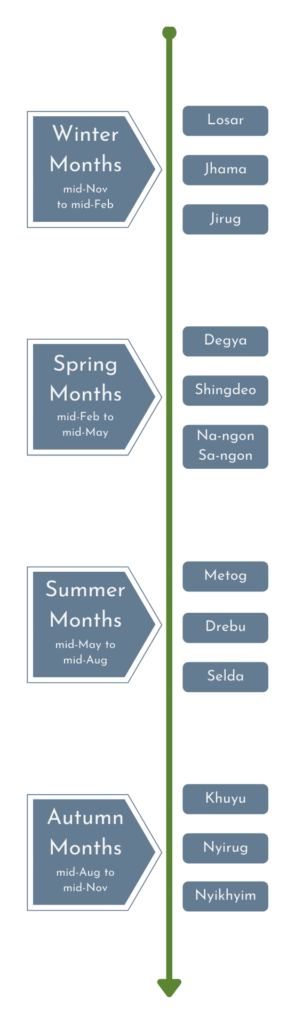
Winter Months 

For Spiti farmers, the year begins early in winter with rest and celebration after a hard year of work in the field.  The first month is called Losar or “New Year” and is celebrated three months before the Tibetan new year.  Losar is celebrated early in Spiti, usually around mid-November of the Gregorian calendar, because the valley, including the villages and pathways, will soon get covered under layers of snow for months.  The timing is ideal for Spiti farmers who have customarily completed all essential seasonal livelihood activities, and are now ready to turn their attention to the important family, communal, and religious gatherings of the Losar month.

Photo: Prasenjeet Yadav

The second month is called Jhama or “Mother Bird.” The bird here is Gharog or raven.  Raven is a bird of augury and protection in ancient Spiti and Tibetan beliefs, like in many cultures around the world.  It is said that once upon a time the divine bird, Gharog (raven), was unable to hatch chicks from eggs despite its many attempts because its body was excessively warm for incubation.

Devastated by this failure, the raven prayed that it would be able to hatch chicks from golden eggs during the coldest winter months. That is the reason ravens prepare their nest on a mountain cliff during the second winter month and the month is named Jhama. There is a local saying that describes Spiti’s coldest winter months: “Jhama Jhama zerna Jirug a-chu-chu.”  This saying suggests one shouldn’t complain about Jhama’s cold weather because Jirug, the following month, is even colder.

The coldest winter month is called Jirug or “Baby Bird” because it is the time when ravens lay eggs and hatch their baby birds. References to divine birds are common in Tibetan calendars. For example, the 2008-09 farming almanac of the nearby region of Kinnaur notes the following during Spiti’s Jirug month: “the divine bird has completed 30 days, if this is followed by snowfall, the divine bird will lay golden eggs, and there will be bountiful agro-pastoralism in Tibet.” It is also important to note that Jhama and Jirug are named not only for mythological reasons but also, and more importantly, to categorize seasonal times based on timely behaviour of natural environment. Researchers, for example, have found that common raven egg-laying and brooding behaviour begins in February, which comes during Jirug month.

Spring Months

The first spring month is called Degya (‘de rgya), which means to “soak in the Sun’s energy” as days become warmer and longer with the spring equinox. As snow cover begins to melt and days become brighter, blue sheep and ibex nibble on dormant plants on distant mountains, often under the lurking eyes of hungry snow leopards.  The month is named after the Sun’s warming energy during this month because it is crucial for melting the snow from the fields so that farmers can start Spiti’s short growing season early next month.

Photo: Dr. Tashi Tsering

The second spring month is Shingdeo (zhing ‘debs) or “cultivate the fields.” On the chosen auspicious day of the month, the farmers gather a few loose rocks on their fields, between which they burn juniper leaves to make smoke offerings. This is followed by offerings of libation drink carefully wrapped in a white scarf and marked symbolically with a dab of butter called yar. Yar-butter is marked on the foreheads of people, on horns of the yaks, and on the ploughs. And all through the ploughing period, the ploughman sings songs and prayers which may guide the yaks to turn, stop, or continue ploughing, or pray for absolution of sins that may come from harming insects and bugs in the process of ploughing.

Photo: Deepshikha Sharma

Spiti comes alive in bright colours during the final spring month of Na-ngon Sa-ngon, which means “blue skies blue earth.” This name invokes the beauty of lush green fields under bright blue skies.  Yaks graze freely on the mountains for the rest of the year until winter snowfall to produce the main source of energy for the village economy: dung for fuel and manure.  During this month, farmers count and wait forty days from seeding to first watering, guided by traditional knowledge, to ensure ideal conditions for seed germination in local soil, water, and weather conditions. Then expert women farmers do the first “mother watering” or Yurma, with Tirping, an irrigation tool made of blue sheep horns that ensures greener crops.

Summer Months

The young, irrigated crops begin to flower in early summer which is why the first summer month is called Metog or “flower”. Metog is indeed a flowering month as all kinds of flowers bloom throughout the valley during this time. The second watering called Rhakti or “watering the sun-burned” plants happens during this month. Farmers allow ten days to pass between the first and the second watering, making young crops dry and sun-burned. This practice teaches the young crops the value of the nourishing powers of scarce water, making them absorb more water in the future. These farming practices follow stringent customs based on the calendar, such as the yearly “ban on the use of sickle” or ban on cutting plants from summer solstice (June 21) until harvest season to ensure maximum plant biomass growth on Spiti’s arid landscape.

Photo: Prasenjeet Yadav

By mid-summer, the farmers’ labor bear fruit as grains begin to grow on the barley ears. This is the reason the mid-summer month is called Drebu or fruition of one’s labor. Farmers wait for the grains to become ripe for harvest next month. As tufts of bristles grow on barley ears, farmers irrigate the fields with a special technique called Kirchuyi. Now watering is done after carefully preparing irrigation channels and sluices in such a way that water will flow to all parts of the field by itself after it is released from the main sluice of the field. Another name for this convenient method is Minchu or seed-ripening water.

The last summer month is called Selda or “harvest month.” Unlike new commercial crops, traditional crops like barley are harvested methodically according to ancient customs. After the crops are cut, the sheaves are laid out in the field in neat rectangle-shaped patches to cover the barley ears from drying under direct sunlight. It is only when the crop sheaves are brought to the threshing ground that the ears are exposed to the sun for drying. The importance of observing this practice is told in the story of Jhojho Druguma.

Photo: Prasenjeet Yadav

Jhojho Druguma was a rich woman who did not bother to dry her barley sheaves in the proper manner. As a result, the ears and grains became too dry, and they fell off when the sheaves were carried from the field to the threshing ground. That is why, to Spiti farmers, the stars of the Milky Way are spread out the way they are so spectacularly over Spiti’s night skies. The stars of the Milky Way are Jhojho Druguma’s grains that fell on her way to the threshing ground.

Autumn Months

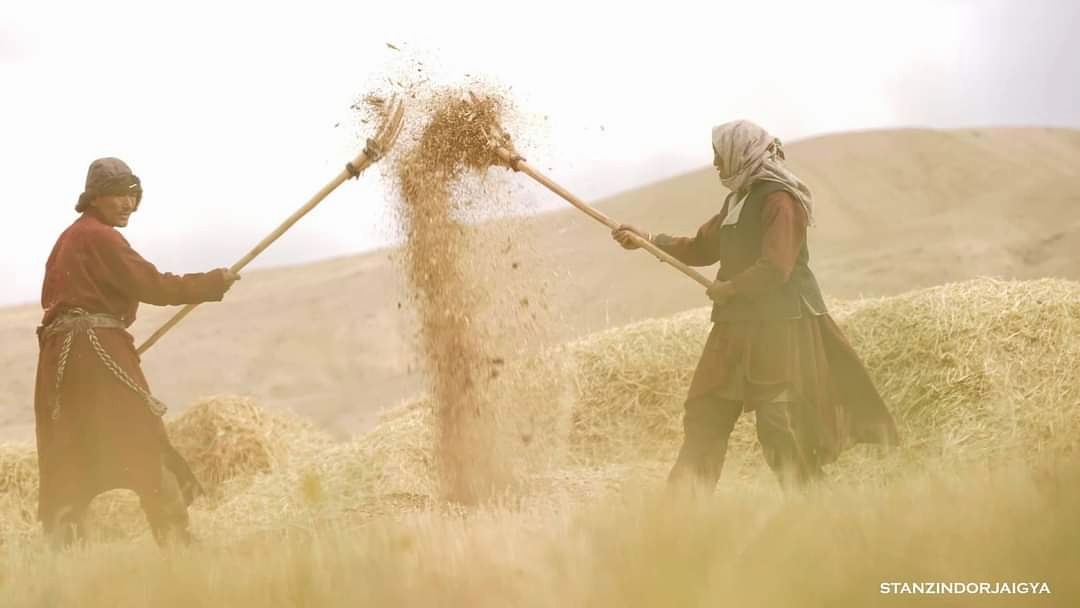
The first autumn month is named Khuyu. Khuyu is the Spiti word for circular threshing that is done to separate the grains from the husks. The process involves tethering yaks and other animals to a sturdy central pole and making the animals trample over harvested crops in a circular fashion. When the animals go round and round, tromping the husks and the grains, farmers use wooden pitchforks (zar) to mix, push or spread the husks so that the grains are properly separated. The whole process is blessed with Khuyu songs that can be heard from distant corners of villages.

The penultimate month is called Nyirug. “Nyi” is a short for Nyima or the Sun. “Rug” means to gather, specifically to gather animals back home before sunset. As such, Nyirug is the month when sun sets early, and days become shorter when farmers gather their horses and yaks back from the mountains in preparation of the oncoming long and cold winters. Farmers also follow stringent customs to ensure that there is enough winter stock of barley flour, dung, and fodder in their households during this month.

The last month is called Nyikhyim, which refers to the twelve zodiac houses of the sun in Tibetan astrology. “Nyi” means sun and “khyim” means house or home. Nyikhyim here refers to the Sun’s return home after completion of its annual cycle. For Spiti farmers, however, the Sun returns home to fulfil the mother bird’s prayers. This is expressed in the local proverb, “nyima garlog, jhama yin”. The Sun returns home so it becomes cold enough for the mother bird to arrive and hatch chicks. As such, the story of mother bird comes to a full circle at the end of the year along with the sun’s annual return home, while in anticipation of “Spiti’s deep cold winters when even yak-horns crack into pieces.”

In sum, the farmers of Spiti Valley practice a calendar that integrates local economy and ecology into a cosmic unity filled with wonderful stories and ancient wisdom that is perhaps more relevant today than it ever was.

1080 608 Dr. Tashi Tsering
Losar : Animal’s Day

Losar : Animal’s Day

I think I am in fact the least excited and most boring person at any form of festival. Much of it could be due to my introverted genes that wouldn’t fancy gatherings, dancing, fireworks or any other things which involve interacting with strangers, but part of it must be because of my upbringing. I am not sure of both though. But my heart just cannot seem to invite festivity as much as my friends and family do.

I hail from a small nomadic village in Ladakh where the livelihood of everyone is dependent on livestock. Almost every household owns some goats, sheep, horses and yak. These animals aren’t merely our source of income, but are used for obtaining food, fetching water, traveling, and most importantly seeking comforts and friendship. Since our life revolves around rearing these animals and more importantly enduring the harsh reality of having no access to electricity, water and worse not even a single shop in the vicinity throughout the year, we have little time for festivity. Or, many of us are even oblivious of its existence, except for Losar– the Tibetan new year and Thrungkar Duechen – His Holiness The Dalai Lama’s birthday. Hence, every single person in the village looks forward to these two days like a child, although for different reasons.

Photo: Namgyal Lhamo

My fondest memories of Losar and Thrungkar were significantly boring compared to my cousins. But these days, no matter how many festivals I witness as I travel through urban life, there is nothing more meaningful and beautiful than this idea of celebration I got to see early in my life. It was on one of the third days of Losar. My father came to me, patted my head gently and said with a smile “Life of your polled lamb will be set free”. I was elated beyond words and this memory has remained in my heart so vividly. In my village, on the third day of Losar or Thrungkar, fathers of the households are the busiest. They get up early in the morning to appease the Land God and other deities who are believed to be the true owners of our land according to their ancestors. This is followed by their brief journey to the animal shed where they would choose some animals randomly and set their life free. By that, we are not allowed to send them to slaughter houses, milk them and are expected to watch them with unconditional love and care which every animal receives anyway, until they die. It was my most awaited moment of the festival. My siblings and I would always hug our father with utter joy after he would come out of the shed. This act is mostly done to honor and thank the sacrifices of animals for our livelihoods while it is also performed for the health and long life of His Holiness and carry his message of love, kindness and compassion towards animals.

We eventually shifted to a town nearby, leaving the whole nomadic life behind due to the inability of my family to see the animals suffer for our survival. But, as I look back, I realised that it was this place where I gave birth to my love for animals. Today, even if we live a totally different life, my parents make sure to celebrate these two days by setting at least one animal’s life free. There is nothing more rewarding at a festival for me than this act of genuine kindness. Somehow I think of these two days as a festival of animals and I hope to carry this tradition forward in my own life too.

792 706 Namgyal Lhamo
Art From Our Valleys
"Huntsman" rock-art, Gya-Miru | Photo: Sherab Lobzang

Art From Our Valleys

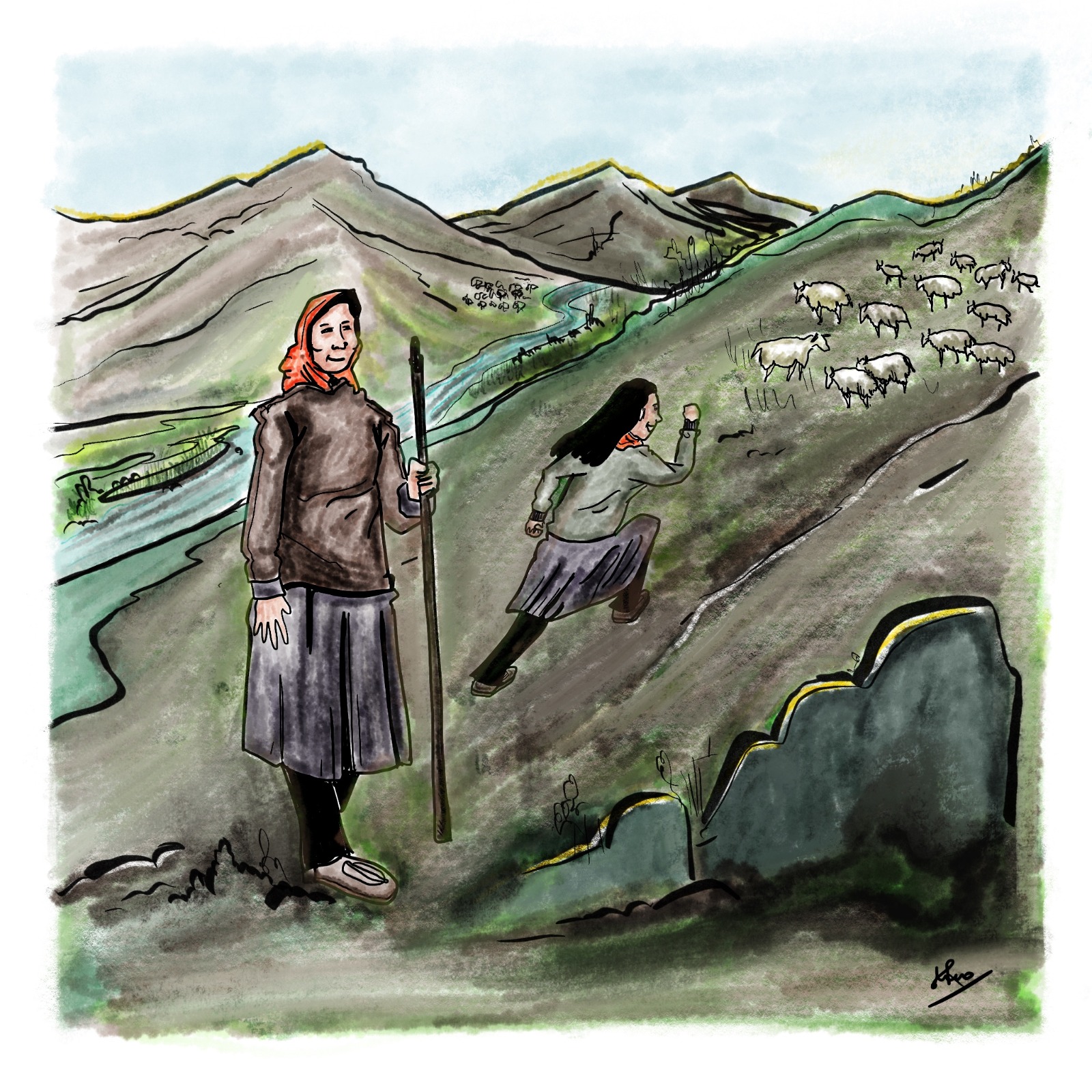
Life in the mountains is tough. In addition to physical fitness, it demands a great deal of mental fortitude. This is particularly true among our elders, especially when you hear them speak about their younger days. Stories of how they managed to survive the long winter months tending to their livestock are hard to believe for our generation. Animals reserve a special place in our lives, and they too are often as spirited as hardy mountain people. Growing up in Ladakh, animals were an integral part of my life too: sheep, goat, donkey, horses, and yak. And then there are the wild animals that were seen rarely, but often encountered when they preyed on livestock. Growing up in the village of Kumdok close to the Changthang region of Ladakh, I enjoyed exploring the mountains as a young kid. I still remember joining my mother to graze the village livestock in the pastures around our village. Each family took turns to fulfill this task. During that time my mother would show me wild animals that were seen in the pastures around our village. We had to keep our livestock safe from hungry carnivores.

Illustration: Rohit Rao

I was fascinated by the outdoors and I still cherish those times spent exploring the pastures. I particularly remember the day I first encountered some very interesting art on some of the rocks in these pastures. As a 13-year old then, I wondered who had drawn them. I asked my mother and she told me that these were made many, many years ago. Probably even before our great, great grandparent’s time. This was from a time when there were no notebooks, pencils, and even schools which is why they may have etched them on the rock.

A few years later, I left the village for higher studies. Returning home each year, I noticed that the number of livestock in my village was reducing. Some years back everyone gave up herding sheep and goat. After completing my education, I began to work in wildlife conservation. My work took me to many places across Ladakh. I interacted with locals of every generation. I also worked closely with researchers who were trying to study nature and the relation that we Ladakhi share with them. That often took me back to rock art that my mother had shown me. Our ancestors may have shared a special relation with nature and animals, as was depicted in the art. This got me even more interested in rock art which is both rare and special. In the last few years, I have encountered rock art in the most unlikely places. I make sure to take a picture, each time I find new art. I often find myself thinking about what our forefathers were trying to tell us through the art. I would like to share some of these pictures and my thoughts with you.

"Hunter" rock-art, Ulley | Photo: Sherab Lobzang

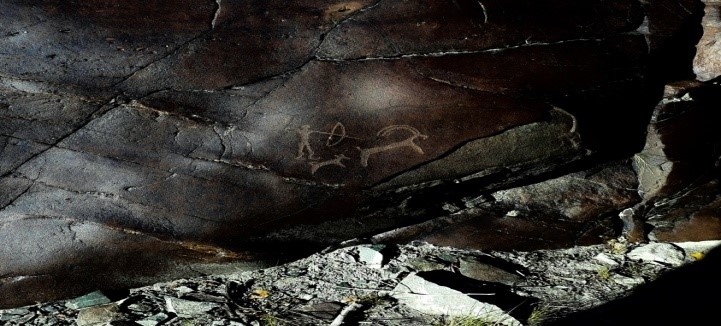
Ulley Tokpo is a village in the western part of Ladakh. Walking along the banks of the Indus River, I stumbled upon this curious rock art. The image shows a hunter pointing a bow at an animal with long curved horns, while a guard dog watches on. Did our forefathers hunt for food? Maybe they did not rear animals like sheep and goat then. Why else would they hunt? When did they start rearing livestock and when did we stop hunting? Thanks to livestock rearing we could stop hunting. But while hunting has stopped, archery remains a very popular sport and a cultural event that we participate in every winter. This is a common practice across many mountain communities in the Himalayas.

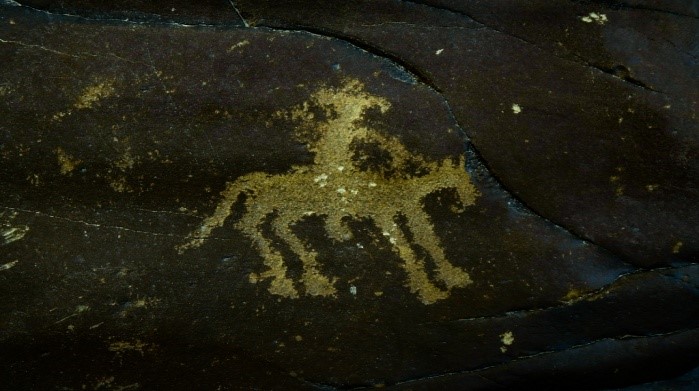
I recorded this rock art image of a horseman between the villages of Miru and Gya on the highway that connects Leh to Manali. One of my senior colleagues had shown me this image. If you drive past this area today, you will not find this horseman anymore. Unfortunately, a large part of the rock formation that carried this rock art was destroyed during road construction. But this image is a reminder of the role that horses might have played in the lives of our forefathers.

Horses were the most efficient form of transport, be that for hunting or even later for trade and exchange of produce through barter. The significance of horses has diminished with the arrival of vehicles. However, they still reserve an important cultural role in our communities. Horse racing is active in some parts during Losar, the New Year celebrated on the first day of the lunisolar Tibetan calendar. Another sport that was played earlier was Ta Polo, Ta meaning horse, and Polo meaning ball. Could this have been a primitive form of the sport of polo? I often wonder where our forefathers might have learned it from.

"Horseman and Yak" rock-art | Photo: Sherab Lobzang

I once encountered this fascinating image of what looked like horsemen pursuing a large animal. I wondered if these were yak. When I spoke with some elders in my village, they mentioned that indeed they were: they were wild yak! Dong, as they are referred to locally, haven’t been seen in a very long time. The domestic yak is believed to have been reared from the wild yak. Our elders explained that dong is much larger than the domestic ones we rear. Today, it is reported from a small part in Changchenmo which is largely unexplored. I wonder if there are other animals like the dong that once occupied these rangelands.

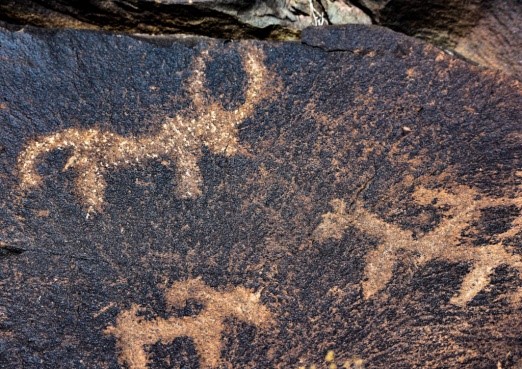
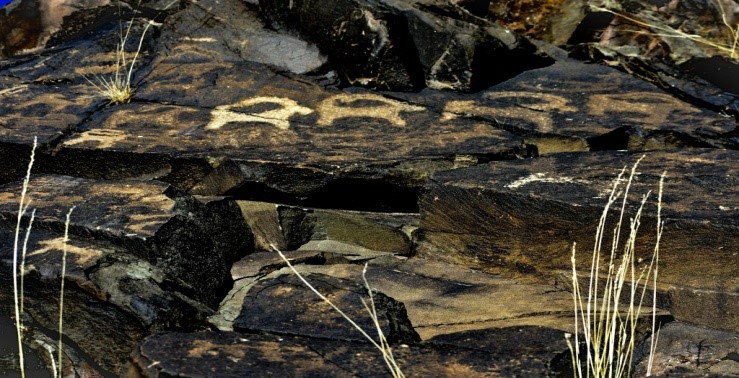
At the mouth of Phuyul valley near the village of Miru, I observed some very interesting rock art while carrying out surveys. This included images of wild animals, stupas which are religious structures in Buddhism, and script which was hard to identify. Some of these etchings look like ibex based on the longhorns they display. I find that particularly interesting because ibex was not found in these areas during our surveys in the past three years. Could the rock art be suggesting that these valleys were home to ibex in prehistoric times? It is hard to say. These are just a few of the images I have found so far. Many more remain undiscovered and I hope to keep finding them and sharing their stories, as I do now. While I have been fortunate to stumble upon these ancient relics that are part of our heritage, I am concerned about the number of these relics we may be losing out of ignorance. Rock art, which may date back several thousand years, are messages to us from our ancestors. They deserve attention and care. If we were to lose them, we might lose an important part of our past heritage.

"Ibex" rock-art | Photo: Sherab Lobzang

This holds true not just for Ladakh, but for all areas where rock art of this kind tells a story of the past. It is up to us to rediscover them and celebrate the wonderful stories they tell. These stories told by our ancestors.

699 391 Sherab Lobzang