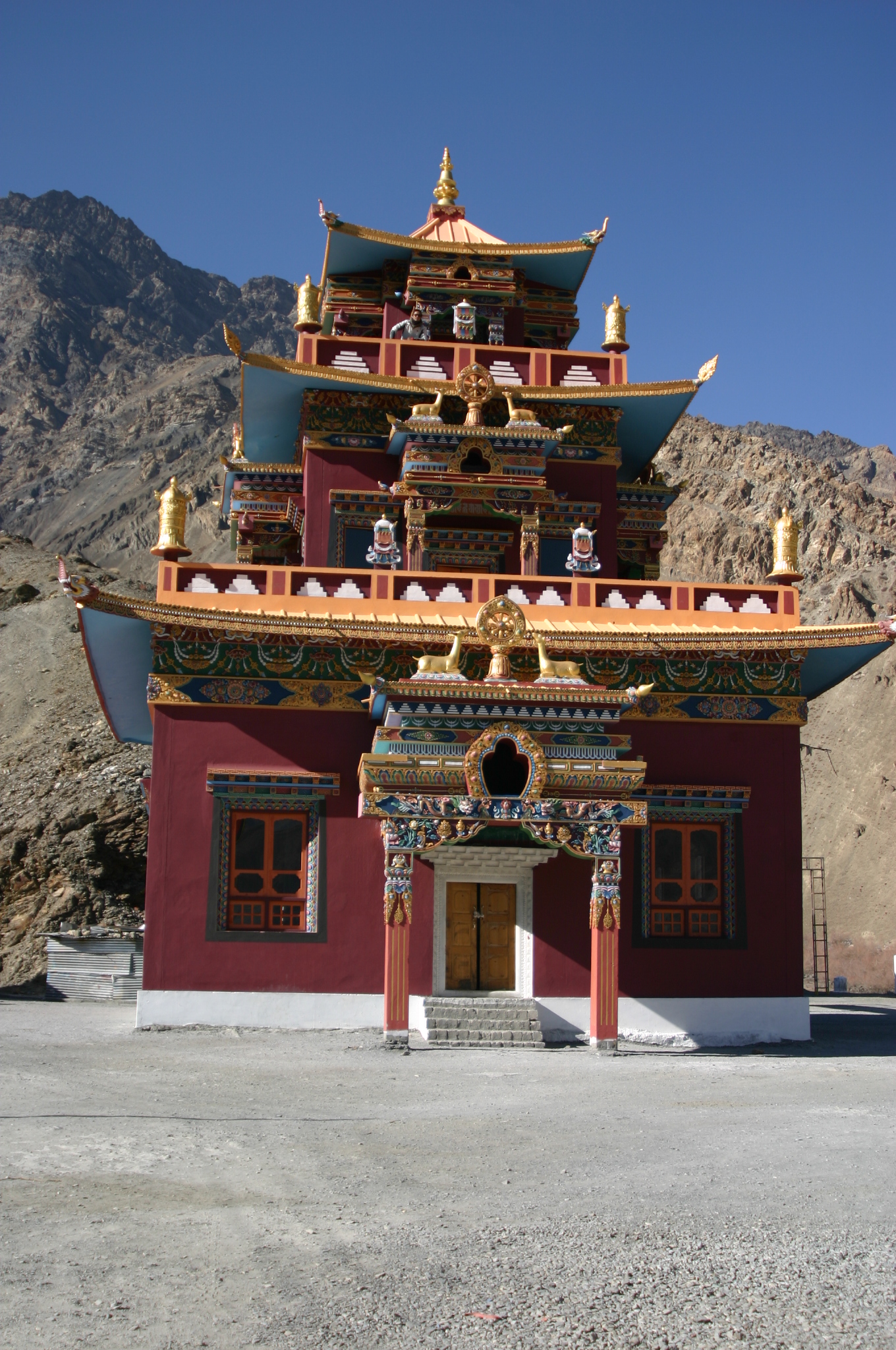
Willow

The Lonely Tree
Illustration: Peeyush S

The Lonely Tree

Young Bishen Singh’s dreams were finally coming true. He had just passed his college exams and landed a government job as a school teacher. He had always wished for it. There was only one challenge though, his first posting was in Kaza. Spiti was still part of the State of Punjab then, and Kaza only found an occasional mention in government reports. There were a lot of myths surrounding Spiti mostly because so few people had heard of the place, let alone visit it. In those days the bus only went up to Manali after which one had to walk across the Rohtang La, then walk the long stretch from Gramphu to Batal and finally cross the Kunzum La. A very, very long walk of over 100 km.  And after all this walking, you only reached Losar. Kaza was another 60 km away. The travel took over a week.

Bishen was partly sad about leaving his family back in Punjab. But he was also terribly excited for the new adventure he was about to set out on. He had always wanted to explore the mountains and this was his chance. He had packed all his stuff, including a lot of woolens, in a single sturdy cloth bag. He also had one bag just for food that could see him through his long walk to Spiti. Bishen left 10 days before his joining date hoping to reach Kaza a few days before his first day at school.

The walk from Gramphu was a pleasant one. He crossed a patch of birch forest at Dorney nalla. He couldn’t recollect seeing so many birch trees in a single place before. There were so many waterfalls to admire that one hardly noticed the distance. His pace dropped every few kilometers as he was in awe of the landscape. It was also early summer and Gaddi herders were setting up camp. Gaddis are always glad to receive an unexpected guest who brings them news from new places. The first few evenings were spent at different Gaddi camps, where the routine was somewhat fixed. Bishen would be welcomed with a piping hot cup of tea followed by rotis drowned in ghee and roti-khadi – all made from goat milk. Bishen had enjoyed his walk from Gramphu to Batal. But the walk from here on was going to be a lonely one since Gaddis only camped up to this point and did not enter Spiti. It took Bishen two full days to summit Kunzum La and then climb down to Losar, the first village in Spiti.

The first thing Bishen noticed when he started descending Kunzum La was how bare the landscape was. The waterfalls were all gone and even the trees began to disappear. By the time he reached Losar, he was struggling to spot a single tree. Bishen suddenly felt as if he had set foot on a different planet. His pace dropped again, but this time in shock. He was struggling to wrap his head around why these massive mountains were without any greenery. Had someone robbed them of it? He couldn’t imagine living in a place like this, that too so far from home. He suddenly felt like he was stuck without anywhere to escape. As he reached the village of Sumling just 15 km from his final destination Kaza, his eyes fell on a lonely willow tree.
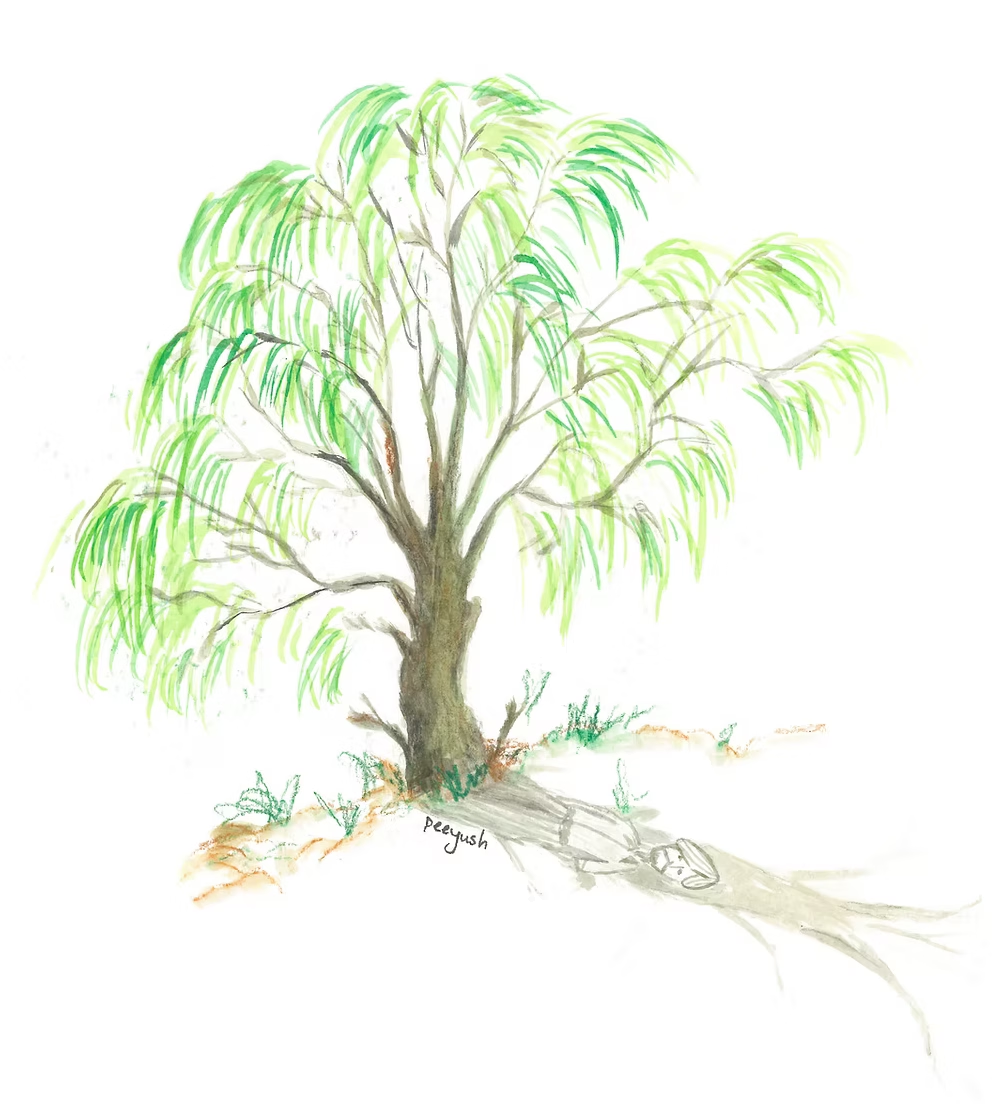
Illustration: Peeyush S

This full-grown tree stood in all its majesty almost in defiance with the otherwise treeless landscape. Bishen felt like he had met a long-lost friend. His eyes welled up and he couldn’t hold himself back. He dropped all his luggage and ran towards the tree. He hugged the tree tightly and sobbed loudly, ‘My friend I have been forced to come this far just so I can keep the hearth burning back home, but what ill luck has fallen upon you? Who cursed you to come to this place?’

Hearing Bishen’s loud sobs, several curious villagers gathered around to see what was happening. But none had the heart to disturb the conversation between two long-lost friends.

  • Kaza is the main town of Spiti and the headquarters of Spiti sub-division.
  • Gramphu and Batal are locations on the road from Manali to Kaza.
  • Birch is a thin-leaved deciduous hardwood tree. The bark usually peels horizontally in thin sheets, especially on young trees. These sheets were traditionally used as paper in many high mountain regions. Several holy scriptures have been preserved by writing on such sheets.
  • Dorney nalla is a patch where one can still find a lot of birch trees on the way from Manali to Kaza.
  • Sumling is a beautiful village on the right bank of the Spiti river.
  • Willow is a tree with long thin branches and often grows near water.
994 1118 Ajay Bijoor
An Insight into Traditional Spitian Architecture
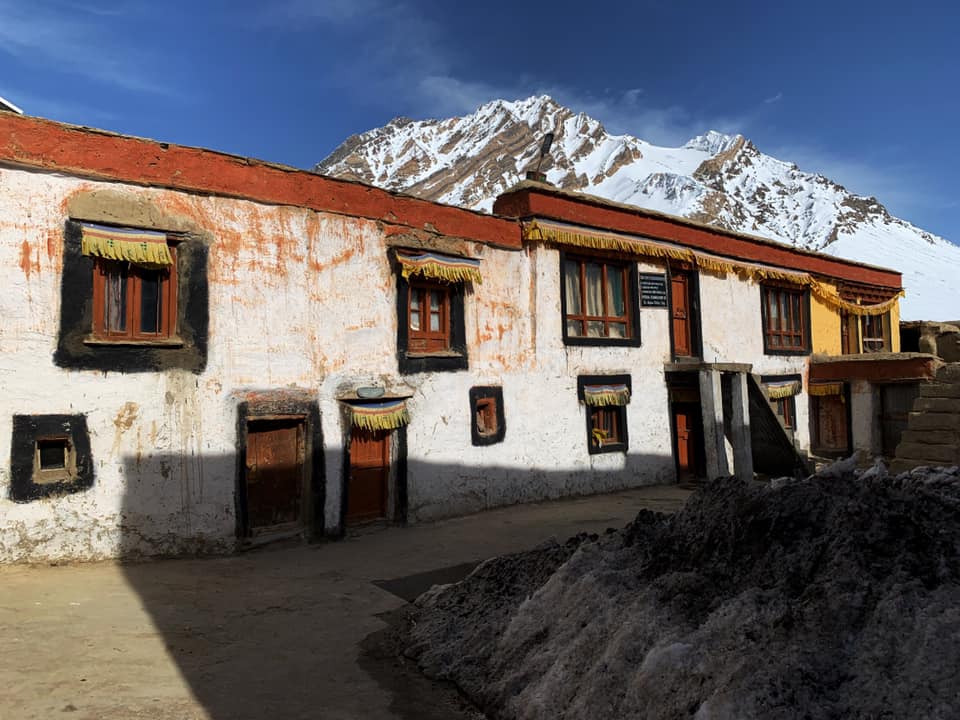
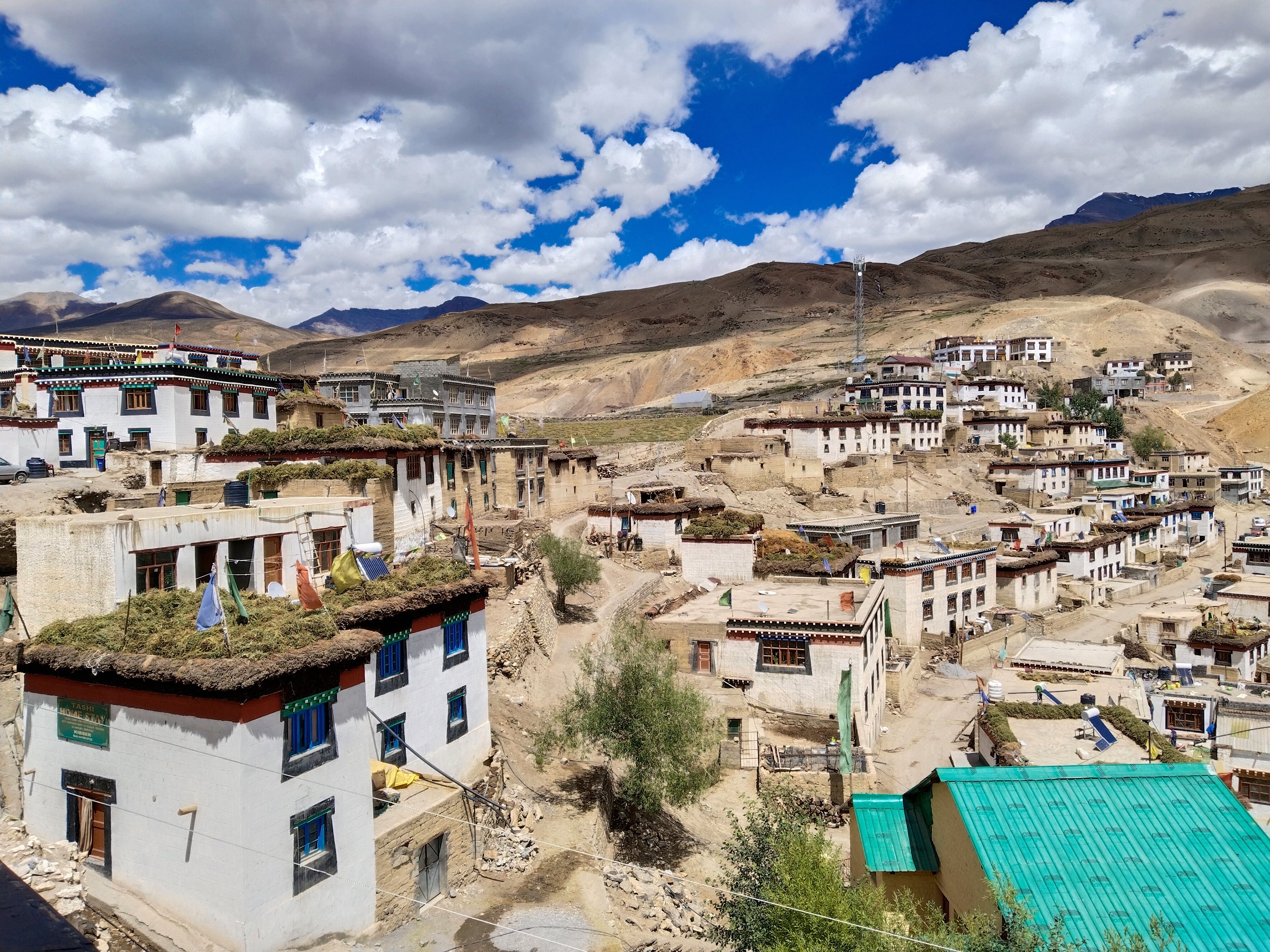
A typical village in Spiti | Photo: Chemi Lhamo

An Insight into Traditional Spitian Architecture

Spiti is a cold, dry desert with a vast expanse of land that has a limited scope of vegetation and productivity. Nevertheless, there’s an oasis of human settlement, small but scattered along the river valley depending upon it for sustenance. Some of these remote ancient villages have existed in this harsh terrain for at least a thousand years and the local houses, architecture, building techniques, materials, and design sensibilities reflect conscious choices that take into consideration the unique topography and natural environment around them. Most traditional houses in Spiti are double-storeyed with flat roofs, and thick walls, with multiple rooms and structures that beautifully suit our agro-pastoral way of life.

I remember my father nostalgically recounting how in the olden times when winters were long and harsh, snow piles high, and seasonal migration to warmer places wasn’t as convenient as these days, they found ingenious ways to accommodate their daily needs within the house. “Snowstorm or drought, we had our granaries filled to last at least two years and hardly had to move out of the house!”  Spitians – despite being people of slender means, were quite inventive and it is tactfully reflected in the vernacular design systems of the houses.

Material & traditional tools used for construction:

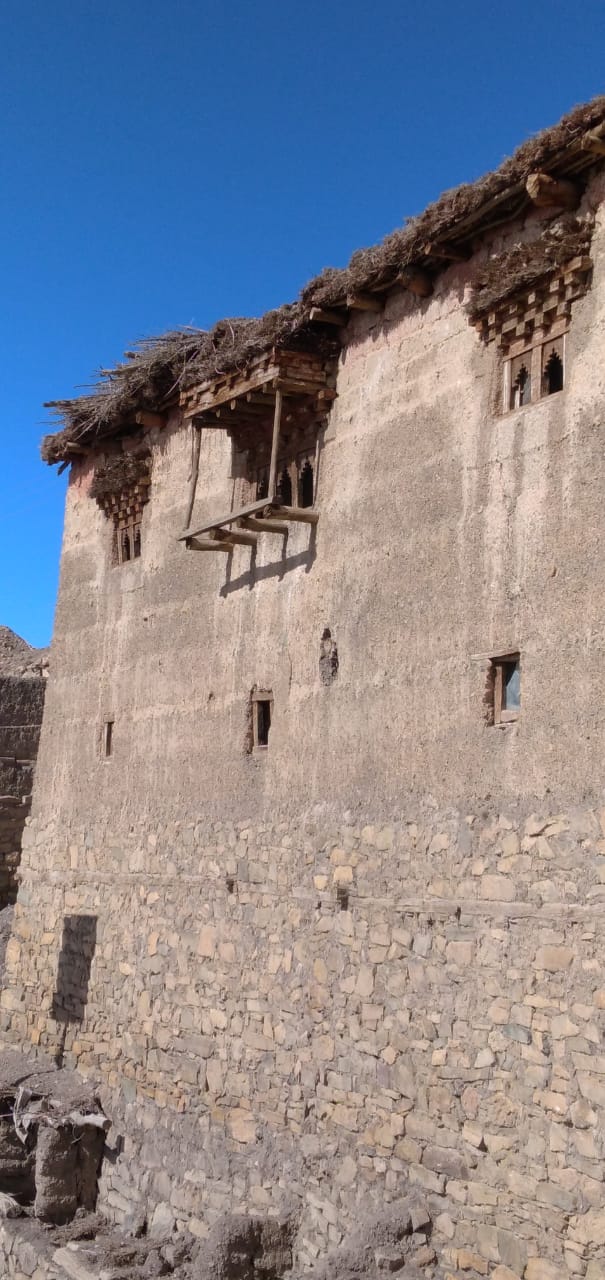
Upon entering any Spitian village, the most striking aspect is the cluster of white mud houses dotted beautifully against the blue sky and gigantic barren mountains. The design, aesthetics, and material composition of the houses are uniquely Spitian – evolved and adapted to suit the cold mountain desert. Primarily natural materials are used for construction; with stones as the foundation, mud for walls, and various kinds of wood for ceilings, door & window frames and support structures like Kawa (pillars). Some of the common materials used are listed below:

  • Thalwa/Dambak (Mud): For the construction of walls and boundaries. A particular type of soil colloquially called Dambak with the right proportion of clay is preferred over black soil and others.
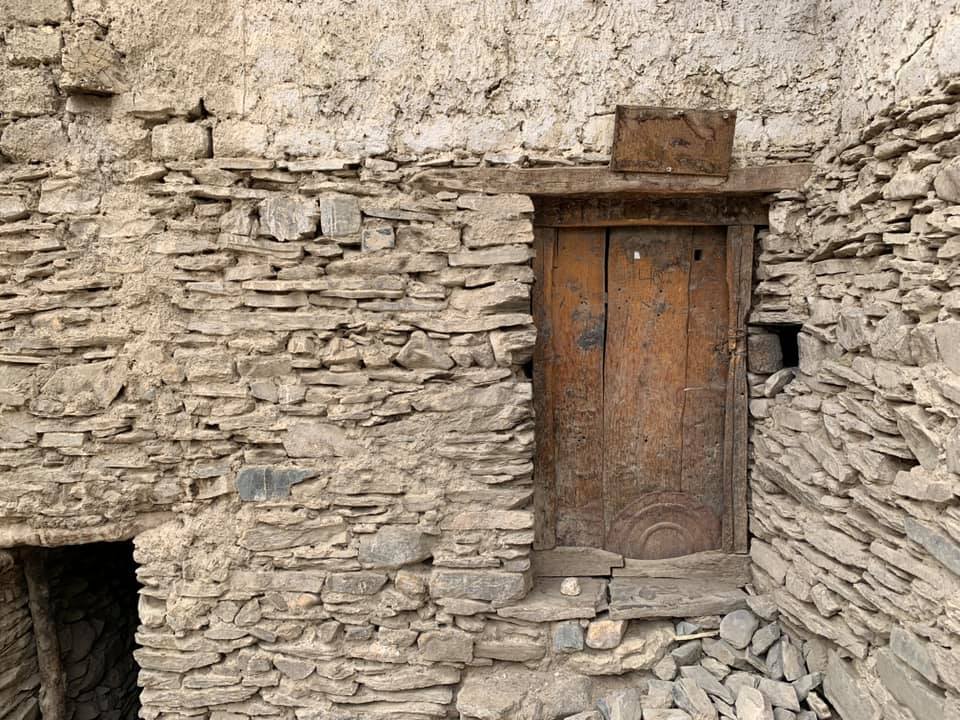
  • Duwa (Stone): Big natural stones chiseled to uniform sizes are preferred for building foundations and structures on the ground floor like Lukra (sheep pen) and Chaksa (dry toilet), as mud tends to lose its structural integrity over time due to excessive dampness from the snowfall.
  • Dhuwa (Clay): Clayey soil is used for waterproofing the roof and plastering the outer walls.
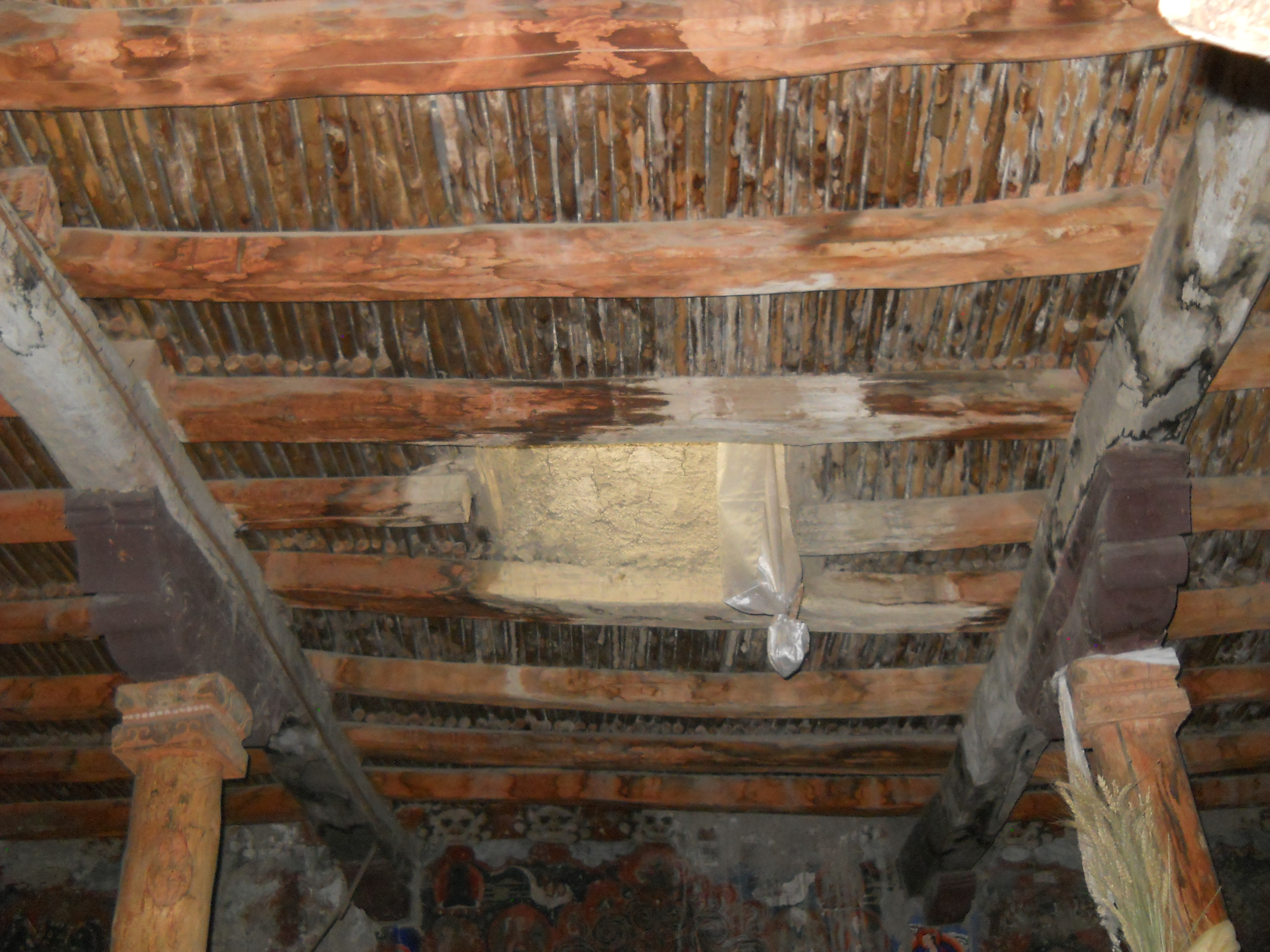
  • Changma (Willow): Willow sticks of two varieties: Gyalchang, used for doors and window frames as it is hard and durable, and Chulshing, a leaner variety of willow used mostly for Dri-lu which is used for the internal structure of a roof.
  • Mal (Poplar): Poplar wood for two giant support structures called Makdung and Burdung for roofing, support beam, window, and door panels.
  • Shukpa (Juniper): For Dri-lu, door, and window panels
  • Kirsi (Lime): For whitewashing and plastering outer walls. Mostly sourced from Losar and other upper valley sides while for lower Spiti valley, it is brought from Gue and Hurling villages.
  • Kova (Leather): Leather, when braided, is called Dangbha and is used for door handles, locks, and door bolts called Korchok.
  • Pema (Wild shrub): Primarily used as a protective structure for wood panels of the window and to prevent mud walls and outer paint from rain and snow.
Traditional ceiling | Photo: Tsering Lhundup
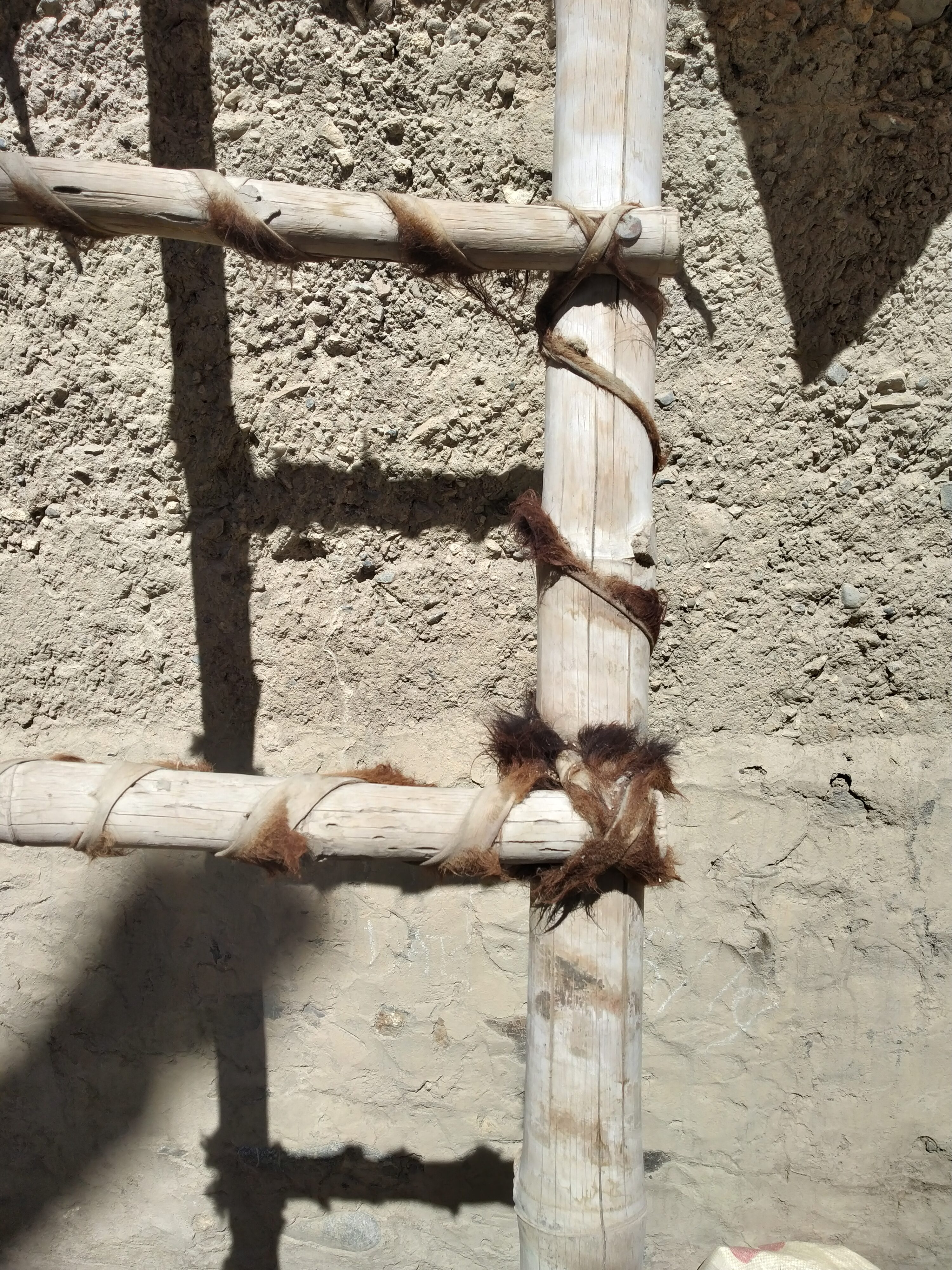
Sitpa  (yak hair rope) | Photo: Deepshikha Sharma

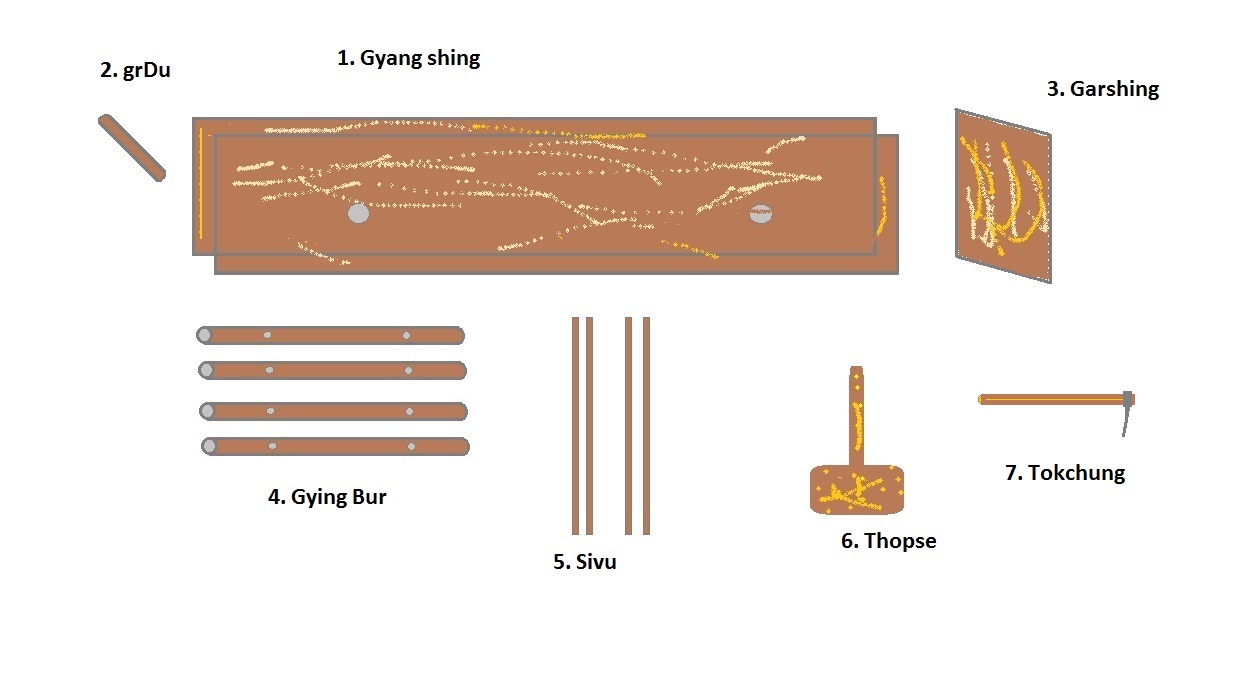
Natural building techniques like rammed earth building are used for construction which is suitable due to its durability, low maintenance, and thermally optimal characteristics which protect the houses from extreme climate and help retain stable temperatures inside the building. Since most of the houses are hand-built, there are specific traditional tools used for constructing particular aspects of a house. It is startling how even for building seemingly simple structures like a wall, multiple tools are used as listed below:

  1. Gyang Shing: Gyang means a wall, and Shing means wood, thus Gyang-Shing is a wooden plank, used to encase the mud to help build the structure of the wall.
  2. grDu: It is used to support the Gyanshing from the inside, and is placed in between the planks to prevent it from collapsing.
  3. Garshing: Garshing is used to enclose either side of the Gyang-Shing to mark the beginning and the end of a wall being built.
  4. Gyingbur: It consists of two pairs of wooden sticks, with two holes in each stick, used to provide support to the Gyang-Shing from the outside.
  5. Sivu: it also consists of two pairs of sticks, used with Gyingbur to support the wooden plank.
  6. Thopse: It is a wooden hammer used to thump the mud placed in between the plank to make it structurally more solid and to rid of air spaces and bubbles in the mud.
  7. Tokchung: It is a construction hoe with a short wooden handle, used to scratch out uneven surfaces, and small stones from the walls before it gets solidifies.
Traditional tools for contruction in Spiti. Illustrative representation: Tsering Lhundup

Dynamic design & traditional practices:

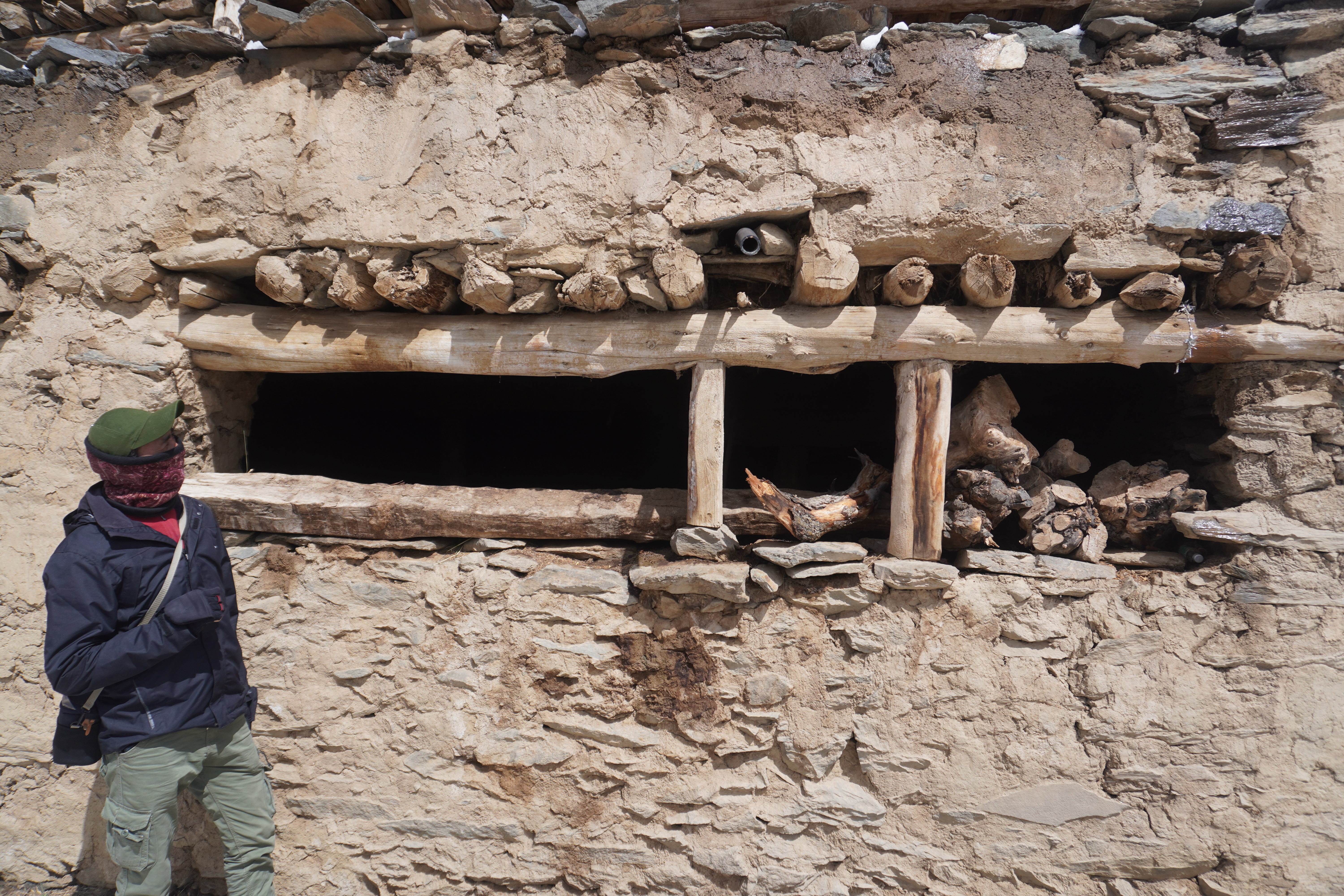
Agriculture and livestock rearing used to be the primary sources of livelihood for people in Spiti and our old houses are constructed to incorporate those needs in the vernacular design. Each house comprises at-least 8-10 rooms with unique functions and features. Elaborate storehouses can be seen in older houses like “Zot” colloquially means storeroom and there are different types of Zot used for different purposes: dry meats are stored in “sham-zot”, agricultural tools are stored in “lak-zot” whereas, alcoholic beverages like chaang and aarak are kept in “chang-zot”. Apart from that, some families have an additional room called “Tiwang” where foodgrains and other edible items are stored, the room is divided into multiple subsections used to keep various items. Within Tiwang, there’s a small compartmentalized room called bhaang where the family’s essential items are stored and access to it is only from a narrow window from the upper floor. Dhaa is a granary on the ground floor where fungma (hay) for livestock is stocked for winter and it has a small window-like aperture to stack grasses.

Photo: Mr. Janhwij Sharma, Additional DG, ASI

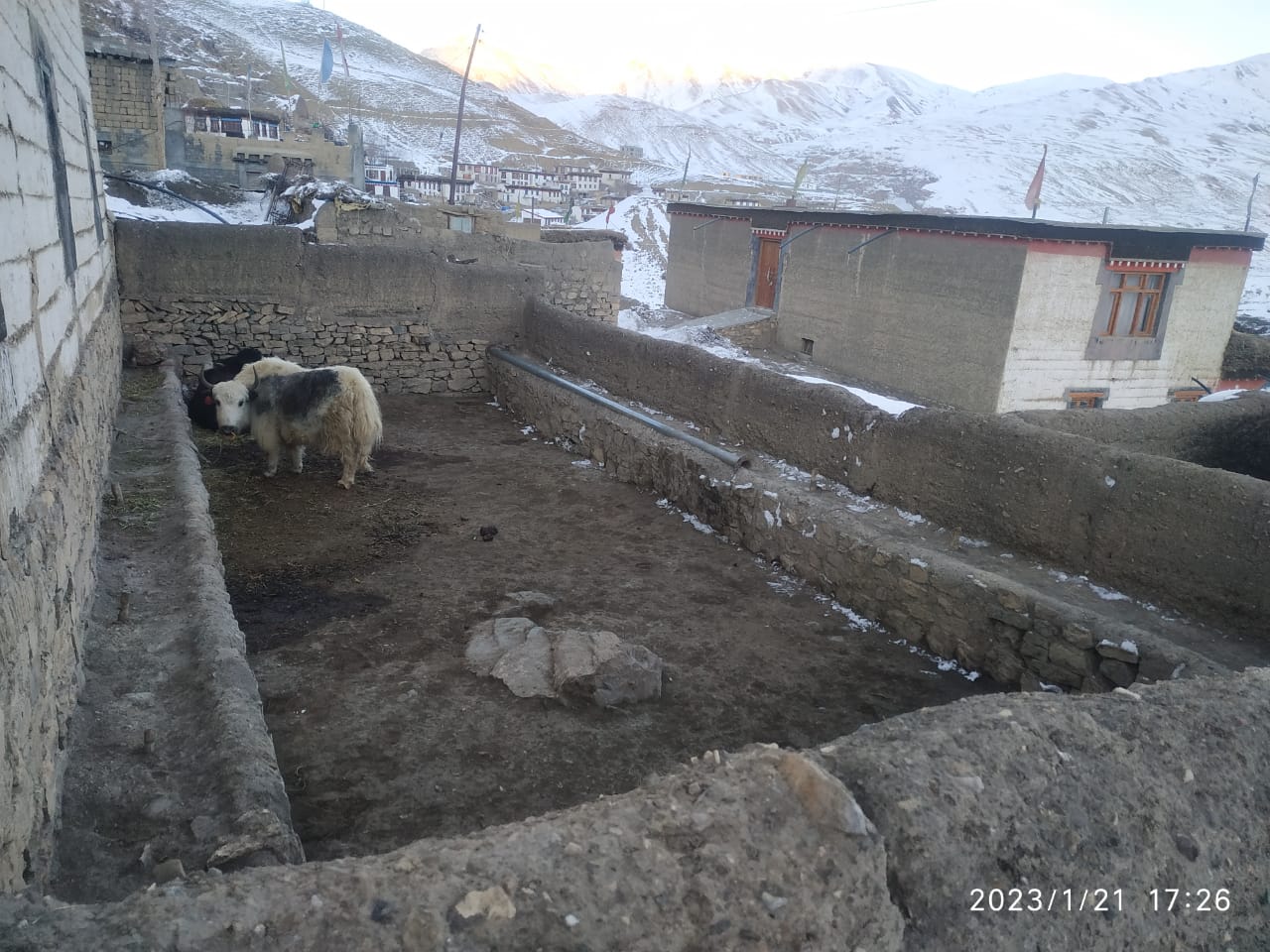
As for the livestock enclosures, most Spitian households have at least two kinds of livestock pen; Luk-raa/Raa is a cattle house placed inside the house on the ground floor while Dhang-raa is an open corral placed outside of the house right at the main entry gate. Apart from that, the family’s winter room Yok-Khang is structurally always in close quarters with the Luk-raah as the room draws insulation from Luk-raah making it warmer and easier to tend livestock during heavy snowfall in case of livestock sickness or during birthing cases. On the upper floor, the key rooms are Ma-khang (main living room), Shal-khang (solar room). Chot-khang (prayer room), Don-Khang (guest room), and Dhang-zey an open courtyard on the upper floor that serves as a functional space for many community activities and which also has a small window-like access point for all the ground storerooms.

The most unique aspect of natural building techniques prevalent in high-altitude regions like Spiti is the communal nature of the work. An individual seeks support from the community in terms of resources as well as labor so it is not unusual to have members of your family, relatives, friends, and other community members involved in building a house. The use of local resources, awareness about the material composition, familiarity with the natural building techniques, and use of local intelligence renders them capable to build a house locally without seeking any help from outsiders. Apart from master artisans like stone masons, mud builders, and carpenters under whose guidance the whole construction takes place, there’s a huge contribution from community members.

Elaborate rituals are performed to seek blessings and forgiveness for causing a disturbance in the surroundings during construction. The one in particular I remember is an offering of Sichu Bhumpa to the local land deity Sa-dak – It involves placing a pot full of precious, semi-precious stones, coins, and scriptures in the foundation to invoke their auspicious blessings. During particularly laborious aspects like roofing works, the entire village gathers to help finish it on time and after finishing all the construction works, villagers take turns to visit the family, offer gifts (like barley, butter, grains, and other delicacies ) and congratulate the owner. In certain cases, a close friend or a relative even hosts meals for the entire family including the chief mason and his men. Similarly, when a newlywed couple build their first house, villagers help by pooling important resources like wood logs. These cultural practices help ease the logistical burden on the host family where the community becomes one’s greatest support system.

In the olden times when importing materials for constrcution was not possible, people often exchanged raw materials or traded labor for raw materials. I remember many such instances where milking animals like cows, Dzomo, sheep, goats, or draught animals like horses, yak, and donkeys are exchanged for important construction materials like dungma (willow log) and timbers.

Gue monastery architecture, Spiti Valley | Photo: Tsering Lhundup

Other commonly traded materials are butter, iron, honey, sitpa (yak thread rope) from which one can buy construction materials of equal monetary value. Iron and honey are not easily found in Spiti and hence were a coveted commodity, sitpa also fetched equal importance but gradually with the emergence of nylon ropes in the local shops and improved accessibility, there was a huge impact on overall trading practices around it. There was a time when it was also possible to pay for construction labor works through local resources. One popular example of this unique labor v/s resource exchange is the payment of one goat to a master artisan for helping build a house. With development, these practices have undergone massive changes and are no longer practiced but it was fascinating to recount such stories and ponder upon various means of material procurement for construction works.

4080 3060 Namgial Lundup