River

Birth of the Chandra river

Birth of the Chandra river

It is fairly well known that Gaddi herders from Kangra spend summer in the rich pastures of Lahaul. This is an annual migratory route that the Gaddi community have accessed for generations. They camp in the high mountain pastures. From a distance their life may seem idyllic – spending the day in the shadow of snow-clad peaks, breathing the crisp mountain air, basking in the soft summer sun. Unfortunately, the Gaddi’s dammed flock does not harbor such taste for a serene life in the mountains. All they care for is food! Each morning they bleat to be taken to a new slope where they can get their fill of fresh summer grass. And the poor Gaddi herder has to run behind them to make sure the flock remains safe, for a pesky wolf waiting to feast on the flock is almost never very far. Summer days are very long. But as dusk sets in, the Gaddi gets some rest.

It had only been a few years since Noopalal started accompanying his aged uncle and their flock. Their settlement was at the farthest end of Lahaul valley. It was so far that most herders had only heard of it. It was famous for a beautiful lake that had turquoise-blue water.
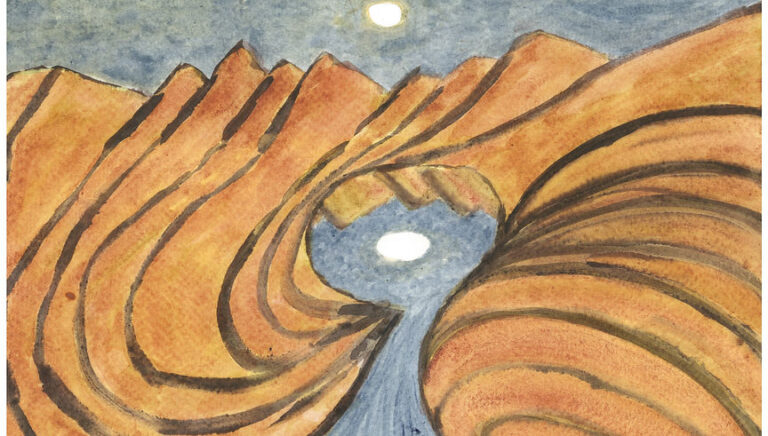
Noopalal was in-charge of the flock, while his old uncle stayed back and cooked for them. Every evening Noopalal would herd the flock and sit outside their thaach, which overlooked the lake. He would slowly pull out his flute and play it softly while his uncle smoked a pipe. Even though there was no one but his animals to listen, he played the flute because it gave him joy. On most days it would get dark by the time he finished. He would then crawl into the thaach, eat his meal, and retire for the day. This was the ritual he followed on most days until it all changed one night. The moon was full and when Noopalal finished playing his flute he looked mesmerized. As if he were possessed, as if someone had cast a spell on him. When he looked at the lake he saw a reflection of the full moon in its turquoise-blue water. He stood up in shock. “The moon has fallen in the lake”, he whispered. “The moon is drowning. Help!” He yelled as he ran towards the lake. His old uncle barely registered anything, and by the time he did Noopalal had jumped into the icy cold water. His poor uncle ran behind him. But he could only watch helplessly. He remembered Noopalal shouting frantically that the moon is cracking, looking at the ripples on the surface of the water. By morning, both Noopalal and the moon were gone.

Did Noopalal sink with the moon that night? Maybe not. But many believe that the moon did, indeed, drown that night and the water that spilled over gave birth to the Chandra river. And the lake, Chandra tal, remains beautiful as ever. Especially on full moon nights. If you ever have the good fortune of spending a full moon’s night by Chandra tal, you might even hear Noopalal’s flute.

  • Gaddi herders are a semi-pastoral tribe that rear sheep and goat. Some of the sturdiest men and women, the Gaddis travel for 10-11 months with their livestock covering a vast distance across the Himalaya and her lower plains.
  • Kangra is a Himalayan region from where the Gaddi herders hail. It is also a district in the State of Himachal Pradesh.
  • Lahaul is another remote Himalayan valley that can be reached after crossing the Rohtang pass. Lahaul valley is adjacent to Spiti valley and together Lahaul-Spiti forms the biggest district of Himachal Pradesh.
  • Thaach is a stone hut that gaddi herders live inside in places where they camp. These stone huts are old and beautifully built by stacking stones. They protect the herders from rough weather.
  • Chandra river rises from the snow lying at the base of the main Himalayan range in the Lahaul and Spiti district. The beautiful Chandra Tal has formed at its source.
  • Chandra tal is a beautiful high-altitude lake known for its beauty. It is also a very beautiful site to watch water birds. It is a mythologically important site.
864 491 Ajay Bijoor
Celebration of Churs-pon
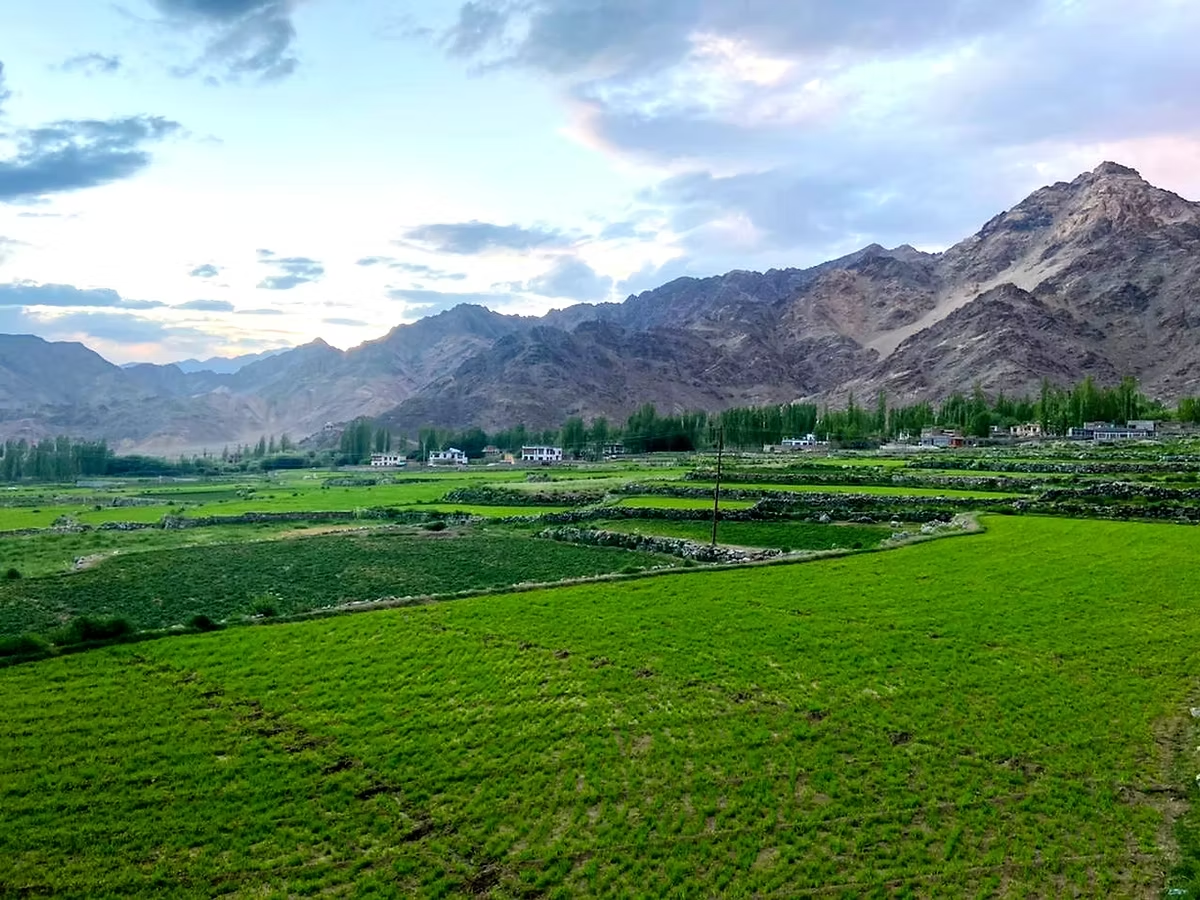
Saboo village | Photo: Dawa Dolma

Celebration of Churs-pon

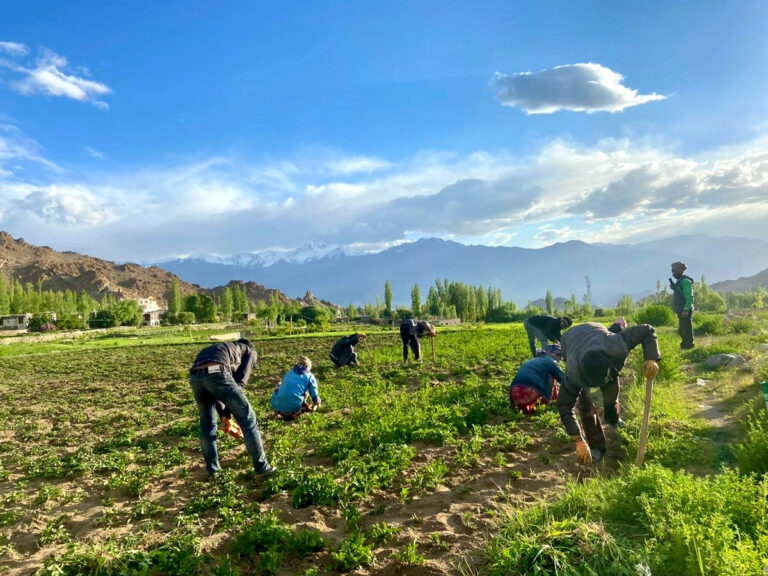
I was a young girl when I first visited Saboo. It was a school picnic and the lush green beauty of Saboo mesmerised me. Having been born and brought up in Choglamsar – a suburb of Leh, filled with overcrowded concrete buildings with sparse vegetation, I assumed all villages in Ladakh to be dull, dusty and barren. So finding a green patch of land was unbelievable. My interest in Ladakh renewed in my early twenties when I first started exploring lesser known places and experiencing its unique socio-cultural practices that sustained life in the region.

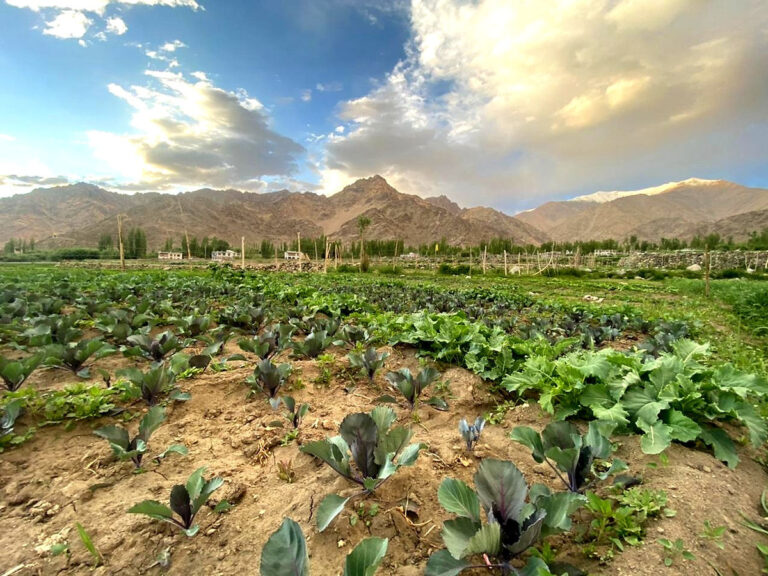
Within a few kilometers outside of Leh, one can start to observe the changes in the land-use. Saboo (Sa-phuk in Tibetan), traditionally referring to an inner grassland near mountain foothills, has abundant water resources and greenery. There is relatively less influence of tourism and people still practice traditional agriculture solely dependent on Gang-chu (glacial water melt) and Chu-mig (natural springs). Due to its proximity to glacial water melt, the area supports healthy mountain grassland and diverse agricultural fields. But the main difference between Leh and Saboo is deeper than mere land use. The rural lands in Ladakh are governed by local traditional systems and customs which are truly rooted in the reality of people living there. These governance practices are highly visible in case of village resource management and are as effective as any other form of governance. Although the nearby town has grown multifold in the past few decades, nothing much has changed in Saboo, which is still a village of 500 households. One such fascinating tradition that has stood the test of time is a local custom of electing a water leader in their village. Water leader is the one who is responsible for governing water resources. In my curiosity to know more about water management, I spoke to a local farmer who shared with me the story of Churs-pon.

Photo: Dawa Dolma

Water is the most precious resource and the election of Churs-pon is an indispensable part of the traditional festival in this village. “Chu” means water and “pon” means leader. Churs-pon therefore is a unique water management system which ensures local governance, maintenance and distribution of water resources. Located at the high altitude, cold arid zone with a short cultivation period people have devised local systems that maximizes their resource usage with minimal conflict. Like any social institution, churs-pon enables farming communities in Saboo to judiciously use their land, water resources and enjoy greater prosperity. Churs-pon are annually appointed at the beginning of the agricultural season and Saboo being predominantly an agricultural society, the election of churs-pon is quite an important tradition in the region.

Historically, villagers unanimously elected a well respected man in the community who had rigorous knowledge of customary duties, rights and responsibilities around water management. Now, Churs-pon is appointed rotationally. The selection process differs in each village but in Saboo, the day is marked with auspicious ceremonies and prayers. Venerable lamas are consulted for an auspicious date and communal meetings are held. It is no less than any other cultural affair and locals host a festival called “sa-phak” which celebrates the selection process of churs-pon. Water being a crucial resource, there’s great excitement around it and at least one member of each family is present during the selection ceremony to ensure appointment of a competent leader. The two key Buddhist prayers “Tashi Tsekpa” and “Nangsa Nang-gey” are recited by monks to mark the auspicious start of farming work and bless the newly elected “churs-pon”for his work. The religious ceremony is particularly important for the rightful selection of the leader, who ethically follows all rules and regulations to ensure equitable distribution of water and harmony among farming communities. Communal prayers and holy tantric rituals like “tormas” (barley flour effigies) are offered to deities for agricultural productivity and to garner their spiritual support during the farming season.

Photo: Dawa Dolma

Traditionally, high-altitude communities have self-sufficient agricultural systems and religious ceremonies are done to invoke spiritual blessings of the local deities and to harmonize people’s relation with nature. “The tasks are overwhelming and challenging – a churs-pon has to monitor the water reservoir from five in the morning till eleven at night. Therefore, the right to churs-ponship is mostly given to male members”, says Tsering Dorjay (46) who was Saboo’s churs-pon a few years back. “Earlier we used to have 2 churs-pon but these days we have 4 as there are numerous agricultural lands and we need to ensure equitable distribution to all fields. The work has become more laborious” he concludes.

The agriculture in Ladakh is governed by a short growing season during which Gang-chu (glacial meltwater) is the most important resource. All Ladakhi villages have a community water reservoir called “zing” where glacial water melt is directly collected for irrigation. The zings are connected with water canals called “yura” which feeds water to all agricultural fields. The water is distributed based on requirements of the crops. Since food and cereal crops consume more water, it is first distributed to wheat fields, followed by green pea, barley and finally to fodder crops which are more resilient. A churs-pon is responsible for managing water distribution, irrigation turns, overseeing maintenance of zing, yura, resolving water disputes and ensuring equitable distribution of water among all families of the village without any personal bias and favoritism.

Churs-ponship of Saboo village is a classic example of how a community resource like water is effectively self-governed by villagers and is codified into distinct rules and regulations that everyone follows stringently. The lives of people are dependent on such traditional systems which are orally passed to the next generation, representing a unique community-led, self-governing system. The ethics of impartiality, equity, mutual cooperation and reciprocity are built inherently into the system. However, there’s considerable decline in the tradition of churs-pon due to alternative livelihood options like tourism and younger generations growing up without any knowledge and awareness about the local agricultural system. Mohammad Akbar, a 52 year-old churs-pon of Saboo village, painfully mulls over the loss of this beautiful tradition in his village, “it is doubtful whether the youth these days will continue with the tradition and do farming. It will be a huge loss if churs-pon becomes another lost tradition in the coming few years”. Entire agricultural practices of Saboo and other villages following this practice will fall apart if there is no churs-pon system. It is an indispensable part of people’s livelihood and forms crucial part of their identity.

1200 900 Dawa Dolma