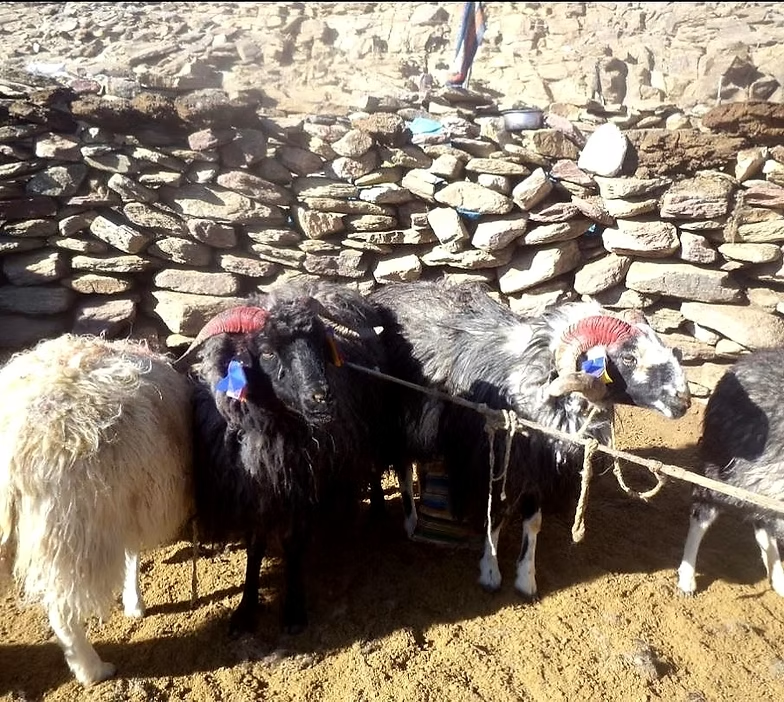
Livestock

Changes in Agriculture (Ladakh)
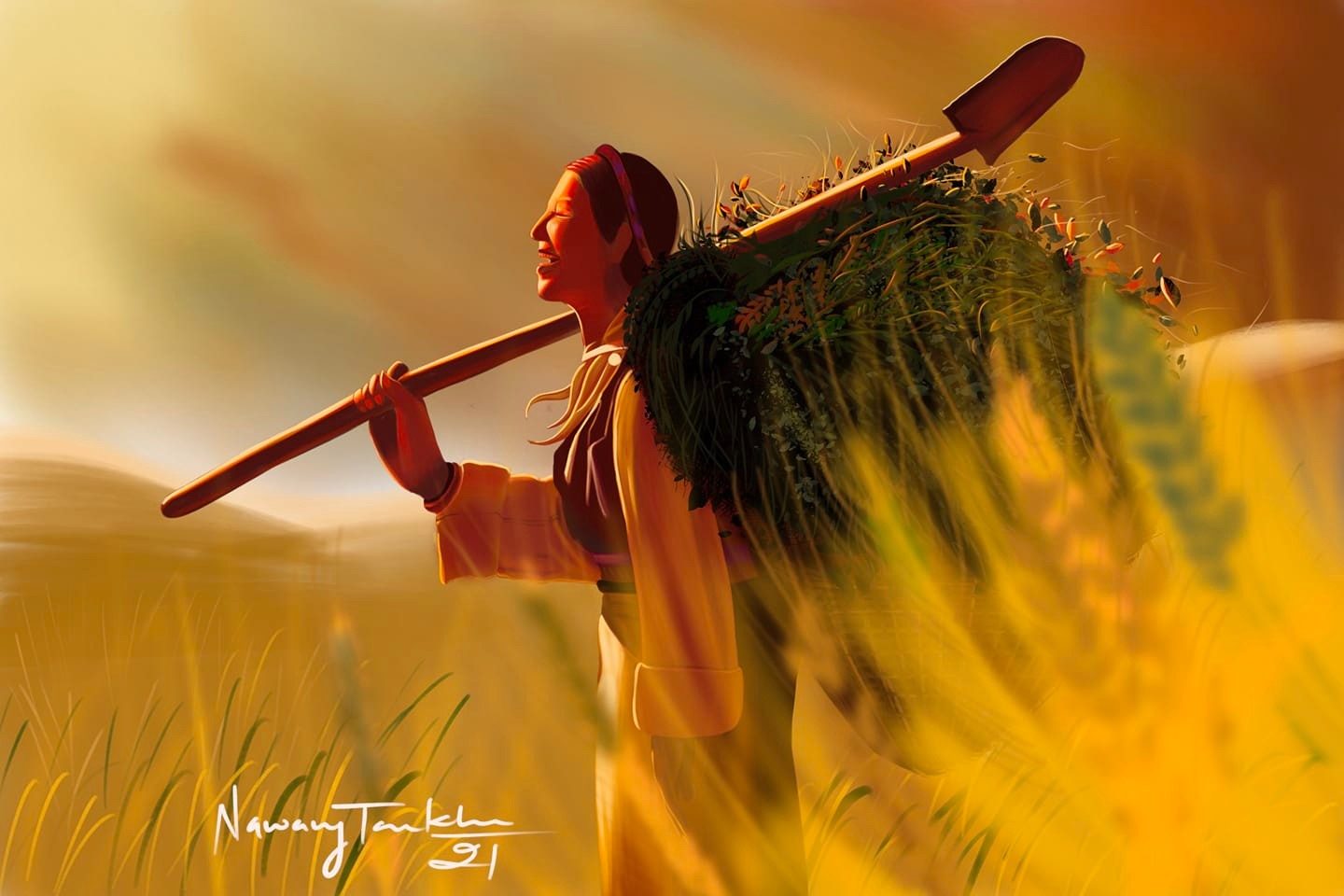
Illustration: Nawang Tankhe

Changes in Agriculture (Ladakh)

The rapid shift away from agriculture to other economic activities is a common trend in many agrarian economies globally, often driven by factors such as urbanization, changing lifestyles, and economic opportunities outside the agricultural sector. Agriculture in Ladakh is no exception.

In the traditional Ladakhi farming and food system, the sun provided the primary energy, enabling plant growth, muscle-based labour power and fast-flowing water for milling and irrigating. The fertility of the soil and crops came from recycling of manure and compost (lut, chulut, and the like) into the fields and from minerals in the glacial melt-water. ‘Packaging’ – if any – was in the form of hand-made woolen sacks, wooden and clay vessels, willow baskets, and masonry granaries, all of which could be safely returned to the soil after they wore out. Transportation of the crops was done with muscle power, and cooking done with local renewable fuels like dung cakes or wood sticks. Care was taken to conserve pasturelands through rotational grazing, and farmers tried to minimise harm done even to insects in the fields. The ecological footprint – meaning total ecological impacts including energy and water consumption, waste generation, etc. – was very low. In current terms, we could say that the traditional Ladakhi farming and food system was solar-powered, zero-external input, zero-waste, regenerative, closed-loop, and sustainable!

Today, while much of the traditional farming and food system continues to exist, it is steadily being eroded by a number of profound socio-economic changes. The environmental impacts of these changes are increasing year by year.

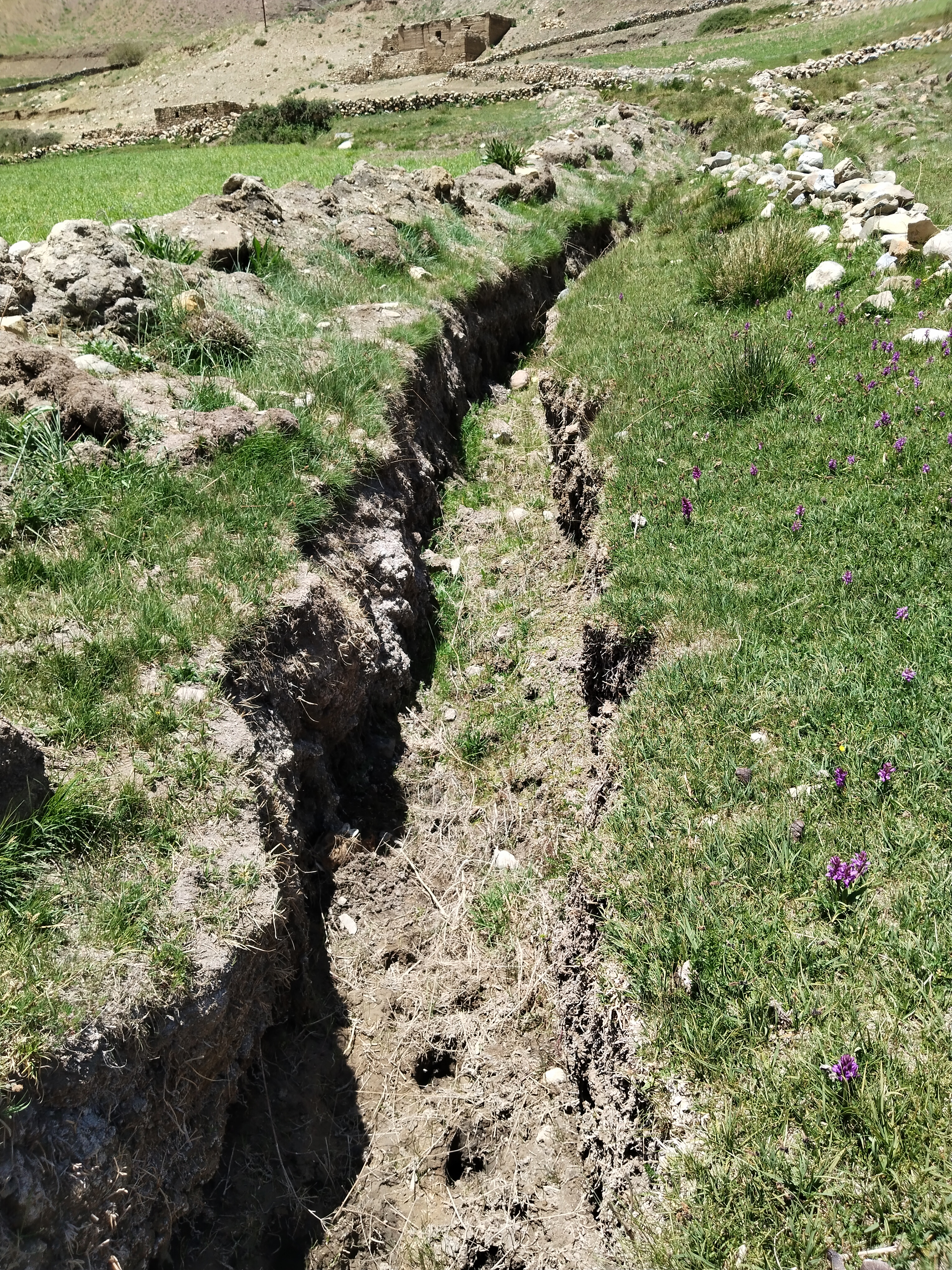
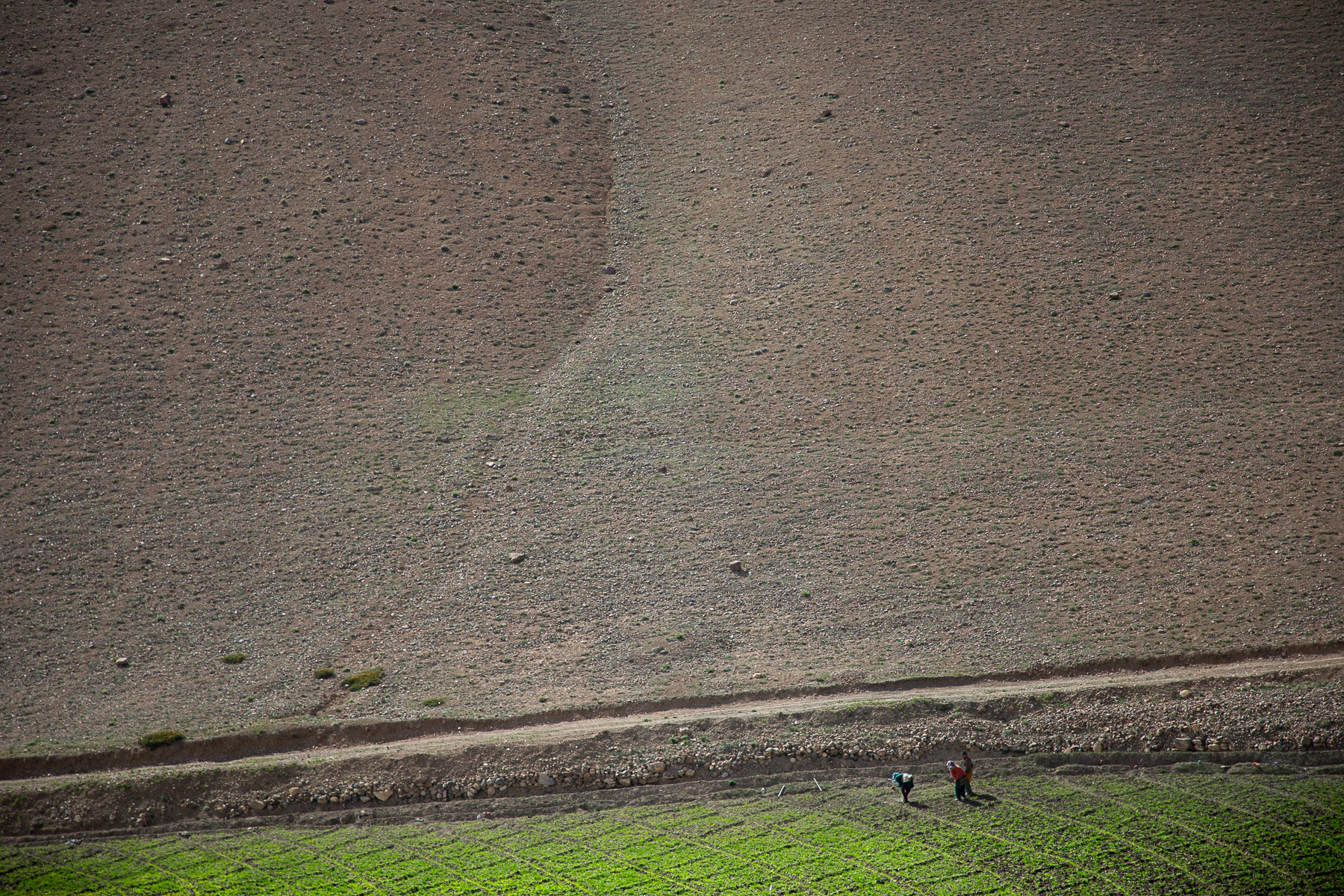
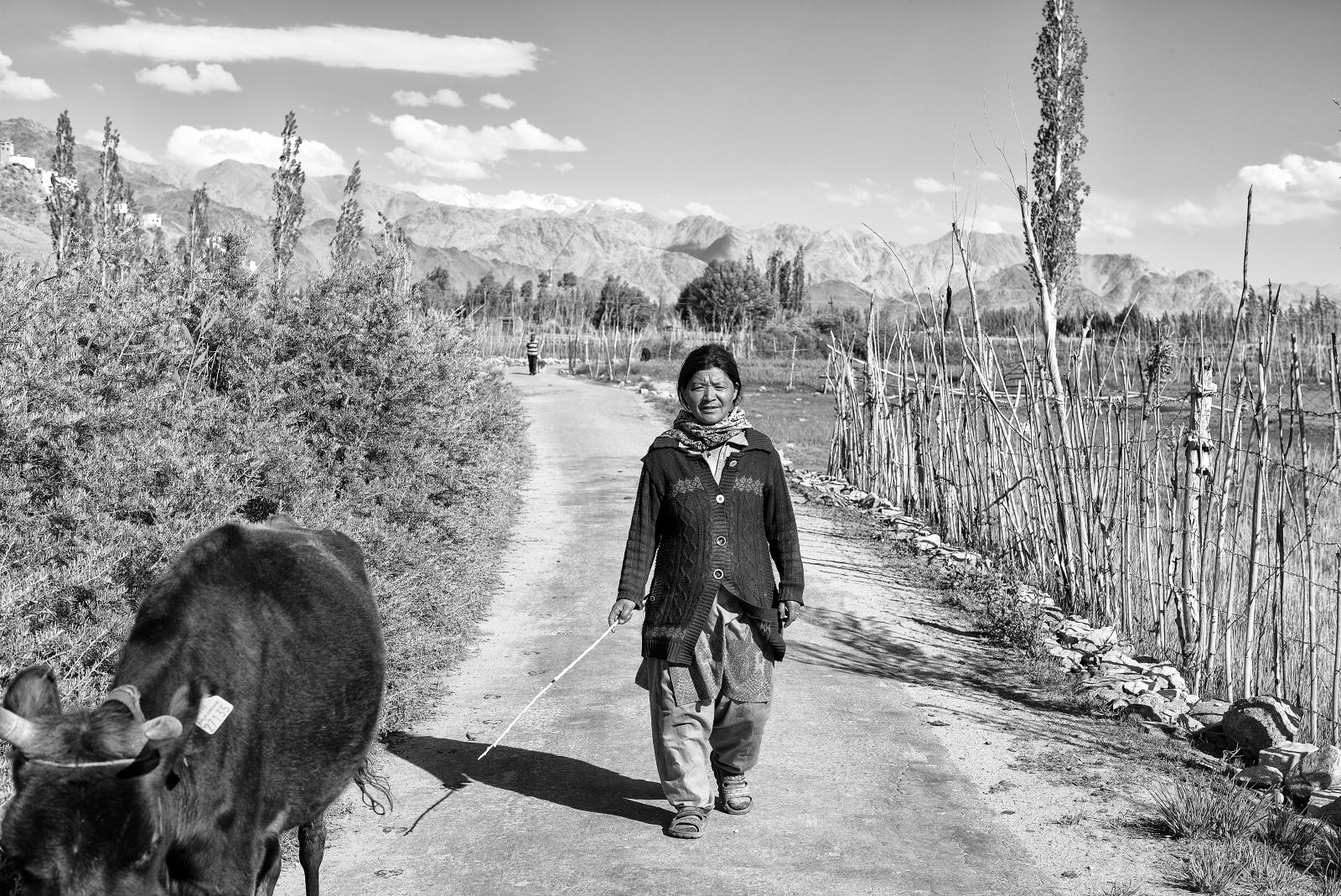
One of the important changes has been the decline of villages due to various reasons and the decline in farming-pastoralism systems that sustained them for centuries. The growth of tourism, the army, and competitive education have combined to drain young people, and young men in particular, out of the villages and into Leh, or even further away. As a result, there is less total labour available, and more farming work has fallen on village women and paid labour. Many fields that were once lush and green in the summers today lie fallow for lack of people to work them. With fewer people, livestock herds have decreased significantly, and in the case of goats and sheep nearly disappeared from many villages. While this change may have benefitted wild herbivores to some extent by reducing competition for forage, it has also reduced the amount of rich, organic local manure available for soil and crop nutrition. To make up for this, many farmers turn to the use of synthetic fertilisers which pollute both water and air, and are very energy-intensive to manufacture from fossil fuels.

Crops & Water

The decline of agriculture is also seen in the reduction of diversity in crops including pulses, cereals and pseudo cereals like buckwheat (although efforts are slowly being made to bring back buckwheat). Fewer local pulses like the traditional black bean in Ladakhi fields and kitchens diminishes the health of the local diet as well as local soils. Pulses naturally fix atmospheric nitrogen into the soil, so when they are planted there is no need for nitrogen fertilisers. Without them, however, an important source of natural fertility is lost. In terms of oilseeds, whereas Ladakhis formerly cultivated local mustard more extensively and produced much of their own edible oil, today mustard farming is also declining. Commercial edible oils, packaged in plastic bottles and trucked in from the Indian plains are now widely used in Ladakhi kitchens.

In the 14,000-foot village of Gya, farmers used to cultivate different varieties of barley because the area’s climate was conducive to their growth. Because of the region’s low temperatures, wheat is rarely grown in Ladakh’s eastern region. The people in that same region are currently cultivating over thirty-six to thirty-seven different kinds of grains and vegetables. Acho Urgain, from Gya village, says that this may be because he has access to a wider range of plants these days. He is cultivating new crops like quinoa, and Tse Tse (Foxtail millet), which are native Ladakh millets that are rarely grown these days. Since 2014, green peas have been grown extensively throughout Ladakh because of factors including climate change that favours such crops, but more importantly because of increasing commercialisation of agriculture, as green peas have high market demand inside and outside Ladakh. A variety of relatively novel vegetables are today grown, such as cauliflower, cabbage, beetroot, and various turnip varieties.

One of the many changes in agriculture that people in the mountains are facing is a lack of water, especially during times of great need.  It is imperative that water be given to the fields by the end of March or the start of April. Variable weather patterns cause glaciers to hold onto water by not melting during the seeding season. June 21st marks the change of the days, so in July there will still be a water shortage. Another impact of climate change on agriculture is from increasing likelihood and severity of glacial lake outburst floods, which have had catastrophic impacts on downstream villages, such as in Gya village in 2007, 2009, and 2014.

Land use

The perspective of agri-entrepreneur Rinchen Yutol from Reetsot in Ladakh highlights the rapid changes in the past decade, which may present both challenges and opportunities.

The conversion of agricultural lands into concrete structures poses a significant challenge, and reversing this process is often impractical. This irreplaceable loss reduces self-reliance in food and increases dependency on imported foods. Such dependency increases vulnerability in the case of any disruptions (like fuel shortages, or road closures) in the transportation network across the Himalaya. Additionally, the fragmentation of agricultural lands due to nuclear families can further reduce the overall agricultural land use.
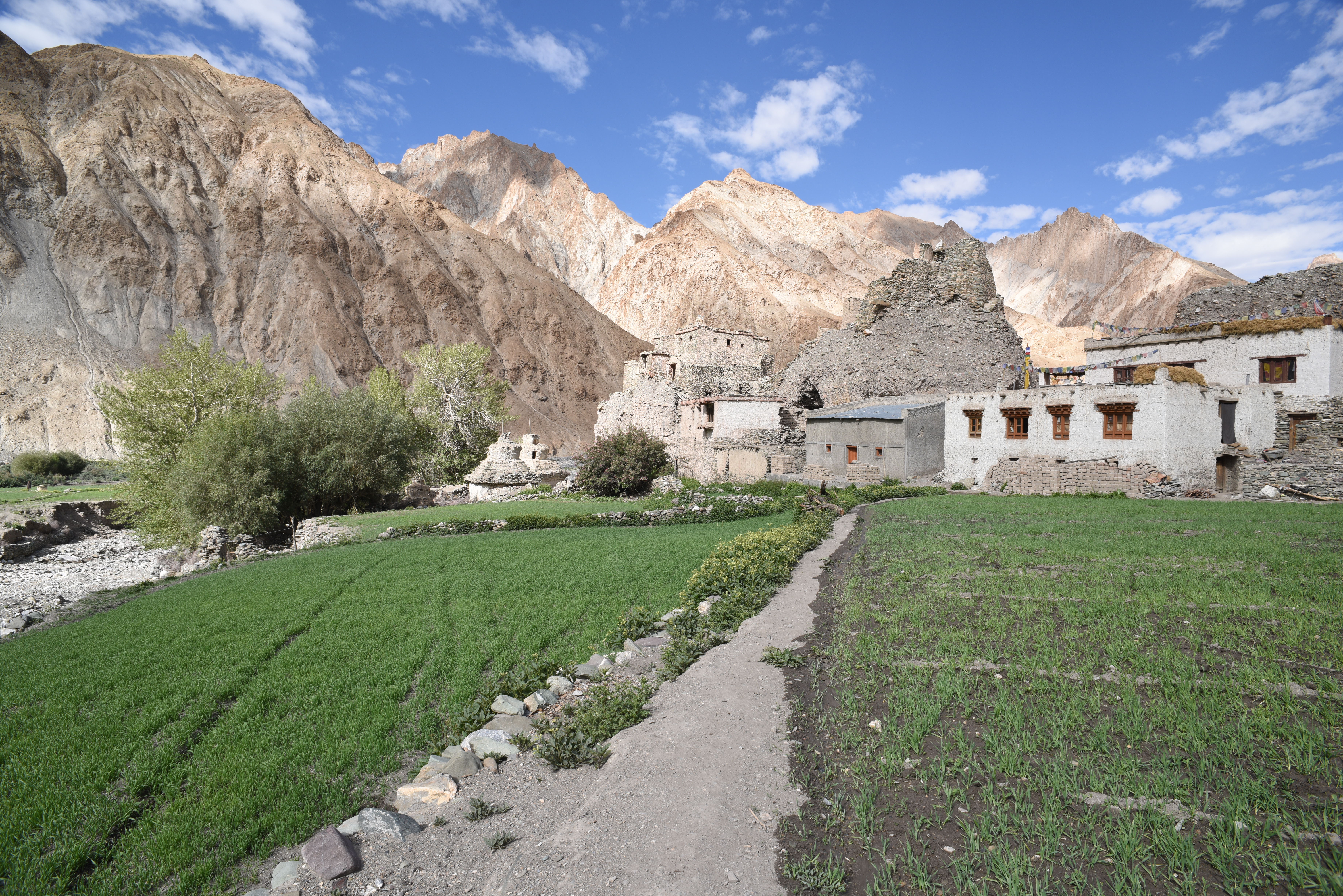
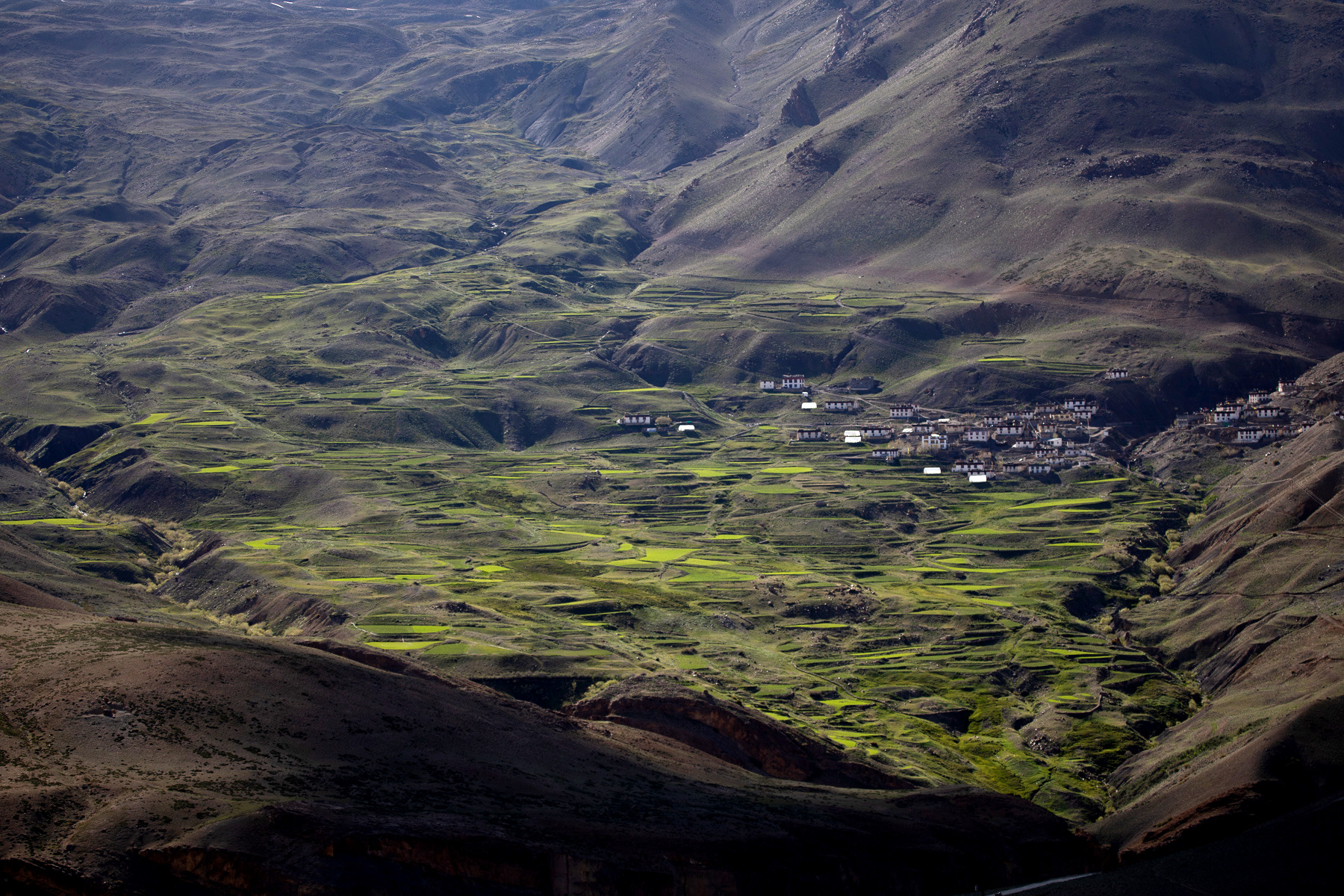
Chortens and fields of Markha | Photo: Wikimedia Commons

Fertilisers

Synthetic fertilisers have been used in Ladakh since about the late 1970s, supplied by the government at highly subsidised rates. Three main synthetic fertilisers are used: urea, DAP (diammonium phosphate), and MOP (Muriate of Potash/potassium chloride). Data from the Agriculture Department and Mission Organic Development Initiative of Ladakh show that in general, quantities of synthetic fertiliser use are decreasing in Ladakh. This trend is reflective of the Hill Council’s new vision to make Leh District fully organic within 10 years. This is very encouraging, since the more fertilisers are used, the more they disrupt the availability of natural nitrogen in the soil, which requires more fertilisers – a chemical addiction!

Besides the loss of livestock manure, the shift to flush toilets and septic tanks accompanying tourism – especially but not only in Leh – is also depriving the soil of rich human manure from traditional compost toilets.

To supplement local supplies, there are new initiatives to bring animal manure from Changthang for use in villages in the farming districts of Ladakh, and the government is also importing organic manure from Punjab. While this is certainly a welcome change from chemical fertilisers, transporting manure and compost also carries an environmental cost in terms of fuel consumption and diesel smoke exhaust. A future challenge will therefore be to generate organic manure and compost closer to where it is to be used, to reduce transport costs and pollution, and to keep valuable local nutrients recycling through local soils. Aggressive promotion of compost toilets, restaurant and residential food scrap collection and composting, and other initiatives could play a role in regenerating the local compost economy.

Seeds

One of the most crucial factors to consider when examining the changes in any region’s agriculture is the seed. The availability of native or local seeds is impacted by the decline in production of native or older crops. The majority of seeds for vegetables that are currently offered by the government or in the market are or hybrid seeds, which have the potential to alter the agricultural landscape of Ladakh, and have implications for the food sovereignty of the region and the economic independence of its farmers.
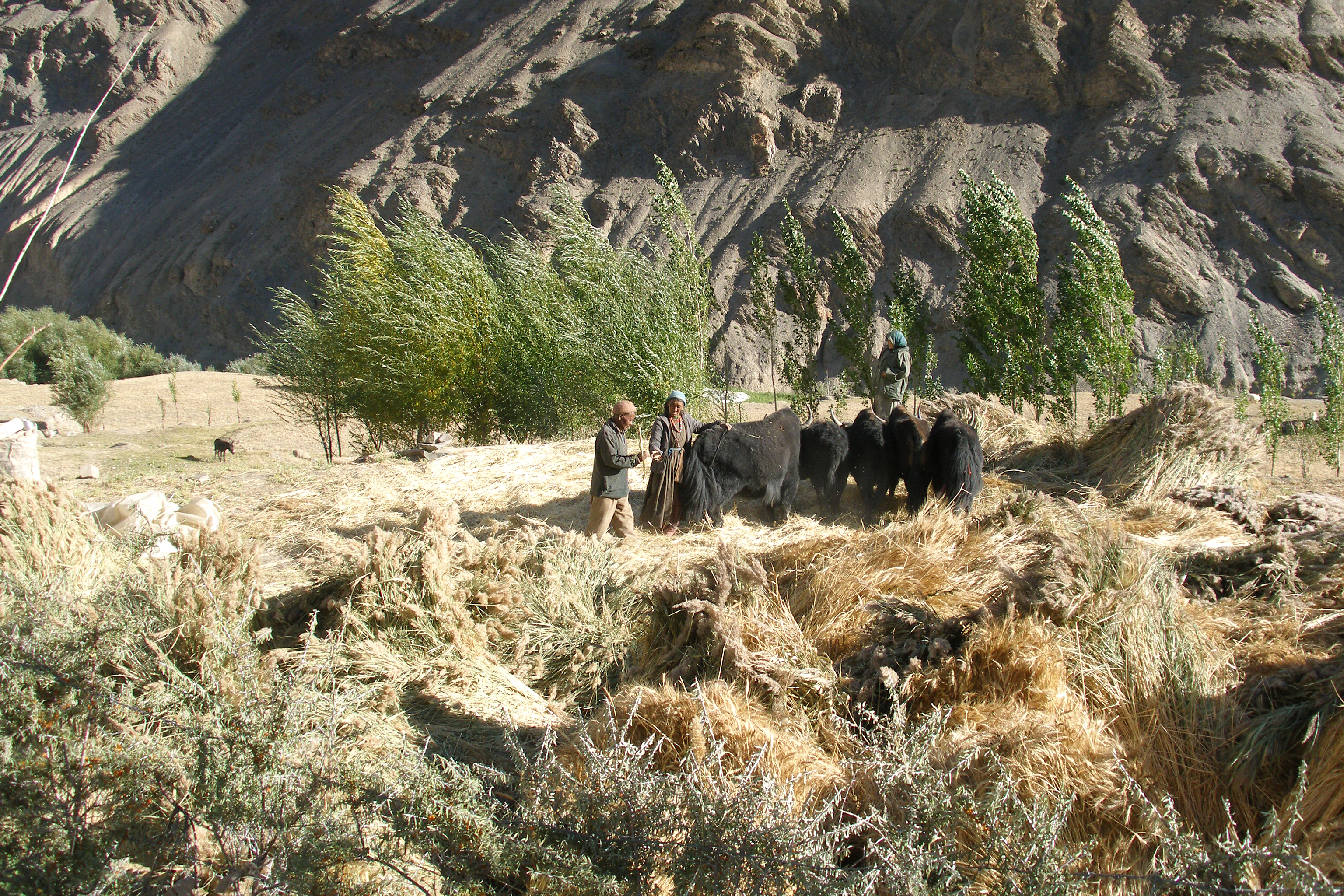
Traditional threshing of harvest in Lamayuru | Photo:Wikimedia Commons

Mechanisation

Dependence on fossil fuel energy has also been increasing in agriculture and pastoralism, as traditional tools, draught animals and techniques are replaced by mechanical, gas-powered threshing machines, mills, ploughs, tractors, etc. In Changthang, pick-up trucks and jeeps are steadily replacing draught animals, which impact the topsoil of the rangelands. This transition also increases dependency on the money economy and outside jobs to pay for hiring or buying the machines and the fuel to power them.

Conclusion

The shift away from the traditional farming and food system in Ladakh, combined with forces like tourism, is clearly having very undesirable environmental impacts. If both public health and the environment are being degraded by this shift, then maybe it is time to rethink, change direction and regenerate the local food economy. How could this happen? The Hill Council’s commitment to making Ladakh an organic farming region is a very encouraging first step. Additionally, the optimism and enthusiasm shown by individuals like Acho Urgain and Rinchen Youtol are encouraging. Their deep understanding of the importance of agriculture in the current era, both economically and beyond, suggests a potential for positive change. Initiatives that focus on sustainable and innovative agricultural practices, coupled with educational programs to raise awareness about the significance of agriculture, can contribute to the revival and retention of this essential sector. In what other ways can the government and local people support such a change, discouraging packaged junk food while encouraging a return to traditional crops, restoration of livestock herds, village renewal, and so on? How can arable land be protected in perpetuity for farming? Can modern farm machines be powered by local, renewable energy? How can young people addicted to junk food rediscover and revalue healthy local foods? What role can tourists play in supporting local, organic food and farming? These and many other questions will need to be urgently answered.
1440 960 Alex Jensen
Losar : Animal’s Day

Losar : Animal’s Day

I think I am in fact the least excited and most boring person at any form of festival. Much of it could be due to my introverted genes that wouldn’t fancy gatherings, dancing, fireworks or any other things which involve interacting with strangers, but part of it must be because of my upbringing. I am not sure of both though. But my heart just cannot seem to invite festivity as much as my friends and family do.

I hail from a small nomadic village in Ladakh where the livelihood of everyone is dependent on livestock. Almost every household owns some goats, sheep, horses and yak. These animals aren’t merely our source of income, but are used for obtaining food, fetching water, traveling, and most importantly seeking comforts and friendship. Since our life revolves around rearing these animals and more importantly enduring the harsh reality of having no access to electricity, water and worse not even a single shop in the vicinity throughout the year, we have little time for festivity. Or, many of us are even oblivious of its existence, except for Losar– the Tibetan new year and Thrungkar Duechen – His Holiness The Dalai Lama’s birthday. Hence, every single person in the village looks forward to these two days like a child, although for different reasons.

Photo: Namgyal Lhamo

My fondest memories of Losar and Thrungkar were significantly boring compared to my cousins. But these days, no matter how many festivals I witness as I travel through urban life, there is nothing more meaningful and beautiful than this idea of celebration I got to see early in my life. It was on one of the third days of Losar. My father came to me, patted my head gently and said with a smile “Life of your polled lamb will be set free”. I was elated beyond words and this memory has remained in my heart so vividly. In my village, on the third day of Losar or Thrungkar, fathers of the households are the busiest. They get up early in the morning to appease the Land God and other deities who are believed to be the true owners of our land according to their ancestors. This is followed by their brief journey to the animal shed where they would choose some animals randomly and set their life free. By that, we are not allowed to send them to slaughter houses, milk them and are expected to watch them with unconditional love and care which every animal receives anyway, until they die. It was my most awaited moment of the festival. My siblings and I would always hug our father with utter joy after he would come out of the shed. This act is mostly done to honor and thank the sacrifices of animals for our livelihoods while it is also performed for the health and long life of His Holiness and carry his message of love, kindness and compassion towards animals.

We eventually shifted to a town nearby, leaving the whole nomadic life behind due to the inability of my family to see the animals suffer for our survival. But, as I look back, I realised that it was this place where I gave birth to my love for animals. Today, even if we live a totally different life, my parents make sure to celebrate these two days by setting at least one animal’s life free. There is nothing more rewarding at a festival for me than this act of genuine kindness. Somehow I think of these two days as a festival of animals and I hope to carry this tradition forward in my own life too.

792 706 Namgyal Lhamo
Lingering memories of my grandmother
Ancestral house where Evi lived | Photo: Chemi Lhamo

Lingering memories of my grandmother

When I was young, I remember my Evi used to take me to yul-sa (Buddhist shrine for village deity) every day in the morning to offer prayers. She would ask me to light butter lamps while she circumambulates around the altar before joining me in prayers. I used to fervently pray for stable electricity at home so that I could watch television the whole day. As an eight year old, I used to be so curious what she prayed and insisted on getting to know. She would shirk me off for some time before succumbing to my pleas and tell me that she prayed for good winter snowfall so that we would have abundant water for our fields and for our animals during summer. She would continue sternly “One should always pray for all sentient beings and your personal wishes will be granted naturally. One should pray for peace, prosperity and abundant snowfall”.

Evi was from Tashi-gang, a quaint village in Spiti with abundant green pastures and less than 6 households. She was quite young when she got married and came to live in Kowang and like any other Spitian women of her generation, Evi had been nurturer all her life; she tended to our fields, the livestock and was sole custodian of our ancestral home where she lived independently until she was too old to live on her own.

Aapa used to tell me that Evi was deeply attached to her land “there was no difference between us, our shinga (fields) and our dzomos (female hybrid yak). She would tend to us all no differently”. She started working in the fields when she was fifteen and did that for another fifty years. She tilled all our fields, reared livestock and would traverse high mountains in our village to collect dungs and dry twigs for winters. When she got old and frail, she stayed with us briefly and would often tell me stories of her younger days. She’s filled with memories of my father’s, my uncle’s childhood and would often reminisce about the large herd of animals she raised with equal fondness; memories of dead cattle, sick goats she nursed, new-born calf she cared for and about our dZo (hybrid yak) which went missing mysteriously few years back. She took pride in the health of our land, our village chu-mig (spring water) and our cattle in the same vein she identifies as being a woman of Khangchen (Zamindar family) household whose life was devoted to agro-pastoral responsibilities. She was so closely engaged with the materiality of the agrarian landscape that it became a deeply embodying experience and a crucial part of her identity.

Ancestral house where Evi lived | Photo: Chemi Lhamo

Just like Tashi-gang, Kowang also is a small rural hamlet with just four or five households. Evi made the mountains, the fields, riverbanks and the vast expanse of barren lands an extension of her home. I was often told that she was very fierce and rigorous –someone who toiled hard in her fields and commanded authority. In Spiti, farming and related activities are considered communal affairs. Everyone partakes in the age-old traditional system “Bhey” where there is reciprocal exchange of work which denotes inter-household collectivism. This is further reinforced by Buddhist teachings intricately tying ecological ethics with religious beliefs laying emphasis on the virtue of cooperation and mutual support for each other in a community. Reality however, is more complex – village dynamics play a huge role in shaping agrarian responsibilities. Land ownership, access to resources and decision making is influenced by the undercurrents of unequal power dynamics within different members of a community.

Although men and women both work in fields, there is an apparent work division; Spitian men engage in more cohesive and heavy loaded works like ploughing, harvesting and grazing while women work on array of scattered works (thereby more invisible) like weeding, levelling fields, drawing water channels, irrigation, winnowing, preparatory works of grinding grains and taking out manure from dry toilets. All these supposedly menial works are equally important, time consuming and render solidity to agro-pastoral labour hence are often overlooked. The division of agriculture labour and resource allocation is a reflection of larger social stratification where men of Khangchen household enjoy greatest prestige. “Ane gyi leya la siruk mekak” (there’s no value in women’s work or women’s work is uncounted) is a popular expression and is often said grudgingly to show one’s discontentment.

Buddhist religious murals inside village shrine: Kowang, Spiti | Photo: Chemi Lhamo

I remember chuckling amusingly at a funny anecdote Evi shared, “Me-me (grandfather) used to be so laid-back. It doesn’t matter whether our luk-chung (lamb) strayed off from the herd or whether our village Zing (water reservoir fed from glacial melt water) is leaking. He has no care in the world. His seeding work is so disorganized that it looks as if he did that in drunken stupor of Aarak.” To balance the narrative she would continue, “What would he know of any farm works; he was a tsongpa (trader) and was always away. I used to do all the field work even the ones like ploughing with Yak and dZo”.

Our ancestors were so well attuned to the natural world they lived in that they bore the harshness of living in a high altitude landscape like Spiti with remarkable resilience and self-sufficiency. Their wisdom was so innate and grounded in the material reality of their everyday life. They were deeply engaged with the physicality of the farm-works that they knew how to harness the health of the whole ecosystem, yet they barely saw their contributions as worthwhile.

Living in remote, resource scarce places like Spiti, the value of rejuvenation is central to their environmental ethics. They might not quite articulate it that way but they embody it and live the experience which is also reflective in their ascetic lifestyle and in their belief of complex connection of living, non-living, material, immaterial, physical, non-physical entities to boost the overall health of an ecosystem. While laying dry hay for goats in Evi’s open corral, she would often lecture vehemently, “Farming is not just acquiring food from nature. It is honouring Kunchok Sum’s (three jewels of the Buddhist trinity) benevolence which looks after our soil, our streams, our pastures and overall health and happiness of our animals”.

Living in mountains is not always idyllic as one would imagine. Feeling of isolation and disconnectedness is pervasive | Photo: Chemi Lhamo

As a child, she used to narrate a story about cursed “srinmos” (demoness). She would say, “behind the gigantic barren mountains of our village lies “srinmo-yul” (land of demoness) where ferocious and hungry demoness lives”. She used to caution me that if we don’t tend to our riluk-balang (livestock), our land, let the crops rot, these “srinmos” can manifest themselves in our fields and can cause destruction to our fields and our animals. I used to believe in her story and would help her in chores like milking cows and putting fodder for cattle. Looking back, I think it was her way of making me reciprocate the deep attachment she shared with our land and our livestock.

The unconventional attachment she shares with the landscape results from decades of tenacious experience of physically engaging with the land yet it is not always idyllic as one would imagine. Living amid vast barren land of our village with scarce human companions posed its own challenge. She despised living in seclusion and would often run away as a newly bride only to be coaxed back to return by family members. Rural isolation drove her to the point of desperation even to pray for “miracle disasters” which would merge Kowang with its neighbouring more populated village Kaza. At her extreme old age she was able to enjoy more familial connections when she jointly lived with my cousin’s family in Rangrik. I was always told my Evi was a brilliant cultivator and I wonder whether I will ever be able to understand the rich tapestry of the life she led with all its apparent glory and poignancy.

1280 960 Chemi Lhamo
A Quiet Desperation
Photo: Chunnit Chhering

A Quiet Desperation

Nestled at the foothills of gigantic mountains, my village Gue is located south – east of Spiti near the Indo-China border. Away from the hustle-bustle of urban plains, we have always lived a quiet life. Our lives revolve around what we primarily derive from nature. Our days are spent tending to our barley farm and grazing livestock in the high pastures of my village. Growing up, I never fathomed this could change or imagined any alternative. Whether it is our elders, women, younger children, almost everyone is tied to some form of agrarian work and everyone did their bit.
​
In the recent few years, we are gradually experiencing an insidious shift – the weakening of the agricultural foundation upon which everything else is built. Water which forms a crucial base for our sustenance is slowly becoming unreliable. Uneven rainfall, drying up of water sources and flash floods are new normal to my village. As far as climate change is concerned, it cannot be more real. Spiti is a high altitude cold desert. We experience cold weather throughout the year with a short period for agriculture. But it feels like a lot has changed since my childhood. The weather feels much warmer and our glaciers appear thinner. Gue is Spiti’s highland settlement and therefore we depend on glaciers and spring water for both domestic use and irrigation. In our village we have a total of 4 sources of water channeled to different households and each of them is facing a threat.

Kirki Phak: A northern side mountain range which possesses a huge reserve of scattered spring waters. All the spring water flowing in this mountain combines at the mountain foot and becomes a rivulet. This used to be the prime source of water for villagers whose fields are located in Gang (north side) but now this blessing has turned into a river of sorrow. During unseasonal rainfall, this river swells up and gives birth to flash floods. A dreadful flash flood in 2010 wrecked havoc and many farmers lost their fertile land. The debris, huge boulders, unwanted sand has made the land unfit for agriculture or anything else. What once was a vast stretch of green has turned into a flat track of barrenness. A lot changed after that, floods, soil erosion became quite normal and now it is even difficult for us to maintain a water canal as when it rains, everything gets washed away.

Photo: Chunnit Chhering

Ringi Buk: This glacial water is located behind ITBP camp (Indo Tibet Border Police). It serves as a source of water for agricultural fields located at Tho (central zone) as well as Chumik Pharma (fields located at the other side of a spring water). Untill last year, this was the most constant and reliable source of water but this year, we struggled even to irrigate our fields. There’s hardly any water flowing in our Kuls! Villagers are now forced to find measures – the only viable way to draw water is to link this source with the Kirki Phak and irrigate our fields.
​
Chhumik: This spring water is a source of water to Matka – fields located at the lower side of the village. The supply of water hardly gets disturbed but it requires extremely sensitive management to cater the needs of all farmers. This is the only source of water during winter as the other sources freezes up but this too is getting disturbed due to change in climate.
​
Phuk: This glacial source is at the Tibet border side. This is an unchanneled source but most voluminous in nature.

Photo: Chunnit Chhering

I do not know much but our lived experiences and relations with nature are changing. We revere nature for its life-giving qualities; our lands, our water, our pastures, our glaciers and other components of our surroundings are precious and there’s a deep sense to protect it, preserve it and coexist amid harsh conditions. The Buddhist values of living harmoniously in our environment with all lifeforms is what makes us unique but that deep veneration, that love is slowly getting replaced with fear. Many people are fearful of fiery elements of nature. Rainfall is very less in our region. But it has become quite frequent and untimely in the recent few years causing a lot of damage to our farm and our crops. Timely snowfall is good for us but hailstorm and torrential rainfall is causing huge devastation. It has disturbed the whole ecosystem and we always live in fear of floods and falling rocks.

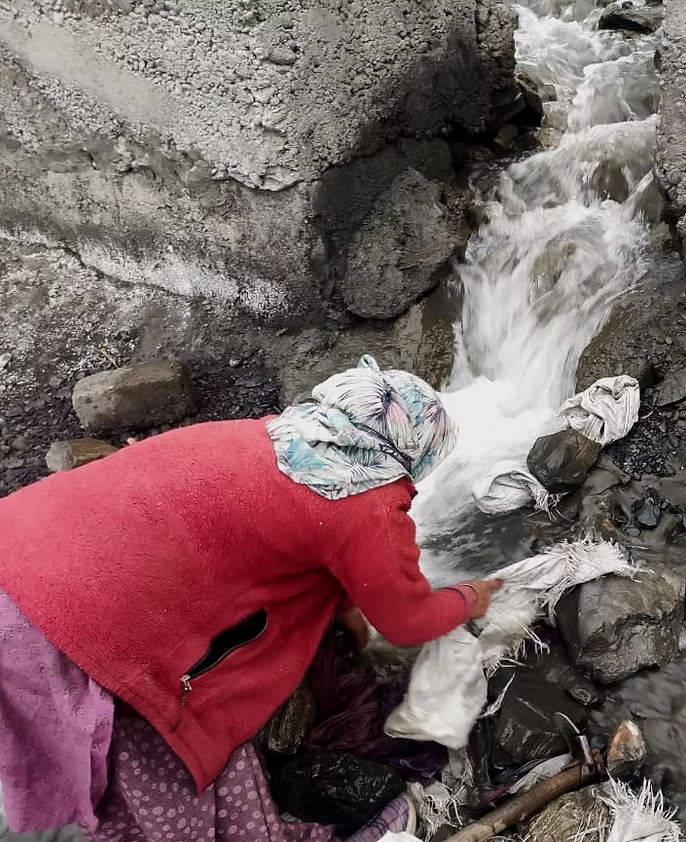
Throughout the mountain region, springs are reported to be drying and mountain agriculture is suffering from drought. The shortage of water has placed an increasing burden on mountain communities particularly villages like us where springs provide access to 90 percent of freshwater. In the whole climate change scenario, agro-pastoralists like us are the most vulnerable. Our village experiences both drought-like situations as well as the brunt of flash floods. Geographically, Gue is slowly turning into a barren land. Our village already lost half of our agricultural land and that cannot be revived. Many people lost huge bighas of land in the process, including mine. Since the flood, there has been a lot of erosion and we also face difficulty maintaining our water canals which is key to the water distribution system. The woman in the picture is my mother with whom I go upto Kirki Phak to bring down water to our fields during our Chu-rey (watering turn). It is not easy as we have to wake up at 4 am in the morning and the canal frequently loses its shape due to excessive siltation which creates hard labor for us. Maintaining water canals is a huge issue and women bear the brunt. With the help of the local Panchayat, there has been some solution to reinforce the canals but if it floods, we are back at ground zero – where we started.

Photo: Chunnit Chhering

Elders in my village believe that if there’s any magic in the world, it is contained in water. Peace, healthy social relations and communal harmony has its strong roots in water availability. The flood has a direct impact on our livelihood. The backbreaking work of agriculture is becoming more precarious and people are gradually shifting from it. Some leaving their fields uncultivated, some finding resort in tourism and odd labor works. It has also marred social prospects for many youngsters as people are reluctant to marry their daughters in our village. I feel all these are climate induced changes – uneven rainfall, retreating glaciers, drying up of water sources, water scarcity, flash floods and its devastating impact on mountain people. Tourism has escalated the situation and placed additional burden. At one point, the number of vehicles entering my village exceeded 400 on a daily basis!

Gue is a popular travel destination and is often listed among off-beat travel itineraries. Our village monastery preserving the mummified body of a great Buddhist yogi draws special attention. Travellers across the world visit the village to witness it but their relation to the place doesn’t go beyond consumerist approach. With more people getting to know about it, there’s huge love pouring to the beautiful picturesque mountains but no one is bothered how locals are eking out. No one is bothered how we are quietly bearing the enormous burden. Away from the limelight – an unspoken desperation. I feel only through collective action we can mitigate some of the climate induced devastations and I hope everyone takes care.

981 857 Chunnit Chhering
In Conversation with Women of Chicham
Chicham Village | Photo: Tanvi Dutta

In Conversation with Women of Chicham

Tanzin Dawa: How has it changed?

Dikit Lamo: We have been experiencing extremely erratic weather conditions these days. I am 40 now and from my experience, I think it is due to changing weather patterns. We used to have snowfall that levelled our houses and had to clear it with the help of our neighbours! Such was time. There’s lushful greenery in our barley fields and our harvests were abundant. In our village, Chu-mik (spring water) gushed with fresh water – we got to choose from myriad streams flowing around – cold, sweet water to drink while farming. From the past 10 years, there’s been a considerable decrease in precipitation. We used to look up at the sky in hope for rain but to no avail. This year was particularly unexpected. There was very little snowfall during winter and we were even unsure whether we would even get to till our land when summer arrives. We, somehow, adjusted to the difficult situation by either carrying a water tanker to our fields and initiating the seeding work. It worsened as months passed by, we had to leave many of our fields half irrigated or completely fallow. There’s no hope for crops this year.

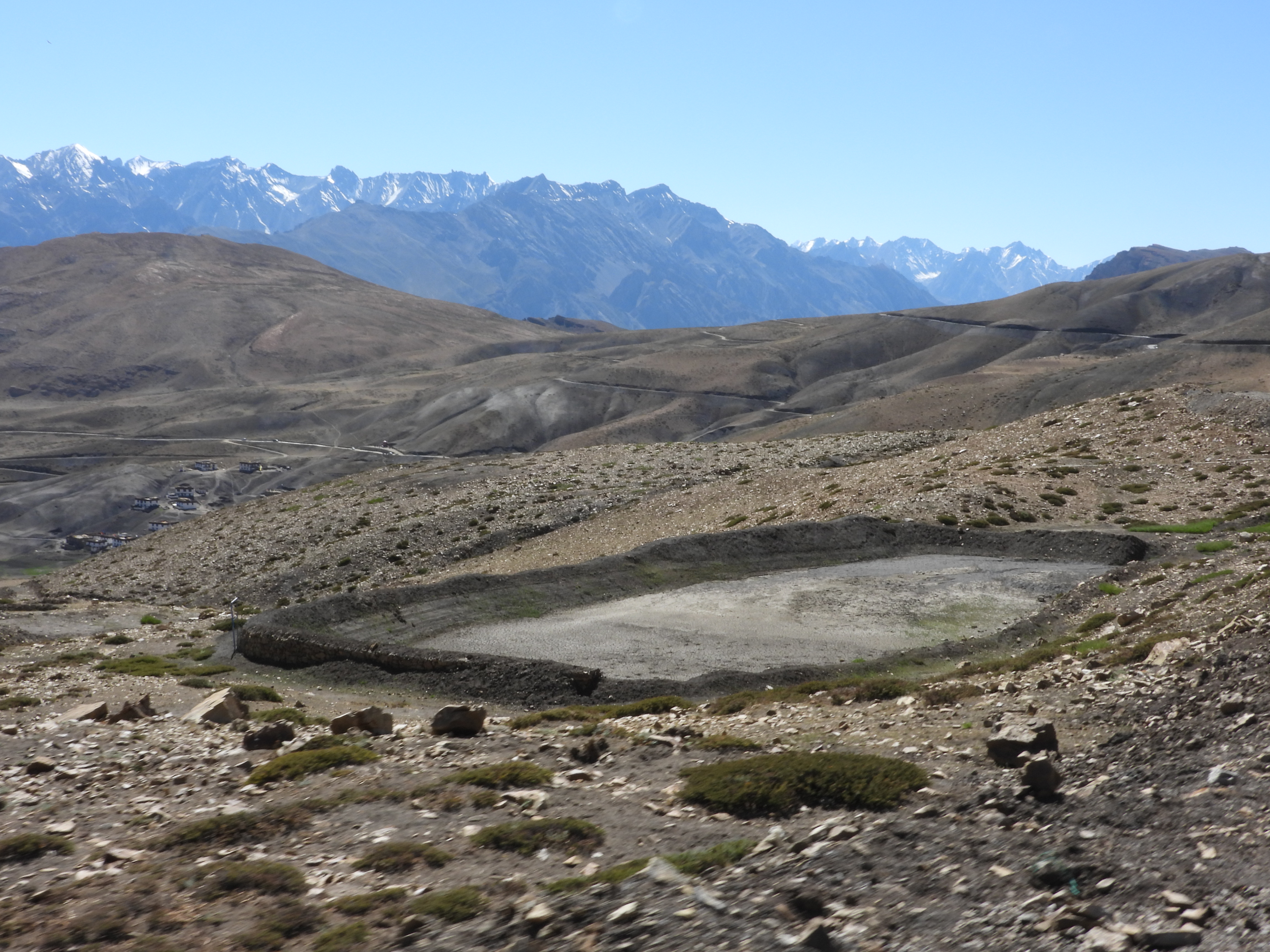
Barren fields and dried reservoir | Photo: Chhunit Kesang
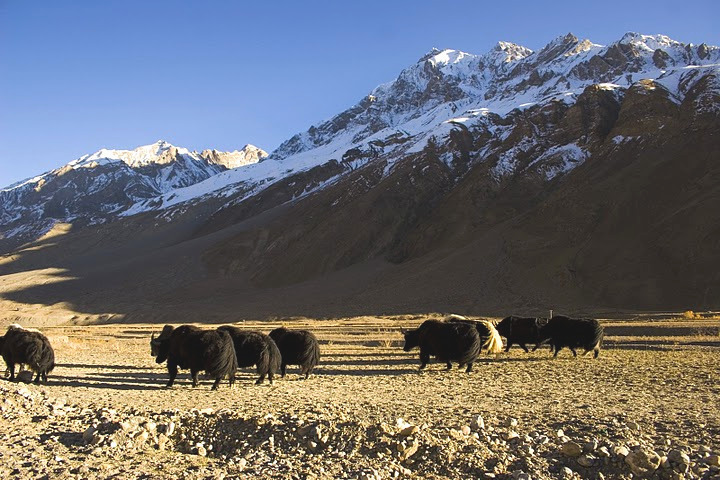
Domesticated Yaks

TD: What do you think is the cause for such changes?

DL: I think it is due to changing weather patterns. They say it is called global warming in English and has to do with plastic usage. I am not sure how it is interrelated and how it impacts our fields here in Spiti but I do believe it. I think about it a lot and think of avoiding plastic usage on my level. But will it make a difference on a larger level? I think collective action is needed. To ensure timely snowfall, we have to revive our traditional ways of living. Rituals are performed according to an astrologically and agriculturally influenced calendar and we have to bring back those traditions and belief systems. We also think about our children’s generation and preserve our natural resources. Tourism has also impacted the way we channel our resources. It is getting extremely rampant nowadays. We have to devise an internal resource and waste management system to reduce impact on nature. I think plantations will be beneficial in desert areas like ours. I hope that will reduce the effect of global warming and our fields begin to blossom again and our kuls brimming fresh snow water.

Padma Norzom: Water situation? It is scarce everywhere this year. In Chicham, even drinking water is getting difficult for us. Our barley and green peas field are all drying up before harvest season due to receding water in our kuls. There was just no water for irrigation and we are forced to abandon our fields. Because of declining water sources, our land, soil, pasture is all drying up and forage availability and grazing system is also impacted.

TD: Was it the same last year?

PN: It used to be enough to sustain our farm work and to feed our cattle but this year has been unfortunate. There was no snowfall during winter and all our spring waters dried up. My jersey cow also looks very weak and without adequate water to drink, milk production has become very less. I stopped selling milk this year. Livestock feeding and water intake behaviours are also negatively impacted and when sent out in the wild for grazing, they gallop towards greener pastures!

TD: How do we resolve this? Is there a way we can utilise water from the Spiti river?

PN: Yes, river water can certainly be channelled but it will be a bit strenuous and resource intensive as it is located far from the village area. If the government can help us, it will be a huge blessing. Some farmers have tried irrigating their green pea fields with generators. But the diesel operated generators turned out very expensive and it was simply not feasible for small farmers like us who also spent a lot of money buying green pea seeds. The cost will come in lakhs – all for nothing without water.

1800 1200 Tanzin Dawa
Art From Our Valleys
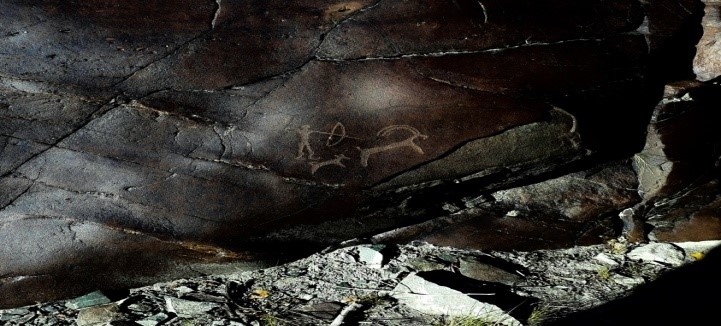
"Huntsman" rock-art, Gya-Miru | Photo: Sherab Lobzang

Art From Our Valleys

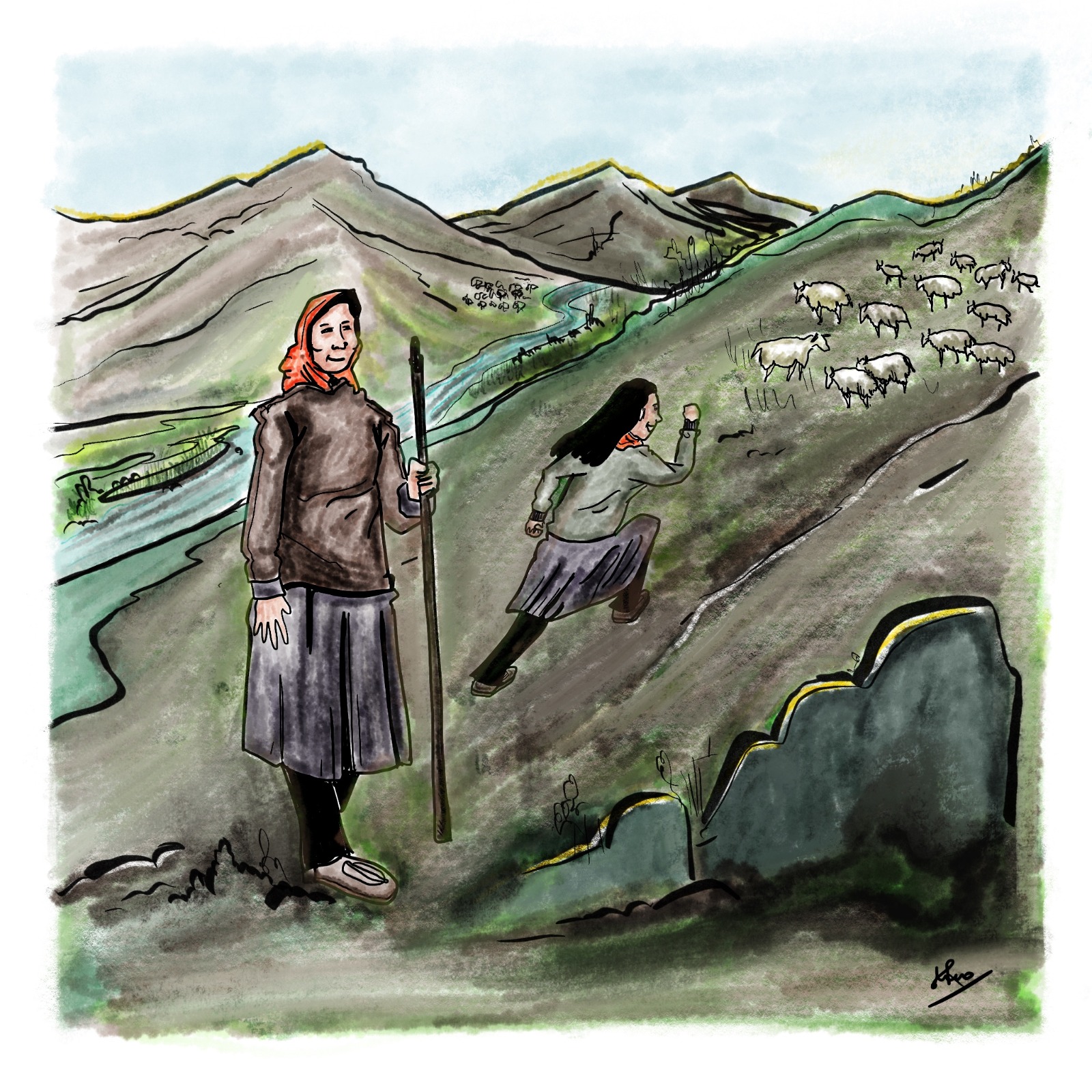
Life in the mountains is tough. In addition to physical fitness, it demands a great deal of mental fortitude. This is particularly true among our elders, especially when you hear them speak about their younger days. Stories of how they managed to survive the long winter months tending to their livestock are hard to believe for our generation. Animals reserve a special place in our lives, and they too are often as spirited as hardy mountain people. Growing up in Ladakh, animals were an integral part of my life too: sheep, goat, donkey, horses, and yak. And then there are the wild animals that were seen rarely, but often encountered when they preyed on livestock. Growing up in the village of Kumdok close to the Changthang region of Ladakh, I enjoyed exploring the mountains as a young kid. I still remember joining my mother to graze the village livestock in the pastures around our village. Each family took turns to fulfill this task. During that time my mother would show me wild animals that were seen in the pastures around our village. We had to keep our livestock safe from hungry carnivores.

Illustration: Rohit Rao

I was fascinated by the outdoors and I still cherish those times spent exploring the pastures. I particularly remember the day I first encountered some very interesting art on some of the rocks in these pastures. As a 13-year old then, I wondered who had drawn them. I asked my mother and she told me that these were made many, many years ago. Probably even before our great, great grandparent’s time. This was from a time when there were no notebooks, pencils, and even schools which is why they may have etched them on the rock.

A few years later, I left the village for higher studies. Returning home each year, I noticed that the number of livestock in my village was reducing. Some years back everyone gave up herding sheep and goat. After completing my education, I began to work in wildlife conservation. My work took me to many places across Ladakh. I interacted with locals of every generation. I also worked closely with researchers who were trying to study nature and the relation that we Ladakhi share with them. That often took me back to rock art that my mother had shown me. Our ancestors may have shared a special relation with nature and animals, as was depicted in the art. This got me even more interested in rock art which is both rare and special. In the last few years, I have encountered rock art in the most unlikely places. I make sure to take a picture, each time I find new art. I often find myself thinking about what our forefathers were trying to tell us through the art. I would like to share some of these pictures and my thoughts with you.

"Hunter" rock-art, Ulley | Photo: Sherab Lobzang

Ulley Tokpo is a village in the western part of Ladakh. Walking along the banks of the Indus River, I stumbled upon this curious rock art. The image shows a hunter pointing a bow at an animal with long curved horns, while a guard dog watches on. Did our forefathers hunt for food? Maybe they did not rear animals like sheep and goat then. Why else would they hunt? When did they start rearing livestock and when did we stop hunting? Thanks to livestock rearing we could stop hunting. But while hunting has stopped, archery remains a very popular sport and a cultural event that we participate in every winter. This is a common practice across many mountain communities in the Himalayas.

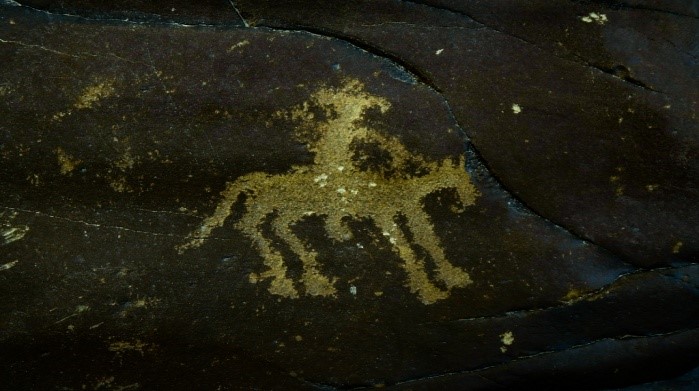
I recorded this rock art image of a horseman between the villages of Miru and Gya on the highway that connects Leh to Manali. One of my senior colleagues had shown me this image. If you drive past this area today, you will not find this horseman anymore. Unfortunately, a large part of the rock formation that carried this rock art was destroyed during road construction. But this image is a reminder of the role that horses might have played in the lives of our forefathers.

Horses were the most efficient form of transport, be that for hunting or even later for trade and exchange of produce through barter. The significance of horses has diminished with the arrival of vehicles. However, they still reserve an important cultural role in our communities. Horse racing is active in some parts during Losar, the New Year celebrated on the first day of the lunisolar Tibetan calendar. Another sport that was played earlier was Ta Polo, Ta meaning horse, and Polo meaning ball. Could this have been a primitive form of the sport of polo? I often wonder where our forefathers might have learned it from.

"Horseman and Yak" rock-art | Photo: Sherab Lobzang

I once encountered this fascinating image of what looked like horsemen pursuing a large animal. I wondered if these were yak. When I spoke with some elders in my village, they mentioned that indeed they were: they were wild yak! Dong, as they are referred to locally, haven’t been seen in a very long time. The domestic yak is believed to have been reared from the wild yak. Our elders explained that dong is much larger than the domestic ones we rear. Today, it is reported from a small part in Changchenmo which is largely unexplored. I wonder if there are other animals like the dong that once occupied these rangelands.

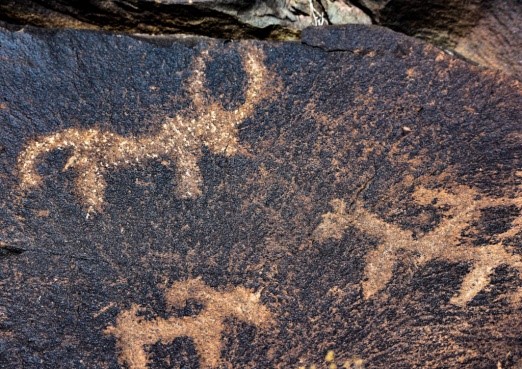
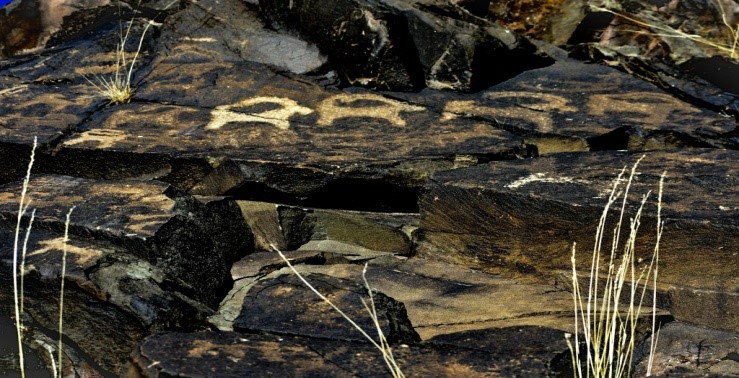
At the mouth of Phuyul valley near the village of Miru, I observed some very interesting rock art while carrying out surveys. This included images of wild animals, stupas which are religious structures in Buddhism, and script which was hard to identify. Some of these etchings look like ibex based on the longhorns they display. I find that particularly interesting because ibex was not found in these areas during our surveys in the past three years. Could the rock art be suggesting that these valleys were home to ibex in prehistoric times? It is hard to say. These are just a few of the images I have found so far. Many more remain undiscovered and I hope to keep finding them and sharing their stories, as I do now. While I have been fortunate to stumble upon these ancient relics that are part of our heritage, I am concerned about the number of these relics we may be losing out of ignorance. Rock art, which may date back several thousand years, are messages to us from our ancestors. They deserve attention and care. If we were to lose them, we might lose an important part of our past heritage.

"Ibex" rock-art | Photo: Sherab Lobzang

This holds true not just for Ladakh, but for all areas where rock art of this kind tells a story of the past. It is up to us to rediscover them and celebrate the wonderful stories they tell. These stories told by our ancestors.

699 391 Sherab Lobzang
The Predicament of a Herder

The Predicament of a Herder

Winters in Spiti valley are filled with celebrations of a fruitful year and prayers for a bountiful year ahead. Most of the time is spent within the villages as travel is usually difficult especially when heavy snowfall causes roadblocks. The year 2018 was also not much different. In the month of November, as we were readying ourselves for the coming winter months in Kibber, I received an urgent message from a colleague in Mysore in Karnataka.

“A herder has lost much livestock in Chango, possibly killed by a wild animal” the message said.

These were the only details along with a WhatsApp video that was being circulated. Understanding that the matter could be grave and the weather was still permitting travel, I decided to leave immediately for Chango which is in Kinnaur. I requested Tanzin Thuktan, my colleague, to join me. Chango is about 110 km away from Kibber.

We did not have any details about the owner or where exactly the incident had happened. Upon reaching Chango we were clueless, but the good thing about small towns and villages is that everyone knows each other very well. So, when we enquired about the case with local shopkeepers, they were well aware of it and they told us that Thuktan Tender was the owner of the livestock and showed us the way to his house. Thuktanji is an apple farmer in Chango and has a settlement at Liti Dogri. When we arrived at his house, he was confused about why we had traveled from so far to talk about his loss. With a little hesitation, he narrated the whole incidence to us.

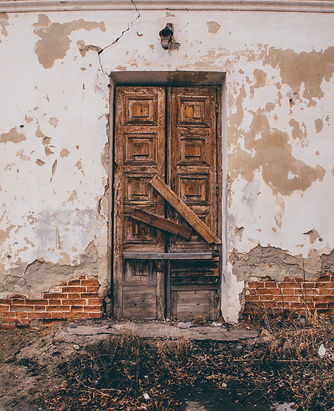
On 16th November 2018, Raju, the caretaker of the corral, had returned to the village to gather supplies for the Dogri. He decided to stay back in the village for the night. The next day when he went back and opened the door of the corral, the animals rushed out in panic. Usually, he would have had to take a lot of effort into getting the animals out of the corral. He knew  something was wrong. It was  strange behavior.

Broken Door | Photo: Mikey Dabro

Standing by the door he carefully scanned the inside of the corral and to his surprise, he saw a set of shining eyes staring back at him in the dark. He immediately knew what it was and slammed the door shut. He called Thuktan and narrated the incident. Within a few hours, the news had reached every household in Chango and nearby villages.

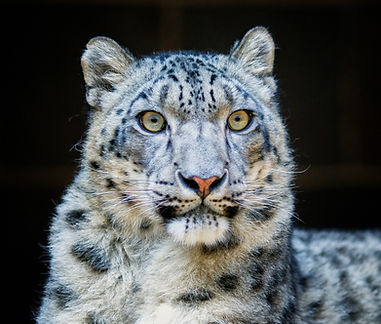
Snow Leopard | Photo: Adriaan Greyling

A snow leopard, which had entered the corral in the dark of the night, had somehow got trapped inside. It garnered a lot of attention from local leaders and the forest department to school teachers. Everyone had reached the Dogri to enquire about the incident and see the snow leopard. Upon many assurances of receiving relief for the loss, Thuktan released the snow leopard. He also made a video of the release as a record that the animal had been released unharmed. When they inspected the corral from inside, they saw 19 animals that had been killed and 11 critically injured. Within 2-3 days even they succumbed to their injuries. However, after the release, all the hype around the case vanished. So, when I met with Thuktanji, a few weeks later, he was understandably angry and had lost hope of receiving any financial help. I asked him if I could visit the Dogri, to which he agreed.

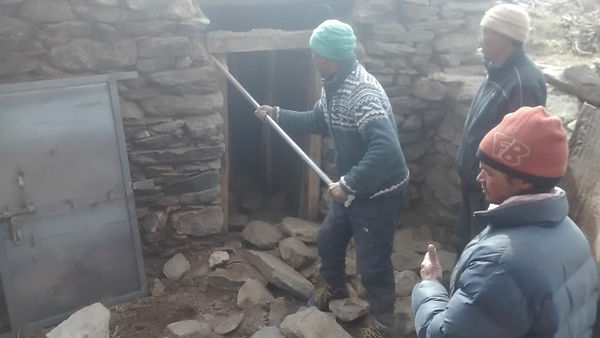
Liti Dogri is about 15 km away from Chango. It has three big corrals which houses small-bodied animals like goats and sheep of several livestock owners of the village. Thuktan ji’s corral at any time has 200-250 animals. Upon inspection of the corral, we noticed that the door of the corral was old and did not shut completely. We gathered that the snow leopard must have entered through the door and had gotten trapped inside. To prevent further loss, we decided that we would replace the door with a new sturdy one. The next few days were filled with hurdles. The closest material shop and welder was 130 km away in Reckong Peo. Getting the material on time was crucial to avoid further losses. The three of us drove to Peo in Thuktan ji’s car and bought doors for the corral. The villagers came to help us fix the door. The compensation process as well as the relief amount was also not very clear.

Repairing broken door of Thuktanji | Photo: Nature Conservation Foundation

We decided to speak to the local Forest Guards and Range Officers. They informed us that the compensation file had been sent to the DFO’s office in Reckong Peo. We then met with the DFO who was very sympathetic and assured us that Thuktanji would receive the claim as per the new notification rates. Within few weeks Thuktanji received the claim from the department. Compared to the actual loss suffered and other collateral costs incurred, the financial relief offered by the Forest Department was often considered too little. Fortunately, the department has revised these rates since August 2018 to ensure that the herders can cope with these situations better than before.

As a herder myself, I believe that we must try to ensure that such events are avoided in the first place. Wild animals have always lived around us and will continue to do so. We have always taken precautions to keep our livestock safe from them, and we have to continue doing so. With access to better resources in our remote areas, we may be able to plan this more effectively and upgrade our corrals to make them predator-proof. This way we may be able to prevent any future losses that might occur.

1014 676 Tanzin Thinley
Living With The Wild
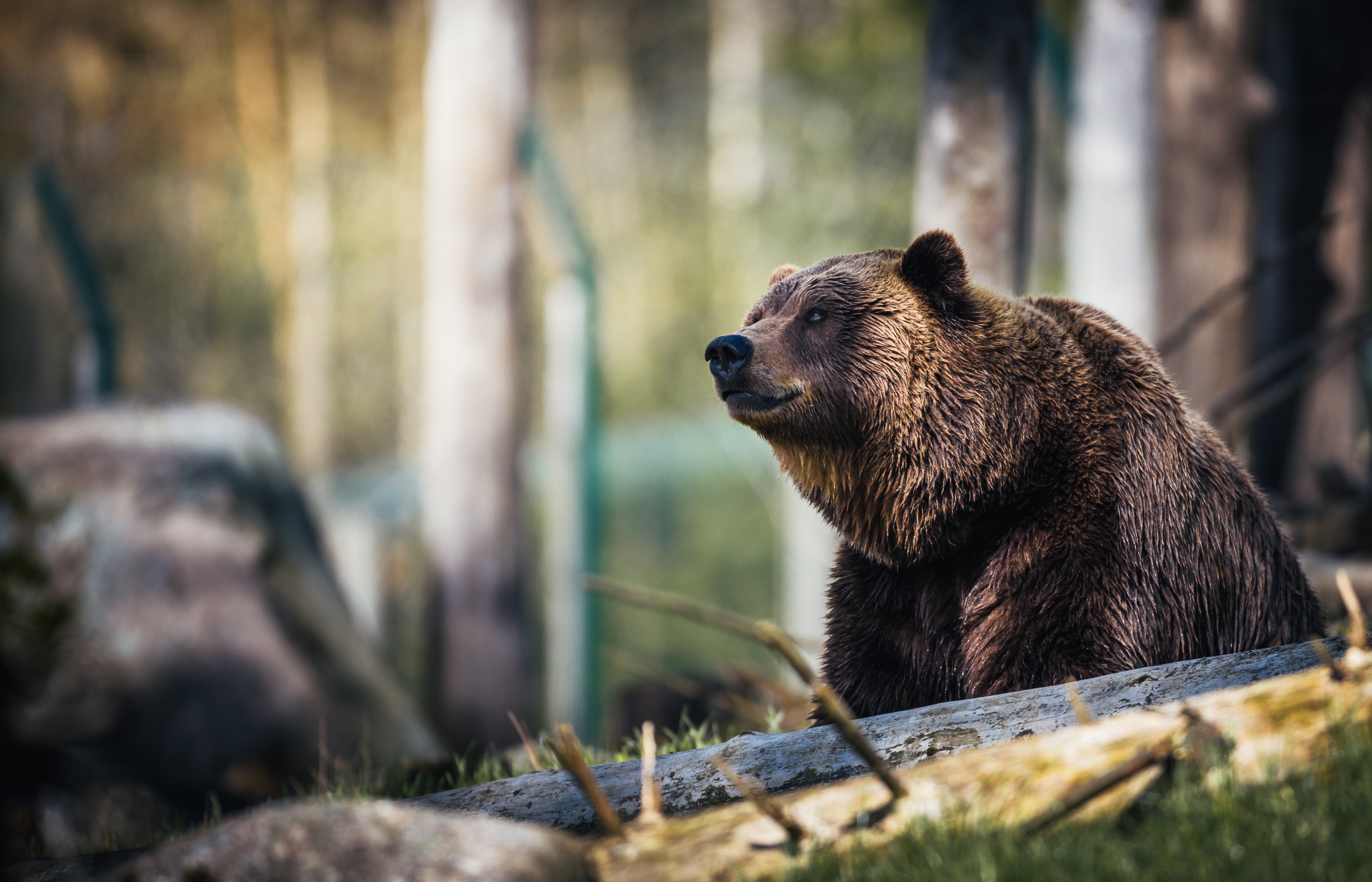
Brown Bear | Photo: Janko Ferlic (Pexels)

Living With The Wild

The 19th day of November 2018 was like any other day for Vikram of Pangi, Chamba district. He was walking his cattle in the nearby village pasture by the banks of the Chenab river. Little did he know that his life was about to change. While walking through thick shrubs and vegetation, he didn’t realize that he had accidentally come too close to a brown bear. The sudden realization of the proximity threatened the animal, and out of fear, it attacked Vikram. Vikram caught off guard, did his best to reduce the impact of the attack. He managed to save his life but suffered multiple grievous injuries all over his body and partial loss of eyesight. He immediately went to the nearest hospital to get medical help. He later filed for compensation with the Range Office in Pangi.

In another part of Himachal, a snow leopard, in the dark of the night, entered the corral of a herder and killed 20 animals. The herder, overnight, lost most of his livestock, and being in one of the remote areas, he had no clear idea of what had to be done and how he could get some economic relief from the forest department.

Such cases are not new to these herding communities who often come in close quarters with the wildlife around their villages and pastures. Some of these instances lead to a lot of emotional stress and in some scenarios may also impact the individuals’ personal relationships. It is a very heavy price one pays for living around wildlife. We must ensure that anyone who suffers such a loss is not neglected and helped throughout the process.

Although this problem has been a part of herder’s life for many generations, there are new-age solutions to prevent and mitigate some of these economic losses.

Reinforcing the roofs of the corral to make them predator-proof | Photo: Nature Conservation Foundation

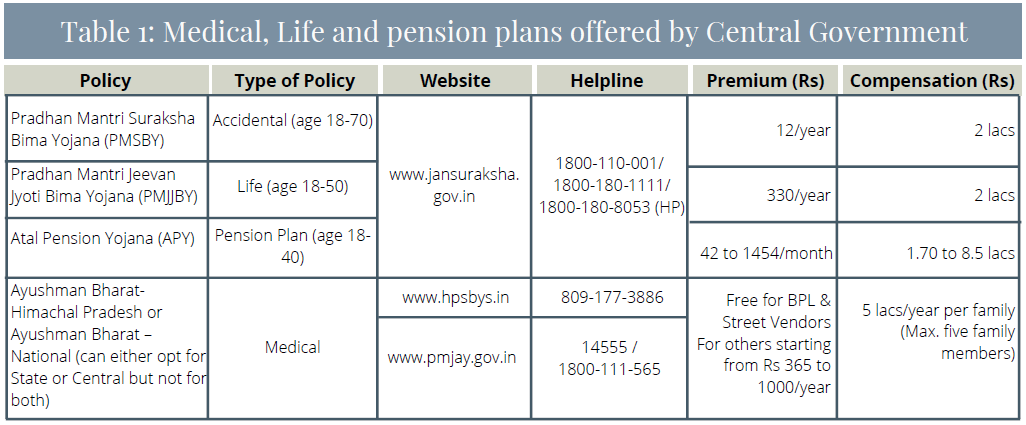
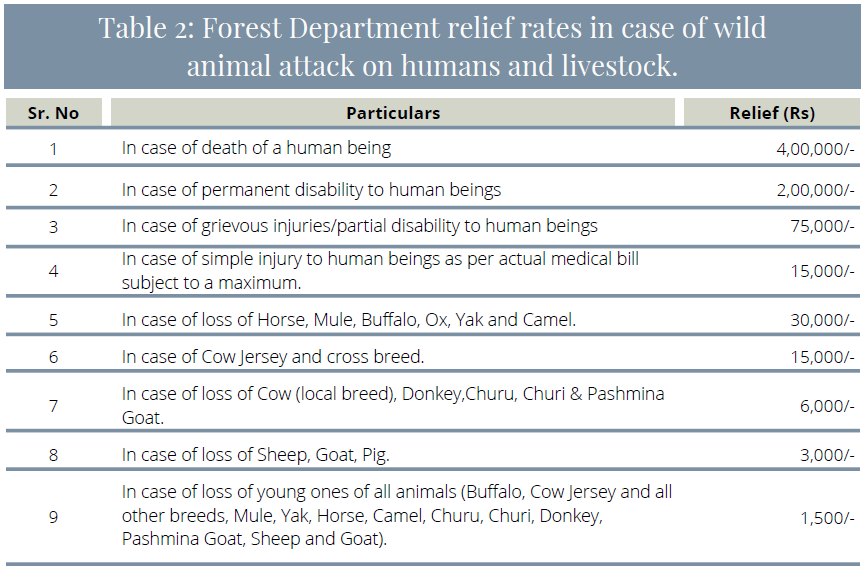
One thing that every individual can do beforehand is to economically safeguard themselves and their family, in case of a medical emergency, by opting for accidental death and disability insurance offered by the central government under Pradhan Mantri Suraksha Bima Yojana (PMSBY) scheme. Although there are eligibility criteria, some degree of financial coverage can be availed from Ayushman Bharat as well. Himachal Pradesh Government offers Ayushman Bharat through its Himachal Pradesh Swasthya Bima Yojna Society (HPSBY). If one does not have any life insurance or pension plan, they should also consider getting one from Pradhan Mantri Jeevan Jyoti Bima Yojana (PMJJBY) and Atal Pension Yojana (APY). For more details on these insurances refer to Table 1. The Forest department also has provisions for providing relief in case one is attacked by wildlife. For details on relief rates offered by Forest Department refer to Table 2.

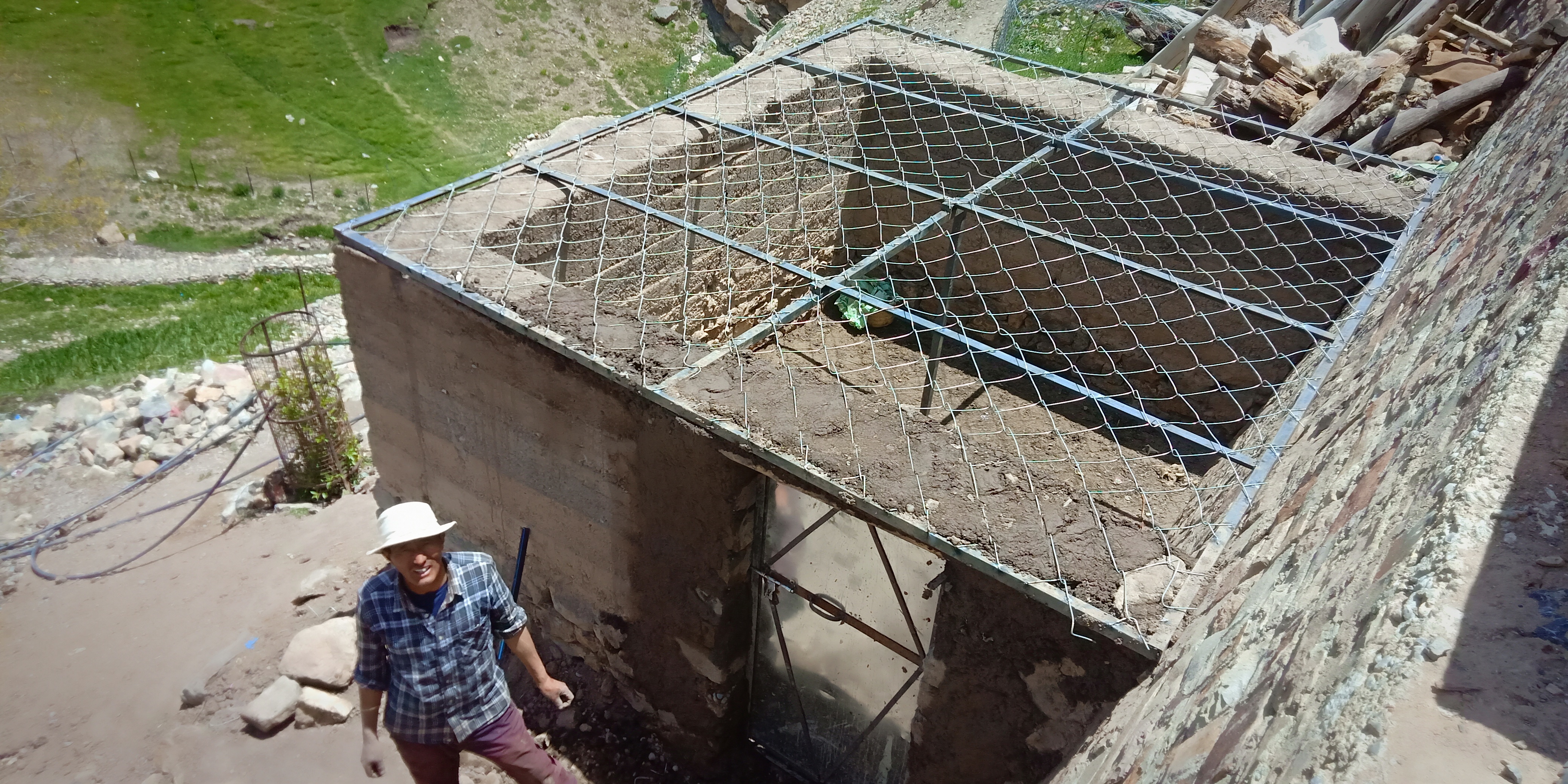
For livestock, one could take steps to prevent such an incident by repairing and reinforcing corrals to ensure no gaps in walls/doors remain. The roofs can be reinforced with metal mesh to close off all possibilities of attack in the corral. Regular and timely maintenance is of utmost importance. However, the livestock is prone to attack in the pastures and forests as well. Village-level measures, like the insurance program, can help reduce the losses suffered due to such attacks. When the collective losses of the village are high, then insurance of livestock can be planned where the premium and compensation are decided by the villagers and a village committee manages the insurance fund. In case of a loss suffered by a family, compensation is paid out from such a fund. However, the community must be careful and set clear rules and guidelines when starting a village-level insurance program. Currently, there are three villages in Spiti valley where are the community runs the insurance program.

The forest department also provides compensation to the herders in case the livestock is killed by wildlife. However, despite all good intentions, there can be genuine difficulties in timely administering such claims by the forest department and one must be patient but persistent. For details on relief rates offered by Forest Department refer to Table 2.

There are also some traditional solutions to the problem of livestock depredation. For example, in Gue village of Lahaul & Spiti district, there were multiple cases of surplus killing this year. Whoever lost their livestock were helped out by the entire community by each household contributing an animal to the owners. This practice not only takes the stress of losing livestock away but also does not let herder suffer economically. Such practices are reported in other parts of Himachal as well. I am sure that there will be many other local solutions that I have not talked about. I would love to hear about them. Do write about the practices adopted to prevent and mitigate losses from wildlife in your village. Also, if you want to take up this issue in your own village or start an insurance program and need further assistance, do reach out to me or my team. Our details are available on the last page of the newsletter.

In the end, I would like to mention that there is no one, sure shot solution to such complex problems, but Himachalis have continuously been adapting to these challenges, a characteristic of life in the hills, and putting up with the adversities they face.

5824 3744 Deepshikha Sharma
Shangdong to Stupa

Shangdong to Stupa

A short video in Ladakhi explaining the Shangdong to Stupa initiative. Shot by Nomadic Brothers and edited by Munmun Dhalaria. (Includes English subtitles)

2560 1417 Nomadic Brothers