Lahaul

The uncertain future of Himalayan Barley

The uncertain future of Himalayan Barley

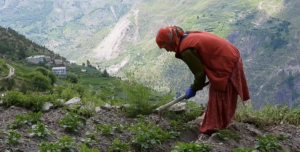
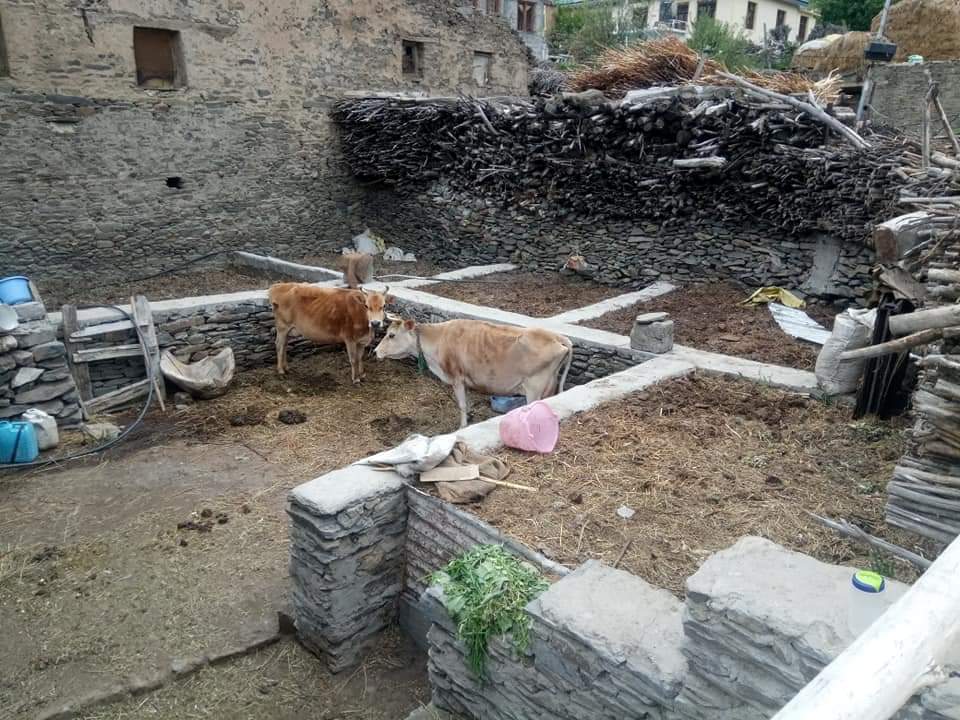
Barley grown organically has been a staple produce in the high altitude regions of Spiti, Lahaul and Ladakh. In the 1980s, the cold summer weather allowed farmers to move towards growing more lucrative cash crops. However, the same weather is now becoming the biggest risk. In this story, Tanzin Thinley, a farmer from Kibber in Spiti talks about this change and the challenges facing farmers like him.

Credits:
Thanks to Tanzin Thinley
Also, thanks to Dikit Lamo of Chicham
Additional footage: Lama Tanzin Chhewang
Stock Footage from Pixabay (https://pixabay.com/)
Music: The Old Farmer by Dream-Protocol via. Pixabay


जैविक तरीके से उगाई गई जौ स्पीति, लाहौल और लद्दाख के क्षेत्रों में एक प्रमुख उपज रही है। 1980 के दशक में, ठंडी गर्मी के मौसम के कारण, किसानों को अधिक लाभदायक नकदी फसलें उगाने की ओर बढ़ने का मौका मिला। हालांकि, यही मौसम अब सबसे बड़ा खतरा भी बनता जा रहा है। इस कहानी में, स्पीति के किब्बर के एक किसान तंजिन थिनले इस बदलाव और उनके जैसे किसानों के सामने आने वाली चुनौतियों के बारे में बात करते हैं।

फिल्मांकन क्रेडिट:
तंजिन थिनले को धन्यवाद
इसके अलावा, चिचम के डिकिट लामो को भी धन्यवाद
अतिरिक्त फुटेज: लामा तंजिन छेवांग
पिक्साबे से स्टॉक फुटेज (https://pixabay.com/)
1200 650 Ajay Bijoor
Spirits of the mountains: Barley liquor (Arrack)

Spirits of the mountains: Barley liquor (Arrack)

Preparation of barley wine involves a delicate process that is usually mastered over many years. Watch how a blend of barley wine is made traditionally.

Special thanks to Tanzin Kunzang


जौ की वाइन तैयार करना एक नाजुक प्रक्रिया है जिसमें महारत हासिल करने में कई साल लग जाते हैं। देखें कि पारंपरिक रूप से जौ वाइन का मिश्रण कैसे बनाया जाता है।

तंजिन कुंजांग को विशेष धन्यवाद

1200 666 Ajay Bijoor
Spirits of the mountains: How is Rice Beer (chaang) made in Lahaul

Spirits of the mountains: How is Rice Beer (chaang) made in Lahaul

Chaang is a fermented, alcoholic beverage traditionally made from barley in the Himalayan belts. Thanks to an effective Public Distribution System, locals now have access to rice and wheat, which was previously rare. Both are rice and wheat are also used to brew chaang now. The key to a great brew though is the fermenting agent, phaav. Phaav is essentially a way to trap and use the atmospheric yeast as a starter, making it specific to each location. The phaav is what distinguishes a great brew from a good one.


छांग एक मादक पेय है जो पारंपरिक रूप से हिमालयी क्षेत्रों में जौ से बनाया जाता है। प्रभावी सार्वजनिक वितरण प्रणाली की बदौलत, स्थानीय लोगों को अब चावल और गेहूं तक पहुंच प्राप्त हो गई है, जो पहले दुर्लभ था। दोनों चावल और गेहूं का उपयोग अब छांग बनाने के लिए किया जाता है। हालाँकि, एक बेहतरीन शराब की कुंजी किण्वन एजेंट, फाव है। फाव मूल रूप से वायुमंडलीय खमीर को स्टार्टर के रूप में फंसाने और उपयोग करने का एक तरीका है, जो इसे प्रत्येक स्थान के लिए विशिष्ट बनाता है। फाव ही एक बढ़िया ब्रू को अच्छे से अलग करता है।

Special thanks to Angmo Gaaji and Chhering Gaaji.
Cover illustration by Nawang Tankhe.
Supporting cast: Shri. Kesang Chunit.

अंग्मो गाजी और छेरिंग गाजी को विशेष धन्यवाद।
नवांग तन्खे द्वारा कवर चित्रण।
सहायक कलाकार: श्री. केसांग चुनित।

1200 665 Ajay Bijoor
How innovation is helping Lahauli farmers

How innovation is helping Lahauli farmers

Water management by women in Spiti has brought rich economic rewards to the locals. We now take you to Lahaul valley, which is adjacent to Spiti, to see how the introduction of a small change has benefitted locals. This story highlights the value in combining traditional knowledge with locally-relevant innovations.

Credits:
We thank Angmo Gaaji and Chhering Gaaji of Grimass village in Lahaul for speaking with us.
Cover illustration by Nawang Tankhe.
Background score via. Pixabay
In the presence of mountains by micgreens
Sparkling water by Alfred Grupstra
Stock footage via. Canva Pro
Voice-over using DesiVocal.


स्पीति में महिलाओं द्वारा जल प्रबंधन ने स्थानीय लोगों को समृद्ध आर्थिक लाभ दिलाया है। अब हम आपको स्पीति से सटी लाहौल घाटी में ले चलते हैं, यह देखने के लिए कि एक छोटे से बदलाव की शुरूआत से स्थानीय लोगों को कैसे फायदा हुआ है। यह कहानी स्थानीय-प्रासंगिक नवाचारों के साथ पारंपरिक ज्ञान के संयोजन के महत्व पर प्रकाश डालती है।

क्रेडिट:
हमसे बात करने के लिए हम लाहौल के ग्रिमास गांव के अंगमो गाजी और छेरिंग गाजी को धन्यवाद देते हैं।
नवांग तन्खे द्वारा कवर चित्रण।
संगीत: पिक्साबे
DesiVocal का उपयोग करके वॉयस-ओवर।

1200 607 Ajay Bijoor
Birth of the Chandra river

Birth of the Chandra river

It is fairly well known that Gaddi herders from Kangra spend summer in the rich pastures of Lahaul. This is an annual migratory route that the Gaddi community have accessed for generations. They camp in the high mountain pastures. From a distance their life may seem idyllic – spending the day in the shadow of snow-clad peaks, breathing the crisp mountain air, basking in the soft summer sun. Unfortunately, the Gaddi’s dammed flock does not harbor such taste for a serene life in the mountains. All they care for is food! Each morning they bleat to be taken to a new slope where they can get their fill of fresh summer grass. And the poor Gaddi herder has to run behind them to make sure the flock remains safe, for a pesky wolf waiting to feast on the flock is almost never very far. Summer days are very long. But as dusk sets in, the Gaddi gets some rest.

It had only been a few years since Noopalal started accompanying his aged uncle and their flock. Their settlement was at the farthest end of Lahaul valley. It was so far that most herders had only heard of it. It was famous for a beautiful lake that had turquoise-blue water.

Noopalal was in-charge of the flock, while his old uncle stayed back and cooked for them. Every evening Noopalal would herd the flock and sit outside their thaach, which overlooked the lake. He would slowly pull out his flute and play it softly while his uncle smoked a pipe. Even though there was no one but his animals to listen, he played the flute because it gave him joy. On most days it would get dark by the time he finished. He would then crawl into the thaach, eat his meal, and retire for the day. This was the ritual he followed on most days until it all changed one night. The moon was full and when Noopalal finished playing his flute he looked mesmerized. As if he were possessed, as if someone had cast a spell on him. When he looked at the lake he saw a reflection of the full moon in its turquoise-blue water. He stood up in shock. “The moon has fallen in the lake”, he whispered. “The moon is drowning. Help!” He yelled as he ran towards the lake. His old uncle barely registered anything, and by the time he did Noopalal had jumped into the icy cold water. His poor uncle ran behind him. But he could only watch helplessly. He remembered Noopalal shouting frantically that the moon is cracking, looking at the ripples on the surface of the water. By morning, both Noopalal and the moon were gone.

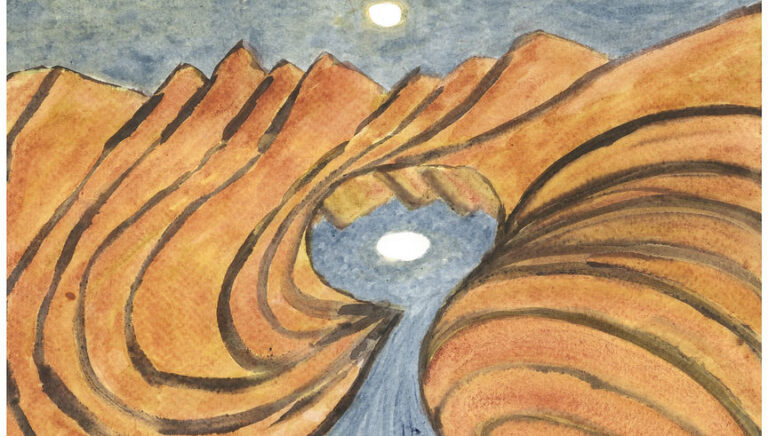
Did Noopalal sink with the moon that night? Maybe not. But many believe that the moon did, indeed, drown that night and the water that spilled over gave birth to the Chandra river. And the lake, Chandra tal, remains beautiful as ever. Especially on full moon nights. If you ever have the good fortune of spending a full moon’s night by Chandra tal, you might even hear Noopalal’s flute.

  • Gaddi herders are a semi-pastoral tribe that rear sheep and goat. Some of the sturdiest men and women, the Gaddis travel for 10-11 months with their livestock covering a vast distance across the Himalaya and her lower plains.
  • Kangra is a Himalayan region from where the Gaddi herders hail. It is also a district in the State of Himachal Pradesh.
  • Lahaul is another remote Himalayan valley that can be reached after crossing the Rohtang pass. Lahaul valley is adjacent to Spiti valley and together Lahaul-Spiti forms the biggest district of Himachal Pradesh.
  • Thaach is a stone hut that gaddi herders live inside in places where they camp. These stone huts are old and beautifully built by stacking stones. They protect the herders from rough weather.
  • Chandra river rises from the snow lying at the base of the main Himalayan range in the Lahaul and Spiti district. The beautiful Chandra Tal has formed at its source.
  • Chandra tal is a beautiful high-altitude lake known for its beauty. It is also a very beautiful site to watch water birds. It is a mythologically important site.
864 491 Ajay Bijoor
Microbial intervention in Himalayan Dry Toilets
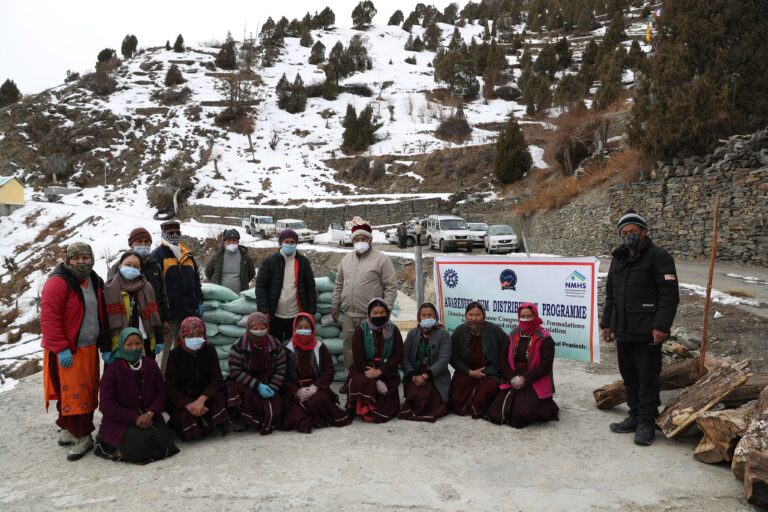
Distribution of Compost Booster in Lahaul

Microbial intervention in Himalayan Dry Toilets

As we meandered through the narrow streets of Ribling, Tandi, Sumnam and Ghoshal villages in Himachal Pradesh’s Lahaul district, we saw the indelible change of modernisation that had reached even the remotest corners of India. The cemented pavement had replaced the old mountain roads and the concrete houses were replacing the traditional wood and mud houses. In this new emerging transformation, small two-storey mud-houses outside people’s houses stood as a mysterious testament to the old ways.

In 2017, we stayed at the Center for High Altitude Biology (CeHAB)’s research centre at Ribling in Lahaul and it was during those field expeditions to the cold deserts in the Western Himalayas that I first came across the concept of ‘dry toilets’.  Just as we were getting increasingly inquisitive about these small mud structures, we ran into Mr. Jagdeep Katoch, one of the residents and a former school principal in the village. He patiently explained to us that these structures are called ‘ghop’ – traditional dry toilets used  by communities in the cold arid zones like Lahaul, Spiti and Ladakh  to uniquely manage human waste in the region.

Traditional Ghop in Lahaul

These two-tiered structures have an upper section, which is attached to the living room of the house; and the lower section where night soils are collected. After every use, a dry mixture of wood chips and ash locally called ‘fot’ is used to cover the faeces. The heap of the night soil is manually taken out every 6 months and left in the fields to mature. Thus, the compost is rich in nutrients and is a very useful input for agriculture in the region.

These regions also receive very less precipitation throughout the year making water availability extremely difficult and that’s why it was intriguing to observe how people in these remote villages sustainably manage human-waste that’s beneficial for their agro-ecosystem. In the Himalayan cold desert, these dry toilets (ghop) help conserve water during freezing winter and sustain organic farming with manure supply. When winter sets in, people increasingly depend on dry toilets, and later in the year, this decomposed night soil is used as manure for farms.

For generations, locals have relied on naturally-occurring bacteria to degrade the wastes. However, the practice comes with several disadvantages as due to extreme cold weather conditions, there are very few microbes that can function at such low temperatures.  As a result, the quality of the compost is not as good as one would expect.

Additionally, the influx of tourism and introduction of modern septic systems has brought change in the regional sanitation practices with more people resorting to pour-flush toilets. This has not only brought tremendous change in age-old practice of using dry toilets, night soil composting, but has also put the availability of water under severe stress in already resource strained places. Dr. Sanjay Kumar,  (Director, CSIR-IHBT, Palampur ) Chief Scientist and an ardent advocate of bio resource has always inspired us to ground our work, research around social issues and due to his guidance and support , we found the best opportunity to address the issue of solid waste management in high Himalayan regions by scientifically intervening and facilitating faster degradation of the night soil through Compost Booster- a microbial formulation for rapid degradation of night soil to manage human waste in cold desert areas.

Distribution of Compost Booster in Lahaul

The decomposition of any organic biomass is dependent on its microbial population.In Lahaul-Spiti, due to prolonged winters with sub-zero temperatures the decomposition of night soil is often slow as the first phase of composting- the mesophilic bacteria phase- crucial for decaying the organic material are inactive in this temperature range. At CSIR-IHBT, Palampur, our team at High Altitude Microbiology lab, Department of Biotechnology, formulated an indigenous bacterial consortium from the night soil compost’s different maturity phases. These cold- tolerant bacterial populations remain active even at such low temperatures up to four degree Celsius and produce enzymes that speed up the process of biomass degradation. The bacteria used for this purpose also have plant growth promoting attributes so that the end product is enriched compost high in nutrients and possess plant growth promoting bacteria.The financial aid from National Mission on Himalayan Studies (NMHS) by the Ministry of Environment, Forest & Climate Change (MoEF&CC) were crucial to enable key research on ground.

The sample of compost boosters were distributed among a few households in Lahaul for trial in 2018. We asked the villagers to use a handful of the sample in place of fot and the feedback was quite motivating. They observed that the mixture helped degrade the night soil better and reduces the odour as well. Mr. Devi Singh of Mooling village keenly shares that  earlier he used to collect 20 “Kiltas” (baskets)  to collect the degraded night soil compost but after the using the Compost Booster, the biomass was degraded so well that he collected only 10 Kiltas which is of much better compost quality and there’s reduction in foul smell too.

With increased demand and product popularity, we conducted awareness drives, interaction sessions and training programmes across five gram-panchayats  in Lahaul and Compost boosters were distributed to approximately 160 households in December 2020 and January 2021. In future, we endeavour to reach out to communities across the high himalayan landscape including Spiti and Ladakh for similar intervention.

Contact for queries:
Rakshak Kumar
Scientist & Asst. Professor (AcSIR),
High Altitude Microbiology Laboratory (HAM-LAB), Department of Biotechnology, CSIR-Institute of Himalayan Bioresource Technology, Palampur-176061 (HP)
Tel: +91 1894 233339, ext. 441
Mobile: +91 98829 86355
E mail: rakshak@ihbt.res.in/ rakshakacharya@gmail.com 

2560 1153 Dr. Rakshak Kumar
The Art of Weaving in Lahaul’s Upper Valleys
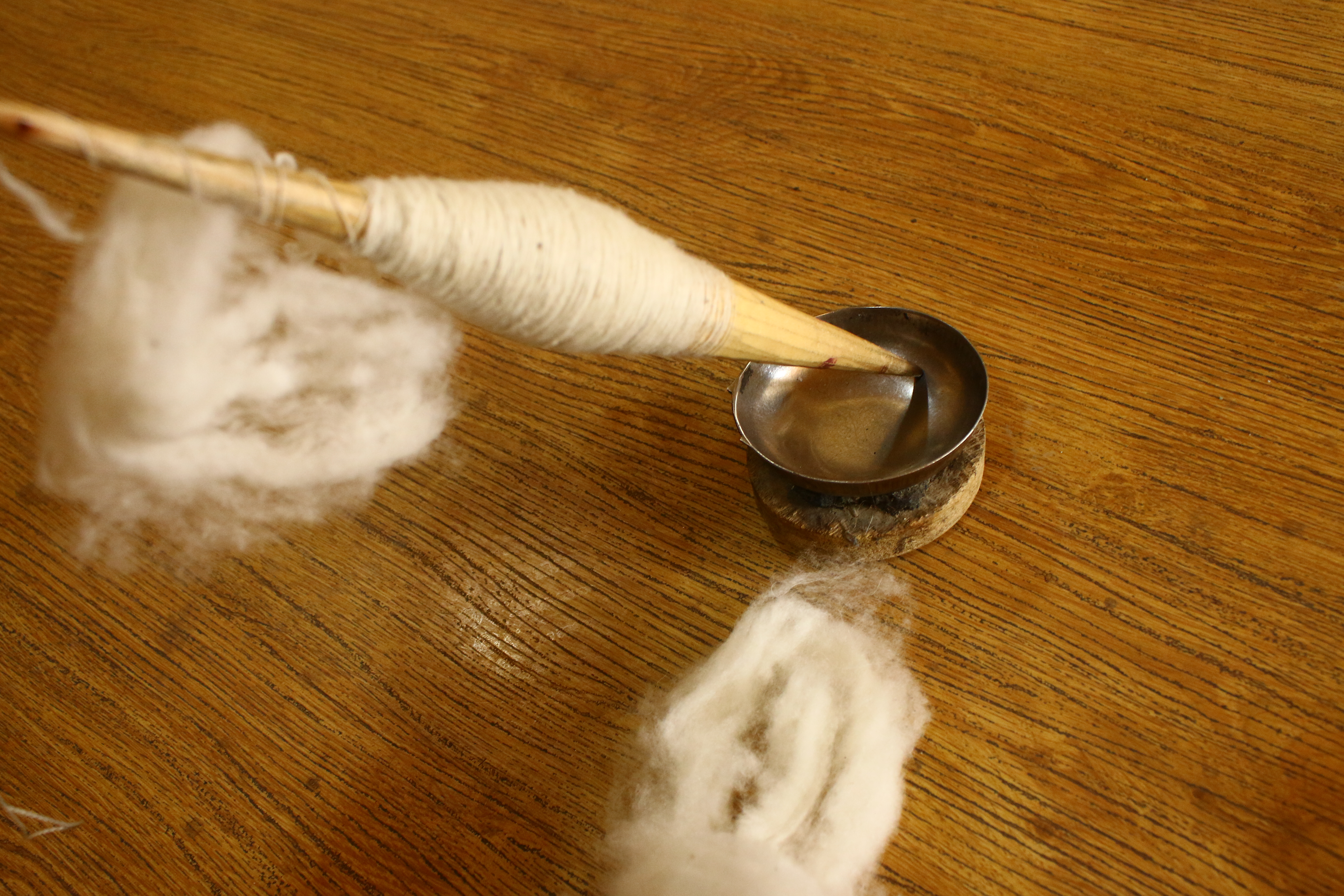
"Phang" - Traditional spindle | Photo: Rigzin Dorjee

The Art of Weaving in Lahaul’s Upper Valleys

In the higher Himalayan region, weaving is an ancient craft and forms an integral part of people’s lives. In Lahaul, weaving signifies a retreat into slower, simpler times amid icy cold weather when the farming works are at its lowest. There’s a saying in local folklore attributing weaving as visual art that reflects stories about people, their communities, and their place in the universe. It symbolizes the value of creation, interconnectedness, and rejuvenation. Weaving requires profound discipline and dexterity to untie complexities; it involves crossing two threads the warp and the weft, one vertical, and one horizontal, one stretched tight, the other intertwining the first. To produce a textile, the two threads need to be bound together otherwise, the weaving work will remain fragile. Hence in ancient Buddhist belief, a weaver is akin to a problem solver, someone who is adept at bridging silos and bringing greater connectedness.

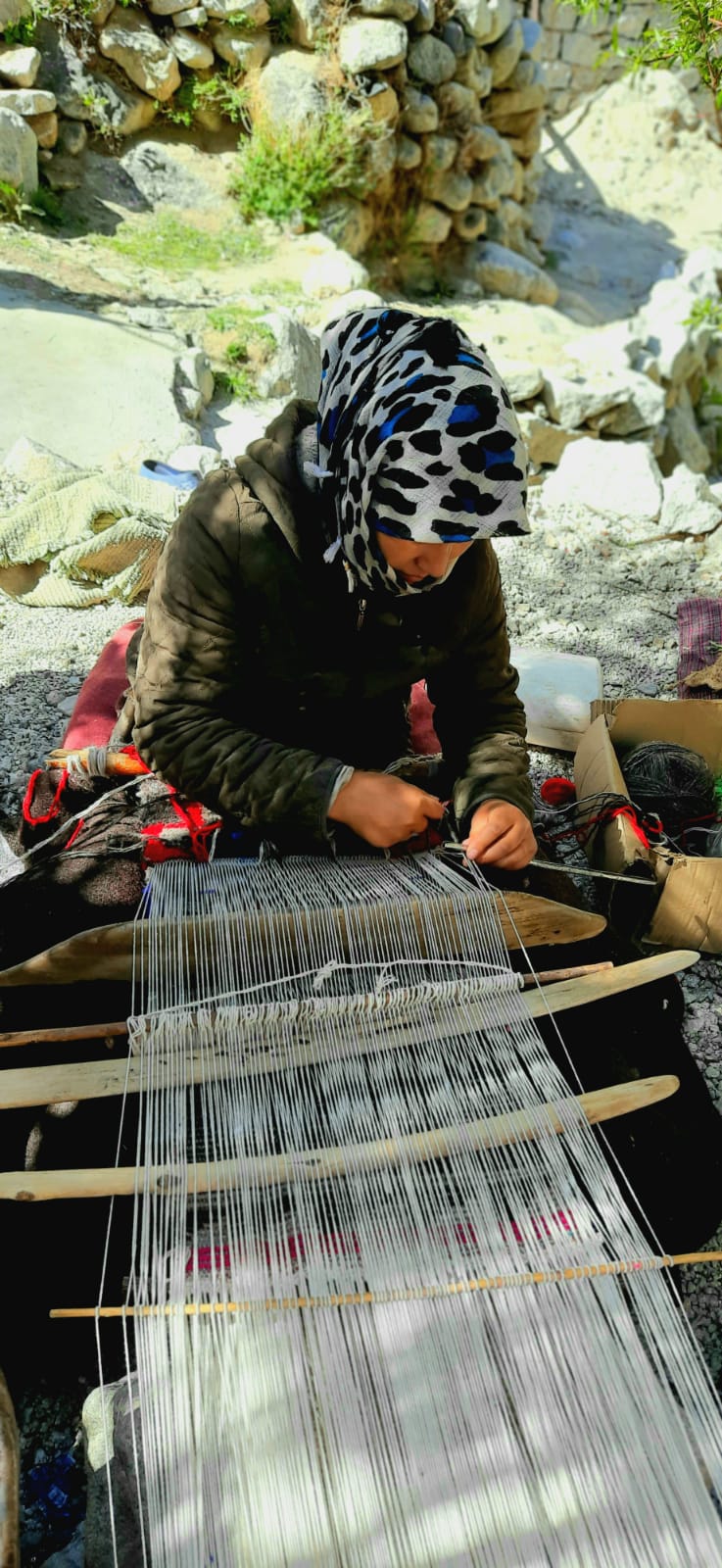
Weaving is a traditional skill that’s passed down through generations and is practiced with great vigor in our village. Of the many products that are woven, Tsug-den (Tibetan rug) weaving remains the most popular with its elegant design and high pile, plush feel. In our village, the handwoven woollen carpets are called Tsug-thu or Tuk-tuk in villages around the Darcha side in Lahaul. Tsug-dens are unique handwoven carpets, that are woven on a backstrap loom called “Khaddi”. It is an extremely slow, time-consuming process, that involves a lot of hard work as each bit of the work is done manually – from livestock herding to wool shearing to cleaning, carding, spinning, and yarn making and finally weaving, the process can stretch up to a year.

Photo: Sherab Lobzang

Most families still keep livestock and the wool is shorn around March or April month. Wool from a single sheep is sufficient to make one pair of Tsug-den. It is then sorted and cleaned to remove any impurities, and further processing of wool is done in Shamshi in Kullu valley in Himachal. We take wool gunny bags in bulk and get them carded and de-haired before we bring them back for spinning and yarn making.

Spinning is done mostly during winter and much like agriculture, it is collaborative work involving a group of women. Wood-made traditional spindles called “Phang’‘ are used for spinning and great care is taken to get consistent, smooth yarn. The base of the weaving is done with cotton threads on a metallic or wooden loom Khaddi. The handspun woollen yarns are weaved in a knotting system where one thread is interwoven with the other on a loom. Once a row of knots is complete, a rod is hammered against it to tighten the row below. A weaver uses the blueprint of a woven carpet to weave complex designs and to ensure accurate shape, size, and alignment of the carpet. Black, white and beige sheep wool is used for tsug-den while the rare white yak hair is used for Challi (woolen quilt).

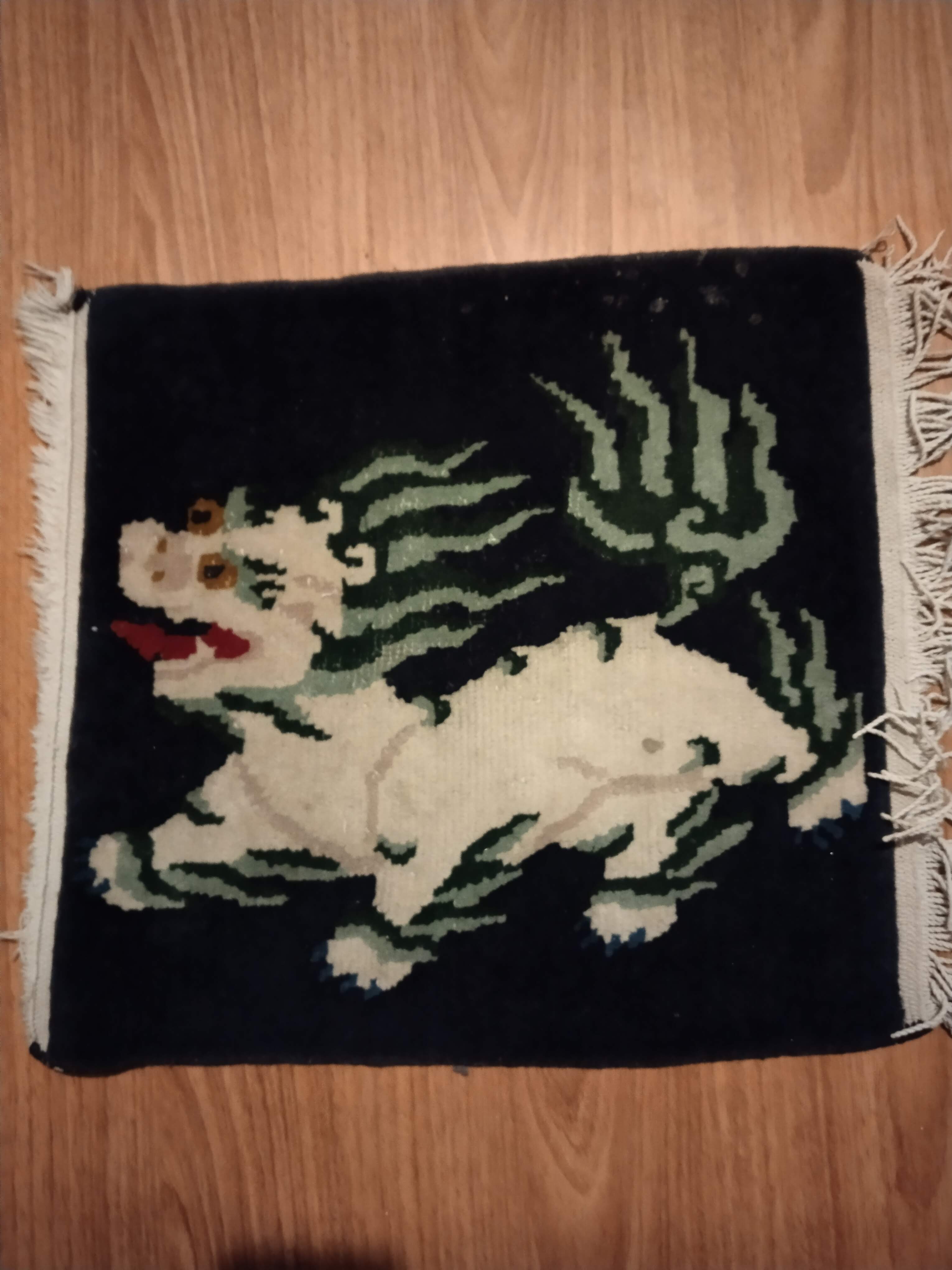
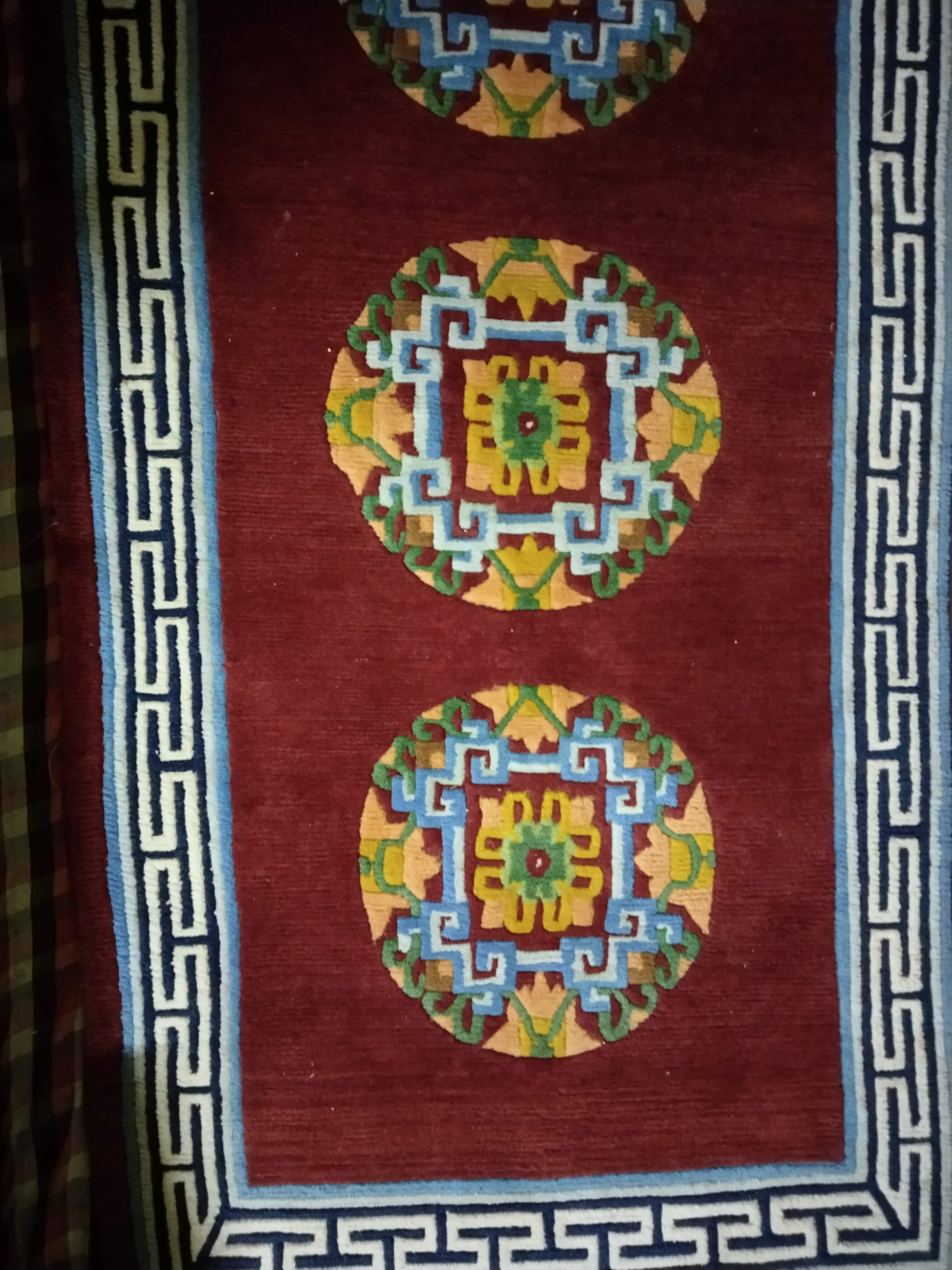
The elaborate designs and motifs on the carpet are inspired by lives in the higher mountains of Tibet and often nostalgically evoke themes of nature and the environment. Motifs of birds, flowers, and mythical animals are quite common- dandelions, native birds, Druk (sky dragon), tiger, ibex, leopards, snow lions, and yaks can be seen beautifully woven on the carpets along with motifs that have special religious, cultural significance like the mandala, four elements of nature (earth, fire, water, space), the Buddha’s vajra, Swastika and depiction of the precious stones Dzi and Gau (amulet). The motifs on the carpet are not mere designs but have larger symbolic meanings to it for eg: the depiction of the crane motif on Tsug-den symbolizes good luck, Yak motifs are reminiscent of nomadic life, dandelions, birds, and clouds depict one’s closeness to nature, the vajra is symbolic of Buddha’s enlightenment, tiger stripes symbolizes one’s prestige and wealth, while snow lion and sky dragons represent mythical creature from traditional folklore and phoenix is a sign of auspiciousness.

 “There’s a saying in local folklore attributing weaving as visual art that reflects stories about people, their communities, and their place in the universe. It symbolizes the value of creation, interconnectedness, and rejuvenation.”

Most families in Lahaul and other higher Himalayan regions own simple domestically produced Tsug-dens and it remains one of the most functional pieces of the item which comes in really handy during harsh winters. The usage of natural fiber and natural vegetable dyes also enhances the overall aesthetics of Tsug-den and it is one of the practical pieces of a garment whose luster, and sheen increases over the years with usage. One of the most appealing characteristics of the Tsug-den-making process is that it is the result of resource utilization in the most natural way. The entire carpet is handspun, hand-carded, naturally dyed, and handwoven where nothing goes waste and the final product lasts for decades, some even passed down to generations. One of the greatest wealth a woman can inherit from her parents is the traditional handwoven carpets, rugs, and quilts along with handwoven shawls. Weaving is not just a craft, it holds ample of material, and cultural value and the artwork on woven Tsug-den is symbolic of values, beliefs, and mysticism beyond our comprehension.

5472 3648 Rinchen Angmo and Chhering Gaaji
A day in the life of a young farmer
Photo: Vicky

A day in the life of a young farmer

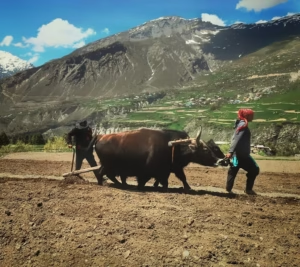
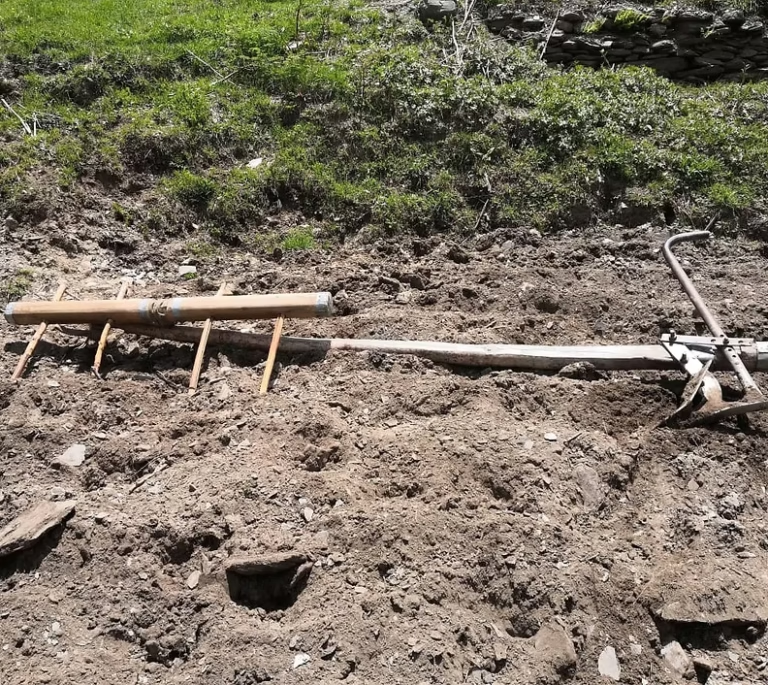
There’s an air of celebration when the agricultural season begins in my village. It is time to end the dormancy of long winter days and come out and start preparing the fields. I remember enjoying working in the fields and on the days when the fields had to be ploughed, I used to try to take leave from school on the pretext of doing some necessary work. We used to take out all the farming tools, clean it and check for any repairs. A day earlier, our bulls were also brought from another village and were prepared for ploughing. The excitement would not let me sleep and I would think of all possible excuses to take leave form school so I could and help my family in the field.

The next day, my grandfather would make a barley offering to the local deity Jogani. After the prayers everyone would take the offerings as blessings and proceed to prepare for the day. Before going to the fields, we would place flowers in the horns of the bulls. All the equipment and the bulls were then taken to the agriculture fields. I would also help out in guiding the bulls to the field which would give me immense pleasure. For traditional rituals, my mother would bring roasted barley (kha) & local alcohol (chhang) to the fields. We would then gather the bulls in teams of 2 and attach the plougher to them. After that we would offer chaang, kha and our prayers to our fields facing east (to garner the sun’s positive energy into our lives).

Photo: Vicky

My family would then begin the hardwork of ploughing the fields which would last a few days. The fields which were harder to plough, were then ploughed with the help of Shaalu – my favourite mare. Unfortunately, I would never get permission from school to take off for a full day, so after the rituals, I had to rush to the school! Lunch for the farmers was prepared in the community hall and was served every day at 12:30 pm. For the bulls, the farmer would prepare Pinniyan balls of barley dough Sattu kneaded with local alcohol Chaang. This would give them strength for the remaining day’s work. After resting for an hour after lunch the farmers would get back to work. In the evening, the farmers would have tea and local bread puri at 6, around the same time we would return from school. We would help out our parents till the sunset and then head back home. If there was any time left before it got dark, we would level out the uneven fields. The blades of the plough would be replaced by a plank of wood and the bulls would then walk the fields levelling it. To add extra weight, my sibling and I would fight to climb onto the plank. By the end we would be covered in mud. We had an amazing childhood.

Farming life has changed drastically. The new age equipment gets the job done quickly but it’s not a celebration like the old times. Earlier whole family would partake in the ploughing, sowing and harvest process, now it’s a one person job. These equipment have in some way facilitated migration as now women single-handedly manage the fields. Bulls are replaced by power tillers and are rarely seen in any village. Agriculture was not just about growing produce for sustenance, but it was a way to form connections with our land, our animals and nature. And now, I see those connections fade.

792 706 Vicky
Beyond Agriculture
Photo: Tashi Angroop

Beyond Agriculture

Agriculture has made considerable progress in Himalayan states. One of the major changes in the mountain farming system is from subsistence to commercial farming practice. There’s a curious move towards high-value cash crops and diversification of cropping patterns. With connectivity and better exposure, farmers in these landscapes are increasingly becoming more innovative. Their approach in production, managing supply chains, and marketing are aimed at higher returns from farming. The New Age farmers from High Himalayan villages are more experimental and are more focused on searching for niches -apples, cash crops, fruits, exotic vegetables, flowers. Their engagement with farming goes beyond survival and sees it as an economically lucrative option for themselves and others associated in the value chain. Stories of such individuals dismiss stereotypical myths about farming and show how it can be adopted in changing times.

Tashi Angroop from Tinno village in Lahaul (H.P) dons more than one hat. He is a farmer, passionate entrepreneur, and agri-businessman who cultivates traditional grains, experimented and scaled up the cultivation of exotic vegetables in Todh valley, and is also initiating agro-tourism in his village. He started his journey in 2007 when he got an opportunity to work with World Bank’s Project in Lahaul promoting Seabuckthorn nurseries. Further collaboration with the Department of Horticulture on Desert Development Program (DDP) deepened his experience of developing poplar tree nurseries and building seabuckthorn nurseries. With Jain Irrigation System, he extensively traveled in Himachal Pradesh covering 11 districts to understand diverse cultivation processes within the state and train locals in nursery building. He took a leap at his own venture in 2014 when he decided to take up farming as a full-time vocation. He took land on lease in his village to cultivate organic vegetables and experiment with the cultivation of exotic vegetables which is a fairly new intervention in Lahaul back then. He began by procuring 1000 potato seeds (1000 Katta) and started growing them in his field. Initially, it was just potatoes, green peas, and cauliflower.

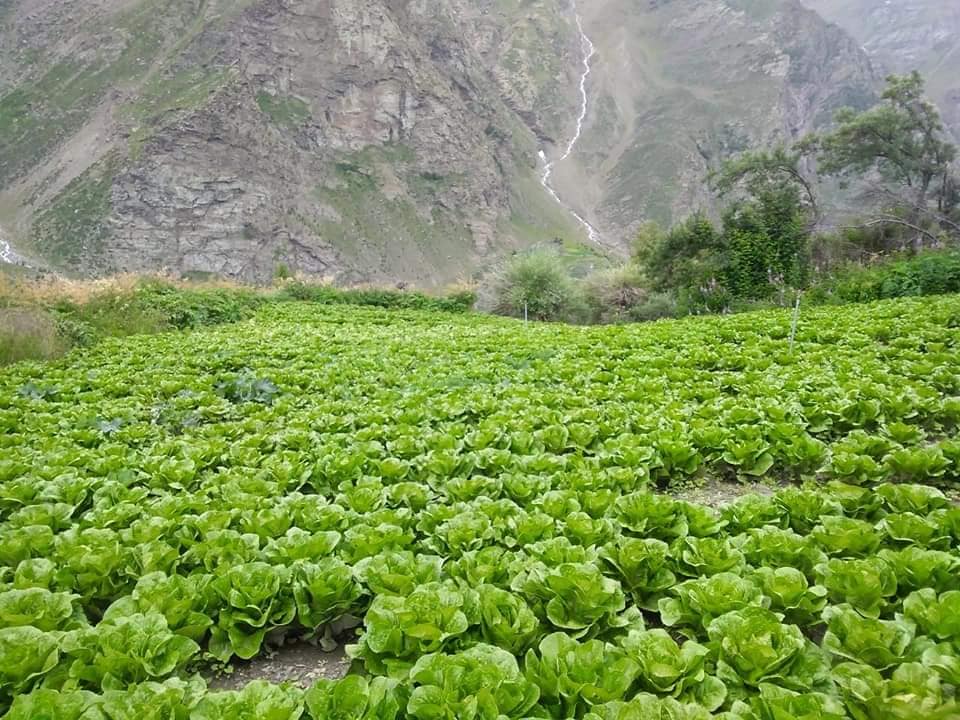
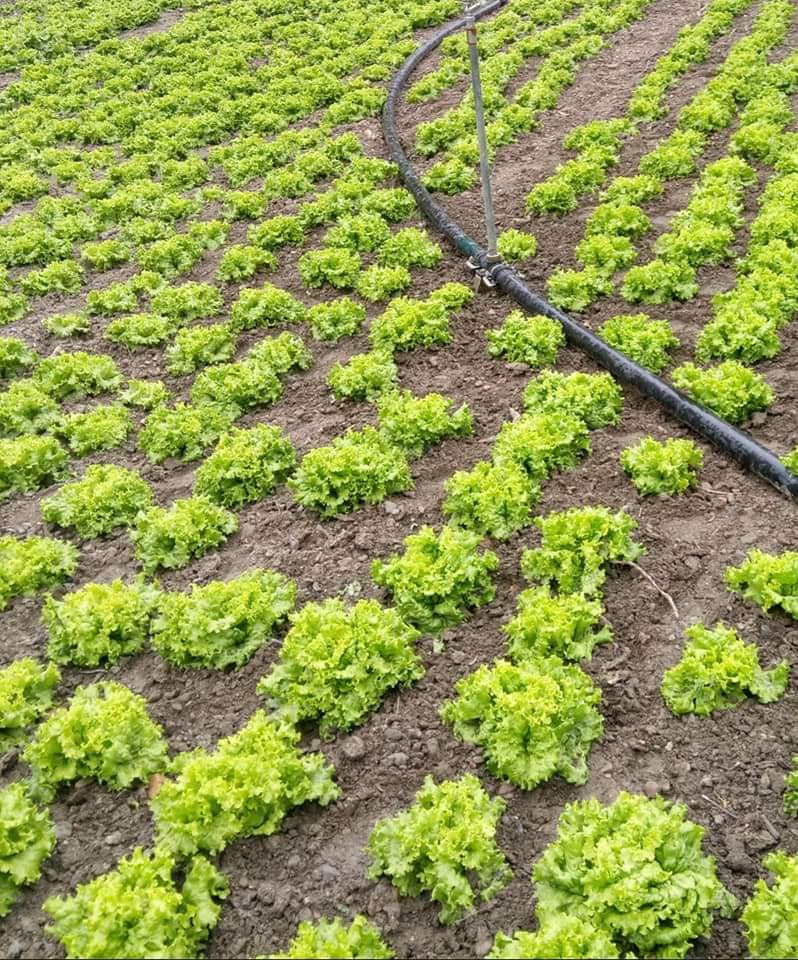
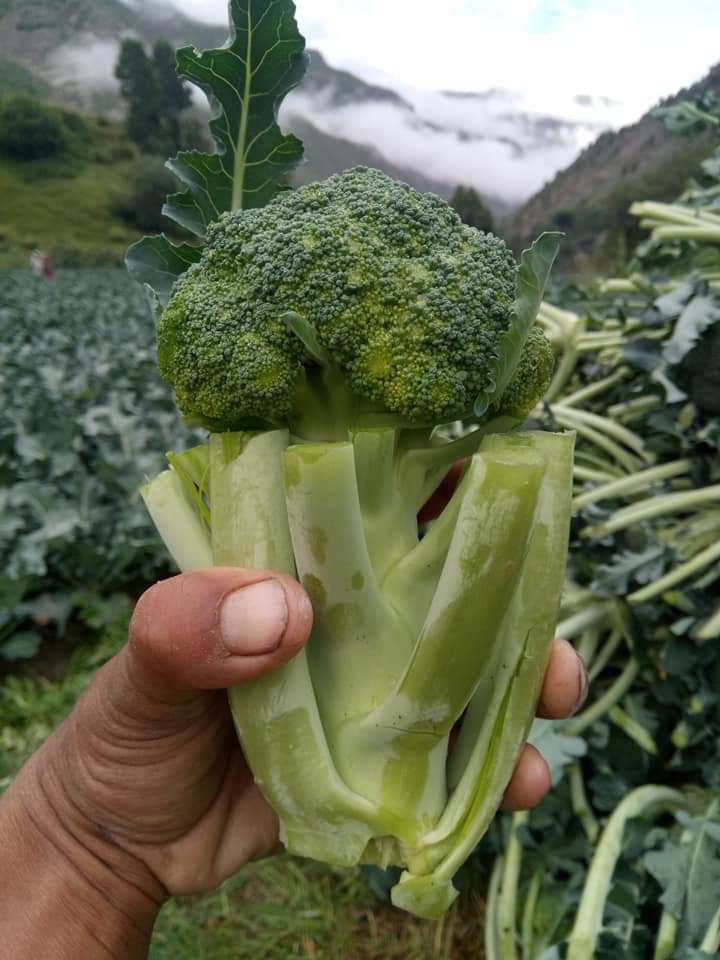
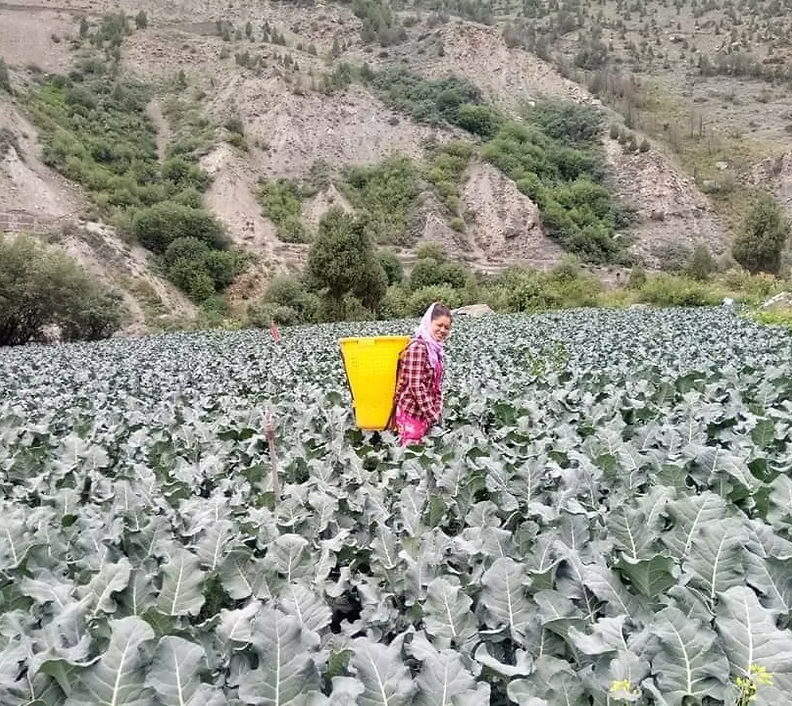
Over the years, Tashi gradually started diversifying and began cultivating more varieties of exotic vegetables and made efficient use of farming technologies and irrigation facilities. He now cultivates 19 varieties (mostly European exotic vegetables) vegetables in his field including broccoli, Iceberg lettuce, Red leaf, Yellow leaf lettuce, green leaf lettuce, Squash (Jugni), Yellow & green zucchini, celery, parsley, leek, snow peas, fennel, European carrots, red cabbages, other herbs, and exotic roots, etc. He introduced the same to many villages in Todh valley (Tinno, Gaimur, Jispa, Chika, and Sumdo) in Lahaul where farmers are now able to grow vegetables during off-seasons and sell them at a premium rate in metropolitan markets. Within his own community, he became the face of changing agricultural practices and popularized the phrase “Tel bharo, Kheti Karo” in Lahaul where he encouraged young farmers to adopt improved technologies like tillage machines and JCBs to do farming. In many instances, he even lent his own JCB and tiller machines to help people till rocky barren lands for farming.

The farming communities in Todh valley of Lahaul are now incorporating off-season vegetables along with traditional cereal crops. Different farming technologies like power tillers, tractor, power bidders, grass cutter, spray machine, sprinklers to improve the yield. Compared to Spiti the neighboring district, Lahaul receives more rain which is suitable for cultivation, potatoes, green peas, hops, cabbages, and other exotic vegetables and herbs. In fact, Lahauli potatoes are considered some of the best in the country and it is believed that these crops have brought prosperity to Lahaul.

Composting is an essential requirement to grow exotic vegetables and locals rely heavily on vermicomposting. Most Lahauli households have separate vermicompost structure at their home. Tashi himself annually prepares around 17 tonnes of compost to use it in his fields. He adds “We use jungle wastes like wild leaves, raw leaves, dry leaves, Juniper leaves, and other organic waste inlcuding manure, human waste, and Kenchua (organic manure)”. “Every household prepares compost 3-4 times in the unit and use it in their field to improve soil fertility”.

With time, locals were also able to enhance irrigation system and equip technologies which is more efficient and convenient. Earlier water resources are distributed among farming households on a rotational basis. There’s a watering turn for everyone and a farmer has to wait for about 6 days to receive his share of water to irrigate the fields. With improved irrigation systems in most Lahauli villages, the watering turns have almost disappeared. Direct pipes were connected from glacial sources to Kuccha Kuls (field canals) and every household have direct access to it. Tashi enthusiastically adds “one can finish the irrigation within 3-4 hours now! Almost unthinkable in the past.” Almost 90 percent of Lahauli villages are relying on piped or drip irrigation systems. There’s an increased use of sprinklers and rain gun watering systems.

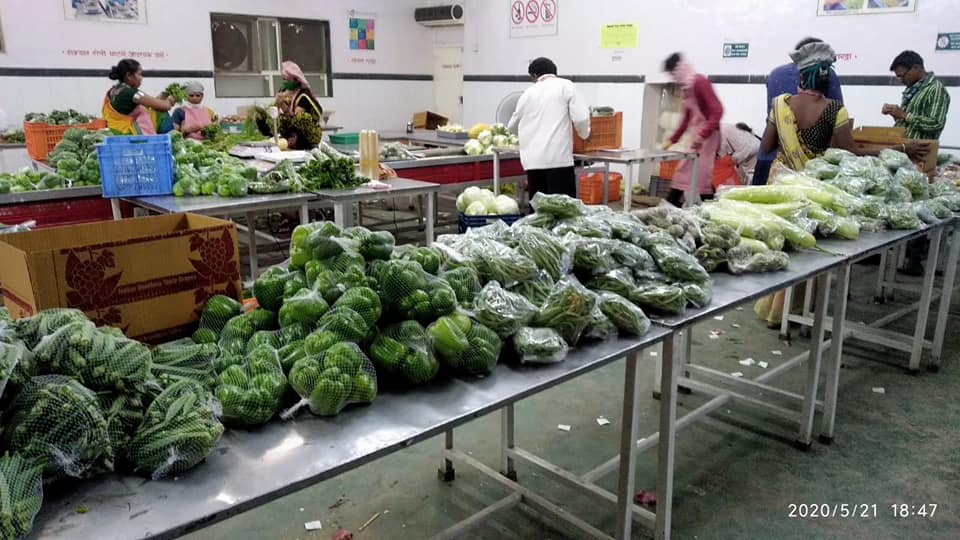
With improved road connectivity, better transportation system, and the availability of new crop inputs like hybrid seeds and organic fertilizers, the farmers in the hilly region of Lahaul are able to fetch gain higher yields and better prices. The returns from the sale of vegetables are five times higher than that of traditional crops. There’s a high demand for exotic vegetables in metropolitan cities and Lahauli cultivators are now able to sell their produce in Delhi, Chandigarh, Ahmedabad, Surat, etc. The farmers from Todh, Turat and Keylong have collectivized and formed a union of 101 farming households to provide better market exposure and greater revenues for the local producers.

Some of the initiatives include farmers market, over-the-counter payment system for the farmers, and also experimenting with the concept of “one village, one crop” where each village will focus on producing a single crop unique to their area and giving better opportunities for farm entrepreneurs. The farmer’s union will be collaborating with big hotel chains like Taj to supply them year-round vegetables.

Opening up of Atal Tunnel has also huge impact on farming in Lahaul. There’s surge in tourists flocking in the valley and farmers are keen on integrating agriculture and tourism. They have initiated farm-based enterprises like camps and homestays where tourists can take part in the sowing process, harvesting, procuring vegetables, and immerse themselves in rural agricultural life with locals during their stay. Tashi’s own farm camp in Tinno and Keylong attracts a lot of tourists. He shares that the motive is to give them first-hand experience of agriculture, self-cooking and be part of the collective experience of the landscape. Cultivators like Tashi show that there can be a more forward-looking approach for agriculture and it can harp beyond the traditional way of life. With greater solidarity, there’s positive hope for farming in high Himalayan landscapes to empower small farmers.

960 720 Tashi Angroop
Reyun Tache
Remu Painting | Jugmat Norboo (Urgos)

Reyun Tache

Reyun Tache is a festival celebrated two days before Losar in many parts of Lahaul. In my village-Urgos, the festival is marked by each household painting Remu paintings on their walls for inviting good omen and warding off evil. Paintings are made with almost a competitive spirit, with each house trying to do better than others. All the members of the house take part in this celebratory moment and contribute to the painting. Each element of the painting signifies a deeper religious sentiment, and connectedness and harmony of indigenous communities with nature. Thus, it is important for each house to ensure all elements are present on their painting.

The next day is when the fun begins. Everyone visits the homes of the others to appreciate their efforts and ensure that they have included all the necessary elements in their painting. If not, then they have to pay a fine to the village committee and carry shukpa (incense sticks) throughout the day as a penalty.

1471 1811 Jigmat Nurboo