Ladakh

Celebration of Churs-pon
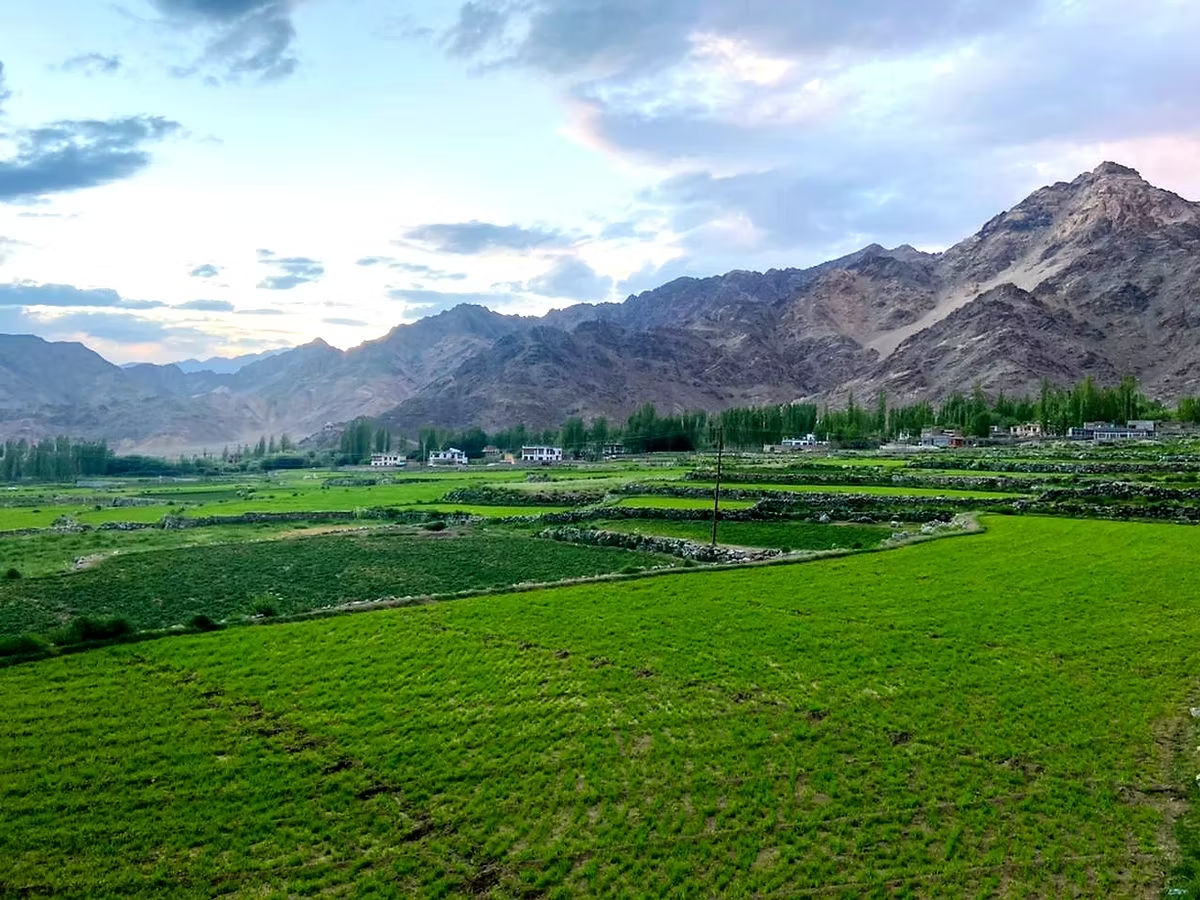
Saboo village | Photo: Dawa Dolma

Celebration of Churs-pon

I was a young girl when I first visited Saboo. It was a school picnic and the lush green beauty of Saboo mesmerised me. Having been born and brought up in Choglamsar – a suburb of Leh, filled with overcrowded concrete buildings with sparse vegetation, I assumed all villages in Ladakh to be dull, dusty and barren. So finding a green patch of land was unbelievable. My interest in Ladakh renewed in my early twenties when I first started exploring lesser known places and experiencing its unique socio-cultural practices that sustained life in the region.

Within a few kilometers outside of Leh, one can start to observe the changes in the land-use. Saboo (Sa-phuk in Tibetan), traditionally referring to an inner grassland near mountain foothills, has abundant water resources and greenery. There is relatively less influence of tourism and people still practice traditional agriculture solely dependent on Gang-chu (glacial water melt) and Chu-mig (natural springs). Due to its proximity to glacial water melt, the area supports healthy mountain grassland and diverse agricultural fields. But the main difference between Leh and Saboo is deeper than mere land use. The rural lands in Ladakh are governed by local traditional systems and customs which are truly rooted in the reality of people living there. These governance practices are highly visible in case of village resource management and are as effective as any other form of governance. Although the nearby town has grown multifold in the past few decades, nothing much has changed in Saboo, which is still a village of 500 households. One such fascinating tradition that has stood the test of time is a local custom of electing a water leader in their village. Water leader is the one who is responsible for governing water resources. In my curiosity to know more about water management, I spoke to a local farmer who shared with me the story of Churs-pon.
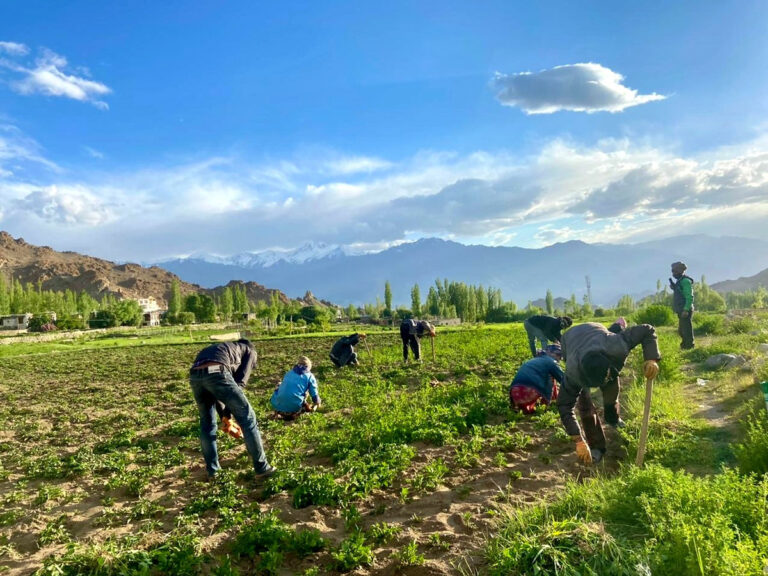
Photo: Dawa Dolma

Water is the most precious resource and the election of Churs-pon is an indispensable part of the traditional festival in this village. “Chu” means water and “pon” means leader. Churs-pon therefore is a unique water management system which ensures local governance, maintenance and distribution of water resources. Located at the high altitude, cold arid zone with a short cultivation period people have devised local systems that maximizes their resource usage with minimal conflict. Like any social institution, churs-pon enables farming communities in Saboo to judiciously use their land, water resources and enjoy greater prosperity. Churs-pon are annually appointed at the beginning of the agricultural season and Saboo being predominantly an agricultural society, the election of churs-pon is quite an important tradition in the region.

Historically, villagers unanimously elected a well respected man in the community who had rigorous knowledge of customary duties, rights and responsibilities around water management. Now, Churs-pon is appointed rotationally. The selection process differs in each village but in Saboo, the day is marked with auspicious ceremonies and prayers. Venerable lamas are consulted for an auspicious date and communal meetings are held. It is no less than any other cultural affair and locals host a festival called “sa-phak” which celebrates the selection process of churs-pon. Water being a crucial resource, there’s great excitement around it and at least one member of each family is present during the selection ceremony to ensure appointment of a competent leader. The two key Buddhist prayers “Tashi Tsekpa” and “Nangsa Nang-gey” are recited by monks to mark the auspicious start of farming work and bless the newly elected “churs-pon”for his work. The religious ceremony is particularly important for the rightful selection of the leader, who ethically follows all rules and regulations to ensure equitable distribution of water and harmony among farming communities. Communal prayers and holy tantric rituals like “tormas” (barley flour effigies) are offered to deities for agricultural productivity and to garner their spiritual support during the farming season.
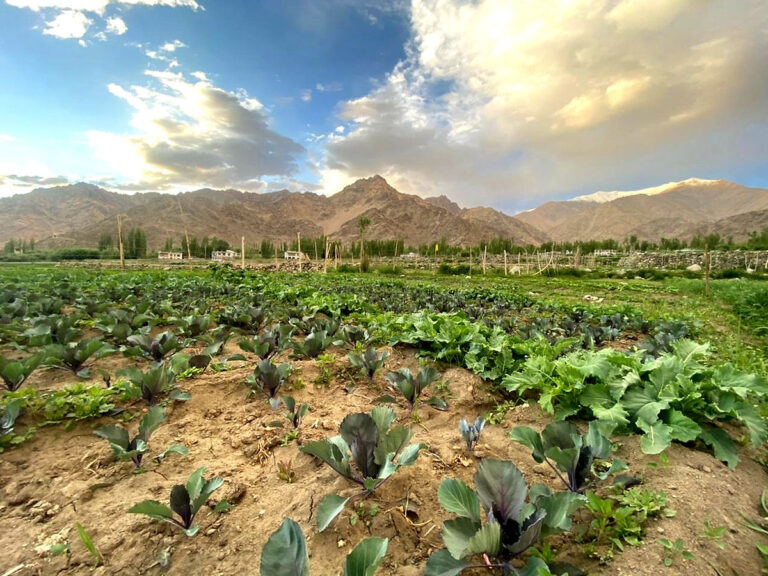
Photo: Dawa Dolma

Traditionally, high-altitude communities have self-sufficient agricultural systems and religious ceremonies are done to invoke spiritual blessings of the local deities and to harmonize people’s relation with nature. “The tasks are overwhelming and challenging – a churs-pon has to monitor the water reservoir from five in the morning till eleven at night. Therefore, the right to churs-ponship is mostly given to male members”, says Tsering Dorjay (46) who was Saboo’s churs-pon a few years back. “Earlier we used to have 2 churs-pon but these days we have 4 as there are numerous agricultural lands and we need to ensure equitable distribution to all fields. The work has become more laborious” he concludes.

The agriculture in Ladakh is governed by a short growing season during which Gang-chu (glacial meltwater) is the most important resource. All Ladakhi villages have a community water reservoir called “zing” where glacial water melt is directly collected for irrigation. The zings are connected with water canals called “yura” which feeds water to all agricultural fields. The water is distributed based on requirements of the crops. Since food and cereal crops consume more water, it is first distributed to wheat fields, followed by green pea, barley and finally to fodder crops which are more resilient. A churs-pon is responsible for managing water distribution, irrigation turns, overseeing maintenance of zing, yura, resolving water disputes and ensuring equitable distribution of water among all families of the village without any personal bias and favoritism.

Churs-ponship of Saboo village is a classic example of how a community resource like water is effectively self-governed by villagers and is codified into distinct rules and regulations that everyone follows stringently. The lives of people are dependent on such traditional systems which are orally passed to the next generation, representing a unique community-led, self-governing system. The ethics of impartiality, equity, mutual cooperation and reciprocity are built inherently into the system. However, there’s considerable decline in the tradition of churs-pon due to alternative livelihood options like tourism and younger generations growing up without any knowledge and awareness about the local agricultural system. Mohammad Akbar, a 52 year-old churs-pon of Saboo village, painfully mulls over the loss of this beautiful tradition in his village, “it is doubtful whether the youth these days will continue with the tradition and do farming. It will be a huge loss if churs-pon becomes another lost tradition in the coming few years”. Entire agricultural practices of Saboo and other villages following this practice will fall apart if there is no churs-pon system. It is an indispensable part of people’s livelihood and forms crucial part of their identity.
1200 900 Dawa Dolma
Losar : Animal’s Day

Losar : Animal’s Day

I think I am in fact the least excited and most boring person at any form of festival. Much of it could be due to my introverted genes that wouldn’t fancy gatherings, dancing, fireworks or any other things which involve interacting with strangers, but part of it must be because of my upbringing. I am not sure of both though. But my heart just cannot seem to invite festivity as much as my friends and family do.

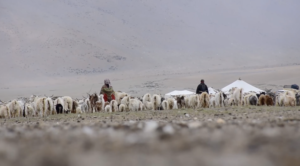
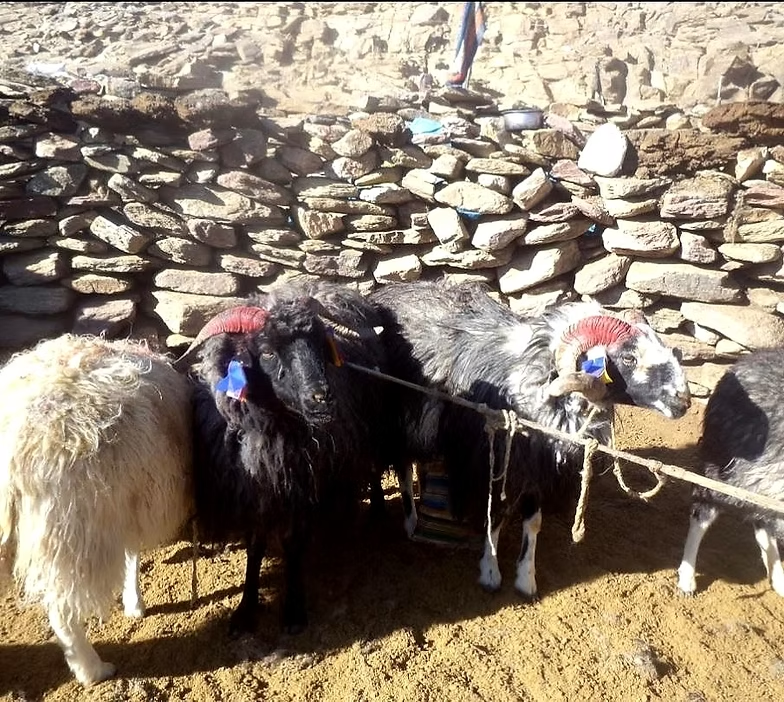
I hail from a small nomadic village in Ladakh where the livelihood of everyone is dependent on livestock. Almost every household owns some goats, sheep, horses and yak. These animals aren’t merely our source of income, but are used for obtaining food, fetching water, traveling, and most importantly seeking comforts and friendship. Since our life revolves around rearing these animals and more importantly enduring the harsh reality of having no access to electricity, water and worse not even a single shop in the vicinity throughout the year, we have little time for festivity. Or, many of us are even oblivious of its existence, except for Losar– the Tibetan new year and Thrungkar Duechen – His Holiness The Dalai Lama’s birthday. Hence, every single person in the village looks forward to these two days like a child, although for different reasons.

Photo: Namgyal Lhamo

My fondest memories of Losar and Thrungkar were significantly boring compared to my cousins. But these days, no matter how many festivals I witness as I travel through urban life, there is nothing more meaningful and beautiful than this idea of celebration I got to see early in my life. It was on one of the third days of Losar. My father came to me, patted my head gently and said with a smile “Life of your polled lamb will be set free”. I was elated beyond words and this memory has remained in my heart so vividly. In my village, on the third day of Losar or Thrungkar, fathers of the households are the busiest. They get up early in the morning to appease the Land God and other deities who are believed to be the true owners of our land according to their ancestors. This is followed by their brief journey to the animal shed where they would choose some animals randomly and set their life free. By that, we are not allowed to send them to slaughter houses, milk them and are expected to watch them with unconditional love and care which every animal receives anyway, until they die. It was my most awaited moment of the festival. My siblings and I would always hug our father with utter joy after he would come out of the shed. This act is mostly done to honor and thank the sacrifices of animals for our livelihoods while it is also performed for the health and long life of His Holiness and carry his message of love, kindness and compassion towards animals.

We eventually shifted to a town nearby, leaving the whole nomadic life behind due to the inability of my family to see the animals suffer for our survival. But, as I look back, I realised that it was this place where I gave birth to my love for animals. Today, even if we live a totally different life, my parents make sure to celebrate these two days by setting at least one animal’s life free. There is nothing more rewarding at a festival for me than this act of genuine kindness. Somehow I think of these two days as a festival of animals and I hope to carry this tradition forward in my own life too.

792 706 Namgyal Lhamo
Art From Our Valleys
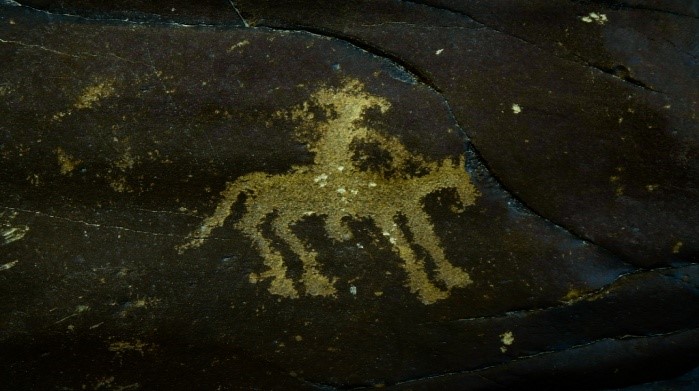
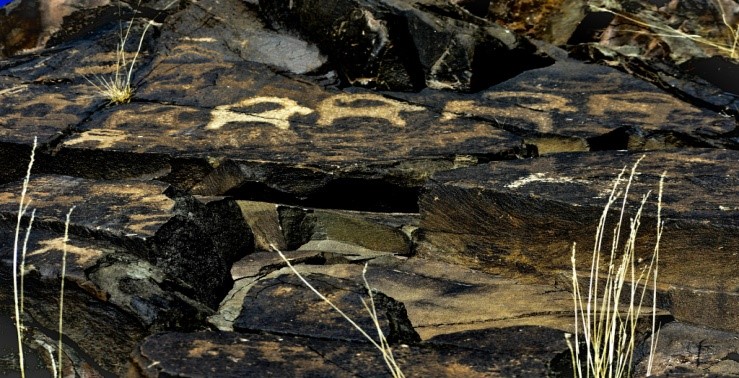
"Huntsman" rock-art, Gya-Miru | Photo: Sherab Lobzang

Art From Our Valleys

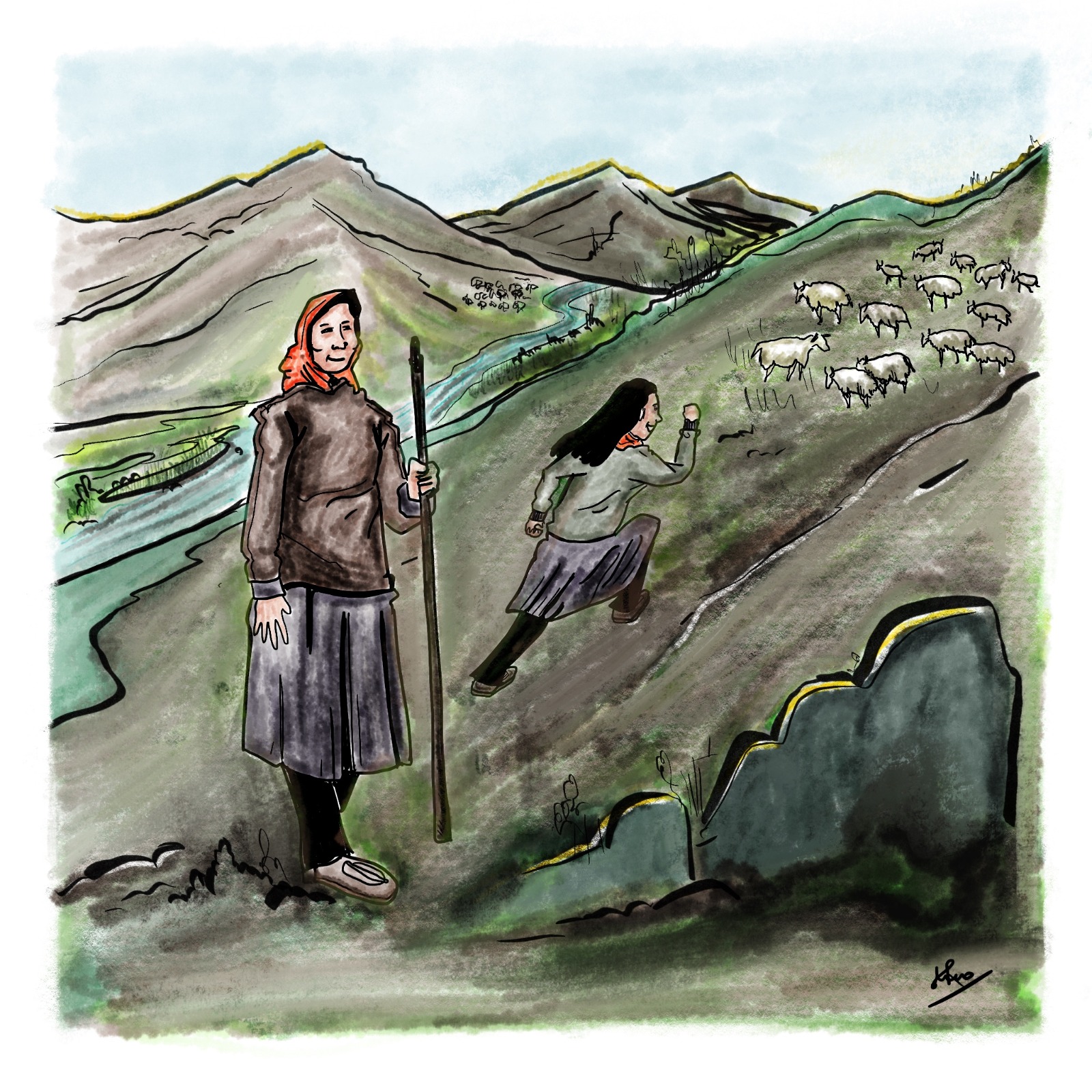
Life in the mountains is tough. In addition to physical fitness, it demands a great deal of mental fortitude. This is particularly true among our elders, especially when you hear them speak about their younger days. Stories of how they managed to survive the long winter months tending to their livestock are hard to believe for our generation. Animals reserve a special place in our lives, and they too are often as spirited as hardy mountain people. Growing up in Ladakh, animals were an integral part of my life too: sheep, goat, donkey, horses, and yak. And then there are the wild animals that were seen rarely, but often encountered when they preyed on livestock. Growing up in the village of Kumdok close to the Changthang region of Ladakh, I enjoyed exploring the mountains as a young kid. I still remember joining my mother to graze the village livestock in the pastures around our village. Each family took turns to fulfill this task. During that time my mother would show me wild animals that were seen in the pastures around our village. We had to keep our livestock safe from hungry carnivores.

Illustration: Rohit Rao

I was fascinated by the outdoors and I still cherish those times spent exploring the pastures. I particularly remember the day I first encountered some very interesting art on some of the rocks in these pastures. As a 13-year old then, I wondered who had drawn them. I asked my mother and she told me that these were made many, many years ago. Probably even before our great, great grandparent’s time. This was from a time when there were no notebooks, pencils, and even schools which is why they may have etched them on the rock.

A few years later, I left the village for higher studies. Returning home each year, I noticed that the number of livestock in my village was reducing. Some years back everyone gave up herding sheep and goat. After completing my education, I began to work in wildlife conservation. My work took me to many places across Ladakh. I interacted with locals of every generation. I also worked closely with researchers who were trying to study nature and the relation that we Ladakhi share with them. That often took me back to rock art that my mother had shown me. Our ancestors may have shared a special relation with nature and animals, as was depicted in the art. This got me even more interested in rock art which is both rare and special. In the last few years, I have encountered rock art in the most unlikely places. I make sure to take a picture, each time I find new art. I often find myself thinking about what our forefathers were trying to tell us through the art. I would like to share some of these pictures and my thoughts with you.

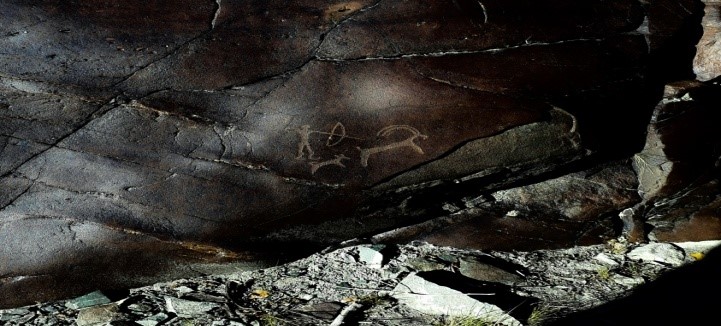
"Hunter" rock-art, Ulley | Photo: Sherab Lobzang

Ulley Tokpo is a village in the western part of Ladakh. Walking along the banks of the Indus River, I stumbled upon this curious rock art. The image shows a hunter pointing a bow at an animal with long curved horns, while a guard dog watches on. Did our forefathers hunt for food? Maybe they did not rear animals like sheep and goat then. Why else would they hunt? When did they start rearing livestock and when did we stop hunting? Thanks to livestock rearing we could stop hunting. But while hunting has stopped, archery remains a very popular sport and a cultural event that we participate in every winter. This is a common practice across many mountain communities in the Himalayas.

I recorded this rock art image of a horseman between the villages of Miru and Gya on the highway that connects Leh to Manali. One of my senior colleagues had shown me this image. If you drive past this area today, you will not find this horseman anymore. Unfortunately, a large part of the rock formation that carried this rock art was destroyed during road construction. But this image is a reminder of the role that horses might have played in the lives of our forefathers.

Horses were the most efficient form of transport, be that for hunting or even later for trade and exchange of produce through barter. The significance of horses has diminished with the arrival of vehicles. However, they still reserve an important cultural role in our communities. Horse racing is active in some parts during Losar, the New Year celebrated on the first day of the lunisolar Tibetan calendar. Another sport that was played earlier was Ta Polo, Ta meaning horse, and Polo meaning ball. Could this have been a primitive form of the sport of polo? I often wonder where our forefathers might have learned it from.

"Horseman and Yak" rock-art | Photo: Sherab Lobzang

I once encountered this fascinating image of what looked like horsemen pursuing a large animal. I wondered if these were yak. When I spoke with some elders in my village, they mentioned that indeed they were: they were wild yak! Dong, as they are referred to locally, haven’t been seen in a very long time. The domestic yak is believed to have been reared from the wild yak. Our elders explained that dong is much larger than the domestic ones we rear. Today, it is reported from a small part in Changchenmo which is largely unexplored. I wonder if there are other animals like the dong that once occupied these rangelands.

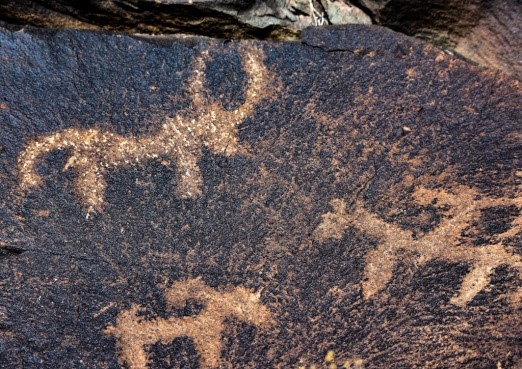
At the mouth of Phuyul valley near the village of Miru, I observed some very interesting rock art while carrying out surveys. This included images of wild animals, stupas which are religious structures in Buddhism, and script which was hard to identify. Some of these etchings look like ibex based on the longhorns they display. I find that particularly interesting because ibex was not found in these areas during our surveys in the past three years. Could the rock art be suggesting that these valleys were home to ibex in prehistoric times? It is hard to say. These are just a few of the images I have found so far. Many more remain undiscovered and I hope to keep finding them and sharing their stories, as I do now. While I have been fortunate to stumble upon these ancient relics that are part of our heritage, I am concerned about the number of these relics we may be losing out of ignorance. Rock art, which may date back several thousand years, are messages to us from our ancestors. They deserve attention and care. If we were to lose them, we might lose an important part of our past heritage.

"Ibex" rock-art | Photo: Sherab Lobzang

This holds true not just for Ladakh, but for all areas where rock art of this kind tells a story of the past. It is up to us to rediscover them and celebrate the wonderful stories they tell. These stories told by our ancestors.

699 391 Sherab Lobzang
Shangdong to Stupa

Shangdong to Stupa

A short video in Ladakhi explaining the Shangdong to Stupa initiative. Shot by Nomadic Brothers and edited by Munmun Dhalaria. (Includes English subtitles)

2560 1417 Nomadic Brothers