Kinnaur

Narkasang: Kinnaur’s Sacred Blooms

Illustration: Nawang Tankhe

Narkasang: Kinnaur’s Sacred Blooms

Illustration: Nawang Tankhe

Kinnaur, a district in Himachal Pradesh, is a paradise characterized by its lofty mountains and lush valleys where flowers of all kind bloom. It’s unique climate, with moderate summers and cold winters, creates an ideal habitat for a plethora of floral wonders. Spring is marked by captivating blooms that grace its landscapes, flowers that are a part of local culture and ecosystem.

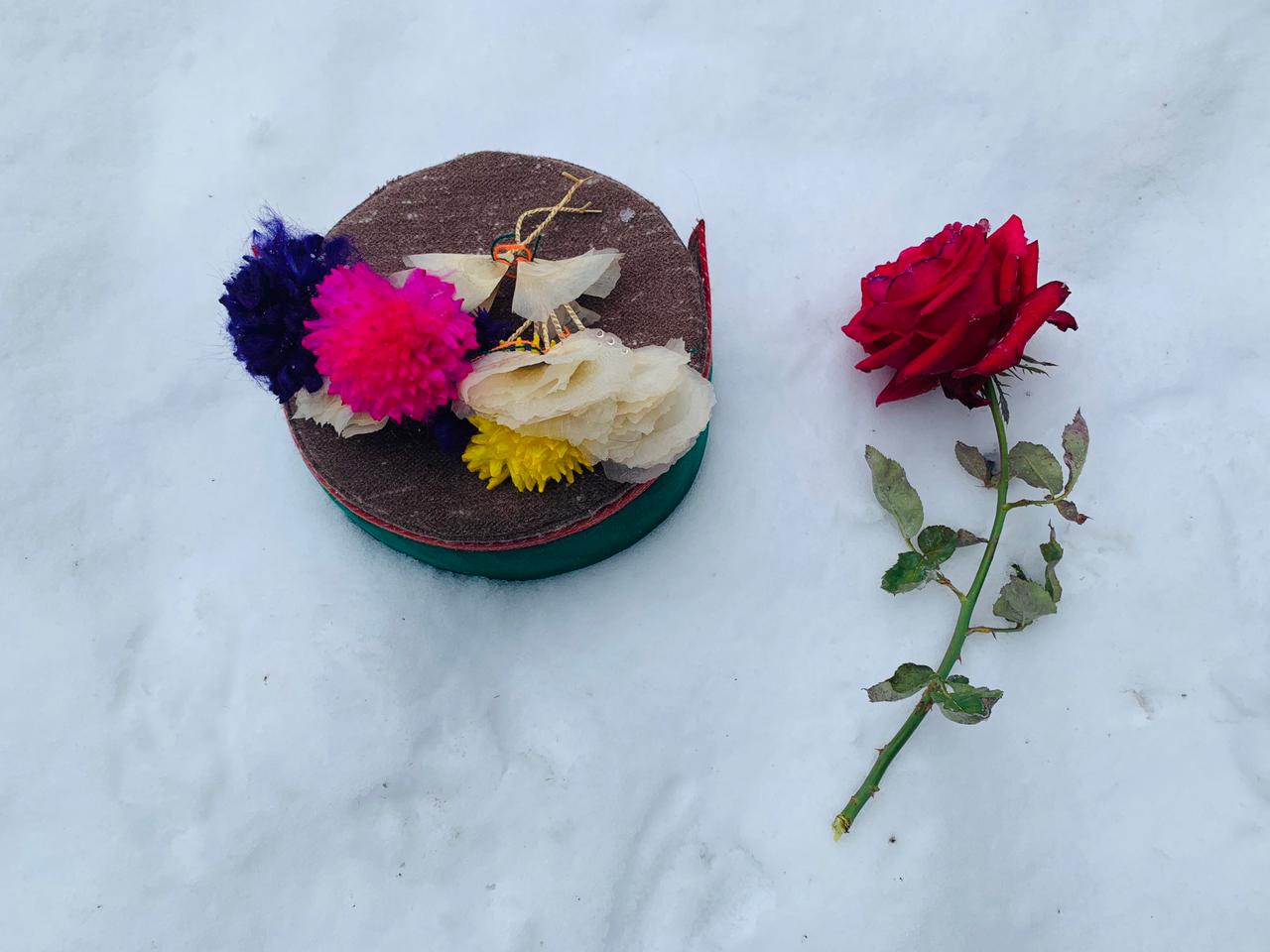
Narkasang (Narcissus tazetta or daffodils), a sacred flower, holds a special place in my heart. During my early years, I vividly remember the first time I saw the Narkasang flower in our Chokesten, our place of worship. I found it to be very beautiful and I asked my grandmother from where she got them. She showed me the wild flowers growing on our farm, saying that they grew on their own. She used to collect these flowers from the wild and keep them in the Chokesten. In Kinnaur, where people follow a mix of Buddhism and Shu culture, Narkasang flowers are offered to the local deity during festive celebrations.

Narkasang has always caught my attention because of its aesthetic appeal, with its simple colour combination of white and yellow. During festivals we often found them in the hands of the Kinnaura people. They also wore them on their traditional Kinnauri caps during festive celebrations, which clearly showed the significance of Narkasang for the community.

For years, Narkasang flowers have been an integral part of Kinnaura culture. Its medicinal properties, where the roots are crushed and used as an antiseptic lotion, have always fascinated me. Applying the extracted paste on boils or pimples on the body helps in their recovery. The discovery of this medicinal use might be lost in history, but this knowledge has been actively passed down through generations.

Kinnauri Topi (hat) with Narkasang Flowers | Illustration: Nawang Tankhe

Narkasang not only holds its value as a flower or medicine but is also mentioned in local songs:

Ladakhi

Seela Chu Nathpa nagas santango
Kinnauri-Nagasu santangcho thang kochang khyama.
Thang kochang khyalima oo bagicho kumo’
oo bagicho kulimo nish dalang Fula.
Nish dalang Fulula narkasang Fula

English

Behind the temple,
there is a garden full of flowers
In that garden full of flowers,
there are two branches of flowers
And the two branches of flowers are that of Narkasang flowers

With time, will our traditional knowledge fade away, presenting a challenge to keep such knowledge alive? Narkasang flowers are hardly seen growing on their own in the wild nowadays.

Documentation and conservation of such knowledge is crucial in Kinnaur. We are working with schools to run programs that provide basic information to students about the importance of nature conservation.
1545 2000 Mahesh Negi
Blending Traditional Values with Contemporary Design
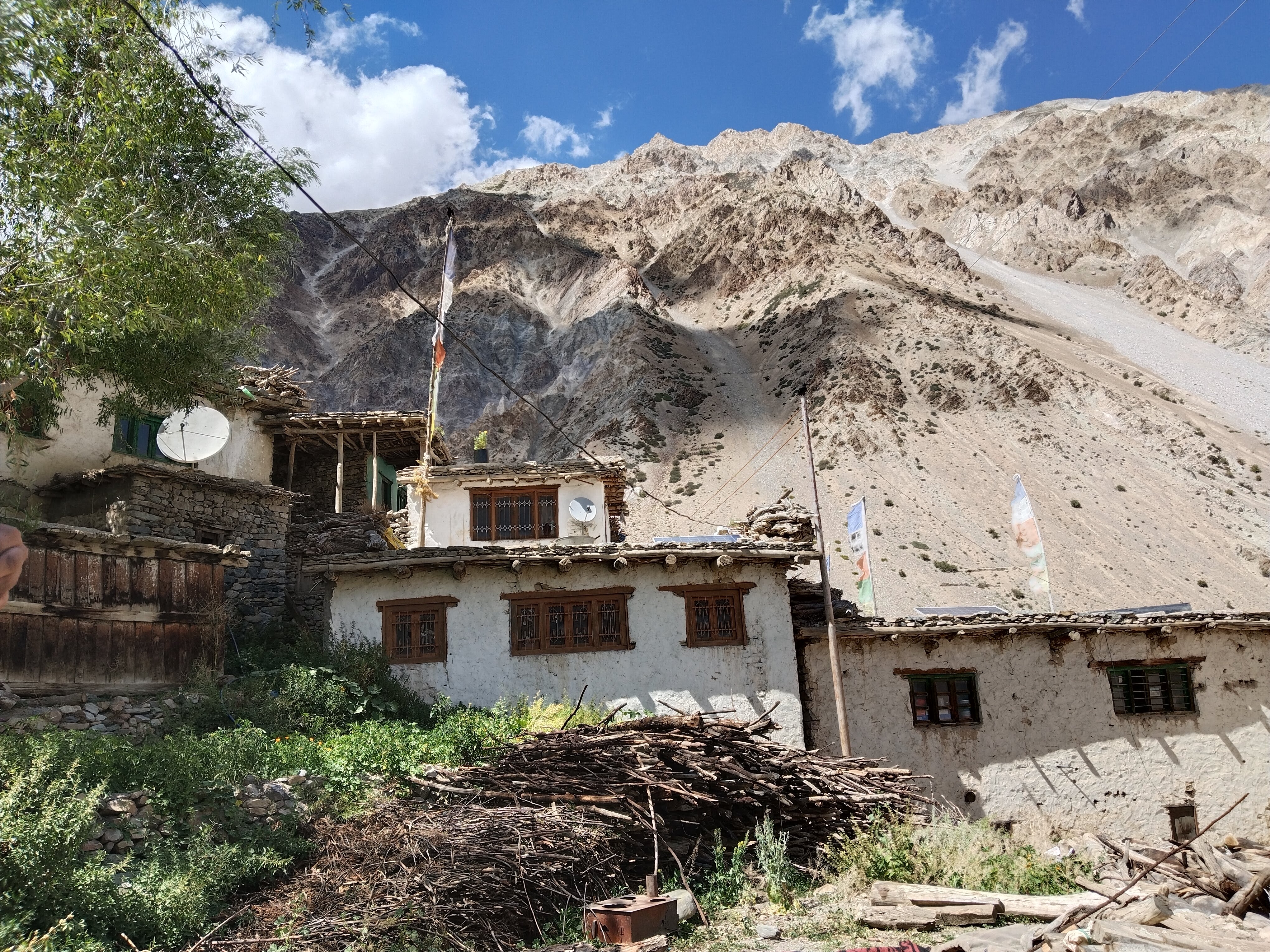
Traditional mud houses in Hangrang valley, Kinnaur  | Photo: Chemi Lhamo

Blending Traditional Values with Contemporary Design

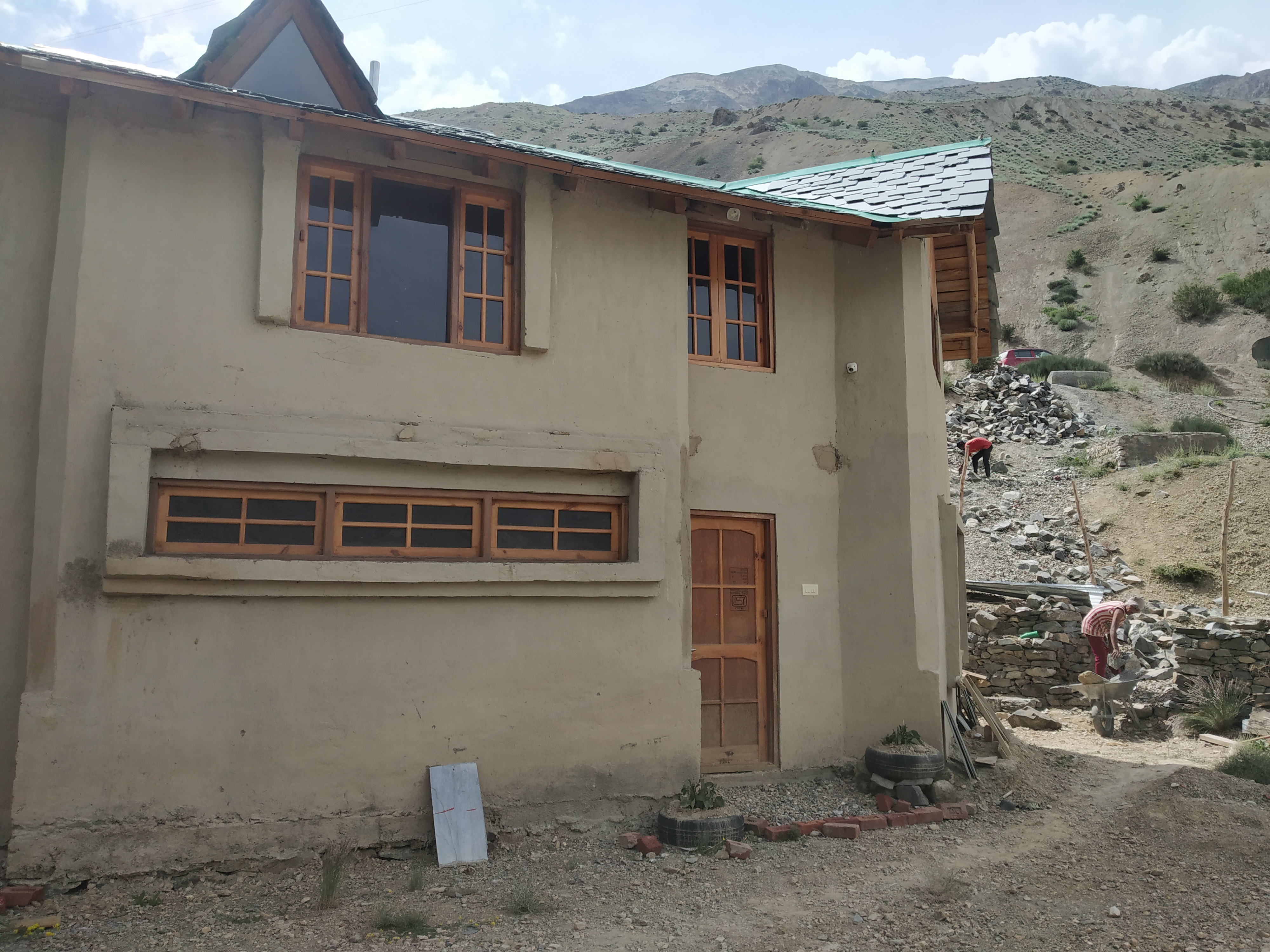
Houses are intrinsically tied to the cultural landscape of the region and in the olden times in Kinnaur, great value is placed on the following traditional uniformity in house designs. A stark resemblance between houses built in the valley and the overall architectural homogeneity creates a strong sense of belonging among community members. Kinnaur district in Himachal is known for its woodworking heritage and detailed ornamentation of traditional homes. Usage of Himalayan cedar tree is popular for building homes due to its termite resistant properties and it’s ability to accept meticulous carvings on the surface but very few of these structures exist today. In the lower Kinnaur villages like Kalpa, Sanghla, Pooh, and Baba Nagar, the Kath-Kuni technique that uses a combination of wood and stone is traditionally practiced while in the upper Kinnaur side covering Hangrang valley, building with mud – adobe, and rammed earth is more prominent.

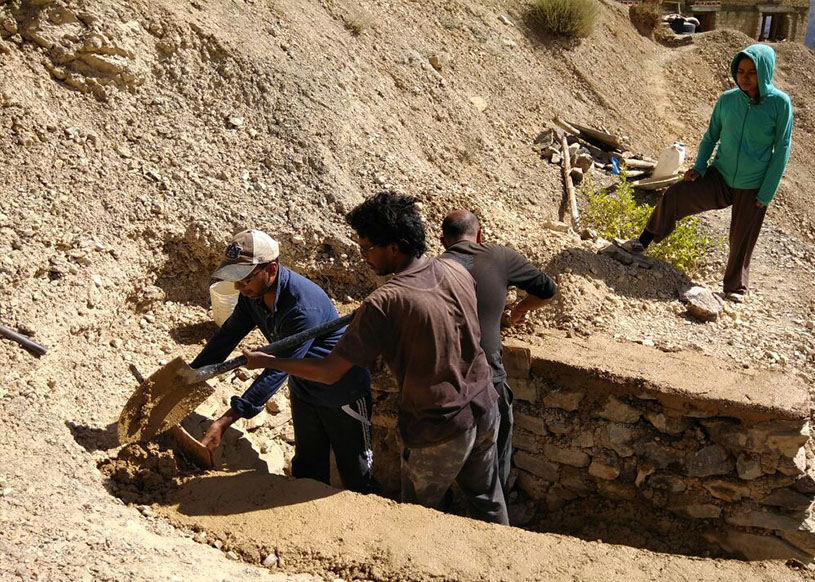
Construction Phase | Photo: Gopal Negi

Many changes are taking place in Kinnaur and growing access to the market, connectivity is certainly impacting how we build houses these days and RCC-based buildings are becoming more wide-spread. When I decided to build my house in Hango a few years back, I was very conscious of building it in a way that amalgamates traditional wisdom, and vernacular designing techniques with a modern sensibility. The traditional construction methods are easy, economical, ecologically sensitive, provides cultural utility and thermal functionality and I was determined to preserve that essence. Any changes in these designs should aim for aesthetic needs, comfort, and suitability to modern-day needs at the lowest possible ecological cost.

The primary material used for the construction was stone, adobe bricks, and wood, and special focus was placed on the building structure given the hilly terrain of the village to ensure it takes into consideration the geographical peculiarities and is climate-responsive. Building with adobe is an ancient, low-cost technique that mixes clay, and sand with organic materials like husk, and sawdust. Adobe bricks are mud bricks that are sun-dried and take about a month to dry and are more durable than kiln-fired mud bricks. The advantages of these bricks are that they are fireproof, biodegradable, and also are great at insulation, which is an important factor when building in a place like Hango. These bricks are allowed to shrink beforehand which also ensures a strong structure. Building with adobe is easier and faster than the rammed earth technique, once sufficient stock of adobe bricks is made, wall construction progresses quickly.

Gopal ji's mud house | Photo: Deepshikha Sharma

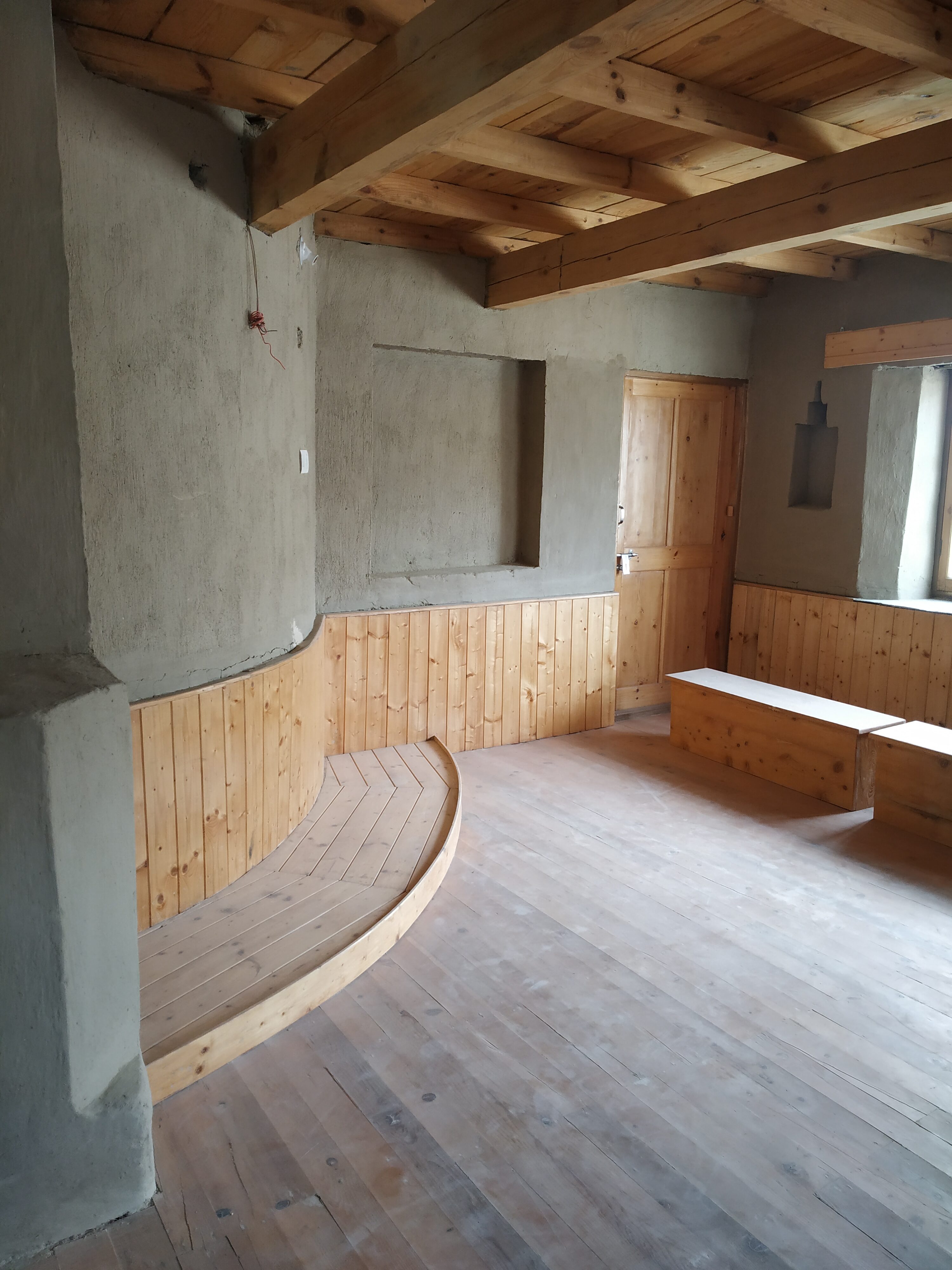
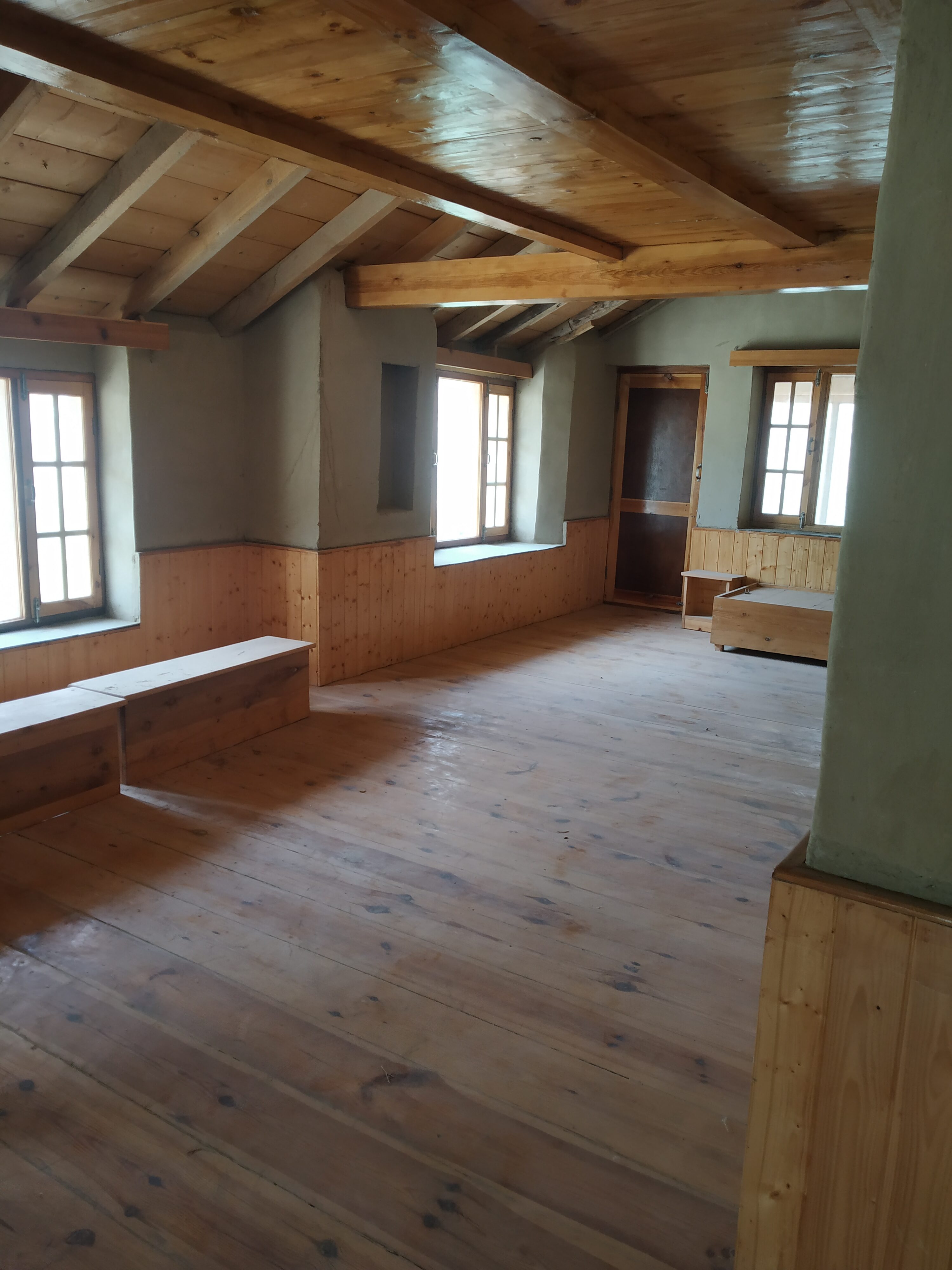
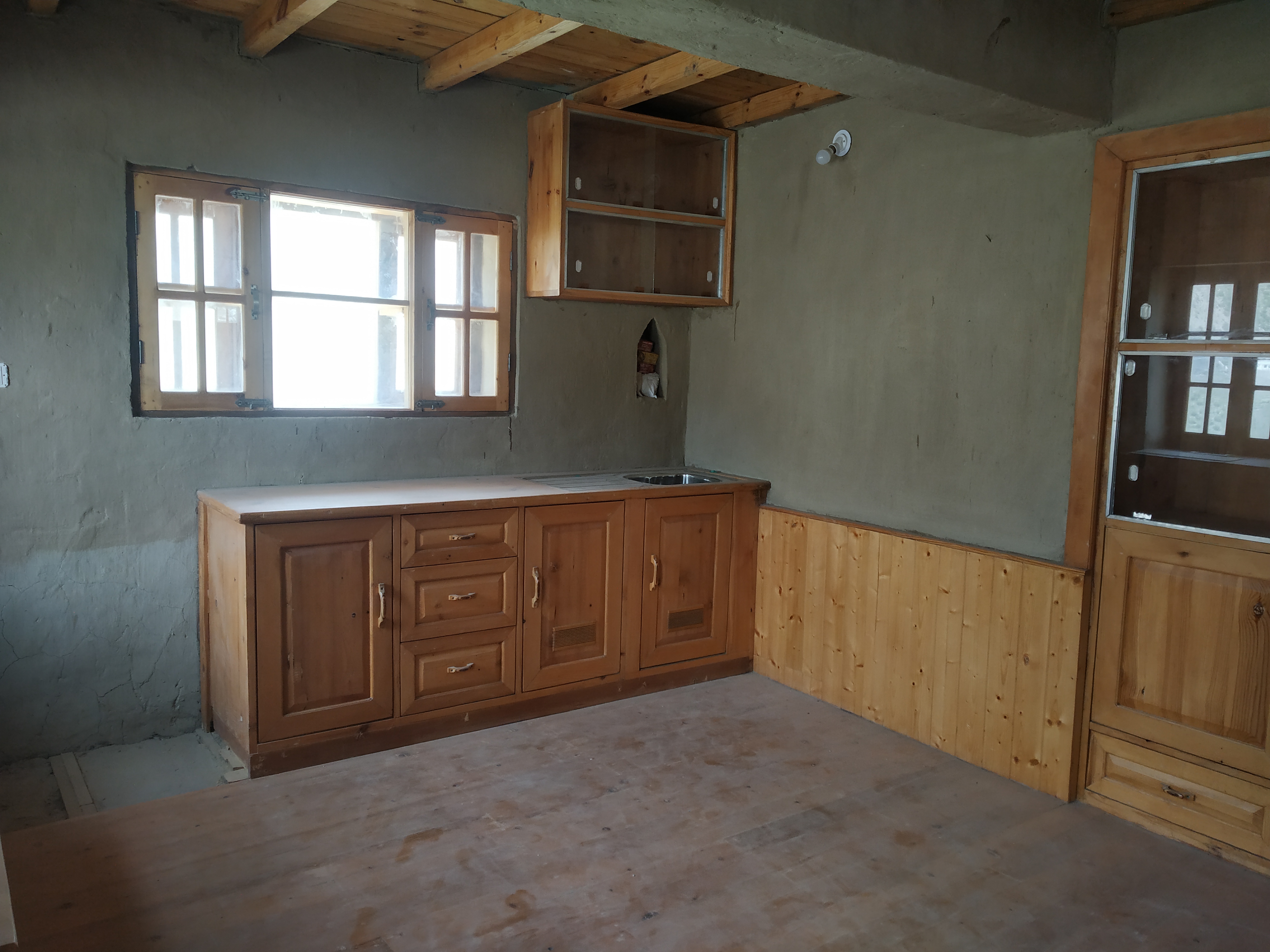
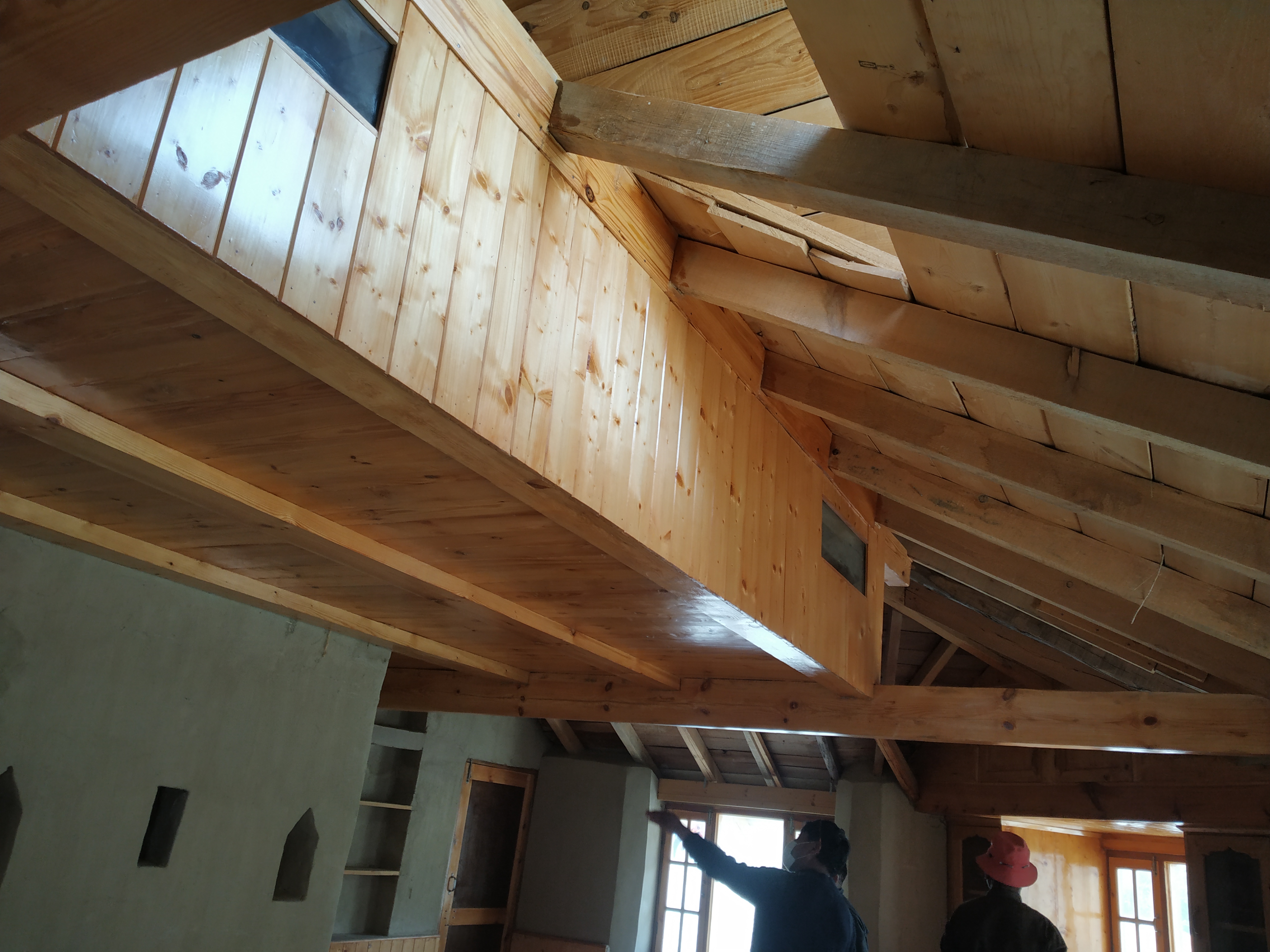
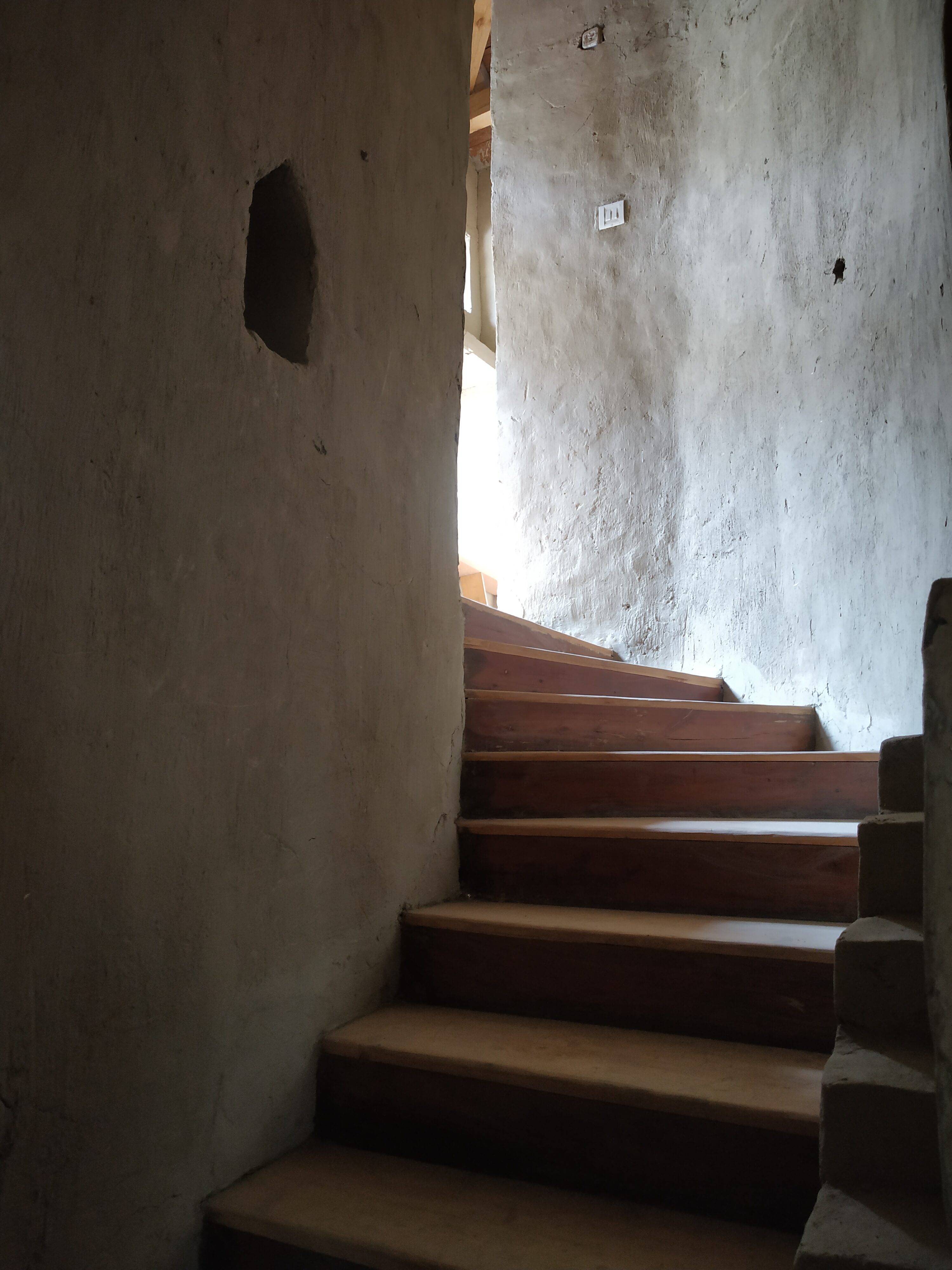
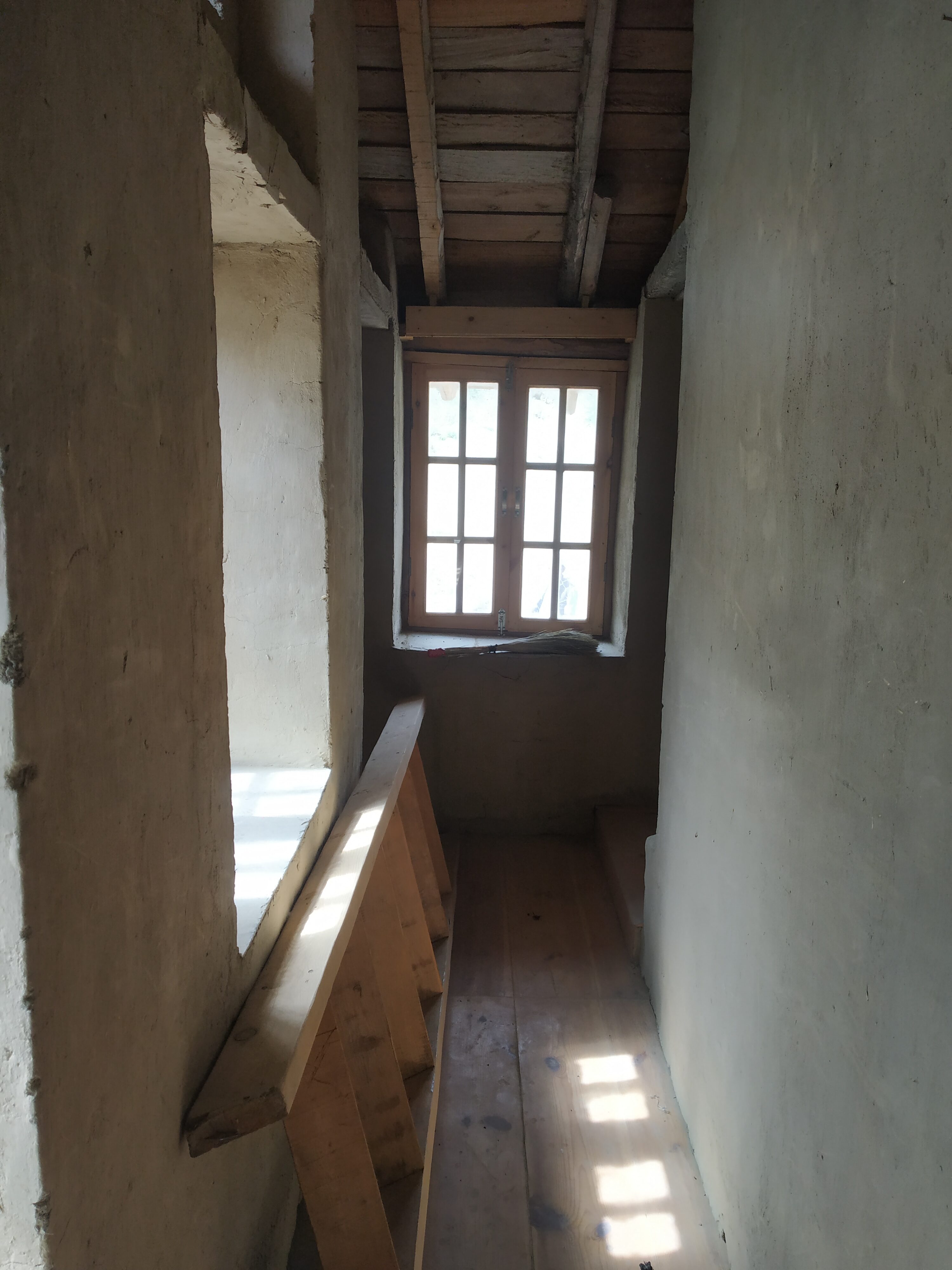
Stone layering is done for the foundation as it is moisture-resistant and helps preserve the structure from deteriorating over time. Adobe walls are load-bearing and thick hence there was no need for load-bearing beams. For the flooring, pine woods were brought from Solan and Chandigarh as the availability of local woods has shrunk and pine was a more cost-friendly option as compared to deodar. I was determined to ensure maximum usage of natural materials and hence the use of cement, iron, plywood, or other popular industrial materials was avoided. The house is built in the traditional Kinnauri style with multiple spaces to store fodder and firewood. Big, well-framed windows are installed to allow maximum sunlight, and double doors to retain the heat inside. The kitchen and living room are on the ground floor and are structurally joined like the traditional mud houses in Kinnaur.

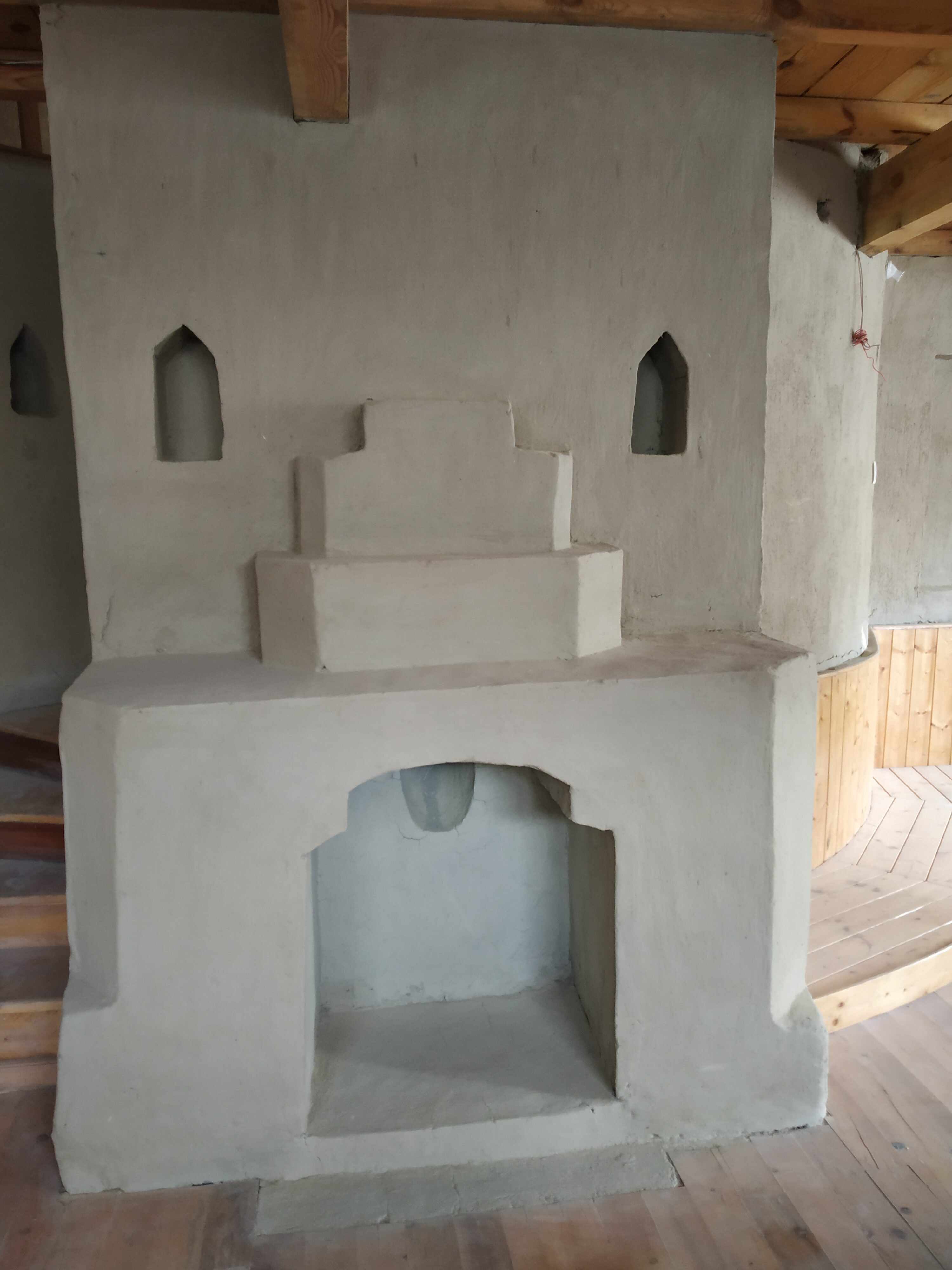
Co-designing spaces like this is a popular practice in most high Himalayan villages as it is warmer and I have given a slight tweak to the traditional heating system to make it aesthetically pleasing and more energy efficient. Hand-built mud fireplace with mud chimneys was made to suit the structure of the house and the walls draw heat from the mud-burning structure. The overall living room layout is in such a way that the family can have the space for cooking as well as a common space to sit, and have conversations and everyone can comfortably utilize the space. Unlike the traditional mud house designs in Kinnaur, the roof has a slanted design with stone slate layering which eases the burden of shoveling snow from the roof during winter as the slanting helps glide snow. A smaller structure of a dry toilet is also made outside the house which doesn’t require water.

It took about one and a half years to complete the double-story mud building and once it was completed, I was happy to receive many inquiries regarding the earthen building – the process, techniques, materials, and many other aspects that garnered curiosity from both locals and outsiders alike. I wanted to demonstrate that durable, aesthetic, eco-friendly houses can be built from natural materials and create a dialogue around a sustainable buildings practices. With every keen look and every curious engagement, I feel I am one step closer to my goal.

4080 3060 Gopal Negi
Tepang – the Pride of Kinnaur
Kinnauri Tepang | Photo: Anuradha Miyan

Tepang – the Pride of Kinnaur

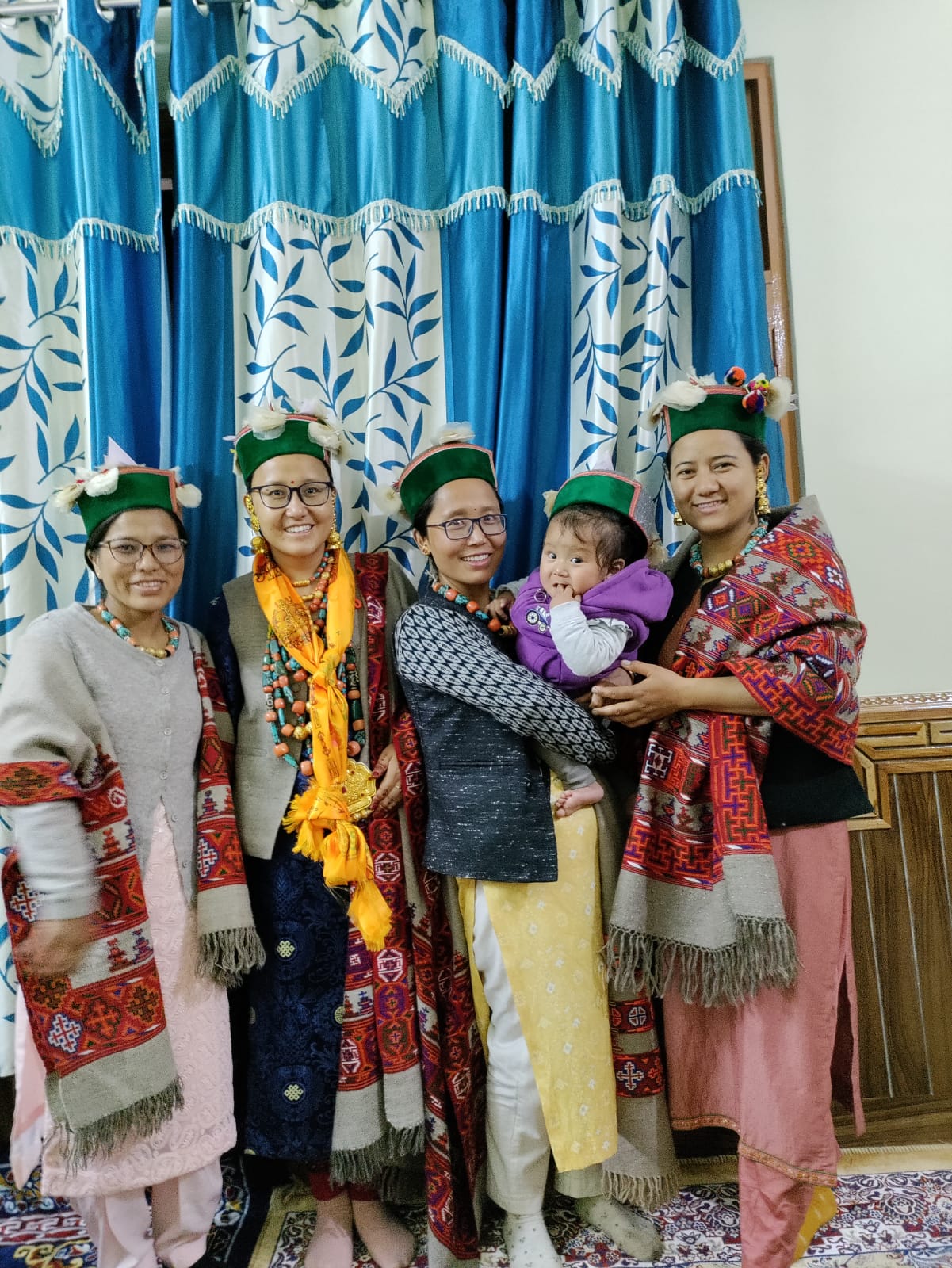
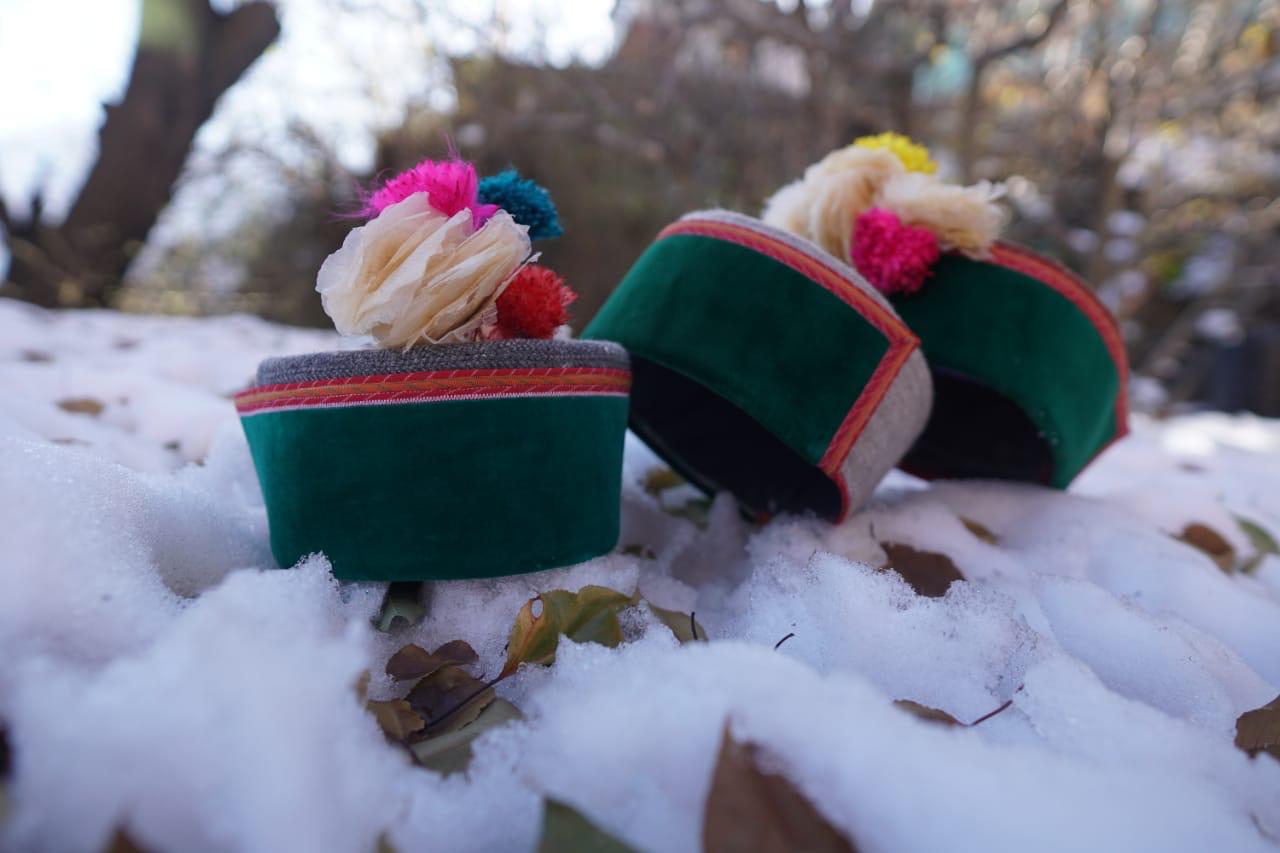
Nestled amid beautiful gigantic mountain ranges, Kinnaur is one of the most picturesque districts of Himachal Pradesh. Owing to its geographical proximity to Spiti and having been historically part of Rampur Bushahr, Kinnaur inhibits the unique cultural amalgamation of Buddhists and Hindus. One of the defining features of people living in Kinnaur is their vibrant traditional dress and the unmistakable headwear Kinnauri Topi which forms an integral part of the whole attire. The headwear is colloquially called “Tepang” or “Khunnu Tiwi” and is different from the Himachali Topis of Shimla, Kangra, Kullu, and Chamba. The design variations and the aesthetics of this headwear represent different parts of Himachal where it is worn. The Bushehri (Rampur region) cap is plain maroon in color with the same design as the Kinnauri topi, the Kulluvi (Kullu-Manali) topis have vibrant multicolored stripes, and the Kinnauri Topi has unique green velvet color and the ones worn in Kangra is a deep saffron color.

Made up of local wool yarn with velvet green stripe, it is adorned with beautiful wildflowers among which the bright white colored flower seed called “Chamakha” ( oroxyllum Indicum) is preferred among locals. The flower is not indigenous to the region and is mostly found in the lower Himachal region like Mandi, Palampur, Bilaspur, Nalagarh, etc. The usage of Chamakha flower seeds became popular in Kinnaur because of the flower’s resilient qualities – once plucked from its pod, the flower seeds don’t get spoiled and can last for years without getting dried.

Kinnauri Tepang

The Chamakha seeds are split open from their’s pod and a bundle of seeds called “Dalang” is strung together on a green, and red thread and is fixed on the Tepang. Apart from that, the cap is also accessorized with peacock feathers, marigold flowers, or the dried petals of the rare Himalayan Brahma Kamal (Lotus). However, the use of Chamakha flower seeds as well as the Brahma Kamal is decreasing as these flowers are endangered.

Kinnauri Tepang forms an integral part of their identity |  Photo: Tanzin Palkit

In the olden days, the Tepangs were domestically made at home by all households but the weaving tradition has become less popular nowadays and it is woven only in a few cluster villages like Leo, other parts of Hangrang valley, Pooh and Reckong Peo. Unlike Kinnauri Shawl and other traditional dresses, the handweaving tradition of Tephang disappeared among general people and is now kept alive among a handful of skilled artisans and weavers. In recent years, machine-made Topis are also getting more popular in Looms and handicraft centers in Lower Himachal. However, the difference between handwoven and machine-made topis is so stark.

There’s a huge difference in terms of material, quality, technique, appeal,  garment feel, and usability. The handwoven Topis, although takes a long time to make and is more labor intensive, the overall usage and desirability isare higher due to warmth and durability. A topi once woven can last for years till its natural wear and tear, while the usage of machine-made topis is more popular among non-locals and tourists for it is also treated as a souvenir. The native Kinnauri people always prefer the handwoven ones for it has far more value than their materiality.

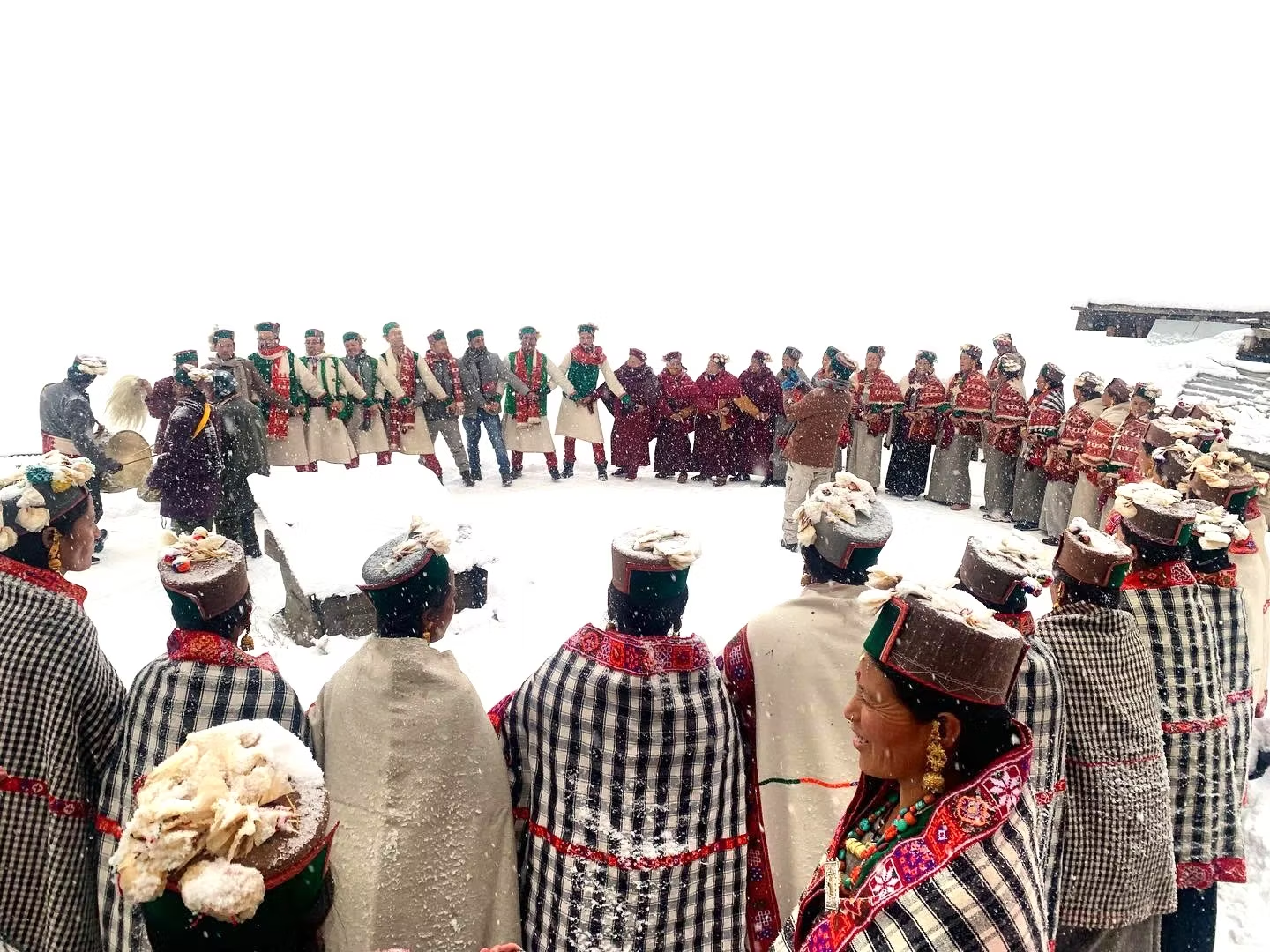
The use of Tepang is ubiquitous across all villages of Kinnaur and locals people take great pride in wearing it. The local communities lovingly refer to it as their crown, symbolizing communal pride and prestige, and they believe it upholds their indigenous cultural values. It is worn both by men and women on a daily basis and during festivals, ceremonies and occasions, people heap it with all kinds of floral adornments. There’s also a tradition of gifting Tepangs to one’s special guest and during weddings as ceremonial gifts. The use of Tepang has percolated so deeply in the collective consciousness of Kinnauris that it not only holds significant cultural value but is also seen as a defining part of their identity.

“One of the defining features of people living in Kinnaur is their vibrant traditional dress and the unmistakable headwear Kinnauri Topi which forms an integral part of the whole attire.”

1280 960 Tanzin Palkit Negi
The Sheep of Himalaya
Photo: Anuradha Miyan

The Sheep of Himalaya

Handloom and handicraft are an age-old tradition in Kinnaur (H.P) and have their roots in the ancient trade routes. The intricate designs and colorful patterns differentiate Kinnauri handcrafted shawls- making them a much-coveted textile product in India. However, the bulk of its history, symbolism, and contemporary relevance remains obscure. A history of textile production reveals interesting facts about the local environment, different modes of living, and cultural exchange. The Silk Road is the most famous trade route dating back five thousand years. Another lesser-known trade route connecting India, Tibet, China, and Central Asia is called the “wool road” which passes through Kinnaur and Kullu in Himachal Pradesh. The strategic location of Kinnauri weaving communities settled along the trade route inspired many weaving traditions across different states as well as took cultural inspiration from their trading affairs. Some of the most famous motifs and designs on the Kinnauri shawl bear a resemblance to Central Asian designs. The journey of wool trade and weaving traditions was truly iconic and drastically changed the destiny of the Himachali textile trade. Today, Himachali handloom stands amongst the foremost contributors of state revenue along with tourism and agriculture.

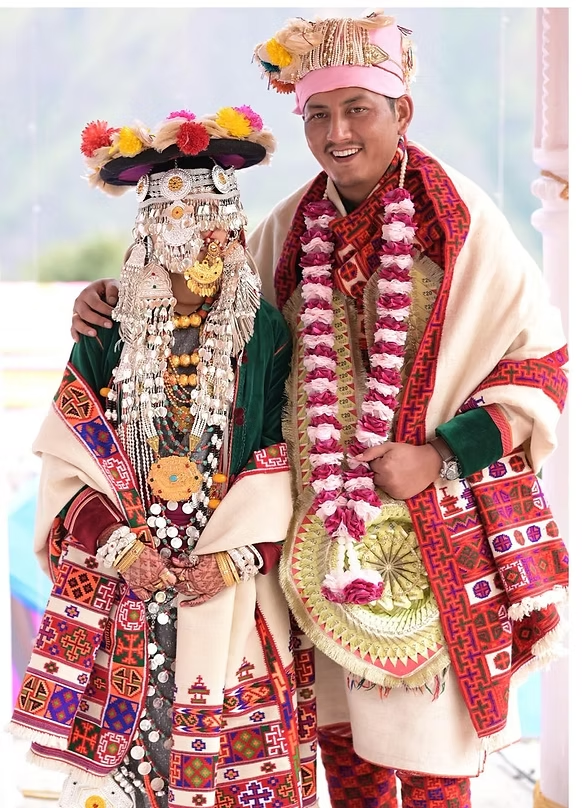
Traditional Kinnauri shawl and Topi worn by the bride and the groom

Growing up in Kinnaur, I saw my elders weave, knit, spin, and make yarn. Most women and young girls in my village knew how to weave and they owned the traditional weaving machine called “Khaddi”. Wool weaving and handicraft became indigenous to the region because of the cold weather conditions and women picked up the skill and nurtured it passionately. Most of the weaving, yarn-making, spinning, and knitting work happens during winter and the process is more collaborative. Since women made garments for self-consumption, it is common for one or two artisanal families to work together especially if it is a large-sized product like a carpet or a woolen quilt. I have always been passionate about handicrafts and after finishing my higher studies (MBA), the zeal was renewed all over again. I observed that although the women of my village – Labrang in Pooh tehsil of Kinnaur are skilled artisans, their products were used only locally within different villages of Kinnaur. There was no handicraft center in our village and given the difficult terrain, the market remains inaccessible to us.

I took a leap of faith and started “Sheep Of Himalaya” in 2019 with just two artisans from my village. The prime motive was to bring some visibility to Kinnauri handcraft on an international level and showcase regional craftsmanship.

Agriculture and cultivation of apples in our village orchards are primary vocations for most people but many women still rely on handicrafts as a secondary occupation to earn for themselves. When I broached the idea of building a clothing brand showcasing our traditional attire, there was a bit of reluctance from many artisans for they feared uncertainties. I took a leap of faith and started “Sheep Of Himalaya” in 2019 with just two artisans from my village. The prime motive was to bring some visibility to Kinnauri handcraft on an international level and showcase regional craftsmanship. While the artisans would weave mufflers, stoles, and shawls with vibrant Kinnauri designs and knit sweaters and socks, I would find market avenues for us. For me, the process proved a bit challenging as there were no established Kinnauri brands and our products were often mistaken for Kulluvi products which have better brand visibility. I took to social media to build a unique handicraft brand for Kinnaur and to connect with people who appreciate the labor of love.

Photo: Anuradha Miyan

Over the years, the enterprise found its feet as more artisans joined us in our journey from neighboring villages like Spillow and Kanam. We are now a proud all-women’s team with twenty-five artisans who are involved in the handcrafted and handloom business during our spare time. Kinnauri handicrafts and handwoven attire require dexterity that can be perfected only through patience and meticulous care while weaving.

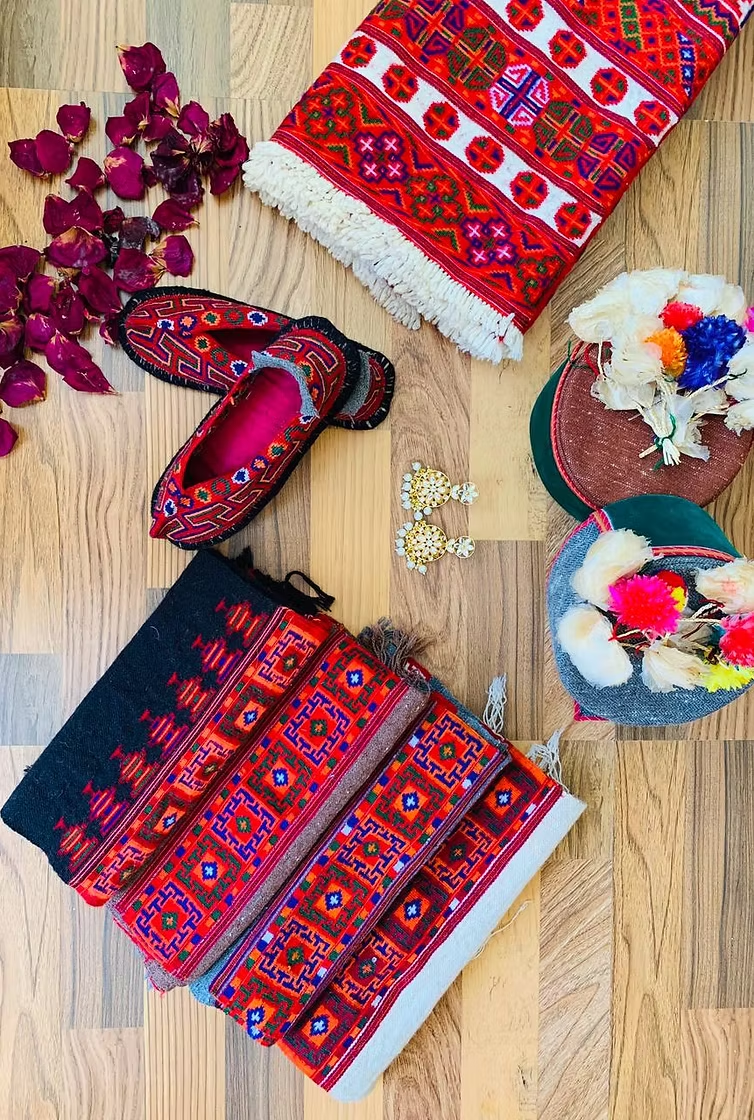
To make a shawl, each thread is carefully pulled through the reed (part of the weaving loom that resembles a comb) and installed on a loom that forms the base for an entire textile to be woven. It is one of the most complex and laborious processes that an artisan undertakes. Given the complexity of designs, it can take up to three months to finish a shawl and it can cost around twenty-five thousand rupees for a single shawl. Widely known for their intricacy and finesse, Kinnauri shawls are unique and reflect indigenous designs. We use five key colors to design our attires – red, white, yellow, green, and blue which symbolize five elements of nature- earth, water, fire, air, and space. The elaborate geometrical and floral designs have strong symbolism and many of the motifs woven have religious significance like the representation of stupas in the border design of a shawl. Since many families are into livestock rearing, raw wools are sheared locally from goats and sheep for making yarn and weaving but in recent times, we have also started procuring Angora and Merino wool from Ludhiana.

Photo: Anuradha Miyan

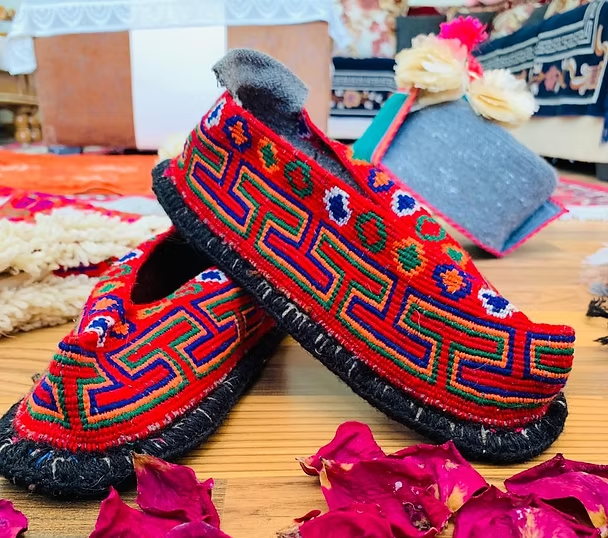
Balzanu Pona or Pullans (grass slippers) is another traditional wear that is slowly disappearing from daily use and in fact, there’s only one artisan left in my village who can skillfully make it from scratch! The footwear is made out of fibers procured from the bark of wild bushes. The upper portion of the Pullan is handknitted with goat wool and is adorned with colorful patterns while the lower portion is made of hemp or Bhang fiber (Cannabis). We make all kinds of traditional wear including Kinnauri shawls, stoles, mufflers, sweaters, Pulla (socks), and Kinnauri topi (hats). It didn’t take us long to sell products online via Instagram/Facebook and soon we were getting international orders! We further expanded our product range and started making children’s wear, cushion covers, diary covers, and pouches – all while retaining our unique Kinnauri designs.

All the women artisans who are associated with us rely primarily on their traditional looms and work from their homes which at times, proves a bit challenging as they have to juggle agricultural work, and domestic works at home and are able to undertake handicraft works only during their spare time. I have been pleading with the H.P handicraft and handloom department in Shimla to open a handcraft center in Kinnaur so that it is easier for weavers and other artisans to organize for a mutually exclusive vision, gain training, exposure, procure raw materials, and boost the entire value chain. We have capable and hardworking artisans who are passionate about their work and with the right market opportunity and assistance from the government, they will soar high.

1440 633 Anuradha Miyan
Reviving Organic Apple cultivation in Shalkar (Kinnaur)
Photo: Mayank Pathak

Reviving Organic Apple cultivation in Shalkar (Kinnaur)

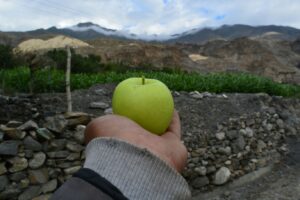
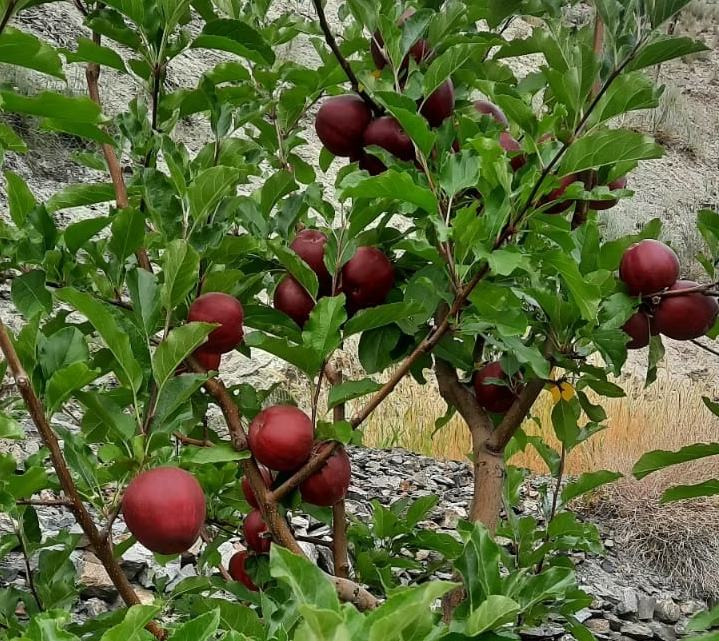
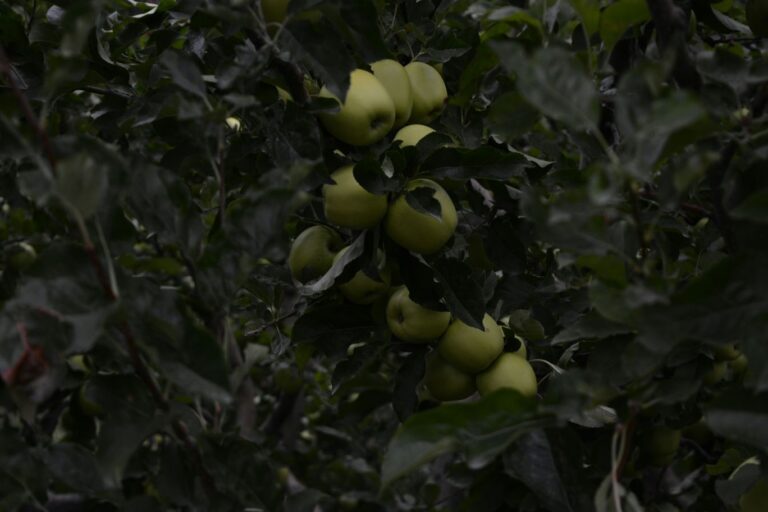
Kinnaur valley in Himachal Pradesh is well known for their apple cultivation. These high hills provide ideal climatic conditions for apple crops with the requisite chilling season in the winter. An apple variety known as Malus Pumila is a widely grown cash crop in the entire Upper Kinnaur valley. Shalkar village in particular is known for growing organic apples that’s much coveted for it’s sweetness and crunchiness. However, organic cultivation hasn’t always been the default practice in the village. This change is inspired by one man’s zeal and subsequent community resilience for better farming practises.
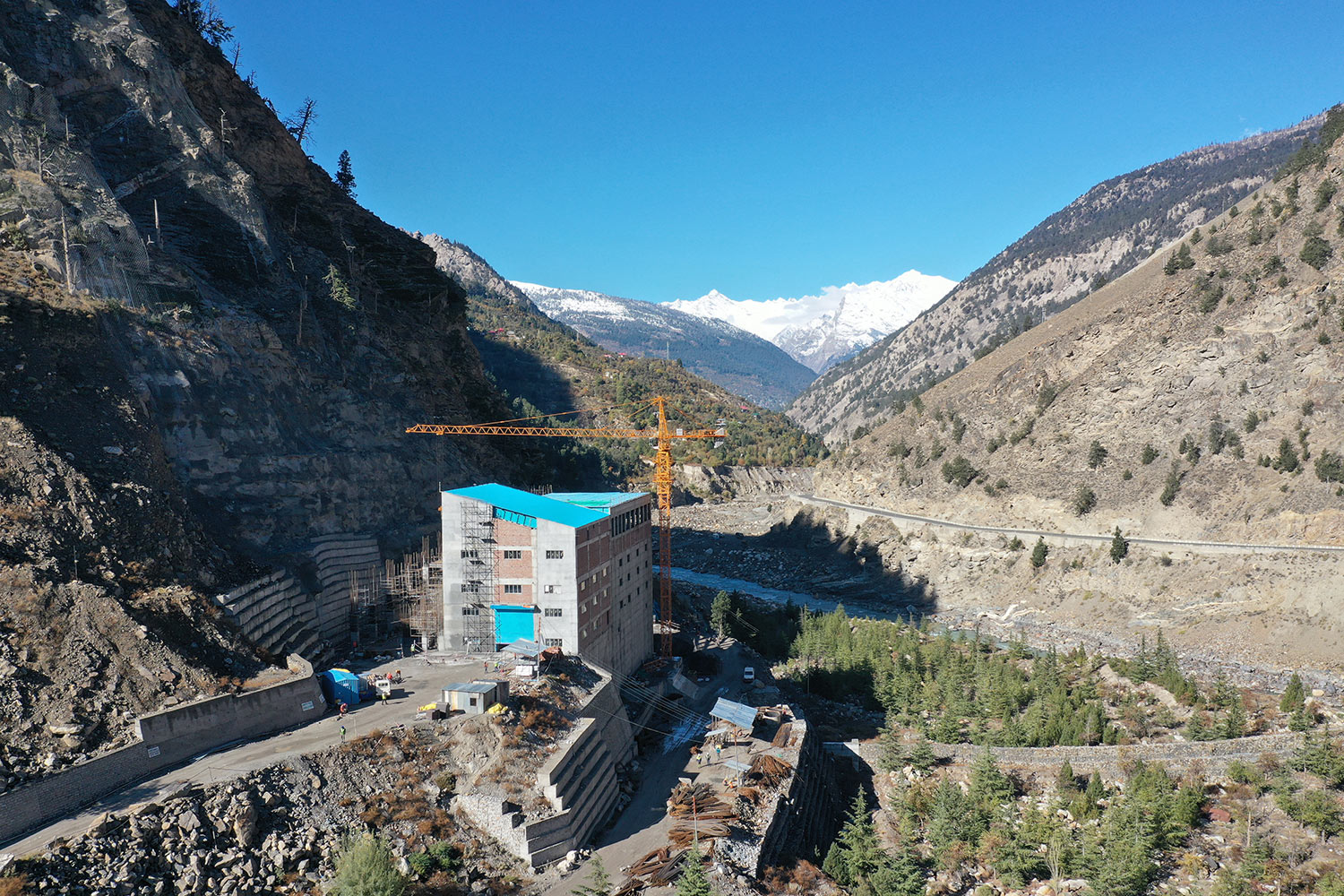
Photo: Karam Singh Negi

Perched at the altitude of 3200 metres, Shalkar is one of the last villages of Upper Kinnaur region before Spiti valley starts. There are over 110 households in the village – most of them dependent on apple cultivation for livelihood. While apples produced from other districts of Himachal ripen by July, the Kinnaur apples grown at a higher altitude start ripening around mid September or sometimes stretching till November hitting fruit markets across the country just before winter. The apples produced here are bulk transported to neighbouring metropolitan states where it is sold at a premium rate. Like many apple producing regions, the farmers here use chemical fertilisers and pesticides for bulk production. The usage became particularly more popular in recent years. In Kinnaur, It begins during the flowering season and continues till harvest. Use of chemical pesticides like Tefgor, Malathion, insecticide like Rogor, Durmet and a wide range of fungicides like Lethal, Kashstin, Majestic became quite handy for farmers seeking higher yield.
Earlier, many farmers do not use pesticides and fertilisers; most of them cannot even afford these but in recent years, the chemical spraying has increased from doing twice in a year up to spraying seven times in a year. The rampant usage of pesticides deeply bothered Karam Sing Negi – a cultivator from Shalkar village. He became conscious of the long term health and environmental hazards of pesticides and was determined to find an alternative. He gradually minimised the use of harmful pesticides and other chemical fertilisers in his own orchard.

The apple worm | Photo: Chunnit Kesang

For a farmer whose livelihood is entirely dependent on his orchard produce it was a risky move but for Karam Singh, there’s no greater satisfaction than reviving natural ways of farming his ancestors practised for generations. Transitioning his orchard for organic farming wasn’t easy – it needed a slow but consistent approach. He started minimising heavy chemical inputs and used only animal manure, human waste and other biodegradable waste suitable for it. For the initial few years, there was no prominent change and the yields were low. But he kept moving on with the same approach – his land needed to heal and the soil, the plants needed to reach its natural equilibrium.

Photo: Mayank Pathak

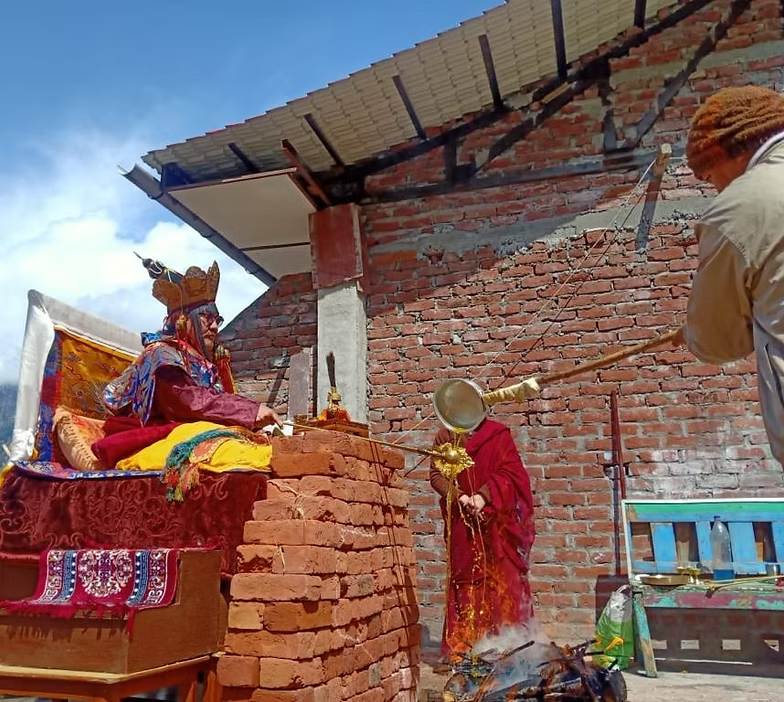
Hearing his approach, His Holiness Lochen Tulku Rinpoche (Highly revered spiritual leader) advised everyone in the village to follow the same path. Rinpoche also shared Karam Singh’s concerns regarding long term ecological damage. Adopting natural ways of farming will not only restore damaged ecosystems but also will help avoid killing of small insects and microorganisms. Convincing everyone else in the village to avoid using pesticides and chemical fertilisers was challenging. Shalkar village comprised both big Zamindars as well as marginal farmers. The villagers had an internal community meeting regarding it and there were various opinions/reactions regarding it. Few agreed with the idea while others were concerned about low yield and low productivity which could eventually impact their own livelihood as apple orchards were subject to a lot of pests and diseases. After much discussion, everyone in the village unanimously agreed to avoid chemical fertilisers in their orchards. The villagers even hosted a religious ceremony seeking blessings from local deities for good harvest. Lochen Rinpoche inaugurated the “Jinshak” ceremony by scattering ash and manure in the apple orchards of Shalkar village and advising everyone to revive traditional farming practises. For the first 3-4 years, the apple yield from Shalkar village dropped drastically. With dwindling yields, there were many uncertainties – some farmers even struggled to pay school fees for their children. However, their resilience paid off when the apple orchards of Shalkar village slowly recovered and started bearing luscious apples again!
With passing years, the villagers experienced improved yield from their orchard and noticed the apples from their village are different from neighbouring Kinnaur villages. Apples grown in organic farms in Shalkar have a distinctive sweet, crunchy taste with a natural waxy exterior which even gained preference among bidders who are involved in large scale apple export business. The villagers are working towards organic certification which will help them gain due recognition in the market. This story of organic farming and community led change in a small himalayan village shows it is possible to grow pristine apples without harmful pesticides.

1368 912 Villagers of Shalkhar
Reflections on farming life
Photo: Panma Gyatso

Reflections on farming life

I was born in Hango (11,500 ft) which is a remote village in the Hangrang valley of Kinnaur. I am 72 years old and have spent my life in this village as an agro-pastoral farmer. Agriculture is very important to us. When I look back, I now realise that some of my most treasured memories of my village are related to agriculture and food. One of my favourite and most vivid childhood memories is from the time chulli (apricot) season arrived. Our village did not have any chulli trees, so our elders would go to the nearby village of Leo and get chulli for us. When they arrived, all the children of the village would run to the common ground to grab as much as possible in our little hands. Women would also find time during the day to enjoy chulli with each other under the winter sun. Relishing chulli was a communal affair. The seeds were saved to make prized chulli oil (750 ml for INR 2000/ USD 27).

Photo: Panma Gyatso

My other happiest memories are of the festivities and celebrations we had after the harvest. Until a few years back, we had an isolated winter in Hango. So we had to work really hard during the summers to ensure we had enough grains to survive the harsh winters. After gruelling work in the short summer season, the celebrations were especially sweet. Our harvest back then was of barley, potatoes, black peas and cheena/chize (local name). Cheena & barley were used to make flour for thukpa (soups) and salma (local bread). During the festivities we would make various dishes like tolopa, chulipanting (sweet apricot). Communally preparing and eating added exponentially to the taste of these dishes.

Barley was and continues to be used for making local alcohol like chhang and arak. No one, now, grows cheena. The seeds are also very hard to come by. It has completely vanished. Black peas & barley cultivation has also reduced and mainly taken over by the cash crops like green peas, apple, cauliflower etc. Due to increase in connectivity with the outside world, wheat and rice which were only heard of back in my days, have now become staple food. Salma, tolopa, chulipanting etc which were favorites of all age groups are now hardly prepared.

With our generation most of the traditional dishes are also fading away. I am hoping that we can slowly shift back to our traditional crops, as they grow best in our landscape, with focus on apricots for better economic gains. This way we will be able to ensure sustainable growth from agriculture.

792 706 Prithvi Singh
Unpredictable Lifelines
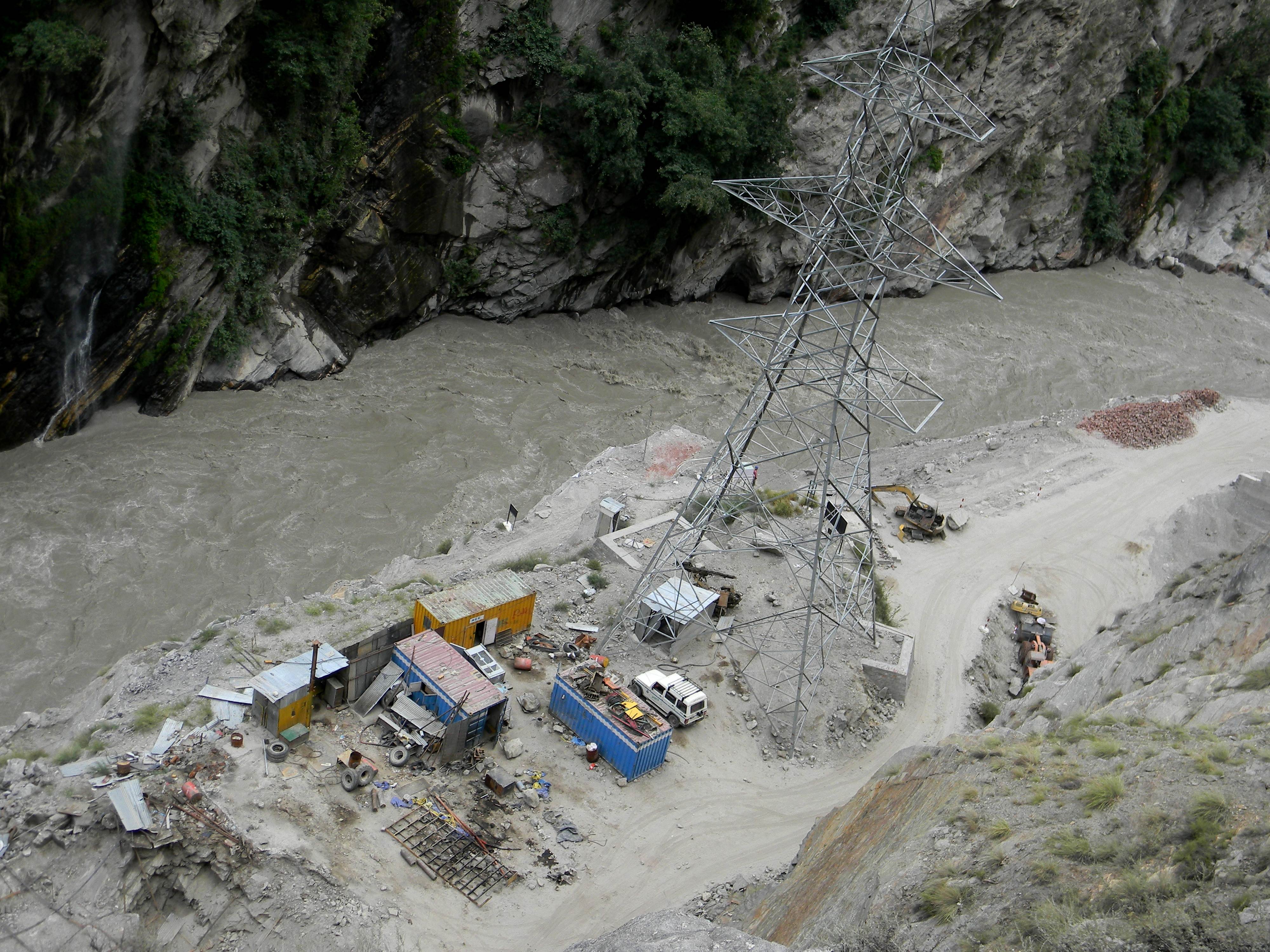
Integrated Kashang Hydroelectricity Project, HP, India| Photo: ejatlas.org

Unpredictable Lifelines

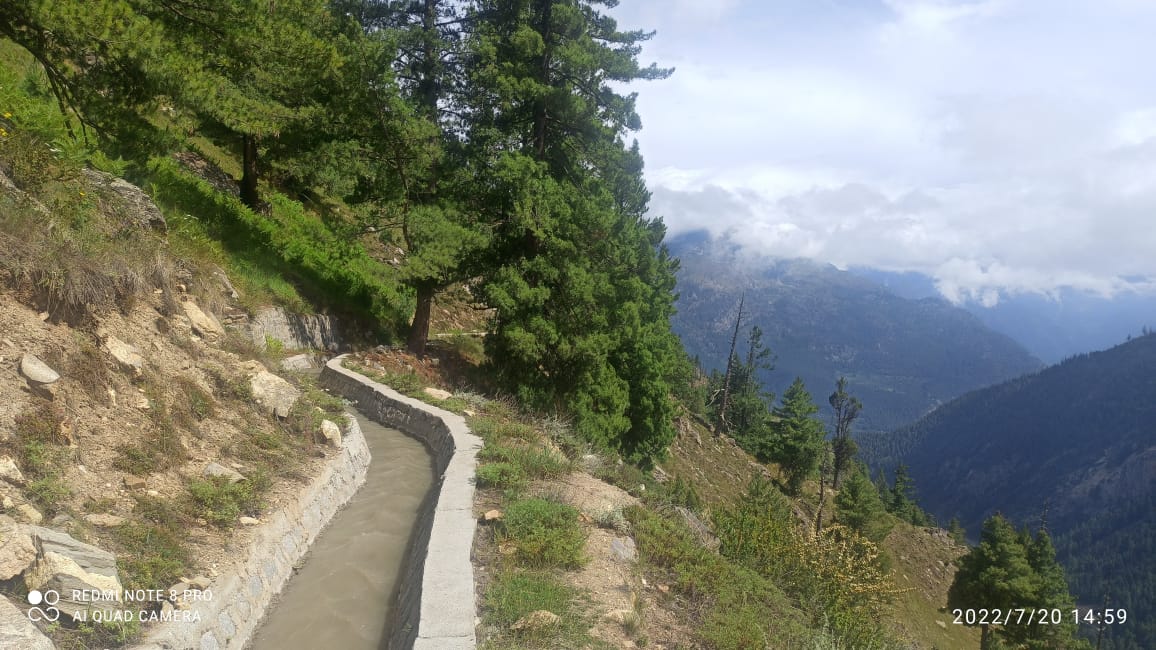
Verses of prayers reverberate throughout the valley as men sing and climb mountains to ensure their village has water in the summer. People from Khadra, Akpa and Rarang village trek for 27 km to reach Pangi top and clear the path of the artificial stream – Kashang nahar to let the water flow freely towards their villages. Generations ago many streams flowed towards the foothills but now only a few remain and Kashang Nahar is the only reliable source. Completed in 2005 this canal is helping the local villages meet their demand for water.

Kashang nahar | Photo: Yowan Negi, (Village Rarang)

Khadra, Akpa and Rarang, villages at 8000ft of Moorang tehsil, fall in the semi-arid region of Kinnaur district in Himachal Pradesh and rely mainly on glacial melt for their water needs. Though over the past few decades things are changing. As the climate is getting warmer, precipitation (rains and snowfall) is getting erratic. With each passing winter the glacier is unable to recover due to reducing snowfall trends. This is not only reducing the water availability during summers to the villages dependent on them but also leading to glacial instability. This phenomenon is already bringing grave consequences to the communities living in the mountains as was observed in Chamoli district of Uttarakhand. A glacier collapsed and released a ton of water and energy which destroyed everything that was in its path.

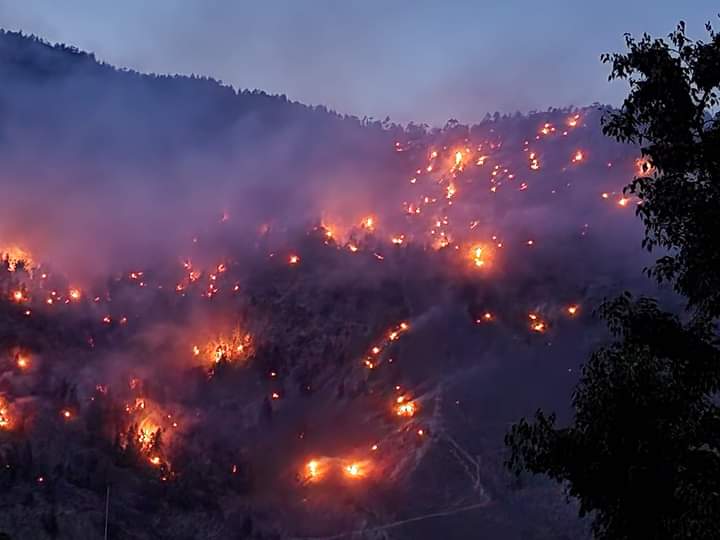
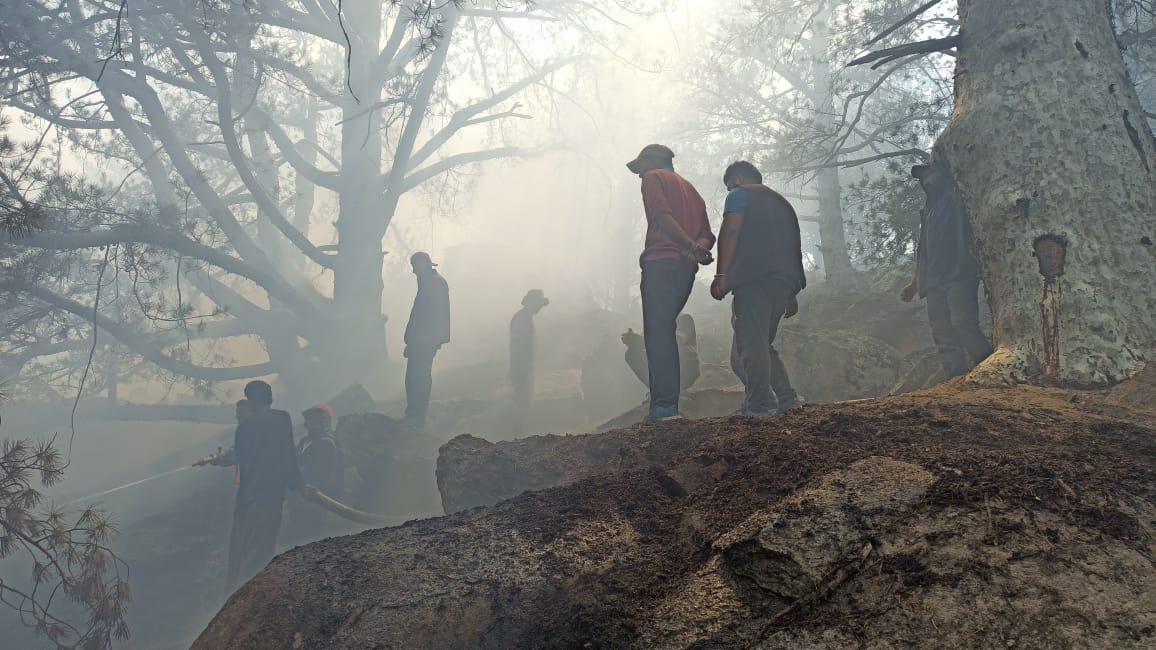
During monsoons, flash floods and landslides are increasing and becoming more frequent by each passing year, adding to the woes of the communities. A few years back, in my village of Khadra and the nearby villages of Akpa and Rarang, a major landslide washed away many agricultural fields leading to loss of acres of productive land. This year we faced a severe heat wave which led to fires in our forests. As Deodar and Chilgoza trees around us burned and fell and the wild species fled, we felt so helpless as the water in Kashang nahar fell short. Some of us collected the water at the base of the nahar and managed to save a few trees. But a lot of the damage had already been done. Each year we are caught up in a dichotomy of drought and heavy devastating rains and we don’t know what we should prepare for.

Forest fires in Akpa & Jangi forest | Photo: Heer Chander (Village Jangi)
Aftermath | Photo: Sunder Negi

Development based on destruction

Himachal Pradesh, being a mountainous and river rich state, is known for its potential to generate hydro power. However that is coming at a cost to the communities. Villages and community forests are sanctioned under different projects to either be submerged or cleared off for the development. Around our village we have two hydro power plants – Tidong (150 MW) & Kashang Integrated (243MW) under construction and one mega project – Jangi Thopan of 804 MW is proposed. Kashang integrated project has plans to divert the Kashang nahar to meet its production needs. These projects are hindering the flow of our already distressed rivers and causing long term implications towards the health of the ecosystems and communities dependent on them. We have always opposed such mega developments and will continue to oppose them.

Photo: statkraft.in

Science and spirituality

To our communities, water means much more than a resource. Our ancestors have revered and protected the resource not just for themselves but for the generations to come. And today we continue to reap the benefits. Even today elders in the village guide us with ways to protect the water and thank the spiritual beings for their benevolence.  Every time we go to the source of a natural spring, we recite Naaga Chhonme, an ode to nature thanking her for the abundance of resources. It is deep rooted in our basic nature to feel connected to the forests, streams, rivers, mountains and we treat them as living being.

As much as spirituality is important to help us stay grounded and connected to our land and water we are also focusing on taking informed decisions to monitor and manage our resources based on scientific tools at our disposal. In early June this year, the youth of the 7 village clubs- Spillow, Kanam, Moorang, Jangi, Akpa, Rarang and Khadra, organised and attended a workshop conducted by Himdhara and People Science Institute on long-term monitoring of the health of the streams around our village. It was a 3-day workshop and we explored various themes around water including topics of development, climate change and its impact on our hydro and ecosystems. With the help of the Open Foris Collect, a mobile application, the youth have already started recording their readings of our streams.

River monitoring workshop | Photo: Sunder Negi

Climate change is a problem that we cannot solve at our village level. In the coming few years, the negative impact of climate change will only worsen and all we can do is prepare for the challenges we are to face. What we can do as a community is to raise awareness, write about the issues and continue to engage people in action towards climate change.

4000 3000 Sunder Negi
The Predicament of a Herder

The Predicament of a Herder

Winters in Spiti valley are filled with celebrations of a fruitful year and prayers for a bountiful year ahead. Most of the time is spent within the villages as travel is usually difficult especially when heavy snowfall causes roadblocks. The year 2018 was also not much different. In the month of November, as we were readying ourselves for the coming winter months in Kibber, I received an urgent message from a colleague in Mysore in Karnataka.

“A herder has lost much livestock in Chango, possibly killed by a wild animal” the message said.

These were the only details along with a WhatsApp video that was being circulated. Understanding that the matter could be grave and the weather was still permitting travel, I decided to leave immediately for Chango which is in Kinnaur. I requested Tanzin Thuktan, my colleague, to join me. Chango is about 110 km away from Kibber.

We did not have any details about the owner or where exactly the incident had happened. Upon reaching Chango we were clueless, but the good thing about small towns and villages is that everyone knows each other very well. So, when we enquired about the case with local shopkeepers, they were well aware of it and they told us that Thuktan Tender was the owner of the livestock and showed us the way to his house. Thuktanji is an apple farmer in Chango and has a settlement at Liti Dogri. When we arrived at his house, he was confused about why we had traveled from so far to talk about his loss. With a little hesitation, he narrated the whole incidence to us.

On 16th November 2018, Raju, the caretaker of the corral, had returned to the village to gather supplies for the Dogri. He decided to stay back in the village for the night. The next day when he went back and opened the door of the corral, the animals rushed out in panic. Usually, he would have had to take a lot of effort into getting the animals out of the corral. He knew  something was wrong. It was  strange behavior.

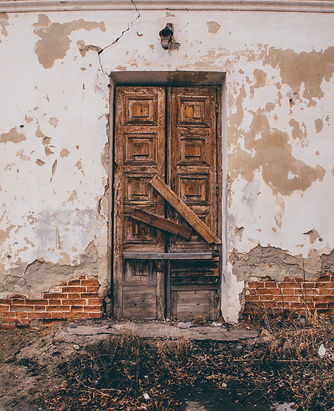
Broken Door | Photo: Mikey Dabro

Standing by the door he carefully scanned the inside of the corral and to his surprise, he saw a set of shining eyes staring back at him in the dark. He immediately knew what it was and slammed the door shut. He called Thuktan and narrated the incident. Within a few hours, the news had reached every household in Chango and nearby villages.

Snow Leopard | Photo: Adriaan Greyling

A snow leopard, which had entered the corral in the dark of the night, had somehow got trapped inside. It garnered a lot of attention from local leaders and the forest department to school teachers. Everyone had reached the Dogri to enquire about the incident and see the snow leopard. Upon many assurances of receiving relief for the loss, Thuktan released the snow leopard. He also made a video of the release as a record that the animal had been released unharmed. When they inspected the corral from inside, they saw 19 animals that had been killed and 11 critically injured. Within 2-3 days even they succumbed to their injuries. However, after the release, all the hype around the case vanished. So, when I met with Thuktanji, a few weeks later, he was understandably angry and had lost hope of receiving any financial help. I asked him if I could visit the Dogri, to which he agreed.

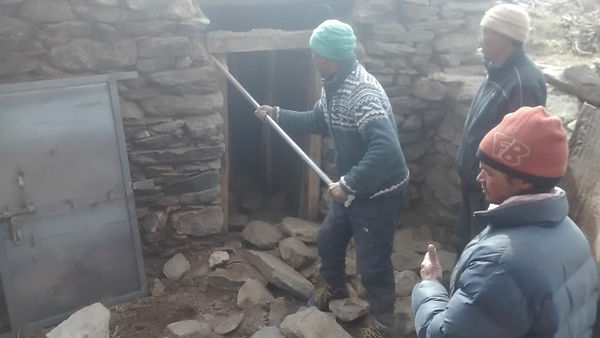
Liti Dogri is about 15 km away from Chango. It has three big corrals which houses small-bodied animals like goats and sheep of several livestock owners of the village. Thuktan ji’s corral at any time has 200-250 animals. Upon inspection of the corral, we noticed that the door of the corral was old and did not shut completely. We gathered that the snow leopard must have entered through the door and had gotten trapped inside. To prevent further loss, we decided that we would replace the door with a new sturdy one. The next few days were filled with hurdles. The closest material shop and welder was 130 km away in Reckong Peo. Getting the material on time was crucial to avoid further losses. The three of us drove to Peo in Thuktan ji’s car and bought doors for the corral. The villagers came to help us fix the door. The compensation process as well as the relief amount was also not very clear.

Repairing broken door of Thuktanji | Photo: Nature Conservation Foundation

We decided to speak to the local Forest Guards and Range Officers. They informed us that the compensation file had been sent to the DFO’s office in Reckong Peo. We then met with the DFO who was very sympathetic and assured us that Thuktanji would receive the claim as per the new notification rates. Within few weeks Thuktanji received the claim from the department. Compared to the actual loss suffered and other collateral costs incurred, the financial relief offered by the Forest Department was often considered too little. Fortunately, the department has revised these rates since August 2018 to ensure that the herders can cope with these situations better than before.

As a herder myself, I believe that we must try to ensure that such events are avoided in the first place. Wild animals have always lived around us and will continue to do so. We have always taken precautions to keep our livestock safe from them, and we have to continue doing so. With access to better resources in our remote areas, we may be able to plan this more effectively and upgrade our corrals to make them predator-proof. This way we may be able to prevent any future losses that might occur.

1014 676 Tanzin Thinley