Folklore

The dog and the wolf
Illustration: Nawang Tankhe

The dog and the wolf

The dog and the wolf are brothers. For long they had lived happily until one day jealousy got the better of them. Ask any herder, and they will tell you how it happened.

The dog and the wolf possessed qualities that helped them survive in the wild. The wolf was a stealthy runner who could run great distances, while the dog was gifted with the power of smell. Together, they complemented each other perfectly. The dog would sniff prey from a distance, while the wolf would then hunt down the prey by outrunning them. They would share the spoils from the hunt and barely did they go without food.  However, one question bothered them – how would they survive alone if the other was missing for some reason? So, both the dog and the wolf made a pact: to help each acquire the skill possessed by the other.

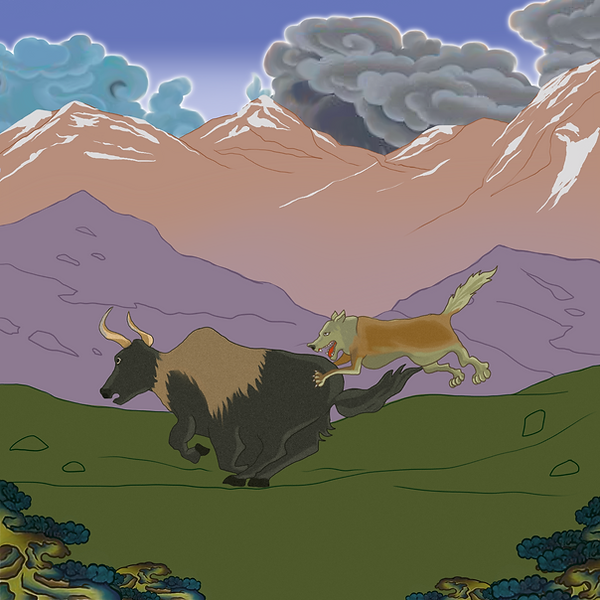
It was the wolf’s turn first. He was a very patient teacher. He taught the dog every trick he knew which had helped him run long and fast. With time the dog followed the wolf’s lessons and became a good runner. It was now the dog’s turn to teach the wolf the art of sniffing. The dog was slow in training the wolf, who was a good learner. Soon the wolf learnt to sniff out prey that were at short distances. The dog promised to teach the wolf the final tricks soon. But it was all a farce. When the wolf woke up the next morning, he was shattered to see that his brother had actually run away and made friends with a new companion. The dog had fled and made friends with the man, just so he wouldn’t have to share his prized skill with his brother.

Ever since, herders who rear livestock have kept guard dogs to protect them from being lifted. But wolves often manage to lift livestock, which herders believe, is an attempt to square off a deal that the dog left incomplete.
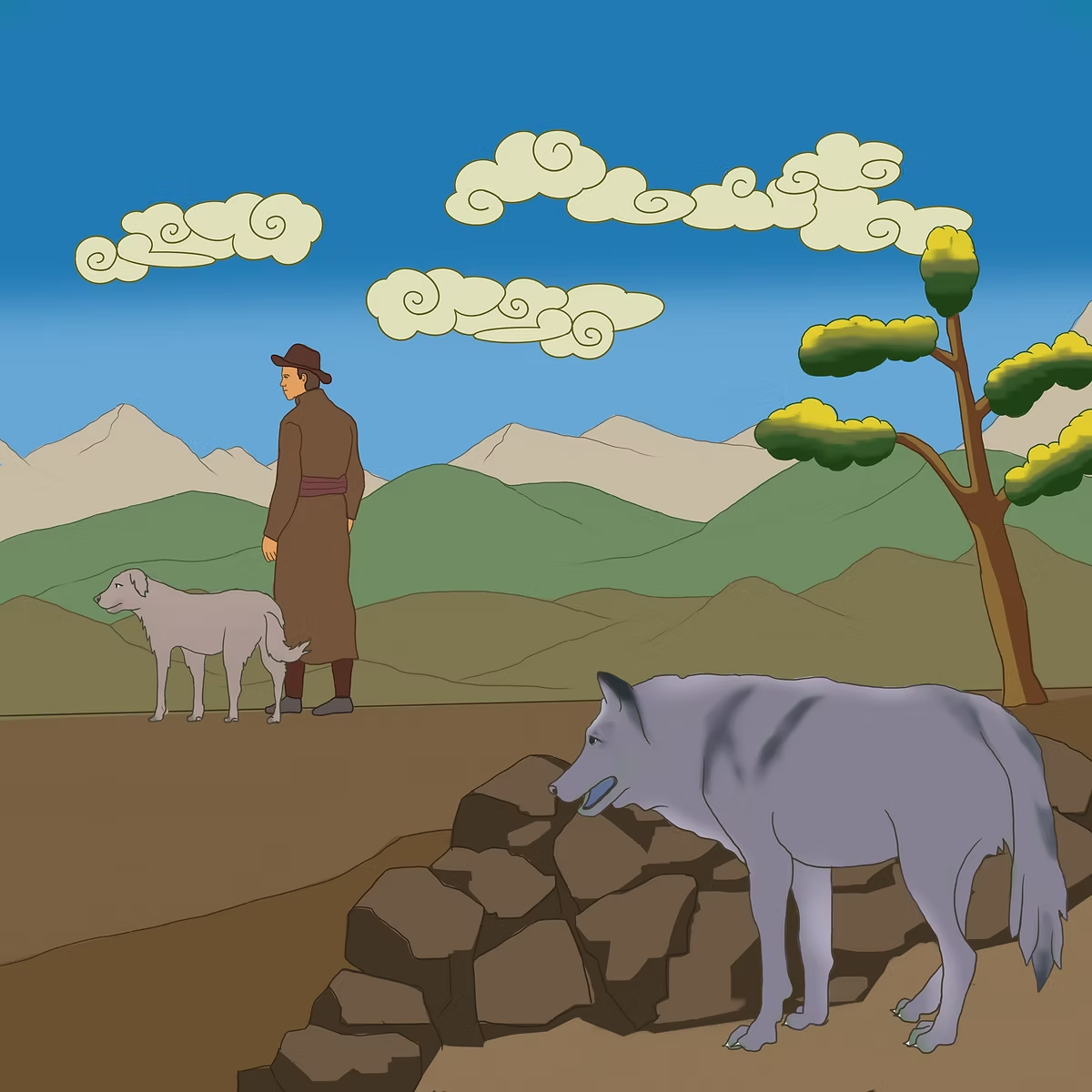
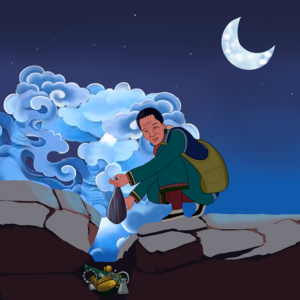
Illustration: Nawang Tankhe
1200 1200 Ajay Bijoor
Spiti’s Richest Village

Spiti’s Richest Village

Morang was a hamlet of just five homes, but it was known far and wide not just in Spiti valley but even beyond. Thanks to Meme Chukpo. Meme Chukpo was the smartest trader of the region. He was also the richest man in the valley. He could sniff out an opportunity to make money where most others saw none. He sold yaks to the Changpas and the best Chumurti horses at the Lavi mela in Rampur Bushahr. He had traveled far and wide to trade. But Meme Chukpo had one festering fear. He was weary of people who came to his door seeking financial aid. Over time, he had devised an ingenious way to deal with such requests.

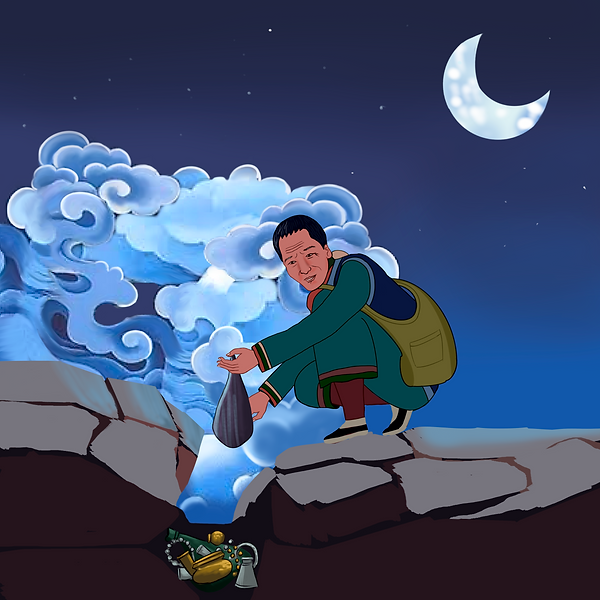
Each time he returned from a trip, he would look up to the sky. Now, if you have ever been to Spiti the first thing you might notice is how few clouds there are on most sunny days. There is barely a cloud or two in the bright blue sky. Meme Chukpo made it a habit to look for such lonely clouds. He would keep some money for domestic use and then dig a hole in the ground under the cloud and hide the rest of his money there. Surely this was the safest place to hide his treasures, and the easiest place to find it if he ever needed it. So busy had he been toiling away making money that he’d hardly ever noticed the magnificence of the rising sun, or the song of a whistling thrush, of flowers that flushed the valley in spring, or that of the slow movement of clouds in the sky.

Each time someone walked up to him seeking financial aid, Meme Chukpo would smile and say ‘I would have helped had there been some money in the house. I’m sorry, but I have none.’ He felt glad that he wasn’t lying after all. All his treasures were buried away under the cloud.

Meme Chukpo went through life working hard. Fortunately, he never faced a time when he had to fall back on the money he had buried under the cloud. But many years after he passed away some children accidentally found a pot of money in a pit under the ground. It was probably one of many pits that Meme Chukpo had dug around Morang.​

Some people still dig the soil around Morang hoping that they might find one of Meme Chukpo’s treasures that he’d buried under a cloud.

  • Meme is a title used by everyone to refer to their grandpa or an elderly man in Spiti.
  • Changpa is a term used to refer to the residents of Changthang – a region in the northern part of Tibet and the eastern part of Ladakh. Changpa are a nomadic community known to rear goats that produce the famous pashmina. They have had ancient trade links with people of Spiti.
  • Chumurti horse is a local breed of horse from Spiti. It is known to be a very sturdy variety, especially adapted for high altitudes.
  • Lavi mela is an annual trade fair that has been held in Rampur-Bushahr for many centuries. Trade fairs were and still are very popular across Himachal Pradesh.
600 600 Ajay Bijoor
The Red Fox and the Yak

The Red Fox and the Yak

Once upon a time in the scenic valleys of Spiti, there lived a clever red fox and a gentle yak. The fox had heaps of fresh, green grass, while the yak had heaps of smelly waste. One day, as they roamed the forest, they accidentally bumped into each other.

“Oh, sorry!” said the fox.

“No problem!” replied the yak.​

As they chatted, they realized how useless their possessions were to them. But then, they had a bright idea.

“Why don’t we trade?” suggested the fox. “Your waste is perfect for my garden, and my grass is perfect for your tummy!”

The yak agreed, and they made the swap. This simple exchange made them best friends.

One day, as their friendship blossomed, the fox promised the yak, “If you ever need help, just call me, and I’ll be there in a flash!”

The yak, feeling mischievous, decided to test the fox’s promise. While grazing, he called out, “Fox, help me!”

The fox rushed to the yak, only to find him laughing. “You got me this time, yak!” the fox chuckled but was a bit annoyed.

The very next morning, while grazing again, the yak was suddenly attacked by a fierce wolf! Terrified, he called out, “Fox, help me!”

But the fox, thinking it was another prank, ignored the cries. Sadly, the wolf killed the yak.

The following day, the fox went to check on his friend. When he saw the yak’s lifeless body, he felt a pang of guilt. He vowed to take revenge on the wicked wolf.

The fox’s first plan was sneaky. He smeared oil on his tail and started beating it against the icy snow. The same wolf, curious, approached him and asked, “What are you doing, fox?”

“This makes your tail strong and beautiful,” the fox lied.

The wolf, eager to have a strong tail, begged to try. The fox pretended to hesitate but finally agreed. When the wolf’s tail stuck to the snow, the fox ran away laughing. The wolf struggled to free his tail, losing all its hair in the process.​

Next, the fox made a sticky potion. When the bald-tailed wolf saw him, he asked, “What are you making now, fox?”

“This potion makes your eyes cool and soothing,” the fox fibbed.

The wolf insisted on trying it. Once applied, the potion made the wolf’s eyes burn! He scratched them furiously, making it worse. The fox, giggling, ran away again, leaving the wolf half-blind and in pain.

Days later, the furious wolf found the fox and wanted to kill him. The quick-witted fox lied again, “Oh, I’m not that fox! I come from another forest and got lost.”

The wolf, now confused, believed him. “What are you doing here?”

“I’m making a basket to carry on my back. It’s great for building strength,” the fox said.

The wolf, wanting to be strong, begged the fox to make a basket for him. The fox filled it with heavy stones and placed it on the wolf’s back. The wolf groaned in pain as the fox ran away, laughing.

The fox’s final plan was the trickiest. He made a sack and waited for the wolf. When the wolf arrived, he asked, “What are you doing now, fox?”

“I’m making a fun sack to play with my friends,” the fox said.

The wolf wanted to join. The fox asked him to get into the sack and pushed him down a hill. Miraculously, the wolf survived, and the fox grew even more frustrated. He knew the villagers disliked the wolf, so he concocted his ultimate plan.

One day, the fox was measuring sand when the wolf, now with memory loss, came by. “What are you doing, fox?”

“I’m measuring sand to make my friend powerful,” the fox lied.

The wolf, eager to be powerful again, begged the fox to put the sand on his back. The fox agreed, piled the sand on the wolf, and climbed on top. They headed toward the village.

Upon reaching the village, the fox yelled, “Help! A wolf is here!”

The villagers, armed with weapons, surrounded the wolf. Shocked and unable to run due to the heavy sand, the wolf asked the fox, “What’s happening?”

The fox replied, “I’m avenging my friend, the yak, whom you killed.”

The villagers, angered by the wolf’s presence, killed him. The fox felt a bittersweet satisfaction, having avenged his friend. The forest animals learned the importance of trust and lived peacefully, always remembering the clever fox and the unfortunate wolf.

  • Red fox is a common fox with a reddish coat. It is one of the most widely distributed species in the world.
  • Yak an animal of the cow family, with long horns and long hair. It is reared in villages in the Himalayan region
600 600 Aryan Gadgil
The Nettle Army

The Nettle Army

In summer, there is hardly any place that can match up to the beauty of Lahaul. Agricultural fields set within a carpet of wild flowers, waterfalls of every size, the majestic Chandrabhaga river flowing in all her majesty with villages along the valley. It was no wonder then that the eyes of invaders fell on this beautiful valley. They were secretly hoping to establish themselves in one village and then mount an attempt to establish themselves across the entire valley. But where could they start from?

A small group of spies set out to find a suitable village that could serve as their base. After much scouring they agreed on the village of Gushal. This village had table lands with fields of agriculture that could feed an entire army. Water was bountiful and the village received good sunlight in both summer and winter. The spies decided that the army could sneak in from the peaks across the village, and take everyone by surprise. The plan was finalized and a handful of soldiers set out to mount an attack on foot, establish themselves and then bring in the rest of their forces.

This small group of men marched straight into the patch of stinging nettle. They crouched and crawled in order to remain out of sight. In the bargain, they’d rub themselves entirely against the nettle bushes. It was only a matter of time before rashes erupted. In a matter of minutes, the entire group was on the floor scratching to soothe their itch.

Gushal, like most other villages, was richly covered by wild plants and grasses. Among them were dense patches of stinging nettle. While nettle leaves are a delicious addition to thukpa, one has to be very careful when handling them. The plant can leave you with an ugly rash should you accidentally touch its spiny leaves. While this was well known to the locals, the invaders had no clue of this. They tried to sneak into the village while it was still dark.

Their leader was particularly distressed. He made an exasperated comment that ‘if the plants here are so feisty, imagine how dangerous the people might be’. No sooner had he made this remark, his men turned back and beat a hasty retreat. He was left with little choice but to follow them, even as he was struggling to soothe his itch. The men went back and narrated the incident after which their headman decided that it was best to leave Lahaul and go looking for a less challenging place to conquer.

The villagers of Gushal woke up completely unaware of what had transpired in the early hours of that morning. Life seemed normal, as usual. Little did they know that their stubborn nettle army had bravely diffused the plans of invaders who were eyeing their beautiful valley.

  • Chandrabhaga river, also known as Chenab, emerges from the confluence of the waters emerging from the Chandra and Bhaga valleys of Lahaul. Their confluence is at Tandi in Lahaul.
  • Gushal is a beautiful village on the banks of the Chandra in Lahaul.
  • Stinging nettle is a plant variety that grows widely across the world, including the Himalaya. It is known to possess several medicinal values. It is also famous for causing burning sensation of skin when accidentally touched.
  • Thukpa is a Tibetan noodle soup, which is prepared and relished in several Himalayan regions including Ladakh, Lahaul and Spiti.
532 500 Ajay Bijoor
Khirav Gompo Dorje
Illustration: Nawang Tankhe

Khirav Gompo Dorje

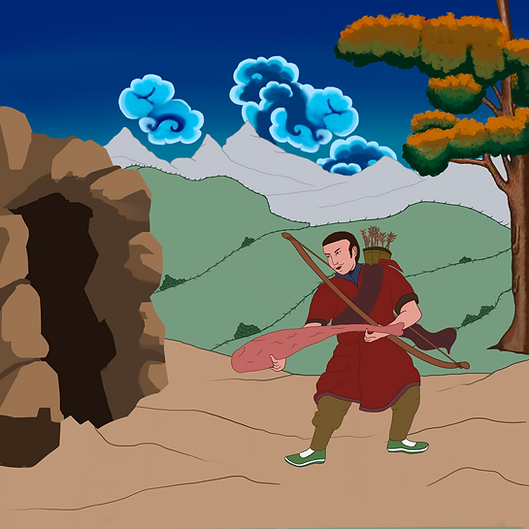
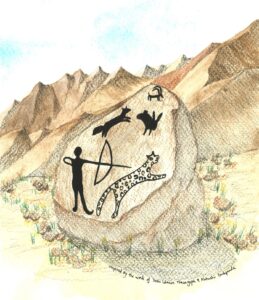
Gompo Dorje was a spirited man. He was a keen hunter. An ace at taking down mountain animals like bharal and ibex – a single hunt could see him through several days. He had grown up watching snow leopards sneak up on their prey while mounting an attack. He used a similar technique to hunt, the only exception being that he used his bow and arrow to take his prey by surprise. He had walked the vast valleys hunting prey and lived alone at the edge of Kibber. People of Kibber called him Khirav Gompo Dorje – Khirav meant hunter – in acknowledgement of his knowledge of the wild and his superior hunting skills.

Khirav Gompo Dorje preferred his own company. He did have one curious habit though – each time he hunted an animal, he would divide it in four equal parts. He would unfailingly offer one part to a revered Lama who meditated in a cave at Bandi-Farah nallah. This cave was at the edge of a cliff face. Not one for the faint hearted. One false step and you risked tumbling down the deep gorge on top of which the cave was situated. Few had the courage to get to this cave to seek the Lama’s blessings. Sturdy and surefooted, Gompo Dorje was the Lama’s most frequent visitor. He would leave his offering of meat at the entrance of the cave and leave. The Lama would accept this offering and leave the bones at the entrance of the cave after consuming the meat.

Illustration: Nawang Tankhe

This routine had gone on for many years. But our lives witness change just as the seasons for a bountiful spring is often followed by a harsh winter. Gompo Dorje too hit a rough patch. Days turned to weeks as he struggled to hunt down a meal. Not even a wooly hare, which he might otherwise have ignored. He wondered what could be done. Suddenly, it struck him! Maybe he ought to meet the Lama and seek his blessings to pull through this difficult phase.

​

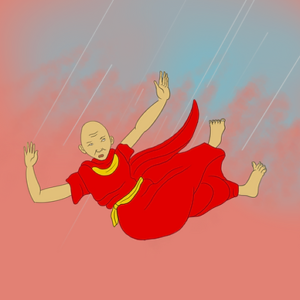
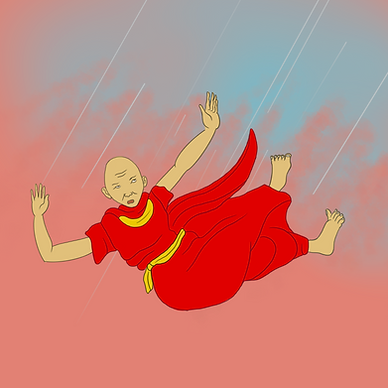
Though he hadn’t eaten in days, he made the long, treacherous walk to the Lama’s cave. At the entrance of the cave, he caught sight of all the bones the Lama had disposed off. Bones everywhere! It felt like someone had woven a mat out of bones and laid it at the entrance. It occurred to him that he had consumed a lot more than the Lama had. How could he?! He was overcome with grief. Gompo Dorje didn’t think twice before jumping off the ledge in remorse. Mountain people believe that when one truly sheds the weight of one’s misdeeds, they are set on the path of salvation. Gompo Dorje was seen flying high, onwards into a different realm.

Illustration: Nawang Tankhe

The Lama observed this episode from his seat in the cave. A thought crossed his mind. If a lowly hunter could find the path to salvation, surely someone of his stature who had lived an austere life, deserved it more. He got up from his seat and jumped off the ledge. But nothing is heavier than one’s inflated ego. Lama tumbled down the deep gorge, never to be seen again.

  • Bharal a is Himalayan wild sheep with a bluish coat and backward-curving horns.
  • Ibex is a wild mountain goat with long, thick ridged horns and a beard, found in parts of Lahaul and Spiti, including Pin Valley.
  • Kibber is a village in Spiti valley which was previously an important center of trade and activity.
  • Lama is a buddhist monk.
  • Bandi-Farah is a beautiful gorge near Kibber. Khirav Gompo Dorje’s cave is still visible from this place.
  • Wooly hare is a shy and usually solitary animal, and although sometimes active by day, it is mostly nocturnal.
388 388 Ajay Bijoor
Birth of the Chandra river

Birth of the Chandra river

It is fairly well known that Gaddi herders from Kangra spend summer in the rich pastures of Lahaul. This is an annual migratory route that the Gaddi community have accessed for generations. They camp in the high mountain pastures. From a distance their life may seem idyllic – spending the day in the shadow of snow-clad peaks, breathing the crisp mountain air, basking in the soft summer sun. Unfortunately, the Gaddi’s dammed flock does not harbor such taste for a serene life in the mountains. All they care for is food! Each morning they bleat to be taken to a new slope where they can get their fill of fresh summer grass. And the poor Gaddi herder has to run behind them to make sure the flock remains safe, for a pesky wolf waiting to feast on the flock is almost never very far. Summer days are very long. But as dusk sets in, the Gaddi gets some rest.

It had only been a few years since Noopalal started accompanying his aged uncle and their flock. Their settlement was at the farthest end of Lahaul valley. It was so far that most herders had only heard of it. It was famous for a beautiful lake that had turquoise-blue water.

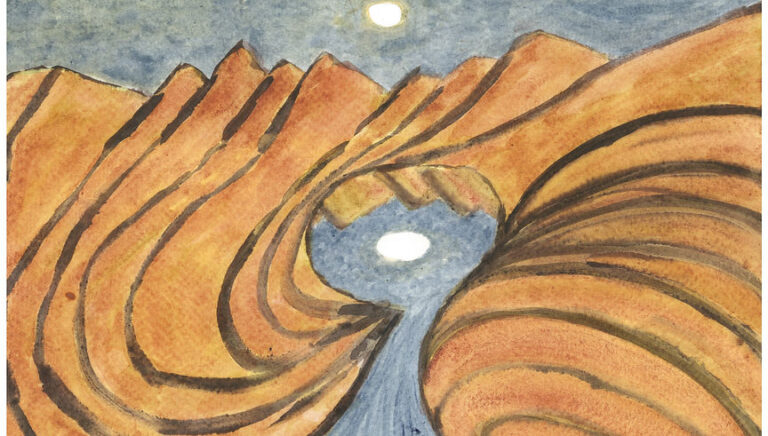
Noopalal was in-charge of the flock, while his old uncle stayed back and cooked for them. Every evening Noopalal would herd the flock and sit outside their thaach, which overlooked the lake. He would slowly pull out his flute and play it softly while his uncle smoked a pipe. Even though there was no one but his animals to listen, he played the flute because it gave him joy. On most days it would get dark by the time he finished. He would then crawl into the thaach, eat his meal, and retire for the day. This was the ritual he followed on most days until it all changed one night. The moon was full and when Noopalal finished playing his flute he looked mesmerized. As if he were possessed, as if someone had cast a spell on him. When he looked at the lake he saw a reflection of the full moon in its turquoise-blue water. He stood up in shock. “The moon has fallen in the lake”, he whispered. “The moon is drowning. Help!” He yelled as he ran towards the lake. His old uncle barely registered anything, and by the time he did Noopalal had jumped into the icy cold water. His poor uncle ran behind him. But he could only watch helplessly. He remembered Noopalal shouting frantically that the moon is cracking, looking at the ripples on the surface of the water. By morning, both Noopalal and the moon were gone.

Did Noopalal sink with the moon that night? Maybe not. But many believe that the moon did, indeed, drown that night and the water that spilled over gave birth to the Chandra river. And the lake, Chandra tal, remains beautiful as ever. Especially on full moon nights. If you ever have the good fortune of spending a full moon’s night by Chandra tal, you might even hear Noopalal’s flute.

  • Gaddi herders are a semi-pastoral tribe that rear sheep and goat. Some of the sturdiest men and women, the Gaddis travel for 10-11 months with their livestock covering a vast distance across the Himalaya and her lower plains.
  • Kangra is a Himalayan region from where the Gaddi herders hail. It is also a district in the State of Himachal Pradesh.
  • Lahaul is another remote Himalayan valley that can be reached after crossing the Rohtang pass. Lahaul valley is adjacent to Spiti valley and together Lahaul-Spiti forms the biggest district of Himachal Pradesh.
  • Thaach is a stone hut that gaddi herders live inside in places where they camp. These stone huts are old and beautifully built by stacking stones. They protect the herders from rough weather.
  • Chandra river rises from the snow lying at the base of the main Himalayan range in the Lahaul and Spiti district. The beautiful Chandra Tal has formed at its source.
  • Chandra tal is a beautiful high-altitude lake known for its beauty. It is also a very beautiful site to watch water birds. It is a mythologically important site.
864 491 Ajay Bijoor
The Rabbit, the Fox and the Snow Leopard

The Rabbit, the Fox and the Snow Leopard

Once, there was a rabbit, a fox and a snow leopard. They lived together in the wild pastures of Pin Valley. The snow leopard was very fond of getting drunk, and loved to drink the blood of animals he had killed, just like humans get drunk when they drink alcohol.

Because the snow leopard was the strongest of all the animals, he would make the fox and the rabbit do all the work. The other animals grew tired of this and decided to get rid of the snow leopard. ​

One day, there was a wedding in the human village and the animals went into the village to partake in the humans’ food and alcohol and to enjoy the party. When the party was in full swing, the rabbit and the fox put on some jewelry and started to dance. Soon, all the animals had started dancing.

The snow leopard was the most drunk of all the animals and started singing loudly. He sang so loudly that his song caught the attention of the human villagers.

The rabbit and the fox smiled at each other mischievously. This was their chance. They got a very long gun and trained it on the snow leopard.

The snow leopard paused mid-song. Even in his very drunk state, the snow leopard had noticed the gun. He froze on the spot.

Meanwhile, the villagers had come running along to see what had caused all the commotion. The fox and the rabbit ran away, but the gun was still trained on the snow leopard, so he could not move.

The villagers saw the mess that the animals had made: the food, the alcohol, the scattered jewelry and the disheveled, drunk snow leopard. The villagers killed the snow leopard, while the fox and the rabbit gained their freedom.

Of course, snow leopards are very precious to us now in Spiti and none of us would ever harm them. But you might still hear local people telling stories of snow leopards who like to drink blood and get very drunk…

1393 1612 Dr. Jane Orton
Balu Thukangbu

Balu Thukangbu

Balu Thukangbu is a little man who lives in the Himalayas. In the Spiti region, you will hear stories of him from Kaza to Kibber, from Chicham to Tashigang, from Kee to Bur, from Demul to Sagnam.​

No-one is quite sure where Balu lives. In Pin Valley, they say that Balu comes from biyul, a hidden land that only holy people can enter. In Kibber Valley, they say that Balu comes from a place just above Gete village, but no-one has seen him for a long time.

Balu is said to be one foot tall. He wears a one-foot-tall hat and carries a one-foot-tall stick. He can grant wishes, but first you must overpower him and take his stick and his hat.

This, however, is no easy task, because Balu has the strength of a bear.

He is also very hard to see. Some people say they once glimpsed something from the corner of their eye and wondered if it could have been Balu. Others say that only holy people or those with a fearful spirit can see him.

This does not stop people from trying, though. People love the idea of having their wishes granted. Some people even try to catch Balu and keep him as a servant.

Balu dislikes such treatment. If he is caught, Balu will try to escape and punish those who held him captive.​

In early times, Balu used to play in Key pond, but some of the villagers tried to catch him. After that, he was afraid and did not want to come back.

This did not stop people from trying, all over Spiti. People love wishes.

One of the villagers did manage to get hold of him one day and put the stick and the hat in a place too high for him to reach. They made Balu live in the kitchen as a servant. At ploughing time, Balu was sent to help in the fields.

Ploughing is hard work and requires help from everyone. The villagers made sure that Balu was always on hand. He was charged with the task of maintaining the equipment and mending anything that got broken.

One day, the stick from the plough was broken, so a boy was sent back to the village to get a new stick. The boy was in a rush. He saw a stick on one of the high shelves in the kitchen and grabbed it. He ran back to the field and gave it to Balu so he could mend the plough.

As you have probably guessed, the boy had taken Balu’s stick by mistake. He handed the stick to the little man. With his stick returned to him, Balu was able to escape.

Balu was still angry at the way he was treated and cursed the village. From Kaza to Kibber, from Chicham to Tashigang, from Kee to Bur, from Demul to Sagnam, people talk about the fate of the village cursed by Balu. They agree that Balu is very formidable, despite his size.​

Of course, that doesn’t put people off trying to catch him. People love wishes. Some people still try to catch a glimpse of him, and discuss whether they would try to catch him themselves if they saw him. What would you do?​

  • Chicham, Tashigang, Kee, Demul and Gete are villages in the Spiti valley and fall on the left bank of the Spiti river.
  • Pin valley is a small valley inside Spiti which is known for its scenic beauty and very hospitable people, much like the rest of Spiti.
  • Bur and Sagnam are villages in Pin valley.
  • Key pond is a lovely pond near the Kee village.
472 625 Dr. Jane Orton
Shangdong to Stupa
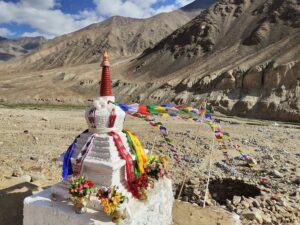
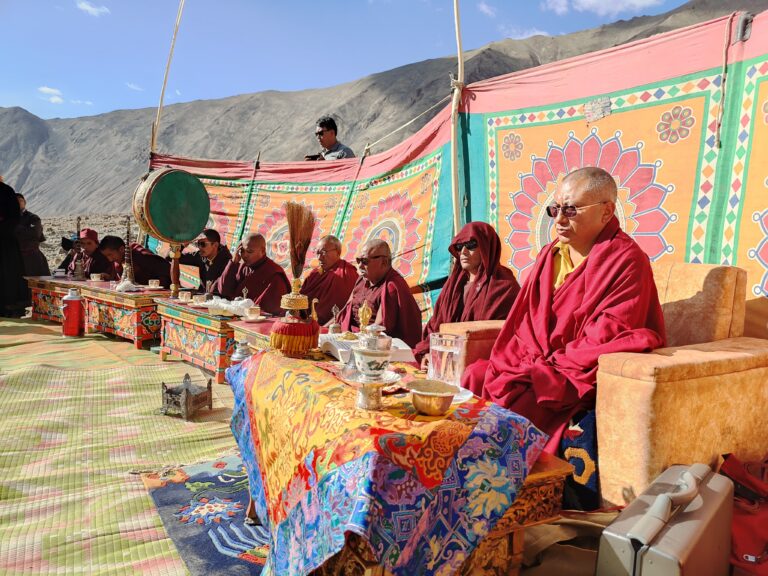
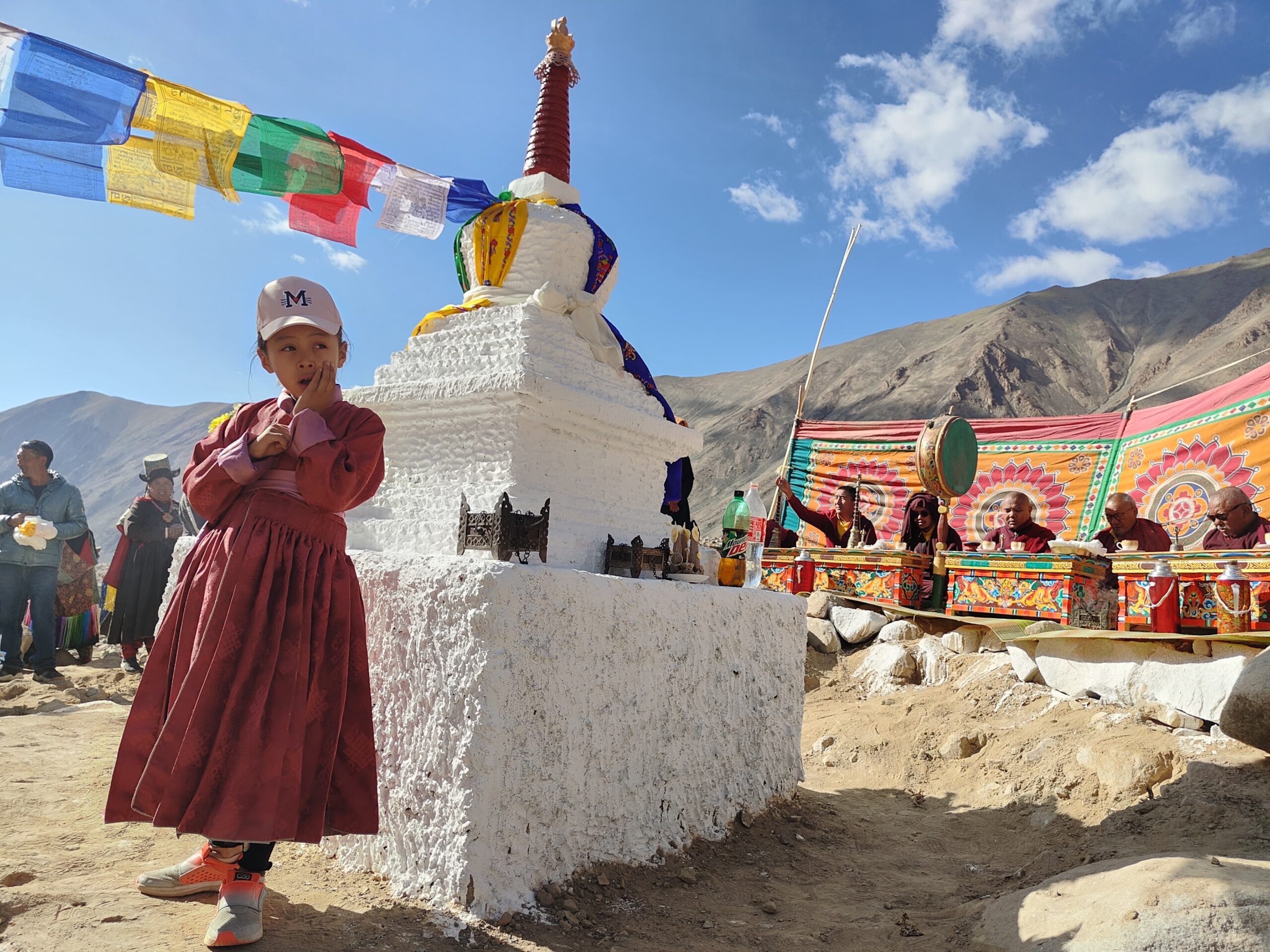
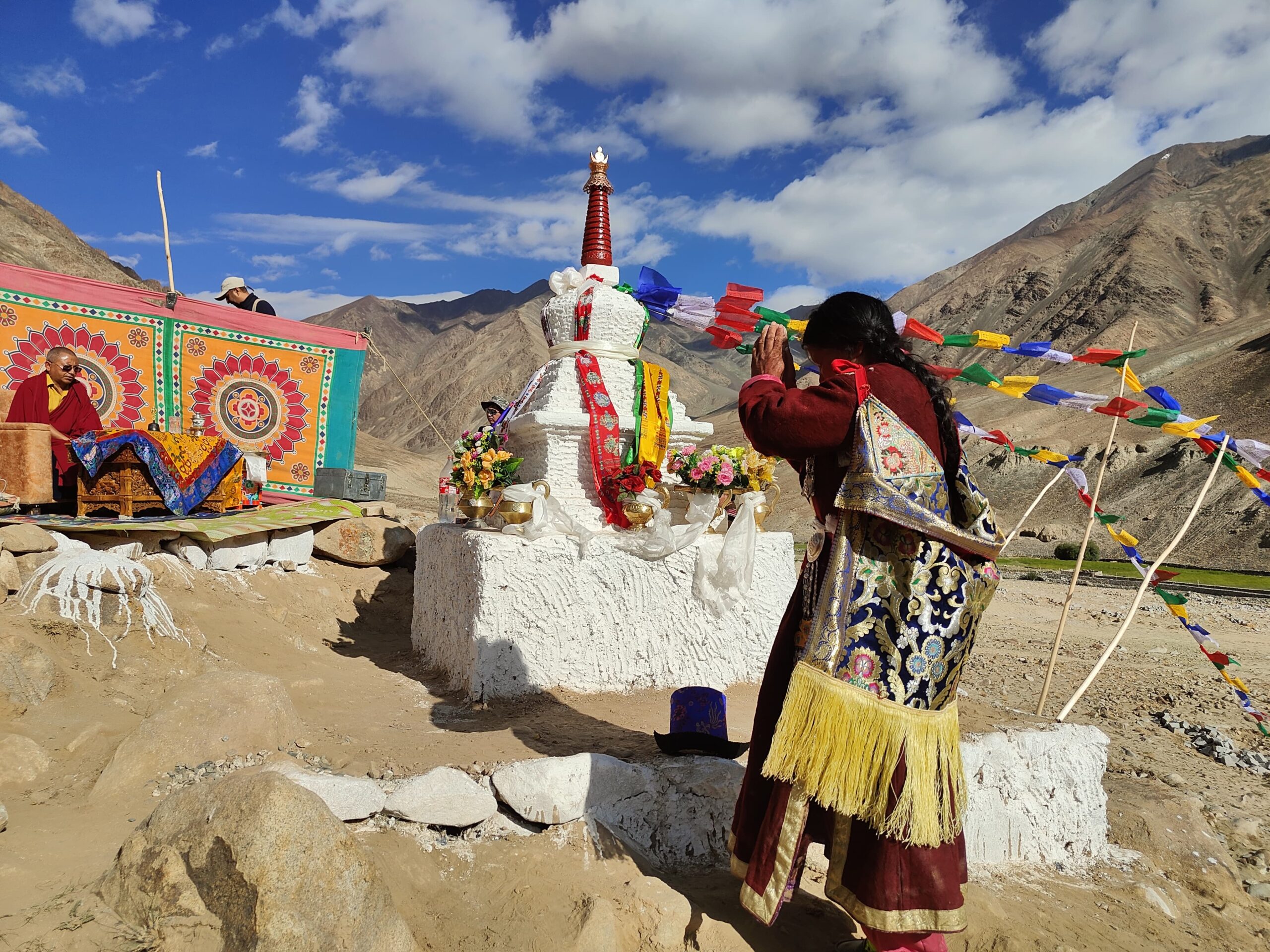
Consecration ceremony of the newly constructed Stupa at Tharuk, July 2024

Shangdong to Stupa

Two years ago, during a winter vacation, I took my four-year-old daughter, Gyanzin Yeeyong Wangmo, to a Shangdong, an ancient wolf trap. I wanted to share the stories of my childhood and the experiences of our village, where people once relied heavily
on livestock for their livelihood. The Shangdong was a method used to control the wolf population and protect domestic animals from these predators. I vividly remember a day when, on my way to school, I heard a commotion—dogs barking and
people shouting. Drawn by curiosity, I arrived at the scene to find a wolf trapped and being stoned by the villagers. The reactions were mixed: some were relieved, while others, particularly the elderly, chanted “OM MANI PADME HUM,” praying for the
wolf’s soul. This ritual reflected a deep-seated ambivalence—people felt compelled to kill the wolf, but not without sorrow.

​Sharing these stories with Gyanzin made me reflect on the complex relationship between our community and wildlife. It also reminded me of the “Shangdong to Stupa” project initiated by the Nature Conservation Foundation (NCF) in 2016. The project aimed to replace these wolf traps with stupas, symbolizing a shift from harm to healing and from fear to coexistence. The first stupa was built in Chushul, and since then, six more have been constructed across Ladakh.​

​The site I visited with Gyanzin seemed a fitting location for another stupa. I reached out to Karma Sonam, the field coordinator at NCF, to discuss the possibility of incorporating this site into the project. Despite recent incidents of wolves preying on livestock in the valley, including losses within our own family, we believed that fostering a more positive attitude toward wildlife was crucial.

Consecration ceremony of the newly constructed Stupa at Tharuk, July 2024

Consecration ceremony of the newly constructed Stupa at Tharuk, July 2024

On July 20, 2024, with the collective efforts of the NCF and the villagers of Tharuk, the seventh stupa was completed near a traditional Shangdong in the Serkungchan valley. This effort, part of the “Shangdong to Stupa” project, represents a significant move towards wildlife conservation and a renewed respect for nature. The construction began on July 14, 2024, with the support of Karma Sonam, the NCF team, skilled stupa makers from Nubra, and the Tharuk villagers. The stupa was completed on July 19 and consecrated on July 20 by His Eminence Bakula Rangdol Nima Rinpoche, Khenpo Shedrup, and monks from Shachukul Monastery.

His Eminence Bakula Rangdol Nima Rinpoche, who had blessed the first stupa at Chushul in 2018, encouraged the community to live in harmony with wildlife and to cherish their natural surroundings . He commended the efforts of NCF and the Tharuk villagers, emphasizing the importance of this project as a model for other regions in Ladakh and the Himalayas, where similar traditional practices still persist.

The transformation from Shangdong to Stupa symbolizes a journey of forgiveness and a commitment to conservation. It reflects a growing awareness and respect for the delicate balance of our ecosystem, where both humans and wildlife can coexist peacefully. Through this initiative, we hope to inspire other communities to embrace compassionate and sustainable practices, ensuring a harmonious future for all beings.

2560 1920 Dr. Stanzin Namgial
Kinzin Racho

Kinzin Racho

Watch a 200-year old ritual performed in Rangrik village on the third day of Spiti Losar (Spitian New Year) remembering the village deity who appeared as a magnificent ibex. Kinzin Racho Halema meaning, the splendid horns of the ibex, is the song sung across Spiti valley in the first week of the Spitian New Year.

स्पीति लोसर (स्पिटियन नव वर्ष) के तीसरे दिन रंग्रिक गांव में एक शानदार आइबेक्स के रूप में प्रकट हुए गांव के देवता की याद में मनाया जाने वाला 200 साल पुराना उत्सव देखें। किंज़िन राचो हलेमा जिसका अर्थ है, आइबेक्स के शानदार सींग, स्पिटियन लोसर के पहले सप्ताह में गाया जाने वाला गीत है।

Singer: Yangchen Dolma
Additional footage: Tanzin Thinley and Kesang Chunit
गायक: यांगचेन डोल्मा
अतिरिक्त फ़ुटेज: तंज़िन थिनले और केसांग चुनिट

1200 702 Himkatha