Dry Toilets

Memories, Nostalgia, and a Forgotten Practice
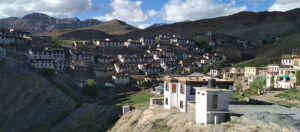
Kibber Village, Spiti | Photo: Nonie Rawat

Memories, Nostalgia, and a Forgotten Practice

Growing up in Spiti, a place so beautiful and serene was a heavenly experience with valleys and rivers that enchants anyone witnessing its beauty. It attracts visitors from all over the world, some first-timers, and some seasonal regulars, and leaves them with the same impressions. When one tries to capture its beauty – the mountain villages clustered with white-washed mud houses in the serrated landscape appear like a flock of sheep grazing on the fields.
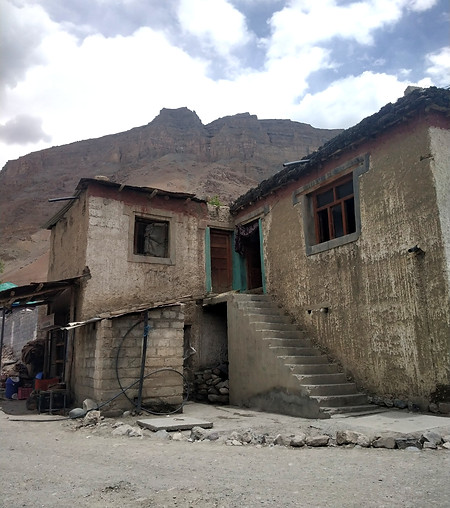
A mud house in middle of Kaza market, Spiti | Photo: Nonie Rawat

The traditional architecture and the socio-cultural practices are the outcomes of the prevailing topography and climatic conditions giving Spiti its unique persona & originality. In the past couple of years, the wave of RCC-based structures has dominated several villages and have taken its malicious grip. It is due to the recent abrupt rise of tourism in the region and considering these changes, the place is likely to lose its essence and everything that’s worth treasuring. The massive plague of concrete structures has devastated the vernacular house designs with the built, form, size, and material totally devoid of its regional context.

The picturesque villages dotted with traditional mudhouses are slowly turning into a jungle of massive concrete structures. It’s mostly hotels, guesthouses, and other commercial buildings. One of the reasons for this shift is to accommodate the heavy-flowing tourists with modern facilities in a cold desert. Spiti being a rural area doesn’t have the preparation required to handle this heavy flux of tourism and the burden is too sudden and heavy for the locals  to administer. The unregulated flow of heavy tourists can have many adverse effects on the local ecology and architecture. It will influence changes in the land use, will cause urbanization, large-scale construction of tourist facilities, illegal constructions, changes in the vernacular design orientation, increased waste pollution, and degradation of local aesthetics which are attuned to its natural surroundings. We need to realize collectively that it’s the architectural authenticity and unique cultural practices of the place that leaves mark on people visiting the place.

Many aspects of modernization are creeping up in the valley – some truly meaningful like building bridges that connect remote villages but others monstrous like encroachment of animal habitat and village pastureland. The abandonment of dry toilets (chaksa) to adopt

modern flush toilets in a water-scarce place like Spiti.  The dry toilet not only saves water but also produces manure for the crops. Whereas the western toilet system is not the most conducive design intervention in the valley as it remains out of order for about 6 months, and the water pipes freeze during winter. In this wave of development, Spiti is losing its authenticity. The constructions are now spreading to agricultural lands as more families find it easier to earn a livelihood from tourism than farming. The old houses have thoughtful architectural designs like having low ceilings of about 100mm, which helps conserve heat. The ground floor and the first floor both have rooms for seasonal activities. The ground floor is specifically built keeping the freezing winters in mind. The floor is divided into spaces for both livestock and the family. There are additional rooms to store grains, fodders, and a Chingbuk – a celler for storing Chang and Aarak (barley based alcoholic beverages).  There’s also a tiny opening for ventilation and heat obtained from the animals, and the grain and grass storing places work as insulators that keep the house warm and cozy during winters. During summer the first floor is preferable due to proper lighting and ventilation. This floor is breezier and has more room to attend to the summer guests. These rooms will be properly ventilated and have big wide windows, with the peripheral frames painted black, absorbing and allowing maximum sun.
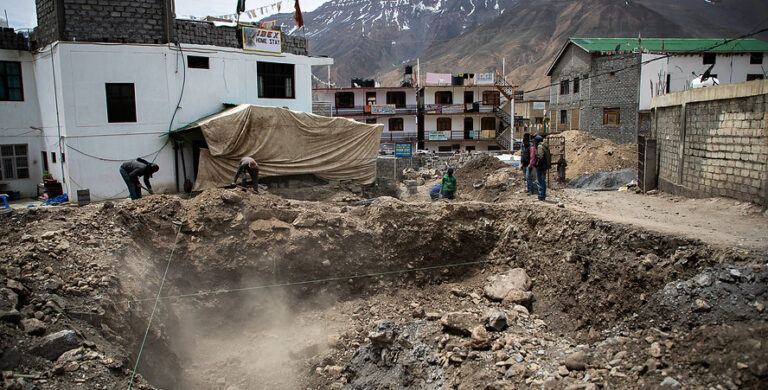
New constructions in Kaza | Photo: Tanvi Dutt

A typical traditional mud house in Spiti has a basic stone foundation running all along with the boundary wall. The locals use wooden planks as mould which supports the foot and a mixture of hay and mud to make the walls. The process is continued and the wall is built layer by layer at a time, leaving voids as per the requirements. The insulated roof starts with placing the main girder mugdungh, which is often supported using a wooden column kaa, this column, in the center of the room, also serves as the aesthetic feature of the room. Then the secondary girder, phurdungh, is placed on top of which, tightly knitted willow sticks, dhilu, are laid. The flat roof is finished with laying a thick layer of mud. To protect the edges of the mud structure from rain and snow some houses have bundled-up bushes stacked at the periphery of the roof along thorny bushes, dhama. The natives used to build with what was available to them and best suited the regional climate. This is what shelter means, building something suitable for you according to the climate and availability of the resource, hence the vernacular architecture of a place merges with the context, the landscape.
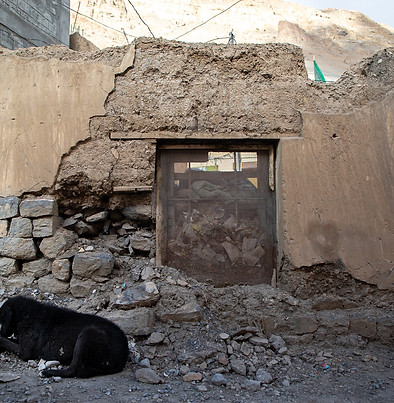
A dilapidated building in Kaza | Photo: Tanvi Dutt

The traditional method of construction is not practiced these days therefore the skill is endangered. The thousand years old monasteries in the villages of Spiti were made of mud block-forming walls up to a meter thick. All these monasteries are still surviving and functional, they are likely to survive another 10-20 decades, even more, if maintained professionally. The maintenance of historical monuments like our monasteries for cultural preservation, further building a repository of local knowledge, and sustaining the innate quality of the historic buildings is necessary. The neglect in restoration work in these historic monasteries is washing down the structure. The walls are likely to survive the next few decades but might lose the other characteristic it holds now. The negligence may not feel like a massive part of this problem right now because it’s at a stage where it goes unnoticed, and is invisible but eventually, over years it will start showing up. We should evolve and use the modern facilities, resources, and knowledge we now have access to.
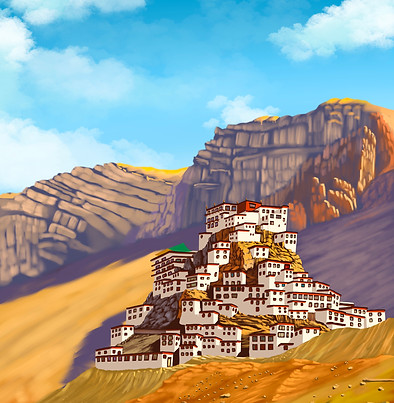
Iconic structure of Kee Gonpa, Spiti | Illustration: Nawang Tankhe

The state of development and accessibility has made us avail many new resources. The traditional houses in Spiti evolved from shutting the tiny window using a good-sized rock to wooden windows to big windows with glass which allows maximum sunlight to enter and keep the house warm. This is one example of how to use the resources available to enhance the traditional structure. But now we are evolving in the wrong direction. Adapting materials that do not comply with the context and then we spend time and energy to fix the problem we created. In a cold desert like Spiti during winter mud houses work as insulated buildings. For the piercing cold winters, people don’t need RCC houses which do not retain heat, freeze everything inside them, and cause a lot of health problems after prolonged usage. Humans have always started with natural resources and mud is the oldest of all the natural resources used in construction. It is found in abundance, and unlike cement, it goes back to nature without polluting the landscape. From the earth to the earth. It’s high time for Spitians to bring back its forgotten practice.
885 389 Nonie Rawat
Microbial intervention in Himalayan Dry Toilets
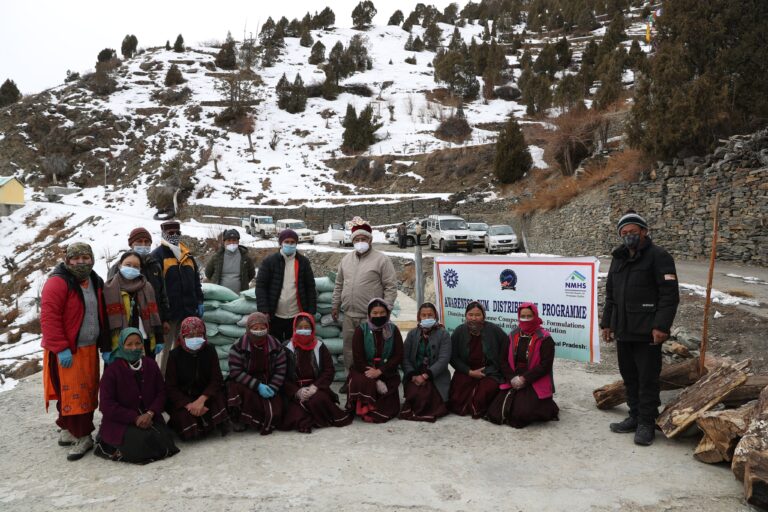
Distribution of Compost Booster in Lahaul

Microbial intervention in Himalayan Dry Toilets

As we meandered through the narrow streets of Ribling, Tandi, Sumnam and Ghoshal villages in Himachal Pradesh’s Lahaul district, we saw the indelible change of modernisation that had reached even the remotest corners of India. The cemented pavement had replaced the old mountain roads and the concrete houses were replacing the traditional wood and mud houses. In this new emerging transformation, small two-storey mud-houses outside people’s houses stood as a mysterious testament to the old ways.

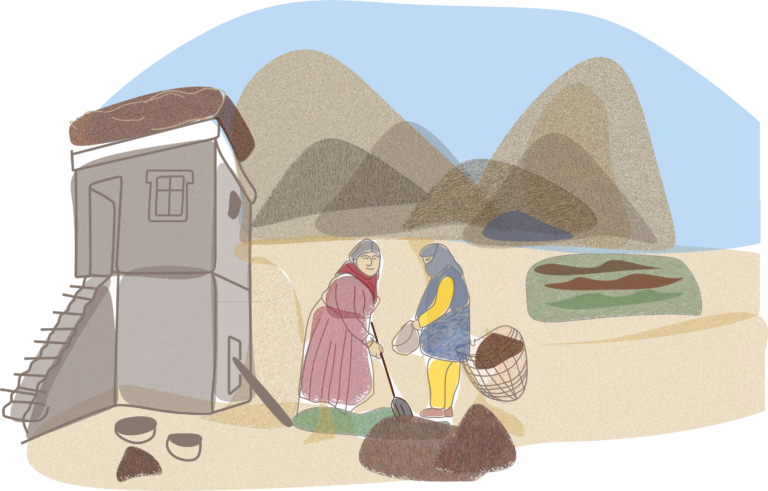
In 2017, we stayed at the Center for High Altitude Biology (CeHAB)’s research centre at Ribling in Lahaul and it was during those field expeditions to the cold deserts in the Western Himalayas that I first came across the concept of ‘dry toilets’.  Just as we were getting increasingly inquisitive about these small mud structures, we ran into Mr. Jagdeep Katoch, one of the residents and a former school principal in the village. He patiently explained to us that these structures are called ‘ghop’ – traditional dry toilets used  by communities in the cold arid zones like Lahaul, Spiti and Ladakh  to uniquely manage human waste in the region.

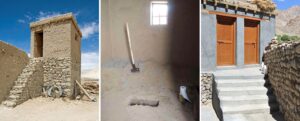
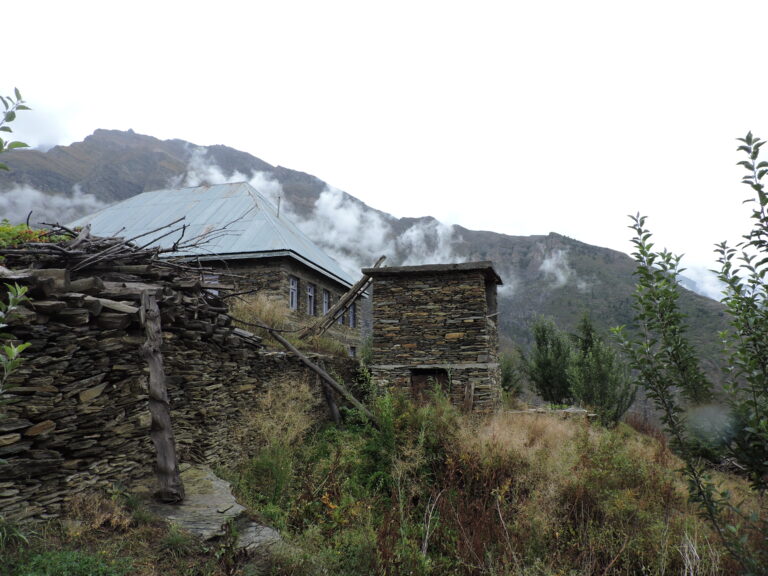
Traditional Ghop in Lahaul

These two-tiered structures have an upper section, which is attached to the living room of the house; and the lower section where night soils are collected. After every use, a dry mixture of wood chips and ash locally called ‘fot’ is used to cover the faeces. The heap of the night soil is manually taken out every 6 months and left in the fields to mature. Thus, the compost is rich in nutrients and is a very useful input for agriculture in the region.

These regions also receive very less precipitation throughout the year making water availability extremely difficult and that’s why it was intriguing to observe how people in these remote villages sustainably manage human-waste that’s beneficial for their agro-ecosystem. In the Himalayan cold desert, these dry toilets (ghop) help conserve water during freezing winter and sustain organic farming with manure supply. When winter sets in, people increasingly depend on dry toilets, and later in the year, this decomposed night soil is used as manure for farms.

For generations, locals have relied on naturally-occurring bacteria to degrade the wastes. However, the practice comes with several disadvantages as due to extreme cold weather conditions, there are very few microbes that can function at such low temperatures.  As a result, the quality of the compost is not as good as one would expect.

Additionally, the influx of tourism and introduction of modern septic systems has brought change in the regional sanitation practices with more people resorting to pour-flush toilets. This has not only brought tremendous change in age-old practice of using dry toilets, night soil composting, but has also put the availability of water under severe stress in already resource strained places. Dr. Sanjay Kumar,  (Director, CSIR-IHBT, Palampur ) Chief Scientist and an ardent advocate of bio resource has always inspired us to ground our work, research around social issues and due to his guidance and support , we found the best opportunity to address the issue of solid waste management in high Himalayan regions by scientifically intervening and facilitating faster degradation of the night soil through Compost Booster- a microbial formulation for rapid degradation of night soil to manage human waste in cold desert areas.

Distribution of Compost Booster in Lahaul

The decomposition of any organic biomass is dependent on its microbial population.In Lahaul-Spiti, due to prolonged winters with sub-zero temperatures the decomposition of night soil is often slow as the first phase of composting- the mesophilic bacteria phase- crucial for decaying the organic material are inactive in this temperature range. At CSIR-IHBT, Palampur, our team at High Altitude Microbiology lab, Department of Biotechnology, formulated an indigenous bacterial consortium from the night soil compost’s different maturity phases. These cold- tolerant bacterial populations remain active even at such low temperatures up to four degree Celsius and produce enzymes that speed up the process of biomass degradation. The bacteria used for this purpose also have plant growth promoting attributes so that the end product is enriched compost high in nutrients and possess plant growth promoting bacteria.The financial aid from National Mission on Himalayan Studies (NMHS) by the Ministry of Environment, Forest & Climate Change (MoEF&CC) were crucial to enable key research on ground.

The sample of compost boosters were distributed among a few households in Lahaul for trial in 2018. We asked the villagers to use a handful of the sample in place of fot and the feedback was quite motivating. They observed that the mixture helped degrade the night soil better and reduces the odour as well. Mr. Devi Singh of Mooling village keenly shares that  earlier he used to collect 20 “Kiltas” (baskets)  to collect the degraded night soil compost but after the using the Compost Booster, the biomass was degraded so well that he collected only 10 Kiltas which is of much better compost quality and there’s reduction in foul smell too.

With increased demand and product popularity, we conducted awareness drives, interaction sessions and training programmes across five gram-panchayats  in Lahaul and Compost boosters were distributed to approximately 160 households in December 2020 and January 2021. In future, we endeavour to reach out to communities across the high himalayan landscape including Spiti and Ladakh for similar intervention.

Contact for queries:
Rakshak Kumar
Scientist & Asst. Professor (AcSIR),
High Altitude Microbiology Laboratory (HAM-LAB), Department of Biotechnology, CSIR-Institute of Himalayan Bioresource Technology, Palampur-176061 (HP)
Tel: +91 1894 233339, ext. 441
Mobile: +91 98829 86355
E mail: rakshak@ihbt.res.in/ rakshakacharya@gmail.com 

2560 1153 Dr. Rakshak Kumar
Ecological Importance of Dry Toilets
Photo taken from an online source

Ecological Importance of Dry Toilets

Spiti Valley is a rural and dry mountain region located in the Indian Himalayas in Himachal Pradesh. Being a cold desert valley, it receives very less rainfall in the summers which is not enough for the crops to thrive. Dependence on water is therefore exclusively centered around glaciers whose water collect in streams traditionally called ‘tokpos’ and rivulets called ‘yuras.’ Local communities thrive next to the tokpos from where water is diverted into the fields through yuras. The unfortunate dual existence of agriculture and scanty rainfall compels the farmers to engage in a tedious task of irrigating the fields using glacial water. Additionally, Spiti also faces water shortage in winters, due to which people depend on pipelines (most of the villages lack it) and hand pumps to extract water for daily use. The hand pumps also have predictable chances of freezing and becoming unusable due to sub-zero temperatures. The problem of water-scarcity is however eased by the existence of dry toilets which do not need input of water like modern pour flush toilets, also producing natural manure for the fields

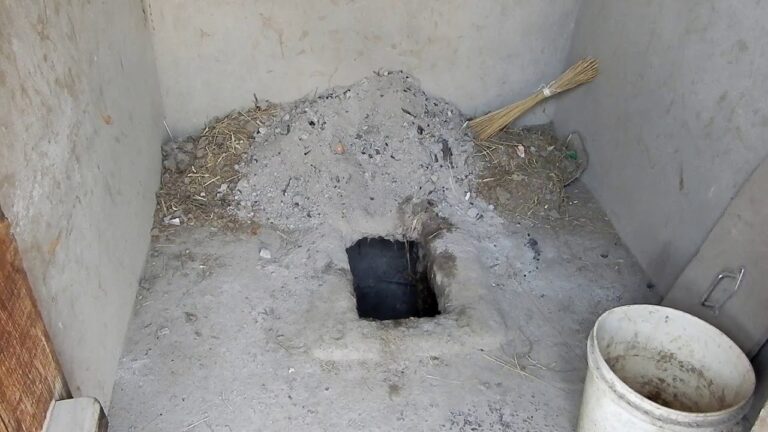
Photo taken from an online source

A deeper look into the traditional agricultural practices of Spiti shows how the local knowledge pertaining personal sphere of sanitation holds symbolic power to question not only the design of modern sanitation systems but also the paradox of development and modernity that cities are clothed with. What is progress if whatever new infrastructural advancements we are coming up with are detached from the ecology of the area it is being used in? Is it even progress if it’s happening at the cost of the deterioration of nature’s resources? We have been using dry toilets for generations in these cold Himalayas. It is also called composting toilets and are the ancient versions of modern eco-san toilets. It has two levels, a toilet on the top and a composting unit underneath. After using the toilet, we shovel a bit of dirt (mostly ashes, hay or dry dung) into the composting unit, through a hole to facilitate decomposition by microorganisms. The dirt also covers the waste and blocks the foul smell. Furthermore, these toilets do not need water.

At the end of every year, we clean the composting unit of every household with the help of our neighbours, friends and relatives. It is a communal affair and the waste that has decomposed is usually dry. The naturally formed manure is put to use in the fields before the ploughing season. In Spiti, therefore, there is no concept of ‘waste.’ The symbiotic relationship between the toilet design systems in Spiti and the fragile ecosystem facilitates growth of healthy crops and reduces the brunt of water crisis in the region. The use of dry toilets is therefore an eco-sensitive wisdom born out of the geographical realities of this cold desert and is especially useful in the winters when water freezes. However, an influx of tourists and the effect of modernity is not only hierarchizing sanitation design systems but is also disrupting indigenous knowledge and the temporal existence of infrastructure when it comes to construction of toilets.

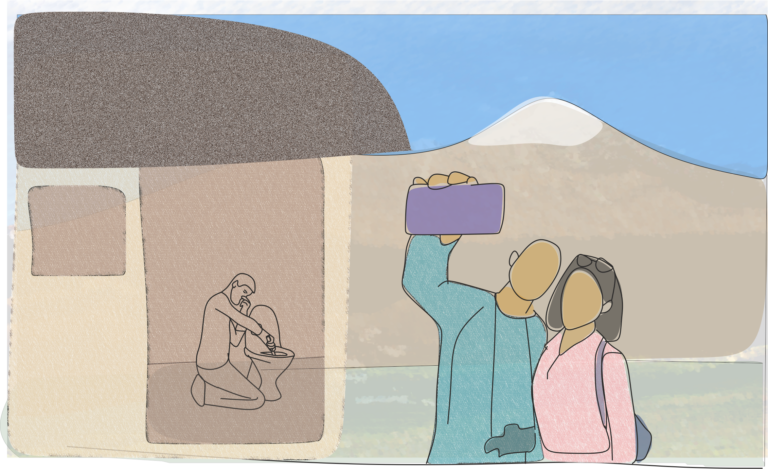
Modern toilets invisibilise waste | Illustration: Malvika

Symbolism of Toilet Design

Sanitation, although a very personal matter, is also very political. It is impacted by class, caste and geographical privileges that one is born with. Living in a society marked by caste, class and gender differences, our everyday objects and infrastructures are filled with symbolic meanings which have political connotations. Most of the semiotics revolving around these infrastructures are shaped by the overarching burden of development that we’re all expected to carry.

User & cleaner is the same person | Illustration: Malvika

The brunt of modernity is borne heavily by the marginalized communities who are socially, intellectually and financially less privileged. In the dry toilets of Spiti, there is an understanding of where one’s waste is going; one sees the waste and later when decomposed to form manure, materially engages with it. The ‘user’ and the ‘cleaner’ is the same person here. With modernity however, progress of sanitation design systems is measured by how well you can invisibilize the waste. There is no awareness of what trajectory one’s waste takes. In pour flush toilets, waste is flushed, it goes into sewers and ceases to exist visibly for those using it. The waste is left in the sewers and septic tanks to be manually engaged by those who are forced by their caste status to do so. Intentionally or unintentionally, modern toilets and sanitation design systems work efficiently only to strengthen the existing inequalities in society and stigmatize dirt, caste status and sanitation work. For the outsiders, these dry toilets are symbolic of the ‘backwardness’ of the region.

These toilets are looked down upon and therefore become an indicator of the scale of development one has afforded to reach. When I took one of my friends to visit Spiti to meet my family, the first thing my parents said on the phone was, “We don’t have a good toilet. Will she be able to manage with our traditional toilet”? With the oppressive discourse of so-called ‘development’ and the hierarchization of toilet design systems, the traditional toilets immediately become instruments that trigger shame and remind Spitians of their class and their ‘backwardness.’ It compels Spitians to be apologetic that they cannot keep pace with the race of modernity.

Tourism and Its Impact On Toilet Design

In recent years, Spiti has become a famous tourist hotspot. To service the influx of tourists, towns like Kaza have built many restaurants and hotels that are attached with modern pour-flush toilets and bathrooms. To cater to the preference of modernity and of the tourists, owners have constructed borewells to extract groundwater. With scarce rainfall, recharging the groundwater seems like a phenomenon that will take forever. Exhaustion of groundwater worsens the problem of water scarcity during the winters when tourists cease to visit. With tourists visiting and the influence of modern infrastructures, Spitians in the towns have moved away from their eco-sensitive traditional knowledge regarding construction of toilets. The indigenous knowledge is losing value in the face of the larger discourse around development and a drive to ‘modernize.’

In this era where development is seen as a linear phenomenon, rather than context-dependent, the dry toilets of Spiti symbolize how ‘backward’ or ‘developed’ one is. The toilets, therefore, become symbolic of one’s class and the scale of development one has reached in terms of sanitation. The visibility of the waste through the hole of the dry toilet is considered unclean. Dry toilets of Spiti are therefore, not only symbolic of how the ‘personal’ is linked to and influenced by the larger political discourse around development but also how infrastructures or sanitation design systems come to acquire and be trapped within social values of power, shame and backwardness.

1000 404 Sonam Yangzom