
Weaving Memory: Tsugden and the Passing of Tradition
1 May 2026
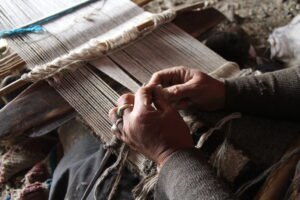
‘This tsugden “གཙུག་གདན” design is beautiful’, I told her. ‘I do not know if it’s beautiful, but it is really warm – enough to keep your bum safe from the cold!’ came the prompt retort as she sat weaving a new set of tsugden, a traditional rug, taking one thread to the next.
She woke up early, around 4:30 A.M., and prepared the fire, then brewed tea, and set breakfast up. Going on to do the daily chukjey, or livestock-related chores, my machung, or aunt, busied herself making sure the mother goats feed their baby goats. It is an intimate, laborious process that unfolds in minus-degree temperatures over the course of close to two hours. Her and Aku, my uncle, have to first let the mamos (mother sheep) and ramas (mother goats) out of the pen and then match each mother to her kid. Machung takes the job seriously. I asked her why. She poses a question of her own to me in return, ‘what would you feel if you didn’t get to feed your own children?’
They both know each baby’s mother and have a specific way of describing the animals so they can identify the right one from the sea of livestock. Once they match each pair, and as the kids feed gleefully, they keep checking whether it is satiated by gently pressing on its belly. If it feels full after a while, they start parting mother and child. Only once the animals were fed to their satisfaction, did we sit down for our own breakfast. Machung offered me fresh milk and bread, eggs remained off the menu; it was, after all, the auspicious 15th day on the Tibetan calendar. She put on some prayers on her mobile phone, the download option on Youtube is put to good use in Changthang! Upon completion, including offering water to the altar, she says she will go to the other tent to work on her thak, the backstrap loom. ‘I have not gotten to work on my thak for a while’, she tells me, ‘I had planned to work on it yesterday but had to go to Ngorchen to collect yak dung’. Ngorchen is one of the 11 locations they move around to as pastoralists in Changthang; here, the collection of dung becomes an essential task, without it the family would not have enough fuel for the fire to keep warm through the cold nights. ‘It has taken me almost a month to work on this piece, I do not get to weave as much as I would like to’, she shares with me. I ask her why she weaves, ‘because I can’, she replies, ‘as I age, I worry I will not be able to anymore’. Carpet weaving is a time-honoured tradition and an act of love Tibetan pastoralist mothers perform for their children. Weaving is how they declare their care, the yarn painstakingly intertwined fibre by fibre as a labour of love and an expression of ancestral tradition. ‘Who taught you to weave?’, I ask. ‘My mother, your eve (grandmother)’, she tells me, ‘I was interested in it when I was young and used to watch her weave, sometimes she would let me join in, that is how I learnt.’
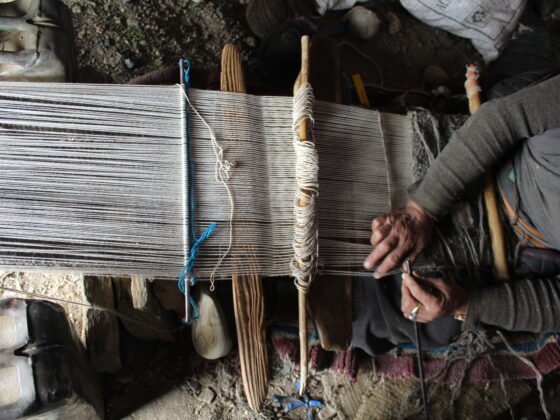
The act of weaving itself is only a part of the whole process. It is preceded by many months of gathering material itself. The first step is shearing the sheep for wool, followed by cleaning to remove grease and dirt, then carding to improve the quality, and finally spinning the wool into yarn. The yarn she is using at the moment was processed last year. Shearing, today, is an exercise of the collective. This time, about fourteen families came together in May to shear one family’s sheep, taking turns one by one to complete the task across almost ten days. They usually start as early as 4 A.M. and finish shearing by 12 P.M., with short breaks in between. When shearing duties fall on a family, they must prepare all the food, refreshments, and more. The affair is equal parts work, equal parts celebration. In my ashang, or uncle’s case, even my cousins who have moved to Leh came back for two days to help. Once the sheep are sheared, machung then keeps some wool for her own use. In the past, she used to do the carding herself, but she now prefers using the machine because it does not require as much work. When she goes to Leh, she takes the material along with her where they card it at a shop using a machine to align the fibers and remove debris to make it smooth and consistent. Once this is done, she finally spins it into thread, all this while managing every other responsibility pastoralist women are responsible for.
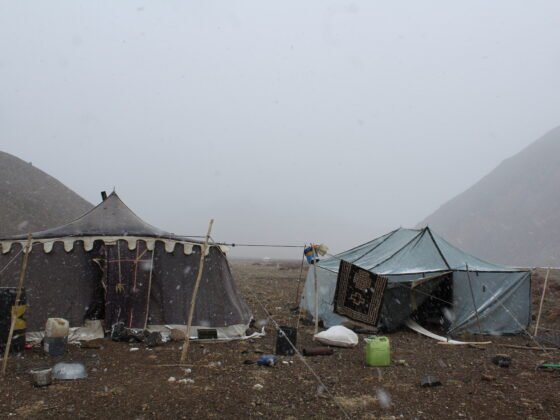
She sat and wove for two hours while I remained in the main tent processing my research interviews. With her lokpa, or a sheep-skin back cape, firmly draped across her back and her feet wrapped in several layers of warmth, she was well prepared to beat the cold. I, on the other hand, despite my best efforts to keep warm, was not doing too well in that regard. The day was particularly gloomy and just some time later it began to snow. As the weather continued to worsen, she asked me to put the baby goats and sheep in the pen, the one that is dug into the ground in preparation for these . The pen both keeps them warm, as well as safe from any wild animals that might want to feed on them. In the morning, the little goats are let out, it is such a joy to see them frolic and run around. Instead of keeping them cooped up, machung intentionally always lets them out on the ground so they can play. While I gathered the baby goats and put them into the underground pen, machung collected firewood and went to the main tent to start a warm, cozy fire as the whole valley transformed and the tall mountains surrounding us disappeared from view.
I think to myself about how different the reality of Changthang today is. In the span of a mere generation, much has changed in the lives of pastoralists living in the Indo-Tibetan borderlands. Intergenerational learning spaces, such as what machung described with the weaving, are slowly vanishing. Most young people are taken away from the plateau in search of education or employment, both necessities to survive the turbulence of modern life. Education for Tibetan refugee pastoralists is more than just a tool to adapt, it is also a crucial weapon in our arsenal as we continue our political fight against the Chinese colonial occupation of our home, Tibet.
Yet, in these pursuits, one most certainly feels a loss. In particular, that of the art of weaving, which is more than just the inert act of producing a commodity. Weaving perfectly captures the interconnected nature of women’s labor, human-animal relations, and relations with the land. In the past, everything was woven, even the clothes that pastoralists wore were made by themselves. Bags used for travel were woven, as are and the rebo, or tent, itself. So much of the culture was created out of necessity, to meet everyday needs. Unlike the interconnected global capitalist world, we live in today, where you can buy everything ready-made at the market, such an option did not exist back then.
While many weaving traditions, such as are slowly declining, tsugden is one enduring artifact still being woven today, mostly that consumes nomadic culture today. Other than for those purposes, these tsugden are mostly decorative, and adorn family homes in Changthang and Leh. Tsugden weaving, its labour process, offers us something beyond the extractive nature of commodity production that is so pervasive today, something that is in tune with the land. It is a slow production of textiles that does not support large-scale extraction and, in that, offers an alternative to consumer culture. These tsugdens are not used and thrown away immediately, unlike most products of fast-fashion which are purchased only to be discarded in pursuit of the next-best-thing. These modes of production, and ways of living have so much to teach us about what kinds of world we can build and inhibit when there are wars, climate disasters and genocide unfolding across the world.
The question then remains: how do we continue to preserve our traditions, knowledge systems, and relations when there is immense pressure to stay away from our lands and prioritize other relations, including getting further enrolled into the broader capitalist relations? Women pastoralists like my Machung continue the crafts my eve, grandmother passed down. But what about our generation – yes – you, dear reader, who has a pastoral heritage? The question for us is what do we value and what do we treasure? What kind of systems should we put in place so our tsugdens continue to be woven, passing down intergenerational knowledge? The future and responsibility lie with us.
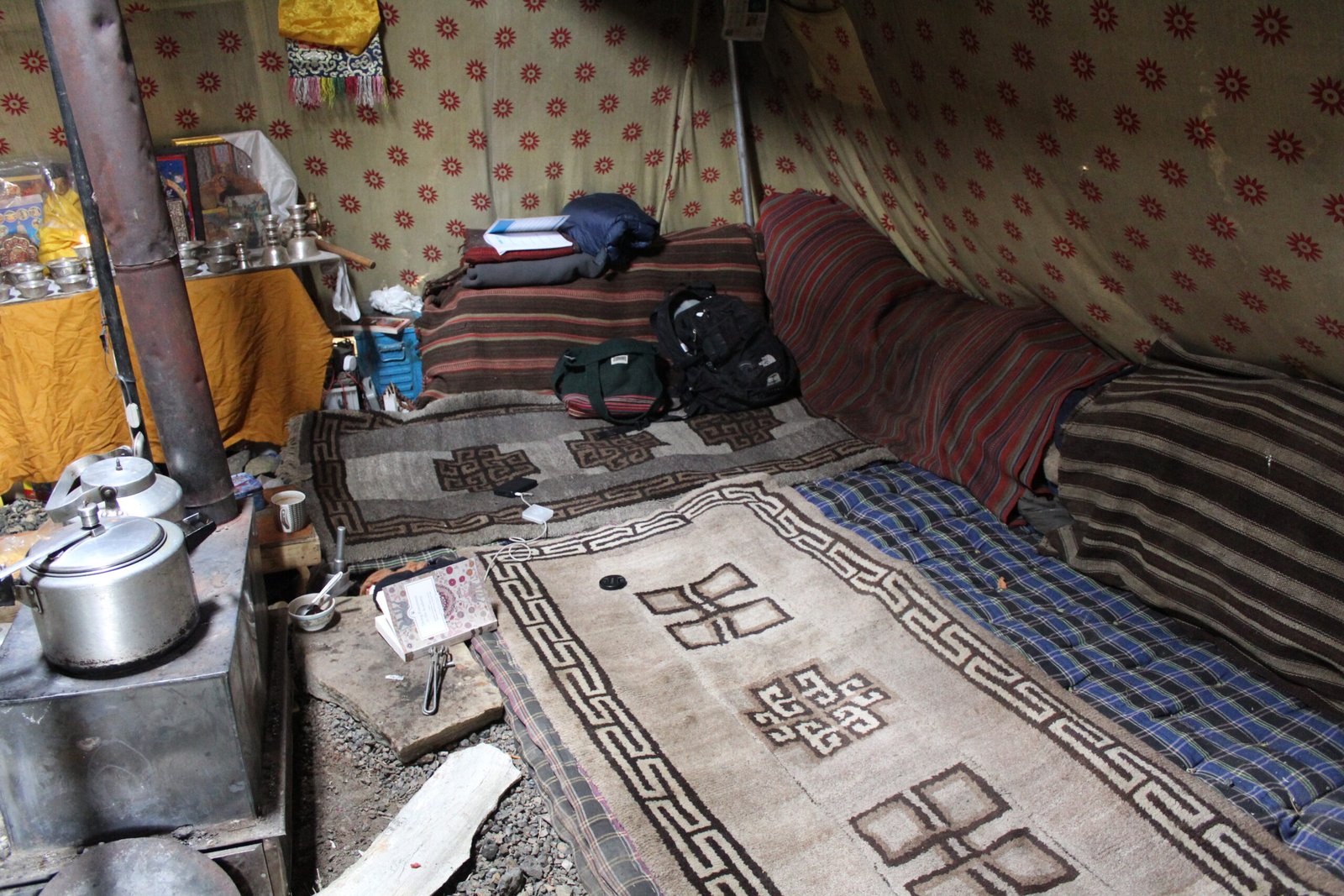
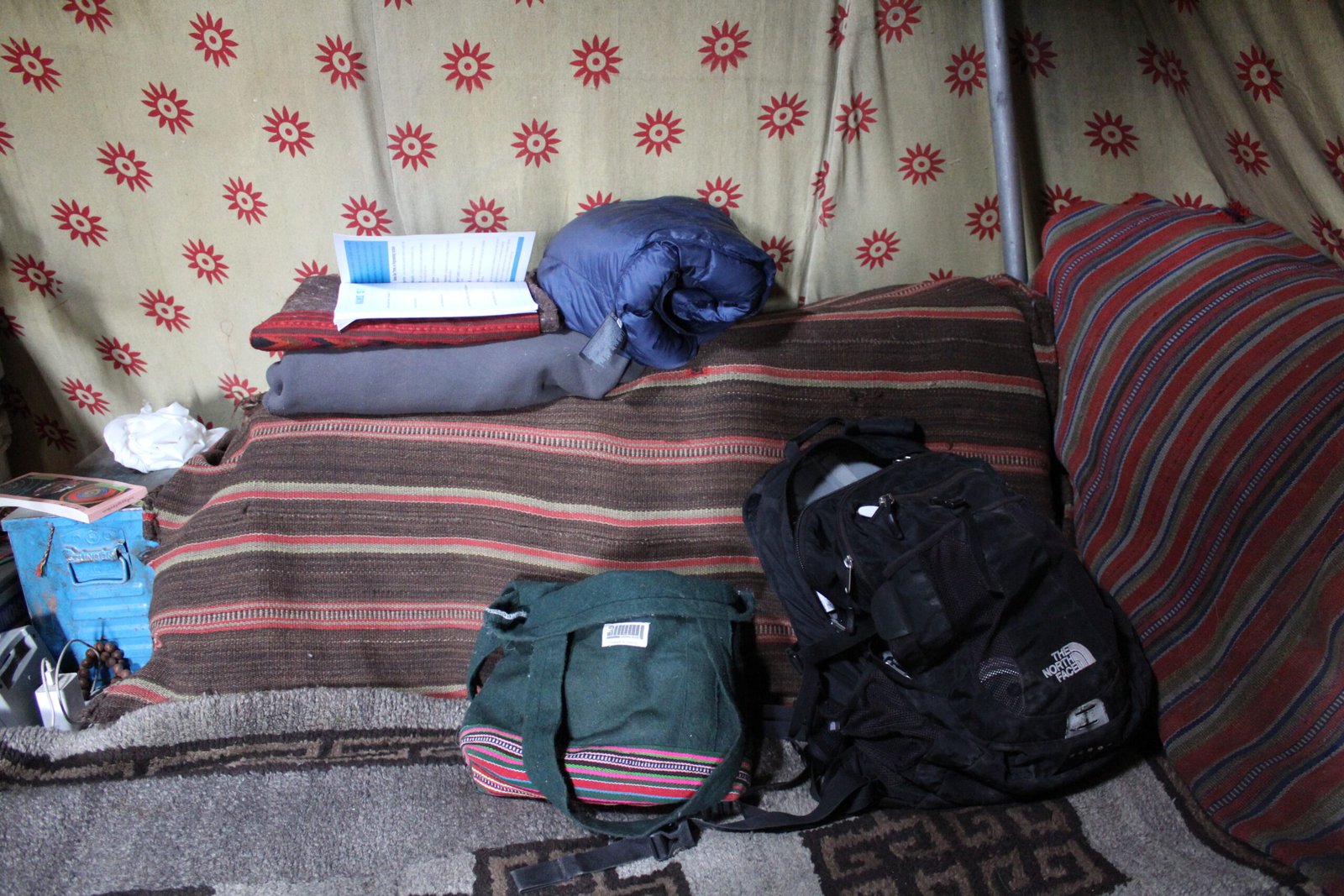
Inside a nomadic home, decorated with Tsugden for seating, and Chali on the side
Footnotes:
Chalis are decorative pieces that also works as extra clothing for sleeping while Tsugdrug are to thick wool-woven blankets. Nambu refers to the clothing made from wool that is used to make different kinds of clothing.
This story was copy edited by Ateen Das