Warning: Attempt to read property "display_name" on false in /home/u621221008/domains/himkatha.org/public_html/wp-content/themes/impeka/includes/grve-header-functions.php on line 255
Posts By :

The beautiful Siyah mentok
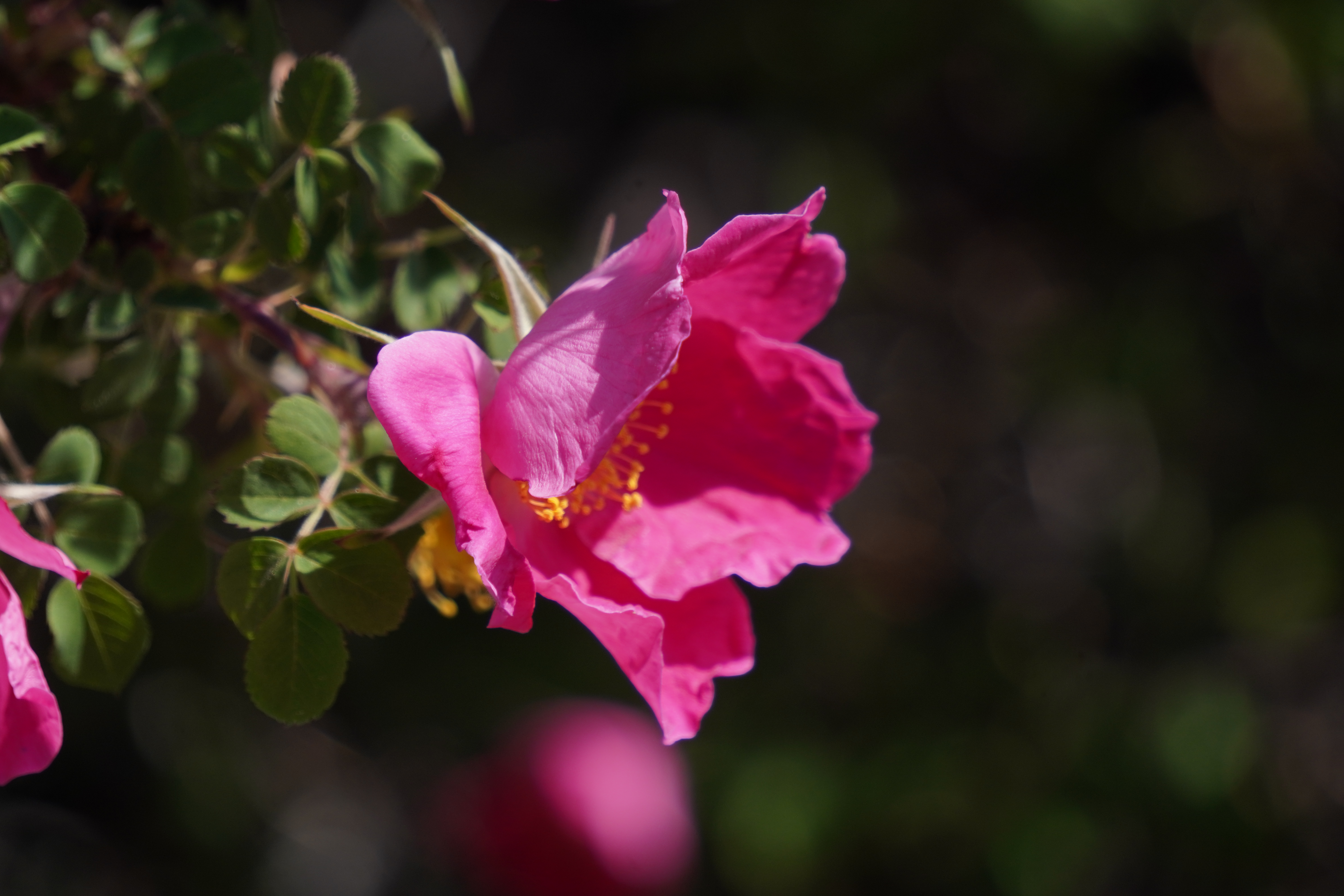
Flower of Rosa Webbiana | Photo: Deepshikha Sharma

The beautiful Siyah mentok

What is home, what is belongingness? For me, it is the uninhibiting mountains, the barren landscape, the deep gorges, and the high peaks of my homeland Spiti Valley in Himachal Pradesh. Also, it is the vast grazing ground, the piercing cold thin air, the green summer meadows, the ripe barley field, the meandering water canal and the delicate pink bloom of Siyah mentok.
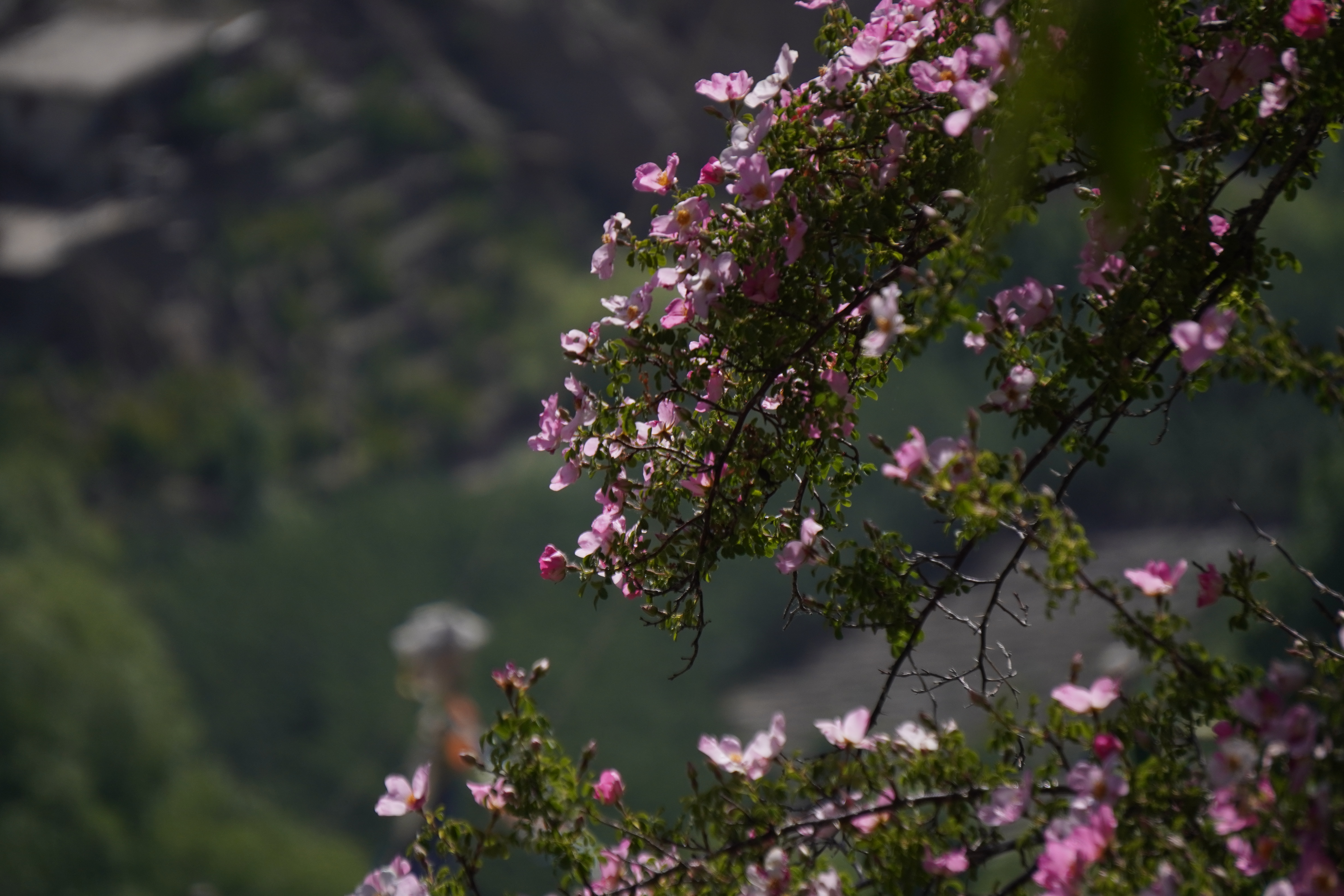
Rosa Webbiana | Photo: Deepshikha Sharma

While growing up, I used to visit my grandmother and stay with her for months. She lived in a small hamlet in Spiti called Gowang which was home to just 5 households and had less than forty residents. My grandmother spent most of her day working in the barley field. Later in the evenings, before darkness of the night seeped in, we would both go out into the pastures to gather wild firewood. During one such visit to the pastures, right at the foothills of giant snow-capped mountains, I first witnessed the beauty of vibrant wildflowers and wild shrubs in an otherwise dry cold desert.

Spiti is a high-elevated region with an extremely arid landscape; characterized by equally sparse vegetation mainly comprising annual perennial herbs, shrubs, and very few varieties of trees (willow, poplars). Despite harsh ecological conditions, the landscape nurtures an incredible diversity of plant species – each unique and resilient in their own way. Pastures and hills are full of wildflowers and have rich repositories of aromatic, medicinal, and edible plants. There is the sour-tasting tirhuk (sea buckthorn) and lichu, the deep ruddy khamet (Ratan jot, Lal jari), the hardy thama (caragana), the healing chukku-gongma (rheum), the delicious kotsey, gyaman (wild herbs, seasonings) and the auspicious shukpa (juniper).

My grandmother would patiently show me how to pluck wild thorns, wild shrubs for firewood without pricking myself. I learnt how to gather tserma (dry caragana) and bursey (white dry woodchips) by observing her. At home, she would skilfully light a fire in our traditional heater (chak-thap) using dry twigs and cow dung and tenderly kindle the firewood to get a good hold before placing more wood logs on top of it. Having lived in a remote mountain village and spent so much time with my grandmother, I learnt to appreciate the wild plants around my home.

Siyah mentok truly deepens my connection to my homeland. Siyah (Rosa Webbiana/Webb’s Rose) is a beautiful variety of wild roses that grows in many Himalayan regions in extremely dry and harsh conditions. It is pink in colour with a mild sweet scent and tender petals that fall in your hands when you touch it. What I like about Siyah is that it is an extremely resilient plant that grows in the harshest conditions and can thrive without water for a long time. Siyah typically starts blooming in late spring or early summer, flowering for a short period of time. But during its brief blooming period, it illuminates the entire surrounding with its striking colour and radiant beauty. It is commonly found at lower elevations of Spiti and all the way up to above 4000m. It can be seen growing on the riverside, rocky slopes, mountainside, in the garden, and in the fields.
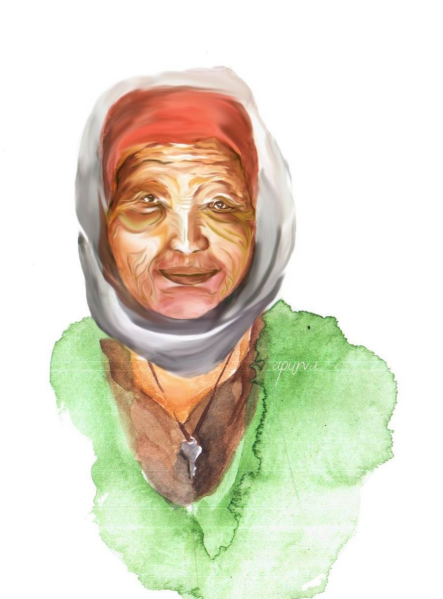
My grandmother’s illustration made by a close friend Apurva Pandhi

The blooming of Siyah is seen as the arrival of summer in Spiti. It is the epitome of beauty and serenity. It is particularly dear to me as under the bushy, dense canopy of this wild rose plant, my grandmother used to rest and take naps during hot summer days of the peak agricultural season. It is the same flower that she alludes to while describing the beauty of Tibetan queens in ancient folk stories and it is the sweetness of Siyah mentok and Serchen mentok (Himalayan golden flower) that she refers to while telling me about sweet melodies sung by nomads herding in the high mountains. It is difficult not to think about my childhood and my grandmother when I think about Siyah.

In many Himalayan communities, Siyah is highly valued for its ornamental qualities and it also features in old traditional songs, stories, proverbs, wise sayings, and other forms of oral cultural expressions. It is often associated with themes of love, romance, and beauty and is also referred to as a symbol of sacred devotion. I remember my grandmother telling me that during her early years in Spiti, if a man likens a women’s beauty to Siyah mentok or Serchen mentok through songs, it is considered a subtle declaration of love and the girl is to immediately discuss the matter with her family! The usage of Siyah in daily household has become quite popular especially, Siyah-cha (Siyah-tea) in higher, more remote villages like Hull, Hansa, Kibber, Demul and Lalung.  It is used ubiquitously by Spitian Amchis (traditional doctors) for its antibacterial, anti-inflammatory, and antiseptic properties. Medicinal plants are used by traditional doctors and healers for ages, particularly for curing skin ailments like boils, blisters, itching, and skin eruptions. For me, Siyah mentok is a symbol of beauty and resilience, reminding me that even in the harshest conditions, beauty and life can flourish.
6000 4000 Chemi Lhamo
Stone breaking ceremony and Buchen of Spiti
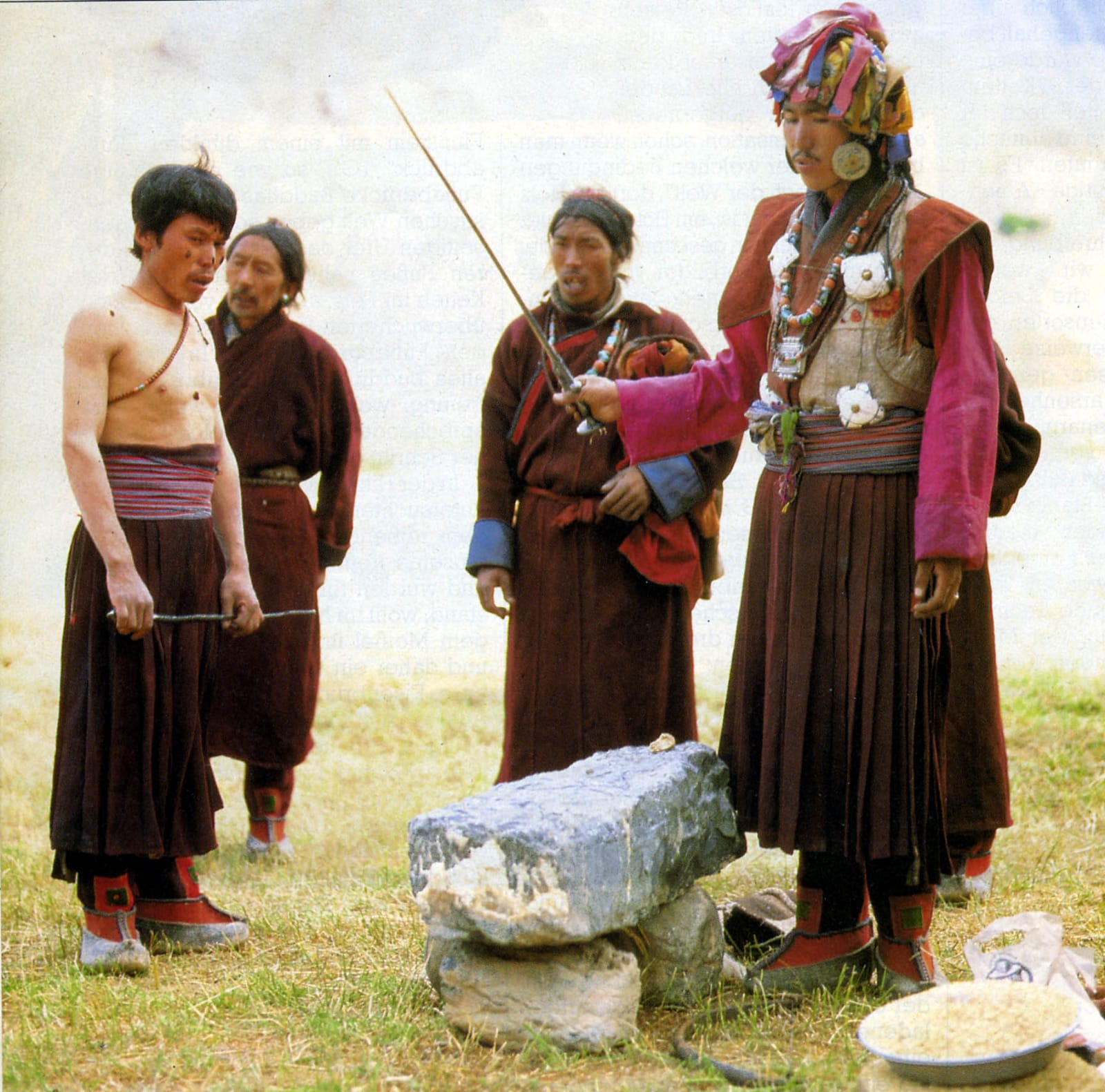
Picture taken in 1998 | Photo: Buchen Tsetan Dorjee

Stone breaking ceremony and Buchen of Spiti

Buchen “the great disciples”

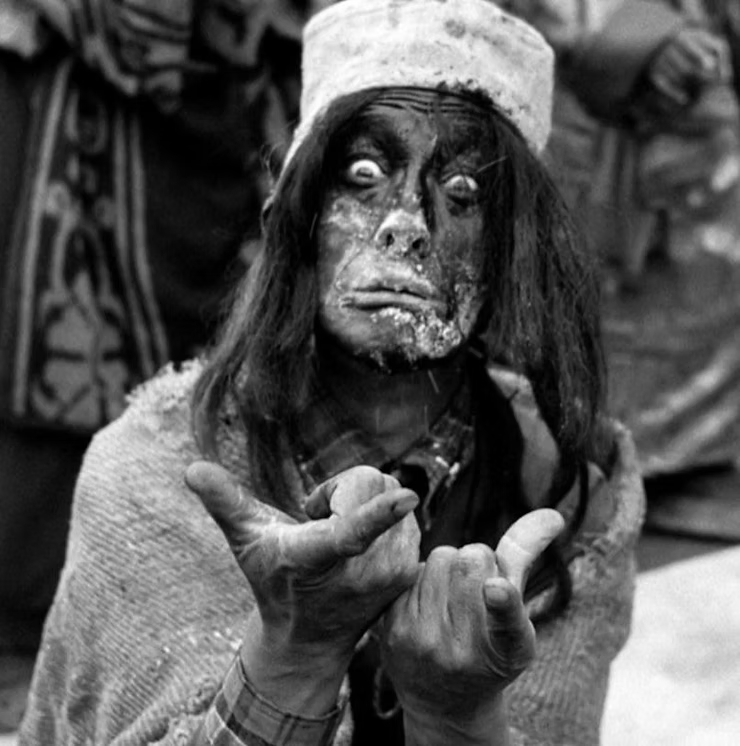
The first time I witnessed a Buchen performance, I remember feeling eerily awed. I do not remember much details about the performance but their ghastly white face smeared with flour and the cheek piercing ritual has stayed distinctly with me. My mother used to scare me that if I ever behaved badly, I would be taken away by meme buchen at night. 

Buchen are a group of religious performers in Spiti who enact elaborate rituals and ceremonies to ward off evil spirits that bring misfortunes. They entrap the spirit in a stone and demolish it through a sacred stone breaking ceremony. The ritual is also associated with curing diseases and healing an ailing heart. Nowadays, it is most commonly commissioned to prevent agricultural mishaps, disease outbreak, disaster and water scarcity in a region. Buchen are well-known for performing folk lore, enacting stories of Buddhist saints, Lhamo (opera) and Namthar (biographies). Given their dynamic role in Spitian society, they are viewed differently as ritualistic performers, opera performers, healers, storytellers and messengers of Buddha’s teachings.

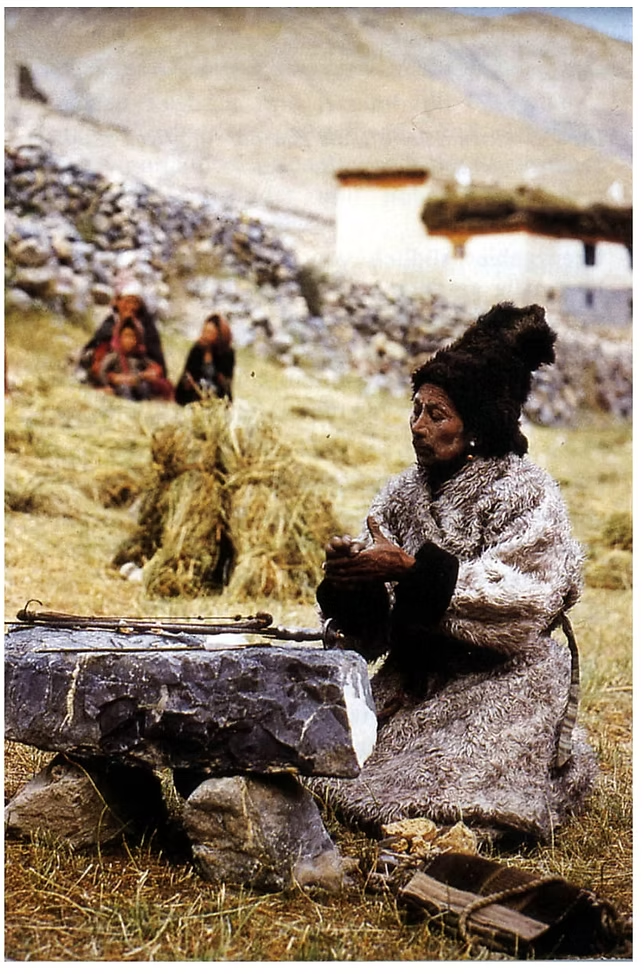
Photo: Pitt Rivers Museum, UK

The Buchen of Spiti trace their lineage to Thangtong Gyalpo, a 14th C religious practitioner in Tibet who was famously known as “Chak zampa” for making iron bridges and stupa in Tibet. It is said that the stone breaking ceremony was first performed by him to curb an epidemic in Tibet; the capital city Lhasa was plagued with 360 different types of deadly diseases – massively ravaging the lives of ordinary citizens. A demonic force is believed to have caused the disease outbreak and it was then Thangtong Gyalpo first performed the sacred stone breaking ceremony to tame the evil spirit. It is believed that he entrapped the demon in a stone, performed the ritual by breaking the stone, and successfully managed to stop the disease from spreading.

He performed it the second time when a demonic spirit was obstructing the monastery he was building. Whatever was made during the daytime was demolished by demons at night. He then performed the stone breaking ceremony where he subdued the evil spirit in a stone and annihilated it by performing the ritual. The monastery eventually came to completion after the demons were tamed. The practice then became widespread in other Himalayan regions and became an important tradition.

Photo: Tenzin Sonam

Thangtong Gyalpo was a versatile figure. He was a highly revered Buddhist tantric master, skilled in monument making, and nurtured a strong penchant for performative art forms like opera, theater, folk songs and writing. He was also the first priest to spread religious teachings through physical enactments of morality plays, allegorical folklore, song & dance and narratorial acting. He strongly felt that the core teachings on compassion, kindness, peace and impermanence should be taught in a way people can understand and implement in their real lives rather than just instructing from scriptures. He then founded the first theatre group in Tibet which goes to every village and performs religious teachings through morality plays and songs. Buchens of Pin valley in Spiti are disciples of this great master and they consider themselves as his sons “Bu-chen = great sons” who will follow the legacy of their master. Paying tribute to Thangtong Gyalpo is a huge part of Buchen’s performance; they put his statue on the altar, pray to him, sing odes and his teachings are orally passed through many generations.

Buchen as healers – relevance of the ceremony

I have seen several Buchen ceremonies during my growing up years and their performances are always invariably very striking. They are bold and impressionistic – one can remember the visuals long after the performance is over. Their repertoire, the enactments, narration and audience engagement are hugely appealing. It is like when they are performing – you are part of the stage, the play and the world they created for you. You might be a silent audience observing them from a distance but they will break the barrier by suddenly putting you in the spotlight – asking you questions, mimicking you and making you part of the play. As such, the distance between the performer and the audience is fluid. You are part of their stage, their world and they derive inspiration, anecdotes from you, your life and the larger community.

The Buchen’s performances are highly centered on religious precepts but with time, it has evolved to incorporate social realities of local communities. The practice is no longer restricted to impart religious teachings but it’s also done to avert serious social and ecological crises like drought, disasters, plague, agricultural loss and to bring harmony among communities. Locals appeal Buchens to perform ceremonies before agricultural season, during particularly low snowfall year, for recovery of physical ailments, while building houses, before starting any new venture in life or to bless a pregnant woman for health and happiness. Meme Buchens play a critical role as healers in Buddhist societies in Himalayan region and their blessings are sought during times of insurmountable distress as well as to bring peace and prosperity. Last year, when the world was gripped with novel coronavirus and there was panic everywhere, remote communities from Spiti sought solace in the healing powers of Buchen, to protect and safeguard them.

Photo: Buchen Gatuk Sonam

Stone breaking ceremonies were performed in many villages like Kaza, Demul, Khurik, Ki and Pin valley. They were also invited to many parts of Ladakh, Zanskar, Lahaul and Kinnaur to help communities deal with crop failure and drought. They were once invited to Patlikuhl, a small village near Kullu/Manali where an annual flood was causing huge devastation. Similarly, in 2018 when His Holiness the 14th Dalai Lama fell gravely ill after an eye surgery, meme Buchen of Pin performed a stone breaking ceremony in his “sim-chung” (private residence) for quick recovery. Individuals, villagers, institutions and monasteries consult them for healing, to dispel hindrances and for an auspicious beginning deed.

Sword dance and the stone breaking ceremony

Buchen form groups of 4 or 5 people. The troupe is led by the head Buchen (Lo chen), an actor who plays the role of Lukzi (shepherd) or Onpa (hunter) followed by two other actors who assist them in various tasks. The Lo-chen performs all key ceremonies and religious narratives while Lukzi grips the audience through his skillful narration, storytelling and repertoire. He is the most captivating character – his deliveries are a blend of social commentaries, mimicries, moral teachings and comic interludes.

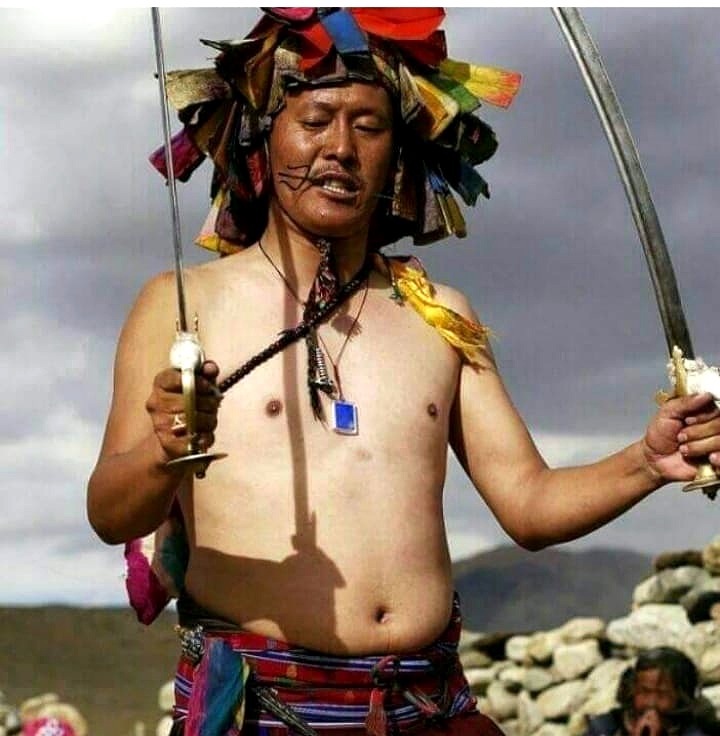
The Buchen head opens the ceremony with prayers, places the statue of Thangtong Gyalpo on the altar, pays him homage and narrates Namthar (biographies). The other team prepares the stage by placing a large boulder near the altar, drawing a human figure on it symbolizing the evil spirit/ demon that is to be demolished and burning incense. There will be brief prayer in between and after that, followed by a dance led by the head Lama rhythmically swinging the sword in slow dance movements.

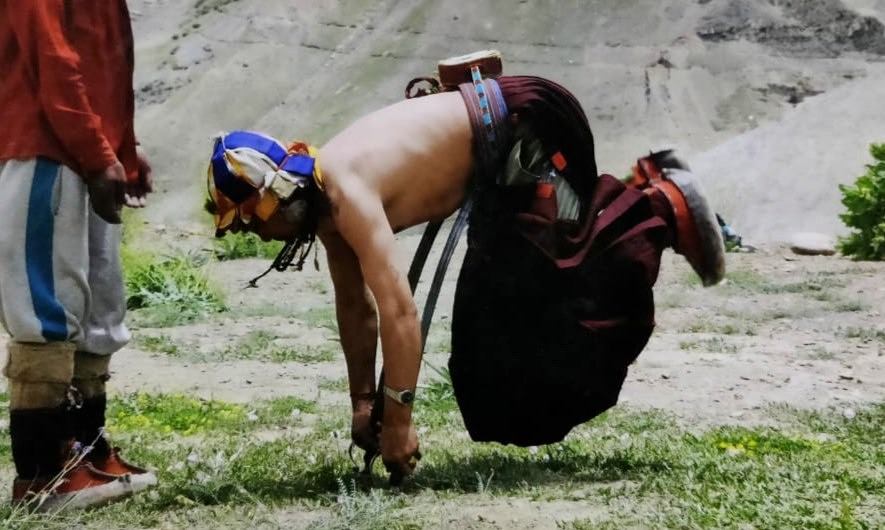
Then comes Lukzi’s turn, who enters the stage wearing a sheep skin and face smeared with white barley flour. He takes over the performance, engaging with the audience – making them crack into loud laughter and burst into tears while the head Buchen prepares for sword dance. He strips the upper part of his body naked, then slowly pierces his cheeks with a large pin and there’s considerable excitement, fear and thrill among the audience who watch him do this. It is a slow careful action and is done to dispel ill omens – the piercing of cheeks symbolizes purity of speech. He then proceeds to point the tip of the sword on his belly and slowly jumps to put all his body weight on it – repeating the act by drawing a sword in his armpits. The whole ritual of body piercing symbolizes the mutual existence of the mortal human body and lha (spiritual deity) that resides in each one of us. The sword dancing and body piercing symbolizes purity of body, mind and speech.

At the culminating act, while Lochen prepares himself for the sacred stone breaking ceremony, the dancer on whose body the stone is to be broken, lies down. A thin cloth and a heavy stone is placed on his body while the other actors look for a second stone. Lo-chen enters the scene, lifts the second boulder and smashes it on the stone placed on the dancer’s belly. The stone breaks with loud thudding noise signaling annihilation of the demon whose spirit was entrapped in the stone. Meme Buchens undergo intense tantric training, yoga, meditation and scripture learning in retreat to acquire such high feat. They acquire immunity towards fatal injuries and mishaps while performing ceremonies after decades of stringent training and disciplining of body and mind. They acquire mastery over their being before they perform healing treatments on others.

Photo: Buchen Tsetan Dorjee

They travel extensively within Spiti and outside to perform stone breaking ceremonies among various communities in Himalayan region like Ladakh, Kinnaur, Kullu/Manali, Riwalsar (Tso Pema), Sikkim and Nepal.  Every year they make a journey in small groups carrying the traveling altar, a trunk comprising their costumes, props and other material used for performance and leave from Pin for months at stretch. Sometimes they are out of their homes for as long as six months and come back only during harvest season for the farm work. They recite Namthars, folksongs and perform ceremonies in settlements where they reside and also make trade deals with the locals. They also sell horses and in turn receive Khullu (Yak wool), hand spun blankets,  Lena (Pashmina) and apricots. The Buchen tradition has seen huge decline in Ladakh and the meme Buchens of Pin valley often get invited to perform ceremonies to revive crop failure, crop damage and to appease local deities for abundant snowfall. They travel all over Ladakh; Demchok, Korrzok, Tsokar in Changthang to Choglamsar, Parang valley and even in Zanskar. Alternatively, in Kinnaur they visit Chango, Nako, Malling, Leo, Hangrang and even go as far as Rampur where the biggest trade fair in Himachal happens. Wherever they go, they are treated with utmost respect and their sword dancing and stone breaking ceremonies are considered equivalent to the Jintsak ceremony performed by highly incarnated Rinpoches (religious leader) to dispel ill omen and bring prosperity in the region.

Buchen tradition has undergone a tremendous change over the years. It used to be a widespread practice in many Himalayan communities but now it is actively pursued only in Spiti and that too minimally – there are only 10 remaining Buchen households in the region. “.. people no longer value our skills” laments Meme Buchen Tsetan (76) who is one of the oldest Buchen in Spiti. “Earlier people would bow down in front of Buchen to show their reverence but there’s considerable change in people’s attitude.” They also confide that with the influx of tourists, photographers and filmmakers, the practice has been reduced to a bare minimum where they are generally not interested in listening to prayers and Namthar (biographies) and rush them to perform sword dance and stone breaking which has more element of spectacle.

1600 1581 Chemi Lhamo
Lingering memories of my grandmother
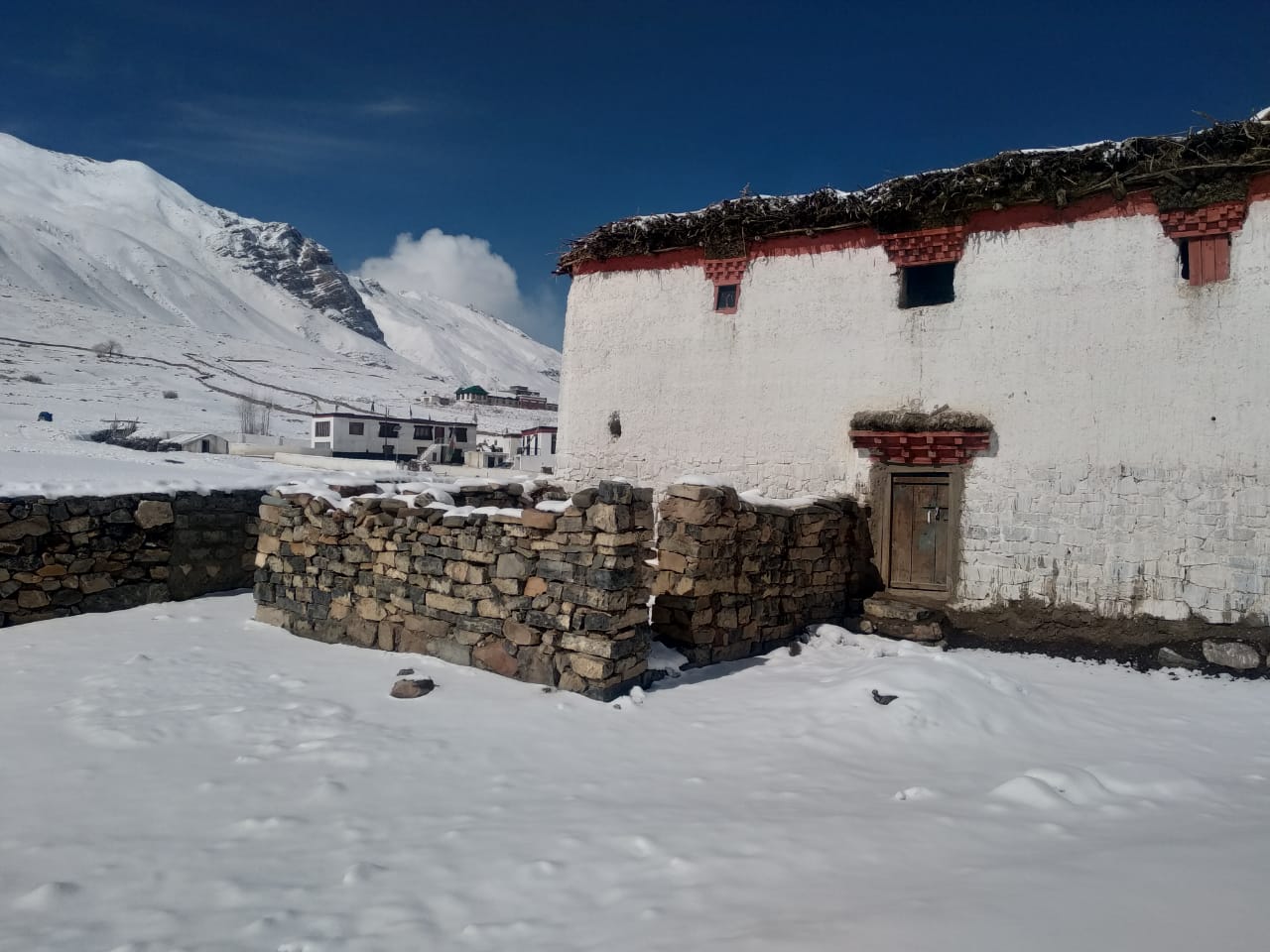
Ancestral house where Evi lived | Photo: Chemi Lhamo

Lingering memories of my grandmother

When I was young, I remember my Evi used to take me to yul-sa (Buddhist shrine for village deity) every day in the morning to offer prayers. She would ask me to light butter lamps while she circumambulates around the altar before joining me in prayers. I used to fervently pray for stable electricity at home so that I could watch television the whole day. As an eight year old, I used to be so curious what she prayed and insisted on getting to know. She would shirk me off for some time before succumbing to my pleas and tell me that she prayed for good winter snowfall so that we would have abundant water for our fields and for our animals during summer. She would continue sternly “One should always pray for all sentient beings and your personal wishes will be granted naturally. One should pray for peace, prosperity and abundant snowfall”.

Evi was from Tashi-gang, a quaint village in Spiti with abundant green pastures and less than 6 households. She was quite young when she got married and came to live in Kowang and like any other Spitian women of her generation, Evi had been nurturer all her life; she tended to our fields, the livestock and was sole custodian of our ancestral home where she lived independently until she was too old to live on her own.

Aapa used to tell me that Evi was deeply attached to her land “there was no difference between us, our shinga (fields) and our dzomos (female hybrid yak). She would tend to us all no differently”. She started working in the fields when she was fifteen and did that for another fifty years. She tilled all our fields, reared livestock and would traverse high mountains in our village to collect dungs and dry twigs for winters. When she got old and frail, she stayed with us briefly and would often tell me stories of her younger days. She’s filled with memories of my father’s, my uncle’s childhood and would often reminisce about the large herd of animals she raised with equal fondness; memories of dead cattle, sick goats she nursed, new-born calf she cared for and about our dZo (hybrid yak) which went missing mysteriously few years back. She took pride in the health of our land, our village chu-mig (spring water) and our cattle in the same vein she identifies as being a woman of Khangchen (Zamindar family) household whose life was devoted to agro-pastoral responsibilities. She was so closely engaged with the materiality of the agrarian landscape that it became a deeply embodying experience and a crucial part of her identity.

Ancestral house where Evi lived | Photo: Chemi Lhamo

Just like Tashi-gang, Kowang also is a small rural hamlet with just four or five households. Evi made the mountains, the fields, riverbanks and the vast expanse of barren lands an extension of her home. I was often told that she was very fierce and rigorous –someone who toiled hard in her fields and commanded authority. In Spiti, farming and related activities are considered communal affairs. Everyone partakes in the age-old traditional system “Bhey” where there is reciprocal exchange of work which denotes inter-household collectivism. This is further reinforced by Buddhist teachings intricately tying ecological ethics with religious beliefs laying emphasis on the virtue of cooperation and mutual support for each other in a community. Reality however, is more complex – village dynamics play a huge role in shaping agrarian responsibilities. Land ownership, access to resources and decision making is influenced by the undercurrents of unequal power dynamics within different members of a community.

Although men and women both work in fields, there is an apparent work division; Spitian men engage in more cohesive and heavy loaded works like ploughing, harvesting and grazing while women work on array of scattered works (thereby more invisible) like weeding, levelling fields, drawing water channels, irrigation, winnowing, preparatory works of grinding grains and taking out manure from dry toilets. All these supposedly menial works are equally important, time consuming and render solidity to agro-pastoral labour hence are often overlooked. The division of agriculture labour and resource allocation is a reflection of larger social stratification where men of Khangchen household enjoy greatest prestige. “Ane gyi leya la siruk mekak” (there’s no value in women’s work or women’s work is uncounted) is a popular expression and is often said grudgingly to show one’s discontentment.

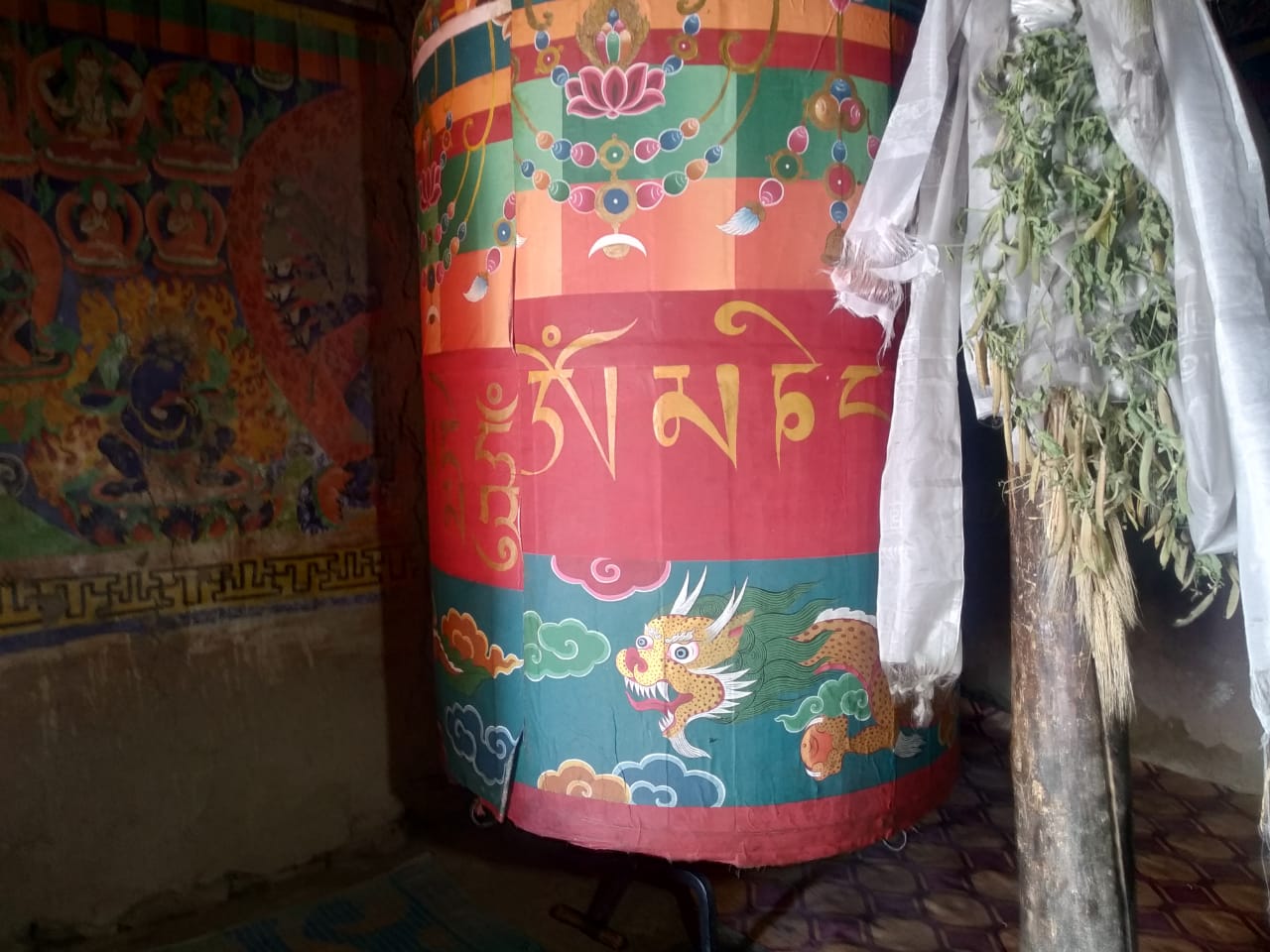
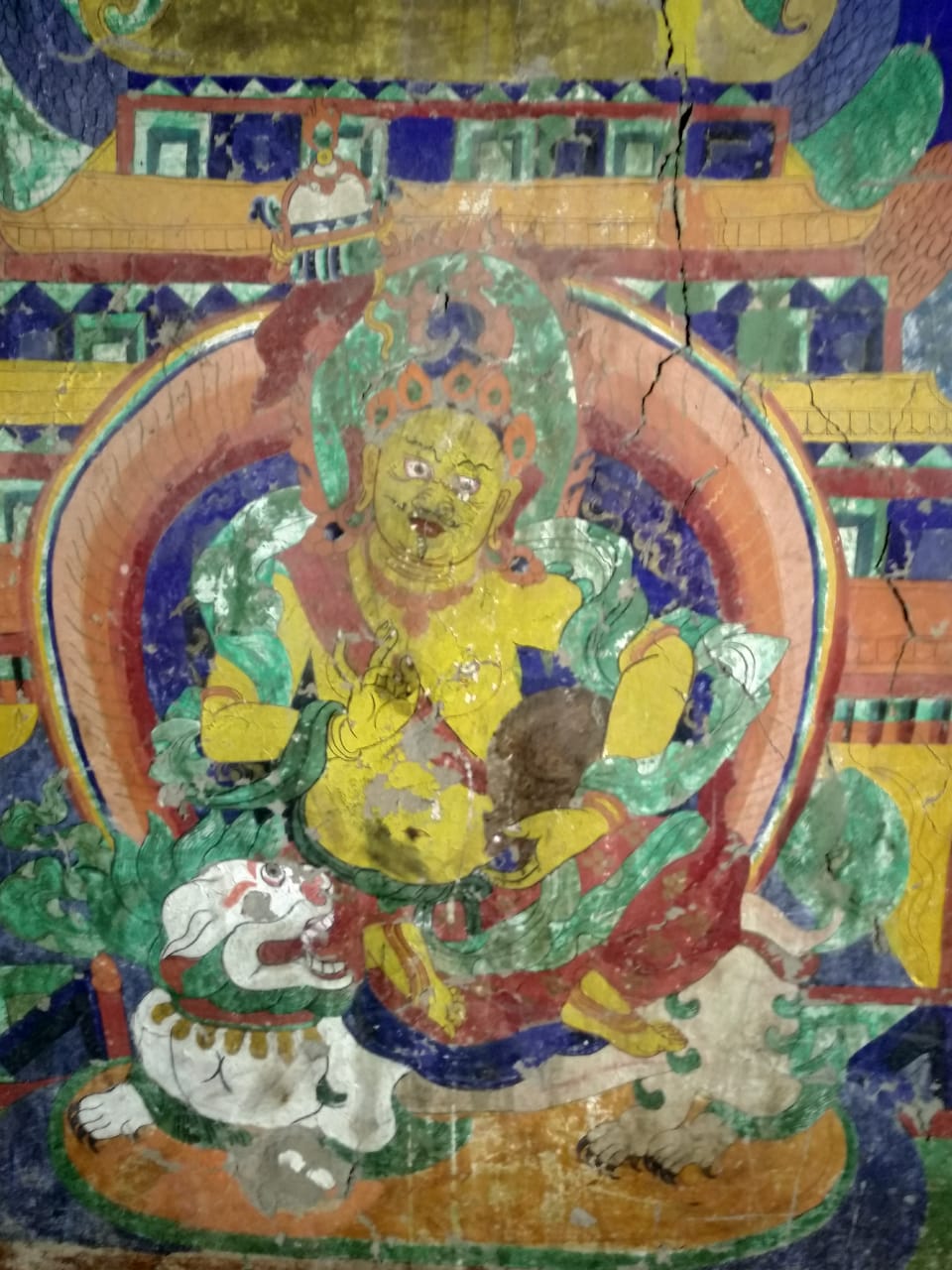
Buddhist religious murals inside village shrine: Kowang, Spiti | Photo: Chemi Lhamo

I remember chuckling amusingly at a funny anecdote Evi shared, “Me-me (grandfather) used to be so laid-back. It doesn’t matter whether our luk-chung (lamb) strayed off from the herd or whether our village Zing (water reservoir fed from glacial melt water) is leaking. He has no care in the world. His seeding work is so disorganized that it looks as if he did that in drunken stupor of Aarak.” To balance the narrative she would continue, “What would he know of any farm works; he was a tsongpa (trader) and was always away. I used to do all the field work even the ones like ploughing with Yak and dZo”.

Our ancestors were so well attuned to the natural world they lived in that they bore the harshness of living in a high altitude landscape like Spiti with remarkable resilience and self-sufficiency. Their wisdom was so innate and grounded in the material reality of their everyday life. They were deeply engaged with the physicality of the farm-works that they knew how to harness the health of the whole ecosystem, yet they barely saw their contributions as worthwhile.

Living in remote, resource scarce places like Spiti, the value of rejuvenation is central to their environmental ethics. They might not quite articulate it that way but they embody it and live the experience which is also reflective in their ascetic lifestyle and in their belief of complex connection of living, non-living, material, immaterial, physical, non-physical entities to boost the overall health of an ecosystem. While laying dry hay for goats in Evi’s open corral, she would often lecture vehemently, “Farming is not just acquiring food from nature. It is honouring Kunchok Sum’s (three jewels of the Buddhist trinity) benevolence which looks after our soil, our streams, our pastures and overall health and happiness of our animals”.

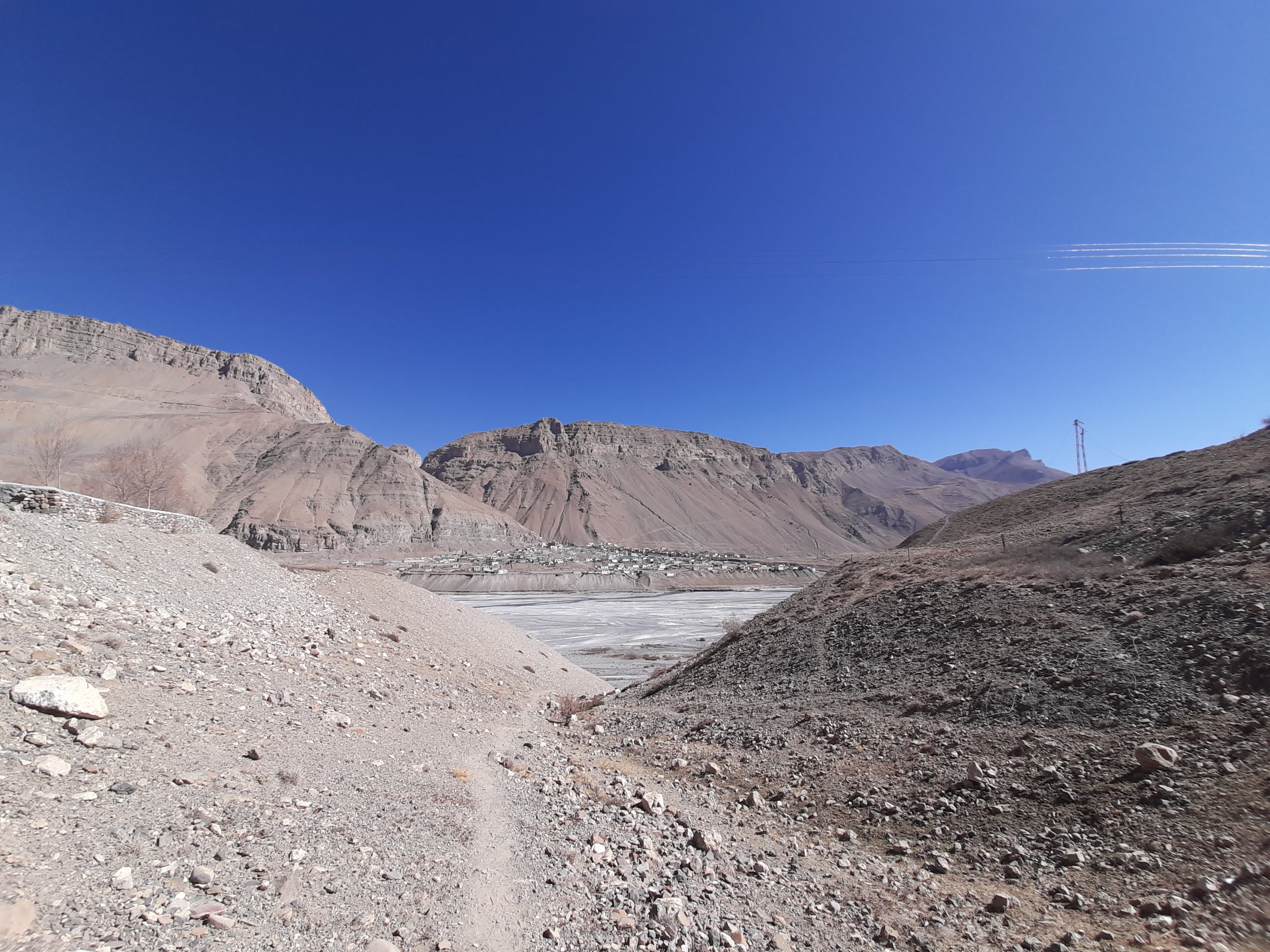
Living in mountains is not always idyllic as one would imagine. Feeling of isolation and disconnectedness is pervasive | Photo: Chemi Lhamo

As a child, she used to narrate a story about cursed “srinmos” (demoness). She would say, “behind the gigantic barren mountains of our village lies “srinmo-yul” (land of demoness) where ferocious and hungry demoness lives”. She used to caution me that if we don’t tend to our riluk-balang (livestock), our land, let the crops rot, these “srinmos” can manifest themselves in our fields and can cause destruction to our fields and our animals. I used to believe in her story and would help her in chores like milking cows and putting fodder for cattle. Looking back, I think it was her way of making me reciprocate the deep attachment she shared with our land and our livestock.

The unconventional attachment she shares with the landscape results from decades of tenacious experience of physically engaging with the land yet it is not always idyllic as one would imagine. Living amid vast barren land of our village with scarce human companions posed its own challenge. She despised living in seclusion and would often run away as a newly bride only to be coaxed back to return by family members. Rural isolation drove her to the point of desperation even to pray for “miracle disasters” which would merge Kowang with its neighbouring more populated village Kaza. At her extreme old age she was able to enjoy more familial connections when she jointly lived with my cousin’s family in Rangrik. I was always told my Evi was a brilliant cultivator and I wonder whether I will ever be able to understand the rich tapestry of the life she led with all its apparent glory and poignancy.

1280 960 Chemi Lhamo