History

The First Bus to Spiti

The First Bus to Spiti

Losar is the first village of Spiti valley which is located in the high Himalaya. You have to cross two high mountain passes to reach Losar. Getting here in winter is impossible because heavy snowfall blocks the roads across the passes. People only traveled in and out of Losar in summer. Heavy winter snowfall kept Losar, and the rest of Spiti, isolated for many months in a year. Winters were usually long and uneventful. But that year was different. Everyone had spent winter in anticipation. Everyone was excited for the new bus service that was going to start from Manali to Spiti in summer. Until then, only a few men had traveled outside the valley for trade. Horses were the preferred mode of travel and almost no one had seen a motor vehicle.

Everyone was talking about the bus. That it would cover the steep climb up and down the mountain passes in a matter of hours, carrying 42 adults! What sort of a beast could carry such a heavy load and run so fast? This had remained a topic of discussion across Spiti, and especially Losar. Someone suggested that this beast had six legs and galloped faster than the fastest horse, while another said that it had the strength of 10 mules. And its eyes light up the mountain like the moon on a full moon night, said one of the better-traveled locals. The entire valley was wrapped in curiosity.

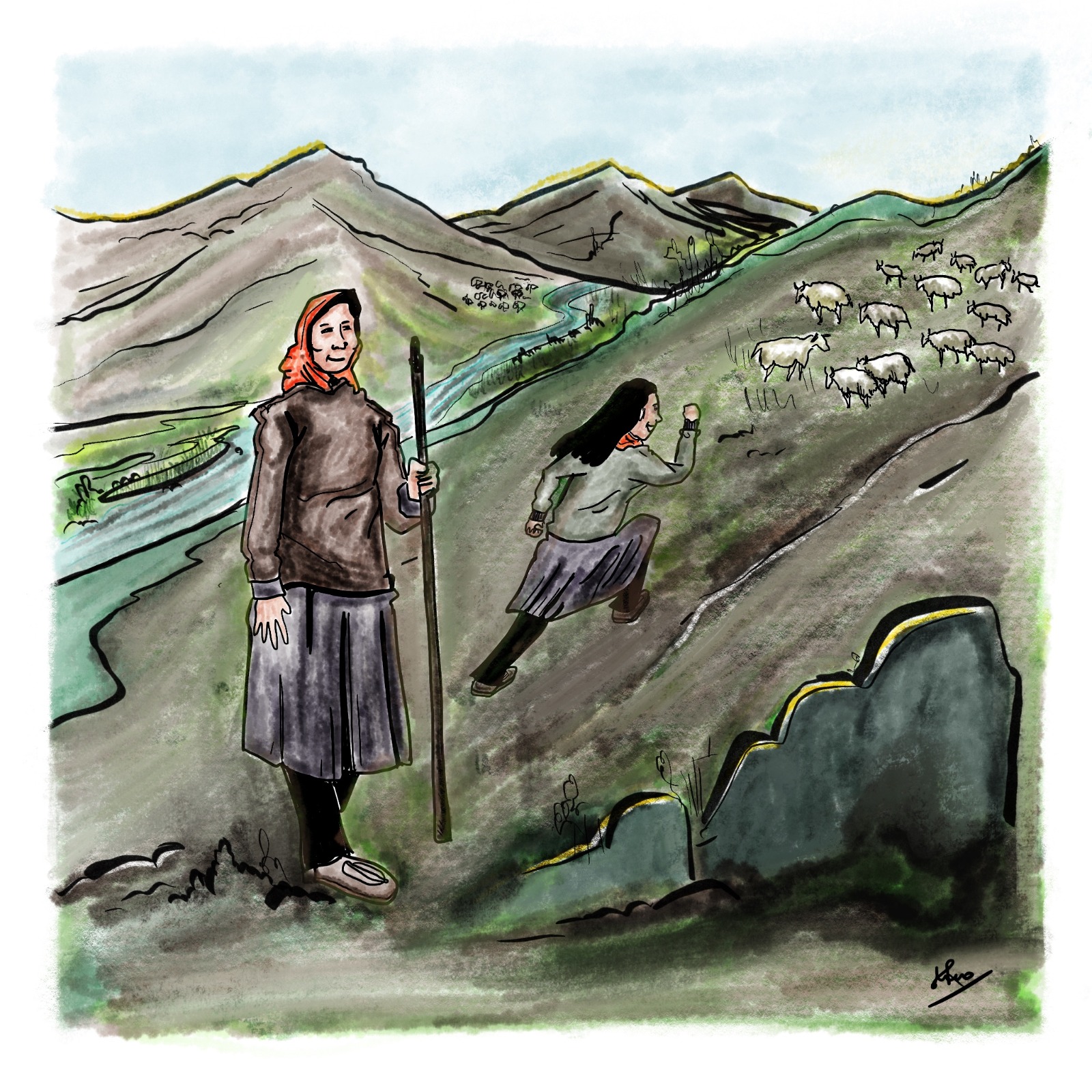
The long wait came to an end when the sun changed its direction marking the start of summer. It took several weeks to clear the snow over the passes. Word finally came that the bus service would start in two days. Losar would have the distinction of welcoming the first bus to Spiti. The entire village got busy. The men were decorating the village gate – an honor otherwise reserved to welcome a respected Rinpoche. The women took a break from the agricultural fields to prepare a feast to mark the historic day. Even the school was called off, so that children could take part in the celebrations.
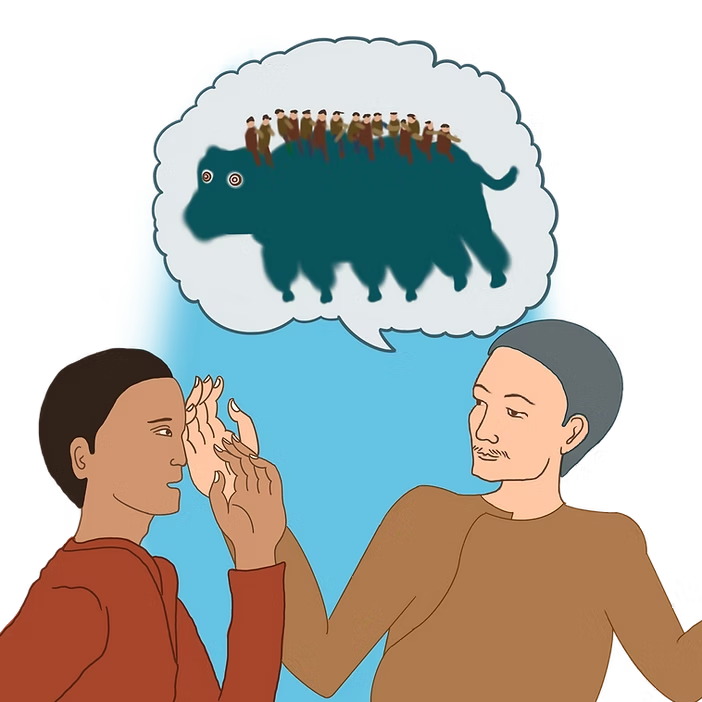
Illustration: Nawang

People lined up to welcome the first bus with an Aashi in their hands. Everyone heard the bus before they saw it. The resounding humm of the diesel engine was met with loud cheers. And then, the bus came into sight. It chugged along the bumpy road. Everyone stood hypnotized seeing this enormous beast. No one moved. The bus came to a grinding halt after crossing the decorated village gate. Everyone moved forward skeptically to examine the bus. Some touched the body of the bus, others were fascinated by the windows and doors, a few observed from a distance lest the bus land a kick like some irritated horses do. The driver and conductor got off and were given a hero’s welcome. As the excitement gradually faded, people began to move towards the area where the food was being served.

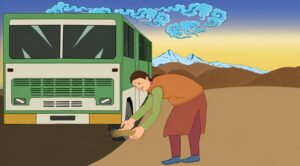
As soon as the crowd vanished, Eve Ning Gemo lumbered out of her house. This kind, old lady was carrying a load of fodder in her hands. She walked up to the bus and laid out the fodder before the bus. Then, looking up lovingly she patted the bus and said, “You must be very tired. These youngsters have no heart. They all cheered as you strode in and then left to eat without even feeding you anything. But don’t you worry, I am here. I have brought you fresh fodder. Eat as much as you wish.”

Eve continued to pat the bus tenderly, waiting patiently for the bus to start eating the fodder she had laid before it.

  • Spiti Valley is a high-altitude region of the Himalaya, located in the north-eastern part of the northern Indian state of Himachal Pradesh. It is one of the most remote areas of India.
  • Rinpoche is a title in Tibetan Buddhism to address a respected and highly trained spiritual teacher or master.
  • Aashi (also referred to as Khata or Khatag) is a white scarf offered as a mark of respect in the Himalayan region. It is usually offered to revered monks and very special guests.
  • Eve is a title used by everyone to refer to their grandma or an elderly lady in Spiti.
1536 850 Ajay Bijoor
Art From Our Valleys
"Huntsman" rock-art, Gya-Miru | Photo: Sherab Lobzang

Art From Our Valleys

Life in the mountains is tough. In addition to physical fitness, it demands a great deal of mental fortitude. This is particularly true among our elders, especially when you hear them speak about their younger days. Stories of how they managed to survive the long winter months tending to their livestock are hard to believe for our generation. Animals reserve a special place in our lives, and they too are often as spirited as hardy mountain people. Growing up in Ladakh, animals were an integral part of my life too: sheep, goat, donkey, horses, and yak. And then there are the wild animals that were seen rarely, but often encountered when they preyed on livestock. Growing up in the village of Kumdok close to the Changthang region of Ladakh, I enjoyed exploring the mountains as a young kid. I still remember joining my mother to graze the village livestock in the pastures around our village. Each family took turns to fulfill this task. During that time my mother would show me wild animals that were seen in the pastures around our village. We had to keep our livestock safe from hungry carnivores.

Illustration: Rohit Rao

I was fascinated by the outdoors and I still cherish those times spent exploring the pastures. I particularly remember the day I first encountered some very interesting art on some of the rocks in these pastures. As a 13-year old then, I wondered who had drawn them. I asked my mother and she told me that these were made many, many years ago. Probably even before our great, great grandparent’s time. This was from a time when there were no notebooks, pencils, and even schools which is why they may have etched them on the rock.

A few years later, I left the village for higher studies. Returning home each year, I noticed that the number of livestock in my village was reducing. Some years back everyone gave up herding sheep and goat. After completing my education, I began to work in wildlife conservation. My work took me to many places across Ladakh. I interacted with locals of every generation. I also worked closely with researchers who were trying to study nature and the relation that we Ladakhi share with them. That often took me back to rock art that my mother had shown me. Our ancestors may have shared a special relation with nature and animals, as was depicted in the art. This got me even more interested in rock art which is both rare and special. In the last few years, I have encountered rock art in the most unlikely places. I make sure to take a picture, each time I find new art. I often find myself thinking about what our forefathers were trying to tell us through the art. I would like to share some of these pictures and my thoughts with you.

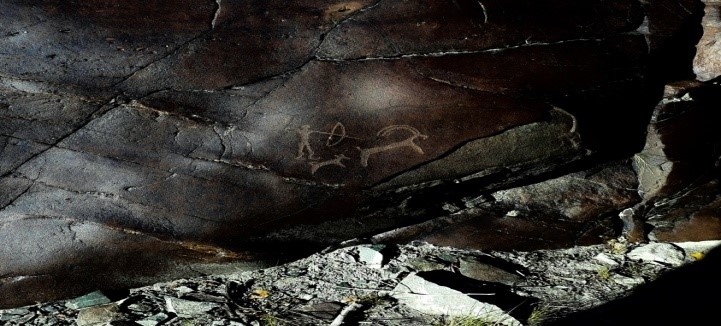
"Hunter" rock-art, Ulley | Photo: Sherab Lobzang

Ulley Tokpo is a village in the western part of Ladakh. Walking along the banks of the Indus River, I stumbled upon this curious rock art. The image shows a hunter pointing a bow at an animal with long curved horns, while a guard dog watches on. Did our forefathers hunt for food? Maybe they did not rear animals like sheep and goat then. Why else would they hunt? When did they start rearing livestock and when did we stop hunting? Thanks to livestock rearing we could stop hunting. But while hunting has stopped, archery remains a very popular sport and a cultural event that we participate in every winter. This is a common practice across many mountain communities in the Himalayas.

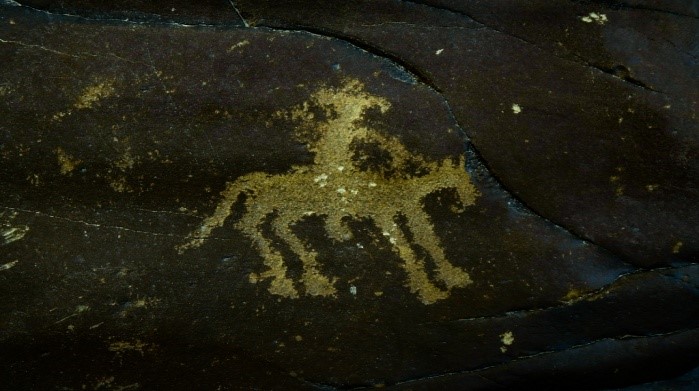
I recorded this rock art image of a horseman between the villages of Miru and Gya on the highway that connects Leh to Manali. One of my senior colleagues had shown me this image. If you drive past this area today, you will not find this horseman anymore. Unfortunately, a large part of the rock formation that carried this rock art was destroyed during road construction. But this image is a reminder of the role that horses might have played in the lives of our forefathers.

Horses were the most efficient form of transport, be that for hunting or even later for trade and exchange of produce through barter. The significance of horses has diminished with the arrival of vehicles. However, they still reserve an important cultural role in our communities. Horse racing is active in some parts during Losar, the New Year celebrated on the first day of the lunisolar Tibetan calendar. Another sport that was played earlier was Ta Polo, Ta meaning horse, and Polo meaning ball. Could this have been a primitive form of the sport of polo? I often wonder where our forefathers might have learned it from.

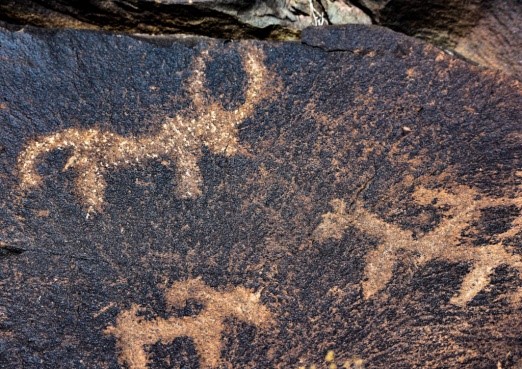
"Horseman and Yak" rock-art | Photo: Sherab Lobzang

I once encountered this fascinating image of what looked like horsemen pursuing a large animal. I wondered if these were yak. When I spoke with some elders in my village, they mentioned that indeed they were: they were wild yak! Dong, as they are referred to locally, haven’t been seen in a very long time. The domestic yak is believed to have been reared from the wild yak. Our elders explained that dong is much larger than the domestic ones we rear. Today, it is reported from a small part in Changchenmo which is largely unexplored. I wonder if there are other animals like the dong that once occupied these rangelands.

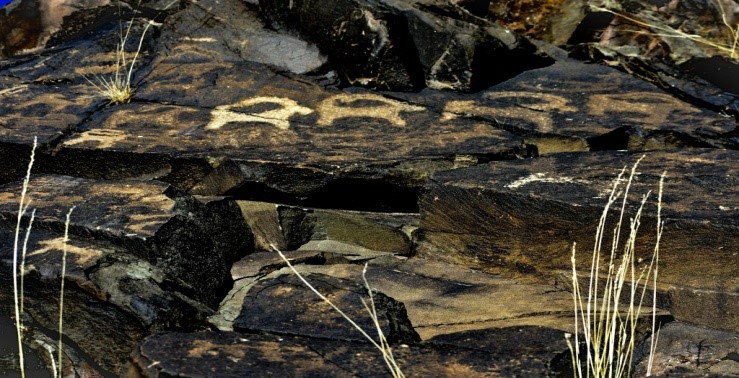
At the mouth of Phuyul valley near the village of Miru, I observed some very interesting rock art while carrying out surveys. This included images of wild animals, stupas which are religious structures in Buddhism, and script which was hard to identify. Some of these etchings look like ibex based on the longhorns they display. I find that particularly interesting because ibex was not found in these areas during our surveys in the past three years. Could the rock art be suggesting that these valleys were home to ibex in prehistoric times? It is hard to say. These are just a few of the images I have found so far. Many more remain undiscovered and I hope to keep finding them and sharing their stories, as I do now. While I have been fortunate to stumble upon these ancient relics that are part of our heritage, I am concerned about the number of these relics we may be losing out of ignorance. Rock art, which may date back several thousand years, are messages to us from our ancestors. They deserve attention and care. If we were to lose them, we might lose an important part of our past heritage.

"Ibex" rock-art | Photo: Sherab Lobzang

This holds true not just for Ladakh, but for all areas where rock art of this kind tells a story of the past. It is up to us to rediscover them and celebrate the wonderful stories they tell. These stories told by our ancestors.

699 391 Sherab Lobzang