Craftsmen

Muds, cobs and clay: The Joy of Building
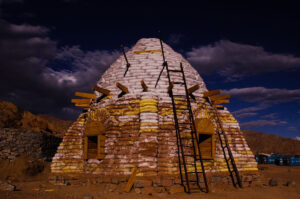
Earthbag dome (Leh, Ladakh)

Muds, cobs and clay: The Joy of Building

There’s unalloyed joy in sculpting with mud; mixing soil with clay, straw; sun-drying the bricks before finishing the cob structure with cow dung clay. The essence of natural building is the hands-on experimentation, close engagement with the material and use of locally available resources – one that can be harnessed for building sustainable eco-friendly architectural designs. “It is the innate familiarity of the natural elements and the freedom to mould it into any design is what makes the process special” muses Stanzin Phuntsog, a self-taught eco-architect from Ayee village (Nubra, Ladakh).  Phuntsog was a curious child and has always been fascinated by the natural world around him; the gigantic mountains, the glaciers sustaining village life, natural ways of farming and the wealth of indigenous knowledge people in rural communities possess.

He was particularly captivated by natural ways of building, the traditional architectural designs and their intricate details. “In Ladakh, everyone has some basic understanding of building structures and I was fascinated by those structures. The knowledge also sowed a desire within me to build something on my own ” he reminisces.  He discovered his own love for architecture and natural material by observing communal mud house building activities in his hometown. With  unconventional views on ‘education’ Phuntsog is a staunch believer of experiential learning. He believes as much learning happens outside four walls of the classroom than by immersing oneself in daily realities. “One can read how plants develop their branches, roots; soil develops their fertility; mountains develop glaciers from a textbook or actually be in the natural world around you and observe and learn first-hand”.  His passion for immersive learning was further fuelled when he explored alternative learning in the Students’ Educational and Cultural Movement of Ladakh (SECMOL, Ladakh) after deliberately walking out of the conventional school system.
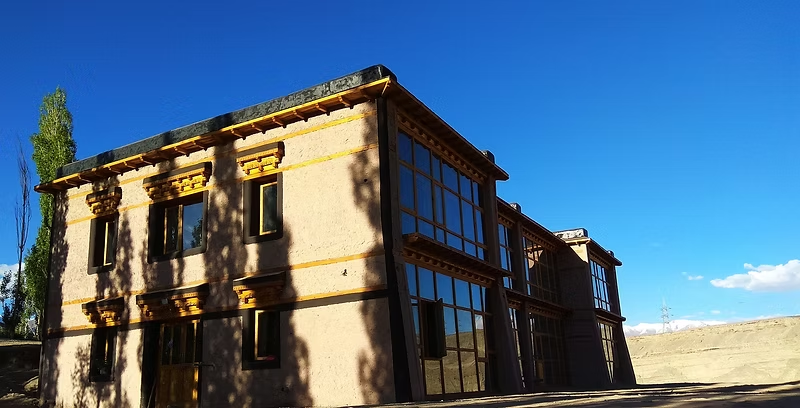
He then enrolled in a 2 year’s course at Swaraj University (Udaipur, Rajasthan) where he received hands-on training in architecture, self-designing, ecological sustainability and exposure to green entrepreneurship. The innate zeal for experiential learning also probably led to pursue his interests in sustainable architectural design and later start his venture Earth Building with Samyuktha whom he met at Swaraj. The venture focuses on reviving natural ways of construction which is aesthetic, functional and thermally comfortable. “We endeavour to do that by reclaiming indigenous knowledge and valuing vernacular architectural designs.” They have explored many earthen techniques like cob (soil mixed with clay and dry grasses), earthbag dome, adobe (dried mud bricks), stone masonry, rammed earth, lime clay plasters and traditional Ladakhi roofing. “The key is to use resources locally available to you and experiment with it. There’s less carbon footprint and one can focus on energy efficiency” he continues.

“To us, natural building is a process which connects people and brings in the confidence that everyone can build their own homes”. Growing up in a close-knitted community in Spiti and having seen my relatives build their own homes drew me to Phuntsog’s initiative. It is precisely that soulful building process, the collective sense of community and the sense of belongingness one feels while building a house makes it endearing. Many houses in high Himalayan landscapes are built that way and communal labour plays an intrinsic role. Phuntsog gained practical knowledge around sustainable architecture by exploring different places and by observing local architectural designs – the kind of soil available in that particular region, the stones they are using and the kind of roofing suited for that place.
He is also keen on passing his learning and engaging more people in reviving sustainable practice around architectural designs. With Earth Building, he has found that balance where he engages interested people and volunteers to learn about eco-friendly building techniques and explore natural elements through community building processes. Phuntsog has a craftsman-like approach to architecture and has an instinctual understanding of handling natural material. He also gives training on stone masonry and traditional architectural design implementation.

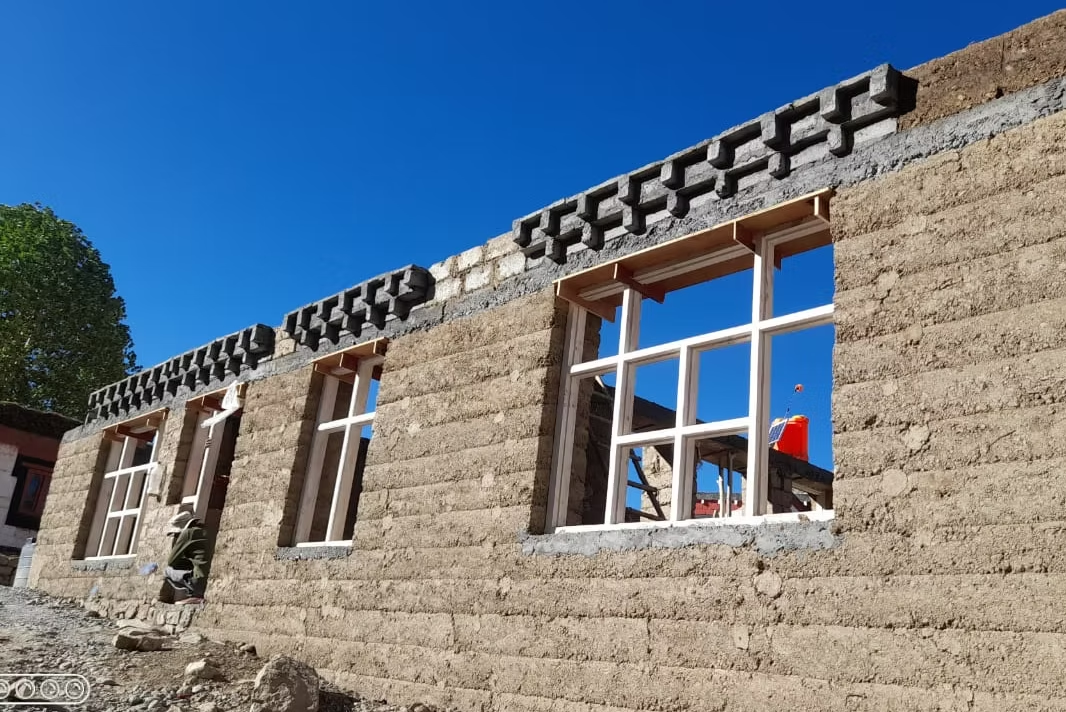
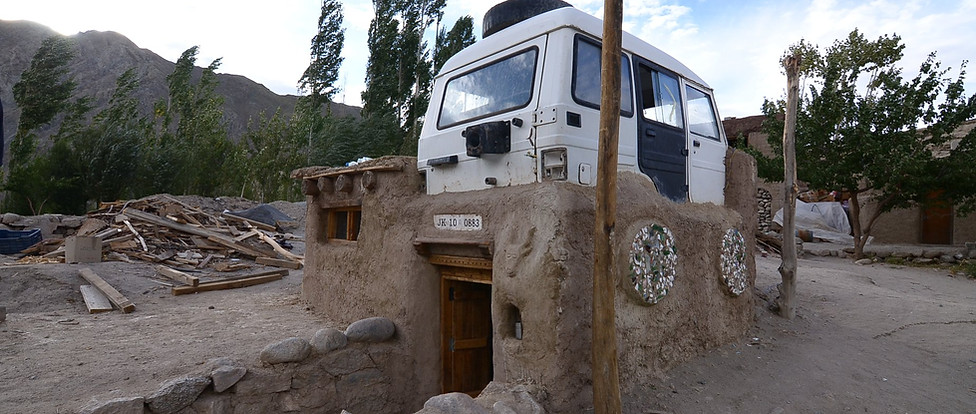
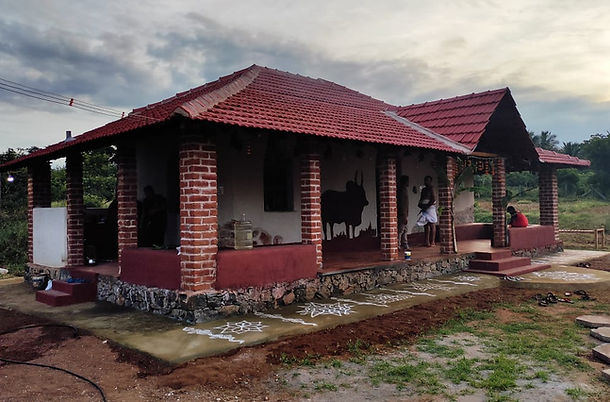
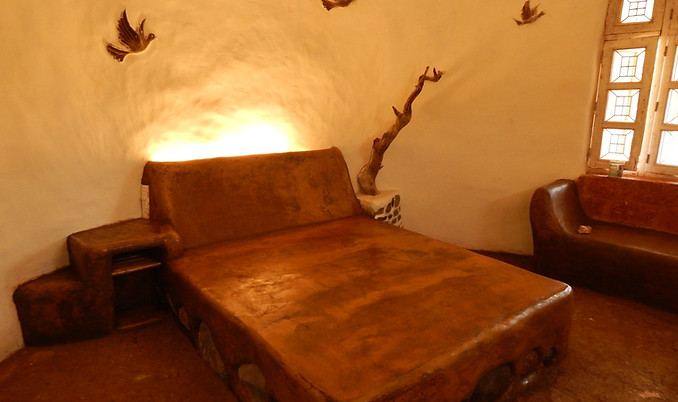
From building an Earthbag dome house and Adobe farmhouse in Coimbatore, Tamil Nadu to cob based interior designing in Talavali, Maharashtra to cob car cottage in Leh, Ladakh, his work shows sensitivity towards regional variations and practicality of weather conditions to sustain those structures. In Leh, he built a unique low-cost cottage entirely with local resources and recycled materials like wood, glass, tyres, bottles and discarded Mahindra car body. They used cob based technique by mixing clay, sand, dried grasses with cow dung clay finishing. Phuntsog’s work is grounded in nature as his ideals and his work unites architecture with indigenous knowledge and conservation.
1128 748 Stanzin Phuntsog
Conversation with a Shing-zowa
Photo: Tanvi Dutt

Conversation with a Shing-zowa

RT: Julley Angdui Phuntsok ji, When it comes to building houses and wood crafting, a lot of the people from Kibber village consult you and rely on you to undertake the work. Can you please tell us more about yourself?
​
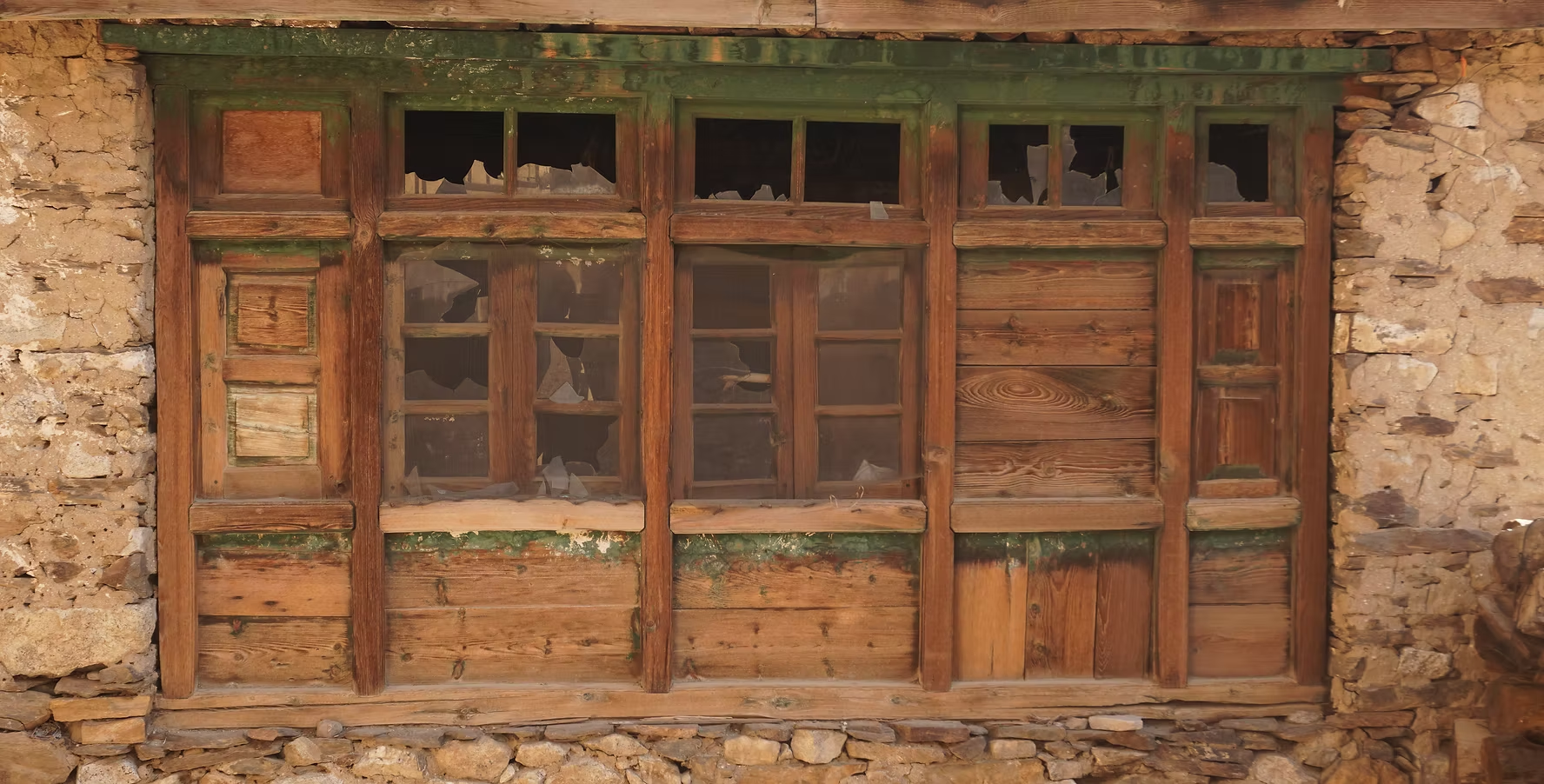
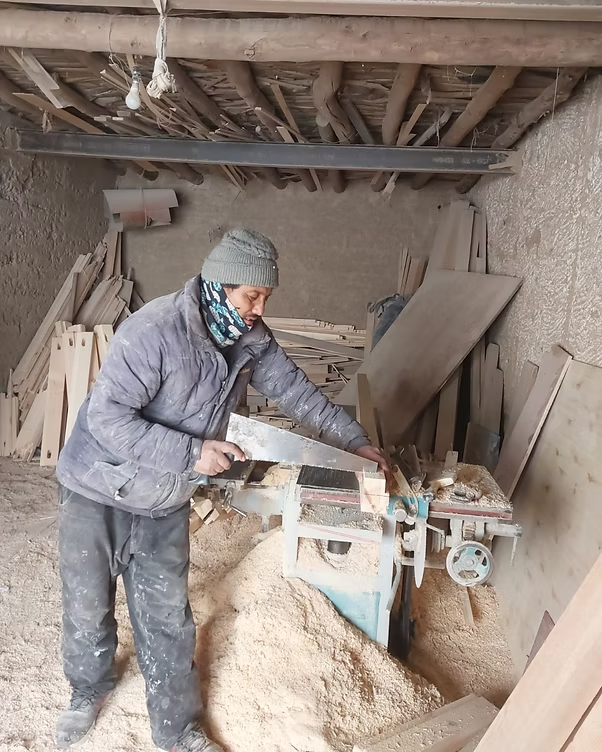
AP: Julley, Namaste, and Tashi Delek to all HimKatha readers. My name is Angdui Phuntsok, I am from Spiti’s Kibber village and I am 46 years old. I grew up helping my family herd livestock (sheep, goat, cow, yak, Dzomo) in our village pastures and plough in our barely fields. I took up carpentry work when I was 20 years old and I learned to make windows, door frames, and Kawa (wooden pillars) for traditional mud houses. I worked closely with Spitian mud-house builders and artisans who were skilled in stone masonry. I eventually self-taught and picked up the skills and started implementing them in my work as a house mistri (chief artisan). I have been building traditional houses and doing carpentry work in Spiti for about 27 years now. I spend my summers building mud houses, consulting, and helping locals undertake various renovation works, and devote my time to carpentry during winters.

RT: How do you undertake building works in Spiti and how is it different regionally?
​
AP: It mostly depends on the host family, and individuals commissioning the work. Earlier traditional mud houses are preferred but these days cement houses are becoming popular and people even go for mixed structures where the walls, the foundation, roof, and the internal structures of a house are of earthen material and mud while the outer plastering of the house is done with RCC. The choice of material is also dependent on local conditions and regional variations. In the Todh valley side (upper Spiti side), the raw materials are scarce whether it is wood, good quality soil, mud, stones, or iron, hence the design and structure of a house are mostly just mud based with minimal use of resources that isn’t available locally. As you move to the Sham valley side (lower Spiti villages) access and availability of raw materials becomes easier hence earth is used extensively from walls to roofs and stone is used widely in lower portions of a building for stability. When you reach the neighboring villages in Kinnaur like Nako, Malling, and Chango, stone-dominated structures and dry stone houses will be visible.

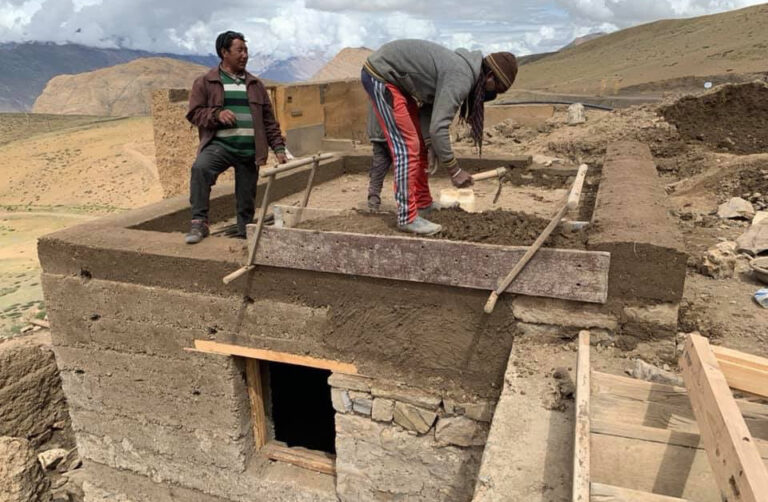
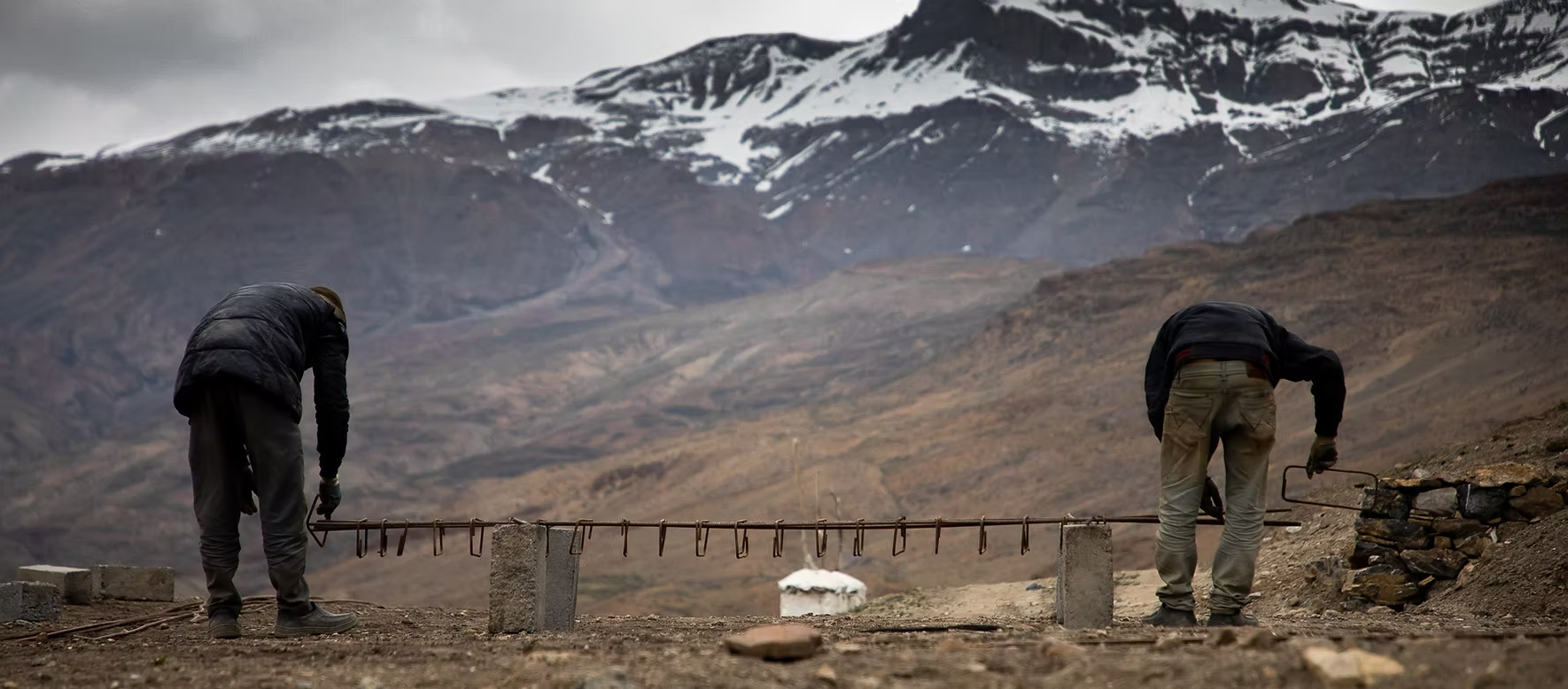
Construction in Kibber | Photo: Rinchen Tobgye

RT: From your experience how have people’s livelihoods, and developmental changes in the region impacted local architecture in Spiti?
​
AP: There is a deep connection between people’s livelihood, their way of life, development changes that happen in the region, and how it shapes the local architecture. Spiti’s architectural changes have certainly undertaken an interesting trajectory and as a local artisan, I am still grappling to find balance and navigate the changes. Earlier Spitians are primarily dependent on agriculture and livestock rearing and the local houses, the architectural designs are built to accommodate the agro-pastoral needs of the household and the community/ suit agropastoral needs. Incorporating separate structures for cattle like corrals, livestock pens, and storage rooms for grains, tools, dry toilets, Dhangtsey (open courtyard), and flat-roofs are all an integral part of the local architecture and function beautifully to fulfill the unique needs of an agricultural family. With accessibility, better connectivity, tourism, and development changes, alternate livelihood opportunities are arising for locals and that utter dependency on agriculture-based livelihood is changing.

Many people are employed in government services, and tourism-based livelihoods are increasingly becoming easier options for people. This is all dynamically changing people’s relationship with their land, their resources, and the local architecture. Vernacular house designs, traditional structures, spaces used for agropastoral-based livelihood, and local materials are losing their relevance. Many households own a lesser number of cattle nowadays and rearing large-bodied livestock like yaks have also shrunk a lot. Only in Todh valley (upper Spiti) it is practiced and hence erstwhile spaces, and structures dedicated to these needs are falling out of use. Modern, cement-based hotels, guesthouses, and giant commercial buildings completely contrast with the local architecture are cropping up. The changes were more prominent in lower Spiti villages like Kaza, Rangrik, and Tabo earlier but in the past 3-4 years, such structures are also becoming more prominent in remote villages like Hansa, Hull, Pangmo too and many of these hotels remain nonfunctional during winters. Like many fragile places, development changes in Spiti are at the cost of the environment, and resource stress, and are slowly changing the architectural integrity of the place.

Photo: Deepshikha Sharma

RT: How is it impacting local artisans and local knowledge around indigenous architecture in Spiti?

AP: The traditional building technique using natural materials found locally is an easy, affordable, locally suited, and eco-friendly way of building. People are familiar with the local resources, materials used for construction and leverage traditional knowledge, and intelligence to design houses. It doesn’t involve unnecessarily complex methods and tools to implement it. It’s very intuitive, immersive, and experiment-based and most people have a working knowledge of the same. The shift to non-traditional, industrial raw materials like cement, steel, glass, and other concrete materials has alienated locals from their own land, own resources, and indigenous knowledge about building systems as it requires specialized masons, and craftspeople to build cement structures.
​
The dependency on non-local craftsmanship is increasing which in turn triggers the migration of workers, artisans, and laborers from lower Himachal districts like Mandi, Kangra, Shimla and some even come from as far as Rajasthan, Bihar, Odisha, Jharkhand and Maharashtra. More and more locals from lower Spitian villages like Kaza, Tabo, Rangrik, Losar, Khurik, Shego, Lara which are hot spots for tourism are outsourcing the construction works to migrant workers from other parts of the country who have no knowledge of the local context and are probably themselves struggling to work in such harsh climatic conditions. Earlier local artisans like Gyangon-da (rammed earth mud builder), Piti Dor-si (Stonemason), Piti Shingzo-wa (wood crafter/carpenters) play an integral role among community members, and their skills, their knowledge, their experiences about the landscape shapes the local architecture. The large-scale tourism and development-based constructions are creating a new social order which is posing multiple threats to the environment, local ecology, wildlife, and architectural heritage. Natural heritage.

RT: As a local mud house builder, and an artisan, what are some of the challenges you experience daily?

AP: Ghawo minang yokak! (… there are many challenges!) Construction is essentially labor intensive and physically strenuous work. As an artisan whether you are involved in stone masonry rammed earth building, or are undertaking other works like carrying stones, mud, bricks, breaking stones, or digging earth, it takes a heavy toll physically. Knee, back, and joint pains are very common, and injuries due to construction work is a common experience. But all that pain goes away if your host, and the individuals commissioning the work are kind and generous, and there’s a sense of solidarity, and camaraderie among workers, villagers, and community members. We all work together, help each other, eat meals together, enjoy the process of building, sing songs, drink copious amounts of tea, tell stories, and within no time, work gets done!

RT: Thank you for patiently sharing your experiences with us.

AP: Thank you.

1770 778 Angdui Phuntsok and Rinchen Tobge
Conversation with a Gyangon-da
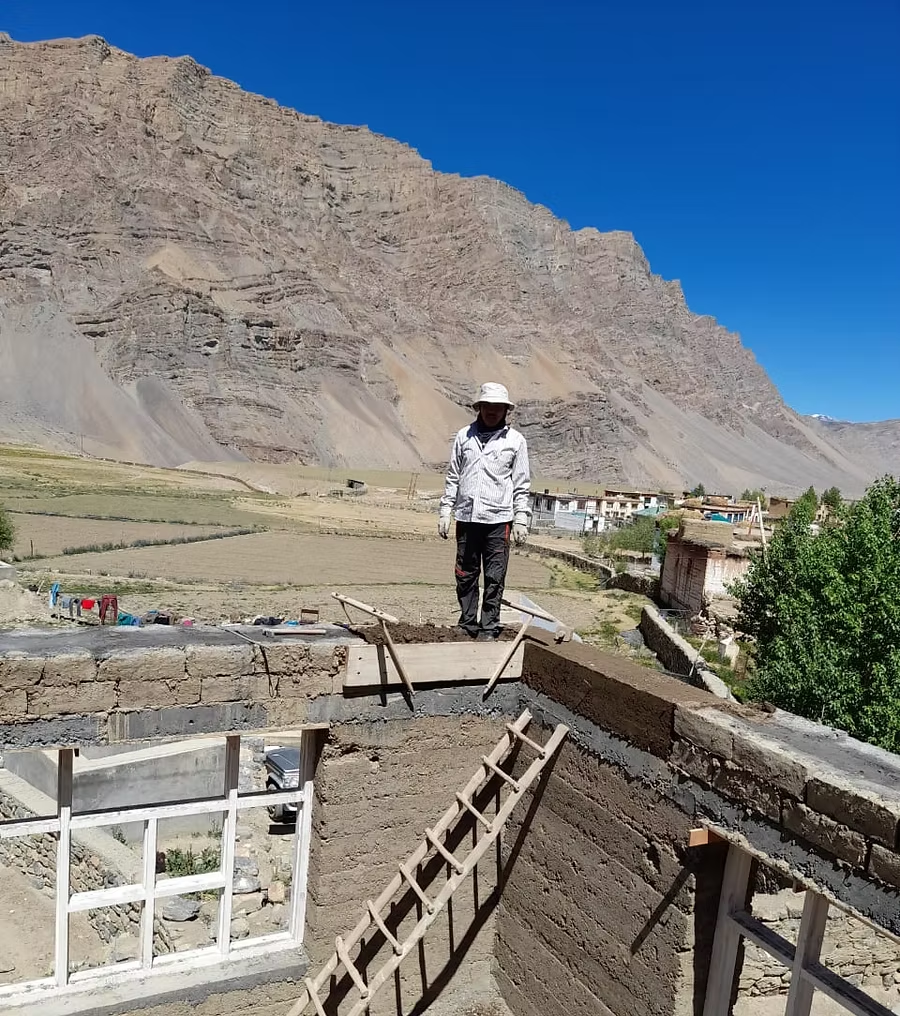
Glimpse of mud house construction in Spiti  | Photo: Tanvi Dutta

Conversation with a Gyangon-da

Demul is a remote high-altitude village in Spiti known for its beautiful meadows and pastures. The villagers are agro-pastoralists and still actively practice their traditional ways of agriculture, livestock rearing, and herding. This village is also home to many Spitian artisans skilled in building traditional mud houses, Dor-si (stone mason), Shingso-wa (carpenter), and Gyanghon-da (earthen wall builder). We spoke to Mr. Chhuldim Pempa from Demul who has been in the trade for decades and is a master craftsman skilled in stone masonry and rammed earth building.

HimKatha: Julley and Tashi Delek. Chhuldim ji, we heard you have spent many years building traditional mud houses in Spiti and are an expert Dor-si (stone mason). Can you tell us more about yourself and how you started?

Chhuldim Pempa: Yes. I have been working in traditional construction for over 30 years in Spiti and my primary work is building houses using mud and stones. I started in the early 90s when I was around 18-20 years old. I stumbled upon it quite unexpectedly – I grew up herding and working in my family field but once there was an opportunity to work as a construction helper to a house mistri (chief mason) in my village. The work seemed pretty doable, it included working under a master craftsman and helping him in manual works like carrying stones, digging works, making mud mixtures, and doing all the preparatory works before the chief mason started laying the stone foundation for a house. It was paying a minimal amount for the labor work, so I took it up along with a few friends. Back then, there wasn’t much to do, so I continued as a labor helper in traditional constructions for a few years before I began focusing exclusively on stone masonry and rammed earth-building techniques. Looking back, I realize, my apprenticeship days were difficult but it’s there amid the mud, stones, and under the guidance of a skilled mason that I learned the most and picked up the skills of the trade before I started practicing it independently in my village.

HK: What changes have you seen in natural building techniques over the years?

CP: In Spiti, rammed earth building has traditionally been practiced for centuries, it is used for building residential houses and monasteries – most of the old mud buildings in Spiti like Tabo Gonpa (built-in 10th C) and the old Tengyud Gonpa are built in that form. To a large extent, it is still preferred in higher Spitian villages like Demul, Komic, Chicham, and Kibber for its durability and inherent thermal capabilities. Architectural changes are definitely taking place in Spiti and with that, there is a stark shift in natural building techniques, resource usage, and general treatment of vernacular design systems.

There’s an increased usage of industrial materials like cement, metals, ready-mix concretes, glass, plywood, plastics, and artificial stones which were not accessible in earlier times. Earlier houses were built with a lot of care and even the smallest details were incorporated with a lot of structural integrity. For eg, all mud houses have “Kyorma” on the upper roof which is a protective boundary made of wild shrubs, it looks aesthetic as well as does a great job of protecting the mud walls from sun and rain. The use of such designs is declining.

Walls are built with Gyang-sa – a specific soil type carefully selected by the master mason, it is mixed with grass chaffs, straw, or small wood chips, and the mixture is then kneaded with water two days before building a wall. It is done to allow better water absorption in the mixture and adding grass chaffs provides warmth once it is built. Thick double walls of about 18 inches are built using a cross-joint technique where one wall is built from right to left and another from left to right.

The structure is then plastered with the same mud mix or tied on the two sides with wooden planks (ghing-shing) on the two sides of the walls and the mud mix is filled in. Once filled, it is slowly pushed in by walking on it which makes the wall structures more cohesive. Such designs are crack resistant and have better resilience towards earthquakes as compared to straight cement pillars that are adopted in new houses these days. Thoughtful building methods like this are slowly fading and I am afraid soon people won’t require artisans like us.

 Mudhouse construction in Kaza | Photo: Mr. Janhwij Sharma, Additional DG, ASI

HK: What tools are used to build houses in the olden days?

CP: We used very minimal tools as there was no access to any resources. Most tools were handmade by Spitian blacksmith artisans from the Dzo community who were experts in making agricultural and field tools used for construction. We used only 2-3 tools like Tokse, Teo, and basal used for digging mud, pulling stones, handling mortar, and other wooden tools for building walls. Since houses were built communally among villagers, tools were also shared locally among people. For measurements, we relied heavily on the ancient technique of using the body as a tool – fingers, elbows, and arms were used liberally to measure walls and base construction. For eg: “Thu” is a measuring length from the middle finger to the elbow while “Dhompa” is the length from one’s right hand to the left once we spread it widely and apparently one Dhompa equals five feet. Such measurements are used for building smaller structures in the house like Chaksa (dry toilets) and Raah (Sheep house).

HK: Are there any community practices and traditional rituals around building houses?

CP: Yes. In Spiti, building houses is a community activity. Everyone pools in the resources and volunteers to help during various phases of construction. It is quite common for 3-4 households to get together and help each other and it is colloquially called the “Bhey” system where the community forms an internal support structure and relies on each other for resources and labor. In a place like Spiti where resources are scarce and sustenance difficult, it proves more feasible and affordable. Many auspicious rituals are performed to bring good luck and prosperity to the host family. The one, in particular, I remember is called “Saney-Doney” where the host family consults Rinpoche (venerable lamas) and he places a pot containing soil and pebbles from Buddhist pilgrimage sites like Varanasi and Nepal in the four directions of the foundation

to ward off evil energies on the land and to bring prosperity for the host family. Another ritual is called Jinshak ceremony which is done on empty barren land to check the suitability of the land for construction. Apart from that, there are local belief systems that imbibe respect for human-nature relations and value natural surroundings. For e.g. stones are never excavated from Chumik – the spring water areas for construction as it causes ecological disturbance in the area.

HK: Thank you for sharing your experience with us.

CP: Zang-song! (Thank you)

Traditional house contructed by Gyangon-da Pempa in Demul village
1770 1000 Chhuldim Pempa