Ladakh Pashmina
The story of Ladakh Pashmina: The authentic, sustainable cashmere. A film by Munmun Dhalaria. (Language: English and Ladakhi with English subtitles)

The story of Ladakh Pashmina: The authentic, sustainable cashmere. A film by Munmun Dhalaria. (Language: English and Ladakhi with English subtitles)
Building with an earthen material is a craft, a philosophy where nature is at the center of the entire life cycle of a building. From its conception, sourcing, material usage, and construction till the inevitable end when the material returns to earth as compost, there’s a balance, harmonious unison with nature. The renewable nature of the natural material renders it environmentally more sensitive and less disruptive to the land and ecosystems around it. Lobzang Choephel also known as Lama Thamo ji the master artisan known throughout the Spiti valley for his expertise in rammed earth building and understanding of natural material feels that the journey of the natural building is rooted in the ethics of care. Being a skillful craftsman, he opines that care frames your relation with the land you are building on, the material used, the people/community you are building for, and their relation with nature.
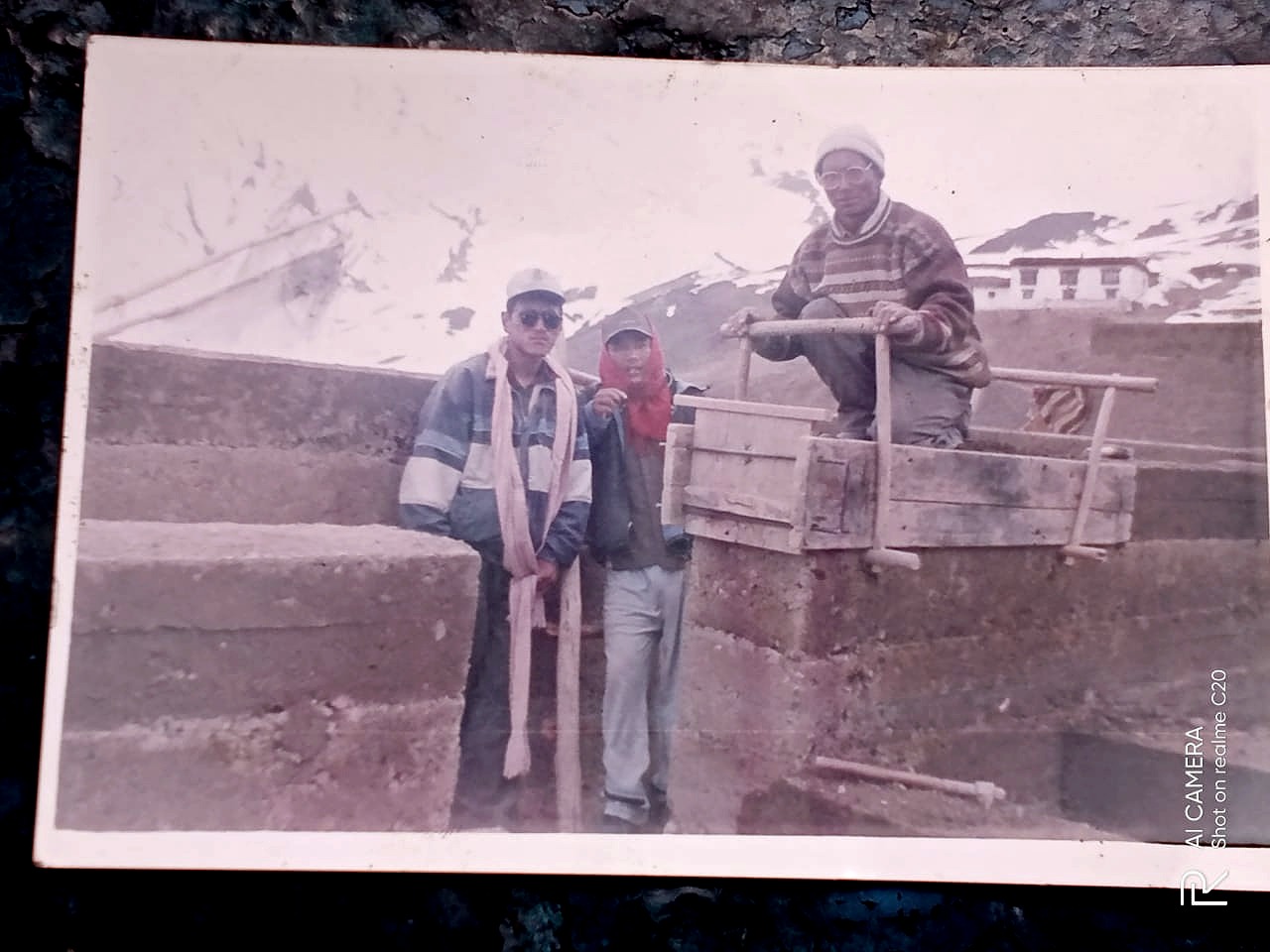
We rarely talk about intention and mindset when it comes to the trade of building but he thinks this is critical and is inevitably tied to the entire process of building. In Buddhism, there’s a huge emphasis on “kun-long sangpo”– having a righteous mind and kind motivation that dictates one’s action. Reflecting on the same, he quietly utters “When it comes to natural building, at the most primal level it means creating a human habitat that reflects brilliant functionality of natural material, inherently sustainable design, and one where care for the nature is there from which we draw so much”. In the daily experience of building, this reflects on being mindful, being responsible in places you excavate stones, dig soil, paying attention to the character of the material whether it is harmful or good for nature, and the overall approach you take in construction. With all the heavy lifting of stones, digging the ground, and building with mud, construction is physically very strenuous, and while construction, a lot of microorganisms get killed in the process. Therefore in ancient Spitian tradition, much like a farmer would recite prayers before plowing, the local artisans offer prayers before construction and express their remorse, their guilt for engaging in what is considered a sinful activity that harms other sentient being including microorganisms which are barely visible through our naked eyes. Tashi Monlam – prayers for the auspicious building process and fewer obstacles for the artisans, the laborers, and the host family are also recited. Another prayer earnestly seeks the blessings of local deities for a productive building experience and appeals to them for strength and diligence to undertake construction works. It can be aptly summarized as “May give us the strength to build this house as if built by god himself, May construction work be easy and fruitful”.
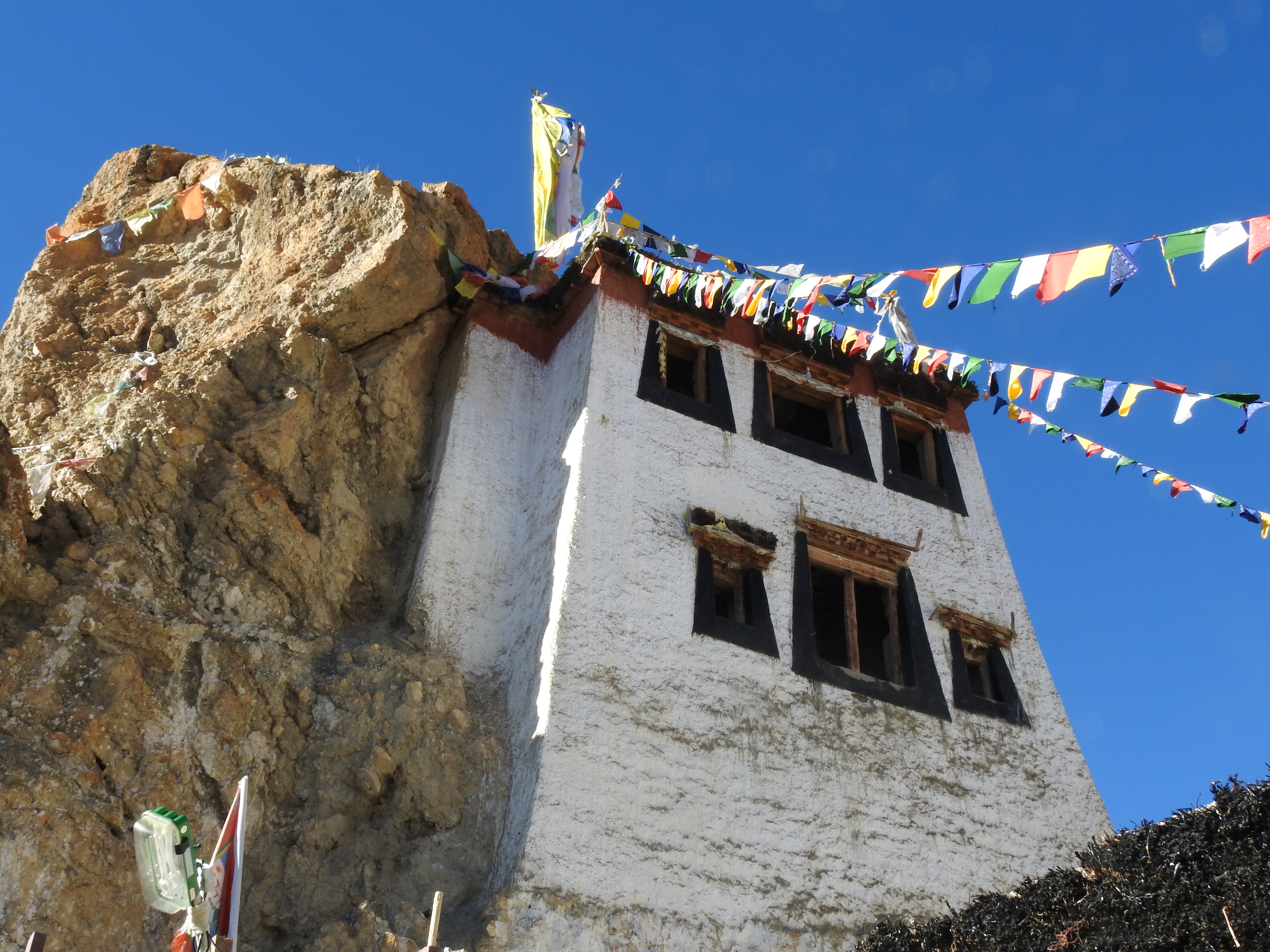
Many indigenous building approaches and such unique cultural practices are rapidly getting substituted with more modern, industrial building techniques which are devoid of ethical essence and are proving more unsustainable. The natural environment sustains the life of all living beings and it is crucial to acknowledge the basic inter-connectedness and relation between humans and nature. In an age where haphazard development and construction activities are surging up, it is all the more important to evoke traditional wisdom and reflect on the significance of traditional materials, techniques, their implementation, and their relevance in contemporary building practice. Being a skillful natural builder for over 55 years and having spent a lifetime devoted to this trade, mindfulness is the guiding philosophy, and his learnings in Buddhist scriptures and meditation often drive his groundwork as an artisan, a builder, and a seasoned mason.
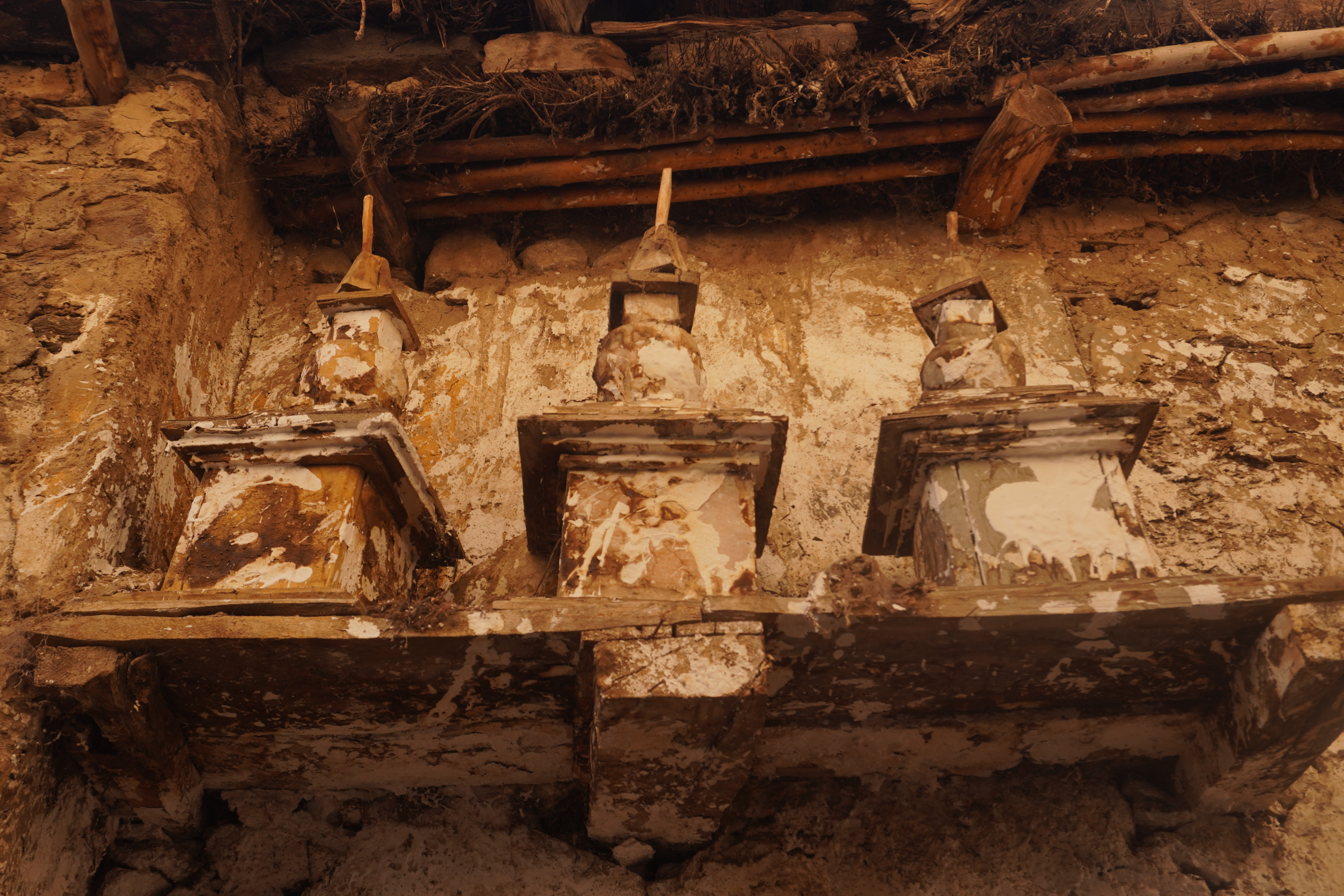
There are so many ways to handcraft with natural material but one thing common across different geographies and contexts is the use of soil – the earth beneath our feet. No two sites have the exact composition of soil and as a builder, it is important to immerse oneself in these materials to gain experience, understand how to work with available soil in a given site, and be aware of the particular qualities, and limitations of soil that gives us scope for experimentation. For instance, deep yellow, orange, and red soil found in villages like Kaza is good for construction, especially for foundations whereas black and clayey soil found in higher villages like Demul, Chicham, and Komic is not good for foundations as it can cause dampness in the foundation. Hence understanding material adaptation is important otherwise it will be risky to build a structure without sufficient attention to detail.
“When I began construction, I worked closely with elder Spitian artisans to build and renovate many monastic structures – especially Dha-shak (monk’s residence), there was hardly any material available apart from the ones you get in your village sites. Even wood materials like willow, poplar, and timber were scarce so it was used judiciously for roofing structures, and most roof structures were made of smaller woods of shorter length which was mostly gathered from the village pastures”.
With accessibility, the struggle has lessened a lot but it has changed the architectural integrity of a place. The use of natural materials, responsible building methods, and the shared ethos of love and care for natural surroundings is fast disappearing and the preservation of traditional wisdom has become an urgent responsibility.
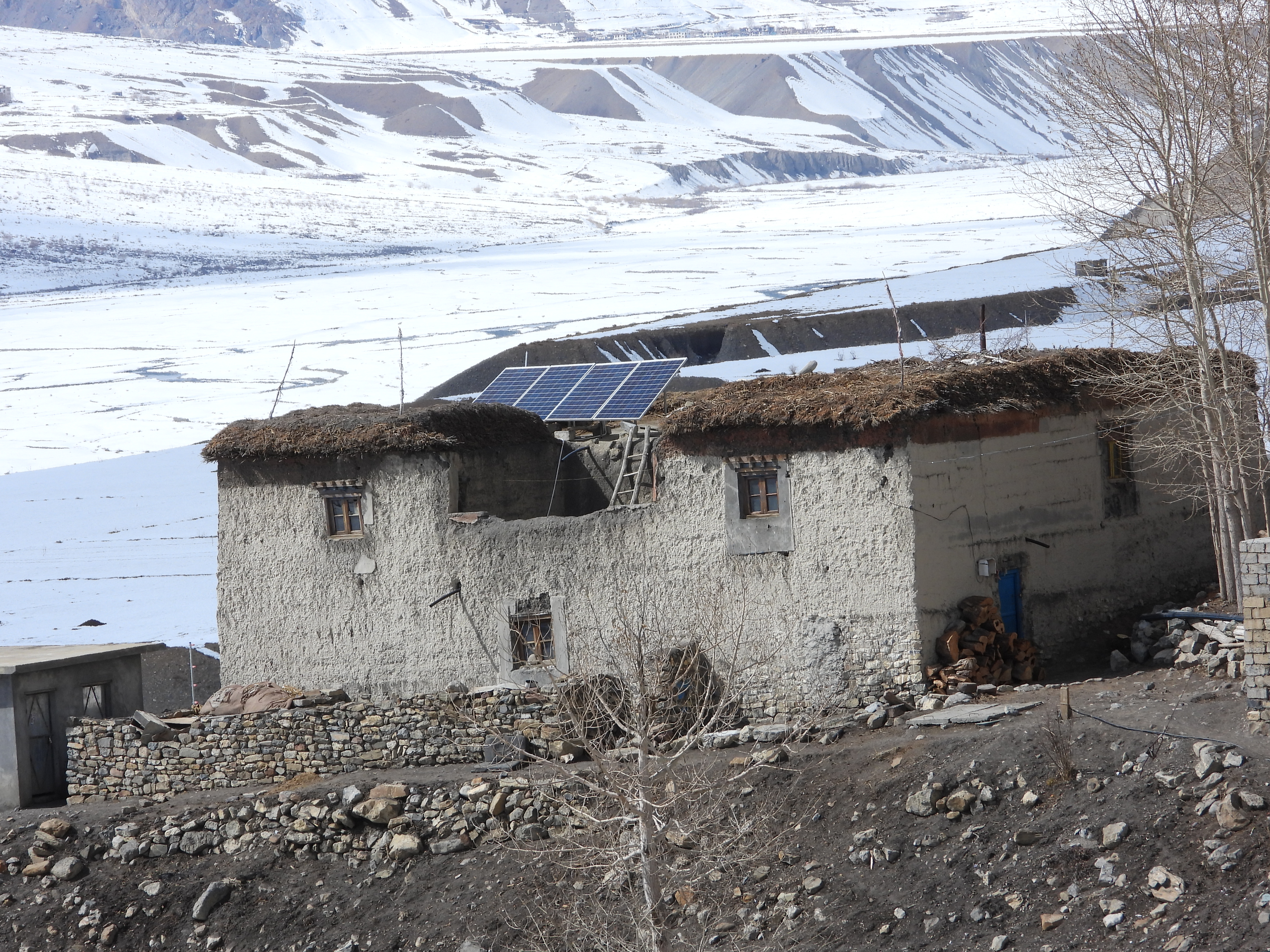
Spiti is a cold, dry desert with a vast expanse of land that has a limited scope of vegetation and productivity. Nevertheless, there’s an oasis of human settlement, small but scattered along the river valley depending upon it for sustenance. Some of these remote ancient villages have existed in this harsh terrain for at least a thousand years and the local houses, architecture, building techniques, materials, and design sensibilities reflect conscious choices that take into consideration the unique topography and natural environment around them. Most traditional houses in Spiti are double-storeyed with flat roofs, and thick walls, with multiple rooms and structures that beautifully suit our agro-pastoral way of life.
I remember my father nostalgically recounting how in the olden times when winters were long and harsh, snow piles high, and seasonal migration to warmer places wasn’t as convenient as these days, they found ingenious ways to accommodate their daily needs within the house. “Snowstorm or drought, we had our granaries filled to last at least two years and hardly had to move out of the house!” Spitians – despite being people of slender means, were quite inventive and it is tactfully reflected in the vernacular design systems of the houses.
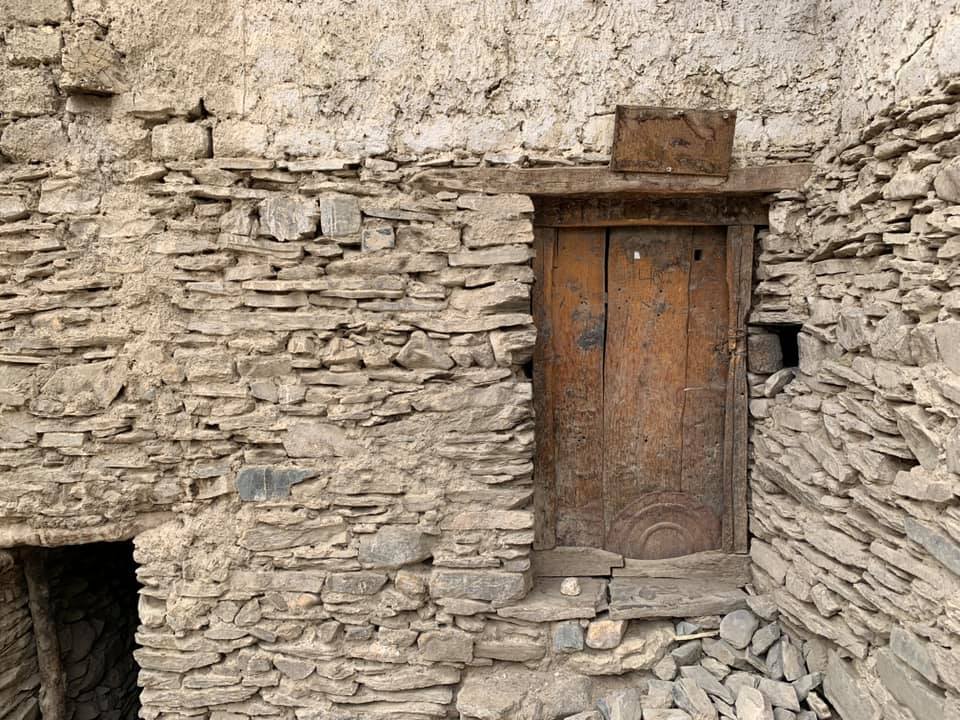
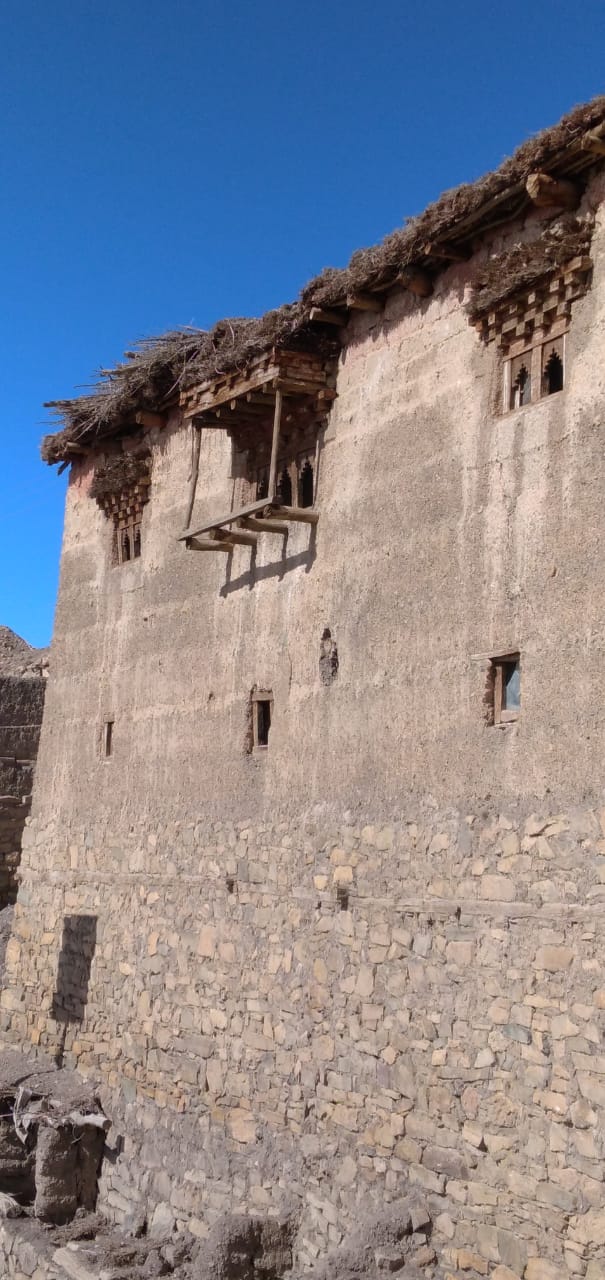
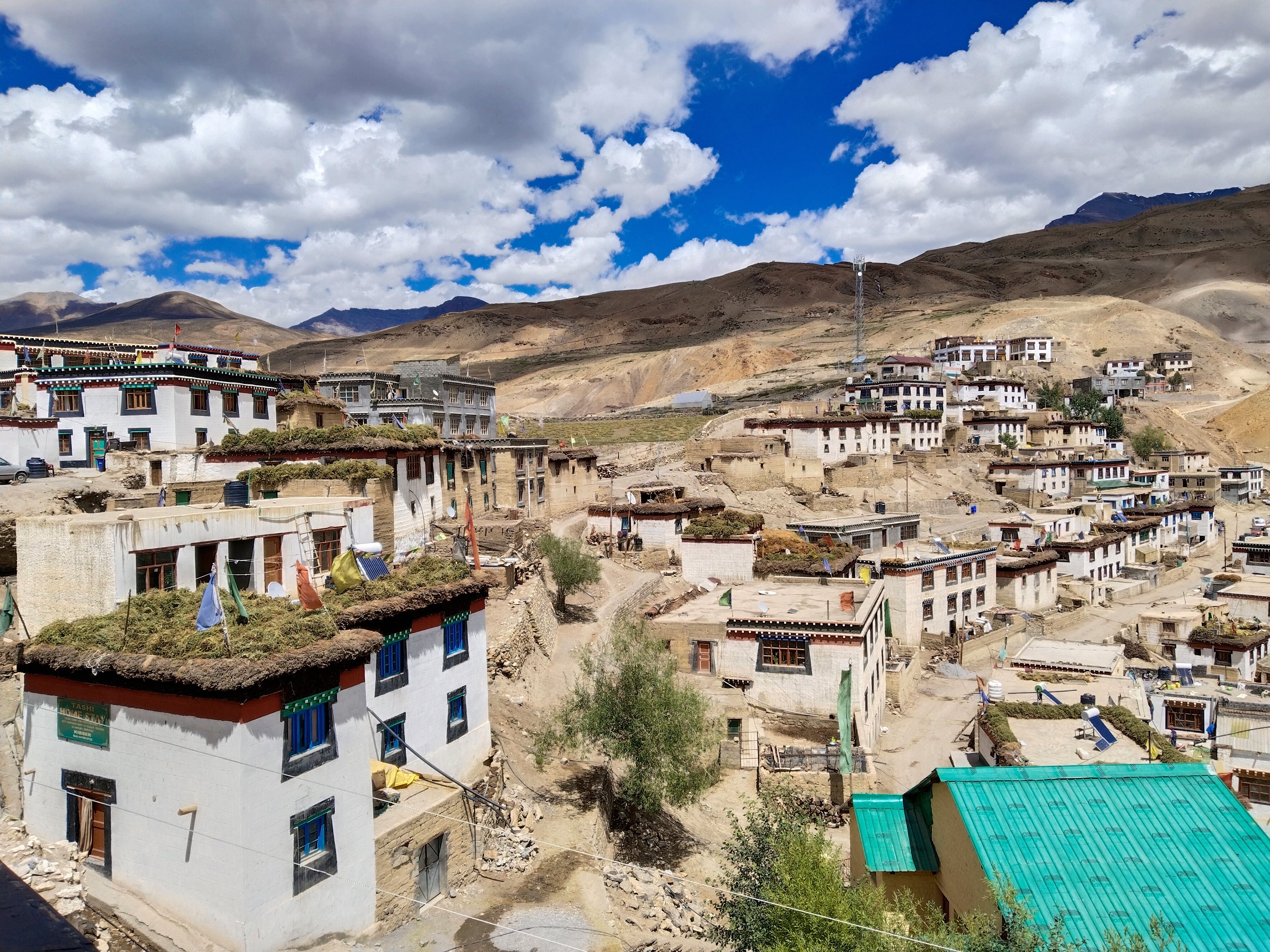
Ancient mud house in Mane, Spiti | Photo: Pema Khando
Material & traditional tools used for construction:
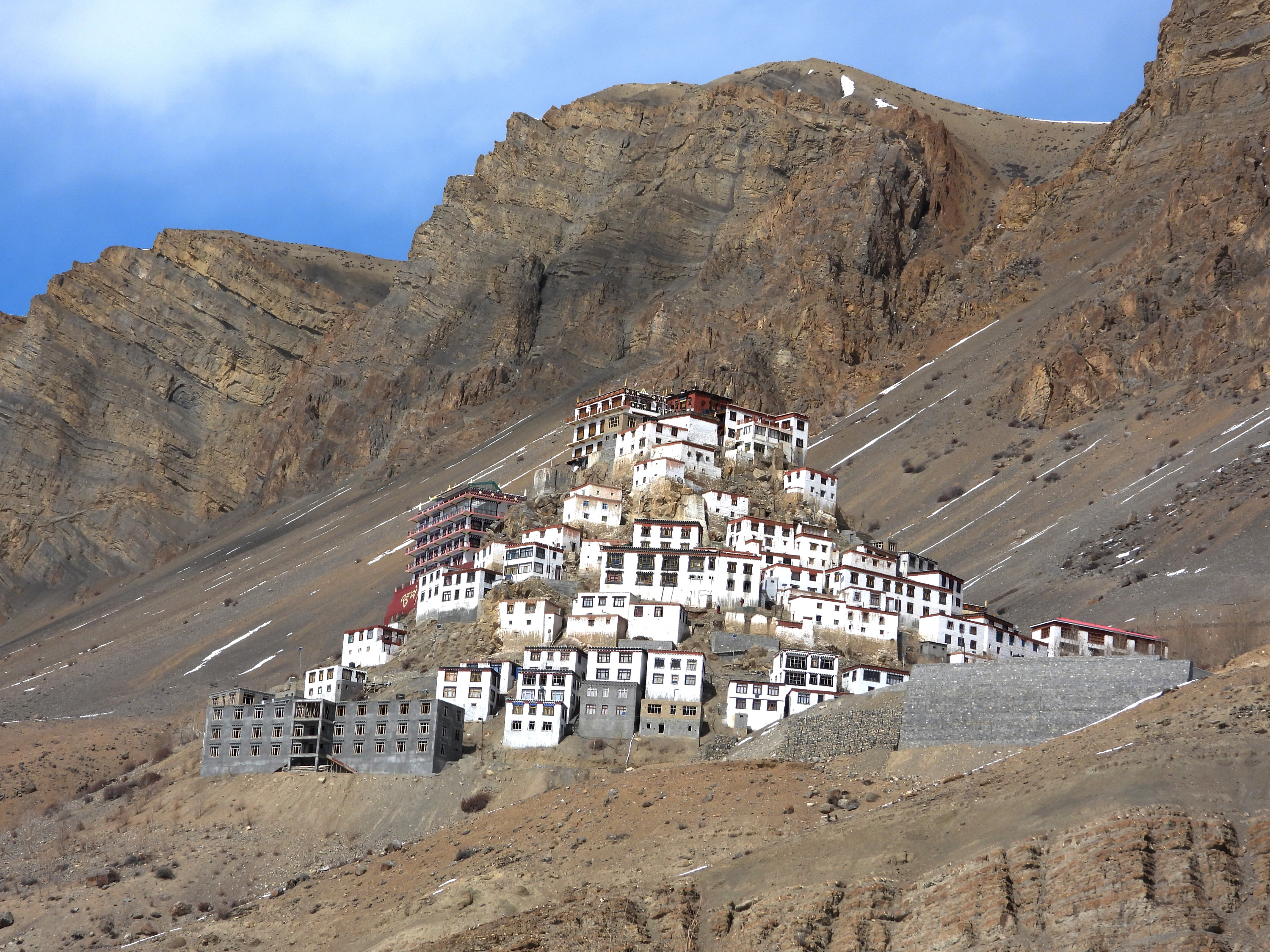
Upon entering any Spitian village, the most striking aspect is the cluster of white mud houses dotted beautifully against the blue sky and gigantic barren mountains. The design, aesthetics, and material composition of the houses are uniquely Spitian – evolved and adapted to suit the cold mountain desert. Primarily natural materials are used for construction; with stones as the foundation, mud for walls, and various kinds of wood for ceilings, door & window frames and support structures like Kawa (pillars). Some of the common materials used are listed below:
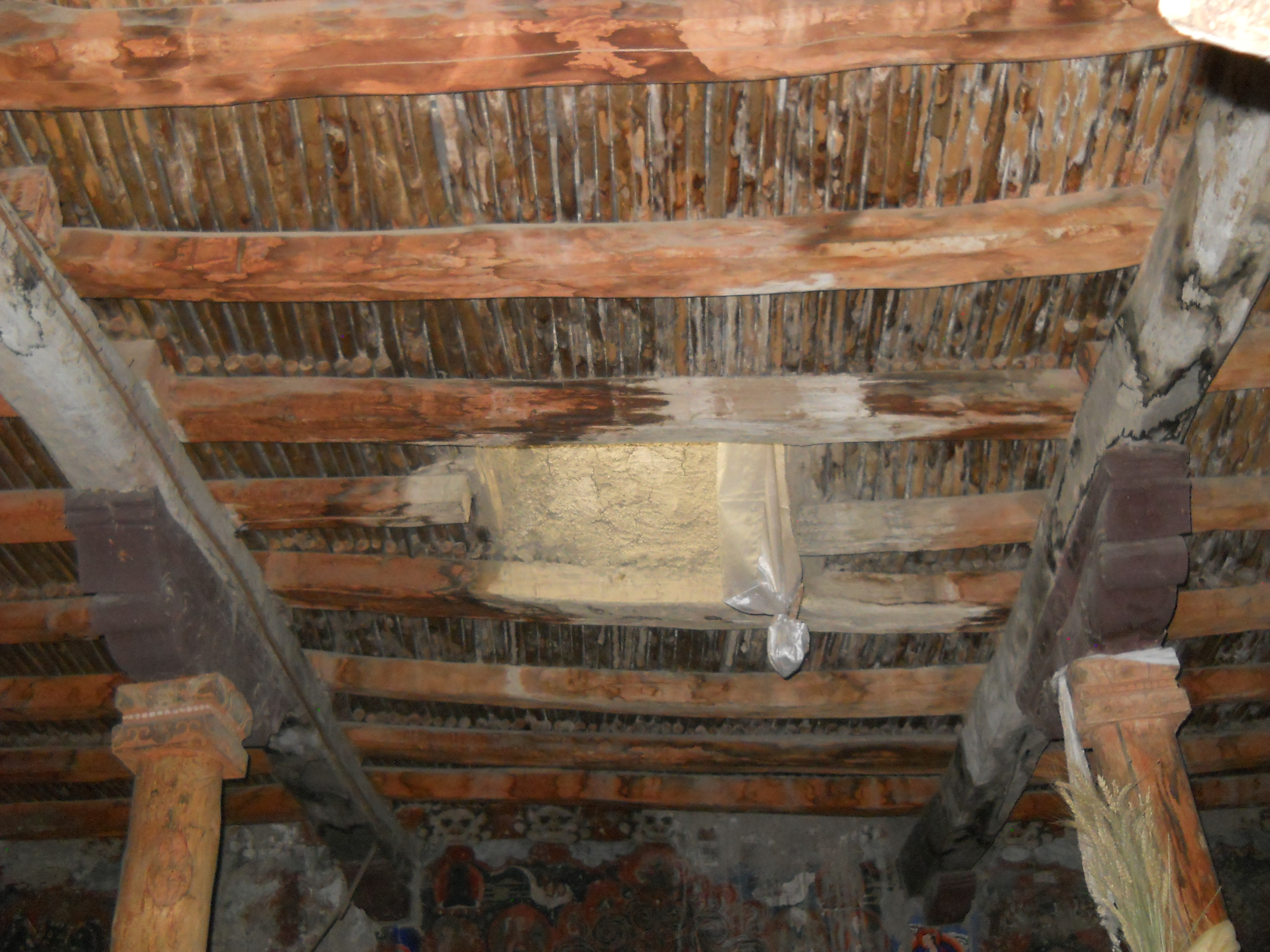
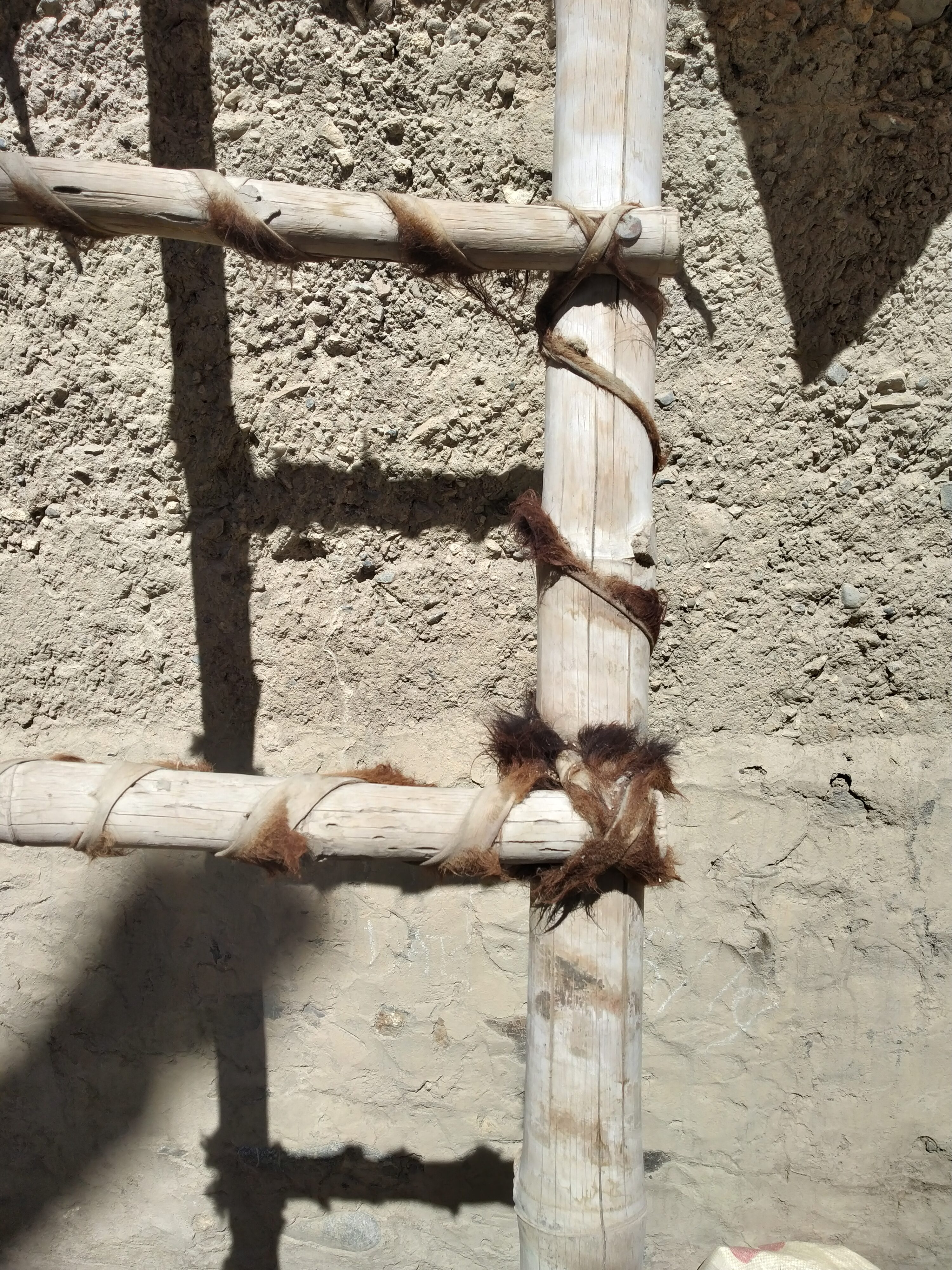
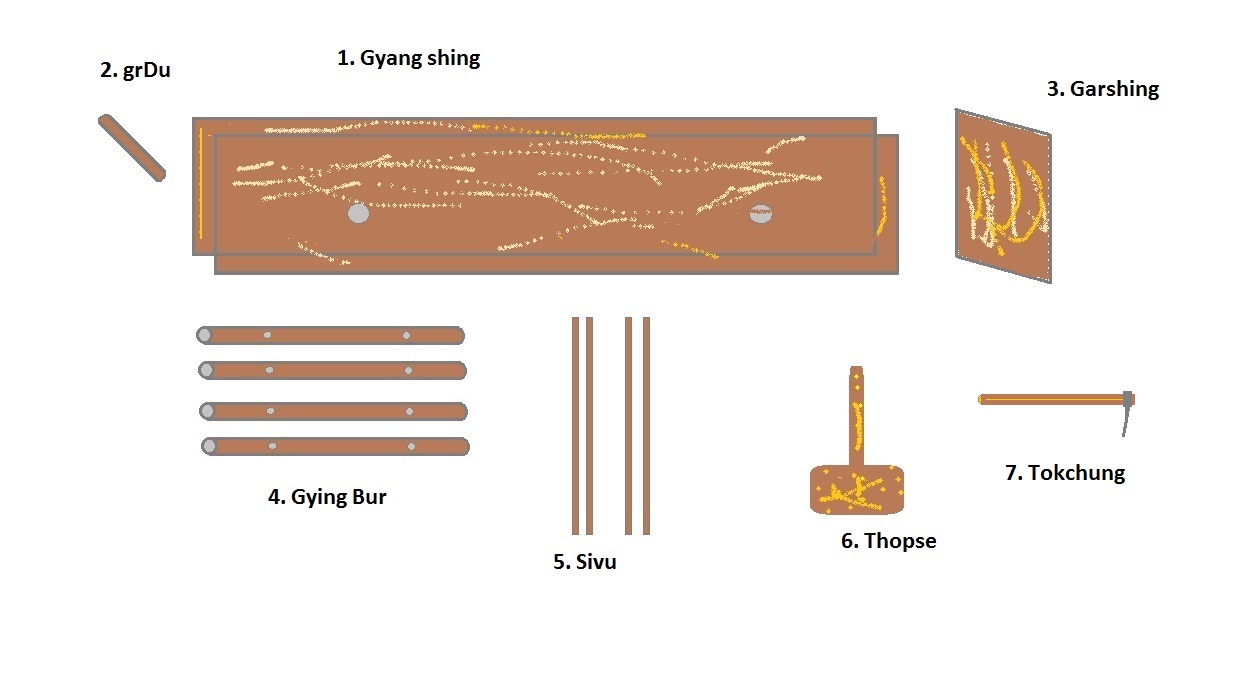
Natural building techniques like rammed earth building are used for construction which is suitable due to its durability, low maintenance, and thermally optimal characteristics which protect the houses from extreme climate and help retain stable temperatures inside the building. Since most of the houses are hand-built, there are specific traditional tools used for constructing particular aspects of a house. It is startling how even for building seemingly simple structures like a wall, multiple tools are used as listed below:
Dynamic design & traditional practices:
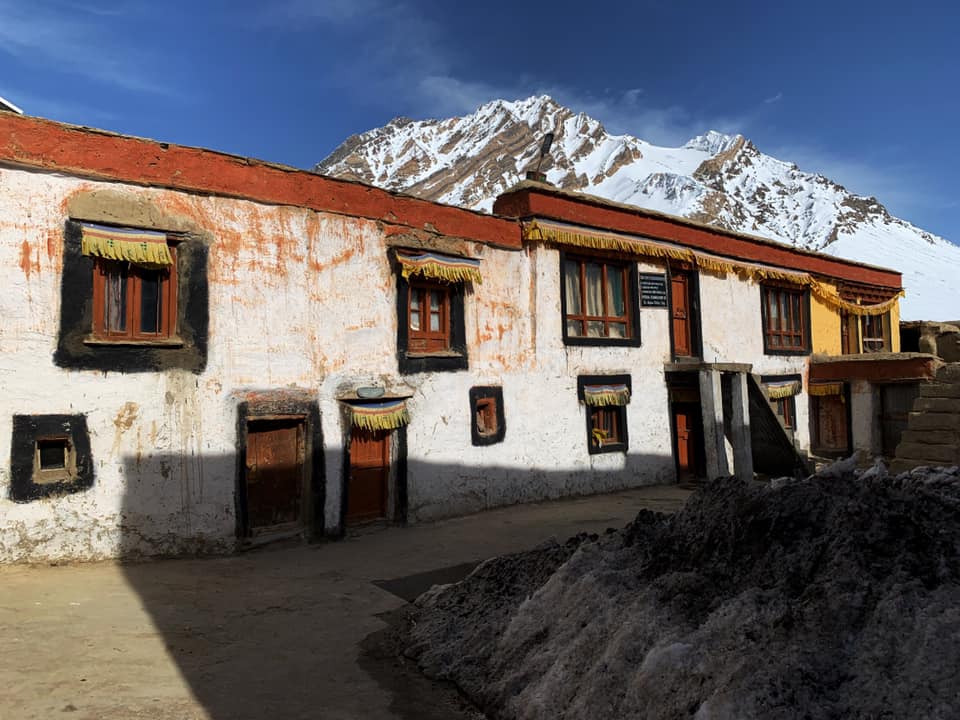
Agriculture and livestock rearing used to be the primary sources of livelihood for people in Spiti and our old houses are constructed to incorporate those needs in the vernacular design. Each house comprises at-least 8-10 rooms with unique functions and features. Elaborate storehouses can be seen in older houses like “Zot” colloquially means storeroom and there are different types of Zot used for different purposes: dry meats are stored in “sham-zot”, agricultural tools are stored in “lak-zot” whereas, alcoholic beverages like chaang and aarak are kept in “chang-zot”. Apart from that, some families have an additional room called “Tiwang” where foodgrains and other edible items are stored, the room is divided into multiple subsections used to keep various items. Within Tiwang, there’s a small compartmentalized room called bhaang where the family’s essential items are stored and access to it is only from a narrow window from the upper floor. Dhaa is a granary on the ground floor where fungma (hay) for livestock is stocked for winter and it has a small window-like aperture to stack grasses.
As for the livestock enclosures, most Spitian households have at least two kinds of livestock pen; Luk-raa/Raa is a cattle house placed inside the house on the ground floor while Dhang-raa is an open corral placed outside of the house right at the main entry gate. Apart from that, the family’s winter room Yok-Khang is structurally always in close quarters with the Luk-raah as the room draws insulation from Luk-raah making it warmer and easier to tend livestock during heavy snowfall in case of livestock sickness or during birthing cases. On the upper floor, the key rooms are Ma-khang (main living room), Shal-khang (solar room). Chot-khang (prayer room), Don-Khang (guest room), and Dhang-zey an open courtyard on the upper floor that serves as a functional space for many community activities and which also has a small window-like access point for all the ground storerooms.
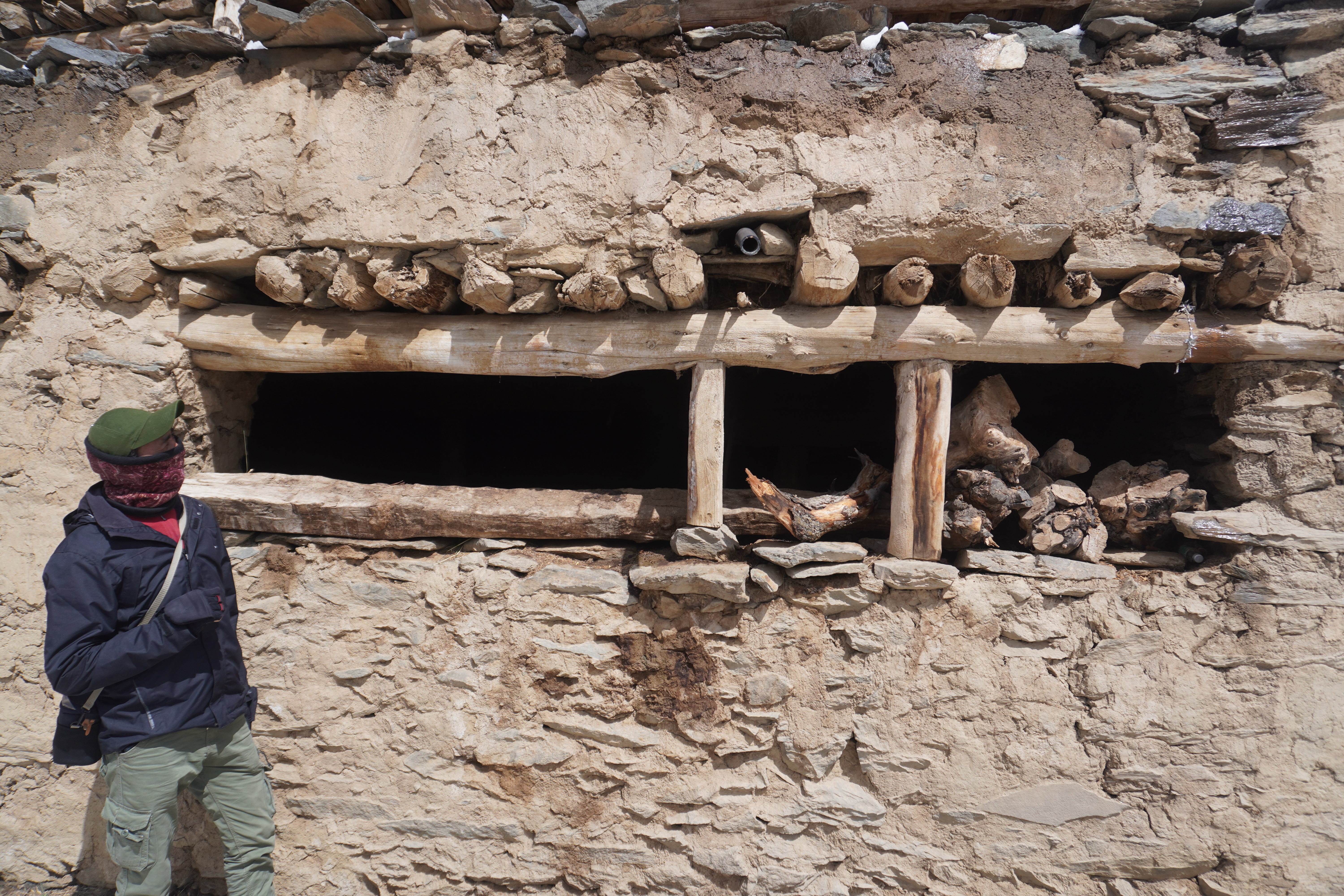
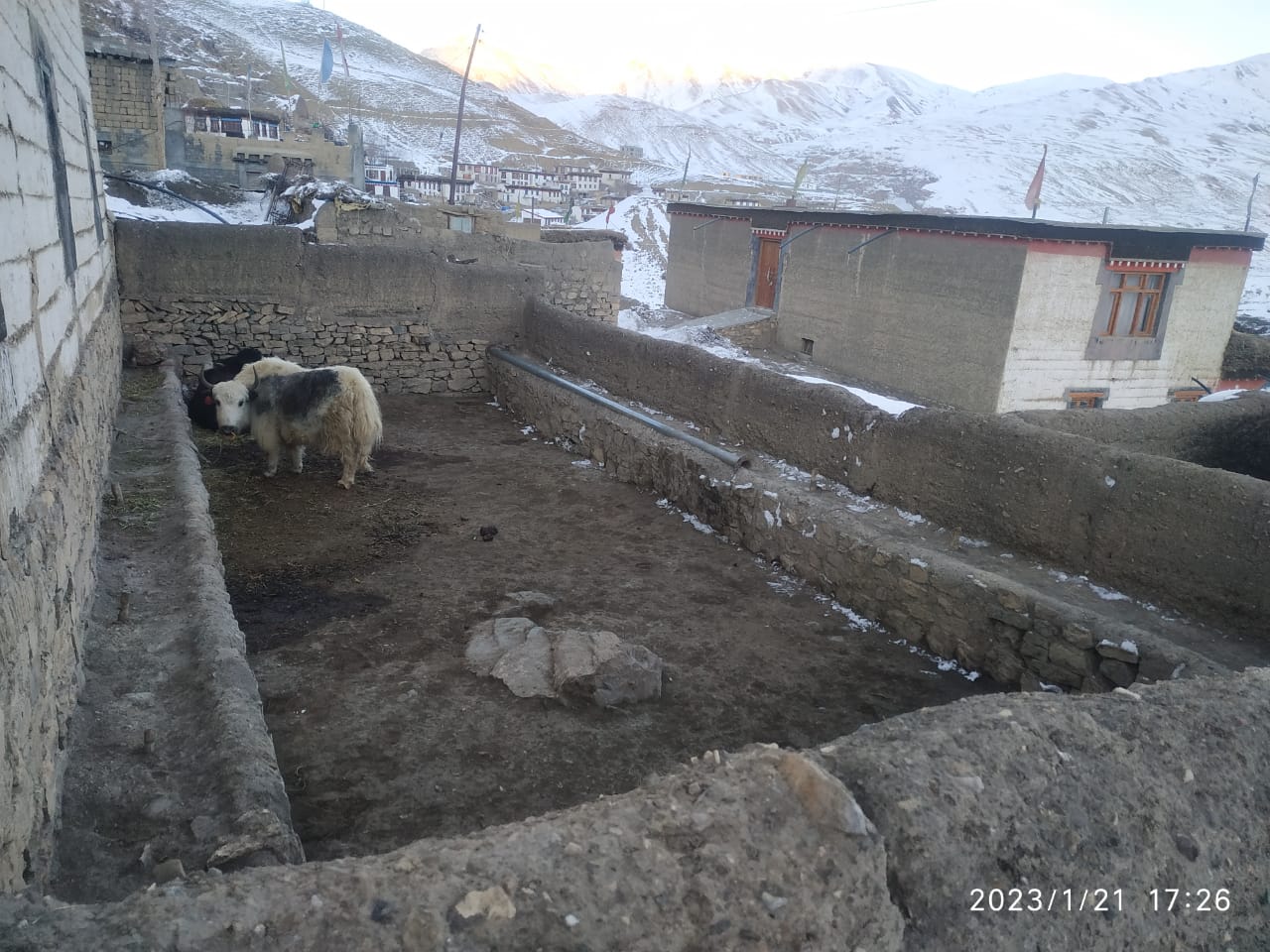
Two different types of livestock corral: Luk-raa/Raa and Dhangra | Photos: Deepshikha Sharma and Chonzom
The most unique aspect of natural building techniques prevalent in high-altitude regions like Spiti is the communal nature of the work. An individual seeks support from the community in terms of resources as well as labor so it is not unusual to have members of your family, relatives, friends, and other community members involved in building a house. The use of local resources, awareness about the material composition, familiarity with the natural building techniques, and use of local intelligence renders them capable to build a house locally without seeking any help from outsiders. Apart from master artisans like stone masons, mud builders, and carpenters under whose guidance the whole construction takes place, there’s a huge contribution from community members.
Elaborate rituals are performed to seek blessings and forgiveness for causing a disturbance in the surroundings during construction. The one in particular I remember is an offering of Sichu Bhumpa to the local land deity Sa-dak – It involves placing a pot full of precious, semi-precious stones, coins, and scriptures in the foundation to invoke their auspicious blessings. During particularly laborious aspects like roofing works, the entire village gathers to help finish it on time and after finishing all the construction works, villagers take turns to visit the family, offer gifts (like barley, butter, grains, and other delicacies ) and congratulate the owner. In certain cases, a close friend or a relative even hosts meals for the entire family including the chief mason and his men. Similarly, when a newlywed couple build their first house, villagers help by pooling important resources like wood logs. These cultural practices help ease the logistical burden on the host family where the community becomes one’s greatest support system.
In the olden times when importing materials for constrcution was not possible, people often exchanged raw materials or traded labor for raw materials. I remember many such instances where milking animals like cows, Dzomo, sheep, goats, or draught animals like horses, yak, and donkeys are exchanged for important construction materials like dungma (willow log) and timbers.
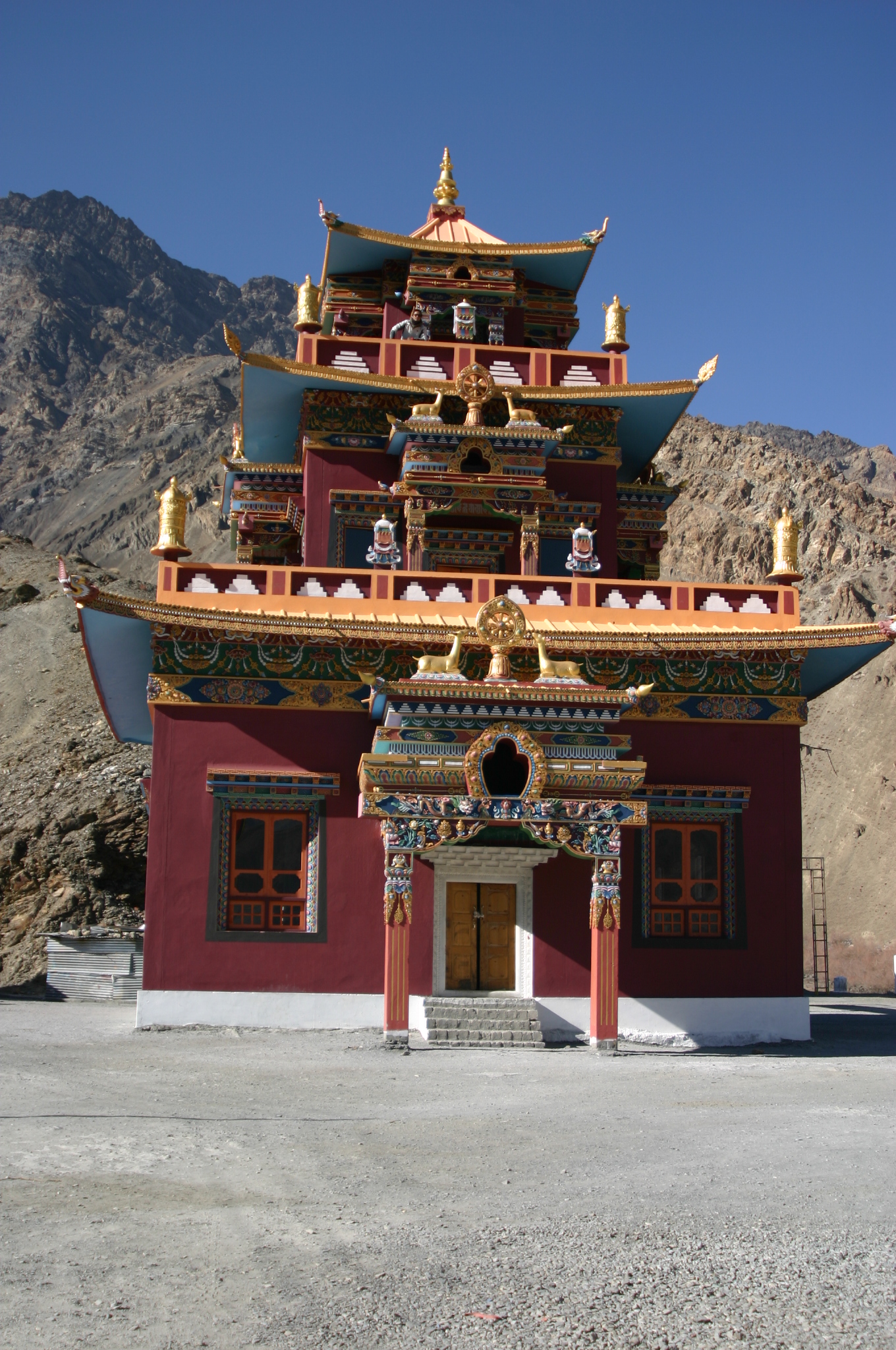
Other commonly traded materials are butter, iron, honey, sitpa (yak thread rope) from which one can buy construction materials of equal monetary value. Iron and honey are not easily found in Spiti and hence were a coveted commodity, sitpa also fetched equal importance but gradually with the emergence of nylon ropes in the local shops and improved accessibility, there was a huge impact on overall trading practices around it. There was a time when it was also possible to pay for construction labor works through local resources. One popular example of this unique labor v/s resource exchange is the payment of one goat to a master artisan for helping build a house. With development, these practices have undergone massive changes and are no longer practiced but it was fascinating to recount such stories and ponder upon various means of material procurement for construction works.
Nestled amid the lofty Trans-himalayan mountains, Changthang is a unique terrain where climate and topography play a crucial role in the sustenance of local communities. The region consists of wide wetlands and giant mountains which offer indispensable ecosystem services and safeguard our water and food security. Many wetlands in Changthang are located at a higher altitude and are fed by glaciers and snow from the surrounding mountains. The high-altitude wetlands in my region contribute significantly to the downstream landscape productivity and form a unique ecosystem for floral and faunal diversity.
The nomadic pastoral communities composed of distinct groups located at Rupsho, Kharnak and Korzokh rear a variety of livestock such as goat (rama), sheep (luk), horses (ta), yaks, and donkeys (bhungpa) which supports them in all aspects of their lives. The Changpa shepherds are skillful in tending their herds; navigating steppe grasslands, accessing fertile pastures, breeding resilient animals, caring for livestock, and preventing diseases. When there’s less grass in the pastures or the livestock are not able to graze due to excessive snowfall, they provide the cattle with fodder they have stocked months before to avoid weakness and starvation. It is precisely the efforts of the local herders and the nutritious resources in the cold arid land that the livestock we breed gives the finest fiber.
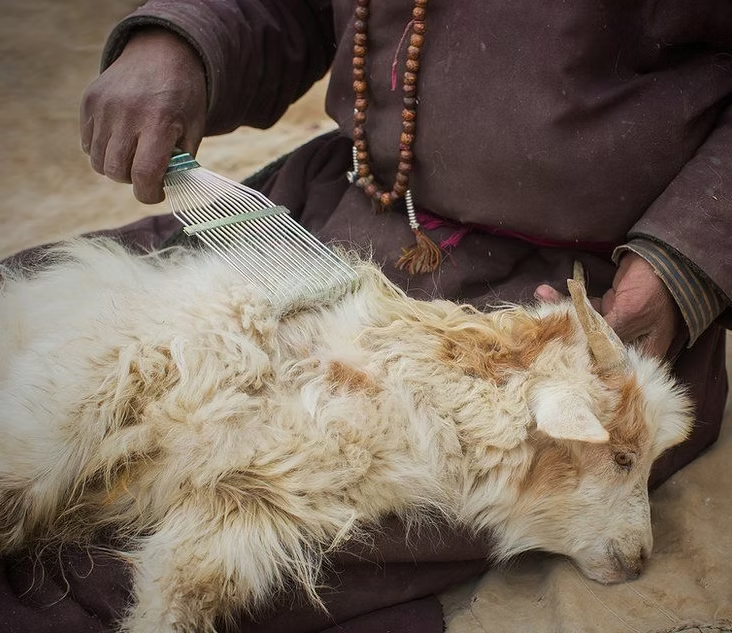
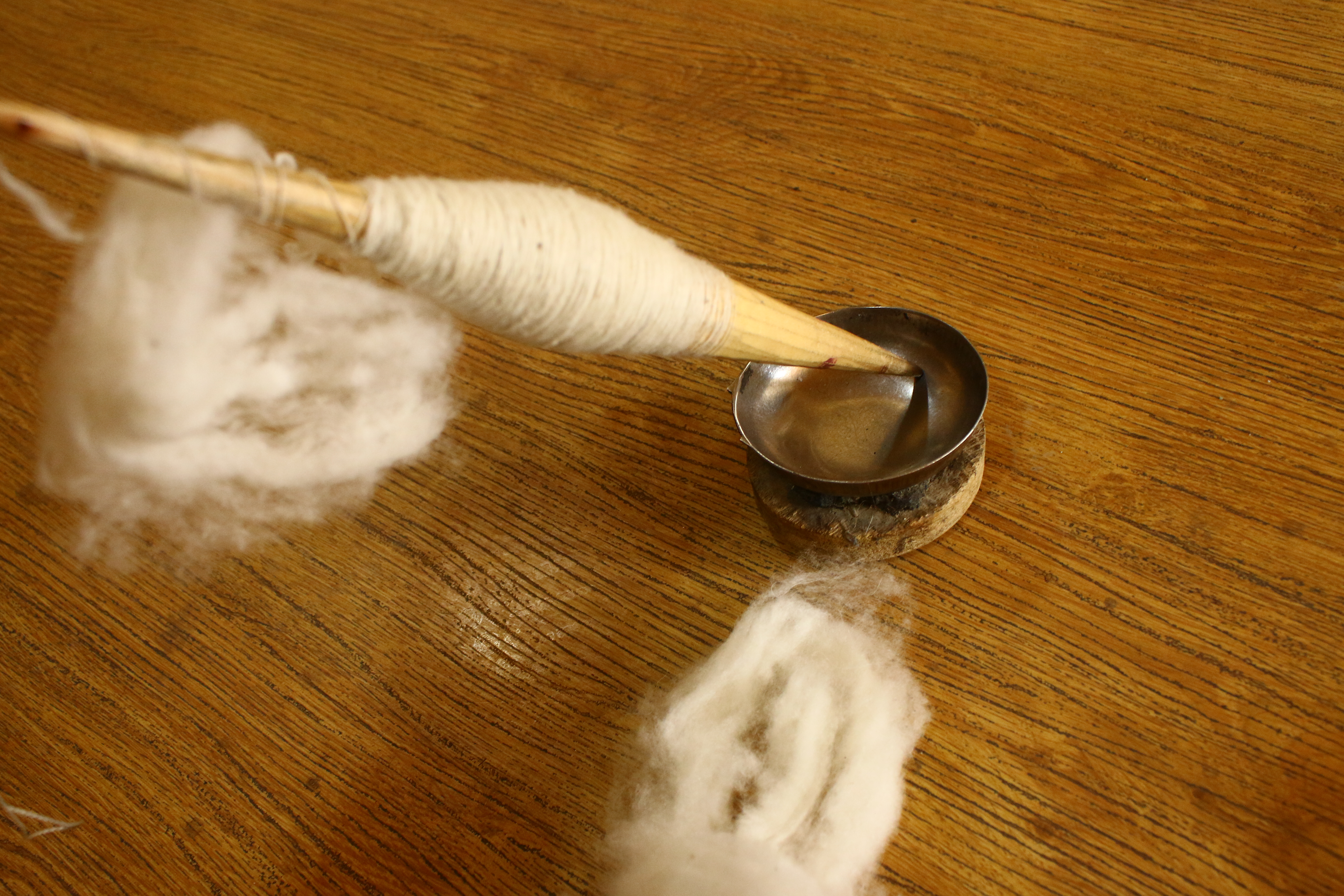
Ladakh has a highly diverse textile tradition that reflects its physical, socio-cultural, and environmental features. The herd provides different kinds of fiber: Khullu or Sitpa from Yak wool, Ral from Goat hair or Sheep wool, and Lena (Pashmina) from the underbelly of Changthangi goat. The wool is sheared from the livestock around early Spring or before lambing season using a wooden/metallic comb. It takes about 2-3 hours to shear wool from a single sheep and since it requires physical strength to hold a sheep, goat or yak to shear, it is usually men who do the work while women clean and sort the wool to remove any impurities. Once the wool is collected, it is laid on the sheet and beaten with a wooden stick to remove dust, dry grasses, and other impurities. It is then washed, dried, and then hand spun with a traditional spindle called “Phang” – thin yarns are made for weaving while slightly thicker and knottier yarns can be used for knitting. From elaborately patterned garments for the nobility to simple home-spun garments from local fibers, a range of garments are processed and procured in Changthang. The local fibers found in Changthang are used for various purposes; Yak wool and goat/sheep wool are primarily used for self-consumption while Pashmina (Lena) is often traded. The high altitude and the intense cold of Changthang serve a good purpose for the growth of the fine luxury fiber Pashmina. Due to its softness, elegance, and warmth, it is one of the most coveted fibers and fetches the highest price.
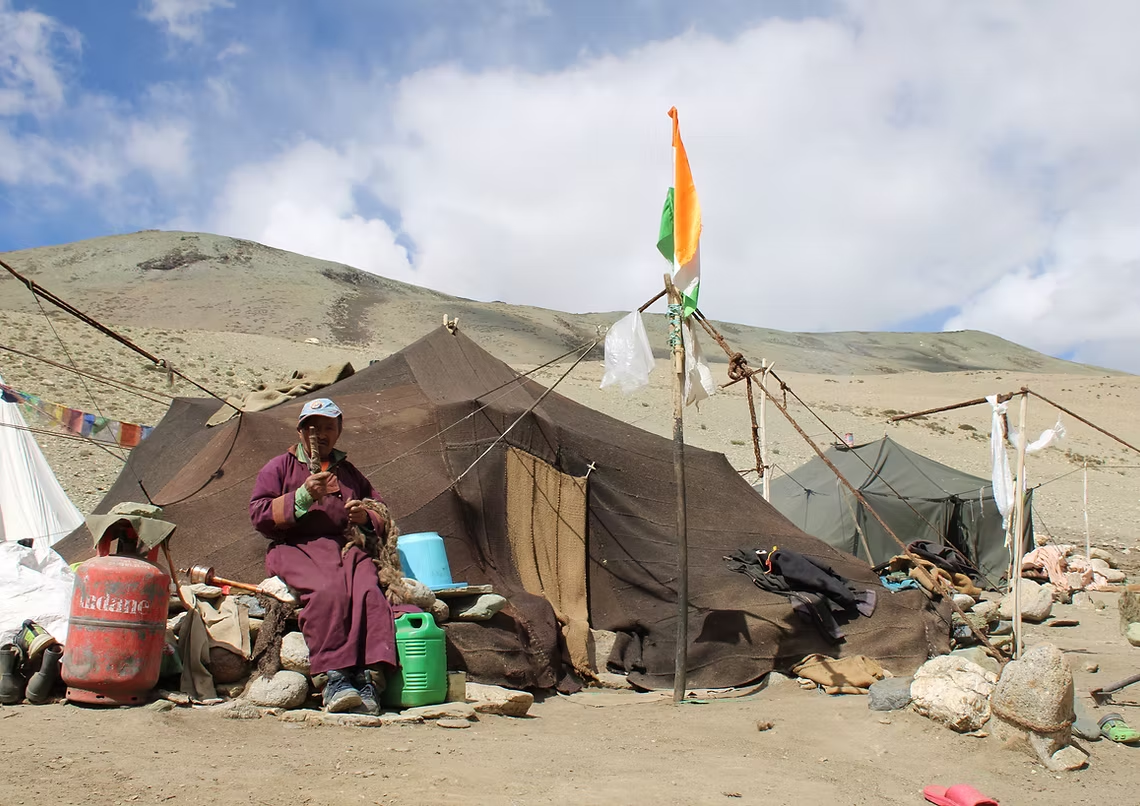
Weaving is an ancient craft and Changpas are reminiscent of the time when our ancestors wore clothes made up of animal skin. Due to freezing weather, animal skins are still used for various garments, quilts, and mattresses. The rich tradition of textiles came into being when our ancestors learned how to spin, make yarn, and weave. Wool and fiber are an integral part of the nomadic culture as Changpas reside in the traditional tents called Rebo made of Sitpa (Yak wool). Rebos are very functional and aptly suited for the nomadic lifestyle – as the nomads migrate in search of better pastures for their herd, the use of Rebo comes in handy for them.
“Rebos are very functional and aptly suited for the nomadic lifestyle – as the nomads migrate in search of better pastures for their herd, the use of Rebo comes in handy for them.”
Making Rebos are extremely labor-intensive as it is handspun and handwoven and a group of nomads makes it collectively. Rebos are also precious family assets and are passed down from one generation to another but these days the use of canvas tents is also becoming popular. Handcrafting has great significance in Changpa tradition, it is a skill that everyone inherits and proves useful in resource-starved land like ours. Weaving and knitting are so economical and wholly self-sufficient – we knit sweaters, socks, hats, and mufflers, and weave mattresses, quilts, saddles, and even containers for foodstuffs. Imagine having to buy all these!

Even the traditional clothes we wear Gos made up of fabric called Snambus. All of which are handwoven from scratch! When I think about the olden tradition of Changpas – whether it is sustainable grazing of the livestock, food habits, lifestyle, or the practices of spinning, and weaving I realize how self-sufficient and environment-friendly the whole system is. However, the practices around local fiber and cloth making are undergoing changes. Machine-made fabrics and ready-made clothes are easily procurable from the markets and one doesn’t necessarily have to make everything from scratch like in olden times. Although a great variety of wool and fibers are found in Changthang, there’s relatively little expertise when it comes to processing these fibers and adding value to them. Kashmiri artisans are way more known for their skills in handicrafts and if this gap can be fulfilled locally, the fiber value chain will be complete in Changthang itself.
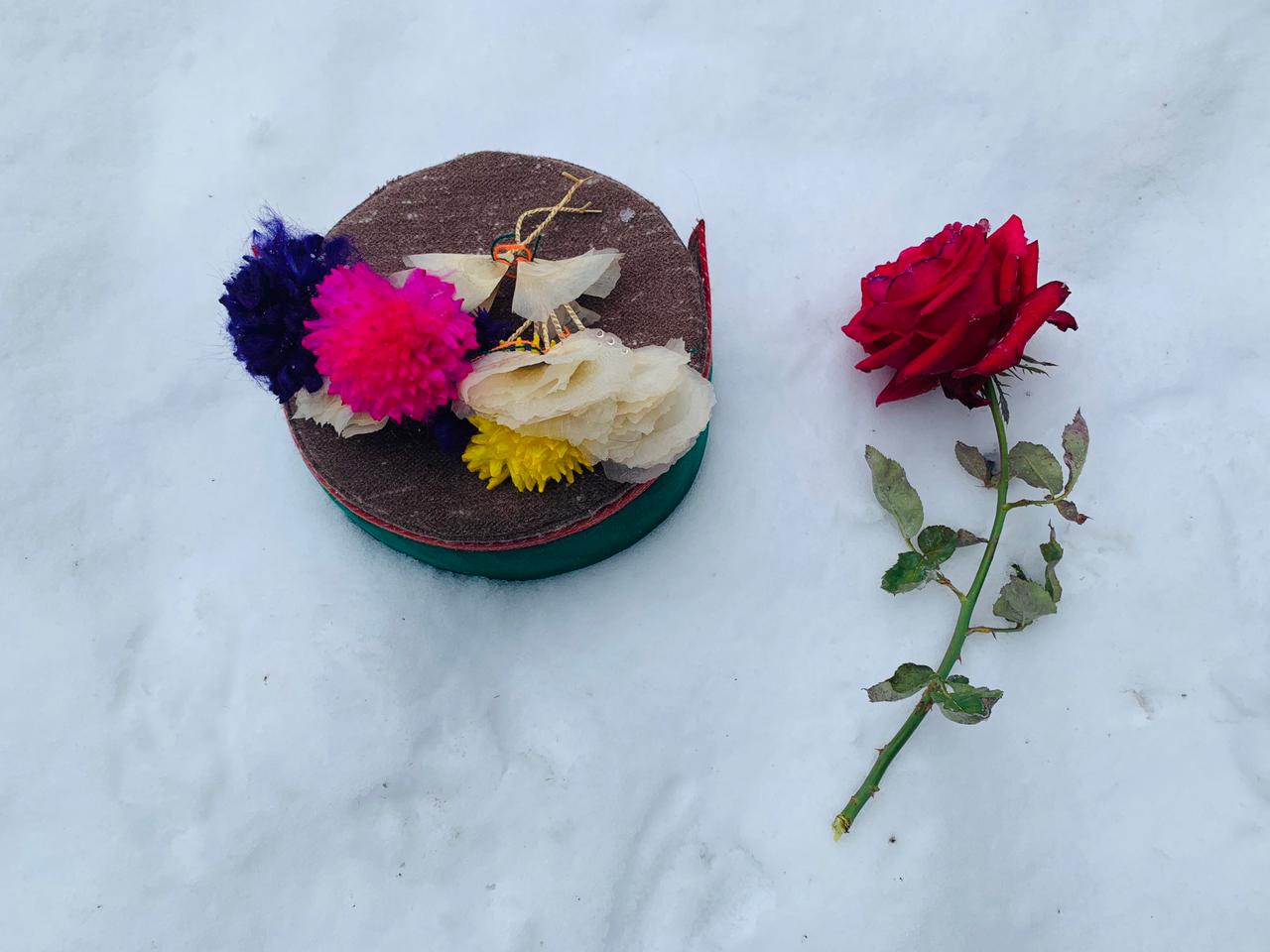
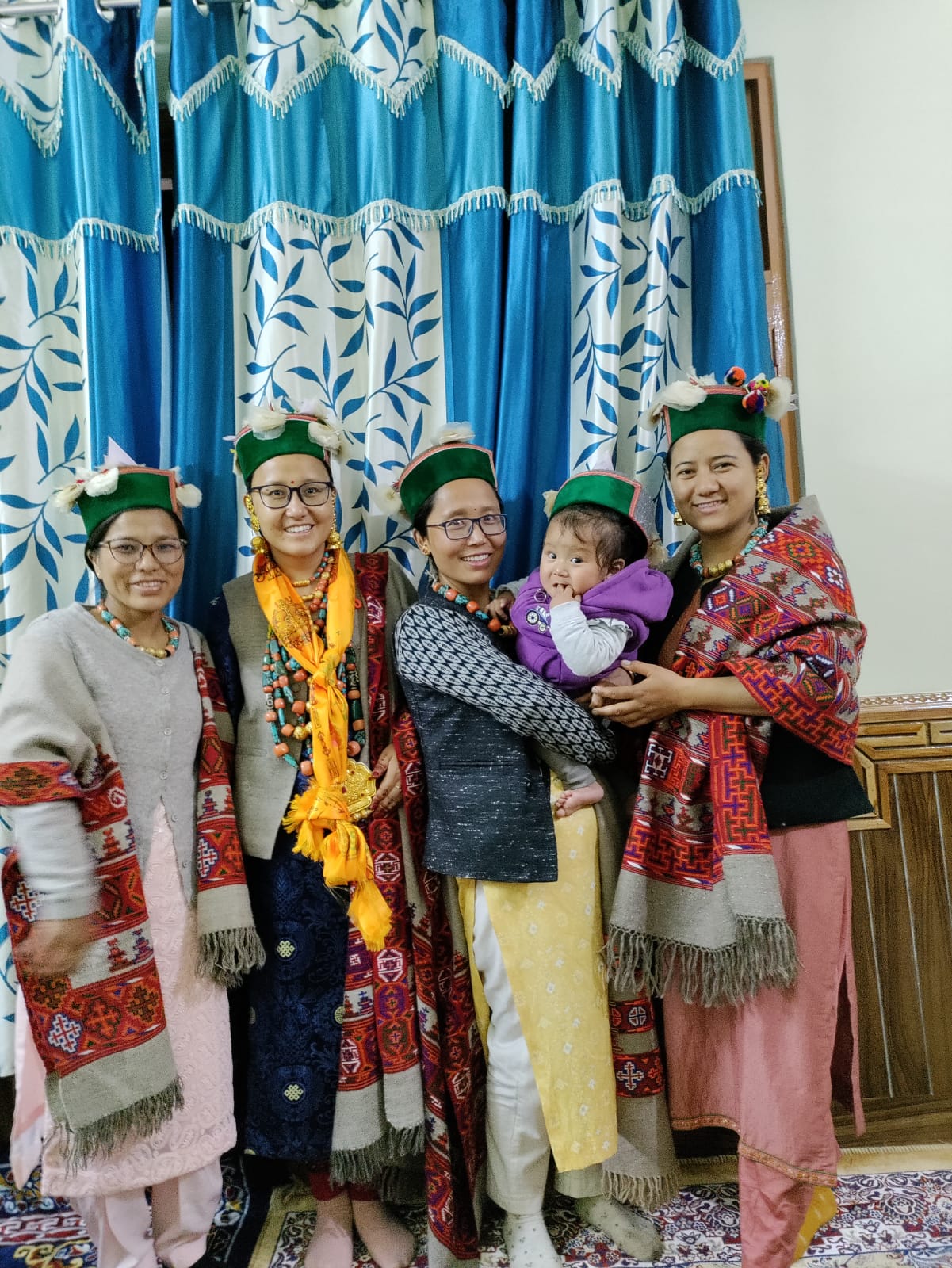
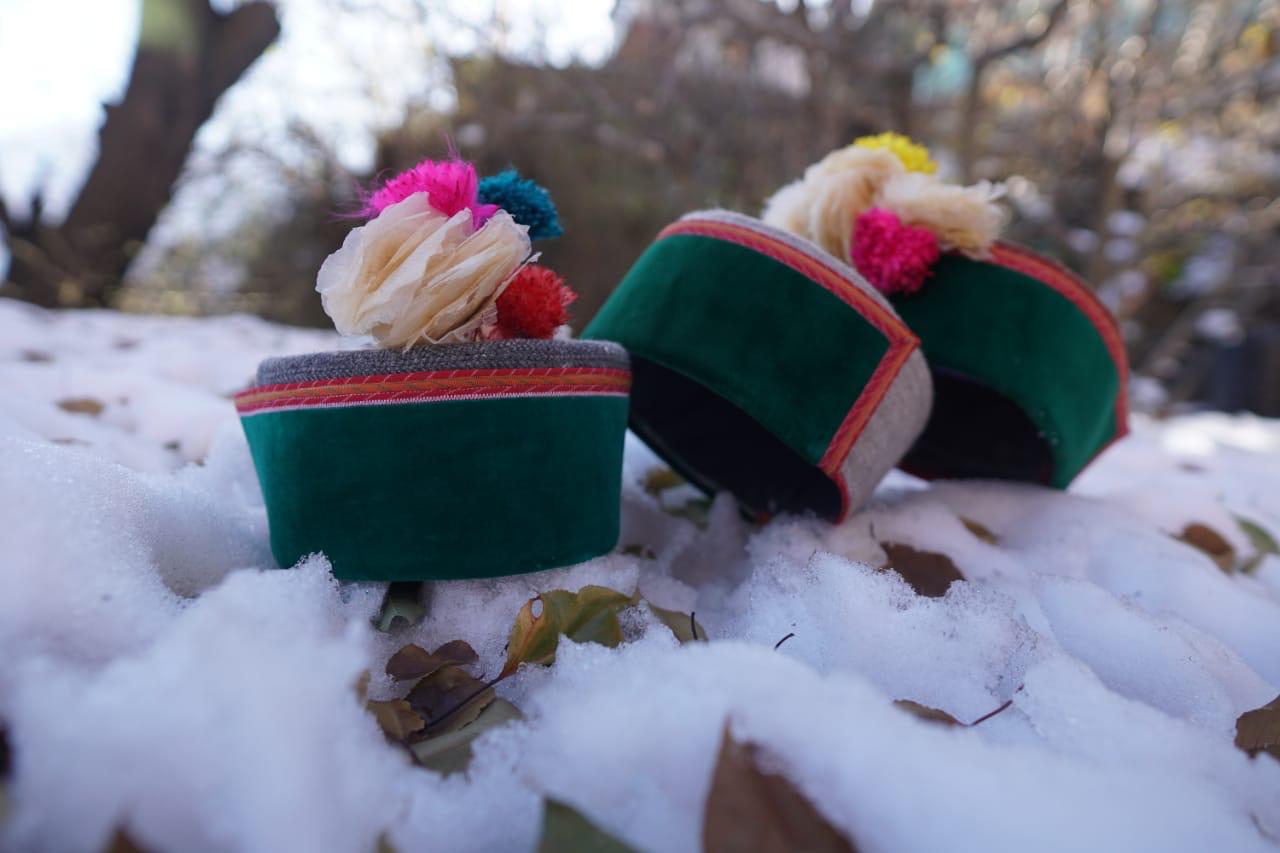
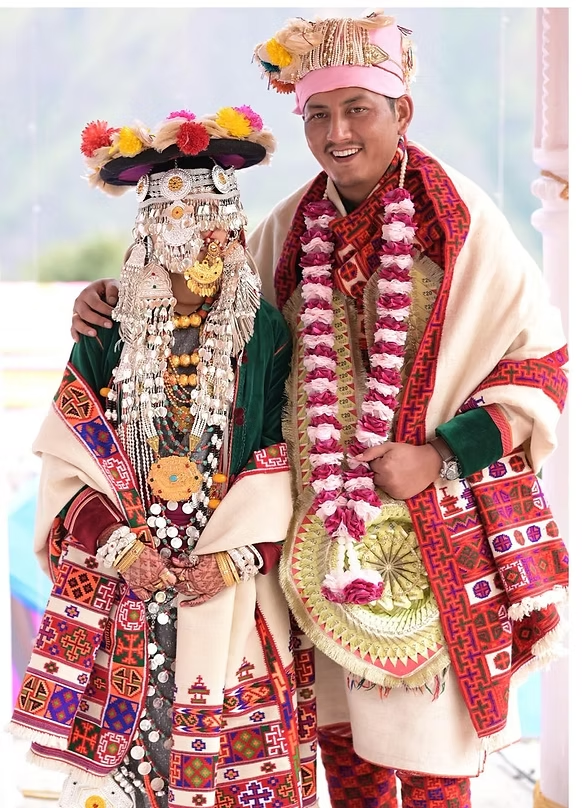
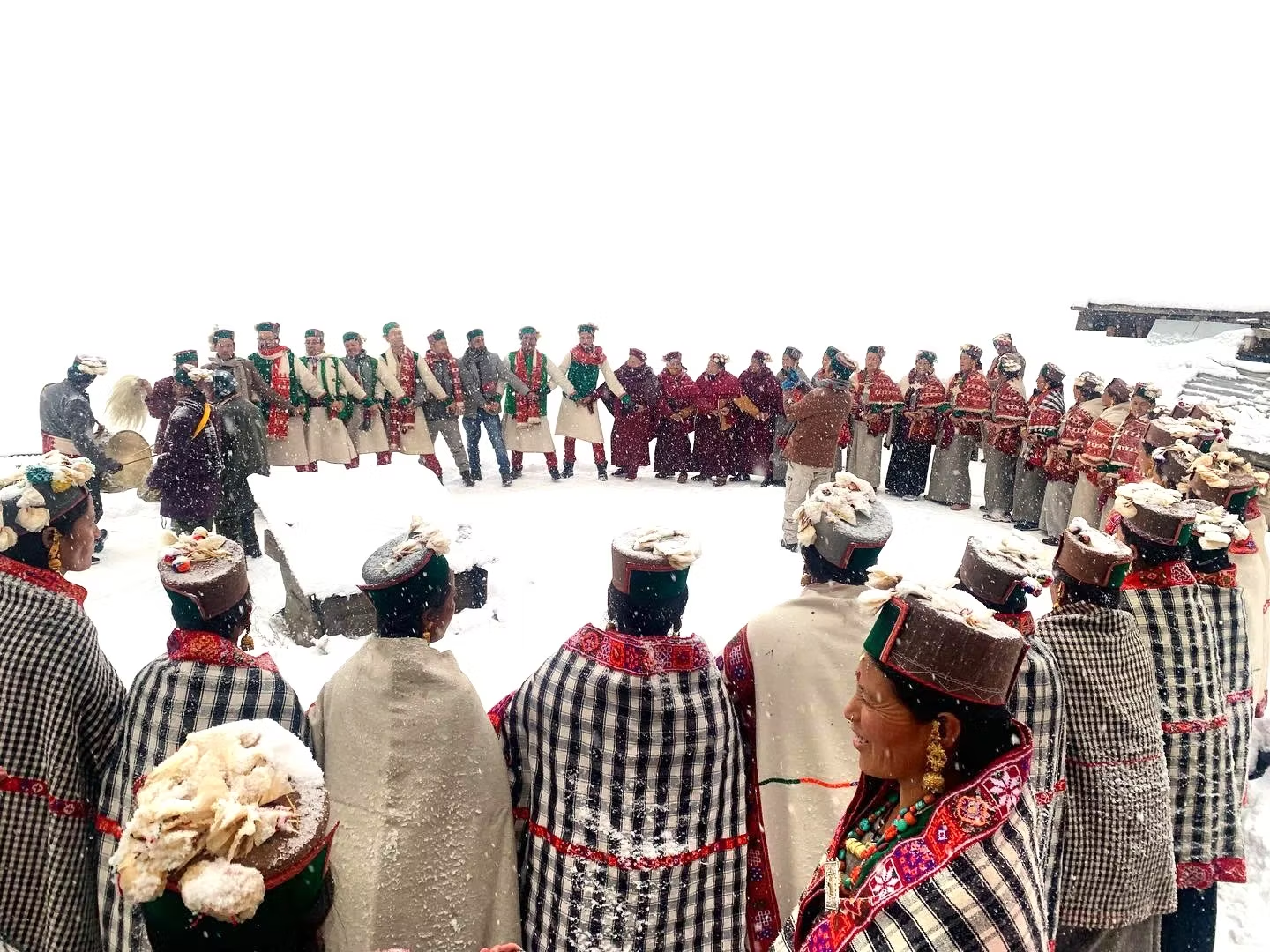
Nestled amid beautiful gigantic mountain ranges, Kinnaur is one of the most picturesque districts of Himachal Pradesh. Owing to its geographical proximity to Spiti and having been historically part of Rampur Bushahr, Kinnaur inhibits the unique cultural amalgamation of Buddhists and Hindus. One of the defining features of people living in Kinnaur is their vibrant traditional dress and the unmistakable headwear Kinnauri Topi which forms an integral part of the whole attire. The headwear is colloquially called “Tepang” or “Khunnu Tiwi” and is different from the Himachali Topis of Shimla, Kangra, Kullu, and Chamba. The design variations and the aesthetics of this headwear represent different parts of Himachal where it is worn. The Bushehri (Rampur region) cap is plain maroon in color with the same design as the Kinnauri topi, the Kulluvi (Kullu-Manali) topis have vibrant multicolored stripes, and the Kinnauri Topi has unique green velvet color and the ones worn in Kangra is a deep saffron color.
Made up of local wool yarn with velvet green stripe, it is adorned with beautiful wildflowers among which the bright white colored flower seed called “Chamakha” ( oroxyllum Indicum) is preferred among locals. The flower is not indigenous to the region and is mostly found in the lower Himachal region like Mandi, Palampur, Bilaspur, Nalagarh, etc. The usage of Chamakha flower seeds became popular in Kinnaur because of the flower’s resilient qualities – once plucked from its pod, the flower seeds don’t get spoiled and can last for years without getting dried.
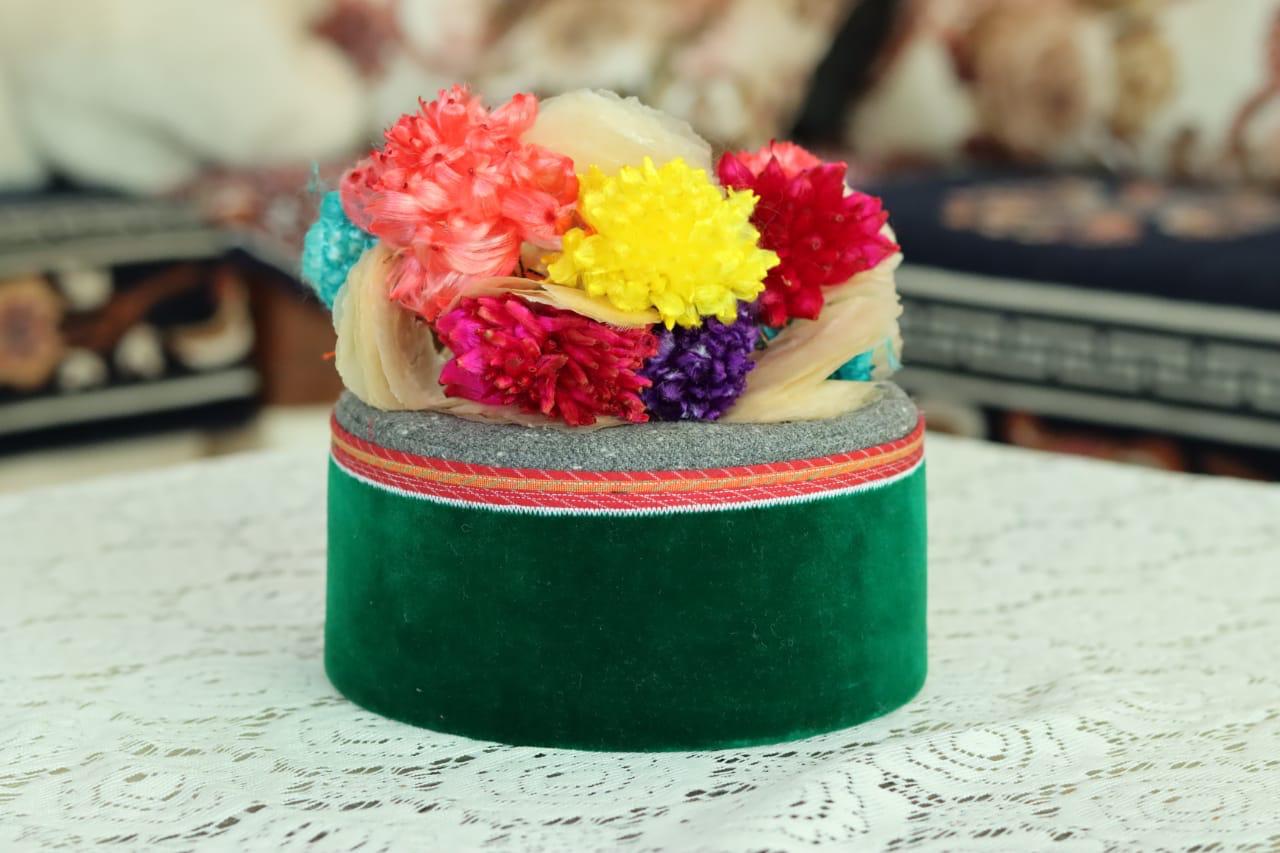
The Chamakha seeds are split open from their’s pod and a bundle of seeds called “Dalang” is strung together on a green, and red thread and is fixed on the Tepang. Apart from that, the cap is also accessorized with peacock feathers, marigold flowers, or the dried petals of the rare Himalayan Brahma Kamal (Lotus). However, the use of Chamakha flower seeds as well as the Brahma Kamal is decreasing as these flowers are endangered.
In the olden days, the Tepangs were domestically made at home by all households but the weaving tradition has become less popular nowadays and it is woven only in a few cluster villages like Leo, other parts of Hangrang valley, Pooh and Reckong Peo. Unlike Kinnauri Shawl and other traditional dresses, the handweaving tradition of Tephang disappeared among general people and is now kept alive among a handful of skilled artisans and weavers. In recent years, machine-made Topis are also getting more popular in Looms and handicraft centers in Lower Himachal. However, the difference between handwoven and machine-made topis is so stark.
There’s a huge difference in terms of material, quality, technique, appeal, garment feel, and usability. The handwoven Topis, although takes a long time to make and is more labor intensive, the overall usage and desirability isare higher due to warmth and durability. A topi once woven can last for years till its natural wear and tear, while the usage of machine-made topis is more popular among non-locals and tourists for it is also treated as a souvenir. The native Kinnauri people always prefer the handwoven ones for it has far more value than their materiality.
The use of Tepang is ubiquitous across all villages of Kinnaur and locals people take great pride in wearing it. The local communities lovingly refer to it as their crown, symbolizing communal pride and prestige, and they believe it upholds their indigenous cultural values. It is worn both by men and women on a daily basis and during festivals, ceremonies and occasions, people heap it with all kinds of floral adornments. There’s also a tradition of gifting Tepangs to one’s special guest and during weddings as ceremonial gifts. The use of Tepang has percolated so deeply in the collective consciousness of Kinnauris that it not only holds significant cultural value but is also seen as a defining part of their identity.
“One of the defining features of people living in Kinnaur is their vibrant traditional dress and the unmistakable headwear Kinnauri Topi which forms an integral part of the whole attire.”
Clothes and identity are closely related: traditional clothes of a region reveal a lot about its geography, physical environment, climatic conditions, and cultural practices. The high altitude and cold weather conditions in Spiti have led to distinct clothing attributes of its people. Since most of the families are agro-pastoralists, the livestock people breed gives different kinds of wool like yak wool, sheep wool, and goat and that forms the natural source for most of the attire worn by the people. In the olden times, people wove handcrafted attires and ornaments from scratch but with increasing access to market and trade, wide varieties of fabrics and garments are available and the clothes designs are adapted with time. Let us share about some of the traditional clothes of the region:
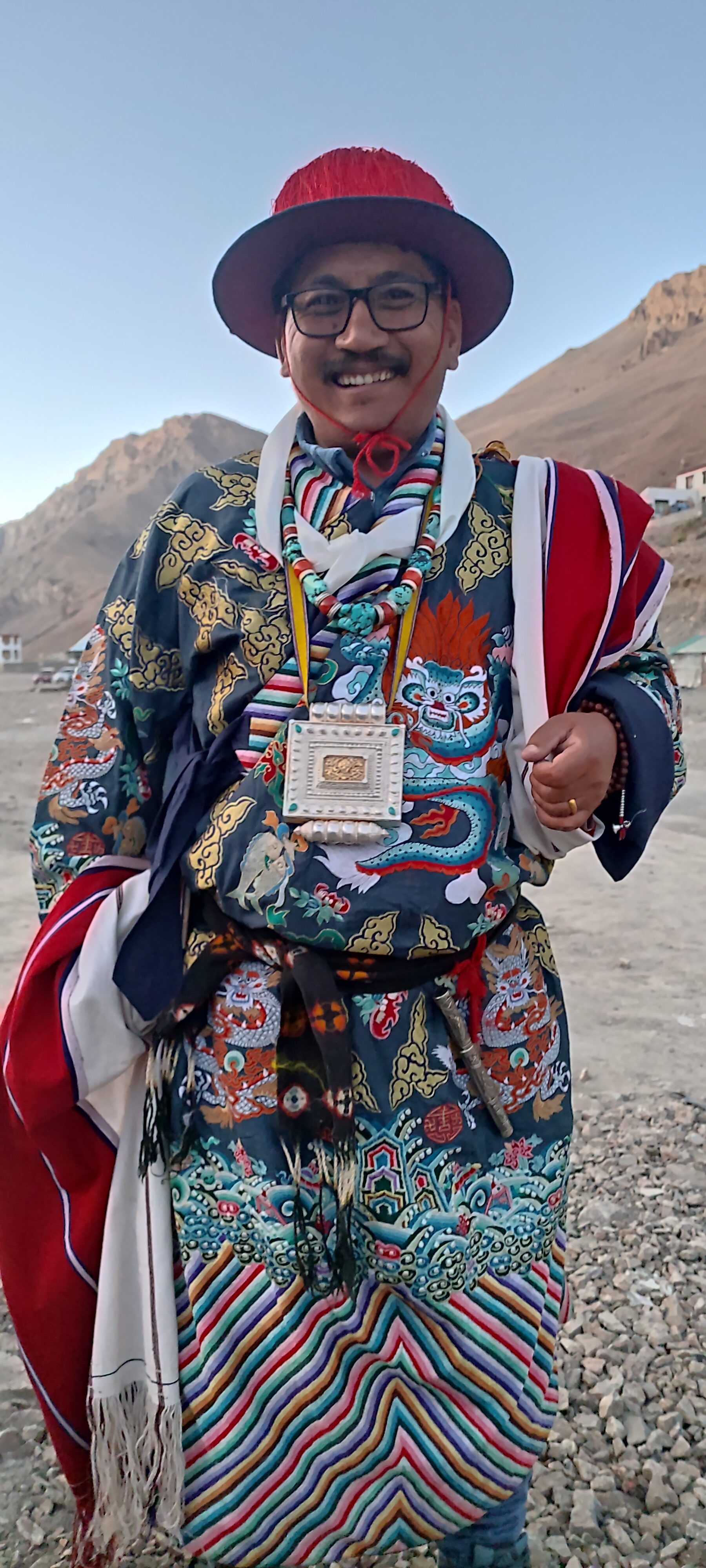
1. Reygoi or Ghoey
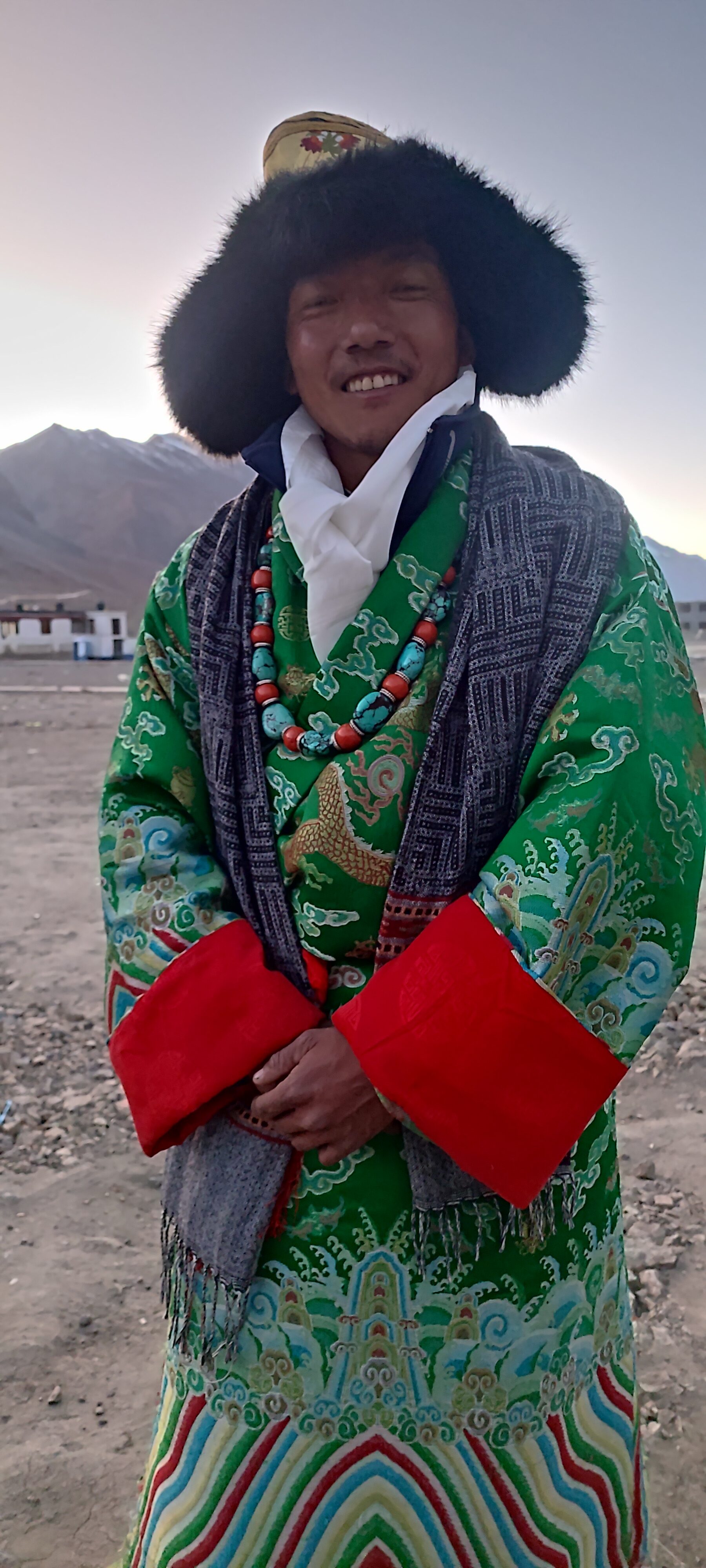
Ghoey is a thick full-length robe worn by Spitian men. In the olden days, men would wear Ghoey made up of woolen material but with time, robes of thin fabric like cotton also became popular which is called Rey (thin cloth) ghoey (to be worn). The style of the robe resembles the Mongolian robe which overlaps on the right side and is buttoned from the left shoulder. Men usually wear a thin shirt or plain trousers to pair with it and the robe is finally secured by a wide belt around the waist made up of woven threads called Keera. These robes come in neutral shades of brown, maroon, dark blue, and black. With changing times, access to fabrics like silk and velvet has increased so a Ghoey can also be made up of silk, velvet, and other multicolored synthetic fabrics.
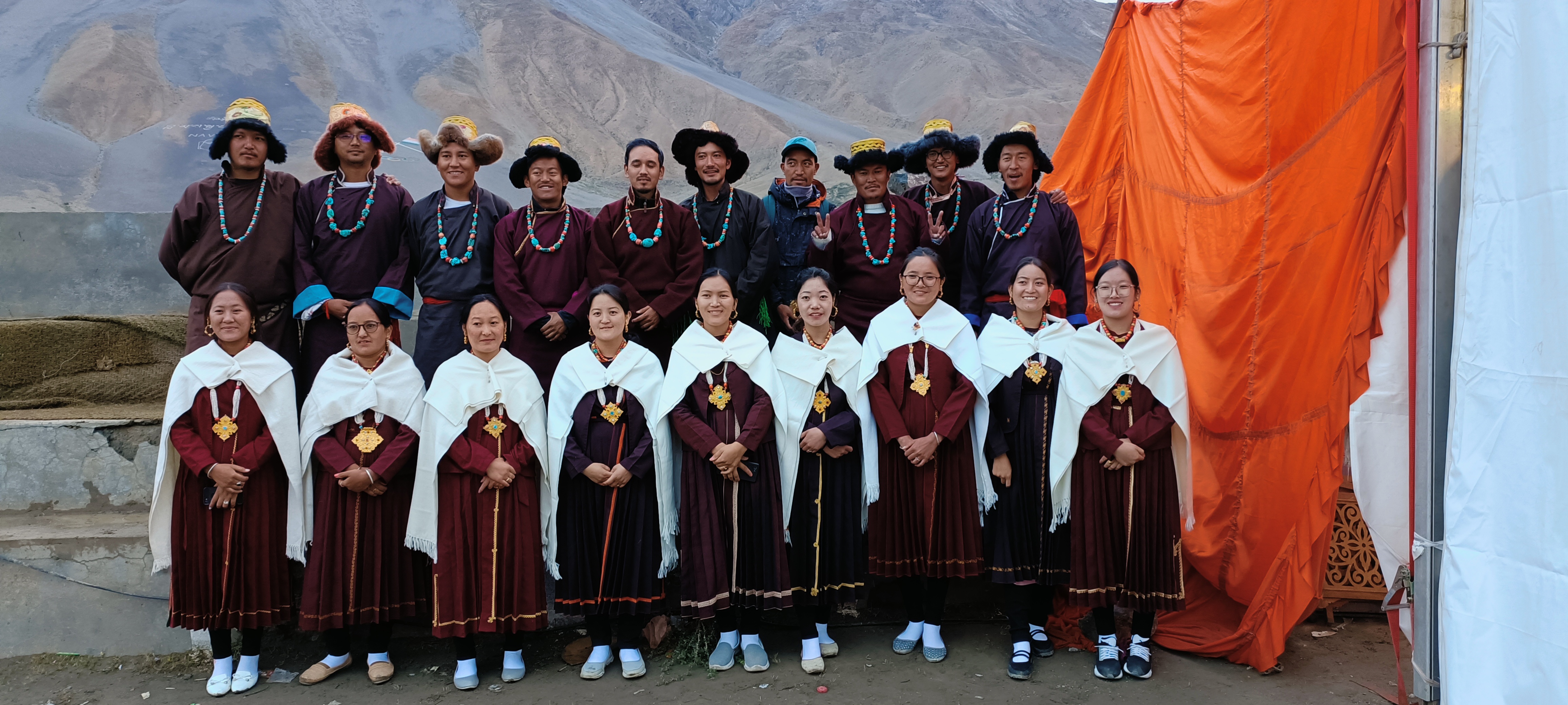
2. Sulma
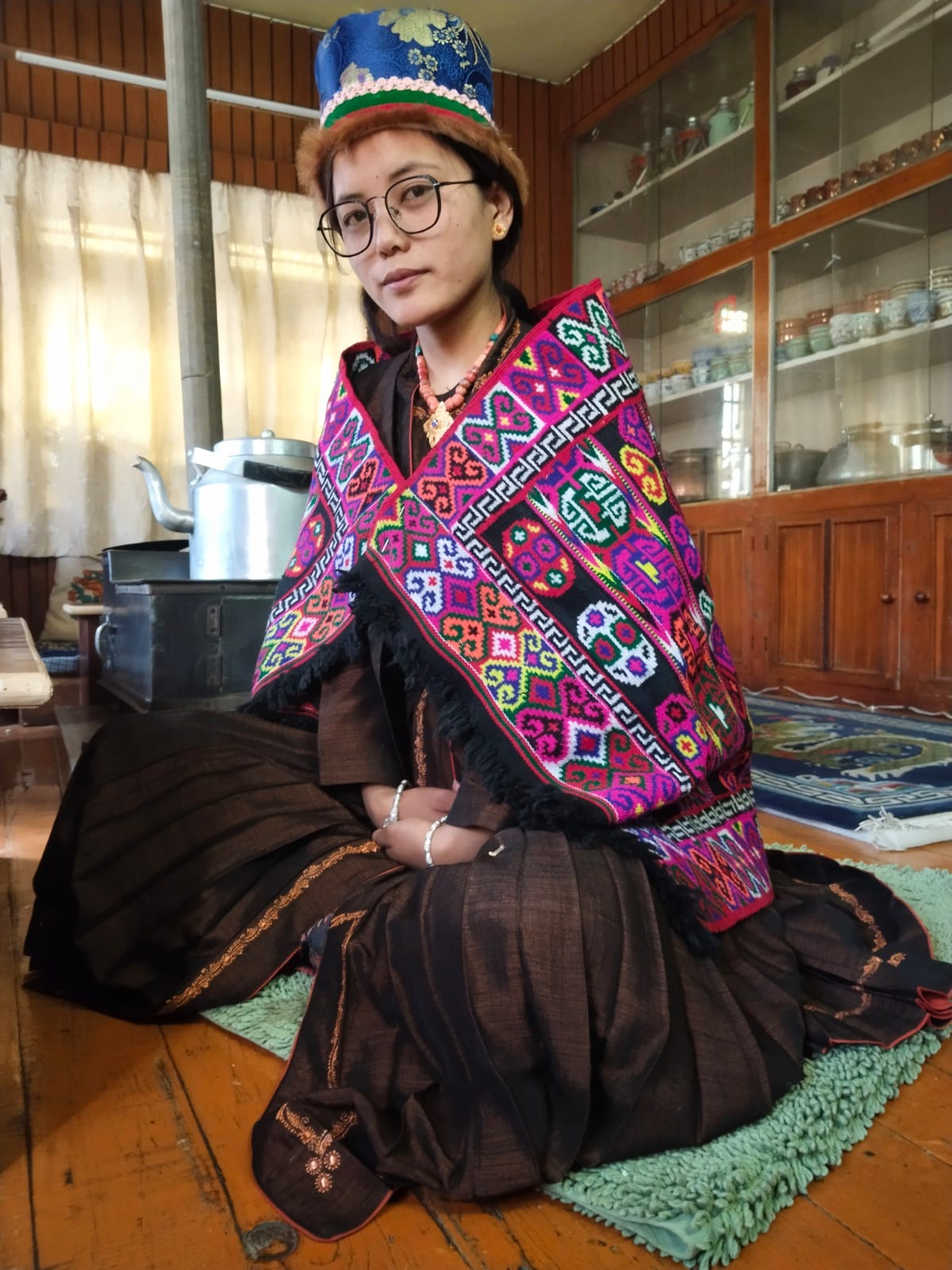
Sulma is a long voluminous traditional gown worn by Spitian women. It has a round neck and long sleeves. The dress flares downwards with multiple pleats which is why it is called Sulma which means; to gather, to fold, to fold into pleats. A thin undershirt is worn underneath and the Sulma is tied with a waist belt called Keera. The dress is fairly wide around the leg, making it comfortable for walking or working in the fields.
3. Bhal Sutan
Sutan is woolen or cotton trousers worn both by men and women in Spiti. It is made up of thick woolen fabric called “Nimpu” procured from the local sheep hair. The fabric is woven on a backstrap loom or foot loom, which can then be stitched into trousers of the desired style. Nimpu Sutan or bhal Sutan (woolen pants) is primarily worn under Sulma by women and under Reygoi by men. With changing times, Spitian women popularly wear it with a matching Salwaar or Suit.
4. Lokpa
Lokpa is a thick cloak-like garment worn by women. It is hand-strewn with sheep skin turned upside down with elaborate woven designs on the front. The local name Lokpa (meaning: to turn over) is reflective of the intricate process with which a seamstress makes it. It is extremely warm and is perfect for harsh weather conditions. The thickness of the garment also cushions the wearer’s back while carrying a heavy load on the back like firewood or fodder for livestock. Sometimes, newborn babies or even lamb kids are wrapped in the garment to provide warmth and comfort.
5. Lingzey
Lingzey is a traditional handwoven shawl worn by women on the back. It is one of the most vibrant and elegantly designed shawls woven by women on the loom and comes in a wide variety of colors and patterns. The base color can be red, white, or black where elaborate symbolic geometrical designs are handwoven. Motifs inspired by nature are common like local flora or fauna or religious motifs like stupa and swastika (to protect the wearer from evil spirits) or motifs of precious stones. Lingzey is worn during special occasions like marriage, ceremonies, festivals, rituals, or while visiting Rinpoches.
6. Tsadar
Tsadar is a plain woolen shawl worn by women on a daily basis. It is thin, light weighted compared to Lokpa, and is woven on a handloom called Khaddi. It is made up of goat or sheep wool and is usually found in toned neutral colors like beige, grey, off -white and black. It is the most functional piece of clothing and can be worn over Sulma or even drape babies in it. In the olden days, it was said that women were not allowed to go out bareback, wearing a Tsadar symbolizes one’s respect for the person you are visiting.
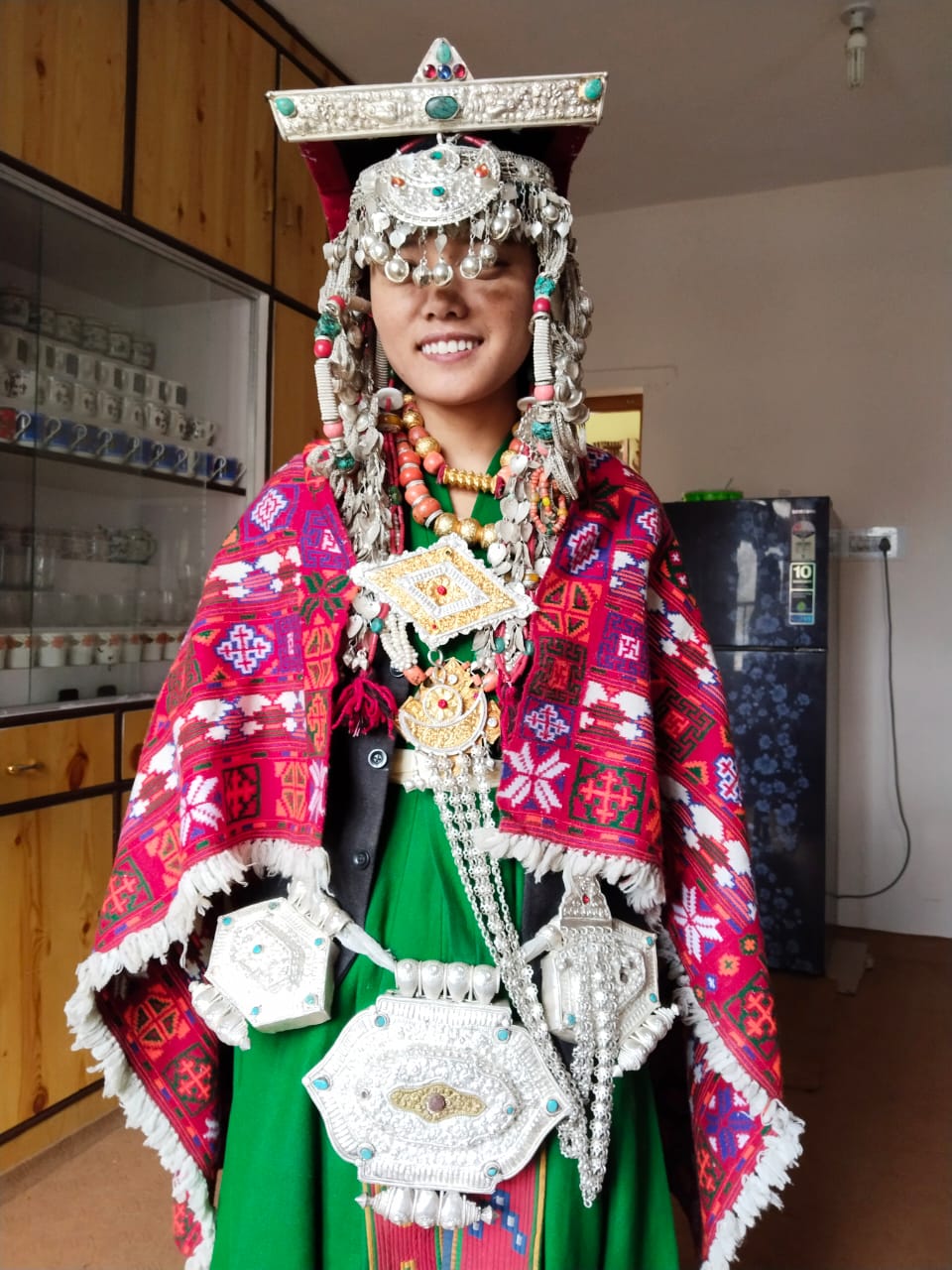
“Since most of the families are agro-pastoralists, the livestock people breed gives different kinds of wool like yak wool, sheep wool, and goat and that forms the natural source for most of the attire worn by the people.”
7. Tiwi
Tiwi is worn both by men and women. Traditionally, Nambu (yak wool) is the base fabric with which it is made and has goat or sheep skin lined underneath. Cotton or wool fabric is sewn inside for warmth with matching silk brocade. Golden or silver zari designs or threadwork can be supplemented depending on the need.
8. Lham
Lham refers to footwear worn by people in the high Himalayan region or more suitably to the boots worn in the nomadic region. Originally it was made up of yak hides but with time, it is adapted to canvas, jute, or cloth material. Lhams are decorated with rich embroidery and exquisite designs of dragons or snakeheads. The material, color, and fabrics used to make Lham showcase the craftsmanship of the creator. Men’s Lham is knee length and comes in handy while treading snowy mountains. It is worn with Ghoey-shan (Silk robe) by men and women wear a slightly smaller frame with Sulma. The usage of Lham has gone out of daily use and is now worn only during festivals or special occasions.
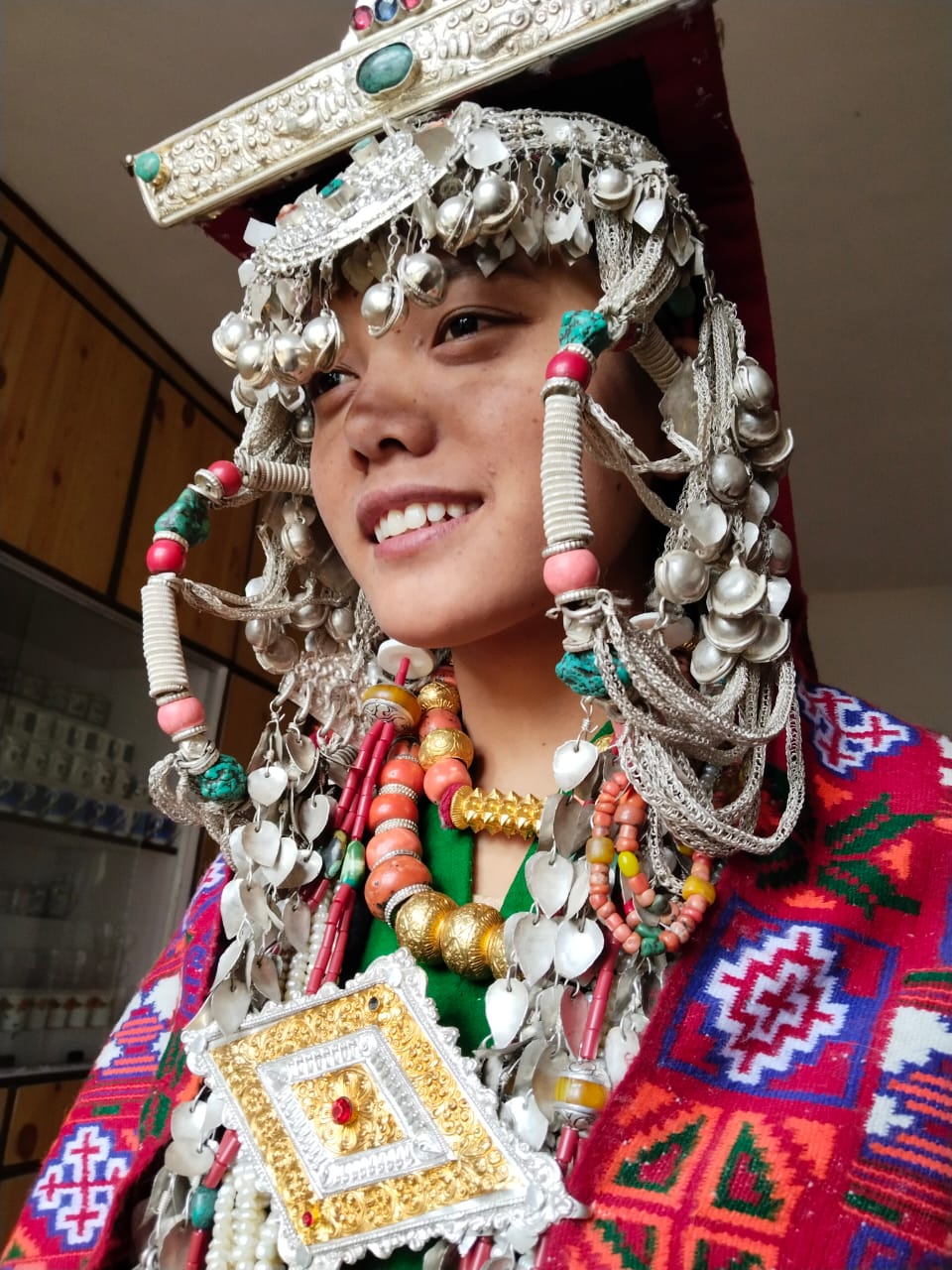
The garment and material used to make the traditional attire of Spiti symbolize the optimum use of local resources and fibers available regionally. During festivals and special occasions, this is adorned with elaborate pieces of jewelry like the vibrant turquoise Perak, the pearl-made Uldik, the Silver Docha, Dhikra (brooch), Khinyur, and Pitsup. Our traditional dress represents close cultural affinity with the Western part of Tibet and forms a big part of our cultural heritage.
In the higher Himalayan region, weaving is an ancient craft and forms an integral part of people’s lives. In Lahaul, weaving signifies a retreat into slower, simpler times amid icy cold weather when the farming works are at its lowest. There’s a saying in local folklore attributing weaving as visual art that reflects stories about people, their communities, and their place in the universe. It symbolizes the value of creation, interconnectedness, and rejuvenation. Weaving requires profound discipline and dexterity to untie complexities; it involves crossing two threads the warp and the weft, one vertical, and one horizontal, one stretched tight, the other intertwining the first. To produce a textile, the two threads need to be bound together otherwise, the weaving work will remain fragile. Hence in ancient Buddhist belief, a weaver is akin to a problem solver, someone who is adept at bridging silos and bringing greater connectedness.
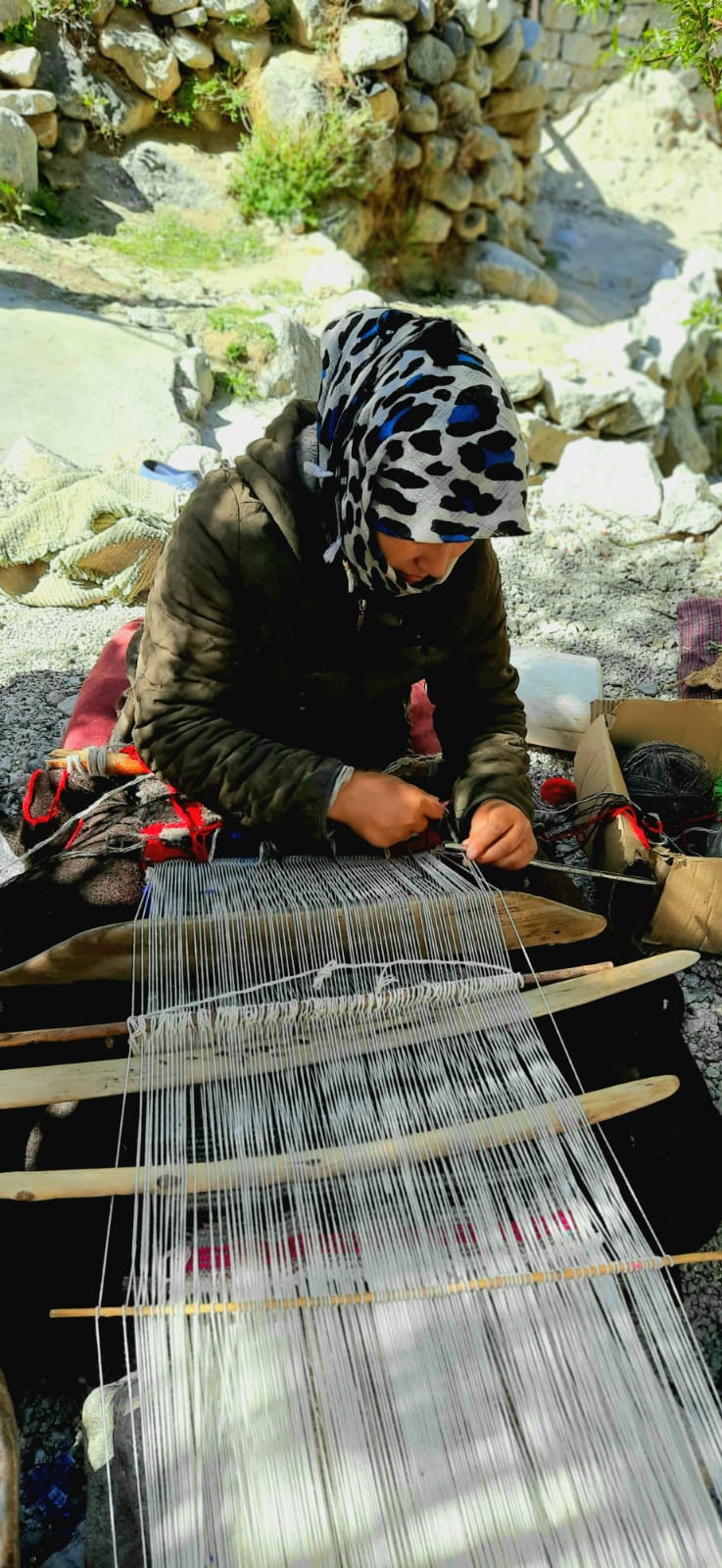
Weaving is a traditional skill that’s passed down through generations and is practiced with great vigor in our village. Of the many products that are woven, Tsug-den (Tibetan rug) weaving remains the most popular with its elegant design and high pile, plush feel. In our village, the handwoven woollen carpets are called Tsug-thu or Tuk-tuk in villages around the Darcha side in Lahaul. Tsug-dens are unique handwoven carpets, that are woven on a backstrap loom called “Khaddi”. It is an extremely slow, time-consuming process, that involves a lot of hard work as each bit of the work is done manually – from livestock herding to wool shearing to cleaning, carding, spinning, and yarn making and finally weaving, the process can stretch up to a year.
Most families still keep livestock and the wool is shorn around March or April month. Wool from a single sheep is sufficient to make one pair of Tsug-den. It is then sorted and cleaned to remove any impurities, and further processing of wool is done in Shamshi in Kullu valley in Himachal. We take wool gunny bags in bulk and get them carded and de-haired before we bring them back for spinning and yarn making.
Spinning is done mostly during winter and much like agriculture, it is collaborative work involving a group of women. Wood-made traditional spindles called “Phang’‘ are used for spinning and great care is taken to get consistent, smooth yarn. The base of the weaving is done with cotton threads on a metallic or wooden loom Khaddi. The handspun woollen yarns are weaved in a knotting system where one thread is interwoven with the other on a loom. Once a row of knots is complete, a rod is hammered against it to tighten the row below. A weaver uses the blueprint of a woven carpet to weave complex designs and to ensure accurate shape, size, and alignment of the carpet. Black, white and beige sheep wool is used for tsug-den while the rare white yak hair is used for Challi (woolen quilt).
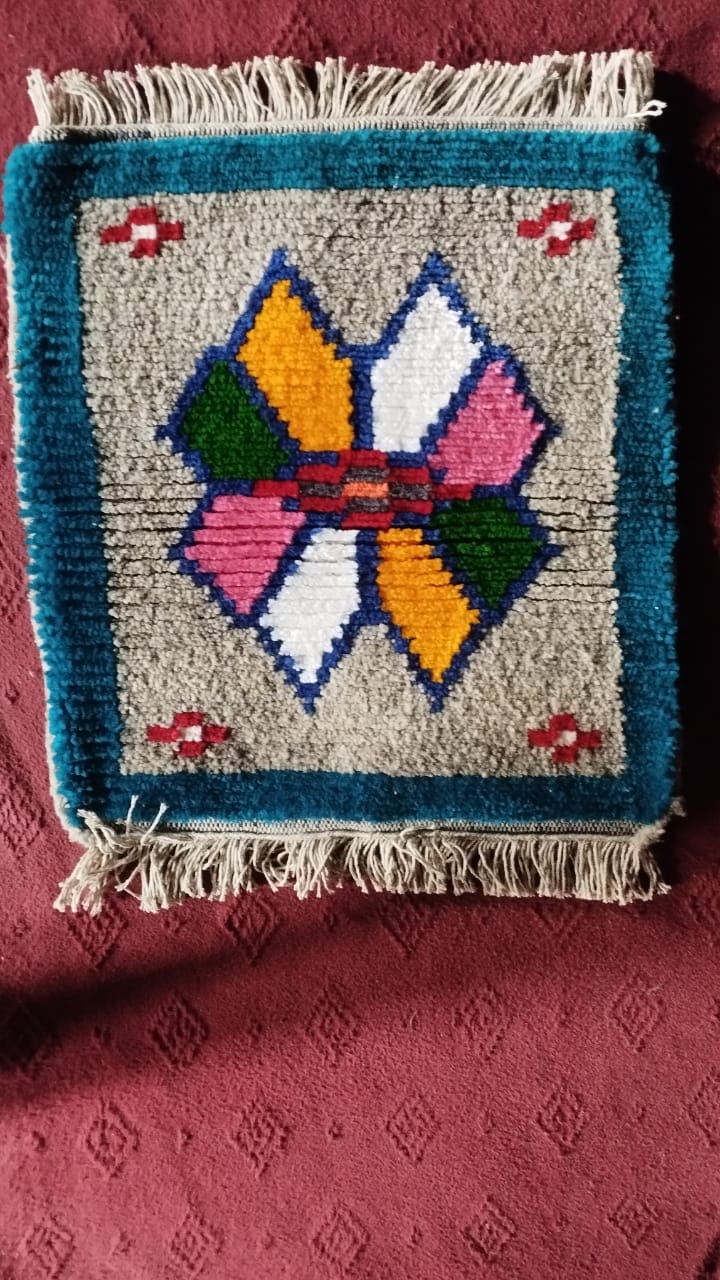
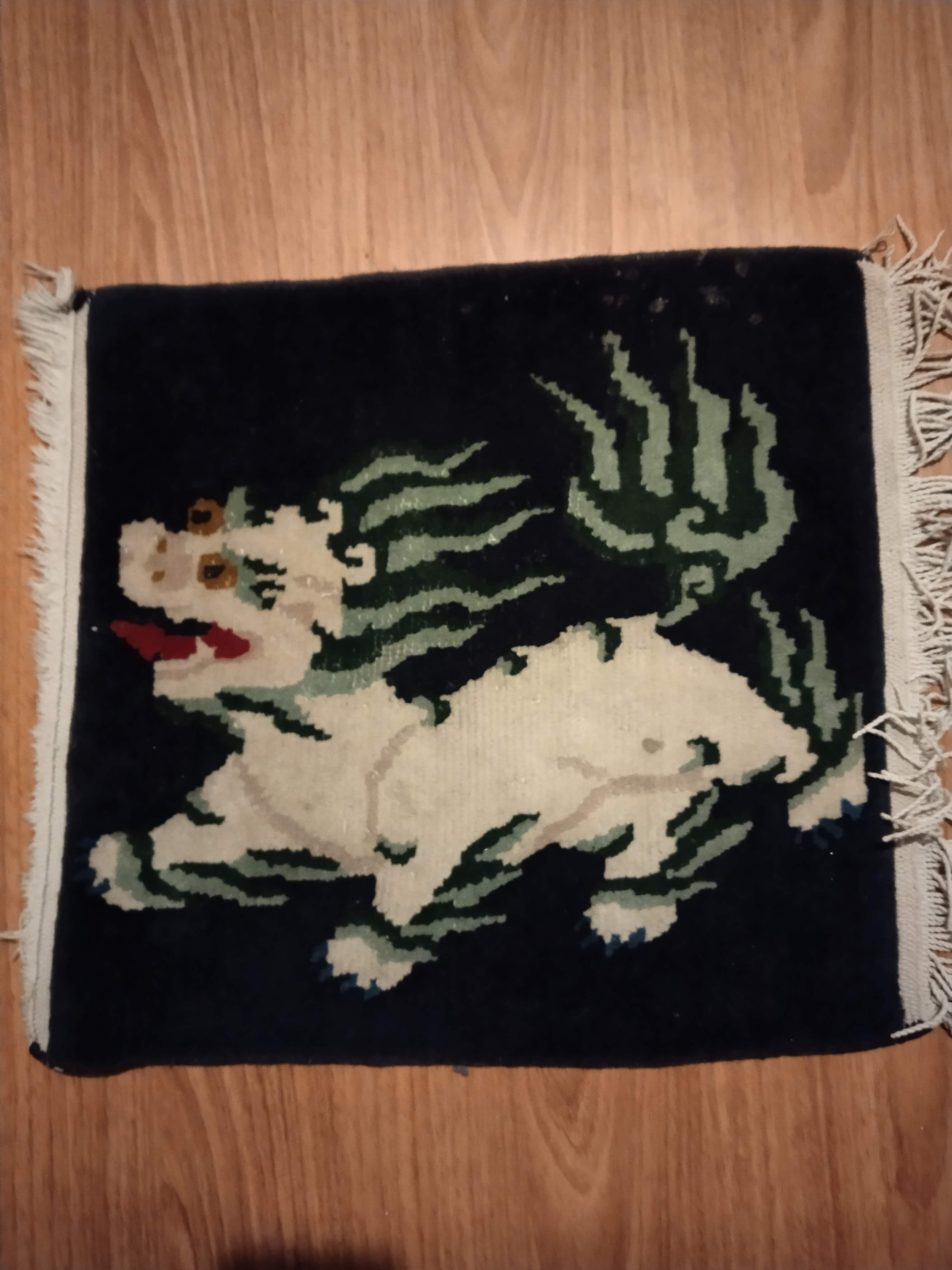
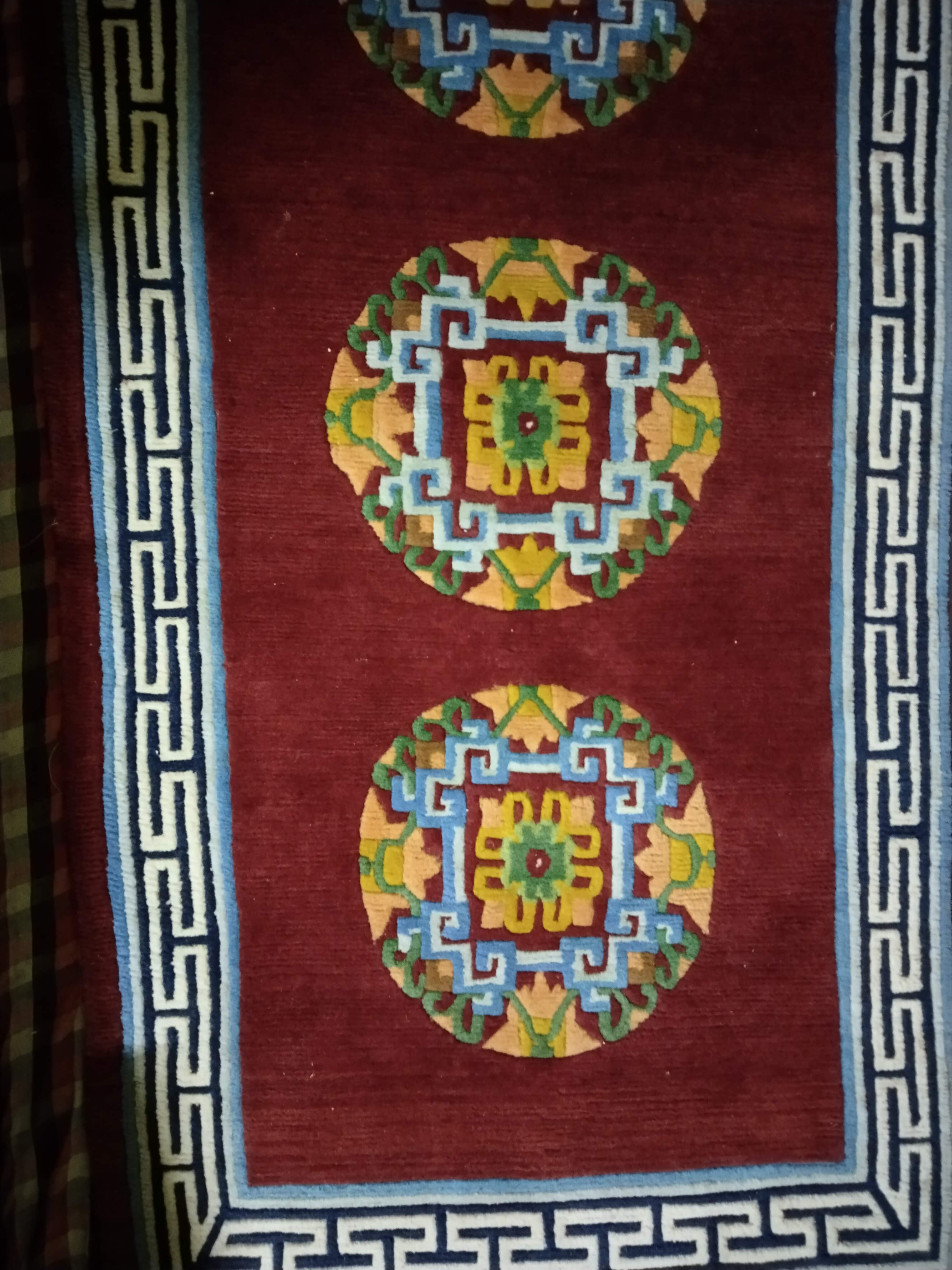
Motif of Snow Lion and Khorlo - a traditional design on a Tsugden
The elaborate designs and motifs on the carpet are inspired by lives in the higher mountains of Tibet and often nostalgically evoke themes of nature and the environment. Motifs of birds, flowers, and mythical animals are quite common- dandelions, native birds, Druk (sky dragon), tiger, ibex, leopards, snow lions, and yaks can be seen beautifully woven on the carpets along with motifs that have special religious, cultural significance like the mandala, four elements of nature (earth, fire, water, space), the Buddha’s vajra, Swastika and depiction of the precious stones Dzi and Gau (amulet). The motifs on the carpet are not mere designs but have larger symbolic meanings to it for eg: the depiction of the crane motif on Tsug-den symbolizes good luck, Yak motifs are reminiscent of nomadic life, dandelions, birds, and clouds depict one’s closeness to nature, the vajra is symbolic of Buddha’s enlightenment, tiger stripes symbolizes one’s prestige and wealth, while snow lion and sky dragons represent mythical creature from traditional folklore and phoenix is a sign of auspiciousness.
“There’s a saying in local folklore attributing weaving as visual art that reflects stories about people, their communities, and their place in the universe. It symbolizes the value of creation, interconnectedness, and rejuvenation.”
Most families in Lahaul and other higher Himalayan regions own simple domestically produced Tsug-dens and it remains one of the most functional pieces of the item which comes in really handy during harsh winters. The usage of natural fiber and natural vegetable dyes also enhances the overall aesthetics of Tsug-den and it is one of the practical pieces of a garment whose luster, and sheen increases over the years with usage. One of the most appealing characteristics of the Tsug-den-making process is that it is the result of resource utilization in the most natural way. The entire carpet is handspun, hand-carded, naturally dyed, and handwoven where nothing goes waste and the final product lasts for decades, some even passed down to generations. One of the greatest wealth a woman can inherit from her parents is the traditional handwoven carpets, rugs, and quilts along with handwoven shawls. Weaving is not just a craft, it holds ample of material, and cultural value and the artwork on woven Tsug-den is symbolic of values, beliefs, and mysticism beyond our comprehension.
Handloom and handicraft are an age-old tradition in Kinnaur (H.P) and have their roots in the ancient trade routes. The intricate designs and colorful patterns differentiate Kinnauri handcrafted shawls- making them a much-coveted textile product in India. However, the bulk of its history, symbolism, and contemporary relevance remains obscure. A history of textile production reveals interesting facts about the local environment, different modes of living, and cultural exchange. The Silk Road is the most famous trade route dating back five thousand years. Another lesser-known trade route connecting India, Tibet, China, and Central Asia is called the “wool road” which passes through Kinnaur and Kullu in Himachal Pradesh. The strategic location of Kinnauri weaving communities settled along the trade route inspired many weaving traditions across different states as well as took cultural inspiration from their trading affairs. Some of the most famous motifs and designs on the Kinnauri shawl bear a resemblance to Central Asian designs. The journey of wool trade and weaving traditions was truly iconic and drastically changed the destiny of the Himachali textile trade. Today, Himachali handloom stands amongst the foremost contributors of state revenue along with tourism and agriculture.
Growing up in Kinnaur, I saw my elders weave, knit, spin, and make yarn. Most women and young girls in my village knew how to weave and they owned the traditional weaving machine called “Khaddi”. Wool weaving and handicraft became indigenous to the region because of the cold weather conditions and women picked up the skill and nurtured it passionately. Most of the weaving, yarn-making, spinning, and knitting work happens during winter and the process is more collaborative. Since women made garments for self-consumption, it is common for one or two artisanal families to work together especially if it is a large-sized product like a carpet or a woolen quilt. I have always been passionate about handicrafts and after finishing my higher studies (MBA), the zeal was renewed all over again. I observed that although the women of my village – Labrang in Pooh tehsil of Kinnaur are skilled artisans, their products were used only locally within different villages of Kinnaur. There was no handicraft center in our village and given the difficult terrain, the market remains inaccessible to us.
I took a leap of faith and started “Sheep Of Himalaya” in 2019 with just two artisans from my village. The prime motive was to bring some visibility to Kinnauri handcraft on an international level and showcase regional craftsmanship.
Agriculture and cultivation of apples in our village orchards are primary vocations for most people but many women still rely on handicrafts as a secondary occupation to earn for themselves. When I broached the idea of building a clothing brand showcasing our traditional attire, there was a bit of reluctance from many artisans for they feared uncertainties. I took a leap of faith and started “Sheep Of Himalaya” in 2019 with just two artisans from my village. The prime motive was to bring some visibility to Kinnauri handcraft on an international level and showcase regional craftsmanship. While the artisans would weave mufflers, stoles, and shawls with vibrant Kinnauri designs and knit sweaters and socks, I would find market avenues for us. For me, the process proved a bit challenging as there were no established Kinnauri brands and our products were often mistaken for Kulluvi products which have better brand visibility. I took to social media to build a unique handicraft brand for Kinnaur and to connect with people who appreciate the labor of love.
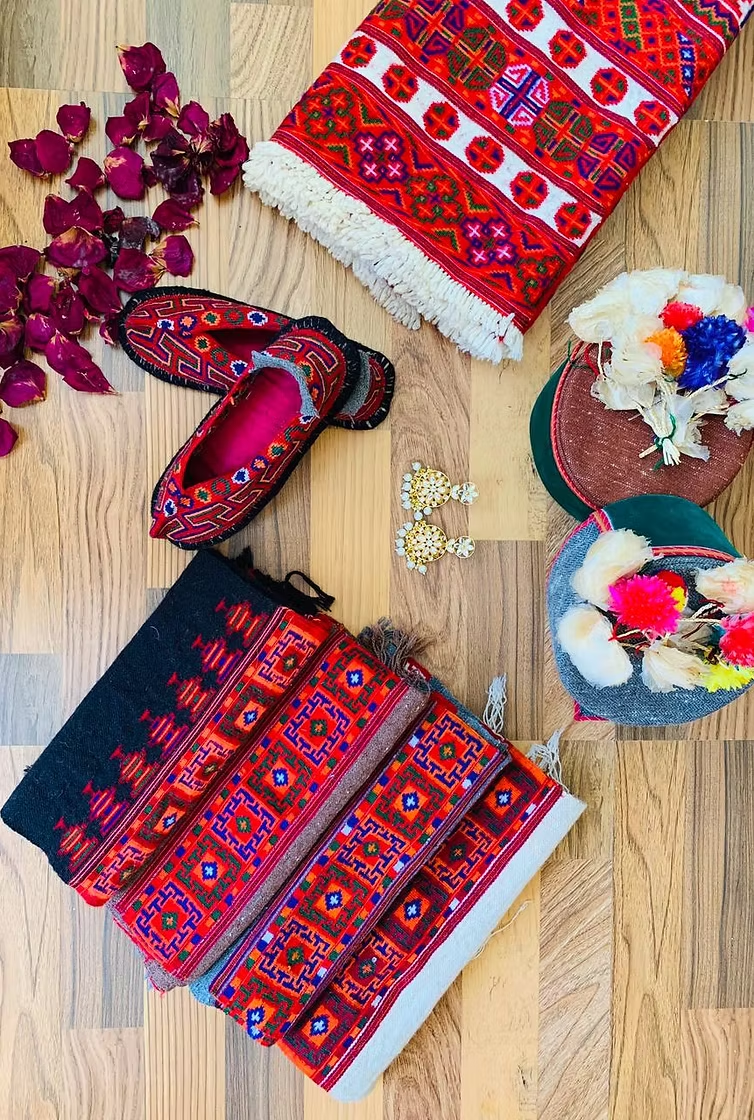
Over the years, the enterprise found its feet as more artisans joined us in our journey from neighboring villages like Spillow and Kanam. We are now a proud all-women’s team with twenty-five artisans who are involved in the handcrafted and handloom business during our spare time. Kinnauri handicrafts and handwoven attire require dexterity that can be perfected only through patience and meticulous care while weaving.
To make a shawl, each thread is carefully pulled through the reed (part of the weaving loom that resembles a comb) and installed on a loom that forms the base for an entire textile to be woven. It is one of the most complex and laborious processes that an artisan undertakes. Given the complexity of designs, it can take up to three months to finish a shawl and it can cost around twenty-five thousand rupees for a single shawl. Widely known for their intricacy and finesse, Kinnauri shawls are unique and reflect indigenous designs. We use five key colors to design our attires – red, white, yellow, green, and blue which symbolize five elements of nature- earth, water, fire, air, and space. The elaborate geometrical and floral designs have strong symbolism and many of the motifs woven have religious significance like the representation of stupas in the border design of a shawl. Since many families are into livestock rearing, raw wools are sheared locally from goats and sheep for making yarn and weaving but in recent times, we have also started procuring Angora and Merino wool from Ludhiana.
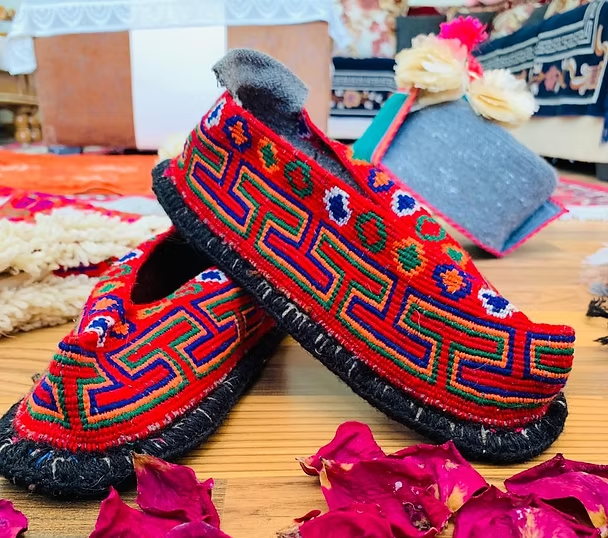
Balzanu Pona or Pullans (grass slippers) is another traditional wear that is slowly disappearing from daily use and in fact, there’s only one artisan left in my village who can skillfully make it from scratch! The footwear is made out of fibers procured from the bark of wild bushes. The upper portion of the Pullan is handknitted with goat wool and is adorned with colorful patterns while the lower portion is made of hemp or Bhang fiber (Cannabis). We make all kinds of traditional wear including Kinnauri shawls, stoles, mufflers, sweaters, Pulla (socks), and Kinnauri topi (hats). It didn’t take us long to sell products online via Instagram/Facebook and soon we were getting international orders! We further expanded our product range and started making children’s wear, cushion covers, diary covers, and pouches – all while retaining our unique Kinnauri designs.
All the women artisans who are associated with us rely primarily on their traditional looms and work from their homes which at times, proves a bit challenging as they have to juggle agricultural work, and domestic works at home and are able to undertake handicraft works only during their spare time. I have been pleading with the H.P handicraft and handloom department in Shimla to open a handcraft center in Kinnaur so that it is easier for weavers and other artisans to organize for a mutually exclusive vision, gain training, exposure, procure raw materials, and boost the entire value chain. We have capable and hardworking artisans who are passionate about their work and with the right market opportunity and assistance from the government, they will soar high.