Warning: Attempt to read property "display_name" on false in /home/u621221008/domains/himkatha.org/public_html/wp-content/themes/impeka/includes/grve-header-functions.php on line 255
Posts By :

The dog and the wolf
Illustration: Nawang Tankhe

The dog and the wolf

The dog and the wolf are brothers. For long they had lived happily until one day jealousy got the better of them. Ask any herder, and they will tell you how it happened.

The dog and the wolf possessed qualities that helped them survive in the wild. The wolf was a stealthy runner who could run great distances, while the dog was gifted with the power of smell. Together, they complemented each other perfectly. The dog would sniff prey from a distance, while the wolf would then hunt down the prey by outrunning them. They would share the spoils from the hunt and barely did they go without food.  However, one question bothered them – how would they survive alone if the other was missing for some reason? So, both the dog and the wolf made a pact: to help each acquire the skill possessed by the other.

It was the wolf’s turn first. He was a very patient teacher. He taught the dog every trick he knew which had helped him run long and fast. With time the dog followed the wolf’s lessons and became a good runner. It was now the dog’s turn to teach the wolf the art of sniffing. The dog was slow in training the wolf, who was a good learner. Soon the wolf learnt to sniff out prey that were at short distances. The dog promised to teach the wolf the final tricks soon. But it was all a farce. When the wolf woke up the next morning, he was shattered to see that his brother had actually run away and made friends with a new companion. The dog had fled and made friends with the man, just so he wouldn’t have to share his prized skill with his brother.

Ever since, herders who rear livestock have kept guard dogs to protect them from being lifted. But wolves often manage to lift livestock, which herders believe, is an attempt to square off a deal that the dog left incomplete.
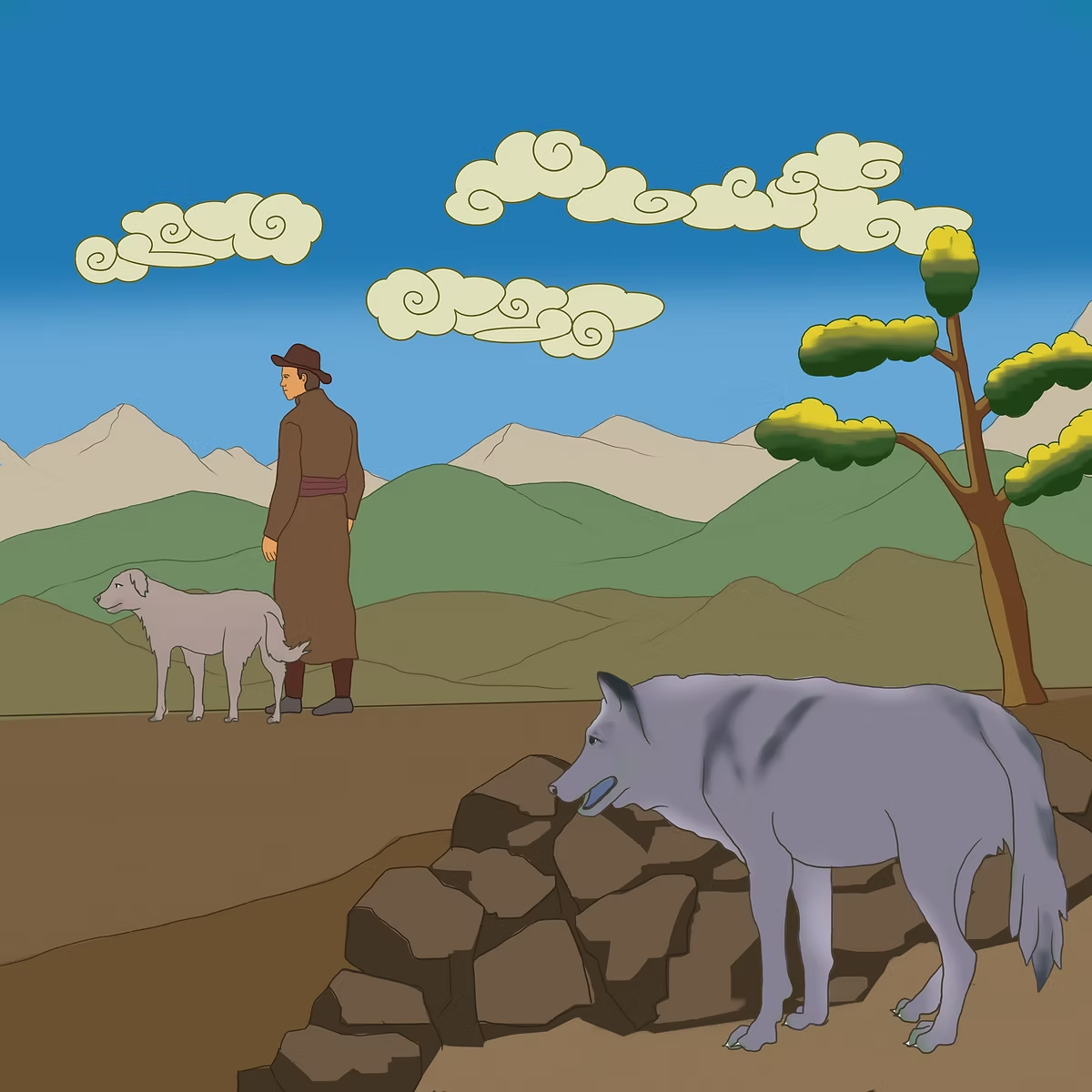
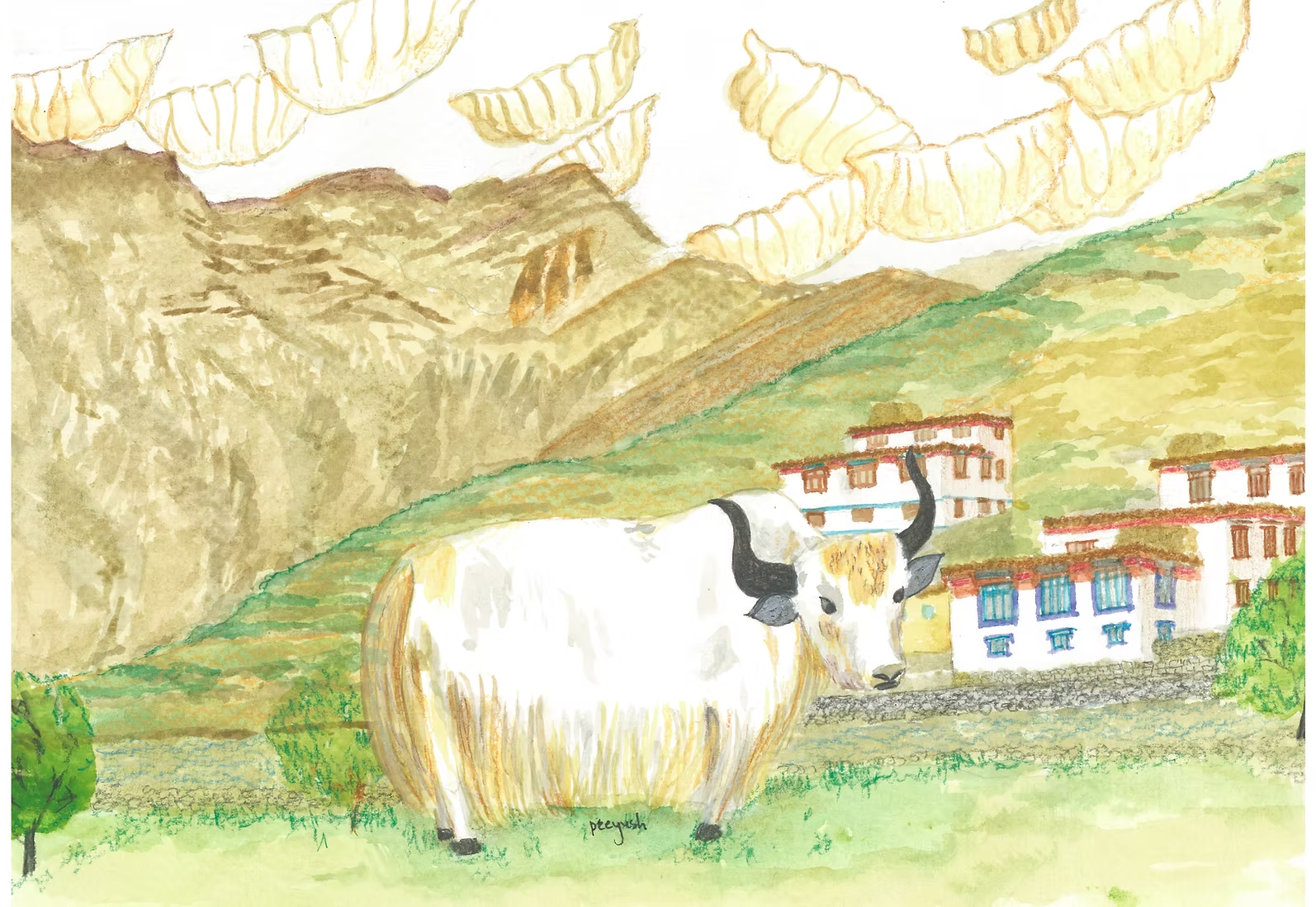
Illustration: Nawang Tankhe
1200 1200 Ajay Bijoor
Meat momos for everyone
Illustration: Peeyush S

Meat momos for everyone

Illustration: Peeyush S

Unlike most days, folks in Lalung were jostling around with a sense of great urgency that morning. Life in this little village, high up in the Himalaya, is generally slow. But not today. It was hard to tell what the cause of this commotion was. I asked Sonam Chhering, my neighbor, what was going on.

‘The villagers are going to herd the yak from the pasture. The herd was last seen at Kibri, a large pasture at some distance from the village, by the ‘yakzi’, the yak herder. He came home running last evening and reported that one of the yaks had gone crazy!’, said Sonam as he rolled in laughter. People in these villages reared sheep, goat, donkeys, horses, and cows. But the most important animal was the yak, and that for several reasons. The sturdy yak is an excellent assistant in the fields, during farming. Yak wool and yak dung was a precious source of warmth in the extreme winter months. And a yak’s tail can fetch over ten thousand rupees in the local market, if it is spotless white! Takpa—another of our neighbors—had recently purchased a yak from a trader in Manali. This old yak had spent all his life posing for photographs with tourists. He was used to a life of being fed by his master; a far cry from a yak’s life in Spiti. Here, yaks are left free to wander the pastures for most of the year. This means that they roam in a herd searching for green grasses to feast on. Not used to such a hard life, this old fellow spent most days basking in the sun, even if he had to go hungry. He soon developed a nasty temper and would chase down any soul who dared cross his path. Yesterday, it was the yakzi’s turn: he literally had to make a run for his life. So, the men from the village were preparing to catch this old yak. It took the men of the village an entire day to catch the old yak. This old fellow was brought back to the village and tied inside a corral so that he doesn’t play any more mischief. From that day on, I could see this old fellow from my window. He would stare back at me and grind his teeth, as if in warning. In some days I grew used to hearing that ominous sound at practically any hour of the day or night.

One evening, as I reached the village I found everyone beaming with joy. ‘There’s a party today. Meat momos!’, exclaimed Sonam Chhering. Momos—steamed dumplings—are the most favorite dish in Spiti and are prepared only on special occasions. That evening the entire village gathered to feast on meat momos eaten along with spicy tomato chutney. Full to our hearts’ content we walked back to our homes, that moonlit night. As we reached our respective homes, I realised something was missing. ‘Where’s the old yak?’ I asked. ‘He was the meat in our momos!’ Sonam had a wicked smile. My stomach gave a little lurch. It felt as if the old fellow was grinding his teeth inside my belly.

  • ​Lalung is a village inside the Lingti valley in Spiti and falls on the left bank of the Spiti river.
  • Kibri is a tiny hamlet deep inside Lingti valley and can only be accessed by foot.
  • Corral is a small enclosure made to keep domestic animals. Usually a corral is built just outside one’s house.
  • Momos are a type of steamed, stuffed dumplings. This is a very popular dish in the Himalayan region and usually made on special occasions.

​

1594 1098 Ajay Bijoor
Spiti’s Richest Village

Spiti’s Richest Village

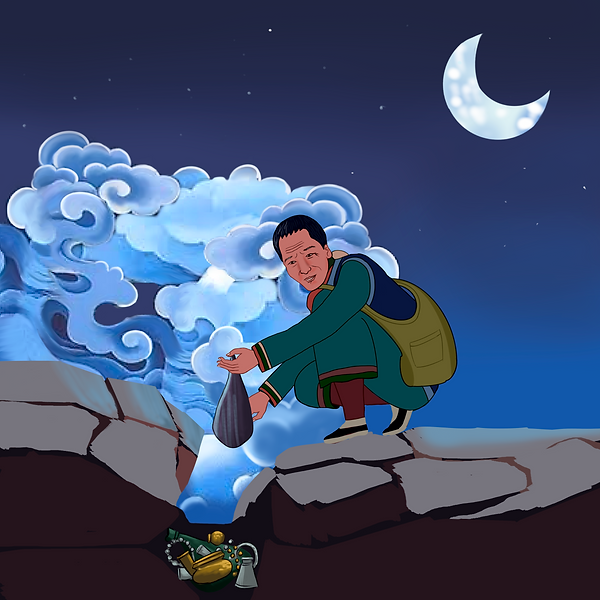
Morang was a hamlet of just five homes, but it was known far and wide not just in Spiti valley but even beyond. Thanks to Meme Chukpo. Meme Chukpo was the smartest trader of the region. He was also the richest man in the valley. He could sniff out an opportunity to make money where most others saw none. He sold yaks to the Changpas and the best Chumurti horses at the Lavi mela in Rampur Bushahr. He had traveled far and wide to trade. But Meme Chukpo had one festering fear. He was weary of people who came to his door seeking financial aid. Over time, he had devised an ingenious way to deal with such requests.

Each time he returned from a trip, he would look up to the sky. Now, if you have ever been to Spiti the first thing you might notice is how few clouds there are on most sunny days. There is barely a cloud or two in the bright blue sky. Meme Chukpo made it a habit to look for such lonely clouds. He would keep some money for domestic use and then dig a hole in the ground under the cloud and hide the rest of his money there. Surely this was the safest place to hide his treasures, and the easiest place to find it if he ever needed it. So busy had he been toiling away making money that he’d hardly ever noticed the magnificence of the rising sun, or the song of a whistling thrush, of flowers that flushed the valley in spring, or that of the slow movement of clouds in the sky.

Each time someone walked up to him seeking financial aid, Meme Chukpo would smile and say ‘I would have helped had there been some money in the house. I’m sorry, but I have none.’ He felt glad that he wasn’t lying after all. All his treasures were buried away under the cloud.

Meme Chukpo went through life working hard. Fortunately, he never faced a time when he had to fall back on the money he had buried under the cloud. But many years after he passed away some children accidentally found a pot of money in a pit under the ground. It was probably one of many pits that Meme Chukpo had dug around Morang.​

Some people still dig the soil around Morang hoping that they might find one of Meme Chukpo’s treasures that he’d buried under a cloud.

  • Meme is a title used by everyone to refer to their grandpa or an elderly man in Spiti.
  • Changpa is a term used to refer to the residents of Changthang – a region in the northern part of Tibet and the eastern part of Ladakh. Changpa are a nomadic community known to rear goats that produce the famous pashmina. They have had ancient trade links with people of Spiti.
  • Chumurti horse is a local breed of horse from Spiti. It is known to be a very sturdy variety, especially adapted for high altitudes.
  • Lavi mela is an annual trade fair that has been held in Rampur-Bushahr for many centuries. Trade fairs were and still are very popular across Himachal Pradesh.
600 600 Ajay Bijoor
The Lonely Tree
Illustration: Peeyush S

The Lonely Tree

Young Bishen Singh’s dreams were finally coming true. He had just passed his college exams and landed a government job as a school teacher. He had always wished for it. There was only one challenge though, his first posting was in Kaza. Spiti was still part of the State of Punjab then, and Kaza only found an occasional mention in government reports. There were a lot of myths surrounding Spiti mostly because so few people had heard of the place, let alone visit it. In those days the bus only went up to Manali after which one had to walk across the Rohtang La, then walk the long stretch from Gramphu to Batal and finally cross the Kunzum La. A very, very long walk of over 100 km.  And after all this walking, you only reached Losar. Kaza was another 60 km away. The travel took over a week.

Bishen was partly sad about leaving his family back in Punjab. But he was also terribly excited for the new adventure he was about to set out on. He had always wanted to explore the mountains and this was his chance. He had packed all his stuff, including a lot of woolens, in a single sturdy cloth bag. He also had one bag just for food that could see him through his long walk to Spiti. Bishen left 10 days before his joining date hoping to reach Kaza a few days before his first day at school.

The walk from Gramphu was a pleasant one. He crossed a patch of birch forest at Dorney nalla. He couldn’t recollect seeing so many birch trees in a single place before. There were so many waterfalls to admire that one hardly noticed the distance. His pace dropped every few kilometers as he was in awe of the landscape. It was also early summer and Gaddi herders were setting up camp. Gaddis are always glad to receive an unexpected guest who brings them news from new places. The first few evenings were spent at different Gaddi camps, where the routine was somewhat fixed. Bishen would be welcomed with a piping hot cup of tea followed by rotis drowned in ghee and roti-khadi – all made from goat milk. Bishen had enjoyed his walk from Gramphu to Batal. But the walk from here on was going to be a lonely one since Gaddis only camped up to this point and did not enter Spiti. It took Bishen two full days to summit Kunzum La and then climb down to Losar, the first village in Spiti.

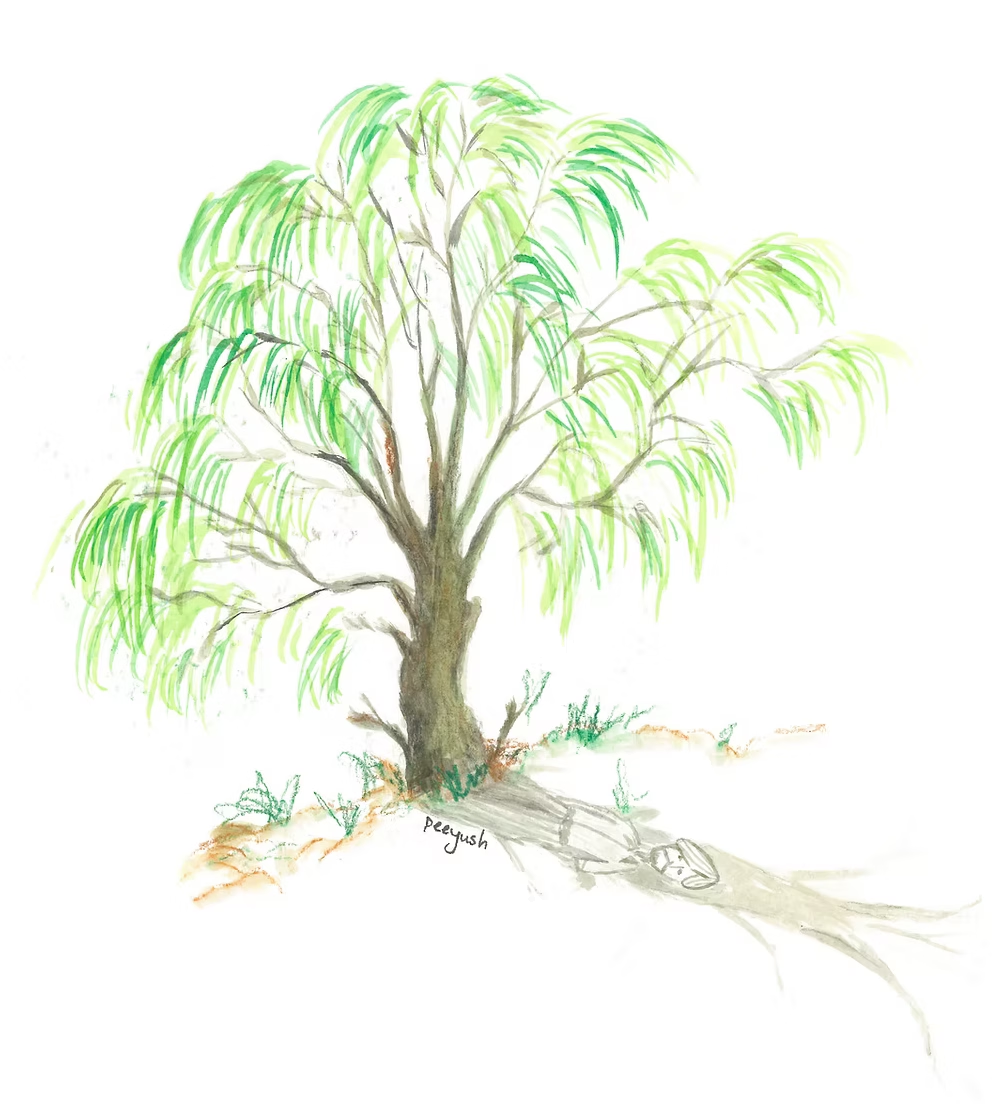
The first thing Bishen noticed when he started descending Kunzum La was how bare the landscape was. The waterfalls were all gone and even the trees began to disappear. By the time he reached Losar, he was struggling to spot a single tree. Bishen suddenly felt as if he had set foot on a different planet. His pace dropped again, but this time in shock. He was struggling to wrap his head around why these massive mountains were without any greenery. Had someone robbed them of it? He couldn’t imagine living in a place like this, that too so far from home. He suddenly felt like he was stuck without anywhere to escape. As he reached the village of Sumling just 15 km from his final destination Kaza, his eyes fell on a lonely willow tree.

Illustration: Peeyush S

This full-grown tree stood in all its majesty almost in defiance with the otherwise treeless landscape. Bishen felt like he had met a long-lost friend. His eyes welled up and he couldn’t hold himself back. He dropped all his luggage and ran towards the tree. He hugged the tree tightly and sobbed loudly, ‘My friend I have been forced to come this far just so I can keep the hearth burning back home, but what ill luck has fallen upon you? Who cursed you to come to this place?’

Hearing Bishen’s loud sobs, several curious villagers gathered around to see what was happening. But none had the heart to disturb the conversation between two long-lost friends.

  • Kaza is the main town of Spiti and the headquarters of Spiti sub-division.
  • Gramphu and Batal are locations on the road from Manali to Kaza.
  • Birch is a thin-leaved deciduous hardwood tree. The bark usually peels horizontally in thin sheets, especially on young trees. These sheets were traditionally used as paper in many high mountain regions. Several holy scriptures have been preserved by writing on such sheets.
  • Dorney nalla is a patch where one can still find a lot of birch trees on the way from Manali to Kaza.
  • Sumling is a beautiful village on the right bank of the Spiti river.
  • Willow is a tree with long thin branches and often grows near water.
994 1118 Ajay Bijoor
The Nettle Army

The Nettle Army

In summer, there is hardly any place that can match up to the beauty of Lahaul. Agricultural fields set within a carpet of wild flowers, waterfalls of every size, the majestic Chandrabhaga river flowing in all her majesty with villages along the valley. It was no wonder then that the eyes of invaders fell on this beautiful valley. They were secretly hoping to establish themselves in one village and then mount an attempt to establish themselves across the entire valley. But where could they start from?

A small group of spies set out to find a suitable village that could serve as their base. After much scouring they agreed on the village of Gushal. This village had table lands with fields of agriculture that could feed an entire army. Water was bountiful and the village received good sunlight in both summer and winter. The spies decided that the army could sneak in from the peaks across the village, and take everyone by surprise. The plan was finalized and a handful of soldiers set out to mount an attack on foot, establish themselves and then bring in the rest of their forces.

This small group of men marched straight into the patch of stinging nettle. They crouched and crawled in order to remain out of sight. In the bargain, they’d rub themselves entirely against the nettle bushes. It was only a matter of time before rashes erupted. In a matter of minutes, the entire group was on the floor scratching to soothe their itch.

Gushal, like most other villages, was richly covered by wild plants and grasses. Among them were dense patches of stinging nettle. While nettle leaves are a delicious addition to thukpa, one has to be very careful when handling them. The plant can leave you with an ugly rash should you accidentally touch its spiny leaves. While this was well known to the locals, the invaders had no clue of this. They tried to sneak into the village while it was still dark.

Their leader was particularly distressed. He made an exasperated comment that ‘if the plants here are so feisty, imagine how dangerous the people might be’. No sooner had he made this remark, his men turned back and beat a hasty retreat. He was left with little choice but to follow them, even as he was struggling to soothe his itch. The men went back and narrated the incident after which their headman decided that it was best to leave Lahaul and go looking for a less challenging place to conquer.

The villagers of Gushal woke up completely unaware of what had transpired in the early hours of that morning. Life seemed normal, as usual. Little did they know that their stubborn nettle army had bravely diffused the plans of invaders who were eyeing their beautiful valley.

  • Chandrabhaga river, also known as Chenab, emerges from the confluence of the waters emerging from the Chandra and Bhaga valleys of Lahaul. Their confluence is at Tandi in Lahaul.
  • Gushal is a beautiful village on the banks of the Chandra in Lahaul.
  • Stinging nettle is a plant variety that grows widely across the world, including the Himalaya. It is known to possess several medicinal values. It is also famous for causing burning sensation of skin when accidentally touched.
  • Thukpa is a Tibetan noodle soup, which is prepared and relished in several Himalayan regions including Ladakh, Lahaul and Spiti.
532 500 Ajay Bijoor
Khirav Gompo Dorje
Illustration: Nawang Tankhe

Khirav Gompo Dorje

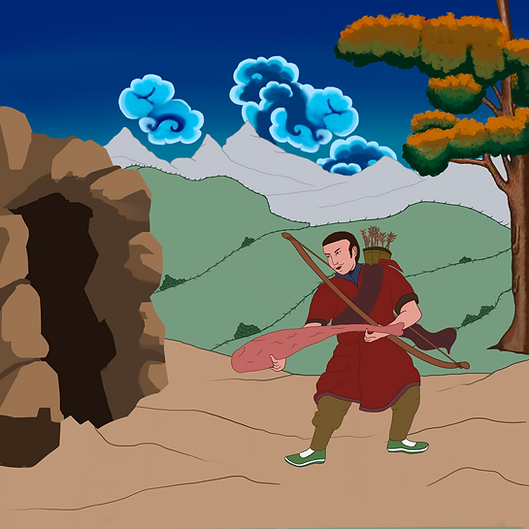
Gompo Dorje was a spirited man. He was a keen hunter. An ace at taking down mountain animals like bharal and ibex – a single hunt could see him through several days. He had grown up watching snow leopards sneak up on their prey while mounting an attack. He used a similar technique to hunt, the only exception being that he used his bow and arrow to take his prey by surprise. He had walked the vast valleys hunting prey and lived alone at the edge of Kibber. People of Kibber called him Khirav Gompo Dorje – Khirav meant hunter – in acknowledgement of his knowledge of the wild and his superior hunting skills.

Khirav Gompo Dorje preferred his own company. He did have one curious habit though – each time he hunted an animal, he would divide it in four equal parts. He would unfailingly offer one part to a revered Lama who meditated in a cave at Bandi-Farah nallah. This cave was at the edge of a cliff face. Not one for the faint hearted. One false step and you risked tumbling down the deep gorge on top of which the cave was situated. Few had the courage to get to this cave to seek the Lama’s blessings. Sturdy and surefooted, Gompo Dorje was the Lama’s most frequent visitor. He would leave his offering of meat at the entrance of the cave and leave. The Lama would accept this offering and leave the bones at the entrance of the cave after consuming the meat.

Illustration: Nawang Tankhe

This routine had gone on for many years. But our lives witness change just as the seasons for a bountiful spring is often followed by a harsh winter. Gompo Dorje too hit a rough patch. Days turned to weeks as he struggled to hunt down a meal. Not even a wooly hare, which he might otherwise have ignored. He wondered what could be done. Suddenly, it struck him! Maybe he ought to meet the Lama and seek his blessings to pull through this difficult phase.

​

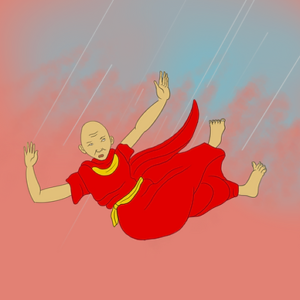
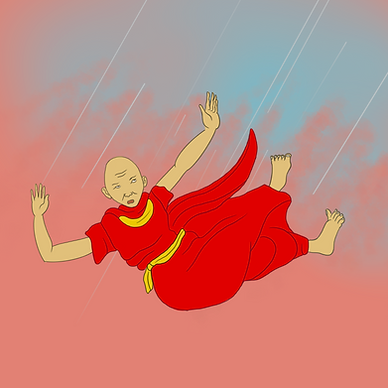
Though he hadn’t eaten in days, he made the long, treacherous walk to the Lama’s cave. At the entrance of the cave, he caught sight of all the bones the Lama had disposed off. Bones everywhere! It felt like someone had woven a mat out of bones and laid it at the entrance. It occurred to him that he had consumed a lot more than the Lama had. How could he?! He was overcome with grief. Gompo Dorje didn’t think twice before jumping off the ledge in remorse. Mountain people believe that when one truly sheds the weight of one’s misdeeds, they are set on the path of salvation. Gompo Dorje was seen flying high, onwards into a different realm.

Illustration: Nawang Tankhe

The Lama observed this episode from his seat in the cave. A thought crossed his mind. If a lowly hunter could find the path to salvation, surely someone of his stature who had lived an austere life, deserved it more. He got up from his seat and jumped off the ledge. But nothing is heavier than one’s inflated ego. Lama tumbled down the deep gorge, never to be seen again.

  • Bharal a is Himalayan wild sheep with a bluish coat and backward-curving horns.
  • Ibex is a wild mountain goat with long, thick ridged horns and a beard, found in parts of Lahaul and Spiti, including Pin Valley.
  • Kibber is a village in Spiti valley which was previously an important center of trade and activity.
  • Lama is a buddhist monk.
  • Bandi-Farah is a beautiful gorge near Kibber. Khirav Gompo Dorje’s cave is still visible from this place.
  • Wooly hare is a shy and usually solitary animal, and although sometimes active by day, it is mostly nocturnal.
388 388 Ajay Bijoor
Birth of the Chandra river

Birth of the Chandra river

It is fairly well known that Gaddi herders from Kangra spend summer in the rich pastures of Lahaul. This is an annual migratory route that the Gaddi community have accessed for generations. They camp in the high mountain pastures. From a distance their life may seem idyllic – spending the day in the shadow of snow-clad peaks, breathing the crisp mountain air, basking in the soft summer sun. Unfortunately, the Gaddi’s dammed flock does not harbor such taste for a serene life in the mountains. All they care for is food! Each morning they bleat to be taken to a new slope where they can get their fill of fresh summer grass. And the poor Gaddi herder has to run behind them to make sure the flock remains safe, for a pesky wolf waiting to feast on the flock is almost never very far. Summer days are very long. But as dusk sets in, the Gaddi gets some rest.

It had only been a few years since Noopalal started accompanying his aged uncle and their flock. Their settlement was at the farthest end of Lahaul valley. It was so far that most herders had only heard of it. It was famous for a beautiful lake that had turquoise-blue water.

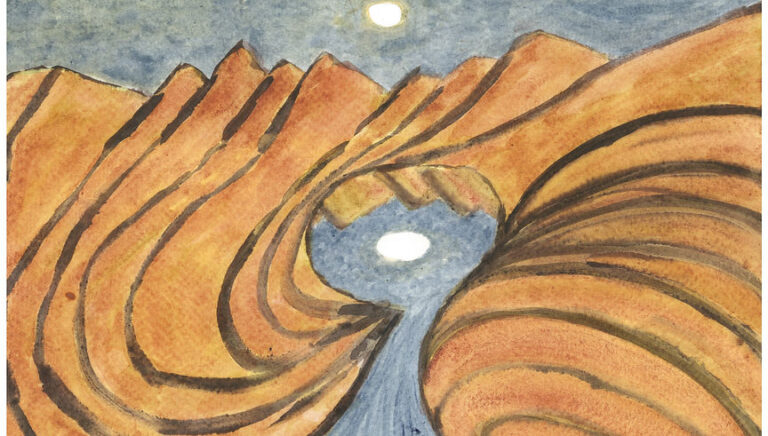
Noopalal was in-charge of the flock, while his old uncle stayed back and cooked for them. Every evening Noopalal would herd the flock and sit outside their thaach, which overlooked the lake. He would slowly pull out his flute and play it softly while his uncle smoked a pipe. Even though there was no one but his animals to listen, he played the flute because it gave him joy. On most days it would get dark by the time he finished. He would then crawl into the thaach, eat his meal, and retire for the day. This was the ritual he followed on most days until it all changed one night. The moon was full and when Noopalal finished playing his flute he looked mesmerized. As if he were possessed, as if someone had cast a spell on him. When he looked at the lake he saw a reflection of the full moon in its turquoise-blue water. He stood up in shock. “The moon has fallen in the lake”, he whispered. “The moon is drowning. Help!” He yelled as he ran towards the lake. His old uncle barely registered anything, and by the time he did Noopalal had jumped into the icy cold water. His poor uncle ran behind him. But he could only watch helplessly. He remembered Noopalal shouting frantically that the moon is cracking, looking at the ripples on the surface of the water. By morning, both Noopalal and the moon were gone.

Did Noopalal sink with the moon that night? Maybe not. But many believe that the moon did, indeed, drown that night and the water that spilled over gave birth to the Chandra river. And the lake, Chandra tal, remains beautiful as ever. Especially on full moon nights. If you ever have the good fortune of spending a full moon’s night by Chandra tal, you might even hear Noopalal’s flute.

  • Gaddi herders are a semi-pastoral tribe that rear sheep and goat. Some of the sturdiest men and women, the Gaddis travel for 10-11 months with their livestock covering a vast distance across the Himalaya and her lower plains.
  • Kangra is a Himalayan region from where the Gaddi herders hail. It is also a district in the State of Himachal Pradesh.
  • Lahaul is another remote Himalayan valley that can be reached after crossing the Rohtang pass. Lahaul valley is adjacent to Spiti valley and together Lahaul-Spiti forms the biggest district of Himachal Pradesh.
  • Thaach is a stone hut that gaddi herders live inside in places where they camp. These stone huts are old and beautifully built by stacking stones. They protect the herders from rough weather.
  • Chandra river rises from the snow lying at the base of the main Himalayan range in the Lahaul and Spiti district. The beautiful Chandra Tal has formed at its source.
  • Chandra tal is a beautiful high-altitude lake known for its beauty. It is also a very beautiful site to watch water birds. It is a mythologically important site.
864 491 Ajay Bijoor
The First Bus to Spiti

The First Bus to Spiti

Losar is the first village of Spiti valley which is located in the high Himalaya. You have to cross two high mountain passes to reach Losar. Getting here in winter is impossible because heavy snowfall blocks the roads across the passes. People only traveled in and out of Losar in summer. Heavy winter snowfall kept Losar, and the rest of Spiti, isolated for many months in a year. Winters were usually long and uneventful. But that year was different. Everyone had spent winter in anticipation. Everyone was excited for the new bus service that was going to start from Manali to Spiti in summer. Until then, only a few men had traveled outside the valley for trade. Horses were the preferred mode of travel and almost no one had seen a motor vehicle.

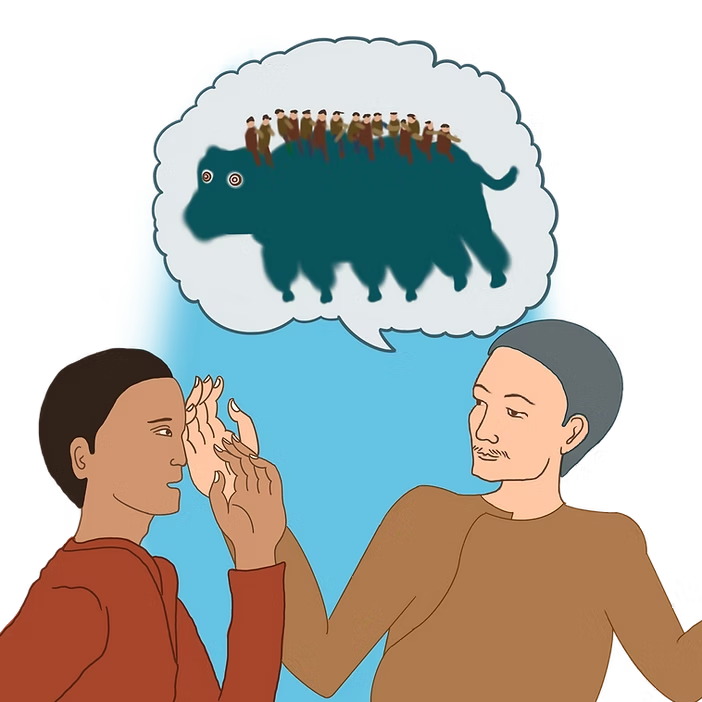
Everyone was talking about the bus. That it would cover the steep climb up and down the mountain passes in a matter of hours, carrying 42 adults! What sort of a beast could carry such a heavy load and run so fast? This had remained a topic of discussion across Spiti, and especially Losar. Someone suggested that this beast had six legs and galloped faster than the fastest horse, while another said that it had the strength of 10 mules. And its eyes light up the mountain like the moon on a full moon night, said one of the better-traveled locals. The entire valley was wrapped in curiosity.

The long wait came to an end when the sun changed its direction marking the start of summer. It took several weeks to clear the snow over the passes. Word finally came that the bus service would start in two days. Losar would have the distinction of welcoming the first bus to Spiti. The entire village got busy. The men were decorating the village gate – an honor otherwise reserved to welcome a respected Rinpoche. The women took a break from the agricultural fields to prepare a feast to mark the historic day. Even the school was called off, so that children could take part in the celebrations.

Illustration: Nawang

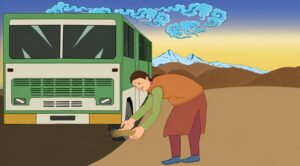
People lined up to welcome the first bus with an Aashi in their hands. Everyone heard the bus before they saw it. The resounding humm of the diesel engine was met with loud cheers. And then, the bus came into sight. It chugged along the bumpy road. Everyone stood hypnotized seeing this enormous beast. No one moved. The bus came to a grinding halt after crossing the decorated village gate. Everyone moved forward skeptically to examine the bus. Some touched the body of the bus, others were fascinated by the windows and doors, a few observed from a distance lest the bus land a kick like some irritated horses do. The driver and conductor got off and were given a hero’s welcome. As the excitement gradually faded, people began to move towards the area where the food was being served.

As soon as the crowd vanished, Eve Ning Gemo lumbered out of her house. This kind, old lady was carrying a load of fodder in her hands. She walked up to the bus and laid out the fodder before the bus. Then, looking up lovingly she patted the bus and said, “You must be very tired. These youngsters have no heart. They all cheered as you strode in and then left to eat without even feeding you anything. But don’t you worry, I am here. I have brought you fresh fodder. Eat as much as you wish.”

Eve continued to pat the bus tenderly, waiting patiently for the bus to start eating the fodder she had laid before it.

  • Spiti Valley is a high-altitude region of the Himalaya, located in the north-eastern part of the northern Indian state of Himachal Pradesh. It is one of the most remote areas of India.
  • Rinpoche is a title in Tibetan Buddhism to address a respected and highly trained spiritual teacher or master.
  • Aashi (also referred to as Khata or Khatag) is a white scarf offered as a mark of respect in the Himalayan region. It is usually offered to revered monks and very special guests.
  • Eve is a title used by everyone to refer to their grandma or an elderly lady in Spiti.
1536 850 Ajay Bijoor
Navigating the challenges of climate change in the Himalaya
Illustration: Nawang Tankhe

Navigating the challenges of climate change in the Himalaya

The heart of the mighty Himalaya is witnessing a profound transformation shaped by the relentless force of climate change. With Himalaya playing a crucial role in shaping the weather patterns across India, climate change is disrupting these patterns. And the Western Himalaya Region comprising of Jammu & Kashmir, Ladakh, Himachal Pradesh and Uttarakhand characterised by complex geography with various local warm and cold zones is affected differently from one location to another.

Climate change refers to long-term shifts in weather patterns that affect local, regional, and global climates on earth. Most of us are familiar with greenhouses that are commonly used to grow vegetables in winter, because the temperature inside these enclosures stays warmer than outside. A greenhouse keeps the enclosure warm by letting in as much light as possible and then trapping it as thermal energy. Now imagine what might happen if our planet acted similarly? In fact, it is because the earth works like a large greenhouse, that our planet can support such a wide variety of life. This phenomenon is called the greenhouse effect. However, a rapid rise in burning of fossil fuels over the last 150 years has significantly increased the level of carbon dioxide in our atmosphere leading to increased warming and a rise in unforeseen weather events.

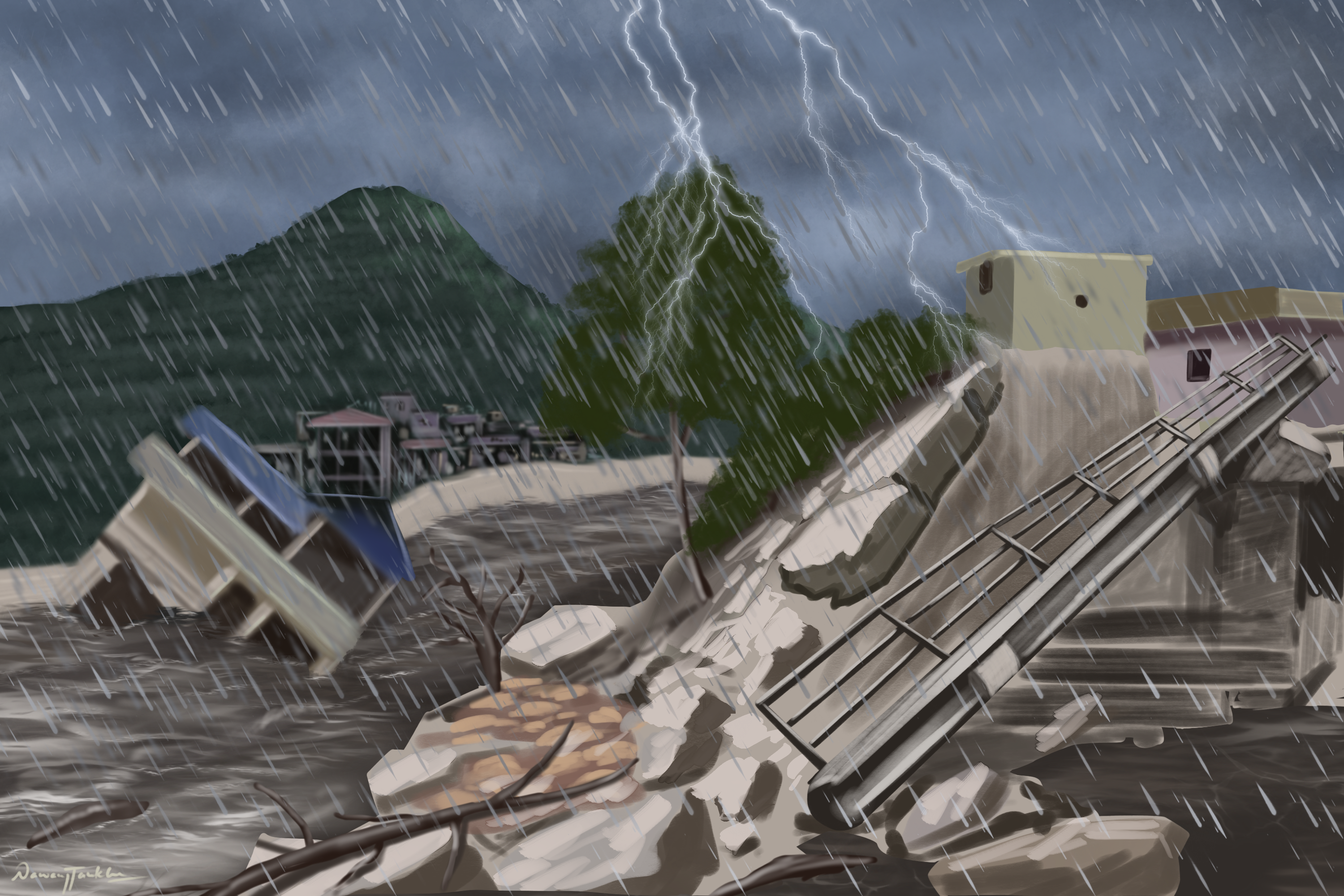
Research findings paint a stark picture of the Himalaya’s changing climate. Over the years the region has witnessed a noticeable rise in both seasonal maximum and minimum temperatures. The difference between daytime and night-time temperatures is also getting larger, indicating a warming trend. Snowfall events have shown variability in terms of intensity and timing. Scientists note a decrease in early snowfall during December and January, accompanied by an extension into February and March. While rainfall intensity remains relatively unchanged, there is a notable shift in its timings. Monsoon rains, once confined up to mid-August, now linger beyond their traditional timeframe, accompanied by a rise in cloudburst events. This shift, intertwined with delayed snowfall, alters the distribution of rainfall and cloud cover across the region.

The impact of this climatic transformation is not an abstract concept but a harsh reality affecting various sectors. Agriculture, the lifeline of many in the region, is particularly vulnerable. In the Kullu valley of Himachal Pradesh, delayed snowfall has cast its icy shadow on apple orchards. The blossoming, bearing, and overall yield of apples have suffered due to altered chilling conditions. Orchards, once thriving in lower elevations, now seek refuge in higher altitudes, affecting not just the geographical landscape but the very quality of the produce.

In Ladakh’s western regions, horticulture crops like apricots and walnuts are facing severe challenges. Spring seasons are turning cooler, delaying the fruiting process and impacting the quality of the produce. Barley, a locally grown crop, is witnessing a substantial reduction in yield, echoing the broader struggle against a changing climate.

Villagers in Spiti tell a poignant tale of declining green pea production, a crucial revenue-generating crop. This decline, attributed to persistent water scarcity, reached its peak in 2022 when Langza village faced complete crop loss due to the unavailability of water. The transformation is not confined to the fields; it seeps into the very identity of these regions.

Agriculture in Uttarakhand, highly vulnerable to climate change, experiences shift in production dynamics, causing changes in crop yield, reduced diversity, and a surge in pest invasions. In districts like Pithoragarh, Chamoli, and Uttarkashi, climate change is altering the traditional collection period of non-timber forest products, impacting livelihoods.

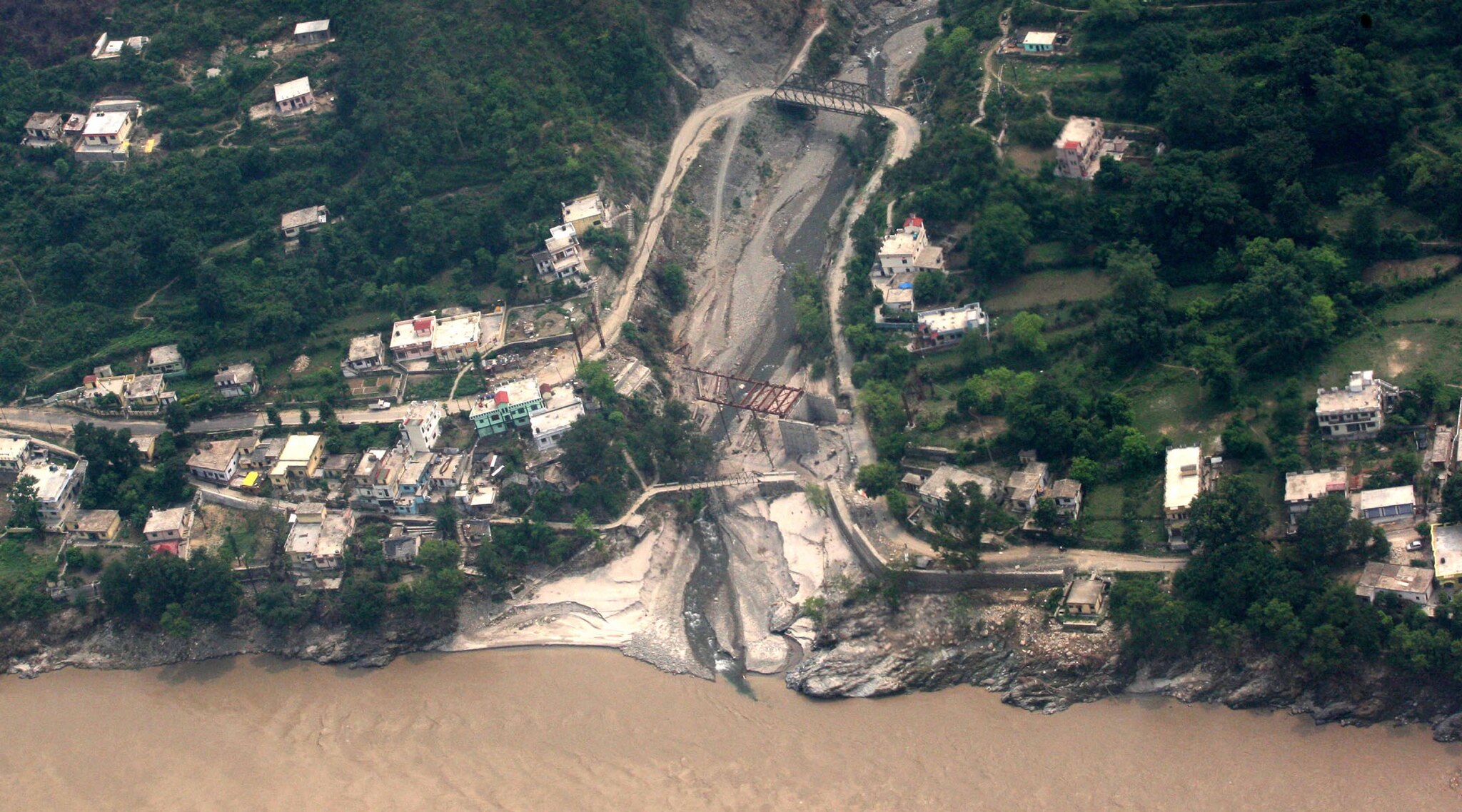
An aerial view of flood-ravaged Rudraprayag, in Uttarakhand | Photo: Wikimedia Commons

The farmers, the custodians of the land, echo this change.

Earlier, we could not see stars in the sky for the whole of July and August. Continuous rains for days during the monsoon season in old times was good for the soil and the crops. But now, sudden and untimely torrential rains are spoiling the soil as well as the crops. The rains have completely disappointed us.

by a farmer from Uttarakhand

Summers are more intense and drier now because of which the crops ripen at an early stage without proper grain development.

by an elderly farmer from Uttarakhand

Earlier the snow was about a foot high and it used to stay for weeks but now if ever there is snowfall it is less than 5 inches and melts within a day.

by a farmer from Himachal Pradesh

Every year, we travelled from Zanskar to Kishtwar by crossing the glacier. Over the years, this glacier has been reducing. The new snowfall is not sufficient for settling, posing challenges to our traditional migration routes.

by a pastoralist from Ladakh

This replacement about 50-60 years ago, which turned agri-culture on its head did not come with the Green Revolution (more appropriately called Greed Revolution) then but was the consequence of what had emerged as the industrial revolution two-three hundred years ago. And it started with de-legitimising traditional society’s existence, identity and knowledge by naming it ‘backward’ and following it up by seeking to shame people’s knowledge systems and their seeds. It was crucial and strategic that this society begin to have an inferiority complex about oneself. This was the first essential stage of the conspiracy. Once this was achieved, it was followed by a systematic replacement of the principles, methods, seeds with the means that it had created. As a result, a creative, productive and self-reliant society has today become a dependent slave farmer society.

3000 2000 Ajay Bijoor